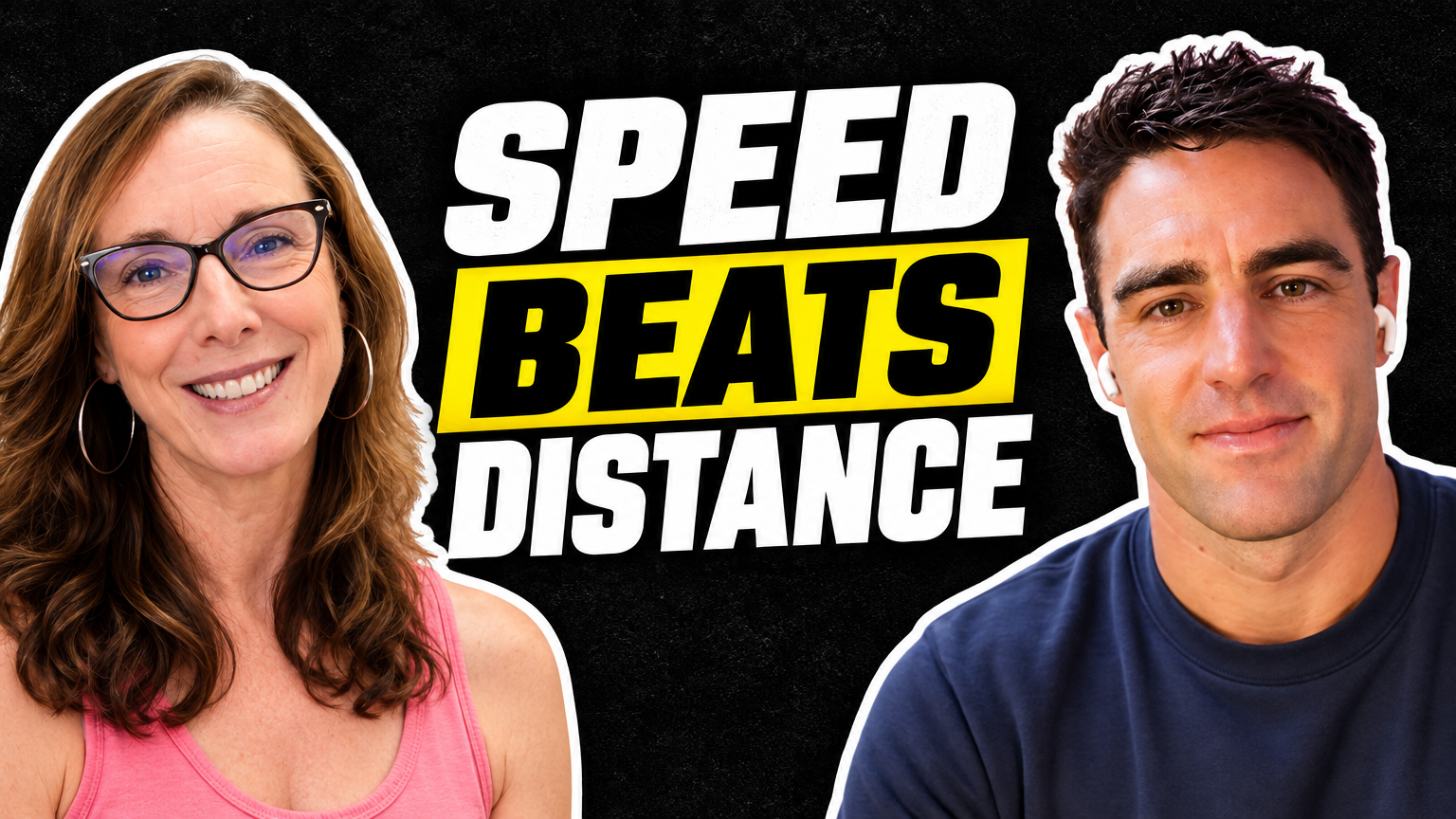









Last year Elise Butler (center) was swimming 20 mins for her 1km time trial. Over the past 18 months she’s made big improvements, now swimming well under 17 minutes. Elise joined us last year for our Hell Week swim camp and has joined us again for this year’s camp in Thailand. In this podcast, she shares how she’s knocked more than 15 secs per 100m off her 1km pace.
02:34 – Visualizing what you are doing wrong.
04:45 – Masters- a good way to challenge yourself.
07:04 – Ability to vary your pace.
14:07 – The Hell Week experience.
Click here for more information on how you can attend the next Hell Week camp
Transcript
Read the full transcript
Welcome to the Effortless Swimming Podcast to show that help swimmers and triathletes love the water, become a better swimmer and live a better life. Here’s your host, Brenton Ford. Welcome to the Effortless Swimming Podcast. My guest today is someone who’s come along to one of our freestyle clinics and has also come to our HoweWeek camp last year in 2016 and by the time you listen to this podcast we’ll probably be at HoweWeek camp again and Elise will be there. My guest today is a friend of mine, Elise Butler, and she’s made some big improvements in the last 12 to 18 months by improving her swim pace by around 20 seconds per 100 and we’ll talk about how she’s managed to do that and swim so much faster. So Elise, welcome to the podcast. Hi, thanks Brenton, thanks for having me. So we’re recording this on the day before we both fly out to Thailand for the HoweWeek swim camp and I kind of want to fit this in just before we left because, I mean, yourself
and Tabitha Jones, who we’ve had on the podcast and who you know, you’ve both had some pretty significant improvements in your swimming in the last 12 to 18 months and I like to kind of get people on the podcast to talk about what they’ve done to make such big improvements because one of the things that people often get sort of stuck at is their swim time, their swim pace and they’re not sure what it is that they can do to get quicker. So if you give the people listening a bit of a background on what you’re looking like or what you’re swimming like 12 to 18 months ago and how much you’re training it and what it looks like now and what sort of racing you’re doing.
I looked awful when I first started. I remember going to one of your freestyle clinics on Mother’s Day. I think that must have been 2016 and we did the first video. I remember putting that up on the day. I was just a bit of call my mum actually because I think I’d forgotten.
And we did the first video analysis and I actually saw myself swimming and I thought, oh my god, that is awful. Like, where do I start? Where do we start to fix this? And I was like, the arms are wrong, the heads wrong, the underwaters were awful. And I was like, oh my god.
So and visually, I’m a very visual person. So seeing it, seeing what I was doing wrong was very much a revelation for me. And once I saw what I was doing wrong, I could then visualize how to fix it. You told me what to do to fix it. And so that made a big difference for me. And how much were you training back then, 12, 18 months ago? And how much are you training today?
Back then I was training, I was doing squad three times a week. And now I’m probably in the pool doing squad five to six times a week. Yeah, nice. And that’s, I mean, my rule of thumb is you’d need to be, really need to be in the water three times a week to see a good amount of improvement. And once you do step it up to that five or six times a week, and it’s not possible for all triathletes because they’re busy running and riding. But I know like you’ve just started triathlons and, but for the people who can increase their swim mileage each week and get in five or six times a week, it makes such a massive difference. And you see that with your swimming as well. And so you’re also doing competitions with masters and you’ve just started triathlons. Can you talk a little bit about that and when you started and what got you into it?
I guess my coach at the time, Todd Robinson, got me into masters and I was absolutely terrified. And I remember marshalling for my first event and going, oh my goodness, I haven’t been in the marshall intense since I was about 12 years old. And yeah, go into the water and just swim as much as I could. And yeah, I had fun, you know, it wasn’t as serious as what I thought it would be. It was just fun. There’s all these people who want to be there, who are happy to be there and they have a great day. And yeah, I really enjoy it. I haven’t done too much of masters. I just had a masters meet last weekend, which was great. And yeah, really enjoy it. Really love it. So when I can get there, yeah, it’s really good. And I think it’s, I really enjoy racing masters as well. I used to coach a masters squad for about seven years. And I just, particularly for anyone who’s 20, 21 years or older, it’s a good way to just be able to compete
and get a benchmark of where your speed’s at, where your time’s at and just be able to challenge yourself. Because I feel like those sorts of things where you actually do get to test yourself and put yourself in competition mode, they’re often the most rewarding things that you can do, whether it’s a running race or a swim race or a triathlon, just being able to put yourself to the test and get your body to that stage where you’re trying to tell your mind to shut up because it wants you to stop swimming or, you know, just to be able to challenge yourself physically in that way. And it’s also a mental challenge. I find that it helps a lot in other aspects of your life as well. And I, you know, we run into each other in the Gold Coast, where Nationals was. And that was your first meet, wasn’t it, at Masters Nationals?
That was my second Masters meet. And Todd signed me up for all these races. I think it was a 400 free, a 200 free. I think it was a 200 breaststroke. And I can’t remember what else. And I’m going, 400 free, I can’t do that. And I was just so nervous. And the first, the 400 free was a disaster. Because I just, okay, I’ve got to pace myself. I’ve got to calm down, relax, pace this out. And I’ll be fine. And I just went hell for that.
The first 50 was a PB. The first 100 was a PB. The first 200 was a PB. I had to hold on for the next 200. And it was, yeah, that was, that was not good. But it was a PB because I’ve never done it before. Yeah. And that’s the only way you learn sometimes. As much as you can learn from other people’s mistakes when it comes to something like that, you’ve often got to go through the feeling of going too hard at the start to realize, oh, this isn’t good. And then once you get a bit more race experience, you can find that you pace it better. And the same goes in training too. One of the most noticeable differences I see between people who have got a fair bit of experience in the water and those that don’t is the ability to be able to hit the times that they’re trying to hit and to be able to vary their pace. And that’s probably something that you’ve, you know, that you’re probably doing quite well at. Now would assume is that you can, you can build through sets
and you’ve got more than just one pace that a lot of people often start with when they begin swimming.
Yep. Definitely at squat, doing squat so many times a week
and just getting used to, okay, this isn’t easy. This is a moderate. This is a fast. This is a 70.3 pace. This is, you know, we go through all those and we practice swimming at all those different paces. So you really get to learn your stroke. And, you know, even if I’m swimming 100, I can pretty much, I pretty much know before I finish what the time is going to be. I’m usually pretty close.
Sometimes I’m surprised, a nice surprise.
But yeah, we’re doing a lot of that, getting to know your stroke and your pace and your stroke rate. And it just comes with time in the water. And I think because I’m just starting out at triathlons as well, you know, the running and the bike, it’s time running and it’s time on the bike as well. Like anything, you know, I tell my kids, you get what you work for. And so, yeah, for me, I’m not an unnatural freestyler. I swim as a kid only because we lived in a country town in New South Wales. That was as hot as Hades. So if we, if we joined swimming club, we got to go to the pool five days a week.
And I was a breaststroker as a kid and never really raced freestyle. Now I know why.
So yeah, but I guess before I found Hell Week, I found you on Google, I think, when I was Googling how to swim freestyle faster. And of course, effortless swimming. And then went to your clinic and heard about Hell Week. I’m like, that is amazing. I would love to do that. I would love to see if I could do it. And you know, and then on the doubt creeps in, it’s like, oh my God, I’m going to be the slowest swimmer there. They’re going to be all these elite athletes. It’s just going to be a little, you know, me. And, but it wasn’t like that at all. Everyone was so nice and so genuine. And I just needed someone to tell me what to do so that I had the knowledge to go away, go home after Hell Week and work on it. It really took, you know, six, seven, eight months after Hell Week of really working on it that my, my time’s got a little bit better. And then probably eight months after Hell Week, they just started taking off when I was doing,
you know, four-second PBs and three-second PBs. And especially in the longer distances, I tend to go a bit better, the 200s and 400s than the open water distances as well. And like, I just, never in my wildest dreams, I think I could swim some of those times. Like, yeah. So very, very happy with the knowledge that I’ve learned. And I’m going back again tomorrow. So I must respect it. Yeah. And I love, I love to hear that night. And that’s what I get, one of the biggest kicks out of from, from Hell Week is when people like yourself come along, have a great time, hopefully learn a lot as well. And then over the coming months, you make those improvements that you want to make. And everyone’s progression and improvement is different. Some people will improve a little bit straight away. Some people, it might take them six months, 12 months, 18 months, but it’s, everyone’s journey’s going to be that little bit different.
And what I enjoy a lot too is just seeing people learn to love swimming because they know what to work on. They enjoy the feeling that they get from, from swimming and from doing a hard session. And it makes them want more and more. So I like to see, to see that happen. And I find that happens a lot at Hell Week because you just immerse yourself in, in swimming 24 seven pretty much. Like it’s, it’s a challenging week. But I mean, the focus is primarily on becoming a better swimmer and, and having a good time over there. Whereas, you know, the first year that I ran it, I absolutely hammered everyone. And they were so exhausted by day three that I’m like, oh okay, I’ve probably got to back it off a little bit. And, you know, the way that, the way that I feel like it’s run now is everyone gets much better results out of it. And, you know, this week I was getting really excited, just, just thinking about what we’ve got coming up
at Hell Week this year. And, and just getting over there to that amazing pool in Puket and some sunshine. And hopefully it doesn’t bucket down rain like it did last year for one or two days. But, and just getting to, to meet everyone. And, you know, and after a day of training where people have put in too hard sessions, a gym and strength session and a talk or two, when everyone’s sort of sitting around the, the dinner table, just sort of sharing how they went in the set or just talking about a few different things. Like I love, I love the ability to kind of relax after a hard day of work like that. And you see it in everyone how they’re, it’s a different headspace that people are in after they’ve pushed themselves to, to the edge there in a session. Like everyone’s just very relaxed and chilled out. And, you know, you don’t sort of get that in a normal, like, you know, in a workplace or you don’t get that when people haven’t
had the ability to challenge themselves physically. Yeah. It’s, it was such a lovely group of people and just had the best time. And just to see people improve so much just in the week. Like I remember John Delaney, I think he was in my lane for, for most of it. And he just, you could tell he’s a real workhorse and he just improved so much in that week. And I think I had a look at his time, his swim time. I think he went to the 70.3 World Champs in Chattanooga recently with Andre. And his swim has just improved out of sight. Like, and yeah, just to see people like, it’s like a light bulb moment. And even with my stroke, we were talking about pools and I had this really bad habit of my coach calls it, put the brakes on where my hand sort of goes up in the water, down in the water and then comes up again. And I, it took me so long to, to work out. What am I doing wrong? And then once I got the, it’s like, like a light bulb.
I’m like, I don’t know what I have to do now. And yeah, I don’t think I’m a Learn to Swim instructor as well. So it’s just something I’ve got back into recently. I used to swim. I used to teach when I was at university. That was my university job. No, I’ve never seen a kid who is a natural, natural freestyle swimmer like it takes. And even with, you know, the kids, I’m trying to correct them now, save them a lot of grief later on when they get a bit older. So yeah, to see everyone improve. And all you got to do is swim, eat and sleep. And that’s pretty much what you’ve got to do. And it gives you that big block of time to be able to do that. You know, you don’t have to worry about what’s for dinner tonight. What do I have to cook? What time do I have to pick up the kids? What time do we work start today? And yeah, so it gives you that space to learn and then apply what you’ve learned. So it’s great. Yeah, yeah, absolutely.
And that’s that’s what I’m really looking forward to. And the other thing as well is just that, like, because it because it’s overseas, people aren’t on their phone 24 seven either. Like they’re people aren’t sort of really taking phone calls or sending texts. Like, yeah, of course, you’re still on your phone a bit, but it’s a very it’s a very different environment when it’s like that, because people tend to have better, deeper conversations, get to know each other a lot better, and just taking yourself out of your normal, your normal training environment, or even sort of your normal home environment. It’s I find that’s a big way to develop as a swimmer and as a person because you could kind of thrown into or thrown out of your comfort zone. And in this with this new group of people, and you come away feeling like you’ve known them for for five or 10 years, like your people who have met at how week before, and then I’ve met sort of down the track.
I feel like I know them really, really well. And but I’ve spent a week with them, but I’ve probably know them better than some of my good friends, because you just get that opportunity to chat with them where it’s not doesn’t happen that often in day to day life. Yeah, and the sessions out of the pool were great, too. Like with Andre and with nutrition and mindset. And then Phil Rush, who I had to hold on your podcast before, like he’s a great talker and he has some great stories. And yeah, it sounds him very inspiring and, you know, a real insight into what and well, he was an elite athlete. He was a professional athlete. So a real insight into what his world was like. Let’s just get amazing. Yeah. And for people listening that Phil Rush is he’s got the fastest double and triple crossing of the English Channel. And he’s I don’t know how many times he’s from the English Channel now, but it’s it’s a lot. And he’s just a champion marathon swimmer.
And he’s coming along again for the the two how we camps this year. And just as you said, he’s got some amazing stories in it, kind of makes you feel like I’m going to do the rottenness channel swim in February. And I’m looking I’m looking at that and go, Oh my God, I don’t know if I can swim 20 Ks. Like I’ve got a lot of training to do. But then I sort of think of I think of Chloe McCartle. I think of Phil Rush and go, All right, 20 kilometers. Yeah, it’s a fair way. But compared to what these guys do and how much they swim and the things that they put themselves through, it’s it’s nothing compared to that. So just kind of suck it up and do it. It’s and when you kind of set the set the benchmark at what those guys are doing or have that as your reference point, then it makes the stuff that the stuff that you do, the stuff that I do go, OK, it’s not that bad. I can do this sort of thing because I just I can’t fathom
how much like say Chloe puts herself through. And she recently attempted the four four crossings for the English Channel back to back. And I just it’s amazing what what people can can do. And they they’re just such normal people too. Like, you know, Phil is just like, yeah, just a normal normal Kiwi and but he just an awesome guy. So it’s going to be great to have him back at how we can. We’ve also got Mitch Patterson, who I don’t know if you’ve met Mitch, but he’s coached with me for a couple of years and he’s held some national and Commonwealth records in the butterfly and yeah, really good guy as well and great coach. So it’s it’s going to be good and fly out in about 12 or not 12, 18 hours time. Yeah, yep. Can’t wait. Yeah, from the flight. Can’t wait. Yeah, that’s that’s probably the worst part of it, isn’t the flight? So so what’s next for for you? So you’ve really picked up your swing over the last 12 to 18 months.
And what have you got coming up in terms of what races you’re doing?
I’ve got one more masters meet this year. The World Series Swim Open Water Series start here when we get back from Hell Week. I think the first one is in the Lullaby on the 18th of November. So I think I’m going to try the five key open water for that one. And then there’s a series of four or five swims throughout the summer for them. Triathlon wise, my big goal is to do the Strati Salute, which is a triathlon on Strabbroke Island. So it’s almost Olympic distance. The run is a bit strange that the run is more of a trial run and a beach run. So it’s not a straight road run and I’m not a great one. So I really going to have to put in the miles for for that one. And last year, I did a 10 K open water swim last March, and that was from Burley Heads to South Paradise. And I did that, loved it. Well, I love the first five K first five K was a dream. I’m like, this is easy. This is so good. And then got a bit seasick.
The swell came up, the waves came up and I got very fatigued, very sick, but finished. So that was amazing. And my husband was a puddler for me for that one. And another girl from Squad Eve swam that with me. So that was an awesome experience. And definitely want to sign up for that again this year or next year. When’s that? I think that they changed the dates around. So it was March last year. It could be anywhere between March and May. So with the Gold Coast Overwater Swimming Club. Oh, cool. That sounds like an awesome event. Like there’s there’s some really good long distance swims up in Queensland and a lot in in Sydney and New South Wales as well. That, yeah, I think the the locations that some of the swims are up your way. Amazing. Like the the World Series swim at Cool and Gata. Did you do that last year? It’s beautiful. Yeah, it’s just I didn’t do it last year. Last year was just after Cyclone Debbie
and the water quality wasn’t good. Like you couldn’t see anything. So I didn’t do it last year, but the year before that was the best is the most beautiful swim you can. The water is so clear. You can see the bottom the whole way and it’s just glorious on the right day. It’s just beautiful. Yeah, amazing. Well, good luck for all of those events, but I’ll probably see you tomorrow night or the day after it. How we can thanks for sharing your story and what you’ve done over the last 18 months or so to improve your swim times so much. And you know, it’s it’s a combination of a lot of things. It’s technique, it’s it’s fitness and strength. And when you put all those together, then that’s you know, that’s when I see people really getting results like you have. So congratulations on that. And I can’t wait to see you in a couple of days time. Yeah, be great. Awesome. Can’t wait. Thanks for listening to the Effortless Swimming Podcast.
If you’d like us to help you become a faster, more efficient swimmer, go to www.effortlesswimming.com.