








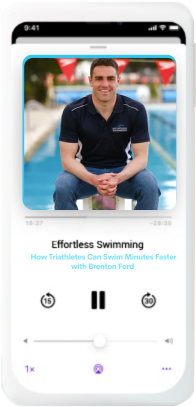
This a rebroadcast from the Get Fast Podcast with Jordan and Gerard Donnelly from TriVelo Coaching Trivelo Coaching: https://www.trivelocoaching.com.au/
Welcome to this week’s episode of the Effortless Swimming Podcast. This is a rebroadcast of an episode where I was a guest on the Get Fast Podcast with TriVelo Coaching with Jordan and Gerard Donnelly. On this episode, I’ll talk about how triathletes can swim minutes faster in any races that they’re doing.
So if you’re a triathlete or you’re interested in triathlon or open water swimming, there’ll be a lot here that can help you improve your swim speed and ultimately make it easier. And a lot more enjoyable. Let’s get into this episode on the TriVelo Coaching Get Fast podcast.
In this episode
- 01:15 — Why Swimmers Get Stuck
- 03:30 — Are Athletes Doing It Wrong After Coaching?
- 06:50 — How Long Does It Take To Change Swim Habits?
- 10:05 — Is A Lack Of Fitness Holding Your Technique Back?
- 13:30 — Overcoming the 2nd Plateau
- 19:45 — The Ultimate Swim Technique Overhaul Plan
- 23:50 — Ideal Time Ratio For Swim Technique Vs. Fitness
- 28:00 — Why Elite Swimmers Avoid Long, Slow Training
- 32:50 — Why Adult-Onset Swimmers Struggle To Improve
- 36:40 — Overcoming The Mental Barrier Of Going Slower To Get Faster
- 39:00 — The Best Tests For Swim Fitness And Speed
- 43:30 — Pool Vs. Open Water: Understanding The Differences
- 46:40 — Swimming Myths Debunked
- 51:31 — When To Push Through Bad Form (And When To Stop)
- 55:30 — Swimming Is A Technique Thing
Links from this episode
- Get your NanoClear swimming goggles here and get 15% off your first purchase with code PODCAST15. https://shop.effortlessswimming.com/
- Change your technique and swim a smoother, easier freestyle with the Effortless Swimming membership
Want to really transform your swimming? Join us on a swim camp in 2025 in the Maldives, Galapagos Islands, or Thailand: https://effortlessswimming.com/camps/
Transcript
Read the full transcript
there are things you can do to see an increase in speed. So there's a very good chance you might be working on the wrong thing. And the wrong thing is possibly something that's a few steps ahead of what you actually need to work on. So I will quite often get people come to clinics or they'll send videos into me and they're like, yeah, okay, I can see that like my catch, my elbow is low and I've been working on my catch and I can't seem to make it any better. But if you look kind of earlier on in the chain of what needs to be worked on, it's like, you can't possibly get a good catch because you're firstly lifting and turning really far to get your breath. So you're over rotating. So your arm's dropping straight down. And so physically you're not capable of actually getting a good catch on that side because of the breathing. And so we need to really just bring it back to the first order of priorities and focus on those, get those right and then build up from there. So I think more often it's a case of just working on the wrong things. And typically when people, I mean, people watch the videos that I put out and I've had a lot of people say, look, I quite often get distracted by working on different things and I hear it on podcasts, I see it in videos and you can get a lot of really good information there but it can also just be like the wrong thing for you. And so I think I'm guilty of it myself as well. Just like you hear a good idea like, okay, well, that's certainly gonna be better than what I'm doing. But if it's not really specific to you, it's not gonna be to change anything.
Welcome to the Effortless Swimming Podcast the show that helps swimmers and triathletes love the water, become a better swimmer and live a better life. Here's your host, Brenton Ford. Hey, welcome to this week's episode of the Effortless Swimming Podcast. This is a rebroadcast of an episode where I was a guest on the Get Fast podcast with Trivelo Coaching with Jordan and Gerard Donnelly. That's a mouthful to say. But on this episode, I'll talk about how triathletes can swim minutes faster in any races that they're doing. So if you're a triathlete or you're interested in triathlon or open water swimming, there'll be a lot here that can help you improve your swim speed and ultimately make it easier and a lot more enjoyable. Let's get into this episode on the Trivelo Coaching Get Fast podcast. So a very big welcome back to the podcast, Brenton Ford from Effortless Swimming. Brenton, this is now I think makes you the most repeated guest we've ever had. So thank you very much for joining us again. Thanks for having me. I expect the plaque or the trophy coming very soon. Thank you. So we want to launch right into the main premise of today and the topic, which is just the notion of this inevitable swimming plateau that everyone hits. And how do you break through the swimming plateau? Because improvement in expectations, improvement expectations in the sport of triathlon seem to be just lower than what you can get in the bike and the run. And a lot of people just accept that the swim is the swim. And once they hit that two minute pace
or 150 pace or 140 pace, they just stay there for years. And so why do you think so many triathletes get stuck at the same swim pace even after years of training? Is it mindset? Is it technique mechanics or is it something else?
It's usually working on the wrong thing. I think it comes down to working on the wrong thing and maybe not sticking with it for long enough to see a change. So if we look at someone, let's say they're being stuck at two minute pace for three years and like, oh, this is my pace. I just simply cannot get faster. Physically, I think majority of people they can go beyond that pace. And so look, it may be a mobility issue. Like maybe physically you can't get into some positions that you are required to get faster. But I think for like pretty much everyone, it's just, there are things you can do to see an increase in speed. So there's a very good chance you might be working on the wrong thing. And the wrong thing is possibly something that's a few steps ahead of what you actually need to work on. So I will quite often get people come to clinics or they'll send videos into me and like, yeah, okay, I can see that like my catch, my elbow is low and I've been working on my catch and I just, I can't seem to make it any better. But if you look kind of earlier on in the chain of what needs to be worked on, it's like, well, you can't possibly get a good catch because you're firstly lifting and turning really far to get your breath. So you're over rotating. So your arms dropping straight down. And so physically you're not capable of actually getting a good catch on that side because of the breathing. And so we need to really just bring it back to the first order of priorities and focus on those, get those right
and then build up from there. So I think more often it's a case of just working on the wrong things. And typically when people, I mean, people watch the videos that I put out and I've had a lot of people say, look, I quite often get distracted by working on different things and like I hear it on podcasts. I see it in videos and like that you can get a lot of really good information there, but it can also just be like the wrong thing for you. And so I think I'm guilty of it myself as well. Just like you hear a good idea, like, okay, well, that's certainly gonna be better than what I'm doing. But if it's not really specific to you, it's not gonna change anything. Do you find that if you give some really good feedback analysis, which is what you do very well, you get people to send videos to you and you analyze it and send it back to them and ask them to work on three major things and you give them drills specific to the things you're looking at. So that's a bit of a quick summary. So do you find that when the athlete comes back, maybe six or eight weeks later, that they haven't changed anything about what you've asked them to do because they haven't done maybe the drills or they haven't thought about it enough? What are the things they're doing wrong in that period between you giving them the instruction and it should work. You know, if they, it's like going to the physio with an injury and then the physio gives you all these exercises to do and you go back four weeks later, you haven't done one exercise and you say to the physio, it's not any better.
You know, is that something that you find is prevalent a lot in a lot of the athletes?
Yeah, it certainly is. It's, there's a few things that can result in someone not having improved down the track. So one is they either haven't done the, like the exercises or the drills, even if it's five or 10 minutes, which is normally what I would prescribe for most swimmers, a little bit in their warmup goes a very long way. So quite often they haven't done the drill or also they probably just haven't exaggerated the change enough for it to make a change. And so when we film it at clinics, second filming, I quite often ask people to exaggerate what they're trying to say. And whenever they do that, I would say one in 50 people go too far with the change. Like I'm getting them to exaggerate head position, rotation, whatever it is. One in 50 might actually have gone too far that we're like, okay, you can scale that back a little bit. But the majority of them, it's like, right. It's right there. It's like, oh, that's really good. But it feels like such a big, big change. And so I don't think people get comfortable enough with the exaggerate, how much they need to exaggerate the change. So more often than not, it's that. So that it feels weird. So like, this can't be right. And then we don't like to stick with something that feels unnatural or weird. And so we just go back to what's normal. So it's just, it's more often that than anything, especially for someone who has, say, practiced the drills that booked in for a follow-up filming. Like they've spent the time, they've spent the money working on, I think working on it.
But if we don't see a change, it's quite often that. Or it's just like they've tried to focus on three things instead of one. So if you, I mean, I was getting some coaching myself a couple of weeks back, I had the coach give me one thing to work on. It was looking really good on video. And she said, all right, now I want you to, I want you to focus on your breath timing and this aspect of your catch. And it fell apart most of the time. Like two is, you can't do two really when you're swimming. So I think it's often confusion as well, or just complicated, too complicated.
What I love about your videos and whenever you're on a podcast is you give such good hope to people that the improvement is possible. And even just your early answers, someone listening will just go, okay, that actually makes me believe that I can improve. You mentioned something really interesting there with not enough time dedicated to it. So when there's a change that needs to be made, what is that amount of time in terms of working on it per session, as well as is it a six-week block that you should expect improvement or 12 weeks where you really should expect that habit to start happening naturally? So when I first started running clinics 12, 13 years ago, there was a guy who emailed me on a Monday morning. So this was up in Sydney. He attended the clinic on the Sunday. Monday morning, he said, I did my 400 time trial and I was two seconds slower. Like, what's going on here? I just attended the clinic.
And then I had someone from that same weekend email me nine or 10 weeks later. And she said, I was working away at the technique stuff. My times were the same. Nothing much was happening, but I thought, look, I'll just stick with it. And then I had this one session where it clicked and she went from, I think it was 140 to 134, and she stuck with it from then on. Like, it just clicked and she stuck at that pace. And I see that as like, if you've got the patience to stick with it for eight, 10, 12 weeks, then you're much more likely to see those results. But don't feel like you're wasting your time if you're not getting faster straight away, or maybe it doesn't even feel better straight away. Like it might just feel awkward because it's different. So normally, and from my own personal experience as well, I think two to three months is pretty typical of how long you should expect it to take. And I was getting some coaching at the start of the season as well for myself. And I got this one cue just about breath timing. My breath was a bit late. And what I found there is that it took me, it was like six to eight weeks practicing it in training. The first two races of the season, there were glimpses of it, but then it was sort of three, four races in where it really started to gel. And yeah, it just takes quite a bit of time, even if it's just one thing. So, but I mean, the thing is, you're gonna be putting the time in anyway. When you're going to the pool, might be in twice a week, three times a week, you're going to be there.
You may as well just be okay with just working on your technique rather than just trying to get the fitness gains from it. Obviously they're really important. Fitness is a big factor, strength is a factor, but you may as well just be focusing on something technically as well, because you're gonna be putting the time in regardless. You could be sending a message out that it's okay to swim slower, to swim faster eventually. And if you stick with the process, that's actually gonna be so much better than if you just keep defaulting. Every time you're under pressure, we'll default to our normal swim stroke, which is actually what you're trying to prevent. You're trying to get this new method of swimming technique ingrained into that being a new default swim technique. And I'm doing the same thing. When I'm in the pool and I'm getting tired, I know my thought process has gone out the window. I'm going back to my old stroke and my times go back to what they were. And if I'm not conscious of saying, no, I'm gonna put up with this, I'm just not going to improve. I'm going to be the same swimmer. And we all keep doing that. And a lot of the time, and the question I'm gonna ask you is, is the fitness causing us, our lack of fitness holding the new position or the new entry or the new catch or the new push through phase or the new breathing style, is it that we don't have the fitness to maintain it? That's why we go back to our old form. Is that what's causing us to default to the old way? Is it because we're not fit enough in the water and how do we manage that?
It can be a number of different things. When we're making a change, we often using different muscles or using the muscles in a different sequence or in a different way. And so quite often we have to engage more muscles in the beginning of this process as we work on this change in stroke. So I think it can be more tiring and more fatiguing in the early days. Plus you've got to put a bit of mental, like mental effort into it as well. And so the way that we swim right now without thinking, like we can sustain that at harder efforts for longer periods of time because we don't really need to think about it because we've got that ingrained. And so when we're making that change, we've got to use that mental energy. We probably have to use more, more of the muscles around the area that we're looking to change until it starts to become subconscious. And so I think it's, and there's also the element of like, we don't wanna lose our fitness gain. So we're afraid to actually take a little bit of a step back in terms of the times we're holding. So it's, there's a bit of that as well. And I feel that too, when I'm swimming like, geez, I hate, I don't like being three, four seconds slower than what I'm used to. And I wanna just kind of push the effort and not be too concerned about the change. So it's, in a way you just have to know what to expect. I think that's probably the first thing. It's like, if you know that that's probably gonna happen, then be okay with it. And think long-term, like let's say 12 months down the track. What's my main goal?
Is it that I wanna be, all right, I wanna be fit and fast for the next three months or 12 months down the track, do I wanna be five, 10 seconds quicker? So yeah, looking ahead, that patience and just knowing that the results will come if you're okay just taking a step back.
Yeah, it's such a great discussion and why we wanted to really go through this because there is this notion of the plateau is there and it's really hard. Whereas what we've already uncovered in the first 10 minutes is that there are so many little things that you could do to push you through. And I think that notion of not wanting to go slow, start with or slowing down to go faster later is so funny because you do know that and this is exactly what you're talking about, Dad. When you just default, you'll be that same swimmer. So you might as well try something different. And the only way you're not going to improve is to not try something different, not to try any one of the things we've already said. Whereas if you try something different, at least you have the opportunity to improve. And if it doesn't work, you'll just default to your normal swim stroke and you probably swim the same anyway. But the next part of the plateau I wanted to ask about is often what the pattern we see is, especially for beginner athletes, they go get their first bit of technique help and they get that first bit of improvement, whether that's five seconds per 100 or 15 seconds per 100, they really make that jump and they get stuck at that next wall because they've worked on some good things. They've got a nice kind of looking at catch and pull and stroke and things are on track. Is that next hurdle any more difficult? Because that's where people who are especially experienced swimmers, and I'm thinking about more experienced triathletes here who have been in the game for maybe years, they've made those progressions really well and now they're stuck at 142. Now they're stuck at 136. Is it a myth that that's a harder barrier to jump over or is it the same principles again? That's a good question.
I think that earlier gains can typically be the easier ones because some of the things we need to work on, you can see that much bigger gains as a result. Obviously, because it's, let's say if you're at 230, getting down to two minutes, it's 30 seconds, but it's like, there's some really easy wins you can do there, like better body position, head position, those sorts of things. It can certainly get a little bit more challenging because there's more nuance to it. Some of the changes are a little bit more refined, I think, so the improvements are, yeah, can be a little bit more challenging to make, but it doesn't mean you can't make them by any means. I think of, there's a guy who came in on the weekend for a follow-up filming. So he did a clinic in January or Feb, so a couple of months ago, and he dropped 15 seconds from his 100 pace, just like his long distance 100 pace. I think he was, I think it was around two minutes, he's down to 145 now. And he had just some basic, like some basic stuff where he was swimming, he was crossing over, he was swimming pretty flat, he was really rushing in the stroke. And so we just, we worked on more rotation, good head position, not crossing over, just some of those things. And he improved them really well because I was going through his video the other day. And so now what he's got to work on is that he's quite like, he's actually swimming a bit too wide. So he's actually over-corrected the change, which is like, all right, well, that's good. At least you're not doing the same thing. So we need to work on that. We need to get a little bit more streamlined.
We need to work on a little bit more rotation. And actually the one thing for him is his breath timing. His breath is very late. And so it's kind of throwing the rest of his stroke out. So if he doesn't correct his breath timing, he's unlikely to make many gains from there because that, to me, that's like the bottleneck that's holding him back right now. So I think the faster you get, typically there's like, there's one thing there that can be stopping other things from falling into place. So I think it's about really getting that dialed in and figuring out what that one bottleneck is. And then just being hyper-focused on that one thing for several weeks and then moving on to the next thing. So yes, it is harder to get faster the faster you get, but I think it just means you've got to be more focused on one certain thing. And it can feel like a challenge to know what that is sometimes, but if you do have someone who knows what to look for, look at it, it can make such a big difference, I think. So it doesn't have to be me, it can be anyone else, but I think, yeah, it's often just that one bottleneck. Realistically, because the bottleneck is individual to everyone, you can feel like, oh, what is my bottleneck? It can be so complicated, but if you narrowed it down, it's probably one out of what? Eight to 12 main things, where it's the catch, the pull, head position, like you just said, timing of breath, the position of the arms, tram tracks,
position of the legs. When you actually list them all, there's not that many it could be, so it's gonna be one of those ones. Yeah, that's exactly right. It's like, there's nothing that I feel like I haven't seen with people swimming, and you're right, it's just like, you could probably make a bullet point list of eight to 10 things, and it's going to be one of those things. But I think it's often the more basic things that are the bottleneck for a lot of people. It's just the basics of, all right, good head position, body position, and the right kick, the right amount of rotation, breath timing is a big one that's sometimes overlooked, and then obviously you've got the catch and pull and those sorts of things. But yeah, it can really boil down to just a couple of things, really, for most people. If, this is something I really want you to consider. If you feel that some of your athletes are plateauing that much, that you would stop them from training, because repeating the same incorrect stroke is nearly as bad as not training at all, because you're just reinforcing that the, you're not gonna create a change by continuing to repeat the same technique that you're trying to get out of. So would it be worth just stopping people from actually training as a swimmer and then just getting them to strip it all back and just do the drills and forget about the fitness, forget about the fitness gains that you should be doing in the swim session? And really, can you do it that far?
Or what I'm worried about is people getting new information, understanding what they should be doing, but still they do that in the drills properly, and then when they go to swim, they just go back to their own stroke again. They just keep, and they're only practicing the drills properly, but they're not actually, should you stop people, if you see that happening, would you be stopping them from doing the swim session and saying, look, we're just gonna have to do drills the whole time if you're not gonna change a stroke. Would that be how you would approach it? Or yeah, let me hear what you think about that process. That's a tough one, because it depends on what their goals are too, right? It's like, they might have a race in six weeks time or even 12 weeks time. It's like, well, we still need to have that level of fitness there. What's that person willing to put up with as well? A lot of people aren't willing to do just technique work for the next two months as well. And like I understand it as well, like you can sometimes just go to the pool because you wanna get a good workout and all of that. So it really depends on how, yeah, on what they've got coming up and what they're willing to do for it. But I think it's- If you had a, put it this way, Brett, if you had a person who said to you, I don't care about any races that are coming up. I wanna change my technique so that I can use this for the rest of my life. How would you structure that next eight weeks? Would you strip it right back like that? If you had the person who's mentally on board,
then they're willing to give up then the next six months of races to swim slower, to swim faster in a year's time. How would you structure their program?
Probably similar to what you said. I would go, like let's, we'll pick one thing to, well, maybe one or two things to kind of focus on for them and just firstly have a look at their stroke, see what they need to work on. We'd do some drills as part of their warmup, just focusing on one or two things. But then I would certainly give them some swimming to do and we might bump up the pace as we're going through it because I wouldn't want them to swim just slow. Like I want them to have to try and hold that stroke at different paces. But when they're really starting to fall apart, it's like, all right, let's stop there. Because you want them to get to this point of failure in a way it's like, okay, I can feel like things have fallen apart. So let's just take a break and go again. But that would probably be the approach and it would probably not be in a squad environment. So I think squad is great for fitness, social. I get a lot from swimming in a squad, but in terms of technique, that is often where things just go out the window, especially in squads where people are pretty competitive, you're pushing off a second behind someone, you're gonna have dirty water in front, you're gonna have this choppy water and you're just gonna be trying to keep the feet. So what I normally recommend there is just try and get one session a week at the pool by yourself with hopefully a little bit of space there and work in that calm water. Now, you're not gonna be racing in probably calm water if you're a triathlete, but if you can't swim well in calm water, you're probably not gonna be able to swim well in choppy water.
So just try and find some space and time where there's no pressure to be able to get there the feeling of what we're trying to do. So yeah, I would really just strip it back. Still, you still wanna put in not a lot of Ks, but you still need to do a bit each session. But yeah, it would just be very technically focused swimming. We'd be doing a bit with stroke count as well, just trying to maintain stroke count. So if you're going from say 40 strokes to 45 strokes a lap, something's going wrong there. So being aware of that as well and giving them tools to be able to know whether or not they're starting to fall apart like stroke count. Like it's a simple one, but it can work really well.
It's such an interesting discussion point around what I think is priorities. And we are big proponents of every single one of our sessions. We ask our athletes to spend 400 meters, four to eight minutes at least on drills. And we would do more, but the athletes often just either skip it because it's kind of boring or don't really focus on it as a priority. And I guess in terms of thinking about the really interesting point you made there with the value of swim squad versus the fact that it's really good for, not just social, but intensity, you know, being really pushed for pace. But the consequence of that is, your stroke can go out of the water and you're potentially thrashing around. And really finding in your week, what's the priority here of time spent on drills, time spent on your own VO2 sets, time spent on endurance, time spent at swim squad. If you were to think about, regardless of the athlete preferences, what would be ideal amount of time to spend on swim stroke and technique as a ratio? The last point I'll make on that is the bike analogy, for example. We know that, you know, straight threshold training would be the most valuable thing. If an athlete could just do that twice a week, you know, an FTP test or a 60 minute threshold session, it would be as valuable as you can get, but it's just so grueling, you know, and it's just not possible to repeat mentally week after week. So in a swimming sense, you know, where do you place the value in terms of time spent with drills? If the athlete didn't have a say in it, what would you be really allocating to?
It makes me think it was like, if you have kids, it's like, you'd love them to have like meat and three beds every night for dinner. And, you know, you can have this perfect diet, but then it's like, what are they willing to actually have? So, yeah, with a triathlete, let's say you're doing a 3K set, I would look to do probably a K of that as some warmup with technique within that 1K. And then the rest of it would be, I mean, some sort of swim set where you're trying to maintain that form. So I don't think you need to do just a full session of just technique. I really like to incorporate this stuff into your normal swimming because that way you really get to, like, you're not gonna hold perfect technique across a 2K swim. It's just not gonna happen. But you're going to start to notice, when does it fall apart? You're going to kind of have to challenge yourself to maintain good form, to maintain your speed. And I think it's good to work it out within the normal swimming. So sometimes, what I wouldn't suggest though is that I had a swim on the weekend. She said, I train, I do 3K every swim, and it's three by 1K. And I just like, I just do three by 1K. And that's fine if that's like just good for your mental health or your fitness, whatever it might be, but you're probably not improving much at all because the intervals are too long. You probably need that mental and physical reset
after 100, 200. So just give yourself that little bit of a rest in between to be able to just switch back on. And now that you've got some drills, all right, let's just focus on these things at the start. So it doesn't, yeah. And what would give someone the biggest bang for buck? We talked about FTP with the cycling. Depending on the person, I think one longer swim can be really good where it's like maybe some slightly longer intervals, they're just holding an aerobic pace, but then also like a threshold set as well where they are and one way they may be just building and progressing through the set. Like I love the sets that crescendo towards the end where it's like you start off comfortable, you're building, you're building, and then at the very end you're like, you're going for it. I think those sort of sessions are so good for the average triathlete, provided that it's not getting really messy and their times haven't dropped off. Like I want them to actually get faster because then they're actually holding good form. Like that's a sign. It's like if you, yeah, if you're going 130s and at the end of the session, you're going 140s, but you're trying to go 125s, well, something's gone wrong there. So you might need to start out easy in what you think. Is the theory behind the shorter intervals if we took the elite Olympic world champion swimmer and then all the way down to the beginner, you don't see a lot of the elite swimmers who train twice a day, who probably swim, I don't know, you'd tell me five or six K in the morning, five or six K at night, that might be more than that.
They don't do a lot of long, slow, three by one K reps for a reason. And that's sort of the message I'm trying to get across to the triathletes. Sure, we need to do open water swim where we are actually getting used to swimming. But if the analogy of a runner was, you need to do that long endurance run or a bike ride, you need to do that long endurance bike ride. So your body gets used to holding that aerobic capacity. But as a swimmer, we know that the swimmers don't do the same as a bike rider or a marathon runner. They don't do that long, slow swim. What's your theory on that as the world's evolved with swimmers over the journey? I know we're looking at people who are swimming Olympics of 50 meters, 100 meters, 200, 400, and of course there is a 1500. But the majority of the events are all around 100, 200 to 400. So is that the reason why we're not doing more long, slow training, or is it because it's not appropriate for swimming?
If you think of the, if you look at the long distance swimmers, like the marathon swimmers, I should say like the 10 K at the Olympics, they will do longer intervals. But again, very rarely are they doing like, yeah, one K intervals. It's like, and I think part of it is just boredom. That's like, if you don't get that reset after say 400, it's like, it's quite boring and it's easy to switch off and then your technique can start to fall apart a bit. I think part of it is that. And also just the monotony of it too, where if it is one K intervals and you're doing an eight K set, like it's just, it goes so much quicker if you break it down to shorter ones. There's different reasons why they do it. But I personally think a lot of it is just, you do start to switch off if you're going for too long. And when you start to switch off, technique falls apart. You might be fatiguing a bit quicker as well. So even that 10, 15 seconds at the wall after a 400, and you go into the next 400, that can make a world of difference to how you're swimming. So it's, yeah, to break it, break up a boring session, it's to get that rest and recovery. I see like sometimes with the marathon, marathon swimmers like the 20 K, 30 K, your English channel swimmers, if they have to do a lot, they will sometimes break it into like one K intervals
and 1500 intervals just to get through the miles sometimes in the case. But I think in terms of performance, yeah, it's normally shorter. So yeah, and now I think of myself, when I did one marathon swim, which was 20 K, and it was very hard doing one kilometer like intervals. I might do one K swim, one K pool boy, one K pool boy paddles, and maybe repeat that twice or three times. But my God, it just goes so slow.
Yeah, right, yeah. Even if it's the same distance, it just goes so slow. It takes a certain type of insanity to commit to a 20 K marathon swim. How was it?
For the most part, enjoyable, apart from getting really cold. I just don't deal with the cold. So English channel is not on my list. And yeah, I'd put on a bit more fat next time. But I had a friend who did the English channel and he put on 15 kilos for the swim and he started taking it off 10 years later. Yeah, that's put me off. Yeah, everything is context dependent though. And an example of where a three by one K is quite appropriate and we do with our athletes is for the Ironman athletes who, and especially a lot of beginner athletes who have never swum that kind of volume, they just didn't need to experience three by one K in the open water and get a feel for that. So that the 3.8 K in the Ironman is not a shock. And that can be broken down to six by 500, but that is appropriate there. And I think that's important for the athletes to realize is that, yeah, there's no blanket rules. That's why we're having this conversation. But I did really like your kind of ratio of, in a three K set, almost a K of drills and two K of a set. That's good to think about. But again, it is always context dependent on where the athletes at and what their race is. Absolutely. And that's the, like I had a swimmer on the weekend at a clinic. She said, oh, my last coach showed me to, was like, I thought I should sort of cross my legs and my kick and do something else. And I'm thinking like, well, that's not what I'd suggest for you right now. But like possibly at the time when he was coaching you, like that might've been appropriate. It's like, I'm not going to say, oh, he's wrong. It's like, he saw what he saw and he gave the advice he gave probably
for a good reason. So it's all context dependent. So yeah, if you're saying, oh, well, I heard you should never do more than 400 meters. It's like, well, yeah, you might need to. Yeah. Just on the, probably a topic that a lot of the listeners would like to hear your opinion on.
The athletes in the world pro tour level in triathlon, we've watched Lionel and Sam Long really struggle at the back of the fast swimmers of this generation who are incredibly good swimmers. They're just below Olympic level almost. And yet they can still ride and run. It's gone are the days where you were just a swimmer and you couldn't ride or run. Now a lot of these top triathletes can do it all there. But Lionel and Sam haven't grown up as squad swimmers. And I'm just using them as two examples. There are hundreds of other pros out there who are struggling just as much as these two guys. But because these guys are in the news a lot more than the others, it sort of means more to people to hear your opinion on this. At Effortless Swimming our mission is simple. Make swimming more enjoyable. Whether you're training for your next race, swimming for fitness or just love being in the water, we're here to help you swim faster, smoother and with more confidence. And one thing that can make or break a swim is your goggles. If you've ever struggled with foggy lenses mid-session you know how frustrating it can be. That's why we created the Effortless Swimming Hydro Clear Anti-Fog Goggles for long lasting crystal clear vision. I've been using them myself and the difference is night and day. I'm not the only one. Deborah swam 36 kilometers down the Derwent River and the entire time her vision stayed crystal clear. No fog, no frustration, just an uninterrupted swim. So what makes a Hydro Clear Goggles different? It's all in the technology.
Unlike ordinary anti-fog coatings that wear off over time, Hydro Clear Super Hydrophilic technology is built into the lens material itself. Here's how it works. Instead of fog forming as tiny droplets, water spreads evenly across the lens creating a thin film that prevents fog from even starting. And the result? Consistently clear vision, swim after swim. And the durability? Our lenses are CNAS certified. Tests show that even after 2000 rubs with a wet cloth under a 200 gram load, the lens stays fog free. No gimmicks, just serious performance that lasts. Using them is simple. Just wet the lenses before putting them on and you're set for a fog free swim. Ready to see the difference yourself? Get 15% off your first pair of Hydro Clear anti-fog goggles with the code podcast at shop.effortlessswimming.com. That's 15% off your first pair of goggles with the code podcast at shop.effortlessswimming.com. We also have a 30 day money back guarantee. So if you're not happy with the goggles for any reason, you can simply return them for a refund. Don't let foggy goggles ruin another swim. Try Hydro Clear today and experience clear vision from start to finish. Is it because they haven't grown up in squad swimming and that they've come to the sport late that it takes so much longer time for them to actually get faster? And let's be fair, they're not slow. They're already swimming 110s, 115s in pool, 120s.
And they were 130s, 140s when they first started. And, you know, but the guys at the front are now swimming 105s in their sessions. And, you know, one to 105s and leaving on the 110 or leaving on the 120. So what is it that's, you know, with the swimming compared to as a runner or a rider, it takes so much longer to actually get to the level where you're wanting to get to. Yeah, it's, with the level of swimming now, especially in the PTO, it's like these guys, they are so quick. They are just, the level's really, really stepped up there. So I think that gap shows even more for that sort of level of racing. And absolutely it's harder. It's absolutely hard if you haven't grown up swimming. And look, you may not get to that same level of the very best triathlon swimmers in the world. Because as you said, they're like, you know, they're almost off, just off Olympic standard for swimming. Like they're just, they're swimming very, very well. But I think a trap that people sometimes get caught in is that they're not, they're worried about losing the fitness gains by taking that step back, that they never fully commit to the changes in their stroke. That they don't want to get to race season and not feel like they've done the same amount of work. Even though like aerobically, they're probably, they're just so fit anyway. Strength wise, they're probably pretty similar
in terms of their swim strength. So I think it can be a trap that they sometimes just get caught in. Feeling like they haven't done the work in the pool and just smash themselves in the pool. But swimming so technical that I think for the majority of them, they're just better off being willing to take that step back and getting beaten in training by their training buddy because they know that they're working on their technique. Because when you get in that competitive environment, a bit of ego flies around and you don't want to be that guy who's like, well, I'm five seconds behind when I used to beat this guy next to me. I know I'm better than that. So it's very easy to get caught in that trap. So for those high-level guys, I think that's a big factor. And I mean, even for your age group, we've got egos as well. We want to beat the person who's nipping at our heels. So yeah, it just takes a lot, I think, to be willing to take that step back. And it's a tough one. Because the thing is it's not guaranteed either. It's like, if you take that step back and you haven't really changed your stroke and you're not swimming faster, and maybe you have lost a little bit of fitness, like, well, that was a waste of time. So it is a little bit of a roll of the dice and you have to trust the process and you have to trust what you're working on. So yeah, it is a gamble at the end of the day. But I think for a lot of people, it's a gamble that is worth taking.
That's that mindset element that I think is the last piece of the puzzle to come into it. And that was the whole purpose of this topic is to not let any mental barriers, like you're saying, and that ego of potentially being unwilling to go slower to go faster and try something new can get in the way. But what is your advice around athletes? You just, it's a warranted fear to be like, I don't want to go backwards. I'm putting the time in. But I just feel like my stroke is stuck. What do you say to get past that mental barrier, not thinking from a technique or fitness or training perspective?
If you look at what the options are on either side, you go, all right, well, is the way that I'm swimming now, if I'm at 140, is it because I'm just, I'm not fit enough? Like, where can I get to if I just get a little bit fitter and a little bit stronger with my swimming? Like, what's the possibility there, realistically? And it might be like, it might be a 120 to someone. Maybe they're just not very swim fit and they're at 140. But I think realistically for a lot of people, it's not the fitness side of it that's actually holding them back. Like they know it's their technique. They've trained three times a week for the last five years in the pool. Like, it's not a fitness thing. It's a technique thing. So if you can objectively take a look at it as an outsider and determine what's actually holding you back and then just go after that thing, work on changing that thing that is holding you back and just know that it is a bit of a gamble to work on it. But like long-term, what's like, really, what's that gonna look like? Maybe I do get a little bit slower initially. Maybe I take this gamble and I don't race quite as well this season. That may happen. But yeah, at the end of the day, it's probably more technique that's holding you back if you have been at the same pace for year after year. And we see that in the data. And we really agree with what you've just said then because one of the things we're often looking at in swim training sessions is how, what's the gap between your threshold work
and your hard efforts compared to your endurance efforts. And so often an athlete is swimming 142s for their hundred sets. But then in their four by 400, they're swimming 144s. The cap is so small. And then you go, okay, well, you've got fitness. Your techniques can probably stop you from going faster. Whereas if the swimmer could swim 130 in their hundred sets, but when they go to an 800 meter effort, it goes to 150. You go, oh, there's probably a bit of a fitness gap there. You agree with that?
Yeah, that's a great way of identifying it, right? It's like, you can see that you can't get faster than a 142, but you can hold 144 all day. Well, that's a very clear sign. So that's a good way of analyzing it. And what do you guys do for testing their, well, testing their swim fitness or swim speed? What are your go-to tests?
It's a very similar principle to cycling and running. It depends so much on the race goal. And the same way that we do 20 minute FTP tests regularly on an indoor trainer, that doesn't help necessarily inform us of the most accurate data for an Ironman race or a half Ironman. But we do it regularly just to have that comparison. So we do regular pull tests, whether it's 1K swim at 1.5K or longer, depending on the athlete. But then they need to go test in the open water as well and show us what they can do in a wetsuit. And especially as you get closer to race day and that becomes difficult depending on where you live and the time of the season. But it's the same principle. It's translating the same way on a bike. You've got to get off the trainer and go out and do a 20 minute FTP test outside. You've got to go out and do a 60K time trial or a 90K time trial for your half Ironman. The same principle applies for your open water stuff. And it's not just a time trial. It's go do your two by 1K efforts or four by 500 in the open water and show us what you're holding there. And that informs us how well you're translating your pull stuff to your open water stuff. Yeah, that's such a big one with the pull versus open water. I know we've talked about that on previous podcasts, but that can be quite eye-opening for someone who's never tested in the open water. They're like, all right, I can hold 145 in the pool. And on race day, it might be 155. And they're like, well, what's going on here? Yeah, so it's good to see that before your race and then try and figure out whether it's like, well, was it bad conditions? Was it because I just don't swim as well in my wet suit? Like, am I shortening up?
Like, am I just going off course? Like, why am I slower? And just making sure you figure that out before race day. It's interesting, isn't it? We do have a lot of athletes who don't actually swim in the open water at all, except for race day. And they do come back with that. Oh, I'm so confused. Why am I swimming so much slower? And every example you just gave is probably contributing to that result. But one of the things I say to them is when you're in the squad all the time, you're swimming in moving water, and you're getting this inflated pace because you're drafting the whole time. And you need to do some swimming, as you said, in still water, where you're breaking the surface as the number one. The only person in the squad who's really swimming properly is the person at the front of the line who's getting to break the water. And so that's more a realistic pace, isn't it? That you can compare. You just can't compare if you're sitting fourth or fifth swimmer in that pace line and expect that that's the time you'll be able to do outside. And I have a lot of trouble convincing people. You understand what I'm saying. Do you have that same problem with a lot of your athletes? Yeah, so many people think they are faster than they really are because they're used to swimming behind other people. And you can save up to 30% of your effort when you are drafting, especially behind multiple people. So I can, yeah, people can think they're swimming so much faster than they really are. But it's like playing Gran Turismo on PlayStation
and then getting in a real car and thinking you can drive around a racetrack the same way. It's not the same. You've got to get out into the real world and just see where you're really at there. So I think certainly that's a big way that people convince themselves that they're swimming faster than what they are. So if they can do, say, a time trial without being on anyone's feet, like that, then you've got still water. You get a much better sense. And then the open water where conditions can change and it's choppy and it's not smooth, that can, and you don't have the turns to get the extra speed and sometimes a little bit of rest as well. That can change the pace that you're actually swimming too. So it's worth getting that data. We see so often on the bike that the trend is more beginner athletes are more efficient on the trainer because they've got this assistance in helping them pedal efficiently. And when they try and translate that power outdoors, they can hold better power indoors and outdoors. And we find with more experienced athletes, they're actually better at holding, they can put more power outdoors and indoors. They're better at pushing against the resistance of the road. And it's an interesting phenomenon that that would happen. And so it's funny with swimming as well. Athletes tend to show some variability. In summer, it's just slower in the pool. And once they check a wetsuit on and for them, they get some buoyancy. It really improves that stroke. And for others, they get out in the open water and they're so much worse than in the pool. So what are the common reasons or trends you see about those differences? That's interesting. Yeah, in some ways, in some ways it's actually,
there are some similarities there between say, beginner and more experienced cyclists. So for some swimmers, if they have really bad body position, the wetsuit lifts them up and they can be faster. But it makes me realize what you said there that with a lot of people who do go from the pool to the open water who are less experienced swimmers, they sometimes have a harder time holding their pool pace in the open water. And I think, but the more experienced swimmers are typically a little bit quicker than they would be in the pool. And this is with a wetsuit on as well. And I think one of the reasons for that is like they, they're obviously more proficient in being able to kind of hold. It's like pushing against the road or the resistance from that. It's like similar in the pools, in the open water. More experienced swimmers are just, they can really increase their stroke rate and they can get a better grip in the open water and they can maintain their line and their rhythm when they're siding. Like it's just, yeah, that experience counts for a lot. And I see the same thing. That's, so that's interesting. A bit of a realization there, so. Yeah, yeah, yeah. And we have had a big discussion on open water swimming and you can listen to an old episode on that, but there is so many elements to it that are just different to the pool. Like the siding, you know, that can throw anyone's stroke completely out of whack. Just that one factor. Yeah, that's right. And you could be doing 2.2K for your 1.9K Ironman swim and that's six, could be six minutes
where you're going slower. So yeah, just that one factor alone is worth getting right. I love that you said that because it's probably our core message to triathletes when thinking about the races. You know, not swimming at 800 meters counts for a lot because if you run an extra hundred meters, it's potentially you're losing 20 seconds. But if you swim an extra, you could be losing two minutes in the swim. So it's something really to get right. Before we go on to, I kind of wanted to finish off with some, some quick rapid fire myth busting questions to see your opinion on, but anything on these last topics data on the plateau or these last topics that you wanted to ask before we go to this final segment? No, I've loved that conversation so far. I think the listener should get the gist now that, you know, it's just not about being fitter in the water. It's all about doing both, having good technique and practicing perfect swimming rather than practicing imperfect swimming will be the thing that you should be actually aiming for as an athlete when you're training. But yeah, I'm really keen to hear some of the, the myth busting questions that you've got lined up to see what Brenton's answers are to this. It's always good to hear his version of what he sees as the important things. And let's get this straight. You are one of the experts in the field around the world, and people should be really honing in on the answers to these questions. And as a preface to this question, these questions, you know, some of these might seem really obvious to some people, and some people will have never heard that answer before. So I think it's really important to, you know, people are coming from all different contexts and backgrounds of education with swimming. So yeah, we want to ask away.
So first one, you need a high stroke rate to swim fast, true or false? False. Add in quickly why.
It's a combination of stroke length and stroke rate. So you can have long strokes and a lower stroke rate if to swim fast as well. Yeah, more Ks or time in the pool always equals more speed. Yes or no? No. I think we've got exactly why, but it's… We would have just negated our whole podcast. Exactly.
Yeah.
This is funny as well. Drills are a waste of time for experienced swimmers and triathletes, and thinking with pros like this as well. Agree? No. Yeah. They're not, yeah, they're not a waste of time. And can sometimes be even more important because it can help them still work on the changes that they need to make. Kicking is almost irrelevant for triathletes. They should save their legs.
Oh yeah, almost, yes. It's like, if your legs aren't doing the right thing, it can really throw off the front end, but you don't need to be kicking hard at all to swim well, or you don't need to be kicking a lot. So it's like, if your legs are doing the wrong thing, it can completely stuff you up, but it only provides probably five to 10% of propulsion for most triathletes, if that. So yeah. Awesome answer. And I'm really realizing now, reading some of these, that I didn't expect the conversation to necessarily go the way it did, and we've answered some of these. Sorry, oh. Sorry, this is me. So wetsuits fix bad technique, reality or myth?
Myth, yeah. It can help improve some things, but it's not a magic wand by any stretch. It's too late to fix your swim if you start it as an adult. True or false? False, you can, yeah, obviously you can improve.
You touched on this before, but I'm interested to hear a slight explanation. You should hold the same technique at easy versus threshold efforts. Is that realistic?
So, not necessarily, but it can, depending on the person. So, yeah.
Yeah, go on, yeah. I was just gonna say, like if you look at someone like Katie Ledecky, if she's swimming easy, she's fairly even, she's fairly balanced. When she goes fast when she's racing, she has more of this sort of gallop stroke. And so some people, like they'll change their stroke that way, whereas other people are pretty consistent no matter the speed. So, it just depends on the person. I'm curious about, you know, potentially thinking about changing your stroke between pool and open water, would you, you know, especially when it's a little bit choppy, like, you know, you definitely can find that trying to get on top of the water and over it, and that's okay for trafficists to think about if they experience those conditions. Yeah, quite often people will be better off with a bit more of that uneven, or unevenly, uneven stroke or gallop stroke, where you're sort of quicker on one side, longer on the other side. That tends to lend itself pretty well to open water, especially with a wetsuit, just to help kind of get over the top of the water. And Dad, chime in with any thoughts you have in these. And I think you were laughing because anytime you, we do this, Dad hates these kinds of questions, because every answer is, a good coach would say, well, it depends, but we still want to get some thoughts on it anyway. I think you're doing a great job, Brendan, because we wouldn't have got past question three with me. A couple more to go. So there is a agreed preferred breath rate and breath first stroke rate. Is that true?
No, no, it depends on the person. It depends what your stroke rate is. Like if you've got a high stroke rate, you could breathe every three, you'd be getting the same amount of air as someone with a lower stroke rate, breathing every two. And just depends what you prefer. Last one. You should never swim with bad form. Is there ever a place for just getting it done, even if it's not pretty?
To a certain extent, yes, but whenever you are really pushing it, your technique will begin to fall apart, but you don't want to continue that for too long and really train that bad habit. But I think it is good to get to that point and be able to push yourself there as it does start to break down, because that's kind of a necessary requirement for people who are looking to compete at a certain level. Just on that question, I'd love to hear your answer, Brenton. The minute you feel like you've lost form, should you take a break in a training session, give yourself 20 or 30 seconds and then reset and go again? If it's within an interval, I think let's say you're doing like a 300 and you're starting to push it, you might start to fall apart halfway through it. Finish off that interval, try to get back on top of it. Try and just make that switch. Maybe you're back off the pace a bit. So you don't necessarily have to go, hang on, stop. All right, I can't continue any further. Try and just correct it the next stroke or the next lap. But if it's just like repeatedly just falling apart, you're having one of those sessions, then you might just want to change what you're doing.
Awesome. Yeah, great answers all around. That's a really good way to finish. Yeah, you did really well there to dispel some of them. And the purpose of asking some of those questions was really just to help any listener gain some clarity on some… It happens in every discipline. There's just some common things. And we, the cadence one, we get that in running all the time. Like I got told I need to have a 175 or 185 RPM with cadence and it's just not true rather. It's true in certain contexts, but yeah, we just want people to avoid falling into the trap of blatant rules. Because as with everything, it's really ever that black and white. Yeah, that's right. And as I said, it depends on the person and the context and what they're training for. Yeah, hopefully people have been able to get something from this podcast where even if it is a little bit of hope that they can get better. Because I see it all the time. I mean, you see it all the time with people that you're coaching. It's like they maybe done a six hour half Ironman and that might've got down to sub five. It's like you can absolutely get better at anything you put your time and your attention to and your focus on. And swimming is no different. Might be a little bit harder in terms of, rather than just putting the effort in, you've really got to put the focus on it as well on the technique, but it's absolutely possible to get quicker. I also really love that side of swimming that it is such a technique thing. I think that's really encouraging because you would look at some Olympic swimmers or the top level pro triathletes or even the top level age group athletes who are 120s and go,
geez, that gap seems so far away in terms of the training. But to know that it's really a technique thing means it's possible for anyone. Anyone can improve their technique, which is really encouraging. Yeah, that's exactly right. It's not just brute strength or height or anything like that. Like it's, yeah, it's almost like a secret, like a card that you've got in your back pocket for anyone and you can play it at any time, but just by working on it. Yeah. Anything last from you, Dad? No, I loved it. And look, I still remember when I used to take you guys to squad training when you were seven, eight, nine, 10, 11 years of age. And I'd see a lot of the big guys come into the pool after they'd been in the gym and they were huge, muscly guys and flexing their muscles. And you had seven, eight-year-old kids just flying past them in the water with no muscle development, no strength, but super efficient swimmers as an eight-year-old. They just used to make me laugh the whole time. These guys are just powering through the water with just brute force, with no technique. And I think that epitomizes the beginner swimmer. They just feel like they've got to brutalize the water to get through it. And it couldn't be further from the truth. It's such a technical sport that if you don't get that right, you are going to be so frustrated for a long time. So I've loved the fact that you're really pushing the technique and just throwing more time at things is great, but not always going to get the right results.
And I think you've really made that clear today, which I really appreciate. Well, thank you so much for having me on. I love telling you about this stuff and especially with you guys. And I appreciate you having so many people come to our clinics and me being able to work with them. It's something I really enjoy doing. And yeah, especially with adults, because they can come in thinking, well, look, I don't, can I actually get any better? I'm just frustrated with it. It's annoying. And I don't love the swim. But I think when you see improvement, that is when you begin to enjoy something and you can see how you can get better. So yeah, it's possible for everyone. So thank you for having me on. And your coaching is aptly named Effortless Swimming, which is exactly what we're talking about. It's supposed to be more effortless and not brute force. So that's a great way to finish. So Brenton, yeah, thank you very much for coming on again. We know that our listeners will get a lot of encouragement from it and we hope we can help anyone out there understand that you can break through a plateau and it is possible and give that hope. So thanks again. And thank you to everyone that was listening and we'll see you on the next episode.
Thanks for listening to the Effortless Swimming podcast. If you'd like us to help you become a faster, more efficient swimmer, go to www.effortlessswimming.com.