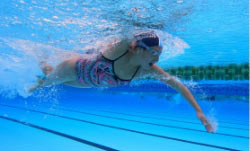

The Freestyle Technique Checklist shows you exactly what to focus on for faster times — and how to make your swimming feel effortless. It covers the seven areas we assess in every stroke analysis: body position, head and breathing, kick, rotation, recovery and entry, catch and pull, and rhythm and timing.
Download the Checklist (PDF)
Free, printable, one page — take it to the pool.
Here’s the full checklist. Work through one section at a time — don’t try to fix everything in a single session.
Body
- Horizontal — head, hips, and heels at the surface
- Posture — tall and proud
Head and breathing
- Eyes looking 0–45° down
- Long neck, slight tuck-in of chin
- Top of the head above water
- Light exhale through the nose, then a big exhale just before turning your head to the side for the inhale
- Head turns to the side with part of the bottom goggle in the water (“head on a pillow”)
Breathing is the area most swimmers struggle with — our freestyle breathing technique guide breaks it down step by step.
Kick
- Kick from the hips and allow some knee bend
- Toes pointed and feet turned slightly inwards
- Floppy feet
- Heels breaking the surface
- Kick in the bucket — the kick can be slightly wider than your body line
Rotation
- 30–40 degrees of rotation
- “Rock”, don’t “roll”
- Hips and shoulders usually rotate the same amount (some swimmers keep the hips flatter)
Recovery and entry
- Hand and wrist relaxed over the water
- “Open” recovery showing the armpit, with the elbow pointing up
- Fingers-first entry, elbow higher than the hand
- Enter in line with your shoulder and reach directly forwards (“train tracks”)
Catch and pull
- Start of catch: when your arm is at full extension in front of you, your fingers should be at armpit depth and be the lowest part of your arm
- Catch: fingers pointing to the bottom of the pool with your arm in a high-elbow catch position
- Viewed from the front, your arm will be at an angle of 100–120 degrees
- Power diamond: as your hand passes underneath your shoulder, your arm makes a half-diamond shape viewed front-on
- Exit: your hand exits just past your hip with your palm facing your feet until almost the very end; your elbow exits the water first
Rhythm and timing
- Movements are slow to fast — slower in front of the head, accelerating through the pull
- Most elite swimmers use front-quadrant timing: always having an arm in front of the head
How to use the checklist
Pick one section per swim and give it your full attention for a few hundred metres at a time. Film yourself if you can — most swimmers are surprised by the gap between what they feel and what they actually do. If you’re not sure which area is holding you back the most, start with body position and breathing: they affect everything downstream. You’ll find more technique breakdowns for every part of the stroke in our swimming technique hub.
Want this fixed in 5 days, not 5 months? The 5 Day Catch Challenge walks you through the catch and pull — the highest-leverage section of this checklist — with video demonstrations, 8 drills, and feedback from Head Coach Brenton Ford. It’s $10, with a money-back guarantee.
Ready to work through the whole stroke? The 8 Week Faster Freestyle course has been used by over 3,000 triathletes and swimmers to swim further and faster without gasping at the end of a lap.