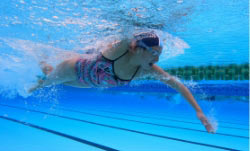

Effortless Swimming · Butterfly
TL;DR: Butterfly is a rhythm stroke, not a strength stroke. Get the timing right — two kicks per arm cycle, a body line that undulates from the chest, and a low forward breath that doesn’t break the rhythm — and the stroke that exhausts most swimmers in 25 metres becomes something you can hold for 200. This guide covers the technique in order, the kick most adult swimmers under-use, and the five drills we use in our Effortless Butterfly program.
Why butterfly feels so hard (and why it isn’t)
Ask a lane of adult swimmers to do 4×25 butterfly and watch what happens. Lap one looks like butterfly. Lap two is a fight. By lap three most people are doing a stroke-and-a-half and gasping.
It isn’t fitness. The swimmers who glide through fly aren’t exceptionally fit, they have the timing right. Butterfly swum with good rhythm costs less energy than most people spend on their freestyle.
Swum with bad rhythm, every stroke is a rescue: the body sinks between arm cycles, the head lifts to breathe, the hips drop, and the arms have to drag everything back to the surface. That’s the stroke most people learn, and it’s why they hate it.
So this guide starts with timing, not with arms.
The butterfly stroke, in order
One full cycle of butterfly, as it should happen:
- Hands enter about shoulder-width apart, arms nearly straight, fingertips first. The first kick fires as the hands go in.
- Chest presses down. This is the start of the undulation. Think of pressing your sternum into the water, not diving your head. The hips rise as the chest goes down.
- Catch and pull. Hands sweep slightly out, then back and under the body in a keyhole shape, elbows high. This is the same high-elbow catch you want in freestyle, done with both arms at once.
- Second kick fires as the hands finish the pull and exit past the hips. This kick is what lifts you for the breath and launches the recovery.
- Breathe low and forward as the arms come out. Chin skims the water, eyes down-and-forward, not up. The head is back in the water before the hands land.
- Recovery. Arms swing over the water, relaxed, thumbs down or flat, and land for the next entry. Repeat.
If you only remember one thing: kick as the hands go in, kick as the hands come out. Two kicks per cycle, every cycle.
Body position and undulation
The wave in butterfly starts at the chest and travels to the feet. It does not start at the head and it does not start at the knees.
- Press the chest, not the head. Nodding the head down drives you deep and costs you the next breath. Pressing the chest keeps you shallow and lets the hips pop up.
- Stay shallow. Good butterfly happens within about 30 cm of the surface. If you’re going deep after every entry, you’re pressing too hard or diving the head.
- Hips lead the legs. The kick is the tail of the wave, not a separate action from the knees. Bend at the hips first, knees second, feet last.
- Keep the line long. As in every stroke, a long body is a fast body. Reach through the entry, press, and let the hips follow.
The butterfly kick most adults under-use
Years ago during a set of 4×25 max-effort butterfly, my coach pulled me aside. My “sprint” fly looked like 400 fly. I was aiming for minimum splash and maximum power and felt efficient. His answer was one word: kick.
My feet were pausing at the surface between strokes. Instead of a continuous dolphin kick, they were waiting for the next arm cycle. On the next 25 I kept the kick continuous and really worked the up-kick, and I immediately sat higher in the water and went faster.
That pause is the most common kick fault I see in adult swimmers. Fix it with three cues:
- Continuous, not stop-start. The feet should never wait for the arms.
- Kick both ways. The down-kick gives propulsion; the up-kick sets up the next down-kick and keeps the hips high. Most people only kick down.
- Small and fast beats big and slow. A big knee-bend kick creates drag. Keep the knees relatively soft and let the feet whip.
The two kicks in each cycle aren’t equal. The first kick (on entry) is bigger and drives the body forward and down. The second kick (on exit) is smaller and sharper, timed to lift you for the breath. Swimmers who kick hard on the exit and soft on the entry end up bobbing instead of travelling.
The pull and catch
Fast butterfly swimmers cruise past others without breaking a sweat for one reason: they’ve developed the pull through drills, not through muscle.
The pull has the same shape as a strong freestyle catch, done with both arms:
- Catch early. After the entry, fingertips point down and the forearms set up vertically. Don’t slide the hands out wide and hope.
- Elbows high. The elbows stay near the surface while the hands press back under the body.
- Keyhole shape. Out, in under the chest, then back and out past the hips. The hands accelerate through the back half of the pull.
- Exit with the kick. The hands leave the water as the second kick fires. If they exit before the kick, you’ll feel stuck.
How to breathe in butterfly
Breathing is where most butterfly falls apart. The head comes up too high, the hips drop, and the stroke has to start again from the bottom.
- Chin skims the water. You’re not lifting your head, you’re letting the second kick lift your shoulders and sneaking the breath in the gap.
- Look down and forward, not at the end of the pool. Eyes up means hips down.
- Breathe every second stroke when you’re learning. It keeps the body line flatter and gives you a non-breathing stroke to re-set the rhythm. Every stroke is fine once the timing is automatic.
- Head back in before the hands land. If the hands land first, you’ll enter flat and the next press has nothing to work with.
For most adults, breathing every stroke early on is what makes fly feel impossible. Try every two for a few sessions and the stroke will feel like a different animal.
Five butterfly drills (in the order to do them)
These are the drills we use inside the Effortless Butterfly program. They progress from kick and timing to the full stroke. Do them in a warm-up or technique set, 25s with rest, and finish each drill with a few strokes of full butterfly so the feeling transfers.
1. Front kick, hands by your side
Kick on your front with your arms by your sides. Every two dolphin kicks, lift your head just enough to breathe, then back down. This teaches a continuous kick and the low breath at the same time. Breathe every two kicks rather than every four or five so the breathing rhythm matches the stroke you’ll swim.
2. Six kicks, two strokes
Two full butterfly strokes, then streamline under the surface and take six dolphin kicks, then two more strokes. The underwater kicks build the continuous kick and the body wave; the strokes make you time the arms to it. Beginners start with two or three underwater kicks instead of six.
3. Keyhole drill
My favourite butterfly drill. Scull out in front with a light freestyle kick for three or four seconds. Then do one dolphin kick and pull through with both arms in the keyhole shape, taking a breath during the pull, and let the hands pop out of the water at the end of the pull. Bring the hands back to the front up the centre of your body and repeat. It isolates the pull and the timing of kick and breath, and even beginners can do it.
4. One-arm butterfly
One arm stays out in front; the other does the full butterfly arm cycle with a normal two-kick rhythm. Breathe to the side like freestyle or forward, your choice. Do three strokes left, three right, then three full strokes. One-arm fly builds a clean entry, the catch, and the kick timing without the breathing load of the full stroke.
5. Three-three-three
Three strokes right arm only, three strokes left arm only, three strokes full butterfly, repeat down the pool. This is the bridge from drill to stroke. If the full strokes fall apart, your drill strokes are too casual; swim them with real rhythm.
A technique set to put it together
- 4×25 front kick hands by side, 20s rest
- 4×25 six kicks two strokes, 20s rest
- 4×25 keyhole drill, 20s rest
- 4×25 as 3-3-3, 20s rest
- 4×25 butterfly, breathing every second stroke, 30s rest — stop the set if the rhythm goes
Common butterfly mistakes
- Pausing the kick between strokes. The one I made myself. Keep the feet moving.
- Breathing every stroke too early. Flattens the stroke and tires you. Every two until it’s automatic.
- Lifting the head to breathe. The hips sink and the next entry is too deep. Chin on the water.
- Diving the head on entry. You go deep and have to climb out. Press the chest instead.
- Straight-arm pull straight down. No catch, lots of effort. Bend the elbows early and pull under the body.
- Muscling it. If you need to be strong to swim fly, the timing is off. Slow it down, fix the rhythm, then add speed.
How to learn (or re-learn) butterfly as an adult
Three rules that work for the swimmers we coach:
- Short and often. 8×25 of drills and fly at the end of three sessions a week beats one brutal fly set on Saturday. Butterfly rewards frequency.
- Stop while it still looks like butterfly. Every stroke you swim with a broken rhythm teaches your body the wrong stroke. Rest when the rhythm goes.
- Fins are allowed. Fins keep you high in the water and let you feel the correct timing before you have the kick to produce it. Take them off for the last couple of 25s.
Butterfly also makes your freestyle better. The catch is the same shape, the core connection is the same, and the body awareness carries across. Training another stroke is one of the ten ways we recommend to swim faster. For the fundamentals that sit under every stroke, start with our swimming technique guide.
Frequently asked questions
Is butterfly the hardest swimming stroke?
It is the most timing-dependent stroke, which is why it feels hardest. Swum with the correct two-kicks-per-cycle rhythm and a low breath it is not a strength stroke, and many adult swimmers hold 100 to 200 metres of it comfortably once the timing is automatic.
How many kicks per stroke in butterfly?
Two. One kick as the hands enter the water and one as the hands exit at the end of the pull. The entry kick is bigger and drives you forward; the exit kick is smaller and sharper and lifts you for the breath.
How often should you breathe in butterfly?
When you are learning, every second stroke. It keeps the body flatter and gives you a non-breathing stroke to reset the rhythm. Once the timing is automatic, breathing every stroke is fine and is what most distance butterfly swimmers do.
What is the best drill to learn butterfly?
The keyhole drill. Scull in front with a light kick, then one dolphin kick and a two-arm pull through in a keyhole shape, breathing during the pull. It teaches the pull, the kick timing and the breath together and beginners can do it from day one.
Can I use fins for butterfly drills?
Yes, and we recommend it when learning. Fins keep the hips high so you can feel the correct rhythm before your kick is strong enough to produce it. Swim the last couple of 25s without them so the feeling transfers.
The goggles I swim fly in

Butterfly is a visual stroke in a way people don’t expect. You’re checking the black line to keep the body wave straight and judging the wall for the turn with your head low and forward. Fogged lenses turn a rhythm stroke into guesswork.
The NanoClear Strike is the pair I point our swimmers to. The anti-fog is bonded into the lens material itself rather than coated on top, so the clarity doesn’t wash off after a few weeks. Soft contoured gaskets hold a light, even seal through the head movement of a breathing stroke.
Three nose-bridge sizes mean it fits narrow faces as well as wide ones, and the wide field of vision covers pool and open water. One pair for drills, sets and race day.