








Are you struggling with the unpredictability of open water swimming? I used to hate every second of it, until I learned these tips, which completely changed the way that I thought and went about open water swimming. In this episode, you’ll learn how to transform your swimming from feeling anxious and uncomfortable in the open water, To feeling confident and at ease.
00:00 Introduction
00:52 Don’t be a victim
01:42 Sighting
04:01 Course Recon
04:50 Goggles
05:25 Stroke Changes
09:19 Stroke rate
10:21 Why am I Slower in open water?
11:57 Drafting
14:41 Pack swimming
17:41 Wetsuits
20:24 Bi-Lateral Breathing
21:20 Dealing with cold water
22:28 Tides and currents
24:00 Entry and exit
25:33 Dealing with panic
27:20 Practice in the pool
29:39 Race Day Strategy
31:35 Swim camps
Transform your swimming at a camp: https://effortlessswimming.com/camps/
Need a premium wetsuit without the price tag?
Use code ‘EFFORT20’ for 20% off Great Ocean Wetsuits. FREE Shipping Worldwide:
https://greatoceanwetsuits.com/
Transcript
Read the full transcript
Welcome to the Effortless Swimming podcast to show that help swimmers and triathletes love the water, become a better swimmer and live a better life. Here’s your host, Brenton Ford.
Are you struggling with the unpredictability of open water swimming? I used to hate every second of it until I learned these tips, which completely changed the way that I thought and went about open water swimming. In this video, you’ll learn how to transform your swimming from feeling anxious and uncomfortable in the open water to feeling confident and at ease.
I’m Brenton and I used to dread every second of open water swimming until I learned these couple of tips. And I went on to break the age group course record at the New Zealand Ironman in a 47 minute swim. I help adult swimmers and triathletes improve their swimming, become more efficient through our online courses, our camps and our clinics. The first thing you need to know about open water swimming is the mindset. One thing that I got taught by Chris McCormack, the legendary Ironman athlete, was that you shouldn’t be a victim. Don’t be a victim when you go to the open water. The swimmers that are timid in their approach are often the ones that get swum over and are really uncomfortable. Now, I know it takes a little bit of confidence and proof that you can be comfortable in the open water, but having that mindset of I’m not going to be a victim can really help you have a lot more success. So you don’t need to be overly assertive or
aggressive to the other swimmers, but you’ve got to make sure that you don’t take a complete back seat because they are the swimmers that tend to get thrown around, pushed under the water more and don’t do quite as well in the open water. So that mindset piece is a really important one.
I’ve coached athletes who have swum 10 to 20 percent further than what they needed to in an open water race. And not only does that slow them down, but it means that they’re taking longer to do the race. They’re having to use a lot more effort and then sometimes they’re going to miss the pack on the bike if they’re doing triathlon. So making sure that we sight well and we don’t lose our speed when we do it is one of the most important things that you’ve got to develop as an open water swimmer. Now, the mistakes that I see people making when it comes to sighting, the number one thing is that they tend to lift their head up, take some strokes and then they put their head back down. And when they lift their head up and do that, their hips and their legs drop significantly. And it’s not only slows them down, but they lose their stroke rhythm. The way that I like to teach people to sight is to use the rolling breath or the sight and breathe
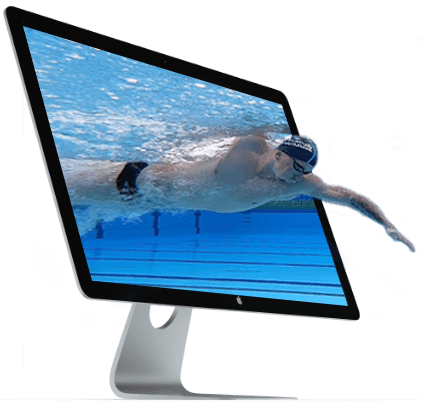
method. And that method is you should lift up and sight on one stroke and then you’re going to turn to the side to breathe on the next stroke. So it’s like a rolling breath. Now, you can see here in this video when Andy Donaldson is doing this, he doesn’t break his rhythm. You can hardly notice that he’s getting this look forwards as just a part of his stroke. And my benchmark, my way of sort of establishing whether or not someone’s doing this well is if you do a fast hundred and you get your time, then you do another fast hundred and you get your time, but you sight every 12 strokes. If you are within one to two seconds of that time from the first one, then you’re probably sighting and breathing quite well. So you shouldn’t be much slower than that when you introduce your sighting. Now, another way to sight is to raise your head a little bit. Think about getting crocodile eyes and take a few strokes where you’ve got to
lift your elbows up. You’ve got to increase your stroke rate, increase your kick to get a good look at where you’re going. That’s another way to do it if you didn’t get a very good look at the first time. So you can use these two types of sighting wherever you need to in your race, depending on what conditions are like, but we just want to make sure that we don’t lose our rhythm and we don’t slow ourselves down when we introduce sighting into our stroke.
A few ways you can sight better as well. One thing that’s good to do in a race is to make sure you do a course recce. You want to make sure that you know where you’re going. What does a course look like and are there any landmarks that you can line up with when it comes to doing the boy turns? So if you get a chance to do a lap of the course before the race, then you can see if the boys line up with anything on the shore and that way you don’t have a very small boy to look for. Because sometimes if it’s wavy and choppy and you’ve got the boys there, very hard to see. But if you can line up maybe a tree or a building or a landmark on the land, then you have a much better idea of where you’re going. So that’s the first thing that you will need to do. The other part of making sure you sight well is making sure you’ve got a good pair of goggles. Open water goggles are usually a little bit bigger with the lenses and I find
that to be quite helpful just to give you a bigger field of view and making sure that you either buy a new pair of goggles for the important races that you’re doing, but test them before you use them. But a new pair of goggles so they’re clear or just get a really good anti fog goggles so that you don’t have these foggy goggles where you can’t see anything. So something like the Maritania Hydro clear goggles are really good but goggles that either don’t fog up or sometimes I would buy new pairs of goggles for races. So I didn’t run into that problem. Some of the stroke changes that you might need to make when you’re going from the pool to the open water motto that I’ve got is higher wider faster. When you think about your arm coming over the top of the water, sometimes your hand needs to be a little bit higher than in the pool. Sometimes it needs to be a little bit wider because you might have a wetsuit on or you might not be able
to get as close to the body as you would in the pool and sometimes you got to be a little bit faster and a little bit more assertive over the top so you carry a speed over and just get that hand in. So higher wider faster is a general way of improving your stroke for the open water if you’re used to swimming in the pool.
The other thing you might note when you go from the pool to the open water, especially if you’ve got a wetsuit on, is you might find you kick a lot less. With the buoyancy of a wetsuit, with the buoyancy of salt water, often your legs don’t need to do too much, especially if you’re going at a slower pace or you’re doing a longer distance event. Generally you keep going to be there to support you, not to propel you. But in the open water and with a wetsuit on, sometimes you don’t have to do a whole lot with the legs, which is absolutely fine as long as they’re still working in coordination and rhythm with the rest of your stroke. That’s what you’ll often find will happen with the legs. For swimmers that like to breathe every two strokes when they’re swimming, I find that they tend to go for a little bit more of a loping sort of freestyle, where you’ll be a little bit longer on one side and a little bit shorter on the other.
It’s that loping or galloping sort of stroke that tends to work a bit better in the open water, especially if you are going fast. So if you find that you naturally gravitate to that sort of stroke when you’re swimming at speed in the open water, then lean into it and sometimes that can work really well. So it’s worth just practicing that and seeing what feels best for you and what feels efficient for you when it comes to racing in the open water.
You’re likely to have less glide as well. When there’s chop and there’s waves, you probably don’t have the same sort of time as you have in the pool. As you’re extending and reaching forwards in the pool, you don’t have anything moving around. So normally we’ll find that in the open water that you’re going to get into your catch a little bit sooner and you’re not going to have the time to extend out quite as much, especially for those shorter, faster events like a 500 meter swim or a one K swim or even maybe a two K swim. You won’t have the time to glide quite as much. Now, if you are swimming more marathon distance, the longer distance swims, then maybe maybe you will, but it really just depends on the event that you’re doing. But a lot of times people will get caught out by trying to over glide in the open water when it gets choppy. Now, not to say you can’t extend out, you look at someone like Andy Donaldson swing and he maintains his length
really well, but for many people, they just need to start the catch a little bit sooner than what they used to compared to in the pool. The other thing I see people doing when they go from the pool to the open water is they’re trying to be too pretty with their stroke. You need to allow yourself to get a little bit scrappy. Get that hand over, get it in the water. Don’t try and be too perfect and controlled with it when the conditions are not great. So allowing yourself to rate up to get your stroke up a bit, to be a little bit scrappy with it, that’s in a way to overcome those difficult conditions is to just move away a little bit from that classic perfect pool technique and just allow yourself to not be perfect, allow yourself to get scrappy. And the last thing there is is the stroke rate. Typically, people will increase their stroke rate compared to in the pool because in the open water, the water is typically more aerated from
people’s bubbles, from the chop and the waves. So it’s not as as thick, which means that you’re probably going to be increasing your stroke rate to account for that. And you’re probably going to be increasing your stroke rate as well, because with a wetsuit on and insult water, you sit a lot higher in the water. And that also just means that you can comfortably get your stroke rate up a little bit higher as well. So for me, my stroke rate will typically be about 10 percent higher when I’m going at the same speed in the open water compared to the pool. I’ll normally be a 65, 66 stroke rate in the pool, but then I’ll be around a 75 stroke rate when I’m racing in the open water for the same speed. And I find a lot of athletes similar with that. A question I get a lot is why am I slower in the open water compared to the pool? Now, there’s a number of reasons for that. The first one being you don’t have the walls to push off of.
You get a lot of speed and acceleration off the walls. Even if you’re not very good at your turns, you’re still getting some extra push from them. So that’s one reason why you might be a bit faster in the pool compared to the open water, especially if you’re in a 25 meter pool or a 25 yard pool. That’s lots of push-offs. That’s lots of speed that you gain each time you make a turn. That’s the first thing. The other thing is in the open water, you haven’t got any rests. You’re always going to be swimming. It’s continuous. And so sometimes without that rest or without those intervals, your speed is just naturally going to be a little bit lower. But then you’ve also got chop and you’ve got waves and you’ve got other things to deal with. So they are other reasons why you might be slightly slower. Now, it doesn’t mean that you can’t be just as fast in the open water as you are in the pool, taking into account with the terms, especially if you’re wearing a
wetsuit and you’re swimming in salt water. That extra buoyancy from those two things can allow you to be a lot quicker. For me, I did a wetsuit test in the pool and drown that I was significantly quicker wearing a wetsuit. So there are ways to make sure that you do swim faster when you make that transition, but I find it does take quite a bit of practice and getting used to swimming in a wetsuit, get used to swimming in the open water to be able to get to that point where your speed is essentially the same. One thing that it took me a long time to learn was how to draft. Drafting an open water swimming can save up to 34 percent of your energy. And if you can draft well, then not only will you be swimming faster, but you’re going to save a lot of effort as a result. Now, there’s two different ways to draft. One is on the hip, one is on the feet. Now, I prefer and I teach most of my swimmers to draft at the feet directly behind the other person
because this is where you’re going to impact the person in front of you the least. And this is also where it’s typically a little bit easier to draft as well. So drafting on the feet, try to stick as close to the other person as you can without constantly tapping their feet. If you’re annoying them, they’re going to get annoyed and they might look to retaliate as a result, but they are also going to kind of get a bit annoyed. So if you can just sit behind someone, avoid touching their feet as best as possible and just kind of sit in there without them knowing, then you’re likely to get a much better draft and pull along as you’re as you’re doing it. Now, you might need to adjust your hand entry. If you do get too close and you’re likely to hit them. So maybe you just got to be a little bit wider with the entry and extension. But you can save so much energy doing that. For example, in a pool, I used to train in a 25 metre pool and I could
I could do my four hundreds 15 seconds faster when I was drafting straight behind a faster swimmer. No extra effort. It was actually easier when I sat right behind him. And sometimes it can be even more than that. So it’s worth practicing drafting. Now, the other way is drafting on the hip and you can get a really big pool along drafting right next to someone. So your shoulder is kind of just behind their hip and you’re sticking pretty close to them because you can see when someone’s swimming, especially a fast swimmer, they have this wake coming off their hips. So it is very coming off it. You can almost ride that wake and get a really good pull along. The downside to that is that if you’re right next to someone, you can take their water, you can almost sort of pull through where they would be about to pull through so you can take their water and slow them down and it feels really heavy
if you’ve got someone drafting off your hip. So it’s good if you’re looking to maybe overtake someone trying to tie them out. But if you’re looking to gain an advantage, I think it’s better in most cases to try and sit at the feet rather than trying to slow that swimmer down, unless maybe you’re looking to finish a race and make that make their swimming feel really heavy. A big part of open water swimming is pack swimming, getting used to swimming with others around you. And this is something that takes quite a bit of practice to do. And with the more you do, the easier it’s going to get. Now, when you are swimming with other people around you, you might need to adapt or change your stroke to account for that. For example, if someone’s really close to you, maybe it’s hard to get your arm out comfortably. Maybe you can’t recover over the water as well as you normally would. So sometimes I’ll find you have to come over somewhat
straight, maybe enter kind of straight as well, or maybe you have to enter wide to avoid hitting someone. So you will have to make these changes to the way that you’re swimming if you are surrounded by a lot of people. And that’s OK. The main thing is do not stop. So let’s say someone maybe tries to swim over the top of you or they push you down. Don’t stop because if you’ve got 15 swimmers behind you, they’re just going to swim into and that’s that whole part of don’t be a victim. So just make sure you always keep swimming. Just a stroke if you have to and just get used to being surrounded by other people. Maybe you will cop an elbow. Sometimes that happens. People aren’t necessarily trying to to do that. But sometimes that will happen. So you just have to be prepared to be bumped around a little bit. Now the other part of that as well is if you find you’re really stuck with someone maybe in front of you, it’s OK to kind of roll over the top
of them, meaning let’s say someone’s here, you’re slightly behind them and you need to get over in this direction. You can kind of lift your chest up a bit and just slide over the top of their legs or over their hips to get across them. It’s a pretty common technique, especially if you’re going in towards a a boy turn and you need to change your position, you can get used to sliding over the top of someone. Now I’d suggest practicing that with a with a friend or someone that you know, but that is a very valid way to change your positioning, especially as you’re going into a turn. This podcast has brought you by Great Ocean Wetsuits, an up and coming Australian performance wetsuit brand for triathletes and open water swimmers. The wetsuits are designed and tested in Melbourne, Australia for fast, easy and enjoyable swimming for athletes of all levels. They’re worn in and raced by Olympians, triathletes and open water swimmers from all
over the world. And I personally use Great Ocean Wetsuits even before they became a sponsor of the podcast. I’ve personally found that the buoyancy, the freedom through the shoulders and the fit are the best that I’ve ever had in a wetsuit. So I highly recommend them and you can currently get 20 percent off either the gold or silver wetsuit models using our own code effort 20 at checkout. So enter the code effort 20 at checkout at greatoceanwetsuits.com and no matter where you are in the world, if you’re in Australia, the US, Europe, there’s free shipping worldwide. So get yourself a great ocean wetsuit. I personally use the gold model of the wetsuit. It just depends on what your goals are. So greatoceanwetsuits.com effort 20. Me at checkout, I know you’ll like them. The right equipment can make the difference between being a 140 swimmer compared to a 150 swimmer. So equipment that you might need when it comes to open water, a wetsuit,
especially down here in Victoria where where I live. So a good wetsuit goes a long way. The difference in the high level wetsuits and the cheaper wetsuits is typically the material that they use and sometimes the cups of the wetsuit as well. Now, depending on what pace you’re at and how seriously you’re taking a swimming in your triathlon, a mid-range wetsuit might be more than enough. So sometimes the mid-range wetsuits will have slightly thicker material, which means that they’ll actually last a bit longer than the more expensive wetsuits, because the more expensive wetsuits have thinner material, usually through the shoulders. So they’re more flexible, but they won’t necessarily last as long. So there’s a sweet spot there. And I think the majority of people can do really well with a mid-range wetsuit, especially one that’s designed well that has good freedom through the shoulders. It’s got a good cut of the wetsuit, something like
the Great Ocean Wetsuits Silver range is more than enough for most people. So make sure you get yourself a good wetsuit. When I’ve done testing between sleeved and short sleeve wetsuits, I’ve been a little bit quicker with the long sleeve wetsuit. I don’t know the difference that it makes for most people, but personally, when I have tested it, I’ve been a couple of seconds quicker per 100 with a long sleeve wetsuit. And my guess as to why that that is, is because you’ve got a little bit more thickness here. So you’ve got a slightly bigger paddle. You’ve also got a little bit more buoyancy as well. So it might just sit you up a little bit more. And sometimes the material on the inside of the arms can provide a bit of surface drag, so a bit more grip. So that’s why I think it can be slightly faster with a long sleeve wetsuit. But if you find that you need tire through the shoulders a lot, well, yeah, maybe better off going with a
short sleeve wetsuit. The other thing is a good pair of goggles. So making sure that you’ve got goggles with good view, they don’t leak. Make sure they’ve got some rubber around the outsides. So if you do cop an elbow, then you’re not going to finish up with a black eye and making sure that you’ve got goggles that’s got good anti fog to them. Or they’re a fairly new pair of goggles. So they’re not going to fog up because I’ve been in races where I couldn’t see where I had to go because I was wearing an old pair of goggles without good anti fog. And that just ruins the race because if you can’t see where you’re going, you might be seeing 20% extra when you don’t need to. If you prefer to breathe to one side, that is totally fine. But you might want to develop your bilateral breathing, your ability to breathe the other side comfortably and submit the same paces when you’re breathing to your preferred side because when it comes to open water swimming,
you never know where you’re going to be getting waves and wind and chop from. And if you are used to breathing on the left, but you’ve got this swell coming in and hitting you in this direction, you might have to turn to the right. You might have to breathe to that opposite side, at least for part of the race. So you don’t want to get out there and find that you just stuck because you can’t breathe to the opposite side. So it’s worth developing that skill as part of your swimming. It’s not to say you have to do 50% to your left, 50% to your right. For me, I’ll do 20 or 30% of my swim session to my non-preferred side, but the rest will be to my preferred side. So it’s a skill worth developing if you are doing any kind of open water swimming. One tip I learned when it comes to swimming in cold water is to if you can’t get in and do a pre-race warm-up, make sure you get some water and splash your face before you get in. That takes away that cold shock
that you’ll often get where it takes away your breath when you hit the cold water. So just making sure that you wet your face and wet your cheeks with that water before you get in and race. Just to get rid of that shock factor. And if you can, try to do some sort of land-based warm-up before you’re about to race, even if it’s like a bit of skipping or a light jog or some arm swings. Just something to kind of get the blood moving to warm you up that little bit before you go into this cold water. Now, if you’re doing something long like an English channel swim, well, that’s going to be a different type of event and you need to make the changes to allow for that. But for anything that’s a shorter distance and has some cold water, there are those ways to get rid of that cold shock factor. Depending on where you swim, there’s going to be currents and tides affecting the flow of the water. And we see this happen a lot here in Australia.
Many of our races are on open beaches or they’re in bays where there is a lot of current. So it’s worthwhile testing that out. If you can get into the water before a race and see which way the water is moving and maybe looking at the boys and seeing if they’re at an angle. So let’s say you’ve got a boy and it’s veering off in one direction. You know the water is flowing that way. Or if you’ve got waves of swimmers before you, you can see which way they’re getting pushed. So for example, the Nusa Tri a couple of years ago, there was pretty wild weather, pretty wild conditions and a lot of waves. And there was people who were leaving from the start line and trying to get out to the first boy. There was a heap of current going down the beach. So a lot of them didn’t even get to the first boy because they got swept so far. When it came time for the pros to race, they ended up running 150 meters down the beach, getting in at that point
and then they kind of got pushed across the first boy. But there’s nothing that they could do to swim at the same speed that the current was going. So sometimes it’s worthwhile just seeing what the waves are doing before you. And for a lot of the races here where I swim, quite often there is a bit of current. So I’m looking at which way of people veering when it comes to that first swim out to the boy. So knowing that, being prepared for that can help you place a lot higher in your swims than what you might used to be doing. If you’re quite new to open water swimming and you’re not quite comfortable amongst other people and in the open water, try to place yourself when you’re entering the water, just away from the pack, away from the masses. Give yourself five or 10 meters so you’re not getting slumber over the top of. Now, if you are looking to be competitive and have a good race, you wanna make sure that you’re positioning yourself
so that you can hopefully get to the boy first. But if you’re not very comfortable, give yourself some space, take a slightly wider birth until you get comfortable being amongst other people. Now, I’ve heard stories of people getting swam over and pushed under and things like that. It does happen, but the good swimmers, if you know you’ve got good swimmers coming up behind you, they’re not trying to swim over the top of you. They would prefer to just go alongside you or just go around you because that’s gonna make them faster. So they’re not looking to try and push you down and get you under the water or swim over the top. Now, yes, it does happen sometimes, but people aren’t always out for that. So just know that, all right, if you do hold your line, yes, maybe people will pass you and it’s likely that if you are getting pushed under, well, look, maybe they just saw you at the last minute. Okay, but just keep swimming, keep moving
and as best you can, try to not be a victim. Just keep it going and get your breath back if you need to. One thing that I find is good to know for people who aren’t that comfortable out there is if you get tired and you’re starting to run out of breath, maybe you’re starting to panic a bit, just roll onto your back. Just be on your back, have your head out of the water, have a light kick or a light scull if you need to, get your breath back, slow your breathing down and then you can go again. So, and that way you can also see what’s coming behind you. That’s a good way just to reset and start again if you find that you maybe got uncomfortable or starting to panic a little bit in the open water. When you’re finishing a race, you might be coming onto the beach and a good marker to know when should I stand up is roughly when your fingers start to hit the sand because that way you know, okay, well, that’s gonna be slightly shallower
than waist step and that’s the time where you can start to stand up and then start to run through the water. Now, if you’re more elite level, if you have a rough idea of where, the depth of the water, then you can start to stand up slightly before that and you can start to duck dive but that’s probably a slightly more advanced skill. So, when your fingers hit the sand, that’s when you should start to stand up for most people. Now, I’ve seen people slow themselves down by 30 seconds coming out of triathons because they start to stand up when they’re this deep and because they can see the bottom, I think, all right, I’m just gonna stand up, I’m just gonna walk through the water. If you can just keep swimming until those fingers hit the sand, you’re gonna be at the beach or at the shore much quicker. So, if you find yourself just wading through the water from here on, it’s too much, you’re probably gonna be a lot slower.
So, when you sit at the sand, that’s when you start to stand up. If you don’t have access to a lake or a beach and you can’t get to the open water much at all to practice, you can practice a lot of the skills that lead to good open water swimming in the pool. You can practice your sighting. If you’ve got friends or other people that you swim with, you can practice your pack swimming and you can also practice your drafting. So, a couple of things that we’ll do in the squad that I swim in is we’ll do a little bit of pack swimming, especially in the lead up to our race season. So, we’ll do something like 850s where we’ll get the slowest swimmers at the front, fastest swimmers at the back and we’re all going fast for that 50. Now, the lead swimmers have to try and keep their lead, fastest swimmers have to try and move through and just getting used to being really tight, having other people around and just making sure
that we learn how to adapt our stroke and change it with the other people really close. The other thing is drafting. So, a set that I love is what we call LA Freeway. So, we’ll do it in groups of three and we’ll swim 50 meters where the first two swimmers will push off directly behind one another. The third person will push off and then they’ve got to overtake those other two swimmers. They’ve got to make their way around. By the end of the 50, they need to have overtaken them and you get a really good draft at the start and then you get a bit of a draft as you’re coming up the side of them but then you’ve got to work really hard to get in front. But it’s a good way to practice drafting, practice swimming close and also just to get used to drafting from the hip and drafting from the feet as well. So, those things you can practice in the open water. Sometimes you can practice your boy turns in the pool as well if you take out a couple of lane ropes.
So, many of the skills you can get used to in the pool but the one thing you can’t get used to is those choppy conditions. That is where experience and practice really pays dividends. If you can get yourself to the open water once a week for six weeks leading up to your open water swim. That can make such a difference and if you’re not comfortable in the open water or you’re going by yourself just play it safe. Maybe you have to stick by the shore. Maybe you can’t go too deep but there are usually ways to get that open water swimming for most people depending on where you live. When it comes to race strategy and knowing how to pace yourself the biggest mistake most newcomers make is that they go out too hard. They get really excited and really nervous and maybe a bit anxious for the first two or 300 meters and they go straight to that top end speed where the heart rate is 180 when in reality it really should be 140 or 150 for the race.
So, the main thing that I like to make sure my swimmers do for that first part of the race is go out strong but we’re looking for easy speed. We’re looking to go out with good speed but keep that heart rate under control. If you feel like it’s, you’re starting to get too out of breath where you couldn’t hold this pace or you couldn’t settle the heart rate back down by the time you’re into the thick of the race then you’ve gone too hard. So, I want you to go out and just always think about keeping that heart rate just below that level where you know it’s going to be too much. So, just looking for that effort level and keeping it there. So, the first two or 300 looking to go strong and then as soon as you can just settle into that rhythm and tempo that you know you can hold for the rest of the race. And depending on whether it’s a triathlon or just an open water swim the speed will change within the race. In an open water race
you’re probably going to bring it home hard the last 100 or 200. So, you’re looking to have that extra push at the end. In a triathlon may not be the case maybe you’re just looking to be consistent throughout it and you might just want to bring your legs into the last 100 meters of the swim just to get a little bit of blood flying again so that you’re ready for the transition and ready for the bike. So, your pace and your strategy might change depending on the event that you’re doing but just make sure you don’t go out too hard. That is the number one mistake that I see most people making when it comes to their open water swims. If you want hands-on experience and coaching with your open water swimming come and join us at one of our swimming camps. We run them in the Galapagos Islands, Maldives, Thailand and the Whitsundays plus a bunch of other locations. So, I’ll put the link in our description below. Thanks for watching.
Here is another video where I talk about how to transform your freestyle technique in 33 minutes. Thanks for listening to the Effortless Swimming Podcast. If you’d like us to help you become a faster, more efficient swimmer, go to www.effortlesswimming.com.