







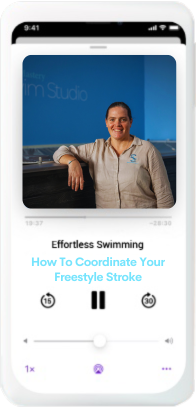
In this episode, we sit down with Tracey Baumann to explore swim stroke synchronization and body connection for a more efficient swim. We discuss six key synchronization points, the importance of feeling the water, and the role of joint mechanics in creating a powerful stroke. Tracey shares her coaching evolution toward focusing on technique and sensory cues, emphasizing the benefits of short-interval training. Tune in now!
00:08 Introduction
01:12 Upcoming Swimming Camps
01:34 Meet Tracey Baumann
2:23 Starting with Stroke Synchronization
3:17 Building the Stroke from the Inside Out
6:45 Avoiding Dead Spots in the Stroke
10:12 Six Key Synchronization Points
17:37 Transferring Pressure and Connecting with the Water
22:52 Softening the Hands for Better Connection
27:00 Effective Coaching Language
29:40 Grounding and Body Awareness
36:00 Short Interval Training
38:40 The Impact of Bones and Joint Mechanics
42:37 Get in touch with Tracey!
Website: https://www.swimmastery.online/tracey-baumann
Instagram: https://www.instagram.com/swimmastery/?hl=en
Facebook: https://www.facebook.com/officialswimmastery
Buy the book (The Swim Mastery Way) and save 10% using the discount code SWIM10:
https://inhousebookstore.com.au/products/the-swim-mastery-way?_pos=1&_sid=f59356e26&_ss=r
Get SwimMastery’s Minimising Shoulder Injury in Freestyle course for 10% off with the code EFFORTLESS10:
https://members.swimmastery.online/product/minimising-shoulder-injury/
Want to really transform your swimming? Join us on a swim camp in 2025 in the Maldives, Galapagos Islands, Whitsundays or Thailand: https://effortlessswimming.com/camps/
Change your technique and swim a smoother, easier freestyle with the Effortless Swimming membership:
https://effortlessswimming.com/training-and-membership-plans/?el=blog
Try PILLAR today, head to pillarperformance.shop and enter code EFFORTLESS for 15% off, or for any North American listeners, enter the same code at TheFeed.com.
Watch the episode on YouTube:
Transcript
Read the full transcript
I use like ice skating as an analogy, but it’s the same concept because someone’s not, you don’t look at ice skaters and they’re going like this to move forward. It’s like they travel on the left skate, travel on the right skate. And when you’re swimming comfortably, you’re swimming well and you’re looking at really nice, it’s what you see. I get that little bit of travel time and not travel time where they’re just stopping here. It’s that perpetual motion, it’s that rhythm. It’s almost like a waltz. You really want to go one two, or you want to, and you get into it. It’s almost like you’re creating this dance and each part of the stroke that you build up are just parts or steps of the dance that you are creating. And once you bring in all the synchronization parts, that’s where the dance comes together and you just dance the dance if you like. Welcome to the Effortless Swimming Podcast to show that help swimmers and triathletes love
the water, become a better swimmer and live a better life. Here’s your host, Brenton Ford.
Have you ever felt like your swim stroke was missing that something extra? Like it could be more efficient, more connected, but you just don’t know how? In this episode, I sit down with Tracy Bowman to unlock the secrets behind a truly synchronized and powerful swim stroke. Tracy has transformed the way she coaches by focusing on something most swimmers overlook, connecting the whole body from the fingertips to the toes and building the stroke from the inside out. We’re breaking down six key synchronization points that can take your swimming to the next level, including some game changing tips like how rotating your fingernails can improve your streamline and why sinking your leg movement with your catch can unlock a fluid and powerful stroke. But it’s not just technique. Tracy dives into the importance of filling the water, using sensory cues to truly connect with it and power your way through the pool. We’ll also explore why short interval training,
focused on technique, beats long, continuous swims every time, whether you’re looking to improve efficiency or just curious how correct joint mechanics can revolutionize your swimming. This episode is packed with insights that will change the way you think about your stroke. Tune in for a deep dive into the art and science of swimming and let’s make your stroke smoother, stronger and more connected than ever. And if you’re someone who loves their swimming and wants to improve and get better at it, we’re running a whole bunch of swimming camps next year. We’ve got camps in the Whitsundays, Galapagos Islands, Maldives and Thailand. So you can explore all those dates and camps that we’ve got for 2025 on our website at effortlesswimming.com forward slash camps and we’ll put the link in the show notes below. Tracy Bowman, welcome back. This is your third episode in probably the same in about three months. I think you’ve had the most recent two popular episodes and I was just talking to
you before the podcast that the last episode that we did has had 40,000 Gs on YouTube, which is unheard of for a podcast that we’ve posted on there. And I think one of the reasons there is the topics are resonated with a lot of people, but the way that you explained a lot of those concepts really drove home some of the things that people are trying to achieve in their swimming and how they can go about it. So I think you’re so good at explaining some of these things and making it really clear on what people need to do. So I wanted to get you back on to talk about some different topics. And today we’re going to talk about how you can synchronize your stroke, how you can connect things up, and also just the speed side of it, the speed equation, stroke length, stroke rate, and how people can approach that. So welcome back, Tracy. Thank you so much for having me on again. The response has been overwhelming and very encouraging. And yeah, it’s just been so great to get the information
out to lots of people and to see lots of people making changes in their stroke and positive changes and hopefully changes that more than anything will prevent or minimize injury in the stroke, but also to help them swim better and faster. And yeah, I get to learn from you and from all the questions that I’ve had from all the people as well. So it’s been a fantastic few months reading everyone’s comments and questions and chatting with you. So thank you for having me on again. It’s my pleasure. I picked up so many things that I’ve started to use in different scenarios with people. So it’s just helped me add a lot of things to my toolbox when I’m coaching, which I really appreciate. So the first topic I want to cover is the synchronization of the stroke and the way that I often approach it when I’m working with people in clinics is we go through our normal process and order of things. And then almost one of the last things we really then start
to drill into is the connection side of it and making sure that things are coordinated. And for people who are new to the sport, it takes a lot to firstly just feel comfortable and balanced in the water. And so that connection or synchronization can feel like it’s a long way off sometimes. And they feel like they’re very wobbly and unstable. So where do you sort of begin with the synchronization of things? And I know we’ve covered previous topics with the balance and catch and those sorts of things. But yeah, if you’re listening to this and you haven’t heard the first two podcasts, I’d recommend go back to those because we covered the earlier parts of the stroke. Now we’re starting to get more towards the tail end of it. So yeah, synchronization, what do you sort of think around there? Yeah, so it’s a really interesting question. And it’s an interesting part of the stroke because yes, we come to it and we address it
much later in the stroke. But the real reality around it is that we’re actually addressing it from day one. And when we’re thinking about building the frame and putting the connector torso to the legs and making that first connection and then putting the connecting the arms via the scapula to that unit, that’s actually our first synchronization point that we’re talking about. And then when we start to add in the arm recovery, we’re already talking to the students and talking to the body because that’s how I like to coach a lot is how can we connect with the client’s body about the synchronization of the stroke from there. So when we get to the part of the stroke where we’re bringing synchronization, stroke synchronization in as a topic, what we’re hoping to already see is that the streamline is happening. So the arm recovery to streamline synchronization point is already happening because we built the stroke up like that from the inside out
from the get go. And then what we can do is we can then start to synchronize how that part of the stroke happens. So they go from their arm recovery to their streamline, and then how do they connect the other arm recovery on the other side to that. So it’s really this idea of building up the points that we’ve talked about in the last two podcasts. So we talk a lot about the streamline position, getting people to imagine, and I think I mentioned this on what about the conversations, getting them to imagine that they’re sliding along a cross-country ski in their streamline position. So they get into their streamline position and that the moment that they get their whole body onto that ski, they’re really focusing on sending the arm recovery forwards at exactly that moment. So it almost becomes that ski and open the wing or ski, open the gate or whichever queue, send the tattoo forward, whichever queue it is that they’re going to think about,
that would be the first two parts of the stroke that we would connect. And making sure that happens really fluidly so that we can iron out any dead spots at the back end of the catch. So we’re not creating any any breaks at the back end of the catch. It just goes straight through to opening the gate open tattoo opening wings. That’s where I would start. I just wanted to go to the like the back of the stroke there, what things the people do there that creates a dead spot, what do you often say? Yeah. So I mean, a lot of things, I think a lot of people sometimes spend a lot of time in the pool drilling. And so they spend a lot of time in drill positions and often saggy in positions that actually don’t fit into the freestyle stroke. And our bodies are incredible. The human body is incredible at remembering positions. So when they then take the drill into the full stroke, they have that dead spot because they’re hitting the drill
position hitting the drill because let’s say for argument sake, streamline, they hit that position and then they’re like, okay, I’ve got there now. So now I’m going to stop for a moment because that’s now got to tell my brain that I’ve put that drill into my body kind of thing. So that’s one of the reasons that can cause a dead spot. So we tend to never really do anything more than two or three meters of a drill because we want to just get that instant integration into whole strokes that we don’t create dead spots by drilling too much. So that’s one reason. The other reason is they could be over cooking the catch. So the thing we hear all the time is people saying you have to accelerate through the last part of the catch and really push up over your hip. I’m mindful of someone’s comment in YouTube that if I’m going to show you anything, make sure that it’s in the video. So I’m doing that. So I’m going
to show you and just really pushing back here then creates a dead spot because now that locks my joint. So now my shoulder joint is stuck here behind the shoulder girdle and I can’t actually do that beautiful release forward that I’m looking for in that synchronization point. So then I have to clear the joint and come forward and that takes a minute or two. So it interrupts that beautiful synchronization and perpetual motion that we’re looking for. So those are probably the two biggest things I could go on and on that that’s there with those two for now.
Yeah, great. And it’s I like their cross-country scheme analogy because and I use like ice skating is analogy but it’s the same concept because yeah someone’s not you don’t look at ice skaters and they’re going like like this to move forward. It’s like they travel on the left skate travel on the right skate and when you’re swimming comfortably, you’re swimming well and you’re looking at really nice and that’s what you see. I get that little bit of travel time and not travel time where they’re just stopping here. It’s that perpetual motion. It’s that rhythm and I always a couple years back we ran a camp in Hawaii and had one of the local coaches that one of our other coaches you came in and just spoke to our guys for a couple of minutes and I remember he he said freestyle or swimming it’s all about rhythm in the hips rhythm in the legs rhythm in the arms and so that that rhythm always just sort of stuck with me.
Yeah, it is about rhythm. They don’t want to be stopping and pausing completely. Yeah, it’s always like I told to this the students or the coaches when I’m doing coach training or the students that it’s really there’s almost like a waltz. You really want to go one two, sorry, one two, sorry and you get into it’s almost like you’re creating this dance and each part of the stroke that you build up are just parts or steps of the dance that you are creating and once you bring in all the synchronization parts that’s where the dance comes together and you just dance the dance if you like. So I love that idea of bringing the ice skating in and the rhythm and it’s a really good way of thinking of that. Yeah, in terms of having things coordinate and connect, I know you’ve got a few different ways to approach it or for people to think about that side of things. So I’d be curious to get your couple of ways that people can think about this coordination piece.
Yeah, so the very first one, so we have, I’ll go through six. I have many because I remember when I first wrote our first coach training program, when we first started about four or five years ago, I was writing the synchronizations manual. They got very carried away with all the synchronization. I mean, it is so exciting how the body is connected and I got so excited. I had about 15 or 20 different synchronization points that we could put in and my partner, business partner at the time looked at it and said, this is way too much for people. So you need to put it back a bit. I was like, okay, so there’s so many opportunities to synchronize different parts of the body because our bodies are just asking for it. They are made for it. They work. We do it all the time. It’s walking, like freestyle is basically just walking. And I often say to people, I want you to walk along and for everyone listening, it’d be really
interesting for you to push pause right now and jump up and walk across the room and ask yourself what part of your body is moving fast when you take, when you walk. And often people that I can imagine people have pushed pause and stood up now and they’re walking across their room and they’re going, oh, there’s definitely my knee. No, it’s definitely my chest. Oh, it’s my arm. It’s my pelvis and coming up with all the answers and the reality around it is there’s no answer. It’s a trick question because everything moves together. And I use that always as an analogy when bringing in the synchronization, assuming because it’s exactly the same thing. I don’t want any one thing to start any one thing because what I’m looking for is whole body movements, whole body connections and continual motion. And so everything has to move together always. So I’ll choose six. The first one is always the end of the arm recovery. So once
you’ve opened your wings, sent your tattoo forward, whichever cue that you’re going to use, it’s from there using whole body rotation. So shoulder to feet as one unit. It’s that rotating the fingernails forwards into streamline. So that’s the first synchronization point that I will obviously the other arm is doing its thing. I can’t rotate and do that all at once because I’m not in water, but that would be the first. So rotating the fingernails to streamline, so using whole body to rotate. That would be the first. The second one would be ending those two things together. So the first one is starting those two things together. So end of recovery, i.e. entry. I try never to use the word entry. You may have noticed that I’ve probably until now never mentioned that I don’t say it because it takes everyone’s attention to the hand is the last place I want their attention because they’ll lift and do and put. As soon as they do that,
they’re going to disconnect the arm from the scapula. So I’m always trying to take their attention to the scapula in the upper arm. I call it their wing bones. I think I mentioned that. So the first one is the start. The second one would be the ending. So the point where they finish rotation and their fingernails or they get hit the ski position. So start, finish. Those are the first two. Then what we would have is we would have the idea of at the moment that they hit the ski position, open the wing. So at the moment they hit the ski position, open the wing. So we lose that, that dense spot. So that would be three. Then what I’m going to get them to start thinking about for much more advanced swimmers is we, and notice how we start from the inside. So we’re always working. And I think I’ve mentioned this on each of the calls that we’ve had so far. We’re always working from the inside out. We’ve never started the
extremities. We start at the extremities. We lose the access to the core. We lose those major connections that we spend all of this time building up. So then when we get into the next part of the equation is when we then introduce the idea of timing or synchronizing the catch to the stroke. So we have rotated into streamline. We’ve opened our wing. Now we’re ready for the next stroke. So as I’m opening my wing, I’m just going to use that for ease. I’m going to be catching at the same time, keeping my rotation stable. So I’m still skiing along my ski as I’m doing this. So I’m just going to hook my fold, my arm over the end of the ski. Then when I get to here, then I’m going to rotate. And at the same time, mindful of that guy’s comments, I want them to be able to see the same time as I rotate, I’m going to apply pressure to this whole line here. And I’m going to apply pressure. And I’m going to send my head and my fingernails forward at exactly the
same time that I apply pressure. So I applied pressure on the catch at the start of my whole body rotation. So if I just did the catch, it would be rotate
at exactly the same time. Then the next one is the end. So the end of my rotation is timed with the end of my catch, which finishing is in front of my body line here, not here. So then it would look like this. So at the moment that I hit streamline on this side, I’m finishing my catch on this side in front of my body line, ready for the next stroke. Then I’m going to bring in the timing of the legs. And this would be the sixth one. And when I’m first introducing this, I just make the legs work together. So I don’t isolate one leg from the other. I make them work both at the same time. So what happens is, is the whole body rotates. I have my legs already in this scissor position, this counterbalance position, that we have taught the students back when we learned streamline. As the whole body rotates, all that simply needs to happen is at the moment that they rotate, they are going to press themselves into streamline and end up
in counterbalance on the other side. And then at the next rotation, they’re going to press themselves forward into streamline and end up in counterbalance on the other side. Then they’re going to a little bit more detail on the legs. I don’t know if you want me to do that now, but that would be where I would get up to you with synchronizations, the simple ones.
Yeah, no, I like it. I’d like you to keep going if you’re happy to. Yeah, sure. So with the legs, when I bring in the synchronization of the synchronization of both the touch and the legs, this is where I start to talk about pressures. So I think I’ve mentioned either when you and I have talked personally or in the podcast that it’s very seldom that I need to teach catch and very seldom that I need to really teach a really well timed leg movement because what often happens is when you set up the body from the inside out and it’s connected, it’s going to take the anchors from the water that it needs. In order for the body to work, it needs a floor if you like. So if you think about all other sports, we do them on land and we have a floor which closes our joint mechanic chain. But in water, obviously it’s open chain mechanics until you learn to connect with the water. And when you can connect with the water, then you can use your joints in a very similar way to how you use them on land
because you use the water as your floor if you like. So when I start to bring in the synchronization points for catch and to be pressed, I’m using the pressure as a way for the swimmer to tap into something physical to hold onto so that their joints and therefore their muscle systems can work in the way that they work when we run or walk or do anything. So I start this process by having them feel pressure on the streamline side. So as they are sending their books and fingernails forward, that’s always a moist thinking middle and less trident prongs or books and fingernails. I’m getting them to start tuning into the pressure that they’re feeling as they are moving forwards. So at no point in my coaching, do I ever talk or say the word back except for one place, then I’ll talk about that in a moment. But at the front end, it’s always about going forwards is what can we do to make this swimmer move forwards and then tune into what they feel when they move forwards. And if they’re really
good at it and they get really good at proprioception and body awareness, they start to be able to feel the water almost coming and hitting their sort of ride riding up their fingernails, hitting their cuticles and then kind of riding up the hand over the wrist up the arm. And I try and make it very sensory for them because the more that they can tune into it, the more they’re going to be going along their ski without me telling them to go along their ski. Because if I tell them to go along their ski, they’re going to go into holding that arm up and I don’t want them to I want to be lengthening forwards, because then they’re going to tap into different muscle systems. So I make it very sensory and I get them to feel that first. Once they can tell me that they can feel the water doing that, and they can only feel it if they’ve got their streamlined position correctly. If they’re feeling this, that nothing going up here,
then you know that their hand is like this. If they’re feeling pressure here, then you know their hands like this. If they’re feeling pressure here, you know, they’re stretching or reaching because the water’s going to hit them here. And it’s such a great way to get people into their bodies and really asking themselves, wow, how do I, what am I feeling? And if I am feeling all of those other things, what if I just used the bottom of my scapula, my shoulder blade to send my fingernails, what changes in where I feel the pressure of the water. So it’s just, it’s a great way to do that. And then to teach people how to transfer that pressure from going along the fingernails and up here as soon as they feel it on their fingers to transfer it to the inside of the arm. And that then helps when we bring the synchronization into the stroke, because when they can transfer the pressure they felt here so that we keep the front end of
the stroke doing what it needs to do, and then transfer it to the inside of the arm at the moment that we rotate, then we know they’re getting an anchor, they’re getting an arm full of water by holding on because they’re feeling the pressure. And then with this, at the same time, giving them the thought process, the moment you feel pressure here on the inside of the arm, you’re sending the middle card into your books or your head and the other fingernails past it. And that creates a beautiful synchronization point for them by building up and using pressures as a way to do that, because that makes sense. Yeah, it does. It’s great. I’m just sitting back and enjoying it. It’s like some really interesting ways to think about it. And like what I was thinking of there was that whenever, like, I put out a lot of videos on YouTube and the couple that I’ve done on the, I guess the concept of softening the hands over the water and then as you’re extending out in front,
for whatever reason, a lot of people have resonated with that and they’re like, oh my god, I’m swimming a bit faster. It feels so much easier. It feels smoother and I guess better connected. And like what I was thinking there is if a lot of people are just way too tense as they’re going through those motions, as they reach out, yeah, they come up and drift up. But when I’ve filmed really good swimmers, they’ve got this softness to their hands. And as they extend out there, they’re feeling those things that you’re mentioning over there. I sort of talk about over there, you’ll feel it over the knuckles as you’re extending through. And yeah, it’s such a subtle part of the stroke. But I think it helps open the door or lead the way to the rest of it, to the catch and that connection piece. Yeah, I mean, with your absolutely without correct because without it, the joint mechanics, the joints are actually not in the correct place
to create a catch. And so if they’re not in the correct position, then anything they do after that is going to be compromised. And it may be that they’re just trying to look for an aesthetic, but they’re not actually allowing their joints to put them into the correct position. So it may aesthetically look okay, but they’re not able to tap into the power that they could tap into if they have the joints in the right place. And obviously it increases the possibility for a which we definitely don’t want to do. So yeah, absolutely softening everything softening. I love the word softening. I ended up putting the word we have a swim mastery swear word book. And there’s quite a few words in the swim mastery swear word book. And one of them has the newest one that has made its way into the swim mastery swear word book is very surprising to a lot of the coaches that work with me is the word relax or a relax
stroke or relax this relax that because at the end of the day, I think that doesn’t allow people to connect with the water. They turn it’s almost like they’re turning themselves into cook spaghetti and they’re not connecting with the water at all. And you have these aesthetically great looking swimmers going nowhere with lots of dead spots because they’re not connecting. And what we want is we are great looking swimmers going somewhere and as fast as they can because they’re connecting with the water. So we don’t want raw spaghetti. We don’t want tension. We don’t want cook spaghetti when they’re relaxed. We want somewhere in between. So I’ll tell you let’s say and so we’re always looking for tone not tension. It’s sport after all. So we have to have tone in the muscles to be able to use them for sure.
This episode is brought to you by Pillar Performance. Our new sponsors Pillar are a sports micronutrition company. And the easiest way to describe it is that while hydration and carbohydrates products will take you through to touch the wall as fast as possible, Pillar’s mission is to get swimmers to the starting blocks in the best condition over and over again. I recently started taking Pillar triple magnesium after a friend had recommended it and it’s been a game changer for my sleep and recovery. I take one scoop 30 minutes before bed each night in the same way that you might start your day with a coffee. I finish it up with a magnesium and recover better for tomorrow’s session in the pool. Pillar performance is used by some of the biggest names in swimming and triathlon, including Zach Stavilti Cook, Jan Frodeno, Ben Canute, Ash Gentle, Taylor Nib amongst the host of other well-known swimmers and
triathletes. Where Pillar differs from other micronutrition you may have taken before is both the quality of the types of magnesium and the tangible results that I see on my garment each morning. If you’d like to try Pillar today, head to pillarperformance.shop and enter code effortless for 15% off. That’s effortless for 15% off all first-time purchases or for anyone in North America. Enter the same code at thefeed.com.
Yeah, and it’s like the subtlety that you’ve got with words and yeah, and I’ve started to sort of check myself a bit on some of the words that I’m using when coaching because it’s yeah, I can if we use the wrong words, it can convey something that we’re trying to avoid. So yeah, I think it’s I think it’s important that’s terrific and and that that tone as well as that shape in that that form. I think I mentioned this on the last podcast, but like picking up a glass of water, you had just the right just enough sort of turn and form to it to do it. Yeah. And it’s the same thing when we swim just enough, enough tension to keep the shape but anymore and it’s wasted effort. And so I think someone like listening to this podcast from just to sort of like summarize the last 15 minutes because you went into a lot of detail there. But like one thing that I’ve found just to help so much and I try and do this when I get into the water and I’m going through my warmup,
he’s that that softening of the hands as I’m coming over entering and reaching out and just being really aware of what you’re feeling through there and trying to get it to come over your fingertips and knuckles and over the top of the hand and just setting that up well. And then I find that helps me obviously with the catch part of it, but it just develops that feel that we need to have in in any swim or in any session. And so for me that’s like a really good just easy way to get that to happen early on in a swim. Yeah, fantastic. Because it puts you inside your body, right? And I think the more we can as swimmers ourselves, but for certainly for our the people that we work with the more quickly we can get them into their bodies and feeling what’s happening rather than thinking everything, the quicker they’re going to tap into their bodies because we can’t think our bodies to move, we have to feel them to move and we have all these beautiful sensory
perceptions on our sensory receivers on every part of our body that we can tap into and make the most of when we’re swimming. So it’s a great way to get them into their bodies for sure. And the grounding aspect of it that you talked about like we’ve on land we’ve got something to connect everything to, whereas in the water we don’t have that sort of stability unless we are you’ve built the frame and you’re in the right position and you’re moving the legs sort of in opposition to each other. And that’s like it’s really obvious for coaches and I think for swimmers when they’re feeling it it’s really obvious when we see someone who doesn’t have that grounded aspect to their stroke where there’s lots of movement happening, but they’re not going anywhere. And but then once people make that change like for many people that can be 20 seconds quicker per 100 and they feel like this is a different sport to them.
This is something that can be enjoyable. And so what what do you for someone who feels like lots of things are moving but they’re not going anywhere? Yeah. What what are some of those things that they are trying to do or thinking of that’s causing them to to not be moving forward much at all? I think that’s a really great question and I think this will resonate with a lot of people listening because I think a lot of people they kind of follow books or follow YouTube videos I’m not going anywhere and I don’t know why and I think a lot of the reasons is because of how humans think about swimming. So I think is the one thing we can do is to help people understand that swimming is not about pulling and ticking it’s about creating a beautiful long vessel and then holding and sending holding on to water and sending energy forwards. We’re going to help those people already but then when we can get them to feel into the pressures and start feeling and applying
pressure to the catch and then and using and transferring that pressure that they feel into forward momentum. So I think a lot of the sets that you can download from online are okay let’s do 400 meters pull. Well that in itself is teaching humans to be even more human and humans aren’t really very good at swimming and our human instincts aren’t very good for swimming because all we’re doing is we’re moving water around but we’re not actually going to go anywhere. So when we look at that set we look at the set and we think okay how can I turn that set into something that’s going to transform forward the swim movies going nowhere into going somewhere. Well let’s just tell them to go somewhere and it seems really simple and it almost seems silly that this is my answer but it makes such a difference and I see it in the endless pool. I’ve had the benefit of having my own science lab for so many years and you
simply just tell someone to do the same thing whatever it is and then tell them when you do this I want you to imagine you’re going forwards through the propulsion unit and they go faster because just that very one thought process of saying do this and send your energy when you do it forward makes their bodies connect and I like the word you use ground find that grounding aspect and then to have them do the same thing with the legs so often they have spent time doing kick sets and you probably are getting to know that kick is one of the swear word books and one of the swim mastery swear words in our book and because kicking is not what we want to be doing in swimming it uses the wrong muscles it’s the wrong movement and it’s up and down and if I go up and down and I look I think about these third law of motion for every action equal opposite reaction if I’m kicking up and down then the opposite and equal reaction
to my kick is going to be the opposite up and down it’s never forwards and actually where I want to go when I swim and it doesn’t matter where I want to swim I want to start at this end of the pool this end of the channel this end of the lake this end of the river and I want to go over there I don’t want to stay here I’m swimming because I want to go to the other end of the pool or something so therefore whenever I do anything that’s got to be my intention then I can start to turn the movement patterns that I’ve been practicing into forward momentum so if I use the legs as a really good example so I want to as my last and final synchronization point I want to use my whole body rotation and I want to press with my legs to send my head and let’s just keep it simple my head or my books forwards in order to do that when I press with my legs I have to press behind me and that’s all I say I said all I’m I need to do is feel pressure and send imagine that you’re
finding that pressure and you’re sending that piece of water for want of a better and that’s not grammatically correct that a hose that piece of water you’re sending it and pushing it to the back wall of the pool and using that to send your head to the front wall of the pool and that action creates the perfect leg mechanics because the only way they can do it is correctly otherwise they can’t send water behind them they can only send it down so in in the queue I’ve created the correct joint mechanics and I’ve given them the instruction of where to send the energy so they connect they get the joint mechanics and they travel so it starts to help people to turn these movements into forward momentum more and more as they learn how to do it and short repeats like if they get it use the wall that’s the best way push off the wall use the momentum of the wall to do maybe two two of these where you’re just thinking okay so feel
pressure here I’m going to transfer it to the inside of my arm and I’m going to rotate my whole body past it and I’m going to see the tiles kicking over and I’m going to do that one more time to stand up because then I’m using the momentum off of the wall to feel the sensation that I’m looking for and then I want to stand up on that amazing sensation so that I can internalize it into my body and go oh my gosh I just did that so if I did that it means I can do it if you carry on for the rest of the length and you lose the momentum off the wall and then you start the pulling thing again because you haven’t quite learned how to do it and you stop after that then your body’s here but can’t do it because now look I’m not doing it so it’s a very different way of practicing as well so then I get them to stand up after those two strokes go back to the wall and do it again and do it again and then after a little while it’s like
learning how to ride a bicycle your body now knows how to do it if if I if you went in the water and I said try and swim disconnected you couldn’t do it I’ve tried to do it for videos to show people how not to do this I can’t do it it’s the most fascinating thing and it feels ridiculous in my body and I’m sure the same would be true for you because it’s internalized in your body and there’s a quick way to find that and there’s a slow way to find it I love it there’s in terms of the short interval short repetitions there’s a fear for people coming into the sport that if they can swim somewhat already it’s no I’m better off just doing two k straight and getting my fitness in and they take it like they’re running they take it like a running session where yeah yeah that’s it but I find just that short rest on the wall you get to number one get a little bit of recovery let the muscles recover and then you get to reset all right what’s my focus here
and I get to go again and as silly as it seems that short 10 15 20 second break after your interval of 25 or 50 or 100 whatever it is it’s like that can make that can be the difference between a really good 100 and a totally rubbish 100 it’s and fitness wise while swimming so technical the technical part of it’s so important that you’re better off that better off doing these short intervals and obviously there’s time and place for longer ones we want to do those if we’re working towards some events but when we’re thinking about technique short intervals are the really the way to go and yeah it’s so great to hear you say that for me less is more like less great stuff is going to give you more amazing stuff and our swimmers get to spend so little time in the water in their daily lives realistically we cannot possibly compare what the elites are doing to what the swimmers that we’re working with are doing because maybe they can get to the pool three
four times a week maybe maximum some people not even that so I always say to them use the time that you’ve got really smartly and get fit in the gym because you that’s the place you build your cardio engine in the gym and yeah I remember Michael Phelps doing an interview I think was after the London Olympics and that’s what he said he said I use all Michael time and that’s at that level for doing technique and I get fit in the gym and I think that is a much safer way to to to do these long swims and build up your technique than doing your two or three k just to get swim fitness for sure so it’s lovely it’s really lovely to hear you say that yeah I had the George Freel who’s a legendary triathlon coach had him on the podcast and he said a very similar thing he when he runs a couple day camps he’s having the swimmers do mostly just repeat 25s for that reason brilliant and I think a lot of people heard that and they’re
like all right good that’s kind of gave him permission to do that and do that any different right they know running and that’s okay and we can put the information out there to show them that they’re there’s that what in water it’s different and that’s okay so yeah it’s really great to hear that I the last question I want to finish with here and we haven’t even touched on the speed the speed topic but we just seem to go forever or so I’ll get you back on again Tracy too so talk about that component but I just want to go into where for you did you start talking about making a switch to talking about like bones and and that sort of thing because I know you’re very much about the sensory aspect of it but very much about the the bones and that sort of thing like where did that come from for you and yeah what were you doing before that if you had a different way of coaching before that yeah it’s that’s a really interesting question
I think it was something that evolved at quite quite a long period of time so I am forever learning I’m always on one course or another because I just love to learn and I love to improve yeah we say to the coaches when we start our coach training that I’m going to tell you what I know today and hope that I learn more today so tomorrow what I tell you may be different because I want to learn from today and that’s kind of my philosophy and I want to keep making things better so that was part of that journey and I was very lucky I did this fantastic course in Germany all about primitive reflexes and it was so and I did over a couple of years and it was such an interesting journey to learn about the start of movement and how movement starts in you in you how the babies learn to do x y and z through these reflexes for example and it got me so interested in in in the body and why people do what they do and how and then I went down the
journey of doing some anatomy and motion courses and working with a very good friend of mine Helen Hall if any of you are runners out there please find go and have a look at Helen Hall’s book even with your shoes on it’s called she is amazing and her and I spent a lot of time working together with the primitive reflexes and her knowledge immense knowledge of joint mechanics and we were putting together these courses I said that was probably where I started to change my thought process of thinking about bones and joints rather than muscles and really understanding and feeling she has a fantastic 4d scanner machine and so we would use some cues and we would scan and then re-scan and it gave us the kind of before and after of how if you think about moving joints how many how much it affects the entire body then if you just target one muscle so using the glutes is a really good example if I just engage my glutes I have very little effect on my whole body but if I
move my pelvis into a position I have effect on my entire body and so that was probably where it started so probably eight nine ten years ago sort of my back end of obviously I worked with total immersion for a long time so probably at the back end of my time there and it was so great to be able to take this knowledge and other things and put it into a system where we can tap into this from a different way different perspectives and really work from the inside inside so literally from the inside spine out to the extremities when it was a game changer it’s evolving still it’s still evolving but coaches always oh we can’t give up with you and I’m like that’s exactly how it should be I want to learn every day and make what we know today into what we know tomorrow so yeah that’s fantastic yeah it’s yeah it’s little things like that can have such an impact on the people that you’re coaching because they can connect to it they can
make that change I can think about the pelvis and yeah yeah adjust what the entire legs are doing and things like that so it’s yeah I was really curious to hear that and I think you might have mentioned it on the first podcast but we did and I thought okay that’s an interesting way to think about I’m gonna explore that a little bit more so fantastic we’ll um Tracy we time flies when we’re chatting like the love happening on you’re gonna have to come back if that’s all right with you so you’ll really appreciate it where can people get in touch with you or find out more about what you’re doing so my website is swimmastery.online so they can find me there and then Instagram and Facebook I think are at swimmastery or one one word and yeah I’ll put out the injury prevention course view I was going to put out a set book today for your listeners but we’ll hold on to that for when we do the speed thing because it will be way more relevant
to them one thing they can do is they go onto our website they can download a free ebook I know you’d be putting out a lot of stuff in the last couple weeks on breathing and we have a free ebook on our website that they can download and read if if they want so just a couple of things and we’ll do the set book next time yeah sounds good we’ll put that in the show notes and yeah Tracy every time it is great haven’t you yeah not my pleasure so I’m sure the people listening or watching this are gonna get a lot from it so Tracy thank you for your time I appreciate it and I’ll see you in another couple of months awesome thank you so much thanks for listening to the effortless swimming podcast if you’d like us to help you become a faster more efficient swimmer go to www.effortlesswimming.com