







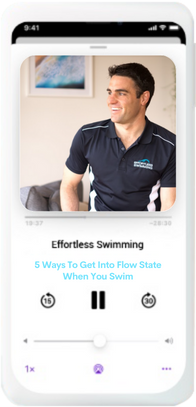
In today’s podcast episode, we are talking about five ways that you can get into a flow state while you swim.
00:24 Why It’s Important
02:06 Eliminate Distractions
02:32 Take Off Your Watch
03:42 Get Into It With A Clear Mind
04:09 Box Breathing
05:00 Meditation
05:17 Journaling
06:57 Listening To Music
08:28 Single-Task Focused
9:16 Using Trigger Words/Cues
Check out the Effortless Swimming membership for online coaching options:
https://effortlessswimming.com/training-and-membership-plans/
View our freestyle clinic schedule around Australia:
https://effortlessswimming.com/freestyle-stroke-correction-clinics/
Form Goggles:
http://formswim.com/effortless
Transcript
Read the full transcript
Welcome to the Effortless Swimming Podcast to show that help swimmers and triathletes love the water, become a better swimmer and live a better life. Here’s your host, Brenton Ford. Welcome to the Effortless Swimming Podcast. On today’s episode, we are talking about five ways that you can get into flow state while you swim. And the reason this is important is because you do need to think about your technique and your stroke, particularly in your warm-up as you’re trying to make some changes. But if you spend too much time up in your head thinking about every little thing that’s going on when you swim, you’re probably going to find it’s not that enjoyable. But you’ll probably find you won’t make the improvements that you would otherwise make if you can be more attuned to how you feel in the water. And that state of flow is kind of where nothing else exists outside of what you’re doing, where time passes and you don’t really notice that time’s passing.
And I’m sure you’ve experienced this in the water sometimes, when you’re swimming, probably in some other activities in life as well. And you might feel that in training now and again, in racing, is when we really want this to happen too. And it’s the state of mind where you come out of it, feeling very peaceful, where there’s nothing much else happening outside of what you’re currently engaged in. So it’s being very present. And before we get into this episode, where I’m going to talk about five ways you can get into this flow state a lot easier. I want to thank you for listening to the podcast. Last week we were number one in Australia, US, the UK and Canada for the swimming category in podcasts. So thank you very much for listening. If you haven’t given this podcast a review on Spotify or on the iTunes Store, that’s all I ask. I’d love it if you could leave an honest review about what you think of the show.
And yeah, that’d be awesome because that will help us reach more people. And a lot of people look at the reviews and see whether or not it’s a show worth tuning in to. So thank you very much for that. Let’s get into the episode. And the first thing here is eliminate distractions. Now, the good thing about swimming is you can’t have your phone on you. No one can talk to you. And it is a really easy environment to be able to eliminate distractions because the water is going to tune everything out. Now, another thing that you might need to do to completely eliminate distractions. Maybe you need to take off your watch. It could be worth trying taking off your Garmin watch or your tracking watch when you swim. And maybe even doing the occasional session without your form goggles if you do wear them a lot of the time. Eliminate those distractions where that way you do tune into how you’re feeling so much quicker.
For me, the form goggles are fine because it’s showing my time. With the watch, like when I was using my Garmin watch when I was swimming, I was distracted by starting it and stopping it. And I was always just very conscious of what the end time would be when I’d stop after each interval. So I don’t mind if you keep the form goggles on if you do wear them. But I think with watches, I find them more of a distraction because you don’t know what your pace is until the end. Whereas the form goggles can kind of just keep you in check. For say, for like a 400 meter swim, it’s going to tell you what your intervals are at every 50 meters or 25 meters. So that’s the first way. You just need to eliminate distractions. The good thing about swimming is you’re forced to do it because of being in the water. So that’s the first thing. The second thing you can do to get into flow state is to go into it with a clear mind.
Now I know there’s so much going on in day to day life and often when you do swim, you might be thinking of what you’ve got to do when you get home or when you get to work. But if you can clear your mind using one of these three methods, you might find that your swimming session becomes a whole lot more enjoyable and you’re much more present rather than thinking about what’s to come. So the first way and the way that I would often go about it is just some breathing exercises when I’m in the car on the way to the pool. I’ll often do some box breathing, which is I’ll normally do five seconds breathing in through my nose, hold it for five seconds at the top, exhale for five seconds through my nose and then just hold it for five seconds at the bottom. And just keep repeating that box breath for a couple of minutes as I’m going to the pool. And I find that that just kind of resets me where I’m able to sort of clear my mind
because if I’ve woken up and I’m thinking about all the things I’ve got to get done that day, then my breathing is a little bit more erratic. Whereas if you can control your breathing, which is the only part of your autonomic nervous system that you’ve really got control over, then you can start to clear your mind that way. So that’s how I’d normally go about it. The other one can be some meditation, just sitting down, closing your eyes and just focusing on your breathing, which even five minutes you’ll find will be quite beneficial there. But I find the breathing exercises are just much easier to do on the way to the pool. The other one can be even just writing, get a pen, get a paper, write down all those things that are going through your mind. Often we’ve got like a tape in our mind that we play over and over and I know I do this too where there might be three things that need to be done that day
and we just cycle through them in our mind every five or ten minutes. Whereas if I get a pen, paper, write down everything that I’m thinking of, all the things that need to get done, then I’ve got them on paper and I can just wipe them from my mind. And if I need to look back at them, I’ve got it there on paper. You can find that journaling or just writing things down. It can be a really good way to clear your mind as well. This podcast is brought to you by Form Goggles. Form empowers swimmers at every level to reach their goals, whether they want to get stronger, faster, swim further, or be more efficient. Get lap by lap motivation with real-time metrics and workout instructions right in your goggles. And Form’s recently released Form Plans, which include a progressive series of workouts to help you achieve your fitness, skills, or triathlon goals. So follow along with the plan and your weekly swims will be automatically synced to your goggles.
So you’ll swim through your workouts with real-time metrics and workout instructions all in your goggles. So it’s like having a coach right there with you. And I’ve had a look through these training plans and I think they are excellent for people who want to train for certain triathlons or reach certain fitness goals. It will build on each week and a really good way to progressively build up your fitness. So if you’d like to follow along with some plans to help you reach your specific swimming goals, then check out Form Goggles at formswim.com forward slash effortless. And this will give you $15 off your purchase of Form Goggles. So formswim.com forward slash effortless to get your pair of Form Goggles. The third one is listening to music. Again, something you can do on the car ride or the bike ride to the pool and listening to the right kind of music. So you might have some songs that have a good tempo to them
that match up with a good tempo that you would have when you’re swimming. In the pool or in the ocean. Sometimes using songs that don’t have any words can be useful as well. So not necessarily hardcore techno, but those sorts of beats and tunes where there is no music can also be really helpful for remembering. And then you’ve got that song in the back of your mind and you might find that your stroke every time you take a stroke it matches with that tempo. So if you have a playlist of five to six songs that can be really good for your swimming and the effort and intensity that you sort of like to hold through your session and if the beat matches up to what your stroke rate or cadence would be then that’s a really good way to get into that flow state. Because we think in images, so we think in pictures and images, not in words and we also move to rhythm and a beat not to words. So I find with music and even just with like say visualization
it’s those two things where you can really just get a tune to that part of it. So the third one is listen to music. The fourth one is to be single-minded or single task focused. So let’s say you want to work on your stroke which you’re probably doing if you listen to this podcast you’ll want to improve your swimming. If you’re going into it with three things often those three things won’t happen because it’s just too much. So if you approach your session with one thing in mind that you want to get a little bit better at just a little bit better and looking for progress not perfection and just keep that in mind the entire session guaranteed you’re going to be able to make some changes there compared to if you have too many in mind there. So just keeping things super simple one thing only and just trying to make it be a little bit better at it. You might not get it every time but that’s those small steps really start to add up.
And then the last one number five is using trigger words or cues to improve your swimming. So a trigger word or cue is an example of that is like post the letter. Now when I’m when I talk about post the letter in freestyle that’s when we want the hand to enter the water and then we reach forwards in front of our shoulder before we start to catch. And if you imagine your hand is a letter and there’s a post box out in front of you that’s in the water you need to post the letter every time that you reach forwards before you start your catch and you start moving through. I’ve used that cue a lot with people at clinics and when I’m coaching people online and it’s quite a good one to use if people are if the hand’s just dropping down too early. So that trigger word or cue is a whole bunch of movements that is condensed into one word or one or a couple of words there. So if someone’s thinking okay enter my fingertips first yet then reach forwards
spend a little bit of time out there and then go through my catch. Well it’s too much to think about but the cue of post the letter condenses all of that and allows the person to keep things really simple and yet it’s the exact same sort of movement. So it just allows you to keep things simple which is really the key to getting into that flow state. So you can use those types of things in your swimming to be able to tune into how things are feeling even if you are working on a particular aspect of your stroke where you might have to think about it a bit but this way you can turn down the thinking brain turn up the feeling brain. So there are five ways you can get into flow state while you’re swimming. I hope you enjoyed this episode. I know this is a solo episode. We will have some more guests coming up but just let me know do you enjoy these solo episodes? Would you like a few more of these? And just let me know send me an email
at Brent at effortlesswimming.com and I’ll reply to all those emails that I get. So thanks very much for listening. Catch you next week. Thanks for listening to the Effortless Swimming Podcast. If you’d like us to help you become a faster, more efficient swimmer go to www.effortlesswimming.com