







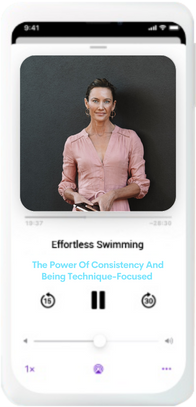
My guest today is Bronwen Stacey who attended one of our freestyle clinics a few years ago. We will talk about the progress she has made since doing the clinic. Tune in to the episode now!
00:55 Three Sessions A Week
01:54 What Is A Towel Session?
03:30 Bronze Medallion Course
05:23 Noosa Triathlon
07:34 Thoughts On Core Shorts
09:09 Learning Something New Is A Struggle But…
10:42 Key Takeouts From Swim Clinic
14:15 Follow-Up Filming And Analysis
15:08 There’s Always Something To Learn And Improve
16:05 Front Quadrant Timing
17:54 Stay Relaxed To Get Faster
19:03 Wearing Form Goggles
20:40 What I Love About Swimming
21:27 Swimming In The Ocean During Covid
22:13 Consistency And Technique
23:51 Have A Good Coach
Change your technique and swim smoother, easier freestyle in the Effortless Swimming membership:
https://effortlessswimming.com/training-and-membership-plans/
View our freestyle clinic schedule around Australia:
https://effortlessswimming.com/freestyle-stroke-correction-clinics/
Form Goggles:
http://formswim.com/effortless
Watch the episode on YouTube:
Transcript
Read the full transcript
Welcome to the Effortless Swimming podcast to show that help swimmers and triathletes love the water, become a better swimmer and live a better life. Here’s your host, Brenton Ford.
Welcome to the Effortless Swimming podcast. My guest today is Bronwyn Stacey, who is based up in Nusa up there in Queensland. And Bronwyn, we sort of met each other about two years ago now when you came to a clinic originally, then you came to one of our follow up filming sessions after that. And I was speaking to your husband, Paul, a couple of months ago now, and he said that you’d really progressed since doing that clinic. And I thought, I’ll be great to just catch up and see what you’ve done over that time to get some really good improvements in your swimming, because I love featuring people who I’ve managed to work with. And I don’t get to hear often how people go after a clinic. If I don’t, you know, see them that regularly. So I thought it’d be great to get you on. So first of all, welcome to the podcast. Thank you. Thanks, Brenton. Good to be here. So you train up up there in Nusa with Nick Croft in his
squad there. And in the email that you sent to me, you’ve been doing really consistently over the last two years with your swimming like three times a week nearly every week. Is that right? Yeah, I mean, I generally it was initially two times a week. Nick really reinforced that three times was going to make the difference for me. So yeah, so I’ve been trying to squeeze in a third around family and work time where I can. But I’ve been pretty good at getting in that third session. And I think that’s that’s really helped, to be honest. My sessions tend to be a mix of a normal, normal swim squad of three point, probably three point five, three point eight case in each session. And we throw in a towel squad once a week. And then there’s a shorter squad as well, which is just a one hour session. So probably doing about nine and a half to ten case swimming a week, which is really good. Like it’s a good amount of distance.
I think and explain what a towel session is. People will have heard that and gone, what’s it? What’s a towel session? I know I asked that question the first time that I heard of it. I don’t know if it’s something that Nick just made up. I’m because people, a lot of people get confused by that. But it really what it involves is is the main set involves putting a towel with a small towel with probably about 30 centimetres long of different weights, depending on how strong you are. But there’s a band that links it, you know, attaches it to your ankles. You need a pull boy, a pull boy in, in as well to be able to swim like that. And it basically stops your legs from moving and it drags them down. So it’s a real strength session for your arms. Well, that’s the way I see it anyway.
So often in our main set for a towel session, we will do at least half the set with towels on. Yeah, big strength session, because I mean, even a small like a small foam, like we sometimes do, yeah, just like some with some foam out behind us or sponges, and it means the same thing as a sponge is just creating that drag. And it doesn’t take much to really feel it in your arms. Oh, it’s just the lightest talc. And really, I find it a really good challenge. Let’s just say that. Yeah, but it definitely gets me strong. And that’s probably something I’ve needed to work on. Particularly as well. I don’t have a lot of upper body strength, so it’s really helped with that. Take me back to the three years ago. So when you your first sort of took up swimming or maybe got back into it, I’m not sure, but you originally sort of got into it for your bronze medallion. Is that correct? No, well, sort of. I was I’ve never really been a swimmer.
I think maybe in primary school, I was doing some squads and then I lost complete interest in it and avoided it ever since then.
I think 2018 at the start of the year, friends of mine said, look, we’re going to put a team in for the Noosa try. You can do the swim. I said, I actually don’t think you understand. I can’t I’m not a swimmer. They said, oh, we’ll just train and we’ll just, you know, let’s just see how we go. So that was really the start for me for swimming. And I was I needed fins to the whole for the whole set to really even complete it. And at that point, I was swimming probably to 20 per 100. Nick, Nick tells me. So, you know, so that so it was it was tough going for me at the start. And Nick was really hard on me to, you know, in saying, you’ve got to you’ve got to be consistent with this if you want to get better.
So throughout that time, I thought, oh, well, I’ll get better. And then I’ll do my bronze certificate. Why not? I must be getting good at this. And I barely I actually didn’t quite make the cut off of initially when I went first went and did the proficiency, which is 400 metres in nine minutes. Is that right? Yeah, yeah. I think I was like nine and a half, 10. So I didn’t manage within the six weeks of the bronze course. By the end of it, I shaved, you know, I shaved the time off to get that four hundred swim in about eight forty five or eight fifty. So just enough to get me through, which was good. And and and then I just continued on training for the for the Noosa try throughout that year.
That first year was hard. I it was it was a really tough swim and the conditions were not good for that twenty eighteen trial. A lot of people might remember it was like northerlies. It was and if you’re not a confident swimmer, it was awful, absolutely awful. But I did it. I breast-striked the whole mainly the whole way
and and did it in thirty seven minutes or something. So that’s when I thought, right, it’s probably a good idea to get onto one of your courses and get some technique going, which was in twenty twenty, I think. Was that twenty twenty or twenty nine? Yeah, maybe it’s twenty twenty. I think it was January or February twenty twenty twenty just before. Yeah, all the lockdowns and stuff. I like their look back at the date. So yeah, sorry, continue. So well, then I had a year of of training
of training a bit more consistently again and then working on that twenty nineteen. I did the first try, the Noosa try as a full try by myself. So I managed to get that swim in and do freestyle this time the whole way. Probably in about thirty two minutes or something, I think it was. Yeah, so there was a big improvement there for me from that point. And I am and and and then subsequent to that, it probably wasn’t too long after that that I did your course. Yeah, yeah, nice. And I mean, just like a spoiler alert for people. So in terms of where you’re at now, you sort of mentioned you’re pretty consistently in the low one thirties. If you’re doing repeat hundreds in training and your your four hundred time trials down to was it six six something? Six forty was my last one last September. Last sorry, September, October. Yeah, I do have to caveat all of this, though, that I do wear the core shorts for pretty much everything except racing.
So, you know, you’ve got to probably add on a little bit of time to that, if you were to take those shorts, drag those shorts off me. Yeah, and look, I mean, I was talking to someone about this the other day and I get asked fairly regularly, like, what are your thoughts on the core shorts? And the purest, the purest swim coach would say, take them off, you know, it’s like it’s not it’s not a sort of normal swimming and you’ll be able to teach yourself better body position and stuff without them. But I’d say for most people like yourself, wear them there. It’s a lot more fun. It’s like you got a pool boy in all the time and times are faster. And yeah, it’s like go for it. You know, I think, yeah, my answer would have been different 15 years ago when I started not 15, 13 years ago when I started coaching. But yeah, now sort of having worked with so many triathletes and and adults just like go for it. It’s a lot more fun.
I love that advice. I’m going to tell Nick that I think they they get me. They get me to squad without them. I probably wouldn’t be doing the amount that I do in each week. So it’s a mental thing for me. That’s the thing, isn’t it? Like you’ll be you’ll be so much better off as a swimmer because you’re looking forward to squad because, yeah, because of what they’re doing for us. Yeah, that’s it. Absolutely. Without a doubt. Yeah. So looking back at so when you had to do breaststroke for that that first news to swim where you’re at now, like, how do you can? You kind of did you ever think that you’d get to this point now where you’re doing it so often? Yeah, it sounds like you’re enjoying it. And that you’re swimming at the pace that you’re at now.
But then if you’d have told me that I would be doing that now, no, I wouldn’t have believed it. I found it hard and it was a real struggle to get, you know, initially for me to get to the pool. Because, you know, at the beginning, it’s really hard work when you’re trying to get on top of something new. And, you know, my arms weren’t working, probably my legs. It wasn’t all it wasn’t coming together whatsoever. And but, you know, there’s a lot of reward in sticking with something, whatever that may be. In this case, it’s the swimming and just plugging away. And I think the swimming results are immediately, you know, get those results really quickly. It’s what I’ve learned is that it just takes a lot of time. And and you probably, you know, I don’t even notice improvements really unless Nick yells out my times and they’re a bit lower than what I, you know, what I’m used to. So it still feels a challenge, but it’s an easier challenge.
And I feel much more comfortable in the water. I think your, you know, your course was great because it gave me a lot to focus, you know, just those three or four things to focus on and get right. And make, you know, and make it not feel as hard in the water as it did. Yeah. So was it, can you remember if there are any takeaways or things that you that you’re able to take on board after the clinic that you perhaps didn’t know going into it?
You know, there were a lot of, you know, that I still reflect back on the the YMCA drills often and where my arms should be. I still have a bit of work to do on that. I think that was that was a really, you know, that was a really good process that we followed through that course. I think you were talking to me about having that front quadrant, my arms in the front quadrant. That’s something I still have to keep, keep working on. But I’m better at it, I think. Yeah, those are some of the key takeouts that I saw. Yeah, that’s that’s good. And thinking back to like what you were doing with your arms before, did you have not like not have much of an idea of where they should be in the different parts of the stroke? And it’s just gave you some guidance on where the hands and the arms should be should be going? Absolutely. All of those things, like even just, you know, those angles of where your hands should be entering the water, what,
yeah, what position they should be that, you know, 11 and 1 and 10 and 2 and kind of kind of location and where they how they should be moving through the water once once you you know, once you get to the catch and and follow through. No, I had no idea. You know, no one really teaches you those things as an adult. Yeah, you know, you go to squad and you just have to, you know, you just do what you think is right. And there’s not always the time to focus on technique. Yeah. Oh, exactly. And I look back at when I was coaching squad for eight or nine years. It’s like I try and teach a little bit of technique here and there. But oftentimes people just I was coaching a master’s squad and they just want to get there, have a good workout and and and go home. Like it some someone certainly wanted to improve and wanted to focus on technique. But often at those sessions, they just wanted the workout. And so yeah. And so I mean, that’s why I run the clinics and focus just on technique
and it’s three and a half hours of six people. So and it kind of takes that long to cover everything. And like we could certainly cover a lot more. But yeah, your brain can only taking so much at one time. Yeah, yeah. Yeah. And I think, you know, it was really good to have those three takeouts that you that you get in and we focus on those. And then I think I checked back in with you a year later when you were up here to make sure that I was sort of on track. This podcast is brought to you by Form Goggles. Form empowers swimmers at every level to reach their goals, whether they want to get stronger, faster, swim further or be more efficient. Get lap by lap motivation with real time metrics and workout instructions right in your goggles. And forms recently released form plans, which included progressive series of workouts to help you achieve your fitness skills or triathlon goals. You can follow along with the plan
and your weekly swims will be automatically synced to your goggles. So you’ll swim through your workouts with real time metrics and workout instructions all in your goggles. So it’s like having a coach right there with you. And I’ve had to look through these training plans and I think they are excellent for people who want to train for certain triathlons or reach certain fitness goals. It will build on each week and a really good way to progress, progressively build up your fitness. So if you’d like to follow along with some plans to help you reach your specific swimming goals, then check out form goggles at formswim.com forward slash effortless. And this will give you $15 off your purchase of form goggles. So formswim.com forward slash effortless to get your pair of form goggles. Yeah. And it’s was I mean, we did so we did the follow up filming. And for those listening, when you do a clinic, you can come and get filmed again
and I’ll compare it to your previous video and just see what’s changed. Let me look at what to what to work on there. And I mean, everyone’s different with that. Some people have made big changes. Some people have changed a little bit. And and I think it’s just good to sort of see just to have that check up again. I’m like, I’m trying to make these changes. Am I doing it enough? And if people haven’t quite got to that ideal position, it’s often because they’ve just changed things a little bit and they need to really exaggerate it. And I was in Perth in the weekend on the weekend for clinics and like so many people realise when they come to clinics, if they if they have to make a change, sometimes it’s got to feel so extreme and so like just awkward or different for it to actually make a make a difference. Did you sort of find that with anything in your stroke? Absolutely, you know, I I was chatting to Nick before this podcast
just to say, you know, what what what are his observations? And he said that front quadrant, you know, I still need to work on that. So I was really trying hard yesterday at squad. And I said, it feels so uncomfortable. I I just and he said, it’s just going to take time, you know, time to get that right. So, you know, there’s always something that’s something to keep working on. Yeah, it never ends. That’s right. You have to have that mentality that it’s OK, you know, there’s always a little bit more and and you will never get that. You know, it’s it’s difficult to get that perfect stroke. You know, I think that’s what what keeps it interesting, too. You know, if you come to a clinic and you’re swimming, I’d be great if you’re swimming like Michael Phelps after a clinic. But, you know, it’s always having something that you can improve. And so in terms of the front quadrant at the moment, is it that the lead arm out in front is just dropping down a bit a bit soon?
Yeah. So so I just I know I need to work on that because it affects buoyancy and affects in streamlining and probably efficiency, perhaps as well, because I think I’m compensating by, you know, trying to move my arms a bit quicker through. And that’s probably not efficient. Yeah. Yeah. This is I was working with this from a few weeks ago. And one of the ways that we’re able to get her in that front quadrant and get the timing, there was two things. So the first one was we had to watch a video of a swimmer that she wanted to swim like and had a might like try and just model that stroke. And I think it’s really good to be able to visualize yourself swimming like someone else because it’s much easier. Well, it’s just easier to kind of replicate it that way if you’re sort of watching watching someone swim. And the other way was like we use the term soft hands. So it’s it’s good to have a little bit of a gap,
slight gap between the fingers and just relax the hands and forearms because I find in the recovery. So over the top of the water, if if you’re relaxed there and you’ve got soft hands and you follow that through to the reach and out in front, it’s much easier to keep it out there. Sometimes people are quite tense and beyond just wants to keep going if it’s tense. So I find like, yeah, that soft hands can work quite well for that front quadrant timing. Yeah. Yeah. I have to work on it. I mean, I think I I do struggle sometimes with in a squad situation that we’re doing made sense and we’ve got to move and we’ve got to, you know, we’ve got to really push it. There’s a sense of panic that rises in me that I think, oh, I’ve just got to keep, you know, work as hard as I can. Whereas I don’t I probably need to relax to get faster. Which is probably what you’re saying. Yeah, it’s always it’s always part of the challenge, isn’t it?
To try and stay relaxed as you’re trying to get get faster. I had a had a client email me two two weeks ago and she had a half Ironman swim maybe three weeks ago. And she just wanted to she just wanted to basically make it feel really comfortable. And so she relaxed completely, wasn’t worried about the time and she ended up swimming like 10 or 15 seconds faster than her previous time because she was so relaxed. And I think now it’s just a matter of all right. So if we can now just put in a little bit more effort while still keeping that same sort of feeling, it’s like that’ll be the sweet spot. But it’s it’s great if you can swim a PB when you’re not thinking about time. Right, that’s perfect. I will aim for that nice to get to. Yeah, that’s I mean, it’s not going to be the case for everyone, but I think it’s yeah, it’s it’s a good thing to to keep in mind because I know like for me as well when I’m forgot someone next to me,
I’m trying to race them. It’s so easy just to try and like want to match them at the start and my heart rate goes up too high. Or yeah, when I used to wear a garment watch, I’d just be trying to beat the time. Yes, there’s there’s a bit of that going on as well. Yeah, it’s then I now I’ll occasionally wear the form goggles and I find that I’m better that way because then I’m making sure I’m not going out too hard because you’ll get your 25 or your 50 split and I can make sure I’m actually going at the right pace rather than a second or two, two quick in that first one. And then I’ll blow up. So yeah, it’s a little bit different when I can see it. My husband, Paul bought me a pair of those and I’ve got to get the hang of them. So it’s just a reminder. He keeps asking me if I’m wearing them and I will. And now now you’ve said that I will definitely make sure I do. So if you feel a difference in between like the pressure of trying to get a good time by looking at your watch
at the end compared to just knowing where you’re at in terms of the splits. Yeah, that’s the biggest difference for yeah, for me, I’ve found with that. I will. I will. Yeah, because I just don’t know. And so if I have to lead it as a main set, I will think, shit, I’ve got to I’m killing my dad. And my pacing goes all out the window because I’m trying not to hold anyone back from, you know, behind who’s behind me and and get to the right pace. So it’s yeah, that the goggles will help. The pressure is real, isn’t it? When you’ve got people on your feet. I hate it. That’s why I like being lost. I’ve, you know, I think everyone teases me because I just pushed to be at the back of the lane always for that reason. And what’s I’m thinking of, yeah, like, yeah, you’re swimming, what is it that you really enjoy about it now? What do you get a kick out of? Oh, you know, what is it? It’s the I mean, I love that as a form of fitness now, really.
I enjoy it. I feel comfortable doing it. I find I’ve, you know, had a good work out at the end of the session.
You know, and the people that are going as well, you know, we’ve formed some good friendships with the people who have who are part of the squad. So there’s that outside swimming element that I enjoy about it as well. Yeah. Yeah. And like it’s a lot of change with with Nick a couple of times when I’m up there and it’s it’s a lot of fun. It’s a great group of people, Nick’s awesome. And it’s just, yeah, it’s just a really good group to be a part of. And I mean, the fact you get to do it up in Noosa as well is is a bonus. Yeah, you know, it was funny. We were just talking about COVID before this podcast. And, you know, when COVID hit up here, the pool shot as they did around everywhere is you were talking about. But, you know, we quickly realigned and and we were running, you know, squads in the ocean. We got to, you know, we got to, you know, spend COVID swimming in the ocean up here, which was pretty amazing.
You know, so it’s a, you know, it was a great it’s a great testament to Nick and how he runs, you know, how he was able to change his oh, change his approach. Sorry. But also that we could still do, you know, we could still swim. Yeah. Time that challenging time. And there’s not many better places than Noosa, I think, for for open water. Swimming. It’s perfect up there. Living the dream. Yeah, absolutely. Well, Ronan, I appreciate you being on the on the podcast. It’s really enjoyed chatting and just great to hear how far you’ve come with your swimming and looking from the from the outside. I think it seems like a combination of the consistency. You just cannot put anything past the consistency and and doing the right thing in training and hopefully a combination of technique and and focusing on that along the way like those two things are a huge part of it’s like 80 or 90 percent of I think what what makes people improve and you’ve sort of hit those two on the head,
which is which is unreal. Yeah, I think there’s, you know, I mean, just back to that consistency. There’s always conflicting and challenging challenges to your time, you know, to your available time. But if you can make that time and work around family or work or those other other things going on, it is it is worth it. You know, you see the results, but it takes a while to do to get there. Yeah, absolutely. And I mean, I think of the good thing about swimming is you can often do it in the mornings and which so you can kind of set your day up really well. And when I’m busy, if I can squeeze that swimming in the morning, yeah, I get more done and, you know, better person to be around and all that sort of stuff, too. Yeah, absolutely. Yeah, yeah, there’s something special about being in the water. I think for sure. Yeah, totally agree. And before we go, any any sort of final final thoughts or anything you’d like to leave the audience with if if they’re listening
and would like to see the same sort of improvements that you’ve had? No, I think you’ve I think you’ve summarised it. I think, you know, that consistency, the focus on technique and and really thinking about technique, but also probably having a really good coach to support that technique and drive you as well. If you’re not necessarily self as self motivated or will need some help because, you know, kudos to Nick in pushing me to to keep going as well. It is driven by partly by myself, but he also makes sure if I if I don’t show up to something, then, you know, I he’s on my back. And, you know, I think that is another important part of the equation. Yeah, absolutely. To and then to have someone who like I think back to when like I grew up swimming with my dad as my coach. And so I was always going to training, unless I was was sick or something. So there was there was no question whether I’d be there or not
because he was going to have to be there coaching. Yeah, that’s right. But but after that, it’s like the other squads I’ve done. It’s the coaches who have it like jokingly kind of got stuck into me about, you know, where have you been the last week or two? And it’s like, yeah, OK, fair enough. I should be should be more consistent. Like it’s it’s a good thing when people are accountable, even if they are, yeah, giving you giving you a little bit of a time in a good way, it’s it’s the right thing. Yeah, that’s right. It can be a pain in the ass sometimes. But you get results and he gets, you know, I I know I can’t get away with anything. Yeah, it’s it’s good. Bronwyn, thanks so much for being on the podcast. And I’m sure I’ll see you sometime in the next couple of months when I’m up the next session and thanks for your time. My pleasure. Thanks, Bronwyn. All right. Thanks for listening to the effortless swimming podcast. If you’d like us to help you become a faster,
more efficient swimmer, go to www.effortlesswimming.com.