







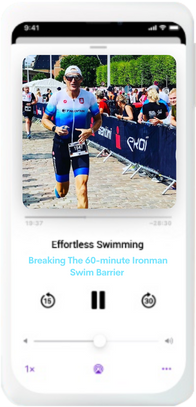
My guest today is Oke Büll. He’s a triathlete located in Germany and recently had some great success in Ironman Copenhagen. We will talk about how he was able to improve his swimming. Tune in to this episode now!
01:00 Getting Started In Triathlon
02:39 Swimming Background
05:15 Ironman Swim Distance
06:43 Breaking Down The Stroke
09:15 Relaxed Swimming
10:15 Changes In Speed
11:37 Quality VS Quantity
13:30 Training Sessions
15:21 Open Water Training
19:40 YMCA Drill
22:51 Maintain Consistency In Training
25:26 Relax And Focus On Your Technique
26:33 Have A Weekly Plan
27:26 Having Patience Is Very Important
Follow Oke on Instagram!
5 Day Catch Challenge:
https://effortlessswimming.com/5-day-catch-challenge/
Change your technique and swim smoother, easier freestyle in the Effortless Swimming membership:
https://effortlessswimming.com/training-and-membership-plans/
View our freestyle clinic schedule around Australia:
https://effortlessswimming.com/freestyle-stroke-correction-clinics/
Form Googles:
http://formswim.com/effortless
Watch the episode on Youtube:
Transcript
Read the full transcript
Welcome to the Effortless Swimming Podcast to show that help swimmers and triathletes love the water, become a better swimmer and live a better life. Here’s your host, Brenton Ford.
Welcome to the Effortless Swimming Podcast. My guest today is Oki Bill. He’s a triathlete located in Germany. And you recently had some good success in Iron Man Copenhagen. Had a great swim. Nearly cracked the 60 minute mark, which is a very high level benchmark, I think for a lot of people. You about 30 seconds off it, but regardless of really good swim and saw some improvements over the last couple of months, using some of the things that we teach. So I wanted to get you on the podcast to talk about what you changed, what you worked on, and and how it how you’re able to improve your swim. And to be able to share that with the audience. So welcome to the podcast.
Thanks, Brent. Nice for having me.
You’re you’ve been doing triathlon for about 10 years, you said, but you didn’t really have a background in in triathlon as a junior. What made you start doing triathlons 10 years ago? Well, actually, really, a colleague talked me into it was, I mean, I was doing every kind of different stuff, all of whole lifelong, I started swimming as a junior, not on a high level, but I just did it. And then I played some other things that I thought I should go into surfing and wind surfing, which wasn’t such a really good idea. Like, I’m a really tall guy, like, 193 high, I didn’t really move like, like he used to move on a surfboard. So that was when I was a student. And yeah, then I did some running and stuff like that. And then a colleague came up and said, let’s start with an Olympic triathlon. I said, Okay, let’s give it a go. And I didn’t really know if I can make it was just like, I mean, I was feeling quite fit and was able to run 10, 15 case. But the combination
of three sports in one, I didn’t know I would make it. And so yeah, I tried to train a little bit for that. And then we towed the line. And I was completely blown away because it was so great. And then I looked around in my area for a triathlon club to join some structured training. Yeah, I’ve never looked over my shoulder. And what was your experience before starting triathlon? Did you learn to swim as a child? Yeah, yeah, I started swimming like I was, I think, four years old, four or five years about that. And I was born race in a small village. So there wasn’t much around like you can buy soccer, you can play handball. And you had this swimming club. And yeah, then I joined the swimming club as a child. And yeah, we it wasn’t like high level swimming, we didn’t go to really big races. But we did go to smaller ones. And that was really fun with going with a group of swimming and a competition. Yeah, and I did that for about
till I was about 12 13 years old. And then I popped out, which is a shame from my nowadays point of view. But yeah, that was basically my swimming background. So I learned all kind of swimming. And it was always normal for me to go for swim.
And 10 years ago, where would you say your swimming was at what level were you at when you first started doing triathlons? And was it something that came easily for you? Or was it something that felt a little bit like hard work in the beginning, until you started to get into it and do it more regularly?
Yeah, I think it was on an average level. And when you’re talking about triathletes, like, it was never a problem for me. It was just like, Well, let’s go for a swim. And what I thought about swimming 1500 meters in the Olympic triathlon was more like, Yeah, you should practice a little bit longest in swimming, but it wasn’t was nothing to worry about. So a lot of other triathletes, especially the late starters like me, they would they try and learn how to swim. They got pretty stressed like, like, Oh, my God, I have to swim such a long, that was not a problem for me. And so it really came kind of easily, like, I wasn’t really fast, but it was not a problem.
So the distance was okay, but speed was the thing that you wanted to improve on. And when you first came across our coaching, where were you at with your swimming, which was about 12 months ago, which you mentioned prior to the call? Yeah, yeah, it was when over the years of doing doing triathlon, the distances grew longer, longer, pretty fast. Like I was interested in the half distance Ironman. I was interested in the Ironman swimming Ironman distance. I started that about five years ago. So when the distances got longer, I and I tried to hit the water like, like I did before, like two to three times a week, I kind of leveled out with my with my speed. And I tried, I worked with a different coach then. And I tried to swim a lot. I tried to swim different kind of training focuses. And nothing really happened. What’s just like I came out of water like in an Olympic, like 25 minutes or about 30, 32 minutes and a half Ironman. And it
doesn’t really matter if I was heading in water more often or not. So I was kind of, yeah, I was, I tried to figure out what is holding me back for getting faster. And then I found your on the Instagram, I found your effortless swimming. And I was just like, Whoa, what’s maybe that would work. And so I tried it with a catch challenge. Yeah, and worked out perfectly.
Was there anything in particular that you changed or you felt made the difference?
I think for me, it was breaking down the stroke in all these different parts really helped me understanding what I have to do for catching water or getting a better technique and not trying to work swimming, so to speak. Yeah, so breaking it down into the components, because it’s, I find a lot of people will say swimming is this continuous movement, which it is, but there’s different phases to it. And if you can slow it, if you can enter in the right way with your fingertips first, and a lot of people who have done the course have said just that first thing where you if you enter correctly, and then you reach out in front of your shoulder, if you do that right for a lot of people that get through the bubbles, and it gives them that little bit of time to then reach forwards and set up the catch. Whereas people who are newer to the sport, they tend to rush that part. And when you feel like you’ve got time out the front, you feel
like you’ve got time to rest a little bit as you go on your left side and your right side. And I think that’s a can feel like a real breakthrough moment for a lot of people, if they’re just used to that continuous windmill type movement. So that’s yeah, that’s one of the one of the key things I think that can really make that switch for a lot of people. Yeah, exactly. That was what was what I was feeling as well. It was just like you got into a smoother movement. It felt so much easier. And you really got into this where you can should apply your pressure and not just trying to rush through the water. Like you said, that really makes such a difference that that got me so so much. Yeah, I felt like getting lighter in water getting higher up in the water. And yeah, that felt so good. And I wasn’t I was really stressed some a lot of times when I hit the water like like, I got problems breathing, not on a short distance. But just like I said, it was so much
energy I was using I was wasting. And that completely changed when I relaxed with this new stroke and the knowledge what I should what my hand should do what my where should I set up my catch? That was just, yeah, just awesome. Yeah, it’s when you can get to that point where you feel like you have lots of time where your hands and your arms are relaxed in the recovery phase and in the reach phase, then the heart rate comes down a lot, whereas people tend to hold a lot of tension through their shoulders and through their chest and hands and then they never feel good and they’re never able to relax. And it’s one of those. I mean, pretty much every sport you want to do you want to be relaxed as you do it because of the water component where not everyone feels comfortable. I think with your background, you obviously felt comfortable, but a lot of people don’t have that comfort because they might have a little bit of fear of water. It’s
unnatural. Then they tend to hold this tension, even if they don’t know it. And if they can get to that point where they can just relax and only enough tension to hold the right shapes and technique, then they get to this next level where they can really see a good improvement. And it comes with time, comes with practice, but also just knowing what to do as well. And what changed your speed? Did you see over those couple of months?
Well, yeah, as I said, I have the I did two races this year like one half Ironman one Ironman. And if I compare these both distances with the last years, I came down from, let’s say, half distance for half distance race like from 31 minutes to 29. So an improvement of two over two minutes and half distance race. And I came down from my last Ironman distance was in swim was in 2019. Like from one hour, two minutes to, yeah, just about one hour. So on two minutes improvement as well. And so I think it’s about five to 10 seconds on 100 k, depending on the distance. And that having said that, with not so much swimming like before, like, I didn’t manage to hit the water as often as I would like to in the last couple of months, but made the improvement time wise. Anyway, so that was just like I was completely blown away with that. Yeah, that’s awesome. And one of the things you mentioned prior to the call was that you focused a lot more on quality over
quantity this year. And you’ve seen that have a positive effect on your results. Can you talk a bit about that? Yeah, I mean, as I’m pretty time staffed, like I was I’m working full time as an user test, I got three kids. So family business is running and work needs to be done. And so and so if you wanted to put in all this training for long distance, prior long, you have to focus what to do when when you’re going to train, what you are really about to do, like I try to understand what I what is in every single training, what is the focus I have to be on. And so I see that not just putting in junk miles, each discipline, but focusing on the quality of the training you you want to do really helps me out. And it doesn’t really matter if you’re doing not so much hours like like other athletes might do, but you make improvement anyway, if you focus on this quality, especially in swimming, as swimming is so so technical for me, it helps me really just
to know when I get my my my technique really next to the next level. And when I focus on this stroke technique, I make improvement, although I won’t have that much mileage in at the end of the season, or comes race day. So yeah, that’s why this thing is really good to focus on on on the quality and not just getting out. And yeah, just for the for the reason to to getting out. And what did that look like with your swim sessions? In what would you what would a standard session look like in terms of time wise and distance? And what kind of training were you doing most of the time? Yeah, um, I live at the Baltic Sea. So only a few kilometers away from beach. So here around you can swim like from May to September end of September, depending on and so I tried to during summertime, I tried to to swim just open water, just going doing long, long distance swimming, like usually 45 minutes to one hour, the normal length of my my
sessions. And during wintertime, when you can’t really do open water swimming here, I hit the pool, and I tried to normal session would be like about an hour, we have some with our triathlon club, we have some pool times in the next city near near where I live in Kiel. And so it’s usually about an hour. And I’m trying to get in another at slightly longer session on the weekend, like about 90 minutes. And distance wise, I would say it’s usually about three K, like maybe when you’re doing when you’re in the pool, and you’re doing some technique tech training, it’s all it’s about two or two and a half K. And if you’re doing more the more distance swimming, maybe it’s about three and a half. Yeah, that’s my you my my normal sessions. And I think it sounds like the open water training makes made a big difference for you as well, because it’s one of the most common things that I’ll hear from people is transferring
their pool times across the open water, they find is a challenge. And if you are getting in the open water regularly, you develop this open water rhythm and style that carries on to your racing. And it’s something that I don’t think enough people do is open water swimming, especially leading up to a race, if you’re only getting in twice, two or three times before the before a race in the open water, it’s probably not enough to get comfortable and to get comfortable wearing a wetsuit. So if you can get in a lot more times in the lead up to it, I think it just it gives you that that feeling and that awareness of how you’re going to have to change your stroke to be able to feel comfortable in the racing and keep your speed up because it can be a very different sort of style. And did you have to change your stroke for the open water? Is it something that you’re aware of from your pool stroke to your open water stroke? This
podcast is brought to you by form goggles, form and powers swimmers at every level to reach their goals, whether they want to get stronger, faster, swim further, or be more efficient. Get lap by lap motivation with real time metrics and workout instructions right in your goggles and forms recently released form plans, which included progressive series of workouts to help you achieve your fitness skills or triathlon goals. You can follow along with the plan and your weekly swims will be automatically synced to your goggles. So you’ll swim through your workouts with real time metrics and workout instructions all in your goggles. So it’s like having a coach right there with you. And I’ve had a look through these training plans. And I think they are excellent for people who want to train for certain triathlons or reach certain fitness goals. It will build on each week and a really good way to progress progressively build up your fitness. So if you’d like to
follow along with some plans to help you reach your specific swimming goals, then check out form goggles at formswim.com forward slash effortless. And this will give you $15 off your purchase of form goggles. So formswim.com forward slash effortless to get your pair of form goggles. Yeah, yeah, definitely. Definitely. At least slightly as you didn’t find any, I mean, yeah, you can find perfect conditions in the open water as well. But you have to take it as it is. And the sighting of boys, the waves, wind, sun, when you’re breathing bilaterally, when you’re not able to breathe bilaterally, that can really mess up your whole race racing. When you when the sun come up, and you just can’t see anything and stuff like that. That really changes your swimming. And of course, your stroke is getting getting a little different from the pool where you just can glide right away. And the currents is another big thing. It’s not really it’s just
small parts coming together, which influence your stroke definitely. And putting up the hat every five, six strokes to see where you are, and not having any line on the bottom of your pool, which you can follow and finding out if you’re swimming straight, or just zigzagging through the waters, all these stuff, you really need to practice. And you should practice a lot of times because it’s when you’re feeling, as you said, when you’re feeling comfortable, and you don’t really think about doing that.
How did you go about keeping the stroke changes that you felt helped you with the catch challenge? How did you go about keeping those changes and carrying them into the open water? Because I was like you mentioned, it’s you’re probably going to have to start to catch a little bit sooner. You might not be as long with each stroke that you take. So when you have that shorter stroke, did you find you were still able to keep some of those elements that you learned in the catch challenge into the open water? Yeah, yeah, you can I could definitely keep that was what was one of my key sessions was the YMCA drill, like the thinking about what your hand is doing or what your arms are doing during the catch phase and during the stroke later. Coming back to that, when you’re swimming in open water was really helpful for me just rethinking where you should apply the pressure and where shouldn’t you apply the pressure what what
happens when you’re entering the water and after that, even if the stroke is shorter. That really made a difference for me and always the staying relaxed staying having your shoulders relaxed and that was another kind of mantra which was in my head when I was swimming in open water, just always this stay relaxed and because I can come back to that even when I’m a little bit exhausted or even if maybe the water is really choppy and you feel like you didn’t really get into a good rhythm. Coming back to that really helped me out like, okay, remember what it was what you was doing in the pool and what you should feel that really helped me. Yeah, that’s great to hear because with the YMCA drill, I think one of the biggest benefits for people is that you have lots of times about to get those positions correctly. And the main thing is for most people having the arms bent in your high elbow catch and in your power diamond. If you’ve got
that bent elbow position, you’re going to be so much stronger. Like if you’re up against if you’re in the pool and you’re up against the wall and you were trying to get yourself out of the pool, you’re not going to do it with straight arms. There’s not it’s not effective that way. So just having the elbows a bit bent through the second and third position in that YMCA drill carries in really well to your stroke because most people that I work with initially, they’re just too straight with their arms through the catch in the pool and they press straight down and they just don’t get much purchase or hold of the water big as a result of that. So a simple drill like YMCA drill can just make sure you’ve got those important parts of your catch in your pool. And when you’re in the open water, your body position is normally good because of salt water and you’ve often got the wetsuit on. And so really, if you can have a good catch and pull, hold
a decent stroke rate with the right amount of rotation, that’s going to take care of a lot of the things that are going to move you forward. So you can keep it pretty simple when it comes to open water that way.
Yeah, that’s true that that perfectly describes me like like applying pressure with the two straight arm and not going anywhere with that, but it’s getting exhausted.
Yeah, yeah. And that’s and some people might know about that. But unless you’ve really sort of seen it describe in or seen it visually and then been given a way to be able to make that change, it’s very hard to know what to do or how to change it. So that’s why I really like that drill progression. What do you think what do you think you’re capable of in the next 12 months with your swimming? Do you see sub 60 being achievable and and beyond that?
Yeah, I mean, I hope so. Like when you just almost made it a sub 60, you definitely want to break that boundary. So, yeah, I think I should what I’m hoping to progress to is is to get more consistency in my sessions. Like as I said, I didn’t work out that good heading in the pool or hitting the water quite consistently. And I saw that the consistency in my training for the bike and for the running really made a difference with these two disciplines for me. So I hope I can take that to the swimming swimming as well. And yeah, I reckon that that that should be I should be would be able to go below 60 on the Ironman distance. And I hope I can do that
because I think that that is definitely possible for me.
And one thing we didn’t mention is you qualified for Kona. You got your Kona spotted Ironman Copenhagen. Is that for is that for next year 2023? Now, that’s yeah, that’s a pretty pretty big problem for me right now. Like I guess you had to go this year and I wasn’t really able to put up a travel plan and to get some accommodation. It was just ridiculously expensive right now. So I have to cancel that. Yeah, pretty shame. But on the other hand, I said, well,
it was such a perfect race for me and Copenhagen. The qualification was, yeah, a really surprise. I didn’t really know where I was standing in the performance wise. So when it turned out that that’s perfect for me and Copenhagen, I think I can do that in the next year. This again, so we decided not to go to Kona this year but try to work it out in the next couple of years. So yeah, it’s it won’t happen this year. Yeah, yeah, it’s great to get that qualification anyway. So yeah, great to hear how I mean, it was just over nine hours, wasn’t it the overall time? So you’re flying there in that 60 second, 60 second, 60 minute swim sets up really well. Anything that we haven’t covered so far that you think would that you’d pass on to another triathlete wanting to improve best swimming or their overall triathlon?
Yeah, maybe two things. One thing, especially about swimming is relax and focus on your technique. And the rest really literally follow like, like don’t be stressed out in the water if you want to hit certain numbers or certain times. And the other thing for the overall triathlon training, especially as an age group athlete, is just
identify your
capacity time wise and you’re making make it good to schedule for your training session to get the consistency. Never the one special session you need to do like you were you read about all the posts to or everybody is doing that never really changes anything. It’s just like the consistency in your training. Keep going, having your weekly plan where you can do what and stick to that plan, no matter what. That is really that that would really make a difference, especially in this in these longer distances. And so coming back to that, when you’re getting a little bit when you struggle, that is really what you should do.
I love it to two really important things there that they can make all the difference. You know, focus on the technique, relax and just follow the process. The times will come and then just that consistency over time is where I’ve seen so many people get those results and and just being willing to stick with it because there’s not many swimmers who will have this overnight change where it’s things have improved in one session. It often comes with several weeks or sometimes several months of practice and work and then things tend to click. So having that patience is is very important. So, OK, I think it’s great for you to be able to share your experience and how you’ve improved with with our listeners. So thanks very much for being on the podcast and can’t wait to to see you at Kona sometime in the future when it when it works out. Yeah, I hope so. And yeah, thanks again for having me and giving me the opportunity to talk to you on your podcast.
Thanks for listening to the Effortless Swimming podcast. If you’d like us to help you become a faster, more efficient swimmer, go to www.effortlesswimming.com.