







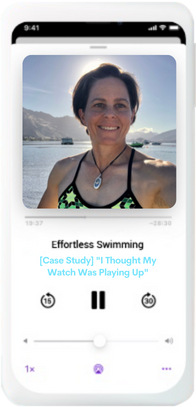
In today’s episode, my guest is Suzanne Nottage. We will talk about the progress in her swimming over the last couple of years. Tune in now!
00:57 Swimming Background
02:10 Joining Ironman
03:28 When Did You Start To Enjoy Swimming?
04:01 Hang Around With The Right People
07:22 5-Day Catch Challenge
10:19 Go Slow Before You Go Quicker
12:44 Two Important Takeaways
14:45 Doing Less VS Doing More
15:40 Timing Of The Kick And The Catch Together
17:33 One-Arm Freestyle Drill
19:02 Big Improvement
21:24 Training Sessions
23:48 Have A Much Better Feel For The Water
25:29 Started the 8-Week Faster Freestyle Course
26:50 Film Yourself
5 Day Catch Challenge:
https://effortlessswimming.com/5-day-catch-challenge/
8-Week Faster Freestyle Course:
https://effortlessswimming.com/8-week-faster-freestyle-course/
Change your technique and swim smoother, easier freestyle in the Effortless Swimming membership:
https://effortlessswimming.com/training-and-membership-plans/
View our freestyle clinic schedule around Australia:
https://effortlessswimming.com/freestyle-stroke-correction-clinics/
Watch the episode on YouTube:
Transcript
Read the full transcript
Welcome to the Effortless Swimming Podcast to show that help swimmers and triathletes love the water, become a better swimmer and live a better life. Here’s your host, Brenton Ford.
Welcome to the Effortless Swimming Podcast. My guest today is Suzanne Nodige. Welcome to the podcast, Suzanne. Hi, Brenton. Nice to join you. I love to get people on the podcast to talk about what they’ve done to improve their swimming because I think first of all, it gives people a bit of inspiration and hope that it’s possible for them. And it also, I find, really helps people find ways that they themselves can improve because we’re not alone. Everyone has similar kinds of issues and struggles with swimming. And I find stories like yours can be really helpful for other people, which is why I love to get people on like yourself. So just for those listening, what’s your background with swimming? How did you get started with it? I agree, lucky as a kid. So before even starting school, that my parents wanted my brother and I to be really comfortable around the water. So we got to that point where we’d probably
date ourselves or swim a length or that sort of thing, but never did any saw their swimming at school in terms of club or anything like that. And then in 2009, when I was in my mid-30s, I was on the internet one night, late, and just entered an Iron Man and then went, Oh no, I’ve got a cigarette, how to learn to swim in the next six months. How hard can it be? And so, yeah, back in 2009, when I actually kind of started figuring out swimming properly, it took two or three years to really like it. But one thing led to another and then I got into long distance swimming, so channel relay and a Gibral the swim and Gibral frosting and things like that. And yeah, since then, it’s just kind of been a variety of things. But yeah, never at the front of the back and eventually just wanting to get a bit better and understand that more about the technique and actually make it fun as well as getting faster. And how did you make that first Iron Man? Did you manage
to swim in six months? I would very luckily with the months to go, I still couldn’t swim the distance. And of course, open water is completely different. It’s like cross country versus, you know, the hundred meters on the track. So I was still scared of, you know, every time I handed a bit of weed or something like that, I thought it was a shark in the lake in England. So someone suggested that I go and get a few one to one lessons and improve my speed by 20% because I don’t think like rotation and stretching out and all those real even putting my swim cap on the wrong way and it was what I was doing. So it was the best place to put your swim cap on the right way around. So here, just the real basics and that improved my speed 20% in four weeks. And so my Iron Man time for the swim was about one hour 52, which now it’s 108. So yeah, 1.32 is certainly and certainly lots of room for improvement there. Yeah, absolutely. Well, that’s an amazing
achievement just to be able to figure out how to swim in in six months or swim that distance and then do the rest of the Iron Man, of course. So that’s really impressive. And then with the longer distance swims, you’ve obviously fallen in love with swimming at some stage where you’ve enjoyed enough to train for those events because they’re certainly not easy things to do. And you’ve got to put a lot of time in the water to actually complete those swims. So when did you start to really enjoy it? To be honest, it took about three seasons of open water swimming to really start to feel comfortable with open water swimming. I still couldn’t tumble turn then. That was a wonderful coach, Michelle, the forced me to learn to tumble turn after about another three years, which was well worth the investment. But yeah, it took about three years to actually get comfortable and actually go in our comfortable sighting. I’m
comfortable swimming through moderate ways and comfortable doing those longer distances. You know, once you get to a certain point, you kind of know, actually, I could swim for as long as I need to. So just to get that little bit more efficiency where you could just stay out there. So don’t if you swim counts and start to hang around the right people as well, who just kind of knew how to do it and pick up from them. Yeah, how to pick it’s about static level. And by hanging around the right people, were they giving you advice or were you watching them swim and visualising yourself swimming the same way or trying to copy them? Where did that all come from? Yeah, it’s probably a mix of things. So I had a few different coaches and have really appreciated they see things different. So each coach was good for a specific part of the journey, but kind of didn’t really take all the pieces that I needed. And then just
hanging around other swimmers. They’re sun swimmers who are likely, you know, either physically or say back around and there’s some swimmers who are really different to me. So either they’ve grown up basically as water babies, they’re more of that plastic open water built, which I’m not. And yeah, just seeing how they approached things and even just seeing things like I saw some video work about a swimmer who I really admire, who was doing a North Sea crossing. And I just realised after watching him, just how much he accelerated through the water, which I just wasn’t doing. So again, you know, there’s something here that’s clearly different. I need to look into how he’s doing it because I can’t do it the way that I’m doing. So what do I need to adjust to my technique so I can get acceleration through? So you’re just exposing myself to different situations and different people, I think really, really helped. Yeah, it’s so helpful.
Like, back when I was coaching a master’s club in Melbourne, Daniel Kowalski, who was an Australian swimmer, I don’t know, maybe 20, 20 years ago or so now, he would sometimes train after the squad that I coached would finish. And I’d often get in and occasionally I’d do a training session with him. And I’d be watching him out the corner of my goggle, out the corner of my eye, and just watching his stroke and head, he sat so high and he had a very quick turnover. And so I would try and copy him and swim with the same sort of stroke. And in case it would work, it’s sort of not my style of freestyle, but it was really interesting just to copy what he was doing and see how he would increase the pace and he was swimming some really quick times. And yeah, just it’s and the other thing that I noticed as well was there was Mac Horton and Greg Paltranieri training together at MSAC here in Melbourne for maybe a year or two. And
I saw them training together a couple times and it was it was amazing, two completely different strokes. Max got your classic long, very long stroke, low stroke count, holding something like 32 strokes per lap for his 1500s, I think. And whereas Paltranieri was something like 39 strokes per lap, maybe even a little bit more. So very fast turnover and quicker strokes. And it’s just good to be able to see what works for different people and just to expose yourself to those different ways of swimming and they all work just depends on what suits you best. And for you, then after that, Suzanne, so you were obviously interested in technique and getting faster over those years that you were training for the longer swims. And then in the last, what is it, six or 12 months you had another round of improvement, I guess you’d say. What happened there and what did you change in your stroke or what did you learn? Yeah, I think like a lot of people
COVID disrupted my swimming. And so I ended up moving. So I lost a lot of contact with the club that I was swimming with, moved to a different area, discovered new pools, et cetera. And it was kind of a blessing and it was a lot of momentum and a lot of swimming. So I think I was out of pool probably for about 18 months. And so, you know, you’ve just lost that feel for the water, et cetera. So you’re starting to scratch. And I did get into a little bit of a rut as you do when you buy yourselves and you’ve got what you know, but you don’t have any fresh ideas, et cetera. So I started watching those videos, et cetera. And that’s where I’ve come across you before, but that’s where I started to follow you a bit more because I wasn’t enjoying my swimming again. It was very much going through the motions and just doing it to fitness. And so I just decided something had to change. And so in around April, I decided to sign up for the
side day catch challenge because I thought, you know, only 10 bucks. What’s the worst that can happen? And I was really blown away with how much value I got out of it. I did each day multiple times which a lot of people do. And thought, oh yeah, this could be amused for two weeks. And after four weeks, I was still getting a lot of value out of it. So I ended up doing kind of a two month boot camp on my swimming. So I was facing book plans at that time and amazing me up here on the North Shore to have always too many pools to count from. So, you know, every morning I was getting up before work and not doing loads of distance, but just it was it was that frequency, which to me is he is swimming all the tailpipe or something like the language to me because I didn’t do a lot of it at suppose those primary school years. So I do lose the feel for the water if I’m not in the pool frequently. And yeah, just for that that two month
I decided to swim as close to every day as possible. And I just really started to see improvements and that inspired me to keep going and then I see more improvements, et cetera, and and not just getting faster, but actually enjoying it. So that was a side benefit that I underestimated. And so yeah, the end of two months, which was the end of June. Yeah, I’d improved much more than much more than I thought and also gone on to the eight week program as well. Fantastic. And it’s such a good combination of the consistency that you’re swimming with and also having maybe one or two things to focus in on. And especially the catch because to me, that’s that’s the 20% of the stroke that can make 80% of the difference for most people. So it’s really worth getting good at it. And it can feel a little clunky at first when you’re trying to figure it out. But then the more you practice it with the right movements, it starts to become somewhat second
nature. How did it feel for you when you started to change things? Was it immediately like, yep, this feels better? Or was it a little bit like a giraffe walking? Yeah, I don’t think I’m a particularly fast learner. And so it was great that in the comments I had read that other people got a bit frustrated before they saw that that improvement. And I think, you know, sometimes we kind of know that when we’re doing change, there’s a bit of a bit where you go more slowly before you go quicker, but none of us want to believe it will happen once. So I mean, to be honest, from the first time I did the first drill, I did feel better. And I saw a small improvement, but it wasn’t even like, you know, five seconds that you talk about. And then I got quite frustrated. So it’s like why are all these other people getting improvements and I’m not. And then I got frustrated with my frustration and just decided to keep going. And then it’s
like, you know, I think, I think you sell you’ve written the comment just sometimes one day, just for you get that improvement. And so, yeah, like I remember the day when all of a sudden it’s, you call it effortless swimming. And for me, it’s like all of a sudden I’ve got a tailwind, like, you know, when you’re running, and you get a tailwind, it just, I don’t know, it feels like you’re on a matric carpet or you’re sliding or it’s just effortless. And you’re going faster. But how can it be faster and easier? But but it is. And so once once I got over that hull and started getting quicker, then, yeah, that just inspired me to keep going up and keep going to the pool while I had this two month window to just see how much I could achieve. So all that window was open. So have you been through all of the five days before and then eventually it clicked or was it? Yeah, the question I think it was actually I tended, I think I tended to do each of
the days about, you know, three to five times. I watched all the videos at the start before I started to know what I was getting myself into. And it was just like, you know, do I feel like I’ve kind of got some degree of mastery after doing the drill for the three or five days to move on to the next one. So yeah, it probably be, you know, in terms of the lapse time, it would probably be three to four weeks when I was starting to see real improvement, although I did get some improvement from, yeah, at the very first time. And was there anything in particular that you feel like you changed or you focused on to get it to click? Yeah, there were two things that you said that just like a penny drop like if I heard this 10 years ago, I kind of where would I be today type of stuff. So one was, and look, I’ve had this, you know, coaches explaining different ways and sometimes just the right words at the right time. So one of them was just
around what’s your your hand of the water and you’re getting that early vertical four hour, whereas you talked about how little the upper arm actually moves at one point at the stroke. And I realised that I’d actually, you know, you often get caught up in trying to do more. We think doing more is the right answer in life. But sometimes doing less is the right answer. So this is the place that they said, actually, once I just tried to mentally focus on keeping the upper arm having less movement at the early part of the step was that was a mental eye opener that really helped because that set me up nicely with the vertical four hour. And the second one, again, I’ve never heard another coach say this, it’s not actually any by big challenge. It’s in another video, but it’s about the timing of the hit with the arm. And look, it’s really obvious and restrained and butterfly, but I just never thought, hey, what if my arms and legs actually worked
entirely with each other in freestyle and doing that at the pool? Yeah, it’s a complete game changer. And like all of a sudden, I feel like my body is swimming with itself together rather than the top half and the bottom half kind of doing different things. Interesting. And and that it’s week seven in our week. Yeah. Of course, and I’ve got a few YouTube videos on that as well. So I’ll try and include that on our podcast notes if you’re listening in there with the first part of the catch. So if you’re listening to this podcast, rather than seeing it on YouTube through that movement of the catch so that initial part of when the hand starts to move down with a really good catch, that upper arm doesn’t move a whole lot. It’s just the hand and forearm moving down somewhat. And that’ll help you set up that high elbow catch. And it doesn’t need to be really extreme where you’re getting into a 90 degree position because it’s not that’s not
comfortable. But yeah, a little bit of that is what helps set up the the catch. And I was watching a video earlier this week of David Popovich, the 17, 18 year old who just broke the 100 freestyle world record. And I was just at him in training. And if you watch him swim, he’s just cruising along. He’s doing so little like there’s just every single stroke is just tip affection where there’s no wasted extra movements or anything like that. It is just pure efficiency. And he makes it look so graceful and effortless. And that’s what we want to work towards is where you’re not actually doing a whole lot. And you’re trying not trying as hard. That’s actually when you’re probably swimming the best. And it’s a funny thing is it’s the same same thing goes to many other aspects of life as well. The simpler you can make something often the better it is. But it takes a lot of whittling away to be able or chipping away to be able to get it to that simplified
version. Just like you mentioned. And the other one with the timing. So I’ve had a number of guests on this podcast talk about one thing that really clicked for them was the timing of the kick and the catch together. And for you was it something that you’re able to put in place pretty quickly? What you heard about it? Or it did so it clicked pretty fast when you did it. It was easy that I expected like to hit it on your podcast. And so I kind of stood up in the living room tried it and when this doesn’t make sense this is going to take ages to commit the hang off. And then I went to the pool and just tried it. It was super easy with sends on I think because the fans comb you don’t know maybe just make it easier to feel because you’ve got that extra weight on your foot. So I tried it brilliant for things on and just went oh my gosh this is I get it and this is easy. Yeah. Can I ask are you doing were you doing a six-beat kick or
two-beat kick? I typically I’ve gone from a triathlete with the mindset of why would I even want to kick. So I’ll do a very nominal two-beat kick just to keep my kind of ankles and feet breaking the surface of the water but not actually connecting it to power or you know anything useful. So yeah it’s a pretty much a two-beat kick. I’ve started to experiment a bit with four and six but I’m you know just having to get the two-beat kick nailed for the for the moment and most of the stuff I do is longer stuff as well. Yeah, cool. And were you thinking of what were you thinking about to time it together? What was the cue? Are you thinking of catching the same side? Yeah if you can catch on the same side. Wicked with completely counted my brain just like no we’re not what you know when you walk it’s lived hands you know it’s opposite opposite. But yeah for my brain that’s just what works is is right arm and right leg going in time. I know
the opposite can work. I mean that depends on what you’re talking about that’s what I’m talking about and it just just works for me. Yeah it’s interesting because a lot of people who try to say that works for them and then a lot of other people go I just can’t get that to work but then the other thing works for them which is yeah one hand entry so left hand entry right foot kicking down at the same time. It’s essentially the same thing but yeah different strokes with different folks it’s yeah it just depends what suits you best and I just added a new drill into that week in the eight week course where if you do a one arm freestyle drill with one arm in front and you breathe let’s say you’re stroking with your left arm you breathe to the left hand side and you do two kicks to each arm stroke and that way you time your right foot kick with you when your hand enters on the left and then you do your left foot kick as you pull through so it’s
kind of it’d be the same as a two bit kick really and it’s another good way to practice that timing and get the feel for it so it’s one arm freestyle drill but you’re just doing two kicks to each stroke and you’re timing it as I mentioned there so just I find that’s quite a good way to also get that that feeling so I only added that about two weeks ago I think but yeah just another way to to go about getting that and for so many people it’s that just gets the whole thing working together where the top half and the bottom half are working together and I think that’s where that easy speed tends to come from that effortless feeling because then it’s not just yeah top half doing something different to the bottom half what sort of improvement did you see in the last well yeah last couple of months I’m really surprised how big the improvement’s been so when I was in the my typical pace
between one and three K in the pool I in the past have avoided the shorter stuff although I’ve started to enjoy that a little bit more recently and so you know typically I’ll kind of do one K and 20 minutes which is splits are about two minutes to a hundred on that so that it’s a bit faster than that that’s a good depth it’s lower than that I get frustrated and annoyed with myself and yeah quite quickly I was getting down to the low 150s to kind of 151 152 is an average then I started to see some 140s and this is for the same another better to 100 and that was great I’m trying to make the screenshot that I that I posted on the five bear catch challenge about the amount of improvement was that I started seeing so I thought there are errors in my and like I’m so what I tend to do is if I’m doing like to just say 10 lap or 10 length set so to 250 meters of the pool that I was in is kind of 9 and 10 I’ll go not not as fast as I can but I’ll just try
and put everything I can in terms of the technique so how much of how efficient can I get which in a bit of bootings to seed yeah sort of thinking my watch is playing up because I’d start to see 120s and then occasionally I’d start to see like the best I’ve seen is a 170 and you know compared to and you know even even 10 years ago when I was super fit and do lots of club swimming it’s a drag to come in under 130 would be a really really good day and so to see the 120s and the occasional sub 120 is just far exceed my expectations and you do you just feel like a fish in in those lengths that’s awesome that’s a yeah huge improvement they must must feel good going at that kind of speed because you’ve got the water rushing past you it’s it’s you must be sitting quite high when you’re doing that like it’s got it’s got to feel good to have yeah it does and the next the next thing I’m looking at is trying to get rid of those slow lengths so you with the gun
and I can I could see each length after I downloaded it and at the moment over over at pay I’m just trying to get rid of those last couple of lengths where it slips into the 150s you know 150 one or 150 three and to knock up a whole a whole pay where every length of the pole has has been a 140 something more or better yeah yeah nice it’s a well it doesn’t sound like you’re far from that at all and and with the training sessions that you’re doing are you you’re making them mostly a continuous swim or you’re breaking them up with different sets what’s the structure yeah and before the five day catch challenge I’d got when I was in my real rut I basically turned up the pole jumps in dedicate on stop with no drills no warm-up no warm-up no variation of pace probably got the coach kind of had in his hands and that sort of thing but yeah it’s just sort of a rut I’m not enjoying it so why would I why would I why would I bury it I’m just getting get out
tick the box et cetera now it’s kind of like yeah during that that team of mock I really slipped it off his head so I followed what the coach said and did a you know do a proper warm-up then do a lot of drills did a lot of short stuff so my mindset changed from just get in and do a cane on stop to actually break it down and can I can I bolt together four good lengths and then can I bolt together six and then can I bolt together eight good lengths because there’s no poison there’s no point in building bad muscle memory so in my view particularly with swimming that’s so technical you know quite technical that’s that thing and running which I also do as a as a triathlete but I don’t want a bad build-in bad technique and have that become ingrained so I’d rather simplify it and short-revinged and really focus on you know just one of those drills for the for the session so whether it’s Swine CA drill or whether it’s a bit of unco or something like that
and just really just re-enailing that and getting getting that price and then try to build up the the distances again so it’s probably the first month that I did my own mini boot camp I probably didn’t swim anything beyond so about a 200 meter and then then I started to do the odds one K block etc but yeah I really just want to focus on keeping it short until I’ve got that consistency every single length and I know I’m doing that good technique so the the whole 400 meters etc around when you’re doing it right and when you’re not doing it right developed over that time as well yeah the question I think the video camera is probably that a judge of far a judge of that and I haven’t haven’t got one of those at the moment but like I mean I do wear my garment while I’m swimming and each time I tumble turn I have a quick look at it it doesn’t distract me in a bad way but it does let me know how that length was and I could kind of get feedback and if I have a few slow lengths
then I’ll just stop and have you know 15 second break for a 60 second break and regret you only need that short little circuit breaker or I do another do two lengths here some specific drill and then do another two lengths of swimming and see if that that improves things yeah yeah nice it’s I mean the I’ve had a lot of people video themselves recently who have either been through and one of those two courses that you mentioned earlier and they’ll send through a video for our for our members call and quite a few of them have gone oh my god I can’t believe this is me this is what I’m I’m doing but a lot of them especially those that have worked on their catch like a lot of them have got quite a a good catch it might just be out of time or they might just be you know rushing the stroke at the the front like they’ve they’ve been able to develop really good things in their stroke it might just be out of place in in one or two other areas and so when they can put that together
it makes it makes a big difference and I mean if you’re hitting those those times you you mentioned it’s you’re doing a lot a lot well there but the video is such a good thing to be able to see where those opportunities lie for you but yeah it sounds like you have got a much better feel for the water from where you were before and a much better understanding what those correct things are to to be doing in the in the pool because that’s yeah yeah it does look at what really some interesting for me is I so in that two week block I managed and at one point I knocked together 12 days in a row which I really really pleased about and again none of these days are more that’s between a K and maybe a mile so not the minus days but then I went off to I got a pool for a month because I went over to France for a wedding etc and so last week I was in Melbourne for where there was a pool in the hotel and I thought okay it’s been about a month since I did a proper swim let’s see how much I’ve lost
the fuel for the water and I’ve actually surprised I felt a lot more yeah just
usually I feel quite uncoordinated when I haven’t been in the pool for a while but I looked at my splits and they were you know a little bit slow but they were still on the right side at two minutes to K just cruising up and down the pool so yeah just through um practicing that technique and also getting to that point through that consistency every day for a while thankfully the improvements have really held on which which I’m really really pleased about yeah that’s great it sounds like you’ve levelled up with your swimming where you you work hard work hard and then you sort of get to this level and then that’s almost like your baseline or your where you somewhat not plateaued is the right word for that but you kind of move up and move up and then if you do take them up out of the pool while your new baseline is is that little bit higher and it sounds like that’s probably the the case which is which is excellent and I think part of that comes with confidence as well where you
see the times you hit and you maybe feel better you’re enjoying your swimming and and then that confidence carries over to when you get into the pool next and you you go I can easily be on the right side that two minutes because I’ve done that before and I know how that feels and yeah maybe there’s a lack of endurance there for now or I might need a bit of swim strength to develop to be able to sustain that for longer but your body knows how to how to do those things going forwards what what do you feel like is the next thing for you that will make the biggest difference what what do you feel like you’ll be focusing on for the next couple of months yeah the question I’d like to so I’ve got the eight week catch challenge which have only just started so I’d like to work through that I’m also tossing up about getting a video camera I’ve had a bit of video done years ago I’m totally aware with you that it’s definitely worth the investment to see yourself swimming and just the improvements
you can get from that so yeah I guess if we fast forward to Christmas I’d love to be knocking out a K with some of the splits I’ve been doing over 400 meters and also being able to hold that technique so the 3K as well yeah so there’s there’s probably the two golds going forward yeah fantastic and I mean if getting a camera I I’m point a lot of people to Facebook marketplace there’s heaps a second hand go pros there and if you get anything that’s the hero six or above that quality is is quite good it’s faster transfer across your phone or your iPad and it’s it’s fairly easy to record that way and you can also get I don’t have one here but it’s called a gorilla pod it’s like a tripod with your bendable legs and you can get a GoPro attachment for it and just sit on the bottom of the pool if you don’t have someone there to hold it or film you so there’s a lot of ways you can film yourself provided that your pools okay for you to do so and yeah it can be something that can be
pretty easy to do because you don’t need a lot of footage you know one pass going towards the camera one going across back and forth left to right and that gives you a pretty good sense of of where things are so yeah it’s it might cost couple hundred bucks I reckon if you get a second hand one on marketplace but it’s yeah it’s a good good tool to have if it’s something that you’re able to use at your local pool so that sounds exciting well Suzanne thanks very much for being on the podcast and congratulations on your improvement over the last couple of months and yeah so it’s exciting seeing where you’ve gotten to so far and looking forward to seeing what the next couple of months contain for you so yeah thanks again for being on the podcast and thank you Brent so I think there’s there’s thousands of us so here we’ve really benefited from your willingness to give away a lot of your knowledge and not only help us get faster but also enjoy swimming more yeah I appreciate it
it’s I’m glad that you missed you commented in the the five day catch challenge because I that’s the only way I sort of find out if someone’s had good results or anything like that and I think there’s so many people who can improve just by listening to the podcast or watching YouTube videos and and those courses I put together I wanted to have some structure for people to be able to go through if they are not sure where they should start so that’s that’s why I put together those courses but yeah I’m lucky to be able to do what I do and I love hearing results like yours so yeah thank you very much I appreciate it thanks for listening to the effortless swimming podcast if you’d like us to help you become a faster more efficient swimmer go to www.effortlesswimming.com