







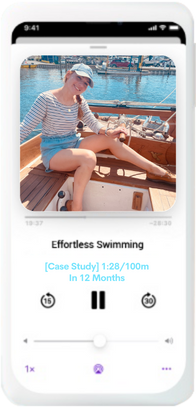
In today’s episode, I wanted to get Victoria Smith, who recently joined the Maldives Camp, to share her swimming improvements over the 12 months. Tune in now!
01:11 What got you into swimming?
9:23 Have there been any frustrations that you’ve experienced with your swimming since you began?
10:48 What helped to make your coordination better?
11:47 Do you come from a dancing background?
13:34 What did you change to have yourself feel stronger in the water?
20:14 What is it that you love about swimming?
23:14 Being Aware Of Your Body
25:37 How long did it take you to get that feeling of being able to hold the water?
27: Did the Maldives camp help improve your open-water swimming?
31:10 What advice can you give to someone who just started swimming?
Follow Victoria on Instagram: @victorialucilleanne
Change your technique and swim smoother, easier freestyle in the Effortless Swimming membership:
https://effortlessswimming.com/training-and-membership-plans/
Stroke Analysis Membership:
https://effortlessswimming.com/stroke-analysis-membership/
View our freestyle clinic schedule around Australia:
https://effortlessswimming.com/freestyle-stroke-correction-clinics/
Form Goggles:
http://formswim.com/effortless
Watch the full video on YouTube:
Transcript
Read the full transcript
Welcome to the Effortless Swimming podcast to show that help swimmers and triathletes love the water, become a better swimmer and live a better life. Here’s your host, Brenton Ford.
Welcome to the Effortless Swimming podcast. My guest today is someone who I don’t know how to introduce. It’s either swimmer, sailor, anesthesiologist, fashion designer. I don’t know where to start, but Victoria, welcome to the podcast. Hi, thanks for having me. I’m so happy to be here. We’ve gotten to know each other over the last almost 12 months now, since we started working together. And I got to meet you in person along with your husband Jody on our Maldives camp a couple of months ago, which was awesome. And I wanted to get on the podcast because in the last 12 months, it’s been awesome to watch your journey and just how much you’ve improved as a swimmer. And I recently, well, just today, I went back and looked at the very first video that you sent through because I’m like, what was that like? Yeah, how were you swimming back then? And well, it wasn’t as bad as what you’re making it sound there, but it was it just made a little bit of
refinement and I think and you only really started swimming last year in September, where you said you could hardly swim two laps back then. So to go from that to where you are now is incredible. So what’s got you started with swimming? So I have always been able to like tread water and I’ve never been afraid of the water, but I’ve never known how to do an actual freestyle stroke or any kind of stroke in particular. And my friend who I talk to almost every day, she is a pattern designer and makes patterns and I sew. So that’s how we met. She got into triathlons. And I talk to every day. So I’m seeing her like train and do all these, you know, cool things. And I’m exercising doing like kind of body weight hit type stuff. But I used to be a dancer. So I never really liked the concept of exercising because you have to exercise. I kind of like just having a goal or like enjoying what you’re doing and just happen to be exercising. Do
you know what I mean? Like just doing something you love, but not. So I was kind of interested in, oh, what’s she doing this triathlon thing? What is this about? And I’ve always been the kind of person that’s like, I’m only going to run if someone’s chasing me. I don’t ride my bike other than with my kids. And I never swam. And so I have a pool basically across the street. It’s like the community pool. And they were they had to sign up for like adult learn to swim classes. And I was like, well, if I’m gonna even consider this whole triathlon business, I’m gonna need to know how to swim. Like, like, let me just see if I can learn how to swim before I even like start anything else. And I was like, I feel like I had been having some injuries and some problems with like the workout I was doing. And I was like, I feel like swimming would be obviously better for my body. So I was like, this is gonna be good. This is gonna
be good. So I go and I call them and I end up taking the class is kind of a long story, but I end up taking the class and I’m with this other girl that’s terrified of the water. And then this other like gentleman that’s a lot older than me. And then I’m in there. And then there’s also this like 18 year old that looks like he could swim forever. And then I’m in and it’s me. And so we’re all just like starting out just kind of like blowing bubbles. And I’m like, okay, like, I’m not afraid of water, but I’ll do it. I’ll do it. And it was really good to kind of, you know, relax. And it was kind of like a sink down basically. And then I it was four classes, only $10 for four classes. And at the end, you know, we learned all the strokes. And at the end, he told us to swim to like the middle of the pool. And I was like, what? No. And so I did. And then I finally went all the way across. And when I got to the other end, I was
like, Oh my God, what just happened? Like, it took me like 10 years to get across. And then I was totally out of breath. So I wanted to obviously continue to swim. And I was talking to the coach, and he has a swim masters like us one masters program in the morning. They don’t compete or anything, but they just kind of swim together like as a group. And I was like, well, I don’t know when I can come because you don’t have to be work at like, you know, 630. And I need to get home before that. And the pool doesn’t open till five. And I don’t know when I get off and the pool opens, and it closes at like 4pm, and it’s not open on the weekend. So it’s very limited. And he’s like, well, you can come so in the morning with us at 430. And I was like, what? Geez, that’s an early start. But I was like, well, I get up at 530. Anyway, I was like, I mean, what’s an hour? Fine. Okay. So I started to come and he was giving me like these
sheets of like, it was like called swim a mile. And it was like a 12 week program where you build up to just swimming a mile continuously in the pool. And so it would be like, you know, I would swim like 25. And then it was like, okay, swim 50s. And then it just gradually built up. And it helped build my fitness. But I was still like, just working so hard. Like every lap was just so hard. And I was, I think I was just, you know, my head was up. And I was just not doing well. I was like, and he he had a lot of people that were swimming and he would swim as well. So he would he would tell me some things. But I started kind of YouTubing. So I was like, okay, I need to figure this out. Like, I need to research. I need to like, investigate like how to swim. So I started coming up on your videos. And I was like, okay, I can do I can learn all of these things. And I can get better at swimming. And but it will feel easier. And I was like, this is amazing. Like,
because I’m the kind of person like, I don’t want to spend a lot of time, like, doing something the wrong way. I think you had someone on the podcast that said something like, to one of his swimmers that he was spending a lot of time, like swimming the wrong way or like, you know, swimming like 3000 meters the wrong way or something. And I was like, well, I don’t want that to be me. But I don’t have that much time to waste. Like, I’m trying to do 5000 things in my life. I need to be efficient. So then I just started watching all your videos and and stumbled upon it and joined the membership. And even like the first, like, I think I sent you an email with a video, which I watched that video the other day. And I, it was so hard to watch. I was like, I don’t see how he can look at these things and not want to say like, 10 things at one time, you know, because it’s just so awful. But at the time, did you, like, when going back to that
first video, when you recorded it, when you watched it, did you have that understanding of what you were doing wrong though? Not really. I mean, the only thing I really noticed was I thought it was helpful to video myself and just watch myself because I had watched a lot of your videos too. But my biggest thing was like, when I saw like my head, I don’t think it was a video I sent you, but I had fixed it for a second to you. But like, my head was like, all the way out of the water, like, I don’t even know. I didn’t think it was that high. And I was like, you could see it like my whole head. And then when I turned it was like, I don’t know, like everything was out of the water. And I thought it was a lot lower than that. Like, I thought, Oh, I’m doing great. I’m low, you know, I feel like I’m good. But when I watched the video, I was like, Nope, that is not okay. But like, looking back at that first video, any
things that stood out to me there, and I know that we worked on was that, like, the first one was the breathing, you were turning and almost looking up to the ceiling. Yeah. And that was causing a lot of rotation through the through the shoulders, which was impacting the catch. And so I think the first thing we really started with was just that that breathing position and trying to stay a little bit flatter as you do that. Because if I’d mentioned 10 things and said, All right, now do this with your catch. And now I want you to make sure your hips don’t roll up. It’s just like, it’d be overwhelming. And yes, what’s been really pleasing for me, working with you is like, you’ve just followed the process. You haven’t been in a rush to change things. You just take your time. And that and in the results of, you know, 11, maybe 11 months now. It’s like, it’s amazing to see what you’re doing. And we saw that like stroke count was you
were 22, 23 strokes, maybe when we started. And then we’re down 18, maybe 19. Yeah, it’s probably more than that might started actually the eight that 22 is probably just a few months ago. But yeah, yeah, it’s a lot lower. Yeah. Yeah. And just watching you swim just purely by the visuals of it, you are holding so much more water. It’s like, it’s great to see that connection and the catch and the pool improve and all those sorts of things. So it’s amazing to have that kind of result in such a short space of time. And I mean, you’ve been really consistent with your swimming. You’re active, you’re doing it, you’re doing a lot. And you’ve just got that patience and willing to, you know, try one or two things at a time, which has been great to see. Has there been any frustrations that you’ve experienced with your swimming in since you started? Yeah. I mean, for a really long time, like, I felt like I was swimming
so much better. And I would look at my watch and be like, it’s the same time. You know, like the time just would not change at all. And I was like, but it’s just so much better. But I mean, it was just getting easier to swim. And then I think when I tried to coordinate my kick, I was like, Oh, my gosh, this is horrible. It feels so weird. Like, I thought I was doing it like, you know how I should be doing it. But when I actually, I think I was like kicking my left leg down when my right catch it, like, I don’t know, I think I was doing it completely the opposite way. Yeah, I don’t know how I think I had to do with my body rotation or something. But when I finally donated that, it was so much better. Like everything was so much better. I like when I, but when I was learning that it was so rough for like two or three weeks, I was like, this is horrible. I hate swimming. I feel so unnatural, you know, I even like I would
swim with a pull buoy and I would like still kick my legs a little bit just to kind of be like, remember, okay, which leg goes down and which arm goes, you know, was there something that that helped make it click or was there a drill or something that actually made it come together after a few weeks of frustration? Yeah, I was not the one with this. I would do it with fins, but you know, it would be like the single arm stroke or single arm drill, I guess, with the making sure your kick coordinates with it. And it helps to also coordinate it with the hand entry, because I think like one of the videos you had said that I like my kick was before my hand or something was entering before. Like I was coordinating it with the catch, but not like it was coming in too late or something. So I was trying to think of it like with both of them and like anything that’s in sort of a rhythm for me is really helpful. Like I’m very like I connect really
well with like music and rhythm and like just like, you know, just like a pattern. And so that was helpful for me. So I can like think about that drill, like when I’m swimming and that helps a lot. So could do you come from a dancing background? Yeah, I did that my whole life almost until part of college I could finally, but then that’s and it kind of comes across in your swimming. Like you’ve got good rhythm and flow in the stroke. And I see that with like sometimes like gymnasts as well who work with like you can kind of see it when they swim and the drill that you’re talking about sounds like it’s the single arm kick timing drill, which is you put fins on, you’ve got one arm in front and then you just do a single arm stroke and you want to try and coordinate the hand entry with your opposite foot kicking down. And then you want to coordinate the kick with the downwards kick on your left foot with your left arm. So and
it’s only two kicks per stroke. So you just focused on those things and I think we did that in the Maldives and most people, at least for the first five minutes, just like, oh my God, yeah, and it like and people just go, I don’t get it. I just cannot get this to happen. But eventually people start to get it with enough practice because it’s a tricky thing. It’s like, you know, trying to find a beat trying to find a rhythm when you’re dancing. I still can’t get that. You know, I probably need a good drill for that. But it’s the same thing in swimming like it’s it does take a lot of practice. But when it does come together, you get that full body timing and connection. And it just it feels good, you know, when you’ve got it. Yeah. And I had practiced that I had been practicing that drill for like three weeks before before the trip. And so whenever I was doing it, I was like, I’ve been there.
And like, I could do it. But I was like, I could not do it three weeks ago. So you got the head start on everyone. Yeah, I was like,
yeah, it’s and especially like what I noticed after you were sending three videos after the camp as well. You’re like, that’s that seems when things really came together for you. And like you said, in like our coaching thread is that part of that you feel like your swim strength has improved like what what changed there for you or what did you change to have yourself feel stronger in the water. This episode of the podcast is proudly brought to you by our sponsor, form goggles. They’re more than a pair of goggles meet the world’s most powerful swim platform. See yourself improve with form smart swim goggles including a free one year membership when you purchase your goggles for only $228 US dollars. Now they’ve currently changed up the offer where you can now get the goggles and you have that one year membership included for free. And then if you’d like to continue with the membership going forward, it’s only 15 US dollars a month
where you get access to their workouts, training plans and their custom workout builder. But you’ll always have access to the real time data of the goggles. So you’ll never lose access to that. So if you’d like to swim without stopping to look at a pace clock or your watch and get live metrics right inside your goggles, including your time, distance, pace, they are right there in your goggles with form goggles. I’ve used these for over 12 months now and I’m a huge fan of these goggles and use them for a majority of my sessions and find them very helpful, especially for gauging my time, my effort and my pace. And I think it’s a very helpful tool for the majority of swimmers that I would normally work with to get your pair of form goggles and save 15% off. Use our link formswim.com forward slash effortless or use the coupon effortless at checkout. And that will get you 15% off your pair of form goggles using our special link
formswim.com forward slash effortless or use the coupon code effortless at checkout. So for a while, like way back when I was I would do the sets that I do with my squad and I would some of them would have paddles. And I think back then my catch was either I don’t remember like too deep or something was going on with it where it was causing a lot of pain here. And so I stopped using the paddles because I was like, well, I was thinking it worse. And so, you know, I stopped using them. But I think since I stopped using them for months and then my catch got a lot better, like technique wise, I wasn’t using just, you know, my shoulder or my pecs. I was using more of my back probably. And then when I went to the monitors, I was like, OK, I feel like my catch is doing pretty well. But I just can’t like keep it up for that long, you know, I can see like I just get tired, like I need to just swim more. But I do swim three times a week, but I
don’t really use paddles. And I was like, well, let me try those again, because I feel like my technique is a lot better. And I feel like they won’t let’s just see if they cause a problem this time. So it’d been a long time since I’ve used them. So I started using them more like whenever, not more than I’m supposed to, but whenever the set would tell me to use them, I would use them. And I feel like that’s helped me a ton. Like I try to use them and then I take them off and then I use them and then I take them off like I don’t do it for, you know, a thousand yards at a time, you know, I take breaks just because I want to try to feel the water with my hands also and not just, you know, with the paddles. But I really feel like that’s helped a lot, just the pals. And I also do, when I remember, I do like the bands, you know, for the rotator cuff, like the rotator cuff exercises. Yeah, with the band. Yeah. Yeah. And my arms have always
been like the weakest part of the enemy. And as a dancer, you have strong arms, but like my legs are always a lot stronger. So yeah, they’ve always been kind of not so great. So yeah, extra hard. It’s really showing. And like you just, it’s a very, it’s quite a unique movement swimming, especially the overhead movement of your catch. It’s just, there’s nothing really that you’d probably be doing in daily life that’s similar to that or similar to those muscles that you’re using. So it’s, yeah, it’s a different form of strength. And I think some of that comes with the time and practice and consistency. But if you can use the paddles and have that little bit more load on them, you can, you can increase the strength and also the TheraBand stuff is really good because you do lose it use a lot of their like infraspinatus, super spinatus through the catch movement. And I think part what might have been causing your shoulder pain through
the front initially with your catch was you were coming, you weren’t crossing under your body, but you were like just coming in a bit too much in the beginning, just loads, loads it up too much through the front of the shoulder. Then you started to come a bit wider, which allows you to get into the, to the lats just from memory. Thinking back to those years. Yeah, I was doing that as well. Yeah. I went through all the areas that was here and then it was here and you’ve found the sweet spot now, which is I’ve done a lot. Yeah. And look, you’ve got to try different things. And that’s what I was just checking out, making sure you were right. Yeah. Yeah, that’s right. And I mean, thinking of your times now, like you’re, I think you’re around two minutes at the start of the year, two minutes for like a roughly 400 and 200 meter time trial. And now I think you’re was it 140 or just under 140s? Probably like nice and easy. If I went for like
an hour, I would probably average to like 142 or 143 or something like that. Yeah, which is a lot better for me. Yeah, that’s really good, especially for having swum for just over 12 months. And then you’ve been doing some hundred time trials as well, just seeing what you can get down to. Is your current best 128? No, 127. 127. There you go. So you’re continuing to edge that down, which is cool. And and you recently sent through like a sprint video as well, like a 25, 25 sprint. And what I like there is that you’re letting things go. Sometimes people are trying to be too perfect with their stroke when they sprint, but you have to get the stroke rate up. So that was that’s really good to see. And I made some suggestions in our last coaching video there, where I think you can find a bit more speed. And some of that was around keeping your length. So when you’re entering and reaching forwards, the hands just rushing down a bit. So even
with sprinters, they’ll they’ll take that little bit of time to reach forwards in front of the shoulder and then start the catch. So I think you can just keep it hold your length a little bit more in the sprint. And it will. I think we can get that down to under 125 in the next month or two, which would be yeah, which would be a good, yeah, pretty good goal to hit. Should be awesome. And and thinking of you assuming what it like a lot of times when people start swimming, they they might try it for a few months and go, OK, this isn’t really for me. But it seems like it’s something that you quite enjoy. You’re doing it regularly. You’re coming to the Maldives for a swimming trip, which probably may not have thought you would have done 12 months ago. So what is it you like about swimming? I think I just love it because it’s so technical. Like I’ve always been like a math person and science person. And I feel like if I can just figure out
how to do something like with my brain, then it just I just love it more. It’s just cooler to me because I feel like I can conquer it like not just with hard work, but also with like technical, you know, I guess the technical part of it. So I think it’s just like something to conquer. Like it’s just kind of like a goal. Like I want to keep perfecting it and I want to keep analyzing it and keep like just and swimming for me. Like I have, you know, three kids. So and we’re really busy and there’s always so much noise and I listen to podcasts and stuff too. You know, and I’ve been learning French for a couple of months and so I’m listening to French podcasts. And then when I get in the water, it’s just silent and I’m just like, OK,
it’s just nice to like not because I think if I have the chance to like listen to something, then I’ll do it because I feel like, oh, I can’t waste time or whatever. But when I’m in the water, I can’t and it’s just like a free moment where I’m just like, I can just listen to nothing and it’s great. So it’s very relaxing. I always feel like my body feels so great afterwards, like I don’t have aches and pains or, you know, issues. You know, I had that one for a while, but that’s gone now. So I just I feel like it’s so easy on your body. And I don’t know. It’s fun. You used to not be fun, but now it’s funny how things become enjoyable and fun when you see improvement, you get good at them and you have an idea of what you need to do to continue to get better. Whereas when you’re coming at it with no experience, no idea of what you should be doing, you just bang your head against the wall and you can put in the hard work and see results.
But it is it’s frustrating. And I compare that to my like surfing for me. I started when I was 18. So I was an adult learner and like first two or three years I saw improvement because you’re just practicing and coming from nothing. But then there was probably a period of about seven years where I was just like exactly the same never got any better. And then I started to actually get some coaching and like listening to someone on YouTube as well. And I’m like, oh, my God, this makes so much sense. Like all these analogies, how you should hold your body, what you should do in different parts. I’m like, oh, my like my world has opened up now. And it’s so much more enjoyable. And I feel like I belong there more. Like if there’s good surfers in the water, I feel like I maybe I can’t match it with them. But I belong there and I’m not going to look like a total kook out in the water, which and that feels good. You know, for me, it’s like,
yeah, like I worked hard to get there and I’ve taken the time to learn these things. And for me, that’s really satisfying that I can see that improvement. And I know that I am getting better and I can still see what’s possible going forward as well. And for me, that’s like, yeah, I get a real kick out of that side of things. Yeah, I think like and it’s a habit for me now to like getting up Monday was a Friday every week and going to the pool. Like now I’d be like lost with that. Like the other day, the pool was closed for Veterans Day and it was Friday. And I was like, what? What am I supposed to do? I don’t understand. This is so weird. And my guy was like, just take a break day. And I was like, no, what? I want to break day. Yeah, that’s the same. And I if I get back from, say, coaching late on a Sunday, if I’ve been into state for clinics and I get home like one in the morning and training, I’ll get up at four thirty to go
training and I’m not going to do that because I’ll be pretty cranky during the day. Yeah, that but yeah, I’m just like, oh, I wish I had gone for gone to swim because it’s like, it’s part of the routine. It’s part of the habit. And you just feel so good because I find it hard to get that kind of workout in, you know, many other X in many other activities. It’s like swimming is just it’s a whole body thing. You’ve got that force meditation in the water. You’ve got the sound of the water as well. And I like that you can be very intuitive with like the effort that you’re putting in and you become hyper aware of how things feel, the output that you’ve got and little changes that you make to your stroke and what correlation they have to your speed and your pace and all those sorts of things. And so you just really just like it is it’s better than lying on the floor and meditating for half an hour. It’s like active meditation. Well, you’re just so you’re
just so aware of your body. Like I was having this conversation with my friend the other day because I was like, I feel like when you’re a dancer, you have to be very aware of your body, like what your arms and legs are doing because even without watching them, you know, I have to just like, you know, I used to have a ballet teacher that like it which you would think I’d be good at high elbow because she would come around and like put your elbow up like when you’re in a, you know, the first position or second position, she’d be like, no, no, because your elbow cannot be down when you’re, you know, so the stuff like that, like you have to know where everything is. And it kind of brings that back, like that feeling back for me, like when I’m in the water, like, OK, I felt like my hand slipped through the water, or like whenever I make a change and I can feel myself pushing more water and I’m like, it’s so cool.
Like when you can feel it, it’s just really cool. How did it take you to get that feeling of being able to hold the water or, you know, move it through? You know, I want to say I really like I felt I always kind of felt it with paddles. It’s easy to see feel with paddles, but like when I would take them off, I would try to get the same feeling. But I feel like after the trip after the swim trip, the Maldives, I think that’s when I really started to feel it because I feel like I finally like saw like I was going up and over kind of, you know, and that I felt like I was like scooping almost, you know, like scooping the water. And I feel like that’s when it really kind of clicked. But like before then I could start to feel like when I would really push back, I could kind of feel like what I was pushing. So I think it’s I don’t only remember like when I first started feeling it, but I do know that like any kind any time that you
would tell me to change something like it was easier than I would think to feel what I needed to change. But I did know I needed to change it until you saw it. But yeah, that’s what I think a lot of the dance trainings probably come in is that ability to the proprioception that you’ve got from it because it’s it can be really hard to know what you’re doing. But I think that dance training would have helped a lot there. And with the camp, like we were in the water twice a day, pretty much every day. That’s obviously more than what you’ve done before. You’re not normally doing three sessions a week. Did that do you feel like that consistency helped you sort of step it up in terms of your swimming? Yeah, definitely. Like I think that because I’ve heard people say before and I might have even heard you say this before, like even if you’re just going to get in for, you know, a couple hundred, like just to practice a few things, like just
reminding your body of something every single day. Like I feel like makes a huge difference. Like I wish I could go to the pool more than three times a week for that reason. But yeah, I think just like being repetitive, like just I think it just helps build the muscle memory like so much more because you’re just constantly doing the same thing correctly. And then you end up ends up just becoming part of how you swim, I guess. But yeah, I think it definitely made a difference. And that camp definitely challenged me in a lot of ways, especially when we swam around the island. I was like, oh my god, what? Never swam that far in my life. I was like so afraid to do it. And everyone else, it was like a normal day, you know? And so that’s probably one of those moments where you’re like with the surfers that are really good. And you know, you’re just I kind of was like, I don’t feel like I’m along here. But I did it and it was fine.
Yeah, well, you ended up doing two laps of the island, which I think is I think was about three and a half kilometers from memory and going one way is hard work because you’re swimming against the currents and you’re just seeing it’s like grains of sand at a time you’re moving past. It’s going so slowly. Once you get around the corner, then you’re flying and you feel like you just turned into Michael Phelps after that. Yeah, exactly. Which was it was good fun. It’s just the warm water, the sea life that the like the people there was that was so much fun. And and I like I doubt you’ve probably swum in like out in the ocean like that before it was probably quite a different experience. Did that did you feel like you gained confidence from that side of things in the open water and just being in the elements of it? Yeah, definitely. Because actually we had so we were we did sail in the Bahamas. No, the. Yeah, the Bahamas before that.
And I did swim a little bit, but I was so afraid the whole time and there were currents and wind and there was this giant stingray. And I was like, oh, my god. Oh, my god. Oh, my god. Done where I’m going back on the boat, going back in the boat and I’m eating some chocolate or something. I’m tough. But in the like in the Maltese, I was like, we were all swimming together and we were in this big group. And I was like, well, I feel safer because there’s so much so many more people around me. And so that helped. And I saw, you know, a couple of sharks swim below. And I was like, it’s fine. It’s fine. You know, it didn’t bother me. It was weird. And then we got so much practice with like open water, you know, with open water skills, like looking for the bubbles so you’re not like looking up while you’re swimming, like you can kind of keep your head where it’s supposed to be and just like see the bubbles of the feet in front of you.
Like that was super helpful. I’d never even thought of it that way. And then drafting. I drafted someone almost isn’t like halfway through swimming around the island. And that was great. It was just like a giant break. I was like, oh, this is so easy. So that was good to practice because I was in a safe environment. I didn’t have to like practice it during a race, you know, for the first time. So that was really cool. And yeah, and just and then you guys would be like, OK, go swimming around here. And I’m like, what? OK, fine. Like, you made it seem like it wasn’t a big deal even in my head. If I was just doing it on my own, I’d be like, oh, that’s so far. You know, but like. Yeah, that’s it’s been really good to just see kind of level up a bit with your swimming since coming back from that camp. And yeah, it feels like everything sort of come together really nicely. So I’m looking forward to seeing what the next couple of months hold for your swimming
because yeah, just keep sort of checking the boxes, making these adjustments and working your way up, which is awesome. And for someone who is either looking to start swimming or they’ve sort of just started swimming and they’re like, maybe how you were earlier in the year where it’s like, OK, I’m I’m working hard, but I don’t know what I need to focus on or what I can do. Like, what advice would you give to someone who was in the same situation to you earlier in the year? I would definitely say just be consistent because I there were probably months at a time where I didn’t really see that much of a change. But like, I knew that things were changing because I would send you a video and you would tell me something was better. So it’s hard to know, like, if you’re getting better because, you know, you’re maybe not videoing yourself or you’re not seeing a huge change in your times. But like, I feel like just consistently
going to the pool. Like, I feel like every time I go, like it does something. It’s kind of like funny because it’s just similar to dance because my dance teachers used to say, every day you don’t dance, it takes two days to make it up. You know, they would all like they would always say, especially at this one ballet school I went to, it was super intense. It’s the same thing. That’s what it kind of like. Yeah, it was just. Then be like, if you missed, you know, a day of dance because for us, it wasn’t just one class. It was like hours and hours of ballet or whatever. And so they were like, if you miss a day, then, you know, you’re behind. It takes like two days. I’m like, oh, my God. So I mean, that that’s like kind of the mentality that I was used to. And so now I’m like, you know, it just I understand is coming from that background, like how every time you get in the pool or every time you practice something like it, it does get better.
But it’s just it can be really small, but it’s still like really does get better. So I would say like the more you despise swimming when you start, the more you should go. Just like, you know, just go and it’ll eventually it will click and get, you know, get easier. But like it just you have to work at it like it’s not magic. Like even my arms like being not that strong. Like I feel like I just I have to just keep going and keep putting the work in and it might take like a couple of years to get faster, just based on my strength, even if my technique is good. I feel like I still just need to be stronger in general. So yeah. Yeah, that’s and it’s such an important lesson as a consistency and like you can’t steer a parked car. You need to be moving. You need to be going to the pool and try and try these things. So it’s yeah, great to see how far you’ve come and being a pleasure working with you as well and meeting yourself in Jodi and you’re both on the camp next year as well,
which would be great both swimming next year as well. So yeah, I can go to Jodi. He was on the beach. Pina colladas and there he’s got to join us. Yep. So yeah, I’m looking forward to that. So thank you very much for being on the podcast and sharing your story and looking forward to working with you in the months to come. Thank you so much. Thanks for listening to the Effortless Swimming Podcast. If you’d like us to help you become a faster, more efficient swimmer, go to www.effortlesswimming.com.