







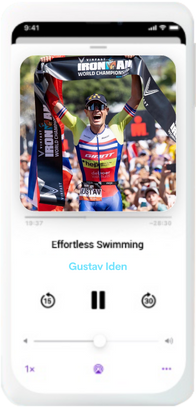
So thrilled to have Ironman World Champion Gustav Iden in today’s podcast episode. Tune in now as he shares his inspiring journey toward success!
02:02 What’s changed for you after winning Kona?
03:06 What is about the sport you love?
04:17 How did you manage the front-pack swim after not as well in some races leading up to it?
05:28 Did you do any race simulation in training in the open water?
10:15 What’s been your journey with swim technique over the years?
12:22 In swimming, it’s different strokes for different folks
15:41 What do you most age groupers could do to improve their swim?
17:03 How often are you doing lactate testing in the pool?
17:38 Do you feel you gain fitness from swimming which helps in bike and running?
18:24 How many kilometers do you swim a week?
19:00 At what point in the race did you start hurting?
19:54 What’s the most important advice you got in your career and why?
21:03 Do you take in the same grams of carbs in swim practice as you do the bike and run?
21:32 What’s your stand-alone marathon time?
22:34 What setting do you use on your form goggles?
23:35 What’s the best of tech from Santaratech for a mid-pack AG
24:44 What is your least favorite thing about triathlons?
25:33 Does your stroke rate or kick change between different distance events?
28:16 What’s next for Gustav Iden?
50% off 8-Week Faster Freestyle course:
https://effortlessswimming.com/8-week-faster-freestyle-course/
50% off 6- Week Beginner Freestyle course:
https://effortlessswimming.com/beginner-freestyle-course/
*Offer ends on Monday 28th November.
20% off Form Goggles from November 24th to 28th:
http://formswim.com/effortless
Watch the video on YouTube:
Transcript
Read the full transcript
Welcome to the Effortless Swimming Podcast to show that help swimmers and triathletes love the water, become a better swimmer and live a better life. Here’s your host, Brenton Ford.
Welcome to the Effortless Swimming Podcast. Before we get into today’s very exciting episode with Iron Man World champion Gustav Eden, I want to let you know about two offers that we’ve got available at the moment. The first one is we’re running a Black Friday sale on our eight week faster freestyle course and beginner freestyle course. I’ll put the links below if you’d like to purchase either one of those, but that’s going to be running until November 28th. So you’ve got until then to get those courses for 50% off if you’d like to either improve your freestyle, make it faster and more efficient, or if you’re more at that beginner level and you’d like to be able to swim 400 meters continuously without stopping, that course is designed for you, the beginner freestyle course. So check out the links in the description of this episode to get half price off those two courses until November 28th. The other offer
that we’ve got available is form goggles are running a 20% off Black Friday sale from November 24th to the 28th. If you go to our link, which is formswim.com forward slash Effortless, then you’ll be able to get access to that discount there. So they’re only running that over the Black Friday weekend. Again, I’ll put the links below if you’d like to get your pair of form goggles, which as you probably know, I’m a big fan of I use in a lot of my sessions and the athletes that I have recommended to and they’ve started using it have had a lot of success with them and really enjoy them. So I’ll put those links in the show notes. Let’s get into today’s episode with Ironman World Champ Gustav Eden. It’s not often I get up at 3.30am in the morning to record a podcast, but when you’ve got the Ironman World Champ on the line, I’ll do anything to to record a podcast. So Gustav, welcome to the podcast. Thank you so much. Yeah, it’s it’s early for you
didn’t realize you were on a New Zealand time. So yeah, sorry about that. No, that’s okay. I know you’ve had a very busy schedule. So you know, whenever we can get you on the podcast, it’s very exciting to have you on, especially since you won Kona about two weeks ago, or three weeks ago now. And yeah, like with that race, has anything changed since you won Kona? Yeah, people ask me like, if things change if I win something big, for me, it’s like a gradual thing. I think the biggest win for me was back in 2019, when I won my first the half Ironman World Championship. And that was kind of revolutionary there in comes to, yeah, to sponsor and media attention and everything. But since then, it’s just been like gradual evolution. And yeah, obviously Kona is the biggest thing I’ve won so far. But I saw myself winning it already a long time ago. So it’s not too much I’ve changed, I still have to do all the training and I still
have to, yeah, to live my life as a high performance athlete. But of course, it’s more attention from the media. And today I had a press conference back home. And yeah, it’s, it’s a lot of more, it’s a lot more attention, but training wise, it’s still the same. And I still love the training. So not too much. Every time I see any videos of you or podcasts with you, you’ve got this grin on your face that it seems like you just absolutely love the sport. What are some of the things that really draw you to it? Yeah, it’s I love being outside. That’s my like, number one love. It doesn’t really matter the weather, even though it’s hard being from Bergen in Norway, where we have a lot of rain and a lot of darkness. But just love being outside and also love this adrenaline rush of going fast. So it’s a miracle I haven’t done anything stupid on a bike yet. But yeah, I just love the speed and adrenaline and yeah, being
outside. And I have to say swimming is kind of, I know this is, it’s a swimming podcast. But it’s sometimes a bit boring. And especially since I don’t feel like I’m not a natural swimmer. I don’t get the hang of it as some others do. And I know it’s yeah, obviously, everyone is working harder to swim. But I feel like I’m working really hard, but don’t get all that out of it as someone else. But yeah, still just love training and being activity. I think, I think some people would hear you say that and go, but you, you swam a 48 at Kona, you’re in the front pack. How can you not be a natural swimmer? But by the standards of it, it’s something where you have to really put in the work to get there. Can you talk to me about the Kona swim and what you did to manage to be with the lead pack there? Yeah, so my swimming, I have been working so hard over so many years. Another felt like I had like a breakthrough way
of swimming kind of. I always tried to, yeah, just swim a lot and see how things go. But for Kona, we did a lot more open water swimming and training that we normally do. And partly because in Hawaii, we only had access to 25 yards or meter pool, which for us is a bit short. And also, you’re in Hawaii. And you have access to this beautiful ocean. So yeah, going into the race, we did a lot more volume in open water. And I think that was a key because swimming in open water is not the same as swimming in a pool, not only because of the current and the waves, but because you don’t get any breaks, like in the flip turns. And also, you have to do a lot more sighting. And yeah, it’s generally just different. So I think that was one of the reasons why I was able to be with the front pack there. We’re doing any race simulation in training in the open water? Yeah, to do race simulation, it’s actually really hard. You
need a quite big group to do that. So we didn’t do too much, we just had focus on some intensity training together with my training partner, Christian, and we did some starts from the beach and those kind of things. But yeah, to do the race simulation, it is pretty difficult because, yeah, you need kind of like the real aggressiveness of the group to really get the sense of how it’s going to be in a race. And the week before before the main race, the corner, they have this open water swim race. We didn’t prioritize to do it this year, but a lot of athletes actually do the open water swim to get the sense of how things will be on race day. And I think that’s a pretty, it’s a pretty smart way to do it because open water swimming, especially in a race, in the race, did you know you were with the lead pack? Yeah, so the dynamic of the race was a bit special. So I wasn’t actually with the front pack the whole way. It was
about after 1000 meter, I think it was almost splitting up. And yeah, I think the front maybe settled down just a little bit. So I was able to catch up again. But it’s yeah, I had an idea after the halfway point where I could see the leaders that I knew that I was in the front pack. But in the start, I had no reference to anyone. And I just tried to keep on the three feet in front of me. And yeah, swim as easy as possible, as fast as possible. But it’s pretty chaotic out there. And yeah, when you’re laying down in the water, it’s pretty hard to look above the feet in front of you. So I didn’t have like an overview of exactly where I was. But when I came closer to the finish, and I saw all the big names around me. And I realized I was in the front pack. And actually, I relaxed so much that I was wondering if people were like breaking in the front, because I was swimming so, so, so relaxed. So that was a nice feeling. And not something I’m
used to in a triathlon. So normally, I’m here so far behind that I’m stressing the whole way to the end of the swim. But this time I actually could relax a bit. So that was nice. Do you think that helped you later on in the event? As you, as you relax, you tend to perform better. Was do you feel like that was the case knowing that you made the front swim pack? Yeah, definitely. So if I didn’t make the front swim pack, I would have to push more in the start. And also it’s hard to know how hard you should push. So it’s not only that you are behind and have to catch up. It’s like, you have to do a lot of calculations in your head. If you should go way above threshold now for 10 minutes to catch the leaders or if we go slightly easier, but then catch them after 30 minutes. Now I knew I was with the front. So then I didn’t have to do all these calculations in my head, I can just relax and follow the group. So yeah, definitely
had a huge impact on a race that I was able to be in the front. I heard the had some of the ritual podcast and I think maybe before the race, you spoke to Mark Allen, maybe asking, you know, what’s your advice? And he said something about like respect the island or respect the spirit of the island or something. And in your mind, you’re just like, nah, like, it’s not about that. It’s about like getting out there and racing. I thought that was quite interesting. Your approach is just like, no, this is like, it comes down to the training I’ve done and everything and that outside thing or the way where it just that doesn’t apply to me. Can you tell me a little bit more about that? I thought that was quite interesting.
Yeah, so I’m not I don’t have any like, yeah, superstitious beliefs or anything. But I do believe you can change your performance with mentality, of course. But it’s not something that comes from the outside. But if you actually believe it comes from the outside, then you have to kind of believe that if that makes sense. So if in your head, you are superstitious, and you need to have the help of the Highland, it doesn’t help to say to you, no, you don’t need it because then it just hurts your performance. Because it’s something that just grinds in your head. But for me, I have no nothing like that. So it’s pure, scientific and mentality part comes from confidence in training and confidence in my plans on race day, and just confidence that my equipment is the right that I can do the right things on race day. So yeah, the island believes this is not for me. But I know I heard a lot of feelings when I say that. But
yeah, I can’t change who I am just to save someone’s feelings. Yeah, yeah, that’s right. And then in terms of the, I guess, the scientific side of swimming, so like biking, running, more a little bit simpler in terms of the scientific side of things with swimming, you’ve got technique which is a large aspect of it. What’s been your focus with technique over the last couple of years? Are there things that you have worked on changing or improving? Are there things that you think about when you’re in the water? Yeah, so as mentioned, swimming is so hard to instrument. We have tried different things to measure swimming. And yeah, it’s really hard to find something that that you can use that also don’t take a lot of time changes the way you swim. So we tried some paddles that was measuring the the power, yeah, the way you swim and some different things. But it’s usually extremely hard to find out data for swimming. But now we have these started
using form goggles, which is a good start, but it’s not the end goal of how I want to instrument swimming. But for my part, it’s yeah, I do, of course, think a lot when I swim. But it’s for me, it’s hard to see how I swim from the outside. So if I see a video of me swimming, it’s like, do I really swim like that? And it’s hard to when a coach tell me to do something on land to implement it in the water. So that’s been my main focus for technique over the last few years. But now I am more leaning towards just trying to, yeah, don’t follow the visual guidelines in swimming. I know a lot of coaches have like this idea of how swimming should look. But if you for example, see running, the best runners, they don’t look the same while running. And we have to see that we all should swim different to reach the end goal. It’s not like that is one size fits all in swimming, especially being different. Yeah, body size, the flexibility, and if your
strength is, yeah, view to max or threshold or whatever, we need to swim differently to achieve the same end goal. So for me, now I have kind of ignored swim coaches that is giving me insights just based on visual data and start using more more concrete data like oxygen consumption, and lactate and more feeling and going that way. That’s funny because we run clinics in Australia, we do a lot of underwater filming and analysis with with age group triathletes and other swimmers as well. And one of the comments we get all the time when they first see themselves swimming is, I can’t believe that’s how I look. That’s not how I thought I swam. And initially, it’s quite painful for them to like, Oh, I mean, I don’t want to look at it like it’s, it hurts just to know that I look like that swimming. However, like you mentioned, it’s not about how you look, it’s about the end result. You know, are you hitting those times, are you doing it at the right
effort level? So it’s good to know that the world champion still has those same issues when it comes to how you look compared to how you think you look. And it’s so true that it’s, there’s so many different styles. I mean, even at the elite end in swimming, if you look at the 1500 freestyle, there was four somers very close together in the Olympics last year. And some very different styles and ways of swimming there. So it really just comes down to the individual and their body type and their range of motion and all those sorts of things. And as a swim coach here, one of the best swim coaches in Australia called Michael Boll. And he was talking to Dan Atkins who works with, he’s a triathlon coach, works with a lot of the elite Aussie triathletes. And he’s, their swim squads were next to each other one day. And Michael Boll said to Dan, just get them in the best position you can and then just get them as fit as you can from there.
Because when you looked at the difference between the swimmers and the triathletes, it’s just, it’s a different, a different way of moving because you spend so much time on the bike and the run. So the swim doesn’t need to be pretty. It’s just got to be fast and good for, good for open water, which is quite a different stroke, like you mentioned. This episode of the podcast is proudly brought to you by our sponsor, Form Goggles. They are currently running a Black Friday sale from November 24th to the 28th, where you can get 20% off your pair of Form Goggles. Go directly to our link at formswim.com forward slash effortless. That’s formswim.com forward slash effortless to receive your 20% off Black Friday discount. Then more than a pair of goggles meet the world’s most powerful swim platform. See yourself improve with Form Smart Swim Goggles, including a free one year membership when you purchase your goggles for only $228 US dollars. Now,
they’ve currently changed up the offer where you can now get the goggles and you have that one year membership included for free. And then if you’d like to continue with the membership going forwards, it’s only $15 US dollars a month where you get access to their workouts, training plans and their custom workout builder. But you’ll always have access to the real time data of the goggles, so you’ll never lose access to that. So if you’d like to swim without stopping to look at a pace clock or your watch and get live metrics right inside your goggles, including your time, distance, pace, they are right there in your goggles with Form Goggles. I’ve used these for over 12 months now and I’m a huge fan of these goggles and use them for majority of my sessions and find them very helpful, especially for gauging my time, my effort, and my pace. And I think it’s a very helpful tool for the majority of swimmers that I would
normally work with. So to get your pair of Form Goggles, go to formswim.com forward slash effortless. That’s formswim.com forward slash effortless. Yeah. And also, yeah, of course, swimming or videotaping, it helps, definitely. And it helps also giving like a visual impact for athletes, but it’s only, you can only take it that far. If you’re doing some obvious mistakes, then, yeah, you have to do the filming and do those things, but spending hours upon hours to change your technique based on visual reference. That’s not how I think it should be done. But for ace strippers, it’s definitely the way to go to do some videotaping just to get a sense of how you’re actually swimming. So I do support you there at the swim cleaning. And when you are swimming well, how does it feel for you compared to when you’re not swimming well? For me, it’s, yeah, it’s a lot of about how I can breathe. If my breathing is relaxed. And usually
it’s when I’m in good shape, then I can just hammer it and have a slightly higher frequency. And then just, yeah, if you swim more rapid with the stroke, you can also breathe more often. And that’s when I usually swim the best. So if I think I swim good with a good technique and have like long strokes, then I actually not swimming that good. But my breathing is too slow. And then I after five, six minutes, I tend to lose power and get too much acid in my bloodstream. So yeah, with a higher frequency of breathing, then I’m usually swimming the best. And how often are you doing lactate testing in the pool? It’s like a period dependent. So towards Kona, we didn’t do too much because then it’s more focused on race pace and not the metabolic training effect. But in a usual altitude camp, we can do, yeah, maybe five sessions a week. And then we do like four tests per swim. So then it means about 20 tests only in the swims a week. So it can be
That’s a lot of what I was expecting. Yeah, it can be quite a lot. And it can be periods where we don’t do anything at all. So it depends on what the focus is. So we only do lactate testing when it’s a metabolic training effect we are. And do you feel like you get fitness from swim training that helps you with the ride and run? Or do you feel like it’s separate? Yeah, kind of you do. But it’s a different kind of fitness. And right now we are focusing more on the total calorie load. So of course, you do get fit in the sense of you burn a lot of calories, and it’s good for your metabolic effect. But I don’t think you necessarily get a faster runner by swimming, but you do get more fit. Yeah, yeah, makes sense. I’ve got a couple of rapid fire questions for you that our listeners have sent in. So you can have these answers be as short or as long as you like. The first one is on average how many kilometers do you swim a week? So now
I’m about six sessions a week. I would say the average swim session is about 4k. So not insane volume, but we tried to have higher volume before. And for me, it didn’t work at all. I couldn’t handle the volume on the slower pace. And if I tried to do more on high pace, I couldn’t. It wasn’t sustainable. So now we have gone back a bit on volume on the swim and do a bit more intensity. So yeah, about six sessions a week with 4k is average. And for Kona, at what point did the right start to hurt for you?
It never really hurt that badly, but it was more the mental fight when I passed Sam Lado because up until that point, it was more firstly a battle between me and Christian. And then when I dropped him, it was a battle to catch up with Sam Lado. And from that point, I didn’t have like a clear person that I wanted to beat. It was just more getting to the finish line. And I had basically everything to lose. So if I didn’t win at that point, it would be extremely bad. So yeah, when I passed Sam Lado and still had like six, seven K to go, that was the worst part. But it didn’t hurt in that way. So hurt less than like some of the short course races that you’ve done. Yeah. Yeah. But it’s a different kind of effort for sure. And what’s the most important advice you’ve gotten your career and why? Yeah, it’s hard to give only one advice. But I have this motto I’m kind of living for. And it’s winning is a choice. And it’s more behind that than just
winning. It’s more that you have to take a lot of choices in both training, but mostly the day to day life. Like is this going to make me a better athlete? Or is this going to make me motivated to continue for another 15 years of this sport? So it’s more like evaluating every aspect of your day to day life and see if that makes you a better athlete or not. And if it doesn’t make you a better athlete, why do you do it? Is it for your own pleasure? Or is it? Yeah, what’s the reason you’re doing it? So try to have an active relationship with the choices you take at the every step of your day to day life. And then usually you would find you’re doing something without reason and take that out of your life. And maybe do some more training or eating or whatever. So winning is a choice. Do you take the same grams of carbs in swim practices? You do the biking? Usually no, because a swim session for me is not that long. And I do more
focus on recovery after. But yeah, usually it’s intensity and distance related. So if I have a longer, harder swim session, then I definitely hit the same grams per hour as I do my bike and run. But just since it is usually a shorter session, I don’t have that high intake. What’s your standalone marathon time? I never did a standalone marathon. I only did it in the Ironman. And yeah, I get this question a lot. I don’t think I could run that much faster at the standalone marathon right now with the same training as I do in an Ironman. But I think if I had this right course, some time to prepare, I think I would be able to reach the Olympic standard, which was 213, I think. And back, I don’t know what it is now. But yeah, I think I will be able to do that with some specific training, but definitely not as a triathlete. Do you see that happening any time soon? No, so I’m too much in love with the biking and just a challenge of triathlon to ever go
running. If I did one sport outside of a triathlon, I think it would be cycling just because the lifestyle is really chill. Have one session a day and spend the rest of the day in a cafe or something. So the cycle is going to be too nicely.
That’s right. What setting do you use on your form goggles? Like what are you looking at? What metrics when you swim? It depends on the focus for the period and also the focus of the session. So I have some different screen times both on the, I think it’s called interval settings and the lap swim setting. But usually it’s a frequency or then 50 meter times. So then that’s like the standard one. I like to have the heart rate on if I swim with a heart rate. So that’s the three main things for now. And I’m so bad at counting. So for the flip turns I have the last or the total distance because I can’t count on swim. So I’m so bad at that.
You’re not alone. There’s one guy I swim with who every main set guaranteed to miss a 50 or 100 and miscount. So I feel like I need to give him the goggles, but they’re good for that. If it was just that alone, is that worth the money? The next one is what’s the best piece of tech from Santaratec for a mid-pack age group? That’s a hard one. Yeah, it’s most of the things is pretty expensive to just buy it to to have it on your own, especially if you don’t know how to use it. So hopefully we can work in the future to bring it more to the masses. But for now, I think I don’t want to like give an advice to buy equipment that costs, I don’t know, maybe from thousand dollars and upwards. It’s quite an investment. But it’s more for now, I think more for the club to buy in to use, especially the virtual master as a club to buy into to use it together with the club. But the one thing I would say is it’s maybe just invest in in your
sports nutrition and do the Morton product. I know it’s not like the technology in the same sense of like a tech piece. But sports nutrition is so insanely important that it’s worth to buy the Morton to have a good Ironman time. Makes sense. I’ve already asked what your favorite way like triathlon. So the next one is what’s your least favorite thing? We try it long with triathlon. I think the struggle on the swim for me. If I go like a longer period, some races where I feel like I’m really, yeah, shit, that’s swimming. I’m trying so hard, but the terms are just going backwards. And I don’t get the sense of why it’s going so slow. If you know why, then at least you can do something about it. But if you feel like you’re really doing your best and it’s still not going anywhere, that’s my biggest struggle with triathlon. Luckily, I have been at least struggling basically nothing with injuries. So if I had a lot of struggle with that, I
guess that would be my biggest issue with triathlon. But yeah, struggling on a swim. That’s not fun. Yeah. Gotcha. And the last one here is does you strike right or does your kick change between different distance events? Or does your swim change between different events? It’s probably a better question. Yeah, I mean, the intensity do change. So I do a little bit more kick in the start of a sprint in the Olympic than I do for the full distance. But it’s actually the worst kind of swimmers out there is the half firm and swimmers. They are so aggressive in the start. I don’t know why it’s why it is like that. I think maybe it’s because in the Olympic distance and sprint distance, we have at least enough space to space out and not have too much fighting in the start. But for all the half Ironman’s I’ve done, people have been so insanely aggressive in the start. So that’s actually been where I’ve been kicking the most in the
start because I just have to fight people off. So I don’t know if they’re desperate to reach the front group or what it is. But yeah, they’re so aggressive. And I think Ironman should do something about it because it’s not even swimming anymore. It’s just fighting the first 200 meters almost. Really? Yeah, right. Is it because you think part of that’s because you’ve got the drafting on the bike in the shorter events typically. So people are a little bit more relaxed about things or me. I don’t know. I think in in the half Ironman in St. George than it was pretty narrow place we started. And also it was in it was so dark. So I think people just realized that if I can see anything, the judges can see anything. And I won’t get any penalty anyway because no one can see me. So I can’t just drag this guy under. So in St. George, it was terribly bad. And it’s not good for the athletes or the sport to behave like that. So I’m not saying I’m like
perfect, but I don’t I don’t do anything in particular to someone. But you get dragged in the feet or held under in the half. So it’s his athletes are known to be bad at that. You don’t need to name any names. Yeah, some are more aggressive and known to be more aggressive. So but usually it’s just they’re desperate in the start and willing to do whatever to get in front. And I think since it’s less personal in the swim, you can’t communicate and you don’t really see who it is. Then it’s easier to get away with. You obviously wouldn’t do it on on a run because then you would get the yelled at that. I think people are afraid of the like personal reaction. But in a swim, it’s yeah, you’re in your own bubble kind of and you just do whatever you can to get to the frontpack. Yeah, it’s weak mentality, I would say. Yeah. And then so your target now is Paris 2024. What’s what’s your thinking behind that being the number one goal for you now? What’s the
appeal of the Olympics in 2024? For me, the Olympics was yeah, one of the reasons I started with triathlon. I really wanted to firstly go to the Rio Olympics. That was like it was too early for me, obviously, but I had like this small ambition to maybe make it in 2016. I didn’t make it, but I still was like a big motivation for me. And then for Tokyo, it was all about winning the gold there. And I knew the few weeks going into the race that yeah, I wasn’t that the level I needed to be to to win there, but I still had an OK performance coming eight, but it was not the race I was there for. So I feel
yeah, I’m really I really missed that Olympic gold. And I wouldn’t be happy with my triathlon career without giving everything I can to win there. And yeah, it’s just the reason why I started loving triathlon is the Olympic game. So I can’t give up the Olympic dream just to go long distance just because it’s more attention and more sponsor money and everything. For me, it’s still maybe 15 years left of this sport. And to just do long distance to please others from now on would be yeah, not as fun as to really do everything I can to win the Olympic games. Yeah, I think it’s great going with what deep down really drives you and motivates you. And maybe it maybe you won’t earn as much money for the next two years because of sponsorship and that sort of thing or as much attention. But if it’s a thing that pleases you most, that’s what I think in the long run really tends to matter. Yeah, and I see some comments like, why would Gustav go back
to shortest and see just one corner? But they really don’t understand what sports is about. If it’s just about finding the easiest to win, then yeah, it will not be fun at all. It’s about the challenge and the constant development and do what you think is fun. So not only about doing what’s maybe fitting you the best, but doing what you love the most. Well, Gustavo, I appreciate you being on the podcast. I was really excited coming on to the podcast to chat to you because that’s not every day gets a chance to chat to a world champ. So I wish you all the best for the future and thanks for being a guest on the podcast. Thank you. Thanks for listening to the Effortless Swimming Podcast. If you’d like us to help you become a faster, more efficient swimmer, go to www.effortlessswimming.com.