








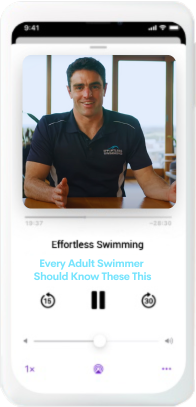
I’ve spent 25 years helping adults become better swimmers, from beginners to pro triathletes. In this podcast, I’ll share what really works to go from feeling slow and frustrated to swimming fast, efficiently, and effortlessly.
00:00 Introduction
00:54 Balancing Tension and Relaxation
01:34 Reality vs Perception
02:24 Finding Your Unique Swimming Style
03:34 The Importance of Technique Over Effort
04:48 Kick Supports NOT Propels
05:57 Overthinking vs Feeling the Water
07:35 Swim Softer to go FASTER
08:42 Consistency is KING
11:14 Don’t train like a runner!
13:26 Using Swimming Aids
15:09 Developing Your Stroke Step-by-Step
16:37 Long-Term vs Short-Term Goals
18:34 Strength and Mobility
20:08 Slow to Fast
21:14 Stroke Length vs Stroke Rate
23:26 Training for Specific Events
24:39 Open Water Swimming Tips
25:45 Turn off distraction!
Change your technique and swim a smoother, easier freestyle with the Effortless Swimming membership:
https://effortlessswimming.com/training-and-membership-plans/?el=blog
Do you want to work with me personally to improve your technique? Join my swim technique coaching here:
https://effortlessswimming.com/stroke-analysis-membership/?el=blog
View our freestyle clinic schedule around Australia:
https://effortlessswimming.com/freestyle-clinics
Try PILLAR today, head to pillarperformance.shop and enter code EFFORTLESS for 15% off, or for any North American listeners, enter the same code at TheFeed.com.
Watch the episode on YouTube:
Transcript
Read the full transcript
Don’t chase speed. Speed will come to you if you get your technique right and you’re really in tune with how you’re feeling in the water rather than trying to muscle it and force it. You’d be surprised at the results that you can get in three years time if you dedicate yourself to that rather than looking at the results that you might want in three months time. Welcome to the Effortless Swimming Podcast to show that help swimmers and triathletes love the water, become a better swimmer and live a better life. Here’s your host, Brenton Ford. I’ve dedicated my career to one thing, helping adults become better swimmers. In this video, I’m going to share with you everything I’ve learned in my 25 years of swimming and coaching thousands of different people from beginners all the way through to pro triathletes, that if you are feeling slow and frustrated in the water, what can help you get to being fast, efficient and feeling effortless as you
move through the water? The first thing is that swimming is a dichotomy between tension and relaxation, and we’ve got to find the optimum balance between the two. It’s like if you were to pick up a glass of water, you’re not going to grab it with as much force as you possibly can. You’re going to pick up that glass of water with just enough tension to hold the shape, but no more from than that. And it’s exactly like swimming. We want to apply enough force and pressure on the water to help move us forwards, but we don’t want to muscle it. We don’t need to put in any more power than that. So finding that sweet spot between tension and relaxation is something that can really help you apply just enough force to move forwards without wasting any extra effort. Reality versus perception is a really big issue in swimming. Whenever I film someone and when we do underwater filming, people will look at their stroke and think that can’t be me.
That is not how I look in the water, but it is obviously how they’re swimming, and there’s a big disconnect from what they think they’re doing to what they’re actually doing. So if you can get video of your swimming and you can actually see what you’re doing, that’s often the first step at actually making some changes. Because for whatever reason, when we’re face down, we’re lying flat in the water and we can’t see much of what’s going on, it’s very hard to tell exactly what’s happening. And if we don’t know what’s happening, then it’s hard to make a change. So one thing I always recommend to people is get some footage. Even with a phone recorded above the water, that can help you make some of the first changes to your stroke that will help you swim faster and swim more efficiently. If you’ve watched any swimming competition or triathlon, you’ll see that there’s so many different strokes. And even in the Olympic finals,
you’ll see that swimmers that are touching within a second of each other swim with very different styles. So there’s not one perfect stroke for every swimmer. It’s going to change depending on your height, your arm span, your experience, your strength, the event that you’re doing. There’s so many different factors when it comes to swimming. And there’s not one perfect style. There is a perfect style for you that you can work with. And it basically goes down to what you currently use, how you currently swim, and just looking to tweak and perfect that. Because if you’re trying to swim like Ian Thorpe or Michael Phelps, but you are five foot six and you’ve got shorter legs and limbs and you’re a stockier build, well, you probably can’t swim with that same sort of style. So it’s about finding the right style for you. There’s certainly fundamentals across the board that we want to work towards, but there’s nuance in that. So trying to copy one certain style of swimmer, if you’re not necessarily
built for that or you don’t naturally gravitate to it, might actually make you slower rather than faster. Effort doesn’t necessarily correlate to more speed if your technique isn’t in place. One of the frustrating things that I see that a lot of triathletes come to me for is they put the effort in on the bike, they put the effort in in the run, and they tend to get faster. But the same thing doesn’t hold true when they go to the pool. They actually sometimes get slower, the harder they work. So the first step there is making sure that you’ve got good foundations with your technique. So we need to have good, good technique to start with. Then as we put a little bit more effort in, you can start to go a little bit faster. But just trying to muscle your way through the water with brute force isn’t the way to actually get quicker. Because swing such a technical sport, we actually need to make sure we’ve got the right timing and coordination and rhythm in the stroke,
as opposed to just trying to put more force in. So it’s almost like a dance. We’ve got to find our rhythm and our tempo, and we’ve got to still keep the coordination in it and hold good technique as we put a little bit more effort in. So sometimes that goes against what people have been used to doing when it comes to things like running or biking. But swimming is such a technical sport that we need to focus more on the rhythm and timing and coordination instead of the pure force aspect of it. When a lot of people start swimming, they find that they need to kick really hard to move forwards and they rely on that kick to propel them forwards, as opposed to using their arms and their upper body and their rotation to help drive most of that propulsion. Now your legs have the biggest muscles in the body. So if you’re kicking very, very hard for long periods of time, your heart rate is going to go up, and it’s very hard to
sustain that. So your kick is not necessarily there to propel you forwards, it’s there to support you. So if you find that you’re tiring quickly, it’s always good to make sure that what your legs are doing is helping support you and balance you, but not necessarily propel you forwards. It’s a part of it, but the kick is something that will tie you very quickly. Even some of the fittest and the best swimmers in the world, if they’re kicking as hard as they can for 100 meters as part of their swim, they can’t sustain that. If you look at say a 1500 freestyle, you’ll find they really start to bring the legs in the last 75, the last 50, but they’re certainly not holding that for 1500 meters. So your kick is there to support you, not necessarily to propel you forwards. When adults start swimming, we try to intellectualize it. We try and think about our stroke with great detail, and we try and make sure we’re doing things
perfectly. Now it’s certainly good to think about your technique, because that’s one way that we’re going to get faster, but adults have a tendency to overthink. And sometimes kids have a tendency to underthink when they’re swimming. We want to find that sweet spot in between. And one thing that I suggest and recommend whenever I’m coaching someone is, okay, we want to think about whatever it is we’re working on, but then we want to move to the place where we’re just starting to feel for it. Because swimming is very much about feel and your awareness in the water. So if you can switch off that thinking brain a little bit, just keep it in the background, but tune more into that feeling brain. And that is a way that you can really start to notice the changes and feel for the stroke more. And I find that people who have grown up swimming, kids, teenagers who have done thousands and thousands of laps in their teenage years,
they’ve become really good at being hyper attuned and hypersensitive to how they’re feeling in the water. And so they can make those changes generally a little bit better because they’ve got that better feeling for the water. So sometimes as adults, we need to make sure we’re doing enough repetitions, first of all, but we also need to make sure that we’re just able to switch off a little bit from our thinking, switch off a little bit from the data and just be almost kind of at one with the water and just be present in there. Because especially in today’s day and age, with the amount of technology that’s there, we can get distracted. So we just want to make sure that we are being attuned to that feel of the water and not just trying to think about every little thing that we’re doing. In order to swim faster, we have to swim softer. Now, I don’t know how true this is, but I use this all the time. I use this way of thinking is
you can only put five kilos of force on the water. You can’t put 20 kilos of force on it. So the way I interpret that is you can only put so much pressure and force on the water that if we go any harder than that, you’re going to slip and your hand is going to slip through the water. So you’re not going to be holding the water. So in order to go faster, we can’t try and muscle our way through there. We need to think about coordinating things well, finding the optimum amount of pressure and force and not trying to go above that. And you’ve probably felt this at times. If you’ve gone from swimming at an easy pace to then sprinting, you probably feel there’s a lot of slippage going on. So trying to apply that right amount of force, approximately five kilos of force, I think is a good way to approach it. And if you’re trying to really just pull as hard as you possibly can, well, it’s not the way to get faster. So swim softer to go faster.
In swimming, consistency is king. And for me, a general of thumb is with two sessions a week, you can generally stay where you are. Three sessions a week or more, you’re really going to start to notice the improvements that come with that. So getting in the water three times a week or more gives you enough consistency to really make some good gains and improvements. Whereas if you’re swimming once a week, it’s probably not enough to really see the improvement that you’re looking for. So trying to get in the pool three times a week, at least for a period of time, can give you a much quicker and bigger improvement than just two sessions a week. And another part of that too, we got taught this growing up was that if you have one week out of the pool, it often takes two weeks to get back to where you were. Now, if you are a fairly new swimmer, that may not necessarily be the case. But certainly at the highest level, taking one week out takes two weeks to get back.
And similar, if you go two or three weeks, well, that could be four to six weeks to get back to that same level of feel and fitness and aerobic fitness. So trying to limit the amount of time that you do have out of the pool can be a good way to approach it. So making sure that you’re consistent with your training. It’s not about doing a huge session once a week. It’s about doing maybe some smaller or medium sized sessions a couple of times a week. And that is a good way to make sure that long term you see good improvement. This episode is brought to you by Pillar Performance. Our new sponsors Pillar are a sports micronutrition company. And the easiest way to describe it is that while hydration and carbohydrates products will take you through to touch the wall as fast as possible. Pillar’s mission is to get swimmers to the starting blocks in the best condition over and over again. I recently started taking Pillar triple magnesium after a friend had recommended it
and it’s been a game changer for my sleep and recovery. I take one scoop 30 minutes before bed each night in the same way that you might start your day with a coffee. I finish it up with the magnesium and recover better for tomorrow’s session in the pool. Pillar Performance is used by some of the biggest names in swimming and triathlon, including Zack’s Double T Cook, Jan Frodeno, Ben Canute, Ash Gentle, Taylor Nib amongst the host of other well-known swimmers and triathletes. Where Pillar differs from other micronutrition you may have taken before is both the quality of the types of magnesium and the tangible results that I see on my garment each morning. If you’d like to try Pillar today head to pillarperformance.shop and enter code effortless for 15% off. That’s effortless for 15% off all first-time purchases or for anyone in North America enter the same code at thefeed.com. A mistake that a lot of people make when they first start swimming is they
approach their swim training like they’re going for a run. They get in the pool and they go on swim one kilometer straight with no change in pace, no drills, no mixing it up at all, it’s just one kilometer straight just like they would if they were going for a run. Now it can be okay to do that at times but if you look at the best swimmers in the world, you look at the best swimmers in triathlon, they’re not going in the water and just going three, four, five kilometers straight with no changes. If you can structure your sessions with a warm-up and a main set where there might be some change of pace and shorter and longer intervals and you have a bit of cool down at the end, that is going to help you get faster and actually develop your swimming so much better than just doing a kilometer straight. So what I’ve seen there is that a lot of people, they struggle to get out of their one gear or their one pace so a lot of times people will come to clinics and they’ll say look I’ve only got
one speed, there’s no fast, there’s no slow, there’s just one pace medium and often that’s because they haven’t developed their different gears. So we’ve got to make sure that when we do train that we’re doing different intervals, there might be 50s, 100s, 150s, 200s and we’ve got to make sure that there is some sort of change of pace. Whether that be progressively building, for example a set of five 200s where you just progressively get faster each one or maybe you’re just doing some easy zone two work and then maybe some sprints so just seeing some sort of change of pace and what you’ll find there is that when you go faster you tend to feel any drag, any additional drag that you’re creating because the faster you go the more that drag is multiplied. So at those faster paces we really start to notice where we’re slowing ourselves down and we also start to develop those neural pathways better when we go at
faster speeds so it’s really important to make sure that we’re not approaching our training sessions like we are going for a run and we just get in and go through okay. Now if you’re looking to just swim and go for enjoyment go for it but if you’re looking to progress then you’ve got to make sure you’re mixing things up. When I first started coaching I came from a swimming background and I was of the purest mentality that anything that’s not pure swimming is cheating. For example pool boys and buoyancy shorts. Those two things a lot of triathletes swim with and my initial thought when I started coaching was that is cheating okay that’s not pure swimming but the thing is most triathletes are racing in a wetsuit and the pool buoy and the buoyancy shorts replicate some of that buoyancy that you’re going to have when you’re wearing a wetsuit so I don’t see those things as necessarily cheating especially
if you are going to the pool because you enjoy your swimming more because these things give you the assistance and the aid that make you enjoy it more. So if that helps get you to the pool and you enjoy it more you end up training a bit harder that’s probably going to make you a better swimmer than you not enjoying it and hating it and going to the pool once a week instead of two or three times. So there’s different rules I find for different people and if you are happy to use those tools and they are very specific to what you’re training for then that might be the right approach. Now that said I have had a lot of swimmers and a couple of pro triathletes who have managed to win themselves off those tools and they’ve actually progressed their swimming because they’ve they felt like they can develop their swimming because then they get a sense of what they’re truly doing with their body and their hips and their legs and so on. So it’s good to try
the different things and just go with whatever works best for you. I’ve coached thousands of different people and there’s so many different approaches that work for different people so it’s very much an individual approach depending on what you’re training for. When it comes to developing your stroke I see it as like you are going on a date with someone you don’t go straight for marriage you don’t ask them to marry you straight away. So in swimming we don’t want to go straight for the catch we need to work through the stroke in the right order there’s a there’s an order of things. So in in swimming the way that we would normally approach that is we’ve got to start with the head and the body to begin with because any amount of drag that we create any additional drag is going to make it very hard to work on those other parts of the stroke. So head and body has got to be number one. Now sometimes before that we’ve got to start
with the breathing if your breathing is not there everything else is going to fall apart. So really I guess it’s breathing then we go head and body then we want to work on the legs then we can go to rotation and then we can go to our recovery over the top of the water then we can go to what our arms are doing under the water and we can then sort of start to look at rhythm and timing after that and for pretty much all the strokes it’s going to follow the same or a very similar order of things. So if you’re sitting there listening to this video and you’re thinking I don’t know what to work on next it’s always good to start at the very beginning. Start with your breathing make sure that’s in place then progress to head and body and so on. And if you want the order that I would go through things in to help develop your freestyle I’ll include a link at the bottom of this video about our freestyle checklist
where you can just go through each part of the stroke make sure you’re doing it right and just tip those boxes along as you go. I’ll often get swimmers come up to me and they want to make a rapid change their stroke where by tomorrow they’re swing faster and they’re swimming more efficiently. Now that’s certainly possible you can make changes and you can do that but we really want to be thinking long term and you’ll be surprised how far you can get in your swimming in three years rather than three months. So the swimmers that I find really improve are the ones that have this long term thinking where they’re not thinking about where can I get to in three months time it’s like where can I get to in three years time because everyone develops at different speeds and some people do progress really nicely in three to six months time some people might take a year or two years but as long as you’ve got that long
term approach and you’re willing to just put in the work and not be too worried about when that speed comes that is what I see across the board is being a consistent thing with those people that really do make good improvements. Now along those lines a good phrase that I heard I really like I heard this from Tracy Bowman was don’t chase speed. Speed will come to you if you get your technique right and you’re you’re really in tune with how you’re feeling in the water rather than trying to muscle it and force it. So don’t go chasing the speed. The speed comes when you get the technique and the amount of effort right and so again in terms of that long term versus short term if you’re happy just working away at your stroke okay every session maybe in your warm-up you’re doing a couple of drills and you’re working on one specific thing if you do that several weeks in a row several months in a row that’s going to accumulate and
that’s going to build and that is going to help you become a much better swimmer and if you’re not worried about well when am I going to get faster with this one day it will click one day you’ll get this session where you’re like wow okay this feels good and my times are actually quicker but it’s very hard to know exactly when that will be so don’t chase speed. I’ve done a bit of work with physios in my time some physios who have been a part of the Australian swim team being a part of the Australian triathlon team and one thing I’ve learned from them is that if you can’t do it out of the water you can’t do it in the water so some of the positions that we’re often asking people to get into physically they can’t get there comfortably because they’re too tight or they may not have the strength to be able to hold it so anything you can’t do on land you’re not going to be able to do in water because water doesn’t have
that stability that we do on land so it’s always worth looking at and considering your strength and your mobility and if there’s holes there if there’s things that you find physically challenging to hold out of the water it might be worthwhile either looking at some sort of strength or conditioning program or even mobility program to help address it and I’ve coached a lot of masters athletes I coached eight years at a masters swim club and we won five national titles we had a lot of very good swimmers in the masters category and what I saw there was that often those swimmers that did some strength training particularly in their older years because we lose our strength and mobility as we get older so those that did some strength training alongside their swimming and even those that did some yoga or pilates those sorts of exercises or activities that can help maintain your mobility they often did really well in the water because
they could move a lot better and they had good coordination so if you find that you just feel very stiff and rigid when you swim it might be worthwhile considering what’s happening and what’s going on outside of the water a phrase that I use all the time when coaching is slow to fast when we’re swimming our movements should be slow to fast they’re not done at the same speed so unlike riding a bike where we’ve got this fairly constant turnover in swimming our movements are slow to fast so for example in freestyle when we enter the water and we’re reaching forwards and we’re setting our catch that movement is a little bit slower than when we are finishing the stroke at the back our limb needs to accelerate through the stroke to really help propel us forwards so it’s a good thing to keep in the back of your mind when you’re swimming that we don’t want to feel like we’re on this treadmill where there’s
no pause button and it’s just hard work we need to have this slow to fast element to our swimming we’re a little bit slower out the front a bit quicker out the back so we get that acceleration and even if you’re sprinting if it’s a 50 meter sprint there’s still going to be a little bit of that change in speed not quite as much as a distance swimmer but there will be that change in speed so keeping that slow to fast element in your swimming can help keep the heart rate and the effort level down for the return that you get back on your speed when we think of swimming it’s very simple the two things that make up your speed is your stroke length and your stroke rate it’s the combination of those two things but it doesn’t mean that that’s easy to change or achieve there’s a lot of different things that go into stroke length and stroke rate now we’ll usually for I’d say for most people we want to work on length before
rates with the exception being that if somebody has a really slow stroke rate let’s say they’re taking 40 individual strokes per minute that’s going to be too low we’d need to up the rate probably to high 40s maybe low 50s to really get them going so unless it’s too high or too low like really in these extremes we yes we’ll work on stroke rate but usually for most people we want to work on stroke length now what what makes up stroke length all right well number one it’s going to be the profile of your body how you’re holding yourself in the water so we need to make sure that we’re doing everything we can to minimize drag which means horizontal with our body position making sure that we’re well aligned with our arms in front of our shoulders and making sure that we’re holding the body long and tall so our our body is very streamlined in the water so we want to work on minimizing drag first of all then we want to work on
increasing propulsion and a big part of your propulsion most of it is going to come from what your arms are doing through the water and then how you coordinate that with your rotation and your hips and your body and your kick so if we keep things simple let’s work on stroke length good body position minimize and drag increasing propulsion then we can start to look at stroke rate and finding that optimum balance between the two and those things will change depending on the speed that you’re going in the effort you’re putting in so sprinters will have a much faster stroke rate than long distance swimmers and they’ll but they’ll have a much shorter distance per stroke so you don’t want to keep the longest stroke possible when you’re sprinting you’re going to have to compromise some of that but it’s about finding the the sweet spot between that but that’s something that’s going to change depending on what pace and what speed that you’re going for it’s always worthwhile training for the
specific event that you’re training towards for example if you look at cam macaboy at the Paris Olympics he had one goal in mind and that was to win the 50 freestyle and all of his training was geared towards that he wasn’t worried about his aerobic fitness he wasn’t worried about getting in as many cases he could it was very specific training now if you’re a triathlete and you’re training for an open water swim that might be two kilometers in length and you know you’re going to be wearing a wetsuit the conditions might be quite choppy and you’re going to have lots of people around well let’s train for that specific event so that might mean that okay you’ve got to work on your upper body strength a little bit because sometimes with a wetsuit we have to we feel like we have to use the shoulders a little bit more and we’re a bit more restricted there so we’ve got to make sure our strength is up so we want to make sure
maybe we’re doing some pool buoy and paddles work in the water and we want to make sure that we’re getting some open water practice and we’re practicing those open water skills so making sure that you’re training for the specific event and that also means just allowing your stroke to be suited to that event so if you’re going to be swimming in the open water with very choppy conditions your stroke does not have to be perfect it’s about adapting your stroke to the conditions and it follows into the next point of open water is almost like a different stroke to swimming in the pool when i first started swimming open water there was a friend that i’d trained with i’d always been in the pool events he’d never beat me we get to the open water and he’d beat me by three minutes in our first open water swim and the reason was i had no idea about siting in the open water i had no idea about drafting i didn’t know how to adapt my stroke to
water that wasn’t completely still and it took me several years to be able to learn that and figure that out and actually be effective in the open water so i can feel like it almost a different sport in many ways so the open water is a is a different beast to swimming in the pool so if your goals and the things that you’re working towards are focused mostly on that open water make sure you get that experience and it’s hard to get that experience outside of swimming in open water or being in a squad that might be doing some pack swimming or some drafting so just getting as much experience as you can in the thing that you’re training towards if you’re used to wearing a watch when you swim i’d recommend taking the watch off once a week at least and it goes back a little bit to the point that i was speaking about earlier which is just being at one with the water and getting out of your head if you look at the best roomers in
the world a lot of them are not wearing any technology when they swim now they might use it just to maybe track their heart rate through a session and just to help sort of measure that that load that they’re taking on but i think it’s worthwhile taking off the watch every once in a while just allowing yourself to switch off from the data and switch off from the the thinking side of things and i find that when i take my watch off and there’s no technology there it’s much easier to tune yourself into how you’re feeling and how you’re moving through the water and some of that is just how you feel the water rushing over your body what you’re hearing when you’re swimming the beat and the tempo to your stroke there’s a lot of things that you can really tune into if you switch off from technology at least once a week in those sessions so if you’re used to always tracking everything you probably know how far you’re swimming anyway you probably know roughly what your times are if you’re using the
stop clock at the pool so you can still track your training sessions without the watch and if you haven’t done that before just try it try it for a month and see how you go and look i’m a big advocate for technology and swimming i use the form goggles i use the swim better devices i track a lot of my swims with the garment but i also don’t use that technology for a lot of the sessions as well and i find that balance between the two is something that has helped me personally and for a lot of the athletes that i coach improve their swimming in a way where now sometimes they were stuck before because they were just too focused on the data rather than just being at one with the water there’s a lot of content around swimming there’s so much advice there that you could take on board and implement into your stroke and in reality we can only focus on one thing at a time we can’t focus on three four five different things if you find that you are getting
distracted from the thing that you were originally focused on because you watched a video heard a podcast and thought okay i’m gonna try this i’m gonna try this there’s a good chance that you may not make any progress forwards because you are distracting yourself and you’re trying too many different things without sticking to the one thing so whenever someone comes to a clinic and they have said they’ve watched a lot of videos and they’ve tried a lot of different things but it’s not quite clicking the advice i give to them is okay we we can see exactly how you’re swimming we’ve taken some video we can see that the first thing you have to work on is your head position don’t distract yourself with anything else just focus on this head position for the next four weeks or six weeks and let’s make that change become a habit then we can move on to the next thing so a lot of times people stall their progress because they are
distracted by too many things and they don’t stick with it but if you have the patience to be able to dedicate yourself to one thing for several weeks or a couple of months very good chance you’re actually going to see results with that but if you try something different every single week you’re spreading yourself too thin and you’re not going to give yourself enough time to make any significant changes so turn off the distractions get some professional coaching or get someone who you find that can can help you with the swimming and work with them and just be patient pick one thing work at that move on to the next thing and you’ll be surprised at the results that you can get in three years time if you dedicate yourself to that rather than looking at the results that you might want in three months time so these are all the things that I’ve learned in my 25 years of coaching be curious to hear what you’ve learned in your time as a
swimmer or as a coach put it in the comments below thanks very much for watching thanks for listening to the effortless swimming podcast if you’d like us to help you become a faster more efficient swimmer go to www.effortlesswimming.com