








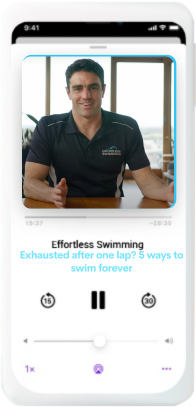
If you find yourself gasping for air after just one lap in the pool, this episode is for you. After coaching nearly 10,000 swimmers over the past 19 years, I’ve discovered that mastering your breathing is one of the quickest ways to transform your swimming.
In this episode, I’ll show you how to regulate your breathing so you can swim lap after lap without feeling exhausted — like taking an evening stroll in the water instead of fighting to stay afloat. You’ll also learn the number one mistake most beginners make that can stall their progress for months, and how to fix it fast.
Plus, if you’re new to swimming, don’t miss our free 7-day email series that breaks down every key part of your stroke to help you swim more efficiently and confidently.
01:14 Why Does Your Breathing Matter?
01:42 Breathing In
02:16 Are You Exhaling Enough?
05:36 Time Your Breathing Correctly With Your Stroke
06:53 Breath In The Correct Position
08:20 Breathing Patterns
10:14 Keeping The Heart Rate Down
10:54 Drills
12:00 Adapting To Openwater
Join a camp:
https://effortlessswimming.com/camps/
FREE Freestyle Technique Checklist ➡ https://effortlessswimming.com/freestyle-checklist/
A simple 1-page guide to help you spot what’s holding you back in the water.
7-Day Freestyle Fix ➡ https://members.effortlessswimming.com/7-day-beginner
One tip a day for a week to help you swim further without getting tired.
Courses Membership ➡ https://effortlessswimming.com/courses-membership/
Get access to all of our online courses, drills, and training plans.
Transcript
Read the full transcript
Welcome to the Effortless Swimming Podcast to show that help swimmers and triathletes love the water, become a better swimmer and live a better life. Here’s your host, Brenton Ford.
If you’re gasping for air after just one lap, this video is for you. In this video, I’m going to show you how you can regulate your breathing so that you can swim 100 laps without stopping instead of being completely gassed after just one. I’ve coached almost 10,000 swimmers in person over the last 19 years of coaching. And I found that this is something that you can change fairly quickly once you know how to do it correctly. So in this video, I’ll share with you how you can regulate your breathing so it feels like you are out for an evening stroll instead of feeling like you’re being dunked under in big giant waves where you feel like there’s panic and that you’re going to run out of air very quickly. And at the end of this video, I’ll share with you the one mistake that most beginners make that causes them to lose or waste the next six to 12 months of their swimming because they don’t fix this one mistake. And if you’re a beginner, check out our seven
day free email series to help you with all the different parts of your stroke that you need to get in place to help you with your swimming. I’ll link to that in the description below. Now, why does your breathing matter? Well, without oxygen, you’re going to have no energy to put into your swimming. So we need to learn how to breathe in a relaxed way and a comfortable way. And it’s probably not that your unfit is that you’re breathing inefficiently. So the goal is to stay relaxed and not gasp for out. So the way that we do this is we obviously need to breathe in above the water, exhale below the water. When we breathe in, we’re not trying to fill up our lungs to 100%. It might be 70 to 80%. So it’s like if you’re going for a walk, you’re not going to take in as much as you can to 100% and then exhale fully. We need to keep that breathing range in sort of 20%, 30% to about 70 to 80%. So we’re never going above and below that range, because
that’s just not sustainable. And we don’t have the time to inhale that much or necessarily exhale that much. The other important thing there too, is that we need to make sure that we are exhaling when our face is in the water. One big mistake that people make here is that they never really exhale enough. So it’s like they’re just topping up and topping up and topping up. And that’s why they find after a lot they’re completely gassed because they’ve never exhaled enough of that carbon dioxide to be able to get rid of it and then not get that lactic acid sort of feeling. So we need to make sure that we are exhaling when our face is in the water. The way that I teach people to do it is gradual exhale when your face is in primarily through the nose, but it’s fine if it’s through the mouth as well. A gradual exhalation on our faces in. And then as we’re turning the head to breathe to get that next breath, that is when we want to release the rest of the air.
And we’re not trying to release every last drop of air that we’ve got there. It’s releasing majority of it, but you’ll still have that little bit left because we don’t have time to completely clear the lungs. So light exhale, bigger exhale as you’re turning to get that next breath. And then we’re ready to inhale. When we inhale, it’s like a sip of air. So it’s not this big gasp of air, it’s like a sip of air, because you’ll find you don’t actually need that much to keep your heart rate down and to be comfortable. So when we inhale, think of it as a sip of air. And don’t open your mouth up too much, because if you’re going for this breath with a big open mouth, you’ll find you’re taking a lot more water. Whereas if you look at the best ones in the world, when they’re taking a breath, it’s almost like they’re reaching around with their mouth, getting that sip of air, and then coming back. And that smaller hole that they’ve got means that
they’re not taking water in. And it also just helps them take that quick sip of air. So you probably need less air than you think. Now I know that can be hard to hard to grasp when you feel like you’re completely gassed after 40 meters or so. But if you can regulate your breathing from the start of a lap like this, you’ll find that you can continue much further. So we’re not trying to hold our breath. We generally want to make sure we are constantly exhaling. The only time you would hold your breath is if you’re doing a breath control set, where you might be breathing every five strokes or seven strokes. But if you’re watching this video, that’s probably not what you need to be doing right now. Hey, real quick, in case you didn’t know, we run swimming camps around the world from the Maldives, Thailand, Japan with Sundays, Galapagos Islands, plus a bunch of new locations for next year. So if you’d like to join us at
a future camp and improve your swimming and explore and experience some of the best locations to swim in the world, then go to effortlesswimming.com forward slash camps. We’ve got all the dates and locations listed there. A question I get all the time is I’m not that quick. Will this camp be suitable for me? We have a wide range of speeds and abilities come to the camps. So as long as you can swim a kilometer, there’s a very good chance that these camps will be suitable for you. And if you’re not sure, just get in touch with us and we’ll make sure that we do find you a suitable camp. Thanks for listening. Let’s get back to the podcast. Now the next step to regulating your breathing is make sure we time it correctly with the stroke. Because if your breathing is out of sync with your arms and your rotation, then that’s going to make it very difficult to achieve. So to make sure that we are able to get the breath comfortably, we need to
make sure that as one hand is coming forwards and we’re rotating onto the side, that’s when we’re starting to turn the head. So the head will go in time with the body roll. So we’re coming forwards here. This arm in front is going to give you something to balance on. So if you keep that arm reaching forwards and just take a little bit of time extending out, you’ve got your balance there. And as we rotate about 30 or 40 degrees on the side, that is when you can turn the head. And so by the time you finish reaching forwards and you’re on your side here, that is when you are ready to inhale. And then we inhale and then as this arms coming back around, we bring the head back with it. So think about turning the head in time with the shoulders and back with the shoulders. What a lot of people tend to do is they will rotate on the side and then they’ll turn the head and then they’ll come around. But it’s out of sync. And so they
feel like they don’t have enough time to get the breath because they’re turning their head too late. It’s also important to make sure you breathe in the correct position. So if you are taking water in when your head’s off to the side, it could be because of the position of your head as you’re breathing. The mistake most people make here is they lift up first, then they turn their head and the top of their head is well above the water. Instead of having their bottom goggle in, half their head in, half their head out. They’ve got the top of their head up too high. Now what’s the problem with that? Well it’s very hard to create this little bow wave around your mouth if the top of your head is too high because you need this part of your head in the water to be able to create that little bit of a bow wave that helps you get that breath low. So the way I would teach this is think about having a skewer through your head, neck and spine. When we turn to
breathe, we turn the skewer and the head’s on that skewer so it just turns and then it comes back. It doesn’t come off that skewer because that’s going to break that line. That way you can get the breath low and you can also make sure that that bow wave’s there. If you’re learning this, it’s totally fine to turn a bit further and maybe have the head up a little bit higher as you’re getting used to it. But ultimately we want to try and get that breath relatively low, relatively quick and that way it’s going to sink in nicely with your stroke. But I don’t mind if you turn a little bit further as you’re learning it and then we can start to bring that back to the optimum position. Now let’s talk about breathing patterns. You’ve probably heard many contradictory ways of doing this in terms of how often you should breathe. This is a very individual thing. One thing I see a lot of with beginner swimmers is they try and take
too many strokes in between breaths. So they might not be taking a breath for five strokes or so. Now even with really fit really good swimmers, if they are trying to hold a breathing pattern of every five strokes or seven strokes, it is not sustainable for a long period of time especially if they’re going hard. So I would suggest either breathing every two strokes or every three strokes. Now depending on the level you’re at, every two strokes you aren’t going to get more air in and that’s priority number one. We need to make sure we’re getting enough oxygen because without it you’re going to tire. But it is good to be able to breathe to both sides and so it’s an important skill to develop. Breathing every three strokes you will be breathing to both sides but you can still breathe every two strokes and cover your bases there. You might go one lap breathing to the left, one lap breathing to the right. So I want you
to develop that skill of bilateral breathing but it doesn’t have to be breathing every three strokes. So if you find that breathing every three is not sustainable, go to every two. That’s what I prefer. A lot of elite swimmers prefer breathing every two but they will mix it up in training where they are breathing to the other side. At least for 20 or 30% of their session if not more. So there’s no hard and fast rules and it can change within a lap. Let’s say you’re swimming 50 meters you might breathe every two strokes off the wall for 10 strokes then you might go to every three and you might go back to every two before you come in for the turn. So there’s no hard and fast rules there. Mix it up and just see what works best for you. Now to help keep your heart rate down as you’re doing this we need to keep relaxation in our body and the way that we move. Now not so much relaxation that we’re just like this noodle in the water we need to have a
little bit of tension to hold our shape and hold our form but we really need to make sure that we’ve got this softness and suppleness about the way that we hold our body and we move through the water. So if you’ve got this tension in your jaw and in your stroke and in your body that is going to use a lot of energy even though you’re not doing a whole lot it’s that unnecessary tension that can cause you to have an elevated heart rate and tire a lot quicker. So I really like to do some drills in the water some exercises in the water where we work on that softness in the body. Now one of those drills is hang floats where you can take a breath in you can hold your breath and just floating in the water and that can help you relax through the shoulders relax through the legs relax through the body and help you just kind of switch off and get comfortable. You can also do sink downs which is breathe in then gradual exhale and as you gradually exhale you
find yourself probably sinking to the bottom if you don’t have a lot of buoyancy you might not completely sink down but we want to get comfortable having not much air in the lungs and we repeat that about 10 times. So you’ve got hang floats sink downs and then you can also do some floating drills as well where you’re floating in a ball and then floating on your front with both arms extended and both legs extended trying to be horizontal in the water and this way if you learn to keep this suppleness and softness about your body that removes a lot of the unnecessary energy that gets used because we’re holding this tension that we don’t need. Now when it comes to adapting this to open water some of these rules will go out the window because in open water we don’t have this calm flat conditions like we do in the pool we’ve got ways and we’ve got chop and we’ve got this unpredictability about it. So when it comes to open water you may have to
turn a little bit further to get your breath you may need to lift up and sight first before you turn to breathe. You’ll also probably find you need to breathe to both sides because depending on which way the chop is coming you might have to turn and breathe to your non-preferred side so that’s why it’s worthwhile learning to breathe to both sides. So some of these things will change when we go to the open water but what won’t change is the regulation of the breathing making sure that you’re inhaling and exhaling in the correct way and if you have any sort of tension or panic when you do hit the open water what I would suggest is start small is go near the shoreline go with friends or other people in a place where you can stand up and go where it’s nice and calm and then progressively build up what you’re comfortable doing and if you can eventually get to this point where you’re in very choppy conditions which as a beginner you might feel like oh this
is just not not safe or not comfortable if you can begin begin small and then eventually get yourself comfortable in these bigger conditions that there’s a lot of chopping waves then you will really start to find that you can kick this heart rate down you can regulate your breathing in conditions that you thought weren’t possible beforehand but I think start small and then gradually build it up if you enjoyed this video take a look at this video here which has got our 33 minute breakdown of the full freestyle stroke that will help you swim faster for a whole lot less effort thanks for listening to the effortless swimming podcast if you’d like us to help you become a faster more efficient swimmer go to www.effortlessswimming.com