








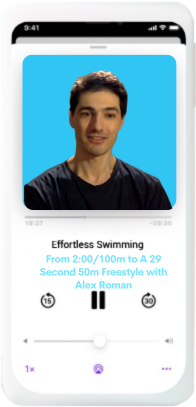
Imagine teaching yourself how to swim, never having a coach, never training in a pool, just figuring it out by watching others. That was Alex Roman’s reality for most of his life. He swam to survive, but certainly not to thrive. But one day, a swimmer effortlessly glided past him in the open water. And it sparked something, curiosity, what made them so fast, and what was happening beneath the surface that he had never considered.
That moment sent Alex on a journey of discovery. One that transformed him from a struggling swimmer with inefficient technique, Doing slower than two minutes per hundred into someone now who competes at national meets and swims a 50 meter sprint in under 30 seconds. His improvement wasn’t just about training harder.
It was about training smarter. And in this episode, Alex shares the pivotal moments that fueled his rapid progression. The techniques and the drills that made the biggest impact and why understanding the science behind swimming changed everything for him. If you’ve ever felt stuck in your swimming or wondered if it’s possible to make huge gains as an adult, this episode is packed with insights that could change the way you approach your own training.
So let’s dive into it.
In this episode
- 10:58 — What Are The Big Things That Should Be Improved?
- 13:38 — Tuning On How Your Body Feels
- 25:35 — Controlled Chaos
- 30:55 — The Importance of Warm Up
- 36:28 — Building Strength
- 37:42 — Getting Feedback
- 39:53 — Drills
Links from this episode
- Get your NanoClear swimming goggles here and get 15% off your first purchase with code PODCAST15.
- https://effortlessswimming.com/camps/
- Change your technique and swim a smoother, easier freestyle with the Effortless Swimming membership
Transcript
Read the full transcript
We tend to focus on parts of the stroke rather than, let's say, take a whole course of swimming and not think about it, just go through and finish the course and improve the whole thing holistically. For someone who ends up looking at your videos, it's probably looking to improve some part of the stroke. And so what I think is important is to find a way to identify actually what you're struggling with. It's not always obvious because if you have been swimming until a certain point, you already feel natural with whatever you're doing. So you should, I would recommend getting feedback from someone, either you send them the videos and then pointing them out to you and then you work on those. Welcome to the Effortless Swimming Podcast to show that help swimmers and triathletes love the water, become a better swimmer and live a better life. Here's your host, Brenton Ford. Imagine teaching yourself how to swim, never having a coach, never training in a pool, just figuring it out by watching others. That was Alex Roman's reality for most of his life. He swam to survive, but certainly not to thrive. But one day, a swimmer effortlessly glided past him in the open water and it sparked something, curiosity, what made them so fast and what was happening beneath the surface that he had never considered. That moment sent Alex on a journey of discovery, one that transformed him from a struggling swimmer with inefficient technique, doing slower than two minutes per hundred, into
someone now who competes at national meets and swims a 50-meter sprint in under 30 seconds. His improvement wasn't just about training harder, it was about training smarter. And in this episode, Alex shares the pivotal moments that fueled his rapid progression, the techniques and the drills that made the biggest impact and why understanding the science behind swimming changed everything for him. If you've ever felt stuck in your swimming or wondered if it's possible to make huge gains as an adult, this episode is packed with insights that could change the way you approach your own training. So let's dive into it. I was always self-taught when it came to swimming. I never had a coach, never swam in a pool until I was, I think it was always in the sea, back in Romania or in France, where I lived for the first time, I saw the first time, and then I picked it up by watching people and just, you know, being able to crawl away. And you could see in that video what the result of that was, but I never improved. It was something that really my teens and then kept me from drowning. And there was a funny event once on a holiday, when I went to work with my wife in Greece, I was swimming away and I didn't think of myself as being a really awful swimmer, but someone just zoomed past me, swimming. I thought I must be wearing fins or some motor or something. They were so fast. And it got me curious. So I looked on the internet to see what happens on the water. They never picked my curiosity. When you look at swimming, you know, at the Olympics and so on, most of the footage is above water and most of the swimming happens on the water, right?
And when I looked it up and I saw the plethora of technique and things that happened and that can be improved. So that got me curious. And I said, fine, let's find a few videos and maybe I can try to mimic those and try to imitate them. And I discovered a few things that blew me away. One, because I'm a mathematician, you know, on my work side, on my professional side, and I discovered that for me, swimming is almost the opposite of mathematics, is that the theory is so simple is you look at a video and it forces your videos when you explain the drills and so on. It looks very intelligible and then very easy and so on. And the moment you try to do it yourself in the pool, it feels horrible because you can't replicate it. And you feel that it's not working as well. Whereas in mathematics, it's sometimes the opposite, is that you see something happening in real life like an experiment. And it just happens. You can see it works. You can see that it's true. And then when you try to prove it mathematically, it can be a horrendously difficult task. So when I was through that journey of learning technique, and I realized that it's an incredibly technical sport and the amount of things that the brain has to coordinate. And as an adult, they found out to be much harder than sports that I learned when I was young, when you rely more on your intuition. So here, my brain was constantly overloaded when I was trying to
do things or trying to focus on one thing. And everything else fell apart. Like my legs were not doing anything correctly anymore because I was focusing too much on the arm and the breathing and rotation. Everything else. So I quickly realized that it's overwhelming as an adult to try to coordinate everything. And you have to focus on things at a time, try to be patient and so on. You don't have the luxury of being a four-year-old and being told, you're doing that wrong. And then change that. And then you go, OK, I'll change it. And it's fine. And then no longer think about it. I was asking my mates at the swim club if they remember learning how to swim. And most of them said, no, I don't remember exactly. I don't remember the process. We just went away. We did it. And now it's muscle memory. So translating that mental effort, the brain effort into muscle memory was an incredibly rewarding journey for me. Maybe I'm a personality or because I'm an academic. But I found the challenge itself to reprogram the body, essentially. You have to fight with your brain at the same time to let go and to allow feeling to take over and then gradually translate into muscle memory if you know what I mean. And I'm sure you've discovered this while working with adults all the time. It's harder for them to change things. In my case, I might have been luckier that I didn't have swimming background to have to change something that I had been doing for a long time.
I kind of started fresh. But still, I have to change that horrible swimming that I have in the series or in my first video into what I'm doing now. It was very rewarding. In my opinion, I don't think humans were born to swim. Almost everything we do optimally in swimming, I found to be done nowhere else in life. And there's nowhere else in life where we do this. And all sorts of movements. You can't breathe whenever you want. That takes up 90-something percent of all of the sports. So it's an interesting challenge that I really, really enjoy the fact that I'm reprogramming my body and trying to teach my brain to let go, translate all that into muscle memory. And I have to trick my brain into doing that because I discovered I can't convince it to let go. And maybe that's just me. But the process in the end, it translates into finding or constructing sets that rely on that process of doing things gradually. So you focus on some things at first, or one or two technique elements, and then you maybe increase effort gradually and so on until your brain can't really keep up, think about it too much and so on, allowing muscle memory to take over. And I can talk about some of my favorite things later on, but that was, let's say that was the process. What actually happened was I progressed very quickly in the first two or three months. I found some more videos that I could give you. I think one or two months after I started with your videos, with your free videos online,
I was already able to swim maybe less than 40 seconds on 50 meters, which was previously unheard of for me. Within maybe four months or so, I was able to swim in the, like you saw me in that second video when I was in the flume. And I went to that flume session to try to discover things that I'm doing wrong and see myself, because in the UK, you're not allowed to swim in public pools. Sorry, you're not allowed to film yourself in public pools. So I had to find other solutions for that. But I would say within four or five months, I went from 230 to minister, put 100 meters down to maybe 130 and I can't say that I remember all the things that helped me improve along the way, but I remember some things very clearly, stuff that I struggled with. And the moment I realized that I can't rely on YouTube videos anymore, I need to see myself and I need other people to see myself and give me more prompt feedback. As in, I can see you're doing this wrong, now go back and do it this way. Rather than having to wait a few weeks, maybe someone sees my video, then come back and so on. The immediate feedback process I found to be extremely rewarding. So I flew out to different countries. I wasn't able to find much help within the UK. Masters clubs have a routine of their own and most of the master swimmers have swimming backgrounds. So coaches are already very full and there wasn't much available camps.
I found to be on the expensive side at first and I was really interested to be working with someone one-to-one and get that immediate feedback and then work together and so on. What you would do in a camp, I would imagine, but even more attention to myself. So I flew to Romania, found the coach. He's a former national champion, 400 meters by the way. His name is Alex Nexu. And brilliant guy, we bonded very quickly and we spent a few days together, but we were a few hours in the pool every day.
And I remember that as being one of the highlights of my swimming journey. The fact that you have that immediate feedback, but that aside, you get someone to see the things,
the biggest things that you're doing wrong or you could improve, telling you how to improve them and so on and going back again. And the other part is adapting to the swimmer, which is something that you talked about in many videos as well. There's no recipe, right? It's every swimmer is different and you have to be able to see what a particular swimmer struggles with and then adapt to be able to help them rather than prescribe things. Like you go through this program and see what you come up with. Because most of us as adults don't start from scratch and are no longer four years old.
So that improved a lot of things at the very beginning, but you learn a lot of lessons along the way, but maybe rather than allowing me to ramble on, we can let the discussion flow and take some questions from you. Because I'm very curious to see what you'd like to find out. Yeah, well, thank you very much for that. That gives me a lot to go with and a couple of questions that come to mind. So what did you first notice when you saw that video of yourself swimming or when you had that moment where you wanted to get better at swimming? What was the first one or two things that you thought you had to do to get quicker? Because that progression, that first three, four months is a very big jump in speed. So what were some of the main things there that you realized you had to change? That's a very good question. You're challenging my memory right now. It's easy to say now what I noticed in that old video, what are the big things that should be improved? But back then, when I looked at my video, I don't think I noticed that many things because I didn't have knowledge about swimming and didn't speak to anyone to tell me what the things should be, what the big things ought to be improved. But I was noticing that my arms were almost completely straight.
So the moment I was entering the water, I was just blotting along. And that was a big difference to what you were showing. So I learned many technical terms from you in the beginning, you know, the high catch and I learned so on, blah, blah, blah, all that. And I realized, well, it makes total sense. You know, you're just getting, first getting to a position, then you want to push water behind you rather than pushing down. Putting pushing down doesn't propel you at all. So I was one thing that I was trying to improve a lot. And I can answer one of your questions is that, I remember struggling with that side of my journey in the first weeks very much. The fact that I got so used to pushing water down, that I was relying on that motion for support to keep my body horizontal. And the moment I was trying to get into your high elbow position, I felt like I was sinking because I didn't have that pushing down in the water feeling and I had to overcome that. And that took a long time to switch from that windmilling, slow windmilling that I was doing to a proper propelling position. Breathing, I don't remember struggling with that much. Kicking was a struggle and still is. And body position still is an issue because now I'm trying to get very fast. And I noticed that I'm still not as horizontal that I would like to be.
But yeah, I think that sinking feeling, the fact I was windmilling and pushing down
rather than trying to push water behind me. And the moment I was trying to push water behind me, I felt like I was sinking because I didn't have the support anymore. And in terms of what you feel like you're doing in the stroke now, how does that change from a year, two years ago? Like what are the things that you're feeling for or trying to do now compared to when you first started? You mean what I'm working on to improve right now, for instance? Yeah, and how you, because one of the things you mentioned is that going from kind of overthinking to having to tune in to how your body feels. So what are some of the things you're working on and what are the sensations that you're trying to work towards that you know is a good stroke? Yeah, that's another very, very good question. So the thing is that the thing that I feel is holding me back a lot right now is body position. So I don't have, let's say, an optimal body for swimming in that my legs are very long. My torso is shorter. So my center of gravity, my center of mass is actually towards the legs. If I try to, let's say, float face down in a cross position where you're neutral and some people are just able to remain horizontal about what and the legs are not sinking. My legs go boom instantly, right? And this is a test that a new friend I made is a former Canadian Olympic triad
and an incredible guy, so he explained this.
Some people have the body for swimming and that helps them more and they don't need to rely on the kick. Those who don't, like me, need to rely a lot more on the kick and on the core to keep you up. You would want to be as horizontal as possible. In my opinion, I think if you were to rank what the most important things are in swimming, I would rank this to be very high. I'm not sure what else could be higher maybe, but being as horizontal as possible because anything else that sinks means you're drag water. You drag yourself through water, so you create drag. So you would want your, let's say, your head and your hips and your heels to break the surface when you're swimming face up and that would ensure a horizontal position. My hips and my legs are sinking and I've been more recently working more on that, trying to find a way to bring those up and to understand why that happens. And in my opinion, the reason why that happens is that I haven't yet developed a good synchronization between my stroke and my kick as well as the rotation. So, you know, that hip-driven stroke, so you would like your kick to drive your stroke and to drive the rotation. I'm trying to get there. Initially, I focused on learning a two-bit kick a lot more than any other type of kicks and I found that to be very hard because I wasn't able to coordinate the two-bit kick either and it's much harder than it maybe is for others. It was very hard for me. But I got there in the end somehow, but now I have this new problem because I don't really like long-distance swimming.
I know you're the opposite, but I like sprinting. And in sprinting, you need to have a very powerful kick and your legs need to be working over time. So, I would like to learn a six-bit kick and that six-bit kick to actually work with my stroke rather than just be erratic. And you need a good coordination. So, I'm trying to learn that coordination. So, what do I do or what I'm in the process of discovering what works for me? I have discovered some things that I think work better for adults than kids. The kind of sets that I've been designing for myself that helps from others is,
let's say you take an hour and I focus for the first 20 or 30 minutes on doing technique work. And I focus on just one or maximum two technique elements at a time. I don't try to do more because then it's too much for the brain. And if I do two elements, then they should be correlated. If it's maybe breathing and catch or stretch and catch, things like that. But if I'm doing kick or rotation, I usually stick to just one. The drills, so you do a lot of drills for the 20 minutes. And I think it's important to take time with the drills. I know some people say that you should do drills at speed in order to start learning. And that didn't work for me very well. But what I do is you work on drills for about 20 minutes. You mix drills with swimming. So you don't just do only drills. Then for the past, for the last 40, 30 minutes, I do, I try to do something that I was mentioning before is where I go gradual. Let's say 25, length of 25 meters or 50 meters.
And I start with them doing as slowly as possible. And I try to hit exact times. If I do 25 meters, I would start from maybe 20 seconds per 25 meter. And I try to hit exactly 20 seconds. So I force myself to go easy so that I can focus on everything I'm doing. But I'm mostly focusing on just that technique element that I worked on for the first 20 minutes. So I do that maybe five, six times. And I take enough rest between the 25s. I don't want my cardiovascular system to become a limiting factor. So I don't want to push myself too much because I'm working on technique skill.
On the next six lengths, I decrease that to 19 seconds. And again, I time myself. I want to hit exactly 19 seconds. It also helps me to learn pace. So what 19 seconds fail and so on. But again, I'm focusing on rotation. For every length, I focus only on just rotation. I don't care about my arms. Maybe my arms are not optimally doing things and so on. But I focus on that or the kick, the kick tempo, kick synchronization. I want to feel the kick driving my stroke and helping the rotation. And then I drop to 18 seconds. And I go to 17 seconds and 16 and 15 and so on until I reach my BB on whatever that length is. And every time I drop one second in swim speed, I also increase my rest time between legs. Again, because I don't want my cardiovascular system to limit me. And I found this to be very helpful for me. I was able to improve a lot with this kind of sense because it kind of tricks my brain. Going from one stage where my brain could think about everything that was happening, especially that technique element, to going full out, but very gradually losing control and allowing muscle memory to take over feeling. And you insist on this for maybe a couple of weeks. I think it's important when you work on drills to insist on things and to allow enough time to this. So that worked for me. That allowed me to progress a lot.
And you take one technique element and you insist on that. And you do just that with this kind of sense. In my case, it was speed because I like to work on speed. If you want to focus on other things, I don't distance swimming and so on. You focus more on efficiency, for instance. You focus on the technique of the stroke or your two-bit kick or no kicking at all if you want to work your core a lot to streamline through and so on.
It worked a lot for me. And even small things like finishing the stroke at the very end of past the hips, I want to still be able to push water, things like that. You shove one second here and there and it's rewarding enough. But yeah, that's one approach that really helped me. The thing I really like about that is when you force yourself to go a specific time, you're really developing those different gears that you can shift between, which a lot of people, especially who are newer, it's something that I see that they tend to struggle with. They have just got that one speed. And so when you're having to be that specific about what pace you're going, then you're going to figure it out what you need to do to get quicker. And especially I think in the early days when technique is usually the worst when you first start and it's going to get better as you progress as a swimmer. But in those early days, technique is such a big aspect of it that it's really worthwhile taking that time. And especially if you're sprinting, so if you're doing longer distance stuff, if you're doing triathlon, you're going to need to have that base level fitness and swim strength to get you through the event. But if you're sprinting, well, it's very much about being refined with your stroke and it's not about doing long, long distances necessarily. So I think that approach can be so much better for sprinting too. So… I like what you touched on just now because it helps during races as well.
So, you know, every race has a certain strategy to it. Unless you're doing a 50 where the focus is not to focus on anything, you just go. But if you're doing anything else from 100 onwards, you have some strategy on each length to follow. Knowing what each pace feels like, you know, having learned that and you can actually strategize better. If you want to go slower or faster and you want to bring your kick into the third part of the race or be more efficient, you have stronger, you know, longer strokes on the first part of the race, whatever you'd like to do, your body already knows how it should feel. So I think it's easy to strategize and it works for longer distances and there's more strategy on longer distances, obviously. For open water, I don't know. I never competed in open water. I just swam open water, but from mates that are doing open water, there's strategy there as well, depending on the race and if it's 5K or more and so on. But yes, I think you're perfectly correct. It's worthwhile teaching your body to know what each pace feels like.
At Effortless Swimming, our mission is simple. Make swimming more enjoyable. Whether you're training for your next race, swimming for fitness or just love being in the water, we're here to help you swim faster, smoother and with more confidence. And one thing that can make or break a swim is your goggles. If you've ever struggled with foggy lenses mid-session, you know how frustrating it can be. That's why we've created the Effortless Swimming Hydro Clear Anti-Fog Goggles, the long-lasting crystal clear vision. I've been using them myself and the difference is nice and day. I'm not the only one. Deborah swam 36 kilometers down the Derwent River and the entire time her vision stayed crystal clear. No fog, no frustration, just an uninterrupted swim. So what makes a hydro clear goggles different? It's all in the technology. Unlike ordinary anti-fog coatings that wear off over time, hydro clear super hydrophilic technology is built into the lens material itself. Here's how it works. Instead of fog forming as tiny droplets, water spreads evenly across the lens, creating a thin film that prevents fog from even starting. And the result? Consistently clear vision, swim after swim. And the durability? Our lenses are CNAS certified. Tests show that even after 2000 rubs with a wet cloth under a 200 gram load, the lens stays fog-free. No gimmicks, just serious performance that lasts. Using them is simple. Just wet the lenses before putting them on and you're set for a fog-free swim.
Ready to see the difference yourself? Get 15% off your first pair of hydro clear anti-fog goggles with the code podcast at shop.effortlesswimming.com. That's 15% off your first pair of goggles with the code podcast at shop.effortlesswimming.com. We also have a 30-day money back guarantee. So if you're not happy with the goggles for any reason, you can simply return them for a refund. Don't let foggy goggles ruin another swim. Try hydro clear today and experience clear vision from start to finish. And one of the things with sprinting, and I think Laura Quilter might have mentioned this, but it's controlled chaos. It's where you've got to just like, you've got to let yourself go. But within that letting yourself go, you've got to have that form and control to it. And just in terms of developing the kick, a couple of things that I've seen working well for people is like with kicking. So kicking in different at different angles. So kicking on the side, kicking on the back, kicking on the front, working the kick in different directions is one. And I think whether or not it's sprinting or longer distance, like just some resistance work with the parachute, it can be really helpful. And then in terms of… I'm sorry to interrupt, I'm smiling because that's precisely one of the steps that I'm working on now, suggested by someone else. The technique part that I'm doing in the first 20 to 30 minutes has exactly that half superman on one side, then at the angle, kicking up rotation, but yeah, kicking at different angles so that you're spot on. Yeah, good, nice.
I would like to peek ahead on more things than this, but yeah, you're totally correct. Also, something that I would want to say is that I'm very enthusiastic about swimming because I'm still learning, you know, and I find it incredibly rewarding. And when I talk about it, it sounds like I'm talking with authority. I have no idea what I mean. I've learned a lot and I love it, but in no way I'm an authority on this, but it's just enthusiasm. I wouldn't want people to confuse it with trying to teach anybody anything I'm still learning myself. It just sounds repetitive, but it's not. I'm just thinking about it. Well, you can speak from your own personal experience, though, having gone from 230 down to 106. I mean, that's a big jump, and I think most people would be pretty happy to have that result in their swimming, so people can take a lot from that. I think it's very, very, very doable. As you probably discovered working with adults as well, there's a mental block as well where they start with the idea that, you know, I'm never gonna be an Olympian or you're never gonna compete against them, and it's fine, it's perfectly fine, but that doesn't mean you can't improve down to maybe even give them a minute. I think it's important not to put any limits when you start. You just discover how low you can go, and that's an incredibly rewarding journey itself, and then you discover that you can actually compete, you can go to meets, and then you meet incredibly gifted and experienced people as well, so you learn a lot. There are things that I would say are important that I would have loved to do or loved to know,
but at the same time, you can't discover everything at first, you know, it's a journey. But I wasn't taking, for instance, I wasn't taking warm-up seriously, not warm-up in the pool. I mean, warm-up, you warm-up your body because, you know, as adults, I think we need more warm-up time, and I developed a little bit of injury from straining my shoulders. I have an anatomy imbalance on my right side, my rib cage is a bit sunk on this side, so it impinges on my shoulder, and so my shoulder anatomy on the right side is a bit odd, and swimming doesn't cause any injuries, but it makes it worse because there's thousands and thousands of rotations in each session, so stretching before sessions I think is important. I think everybody should do that and take it seriously. Muscles are not that big of a problem with age. Apparently they adapt very quickly to age and to effort, depending on the age. The tendons is not the same ballpark. Tendons take a lot longer to warm-up and you want them to be elastic.
Most of the injuries are, I mean, most of the lasting injuries and the problematic injuries are in tendons, and that's where I've been developing. Recuperating, I've been working with physios and so on, so I've been doing that. And also then, besides that, some land training, those kids who started at four years old, they had a lot of land training as well, and they've been developing their shoulder muscles and back muscles a lot for swimming, and the bone structure also evolved with swimming, so it enables swimming in a different way. Someone who takes swimming out like me at 42 years old doesn't have those tendons and muscles already developed to help them, and so on, in my opinion, important to look after them and develop them. So besides swimming, so besides what you do in the pool, I would encourage taking time to work on the shoulder and back muscles, and if you lack the time to do too much, just do pull-ups. In my opinion, everything from all the land training that I've done, pull-ups are the number one exercise that I could do and drop everything else and to still cover a lot of what I need for swimming. And then you reduce the risk of injuries. You have your body there to help you more for swimming because you want to have that strength. You can then focus on the endurance part and develop in your cardiovascular system that swimming can do that for you. I don't think you need to take up running as well, but it helps, things like that. So there are plenty of stuff that I need to talk about.
I'm sure, like I said, I'm very enthusiastic by it, but I will now ask more questions because your questions are more interesting than I have to say. That's good. It's a couple of things you touched on there, like warming up before a session. Like I'll wake up, well, I get up way earlier than I need to before a training session in the morning, but I'll do five, 10 minutes of kind of like a yoga routine just to go through those different movements and warm up the muscles and the tendons and stretch a bit, particularly through the shoulders, hips, back, and I find that that makes a big difference prior to training early in the morning. And then strength training, I think like the last three and a half years I've started to be consistent with gym, two to three sessions a week. And the first six months were quite frustrating because I kept injuring myself from going too heavy, too early, so I didn't build up progressively enough. But then once I had a bit more time under my belt and then I just progressed a bit more slowly with the weights, now it's like I rarely, well, I don't get injured from the gym, but I rarely get like, pull my back, I rarely have those sort of injuries. And I think as we get older, and this is something that I realize now, I'm late 30s, but in your 20s, like generally, if you're active, you've got good strength, you don't get injured, things are good. But I think for adults, it's just, it's something that really should be considered during at least two sessions a week.
And there's science about it as well. It's not just what we experience or personal experience, it's the science that supports all this. In my swim journey, I also like to read a lot. So I like to read science, fix stuff about swimming and technique, but also anatomy, physiology, and biology as well. And one of the articles that I stumbled on was about this aspect, the aging process between, I mean, how the aging process affects muscles, tendons, ligaments, and bones. And they all react differently. And I was surprised to find, I mean, maybe not as surprised because I was already feeling it, but the muscles have the least problem to adapt. Whereas tendons are one of the worst and then require more diligence. And in swimming, you want to make yourself as long as possible. So you want your tendons to be flexible. That means you want your tendons to be warmed up and there's no blood flow for tendons. There's no vascularized. So you need to worm up the muscles around them for that worm to translate into the tendon so they become more flexible. It's all the joints and so on. So the stretching part that you were mentioning, I believe it's really important, especially if you feel that you're developing injuries. Most of the injuries in swimming, as you were saying in many of your videos, they come from some technique element that you were doing improperly. And you're crossing the midline, then you start pulling, you're turning,
you have some outside rotation into an internal rotation, and bam, you start pulling on a tendon somewhere. And when that happens, it's very, it's both strange, but also difficult to fix because you want to continue swimming. You should find whatever you're doing, I can say wrong, the technique in swimming in order to stop doing that, but also work on outside of the pool to strengthen that part of the body. Shoulder is an incredibly complex joint, as you know, they have so many things, but one of the good side, one of the good things about it is the same things, because it's an incredibly complex technique, there are many muscles around it. If you damage one tendon, and again, this is scientifically supported as well, you can use or strengthen the other muscles around it in order to take over functions of the damaged part and continue over.
My physiotherapist was a very funny guy, but also incredibly talented. I showed him the MRI that I had just done a few months ago of my shoulder, and there's so many things happening there. Apparently I have two chronic tendonitis, a ligament that has a quasi-complete rupture. There's a slap tear, which is a labrum tear that started forming that, apparently that's the biggest one. And a few other things and so on. And I was scared, when I read that, I thought I should probably stop swimming, this cap go on, but I didn't feel that bad. But it got to the point where it was hurting during sleep, things like that. So I showed the MRI to my physiotherapist, Alejandro Torres is his name, just a shout out. And then he goes, yeah, don't worry about it, there's so many things happening in everybody's shoulders. Anyone who has an MRI in the shoulder will discover tons of things. Chronic doesn't mean permanent, so we can fix that and so on. Probably the slap tear is the most important. We should work on that. And you work outside the pool, but you have to be very careful what you're doing in the pool because you just bring it back if you continue doing the same things. And you spoke about this in many of your videos. Technique is such an important element in this sport because it's extremely repetitive. So anything that you're doing slightly off adds up and can become a big problem. Whereas many other sports where movements are much more varied, they don't tend to be big problems. And swimming may not cause problems,
but it can certainly make things worse because of that. So yeah, I completely agree with you. I wanted to mention this is I think is important, especially for adults, as you were saying, to take the time. Yeah, yeah, absolutely. And I mean, in terms of the shoulder blades and those muscles surrounding it, when people tend to fatigue, they lose the control through those movements. Like the shoulder blade starts to go into positions where it's not, they're not as strong and they're having to use these sort of weaker muscles and it puts them in that compromised position. So I think particularly with the TheraBands, if you can just build some strength through those muscles that are supporting the shoulder blades, that's a big one, as well as obviously the right technique. Because there's so many people that I see at clinics and like, I hope my left shoulder's hurting here. Is there anything technically related to that? And we look at their video and nine times out of 10, it's super obvious of like why they're getting that issue. Like it's just, it's in plain sight. So yeah, if you are having issues with the shoulders, yeah, good chance it is technically related. Alex, anything else that you think would be worthwhile for people listening to this in order to either get quicker, improve their swimming, anything that you've picked up along the way? Yeah, I'm looking through my notes because I found the questions to be very good and I made some notes on this. Let me see if there's anything that is worth mentioning now. I would say with adult swimming, we tend to focus on parts of the stroke
rather than, let's say, take a whole course of swimming and not think about just go through and finish the course and improve the whole thing like wholistically or someone who ends up looking at your videos is probably looking to improve some part of the stroke. And so what I think is important is to find a way to identify actually what you're struggling with. It's not always obvious. It's because if you have been swimming until a certain point, you already feel natural with whatever you're doing. So you should, I would recommend getting feedback from someone. Either you send them the videos and them pointing them out to you and then you work on those. But then the next step is when you're changing something, it needs to feel weird. If it doesn't feel weird, you're not changing it. And then I discovered this early on and then you insist on that weirdness for as long as you need until it doesn't feel weird anymore. And maybe with some coupled with feedback, while you're doing it such that you don't come back to what you were doing previously. So one thing was this, just look for the weird feeling and get feedback all the time because we can't see ourselves in water and you need to feel, it needs to feel weird. It shouldn't feel natural whenever you change something. The other part, maybe
when people look for drills. So I wouldn't recommend someone as an adult taking up swimming to do what I did to start with clips and insist on those parts and then find other clips and insist on other parts. That's what I was doing, essentially. I was looking at one technique element and then what in the pool the next day and working on those and so on until it felt a little bit better and then changing it and so on. Suggesting drills and perhaps this is one criticism I have with most clips that are available on YouTube is that a lot of them are suggesting drills and yours are better because you say if this hurts and so on then you might want to work on this and so on. And the aspect that I found I was missing the drill itself is helpful but because I'm a beginner I don't know how to incorporate that drill into a larger set or into a program that then helps me actually develop. So your full program is very good at this because it's very structured and you do this and you have sets to work on but for someone looking to take bits and pieces to improve one part of the stroke it would still need a full set. Don't just work on drills. As a beginner we don't know what else to do besides the drill and you always need to do some swimming between drills after you work on technique you just do some swimming as well to translate it and so on and so forth. I think we talked about this warm up and so on I have a few more notes here but probably running out of time.
Yeah, I think that's great. Yeah, in terms of drills like I think the mistake I see a lot of people making is that they see they do the drills without the thought of what they're actually focusing on and the purpose of it. Like they just do the drill but what am I actually trying to focus on here? But with almost every drill you could have five, six different things that you're working on with it so you wanna make sure that you're working on something that's specific to you. For example, like a six one, six drill or six kick switch, like I use that drill a lot but it depends on the person in terms of what I want them to focus on with it. Like it might just be your alignment. It might just be the position of your hand in front so you're not up too high. It could be the rotation. Like there's so much stuff you can work on with different drills so it's about knowing the purpose of it. Yeah, so the technique and the drills are super important and then in my opinion what I discovered was working and not working don't focus on too many things at a time. If you wanna focus on kick then focus on kick and find drills that focus on kick. The six one, six for instance that you mentioned is an incredible drill. Whenever I was doing just drills in the beginning it always felt okay. I didn't feel like I was doing it but when I was translating and I was trying to do swimming it didn't feel as great anymore so make sure that you're doing
enough swimming between drills and that you have this gradual transition between drills and swimming so that your brain can learn to let go and you rely on the feeling so you learn that
and maybe one other aspect that I would encourage is after you do enough drill with swimming and so on where is the easy part? Do that part where you allow yourself to feel the water very easily, very nicely. Don't do the drills at too big of a speed don't force yourself if you feel that the pace is too high, no doubt but after you're done with that technical part try to actually get into a regime where you are getting tired so swim enough so that your cardiovascular system is being pushed and then focus on the technique because you want to be able to maintain technique when you're tired. That's maybe one of the biggest aspects in racing, right? If you're not dead by the end you touch the wall then you probably haven't given it enough or you had more in the tank and the other part is I feel the learning part happens best when you're tired because that's when the brain can't actually think about coordinating anything anymore you're too tired to do it. So if you can force yourself to still maintain technique when you're tired, well, don't injure yourself obviously but I think the concept of what I'm describing is clear enough. I think it's important to get into a regime where you have to maintain technique when the body is tired as well and then you learn more. It cements the technique better and having the feedback. It's if you can have someone to look at you
and do that, send the video or someone with you in the pool will be even better than the progression would be almost as a given. Yeah, yeah, absolutely agree. Well, thanks so much for sharing your journey over the last couple of years and lots of good takeaways there and yeah, I appreciate you jumping on and reaching out as well because when I saw that before and after video it looks like a different person.
Like a really, really huge improvement. So the fact that someone can do that in a fairly short space of time as an adult is outstanding. So congratulations on that. I think it's doable and I think it's important and what you're doing I think is important. It's also very hard to make adults believe that it's possible. It's very possible. You just have to obsess a little bit, find the time and then keep to a schedule that's also important. If you don't feel like it, then maybe that's the right time to go and actually do it. Keep to a schedule and the improvements are there to be ready to, it's an incredible sport. It's hard, but that's the nice part about it. Yeah, that's right. There's always something to learn and it's always challenging. So Alex, thanks so much for being a guest on here. Thank you very much for having me, but it was lovely to chat to you. Thank you very much for the work you have been doing and thank you very much for the free videos that you're posting, which are incredibly, incredibly useful. That's my pleasure. Listening to the Effortless Swimming podcast. If you'd like us to help you become a faster, more efficient swimmer, go to www.effortlesswimming.com.