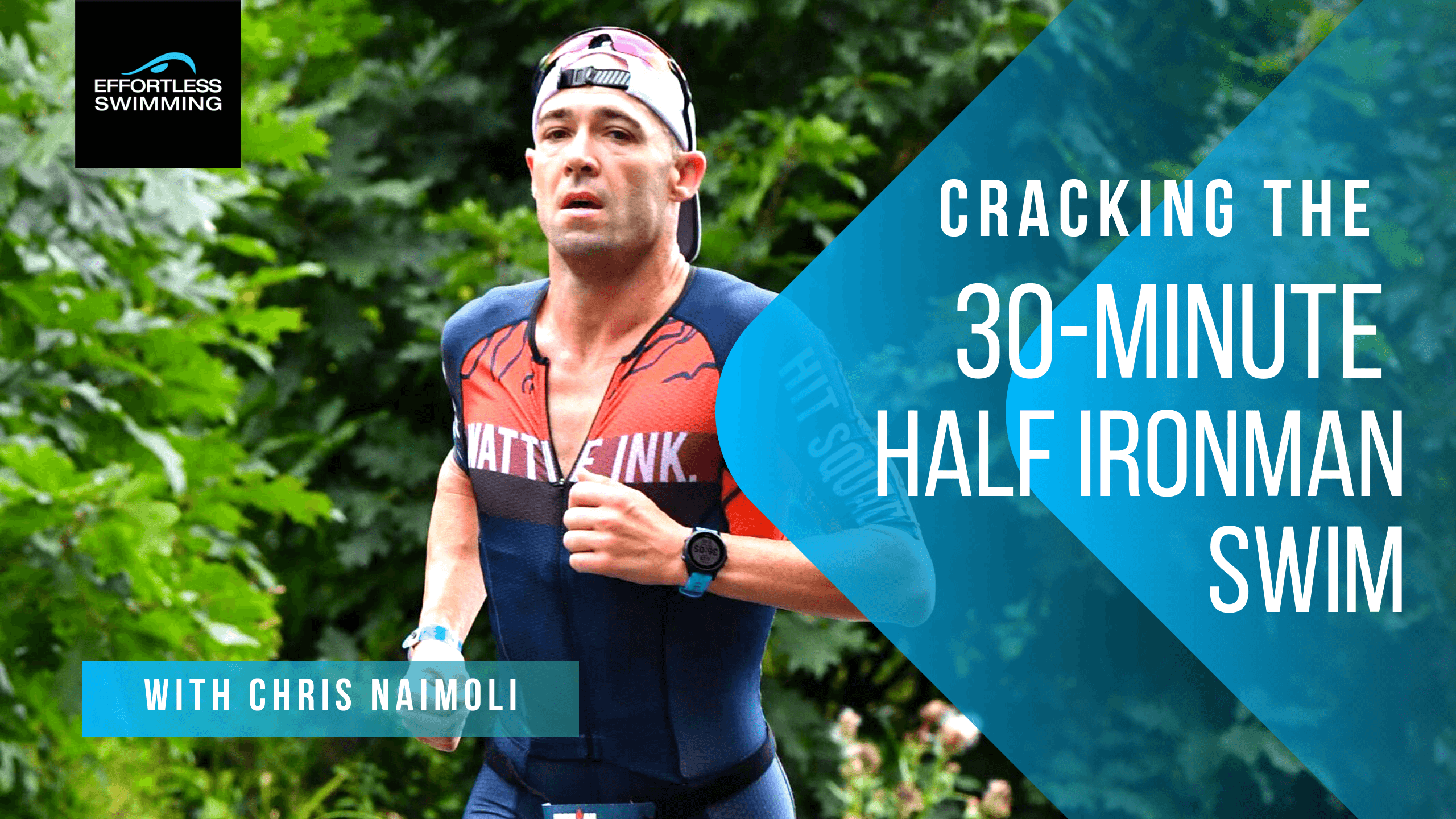








I have been working with Chris for a little bit over a year and recently had a good result in his Ironman swim. I thought it would really good to get him into the podcast to talk about what he has done to improve his swimming.
01:09 Swimming Background
02:40 Swimming In The Dark
04:18 Reluctant To Record A Video
06:02 Ripping The Band-Aid Off
08:03 Get Over That Fear And Talk About It.
09:42 Ironman Race
15:57 Focusing Technique and Drills
17:50 Training Solo
18:42 Confidence In The Pool
20:32 Areas Of Improvement
24:16 Sprinting Faster
Join the 5 Day Catch Challenge
Join the Effortless Swimming Membership
Effortless Swimming Freestyle Clinic
Transcript
Read the full transcript
about that time I started thinking, you know, I need to get some really, some real help here because I could be better. I could be good, but I’m really swimming in the dark here. Literally, I don’t know what I’m doing wrong. And no one could tell me being through a few teachers and it was all very generic. It was nothing really, you know, there was no yeah, it was very I was really literally like swimming in the dark. I didn’t know what to do next to improve or what was wrong. Welcome to the effortless swimming podcast to show that helps swimmers and triathletes love the water, become a better swimmer and live a better life. Here’s your host, Brenton Ford.
Welcome to the effortless swim podcast. This is episode number two hundred and two. And my guest today is Chris Georgeson and Chris, you’re you’re
some Berg and Reese. Yeah. And recently had a really good result for your Ironman swim. And we’ve been working together for a little bit over a year. So I thought it’d be really good to get you on the podcast to talk about what you’ve done to to improve your swimming in such a dramatic way. And we’re just talking before we started here. And really interesting just listening to what’s what’s made a difference for you. So welcome to the podcast. And I guess I tell everyone listening just a little bit about your background with swimming and racing. Yeah. So I think that I always loved the water, I guess, in the in the grew up by the sea. I never really did any swimming with with clubs or anything when I was younger. It seemed a little bit dull, but it’s been lots of time in the ocean. When I sort of obviously was doing a bit of like running and cycling. And a few years ago, I decided to give a give triathlons ago.
So I picked up a swimming again. And yeah, you still there, Brenton? Yeah. OK. I’m sorry. Yes, I picked up the picked up the swimming again. And yeah, and I actually got quite passionate about it. I really enjoyed it. I found that it was a lot of fun. And yeah, really, it just just just became a lot of fun. Really, really enjoyed it. And I thought it was a lot of great. Since I was younger, the swimming had changed as more modern. There was better teaching techniques available. And I sort of obviously came across your channel on YouTube and started to follow and think, OK, I could become a better swimmer.
And you started, I think you were saying your first Olympic distance race was two thousand and eighteen. Yeah, that’s right. Yeah, so I did. Yeah, do you want to talk a bit about where you were in terms of speed and time and just even like when she had with you with your swim, where you’re at two years ago, three years ago. Yeah, that was pretty funny. I think I had a lot of confidence because I’m quite relaxed in the open water. But yeah, I did that first Olympic swim and it was two minutes, sixteen to get around the course, which is quite funny. So that’s quite slow. It involved a lot of over swimming. My sighting was really, really bad, but there was a lot of enthusiasm there. Yeah, and that was that was three years ago now. So, yeah, so that was probably my my starting point, my very first swim. After that, I joined a I joined a local club to try and get some swimming, you know, swim more in a team, see if I could learn from other people.
Were there any coaching programs that I was missing out on? And that seemed to help me a little bit. So by two thousand and nineteen, I did another I did a half Ironman. At this point, I was down to one forty seven for a half Ironman. So that was that was great. I got I got rid of a lot of the kinks, but it was a huge effort. It was it was a big one forty seven. I was putting a lot of effort into it and I was.
Yeah, it was it was it wasn’t really relaxed. It wasn’t really like, you know, I wasn’t technically very good. And I think that was about that time I started thinking, you know, I need to get some really some real help here because I could be better. I could be good, but I’m really swimming in the dark here. Literally, I don’t know what I’m doing wrong. And no one could tell me being through a few teachers and it was all very generic. It was nothing really, you know, there was no. Yeah, it was very I was really literally like swimming in the dark. I didn’t know what to do next to improve or what was wrong. And then when you you recorded your first like a couple of videos, like halfway through last year, I think it was, had you seen yourself before that or these like the very first videos you’d ever seen? Oh, these are the first videos. Yeah, so I was I was I think I was I think in the back of my head, I knew I didn’t want to see myself swim on a video because it was it was
going to be bad, you know, and it was I think that was one of the biggest.
I think even when I signed up, I still a little bit reluctant to record a video. I was hoping maybe we could just talk and you could tell me how to improve. But yeah, seeing yourself on video is pretty confronting. There’s so many mistakes. And I think the first thing you showed me, which became really obviously I was crossing over at the front, which is quite funny because yeah, I thought I was swimming on train tracks. I thought I was doing everything perfectly. And then you see this video, you know, who’s that guy in the pool? He doesn’t look cool at all. Yeah, I actually had a look back at those videos because I I hadn’t seen him since last year, I don’t think. And then just obviously looking at the recent ones that you sent through. And it’s it’s really interesting to see that progression for people like people still look the same like the same sort of style when they swim. But when they improve and they develop like you have,
it’s just everything works a whole lot better. Everything’s a whole lot better connected and timed and obviously improving the catch and alignment, that sort of thing too. But yeah, it’s interesting, like looking at that first video, you there was like a real high recovery, like really close to the body and getting a bit jammed up. And then I think that was leading to a bit of over and and everything. So yeah, it was good to see that that first one. And once you’d got out, once you’d sent the first video on giving us some feedback, was there reluctance to send videos after that? Or was it just like, was it like ripping the Band-Aid off? And it’s like, OK, free for all. Yeah, I’ve seen it. It was, you know, you know what? I think what it was is definitely ripping the Band-Aid off. And actually, I would go swimming a lot with my with my daughter. And then she would she’d watch your videos as well. And my wife was watching.
And now you’re still doing it wrong. So I actually I go to the pool and everyone would be giving me feedback that’s in your videos. And I know you’re not doing it yet. So actually, I took a bit longer to to send you the next video because I really knew that I hadn’t actually worked it in yet. And I I think there was some point. There was yeah, there was some point. Actually, right before I sort of got in touch with you, I realized it was sort of possible to to make these improvements in the pool because I’ve been practicing my broken arrow in my and I and I what I realized is, OK, maybe it takes me three to six months like to make an improvement. And I became quite relaxed. So I knew with what you were saying to me, like, yeah, don’t rush to see one in the next week or the two weeks. Like if it takes you six weeks or eight weeks, just get comfortable with that change and it will come. And I think that was the bit I’d sort of come to that understanding
that swimming is about, you know, changing that changing that muscle memory, changing that technique and just work on one thing. And when I did that, I think our videos I felt like each video was meaningful because they were, you know, there’s been a meaningful improvement and that was positive for me because I felt like I’d achieved something with each video.
Yeah, that’s interesting. And that feedback, obviously, from your family helps as well, because as you know, it’s so it’s so easy to think that you’re made to change. But then when you see it or when someone’s actually watching the gun, you haven’t touched anything yet. Yeah, it happens all the all the time. I remember that I filmed and yeah, I was like, man, I’m not. I thought I was changing something here, but it’s not the case at all. Yeah, I think it’s the same for everybody. You have to just get over that fear and have a discussion. And I actually, I train with another guy sometimes and he’s got quite into it as well. And, you know, we take the camera down. You get someone else to talk about it or to have a look. And I think it can be quite a good quite a good process. Yeah, yeah, that’s right. And it’s so much more enjoyable to know what you need to to work on. And it’s specific to you because you’ve just got to see it.
You know, you know what it is you need to change. I really liked as well that, you know, I think we know when people are asking, you know, what’s it like, you know, with Brenton’s coach and you and it’s quite funny because you’re a bit of a personality and swimming circles. So what I what I sort of say is that like what I really like about it is you it’s simple. There’s one point I know what I need to focus on. And it’s it’s like you kind of get to the essence very quickly. Like, I don’t think it takes you to, you know, long to say, Chris, just work on that. And I think I straight away sort of big improvement. I mean, it doesn’t mean that you go faster, but maybe you’re more comfortable. You’re fresher. You’re not having any pains. But I think that’s what I really liked about how you teach was just that getting to that one key point. And that was all I had to think about. Yeah. Oh, that’s good. That’s good because it is always get distracted in swimming.
Just like whether that’s watching different videos that I’ve put up or other people have put up and then going, oh, that’s interesting. I might actually try that when but when you’ve got that thing that’s specific to you that you can just dial in on. It’s yeah, that’s when you see that. Yeah, that’s amazing. That’s really amazing. And it’d be good to talk about. So your race, personally, it was Ironman. Is it severe? So yeah, severe in Italy. Yeah, severe. And yeah, and so tell everyone about the time that you went at the pace that you were at and just generally about the races as well because looking at your results there, like top 10% in the swim, I think, across like 1500 competitors, that’s like a huge result from where you started at 218 pace for an Olympic distance swim. Oh, it was a really great race. Yeah, I was really happy because I was, it was a, what it was, was that the, it was even, yeah, so it was in the sea, which was great.
So I kind of liked those sea swims. It was a bit of a swell, not too much. So obviously the boy salt gives you a bit of buoyancy and you’re in the wet suit, which is great. The, I sort of got into the race thinking, okay, I’m gonna take it very easy. You know, I’ve got this, my biggest probably concern was probably the run. I knew the cycle I was pretty comfortable with. So I really wanted to take the swim easy. And I was like, I don’t wanna, this wasn’t like a hard effort. This is not me like pulling on every stroke. This is just a really relaxed, natural, had the clicker in my ear to know, okay, just swimming on that stroke rate. And it was a very, it was a very sort of peaceful swim. So I was quite surprised when I got out at 137 and I was like, gosh, this is much faster than I thought. Yeah, and so that was pretty awesome. And I think that, you know, it really felt like it was just a technical swim. I didn’t feel like I was pulling anything
on my energy stores. So I finished the race, finished the swim, you know, really, really fresh, jump on the bike really fresh, no stress. I only had like a hundred meters of extra distance. So I actually saw I was citing better than the main pack. So I ended up not even swimming on feet. I was just, I swam my own race, boy to boy. And just to actually, I saw people swimming way off. And I was like, it was a bit strange in the moment because you’re feeling like, okay, why is everybody going in that direction? But they just weren’t citing well.
So yeah, really, really, really fun race, really enjoyed it. And yeah, it got a great time as well. So that was 10 seconds up. Yeah, I mean, 137 for four kilometers, just under. That was awesome. I was really proud of that. Yeah, like a 103 is a solid I-man swim. I think a lot of people would be pretty stoked to get down to that sort of time. So it’s great in the moment of the race, like in terms of like the main pack going off course. It’s like, you’ve got a moment there to decide, do I stick with them or do I just keep going straight? And it’s a tough one because sometimes going with the pack is going to be quicker if they’re going in and you’re a little bit off course, but you get that draft. But yeah, just keeping on track there, seemed like it worked really well for you. Had you thought about that prior to it? Had you experienced that in previous races or was it just like, are you swimming with your gut? I just went with my gut.
I think I felt like it felt really strange because this was the first time I was just constantly passing people on the swim. So I went to the back of the one hour block and I was just constantly overtaking people. The people were on my ankles or people were around me. I just put on a little bit of pace and I was suddenly 20, 30 meters ahead of them and it was back then back to my slowed down pace again. I didn’t want to overexert myself. So I think I had the reserves as well there. I knew I could out swim these people around me. I was just constantly overtaking. And even I was thinking about my diamond and my entry because I was watching people swim and I was like, oh, that guy’s got like a really terrible entry. He’s like, oh, his high elbow is nowhere to be seen. And I look at it. So it’s kind of funny. I was going through watching these people as overtaking and there was something much faster stroke rate but I was just relaxed, you know, going past them.
So it was a good swim. That’s awesome. And it sets up so well for the bike and run. If you can just take it easy. And being your first, is your first diamond distance, right? Like full distance. It was, yeah. Yeah. And like, well, I know for me personally it was just like really, yeah, I wanted to do well but it was just make it through it. All right. And don’t be overly concerned with the pace. And so I would imagine that next time, if you do another one, that you’d probably find yourself swimming faster because you know how much you can push it under the belt. Well, I think my goal is, I’d like to take like another five seconds off. That’s kind of my goal. I think I feel like I could have easily got under the one hour, you know, maybe the conditions can be different on the day. But I, like I said, I really finished that swim fresh, no pressure, just very, very relaxed.
I’m curious now if I have pushed it a little bit more, probably my coach won’t recommend that. I probably won’t push it. Yeah. The next one will be to get under an hour in the swim. And yeah, I’m keen to do another one again. I mean, it was like you say, the first one is just a finish and people are crumbling all around you and people are racing off on the bike. And it was just, it was carnage, you know, it was really, I was not, and I just stuck to the plan very slow and steady. I did my, did my swim, I did my cycle. I got around about six hours. Did my, I did stuck to my, my running pace got through about four and a half hours. But I didn’t push anything. Took my time and transitions just like I just really want to finish. Like I said, then maybe, and I’ll go back and do the 70.3 in Lux next season. And I, and I feel like, yeah, already, like that won’t be a fun one to really like attack a little bit on the swim
and just really go for it a bit. Because, yeah, I can always recover on the bike a little bit, you know, but it’s fun for the swim. I really enjoy the swim now. I just, yeah, I love it. Yeah, that’s great. And he was saying actually before the call about last year when your pool stayed open. So it’s basically like booking, you have a line to yourself. And you found that that was actually an official for your swim because it was just a slightly different approach. Yeah. What you’re doing. Absolutely. Yeah, no, it was, it was great. I mean, I was really fortunate because I saw everybody was on, was locked down. And I, yeah. So I took the opportunity just to say, right, okay, what’s wrong with my swim? And I knew it was my technique. I knew my fitness was pretty good. And I just sometimes I started doing like getting up to like, say doing the first kilometer was, it started off with like my drills. And I think you said in somewhere to me,
or you’ve said it on anywhere on YouTube. Is it here? Oh, sorry. Said to just focus on your drills. If you’re good at your drills, you’re a good swimmer. So I sort of took that to heart a little bit. And it was a little bit embarrassing because everyone’s going past you in the pool. Everyone’s looking at you going, oh, you’re like a beginner, you know, because you’re doing all these drills all the time. I just sort of blocked it out a little bit. And then I started growing and growing. So I think the six months there, I started off doing, say, 500 meters of drills, enjoyed it. I saw what else you were teaching. I actually made my own program and I got it to like 1200 meters of like warmups and drills. And then I did a, I sort of got to about two kilometers and I realized, okay, you know, just take the six months, you haven’t got a race, everything has canceled. And I just focused purely on the technique and the drills.
And there’s so much to learn, so much to focus on. Yeah, so I really, really, and I’m actually still doing that a little bit. I actually get my fitness from running and cycling. And I’m with the swimming, I feel like just to learn about the technique and the, and I’m getting improvements like that, you know, just purely technical. Yeah, that’s so good to hear. And I mean, I don’t do it as much anymore. Since I moved on, generally swimming with a squad. So we, you know, we usually push in the pace a fair bit, but I used to train mostly by myself. And it was, what I liked about training solo was that you’ve got the time to spend on drills and technique. And then you sometimes have a land to yourself. And so there’s not as much going on. And you just like much more tuned into what you’re doing. And that sort of time aside from all the chaos that you can have in either a squad or when you’re got people in front and behind,
like it’s very beneficial, especially for technique because you haven’t got as much happening in the lane with you. So it’s quite good. And how do you feel when you’re at the pool now compared to say two or three years ago, like where’s your head at, where’s your confidence at and what are you thinking about and what’s different there? So yeah, so when I get to the pool, I mean, I think that normally, yeah, I’ve started, obviously started to be one of the better swimmers in the pool. So I’ve got like a lot more confidence to try different things. You know, I think that I’ve started to, you know, I’ll be pushing a lot more butterfly to build up some strength. I really liked your videos on Kali Ledecky. And so I was like, I’m feeling more confident to start trying different strokes. And that was been a lot of fun as well. I’ve been trying to, you know, see what happens when I swim in a different style, which is cool.
I haven’t done any videos for you of those yet, that they don’t understand about. Yeah, experimenting with my style. I mean, I’m doing, I’m pushing it a bit more. I’m trying to do like one arm swimming drills to build up that strength. Especially since I did that five day catch challenge on a holiday, I’ve sort of been trying to work in some of those one arm strength, the coordination, the balance. So yes, I really wanted to push that a bit more. And yeah, I mean, in the pool, I think there’s just, yeah, total confidence here. I think that I would love to swim again with a good squad, but I think you’ve got to have a good, yeah, if you’re not in a good squad, you’re probably not improving and you’re not changing too much about your swimming. So it’s got to be a good swim. Well, it’s been great to see your improvement over that time. And I certainly don’t think that you’re done neither like there’s before like,
even if you’d pushed the pace a little bit more in your Ironman swim, perhaps you could have gone under that 60. But that aside, like, I think there’s obviously still a lot more improvement available and that’s what we’re obviously working on. And where do you feel like that can come from for you? Where do you think those areas are? You know, I’ve been really focusing on the sort of, on the catch. I think it was a Eureka moment about three months ago before the Ironman, and I finally felt that high elbow in the water. And it was just awesome. I think I sent you a video and I said, like, Brent, and I’ve got it. I’ve got that, like, I finally understood what you were talking about with that high elbow because you can watch all these, but it’s like Confucianism until you experience it. You don’t, you know, they would say you don’t really know it. And I think that’s the thing I would say to people keep trying because you’ve got like a lot of knowledge
and you’re explaining a lot of things, but you just certainly you won’t get it until you feel it in the water. You touch it, then you get it. And suddenly it’s amazing. And it’s that high elbow for me was just, I’ve heard you say it for like years and years. And then suddenly I got it on the pool and I got that feeling in the water. And it was just, it was like magic, you know. So now I’m working on that. I’m doing a little bit of strength work in the park. I’ve realized I can work on the lats. I can do a few sort of, there’s a few of those exercise machines in the park where you can actually practice your YMCA drill slightly with a little bit of resistance. I really wanted to say just play around with that, do a little bit of strength on the catch between the catch and the diamond. So I’m down at the local park doing a bit of strength work like that just to really sort of get that ingrained in me. And that’s where I think the big one is for me.
I need to get a bit more acceleration on my pool, you know, from slow to fast. I think that’s really the big one. I’m locking that technique, build up the strength and fitness a little bit. And I think probably over the next year, for me it feels like that’s where the strength’s gonna come from. I’ve relaxed my legs a little bit. I’m not kicking so much anymore. I’m just using them to balance. And that’s leaving me a lot less tired as well. I’ve got like a lot more oxygen, a lot better breathing capacity since I stopped trying to kick so much on my, which is one of your points as well, I think. Yeah, that’s great. And I completely agree with where I think that improvement can come from, like with perhaps a bit more strength through those movements, especially when you’re doing open water swimming and triathlon, like you need a reasonable amount of strength there. And then, yeah, perhaps it’s just that being able to sustain a,
well, sustaining a higher effort level throughout the race. And that’s what that half-iron man would be great to sort of test out with. And let’s say you push it too hard and you might blow up a little bit in the swim. Yeah, it’s not bad to get to that point sometimes and just see what you’re capable of. So it’s, yeah, it’s exciting. And look, I think, you know, perhaps goal would be like your sub, sub 130 pace for a half-iron man swim and beyond. And once you crack that up, to me too, that’s like one of those benchmarks where I think for a lot of people that initial benchmark’s like two minute pace, get under that. And then sometimes like 145 and then I think 130 is that next one. So not too far away from it. Yeah, I hope so. I mean, I think I could, like I’ve been doing some faster swims in the pool, getting down into the 130s in the pool, which you don’t have the buoyancy, you don’t have the, you know, you’re also sort of doing your turns.
But I also sort of encourage myself over the summer to go up to the lake and when we take a holiday, always go somewhere around the beach. And when I always take, you know, some time during the day and those longer swims to do like these 200 meter, like 200 meter distances to, you’re turning at 200 meters just to practice that longer swimming. And I think that that really helped as well. And then, yeah, I’m super excited. My, yeah, my sort of goal at the moment, when we first started working together was to get into the 130s, swim comfortably. Now I can see the 120s. I’m like, okay, maybe I could get down to that 120s. But I’m actually striving at the moment too with all the technique gains to go much, much faster. The funny thing is, you know, I might have sprinted faster before I knew, before I knew what I know now. So now it’s a bit harder to get my sprints faster because I feel like I’m doing, so technically it’s great,
but that might be something interesting for us to say, how do you sprint faster? Or is there any benefit to it? Because I’m still improving, but you know, sometimes you wanna sprint and yeah, that sort of has been a bit challenging with all the remembering to what to do. And yeah, sometimes when it comes to sprinting, I think it’s allowing yourself to just let it go a little bit and just allow some errors to come in, because the stroke’s probably gonna be different as well. It’s, you’re not gonna be reaching for as long because you’ll start the catch a bit sooner. The entry will sometimes be a little bit more, a little bit quicker and recovery is a bit quicker. And yeah, so it might be a matter of just like, just throwing a couple of those things out the window and just like, just going based on effort and then fine tuning from there if you’re doing some repeat sprints. So that’d be interesting to do because I think one way to kind of look at it is,
if your best 100 meter time is say 120,
then like a 130 or like a certain percentage of that 120, but if your best 100 meter time is a 115, then 130 is much less of a percentage of your top end speed. So it is worthwhile, sometimes just being able to get that sprint timed down a little bit or to work on that because it can mean that like your threshold pace is a low percentage of your top end pace. So it’s, yeah, it’s worth kind of doing and even just testing it out. I’ve got a couple of snows that I work with that will do their like 100 meter, like they do 100 meter effort like once a week or once a fort and they do like to see what they can get it down to. And it’s quite a good benchmark too, I think of just of your technique as well because at the high speed you create more drag. And so if you can bring that down and it’s a sign that your technique has improved as well as one part of it. So it’d be good to just probably test that every now and then too.
Yeah, well, I think we’ve got the winter season now too. I sort of see it as the downtime to work a little bit on these techniques, try some sprints and really maybe consolidate the gains. So we go into the next season. We’ve, yeah, we sort of work, I think, but definitely the underwater push, get that strength, lock in the gains on the high elbow to the diamond, get that strength, repeat the movement and get that acceleration. And I’m not accelerating anything at the moment under the water, it’s a very one speed. So that’s also gonna be a, I think that would probably be more than enough for the next six months. Like, yeah, you, it’s a sort of a marathon ride of improvements that I need to rush too much at once. But yeah, no, it gives me a real buzz. It gives me a real focus to go into the pool. And it’s great when you’re working and you’re busy to know you’ve got this other side project. Be a dash off to the pool
and think about some sort of small aspect of it. Yeah, that, yeah, it’s exactly right. Well, I mean, what you’re doing now has worked inside that willingness to take your time and to just focus on the technical side of things and the speed calms, that’s been a big part of your success, it seems like. So I’ve really enjoyed working with you and I appreciate you being on the podcast and sharing this cause I’ve got no doubt that people listening will be able to get a lot from it cause I’m sure that a lot of them are in or have been in a similar position to perhaps way where two or three years ago. Yeah, I think so. And it’s just, I think it’s not to be afraid to just focus on your technique. And I heard so much negativity about not being able to improve, when you’re an older swimmer or so many people put the mentor blinders up but I would encourage people not to listen to that and just say, yeah, no, just focus on your technique.
You know, it’s sort of you’ve got the time, there’s no rush and that’s where all your gains come from not from fitness, not from anything else. And then you’ve got so many and you’ve sort of distilled it well Brent and I think, you know, you’ve got a great formula there and I can really visualize now exactly the improvements and where your swimming changes and I can see to get to 120, what I need to do it’s becoming very clear to me. So I think that’s a great, you know you’ve got a great formula. So I’d just say to people, yeah, just try it out. Don’t be afraid to just really invest that time. Yeah, well, I appreciate that. And yeah, I love seeing results like you’ve had and when you sent that message after the Ironman you seem pretty excited about it just based on your message. And now, yeah, I was just like, I guess, yeah it’s great to surprise yourself with this one as well. So yeah, fantastic. And thanks so much for being on the podcast.
Yeah, my pleasure. Thanks for listening to the Effortless Swimming Podcast. If you’d like us to help you become a faster, more efficient swimmer, go to www.effortlesswimming.com.