







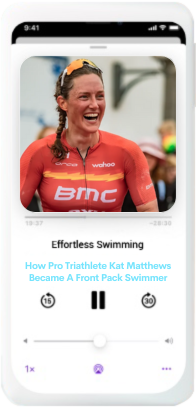
What does it take to finish second at the Ironman World Championships? In this episode, I’m joined by professional triathlete, Kat Matthews, who’s not only a fierce competitor, but also a source of inspiration for anyone looking to elevate their performance. Kat opens up about the strategies and habits that helped her climb to the top, from staying consistent with her swim training, even while traveling, to making small technique tweaks that delivered massive results.
We talk about her mental approach to open water swimming, How she tackles the swim to bike transition, and the mindset required to thrive in tough race conditions. Kat also shares her journey of recovering from injury, and how it transformed her mental resilience. We discuss why creating a stable training environment, and dialing in proper nutrition, and learning to fuel correctly during workouts can make all the difference.
Not just in racing, but in life. Whether you’re a triathlete, a swimmer, or someone looking to gain a competitive edge, This episode is packed with actionable tips and powerful insights to help you achieve your best. So dive in and let Kat’s story motivate you to push past your limits.
03:02 Leading up to the World Championship. Keeping the consistency and structure.
06:59 Vo2 Sets.
09:13 Travel and Training Calendar.
10:44 No Pressure Swims.
12:48 Change of Pace, Feeling of Control.
17:02 Swimming From Inside Out.
19:14 Race Conditions.
24:52 Don’t Be A Victim
26:50 Openwater Stroke.
28:04 Bike Transition
33:00 Creating a Stable Training Environment
39:54 Fueling Correctly.
Follow Kat on Instagram
Want to really transform your swimming? Join us on a swim camp in 2025 in the Maldives, Galapagos Islands, Whitsundays or Thailand: https://effortlessswimming.com/camps/
Change your technique and swim a smoother, easier freestyle with the Effortless Swimming membership:
https://effortlessswimming.com/training-and-membership-plans/?el=blog
Get 20% off wetsuits at Great Ocean Wetsuits with code ‘EFFORT20’:
https://greatoceanwetsuits.com/
Watch the episode on YouTube:
Transcript
Read the full transcript
If you know you’ve done a really good set, you know, a few days before I try and be like, right, this is how good I am at swimming. And I focus my attention and confidence off that. I try really hard not to let any of those race swims affect my confidence. Welcome to the Effortless Swimming Podcast to show that help swimmers and triathletes love the water, become a better swimmer and live a better life. Here’s your host, Brenton Ford.
All right, welcome to the Effortless Swimming Podcast. Kat, this is your second time on the podcast. I actually checked and it was all a little bit over a year ago that I had you on. So welcome back. And one of the reasons I’ve got your back is because you’re coming off a second place at the Ironman World Champs in Nice. So big congratulations. Thank you so much. Yeah, thanks. It’s cool to feel like a regular. I mean, it’s only the second time, but to feel part of the show is pretty special. So thanks for having me again. Well, and actually another fun fact is that I think you’ve got like we sort of reposted a video that I think Ironman shared a view swimming. I think that’s had the most views on our Instagram. It’s had like five million views, that video of you swimming. So you’re a big hit in that in the Effortless Swimming World. So congratulations on that as well. That’s mad, isn’t it? I think like a smooth, smooth swim strokes is one of those sort of
like skiing or snowboarding, you know, when it’s like a sunrise or something. It’s that mesmerizing sort of goodness, I just call myself mesmerizing. Generally, in general, they’re like a mesmerizing good video just to watch, aren’t they? And I guess the playtime must be so high. It’s just such a lovely video of you swimming and like it just it looks so graceful and mesmerizing. It’s like, I think I can see why it’s had so many people watch it and share it and things like that. So yeah, I thought that was that was really, really cool. And talking about your Ironman World Championship race for the Ironman, I was looking at the swim times and I saw that you did a 49 minute swim. But oh my god, like that is that is quick. And that in the front pack with the top, I think 11 girls there, which which I thought she’s got to be stoked with that she’s got to be so pleased with that swim. Because, you know, out with the people who grew up swimming who come from that
swimming background and had a really good swim. So I want to dig into that a little bit, just to get your maybe what you’ve done over the last six to 12 months to continue to improve your swimming and what it took to make that front pack and maybe any differences that you had seen in your stroke or in the way that you’re racing. Because I know a lot of people can swim quite well in the pool, but I really struggled to put it together in the open water. I get that all the time with the people that I’m coaching. So in terms of the lead up to the world champs, was there any sort of change here training or how you were swimming or how was your swimming feeling leading into it? Yeah, I mean, it’s going to take us the full podcast of dissect isn’t it? But um, yeah, really happy with that swim. Firstly, like, it feels you don’t often get the rewards for your efforts. And that just really felt like a really great sort of cherry to have had. And you can’t, you know, lose that it’s not,
you can’t fluke swimming or anything like that. So I just feel really satisfied with the swim generally. And then coming into the race, I guess, I guess it comes off just the consistency of training. Ultimately, that’s, you know, that’s all we know that swimming sort of builds off. But I think maybe the sort of specifics of keeping that structure really importantly this year. So because I’ve raced, I think it was like my eighth or ninth race of the year already by the time we hit the world champs, I’d had one race before. And so every time you’re racing, you’re traveling, you’re finding a new swimming pool, so you’re losing a couple of days and then at least, I don’t know, three to six K of swimming that week, perhaps, depending on how motivated you are the day after the race to, you know, get back in the pool and things like that before you travel home. So it was really easy this year to have like lost
that consistency. And I think I just really forced it, like I made travel plans around the year. And specifically that summer, so I would have a swim in the morning before, hopefully before I could do a travel day, then I’d make sure I was forcing myself to swim before I traveled home, you know, just like keeping the consistency.
My biggest training partner here in Loughborough actually was traveling a lot as well with our other friend, Indy, because he’s coaching her now, Indy Lee, Sam Proctor. And so I lost a little bit of company. And I am, I guess quite proud that I maintain the consistency. So even though he wasn’t there, I was like, right, it’s Tuesday, I’m going to do VO two today. And I sort of really kept that structure and doing solo VO two is a bit sad. And you get a bit of, you know, a few weeks before the race, the lifeguard actually came over to me because I had to get out after the session, you know, just I couldn’t maintain my composure in the water. I’d finished the session. I was just having a little breather on the side before I did a, you know, another 400 meters or something to cool down. He’s like, are you okay?
So I pride myself on keeping the consistency and in the sort of intensity. And the same with, I guess, all through the different intensities of the swim. So that was the biggest thing for me. And then, yeah, I was just swimming really well before the race. So I was really confident, which is a bonus, I guess.
And what does VO two set look like for you? Like what are those sets like where you’re doing them solo? Because I know the ones that we do, I do in a squad on a Friday, and there’s like 20 of us in there. And it’s easy when you got like someone to race and you’ve got other people there turning through it, it flies like, but it’s such a hard set. So yeah, what are those sets look like for you? Yeah, I mean, I base it off a session, like program session that I’ve been doing with Sam under IntelliTry. And it looks like a few 25s, a few fifties, the hundreds of the killers. And then it and then I go back to 25s, and then fifties. And I feel like that’s a really nice sort of way of doing it. And I guess I just keep the discipline of it’s off this time, just go, just go. And I started using if the clock’s not there right in front of me, I’ve started using like a clock in the goggles. And that keeps me focused, but I’ve only used those for a couple
of sessions in the summer. Obviously, before that is just desperately looking up for the clock. And I actually find it quite nice, like I’ve come to the conclusion that it’s like, desperately hard. But I much prefer it to 200s, which I did a few of, I guess, in the preseason, it was like six 200s for you to with a really long rest, but that in a 50 meter pool. And that’s, that’s the worst that’s worse I’ve ever felt. And I’m not sure I couldn’t do that without someone else. I don’t think whereas like fifties, even hundreds, you can thrash yourself. And it’s okay. Just yeah, it’s manageable. Yeah. Yeah. Wow. And so I think that’s such a such a key thing is that you’re right that consistency in in swimming because you tend to lose the feeling of the water very, very quickly. And I think like personally, you know, for me, if I in the lead up to summer, if I’m doing some races, if I can get in the water five times a week,
then I’m feeling pretty good leading into the races. If it’s three times a week, it’s okay. But it’s just not it’s not nearly nearly enough. And especially with the amount of travel that professional triathletes do, especially yourself, you’ve had a pretty busy year. That’s that’s got to be such a tough thing to to keep is that is the habits and the training calendar. And so how do you manage to fit that into the to the travel? Like, did you just kind of look ahead and go, right? I know there’s a pool here. I’m going to be flying out in the afternoon. Like, was this did a lot of planning go into that? Yeah, I mean, it’s sort of simple. Like, um, for the T 100 races, we often have to be there for days before. So it’s like on a Tuesday. And I, I if it’s a, you know, a long travel, I can only swim at 11am generally, because it’s the public lanes. So I have to plan an afternoon trip or plan to have a, you know, a different airport that’s closer to a pool. So I can swim in the morning
or just scrap that and just make sure when I get there, because obviously America, like you get a time difference, like I just get in the pool that day. And I think I’ve got better at that. Like I used to travel and be so stressed out by the travel that I couldn’t tolerate training at all. Whereas actually, I now sort of want to swim. I think it’s a different mindset, perhaps of like, I know how good I’ll feel during the week or on race day if I swim. So I get this sort of secondary motivation, knowing that it will make me feel better, even though it’s a bit of a faff and planning it in. Yeah. Yeah, I am.
I, I’ve had a couple of camps recently. We had one in the Maldives and one in Thailand. And like, it’s not a huge flight. It’s like probably door to door. It’s probably 12 or 14 to 16 hours. But and the time difference isn’t too bad. But the first thing I want to do is just get in the water and swim. Because I think in terms of that, how your body just tends to
tense up and get a bit stiff from the travel, there’s nothing better than a swim just to loosen up. And I try to put no pressure on myself at all. It’s just like this. I’m just going to roll up and down times. I’m not even going to look at, but I’m just going to knock out whatever it is, like 2K or something. And usually it starts to feel really good towards the end of it. Did you find anything like that? Like, did you have any pressure to perform in those training sessions, or were they just like to roll the arms over? Oh, yeah, no, definitely no pressure. I think I actually, maybe during the week, I’ll have a couple of those swims anyway, which is just no, no pressure swims just like volume. And I think, yeah, definitely not necessarily before travel, I don’t give myself that courtesy. But after travel, and even the day after, you don’t know quite what that pulls like everyone’s sort of always this pull fast, this pull slow as well. So even the day of the
travel or the day after, even the whole race week, to be honest, like no pressure. If you know you’ve done a really good set, you know, a few days before, I try and be like, right, this is how good I am at swimming. And I focus my attention and confidence off that. I try really hard not to let any of those race swims affect my confidence. And if being more like maintenance, maintenance, maintenance, doesn’t matter, doesn’t matter. It doesn’t mean that I’m suddenly a rubbish swimmer because I can’t swim a 120, you know, I don’t know, 26 yard pull or something stupid. So yeah, definitely, definitely no pressure and just consistency. And also just race week intensity. You don’t have to do as much anyway, so you naturally feel better.
And in terms of your technique, is there anything in the last six months, 12 months that you’ve put particular attention on?
Yeah, so I know we talked about technique quite a lot in the last podcast, like with terms of like body position and kicking and things like that. And I think a lot of this year has just been the consistency. It’s a bit boring really that there’s no there’s less secret sort of big improvements. But I think we talked about head position, using the snorkel sort of body position, like feeling the water, kicking, I’ve definitely been a bit more consistent with my kick. You mentioned that I, you know, like, committing to an actual kick set, like with purpose and focus and intensity would be, you know, a good idea, or you said it on the podcast. And I think I’ve started sort of racing my, my friends in the swimming pool now. So
they’re a bit annoyed at that. But it’s definitely helped with, yeah, the change of pace. And I think maybe it’s not a technique bit, but it’s more like the intense, like, I feel like I have gears now in swimming, like, before it was just, you can just swim at intensity and like tolerate it. And now it’s like, Oh, okay, I can now go harder, and I can back off. And I feel like that is given me the control to be able to, well, it just that feeling of control to be able to recover, and not just die and just and then get worried about dying. So going too easy.
That’s a bit convoluted. So yeah, having the sort of technique, I guess, of being able to go harder and slower. And I think both our skills, not just being able to go faster, I think being able to swim slowly is also perhaps like a sort of a technique that you can learn as well. So we are like to be able to give yourself that time to recover. And yeah, sorry, maybe that was off tangent, the technique side as well. I think things like just solidifying, like hand entry,
and working on utilizing my lats and sort of coordinating my hip movement. I think things like that I have focused on as well. And I go through maybe, I don’t know, a few weeks at a time where I’ll be like, Oh, this is my my limiting factor. And I’ll then just focus on that for the two or three weeks until I get a bit bored. And I don’t feel like it’s affecting me anymore. And then something else will crop up and it’ll be like, well, I’ll have one bad swim where I feel like my core is weak and then I’ll be like, right, I’m going to now focus on my core for three weeks. So yeah, there’s this sort of the levering through lats and like the connection with the other hip. I think that’s something I’ve really worked on specifically on my left side. I think I’ve always sort of felt a bit weak on one side compared to the other. I think most people do. And I definitely think during some of the harder like VO2 or threshold sessions I’ve been doing, I’ve got out and
I’ve been like clutching my lats, like they’ve been so sore. And I see that as like such a success. Whereas I never, I would just get sore shoulders before. Massive lats.
You struggle to get out the door when you leave the pool at the area, working them that much. That’s that’s great. And I have quite a few swimmers who maybe come to a clinic or they come to a camp or something. And they say, Oh, I’m so like I’m really sore through my lats and kind of through like the back of the shoulder here as well. And it’s like, that’s great. Keep doing what you’re doing because they’re the muscles you want to be using when you’re swimming. And it’s interesting about what you say there about like you’ll focus on something for a couple of weeks, move on to another thing. I find myself very similar with that. Like I might hear an idea from someone and I’ll practice that for a while or I’ll feel like something’s just not quite clicking. So I’ll just I’ll put some attention on that. I think I’m very much the same with you. And and something that I’ve been working on just the last sort of week or so is is thinking about like you want to swim from the inside
out. I heard this from I think as an Australian coach, I think it might have been Dennis, Dennis Cottrell, who like coached Grant Hackett and Sun Yang, something like the really good distance freestylers. So you want to swim from the inside out. And in terms of the arms, I’ve been thinking about thinking about the shoulders, get those right in terms of the rotation, think about the elbows, and then it almost takes care of the hands in a way because, you know, swimming from the inside out. So the shoulders, elbows are closer to that than the hands. So I’ve just really been trying to work on shoulders and elbows, and then let the hips kind of just stabilise behind, let the legs stabilise behind and do that. And it’s been feeling really good. So I’ve just been leaning into that sort of leaning into that kind of feeling and sensation. And it’s working quite well at the moment. Because one of the things I’ve,
I think that sort of stuffed up my stroke over the last couple of years is since I started surfing and surfing more, my recovery and the way that I swim has gotten a lot uglier. And especially when I swim in the pool, I kind of feel like I just don’t recover over the water as well as I normally would. So I’m trying to like get that back a little bit. And I feel like this is helping. So yeah, taking these little like side quests and just trying different things and seeing how it affects the stroke and the times. And yeah, it’s a good way to discover I think what’s working for you and what’s not. And just working those kinks out in the stroke. Cool. You’ve given me the next few weeks of focus. I think it also keeps you interested in the sport, doesn’t it? Like that wanting to develop something like very small little things rather than thinking, I need to get better at swimming. It’s like, I’m going to focus on this. I think that that’s
especially when you’re doing this sort of longer term, or like you committed to doing it professionally, that you need those little things to like break up a season.
Yeah. Oh, that’s right. And it keeps swimming really interesting as well, doesn’t it? Because it can get monotonous going up and down the pool. But if you’ve got even one thing to focus on that might be kind of new, it can really help. And I want to dig into the race itself. So what were the conditions like? Was it fairly choppy out there? It looked quite choppy. Yeah, all week it had been really warm. So that’s the first point is that it was meant to be a swim skin, non wetsuit for pros. I think it was always going to be wetsuit for the amateurs. I’m not entirely sure what they’re cut off, but it’s always too high, I think. Same for us. It’s always too high. But it was sort of the day before someone mentioned, oh, it might be a wetsuit swim. It was a bit ridiculous, but it was then pretty certain if the temp, you know, it’s not going to drop overnight. It’s not going to increase overnight. So yeah, wetsuit swim, but very borderline. And I was really nervous about
getting too hot because I generally get too hot in a wetsuit, let alone at the actual borderline sort of limit for being illegal to wear one. But that’s potentially a caveat to some of this is that I think people think that the weaker swimmers benefit from a wetsuit fact like more than a better swimmer. But I don’t necessarily think that’s true. I mean, you’re way more experienced, but I think different swimmers and different styles benefit differently. It’s not just how fast you are. And I know recently that I haven’t needed, oh, I felt like I haven’t needed a wetsuit and my body position feels better. Whereas in the past, I definitely sort of use the buoyancy to help my hip position. But the actual conditions, I think I don’t think because it’s so dark in the nice race is only is you actually start right on sunrise. So you’re warming up in the dark. I don’t really remember thinking it’s super choppy or thinking oh, it’s really choppy. I don’t remember that. From the whole week,
I remember that as you get further out, it feels like it gets more choppy. But I think that’s just a classic sea swim. So I’m not sure I would say oh my goodness, it was super choppy because it to me, it just felt like a sea swim. But I think that’s the feedback is that it was really hard conditions. It also might have been that I was swimming in a pack and I definitely was not at the front of the race. So you naturally get a little bit of shelter from the front of the sort of conditions, I guess. And so yeah, I had a really good start. I think something that’s recently come to me is that I have earned to be at the front of the swim start. As in, I am trying to win this race. I’m going to be on the front line, even if I’m not the best swimmer, you know, it’s a very, very, very wide start line ish that you had to have. And therefore, if I want to be, I’m going to get to the front of this, no matter who’s just sprinted
off this sort of the beach to get to the open water start. So I made sure I was at the front, which was, it sounds silly and obvious, but I don’t like that sort of boistery get to the front element of the swim before the gun goes. And then there’s the
natural creep of the race. As in, there’s no physical start line. I asked at the briefing the day before like, where is the start line? And it was like, we’re sort of here ish between these two boys don’t don’t go in front. And I’ve had many experiences in the last couple of years where people just creep and it’s not penalized. And to me, that’s it’s not a good part of the Ironman pro racing. But again, like it was happening. And instead of being, you know, goody two shoes, Sally, I, I crept with everyone else. And so I don’t have any regret about that. That was just the nature of the swim start, which meant I got a good start. So I didn’t really notice too much about who was around me. Just that I felt really good, I felt really confident, it wasn’t super aggressive, which it has been in the T 100 races, in terms of speed, like initial speed and just like people around you, because it was a C so spread out, it meant that you could really find your own line in a way and just attack
as best as you felt like you could. So yeah, it started really well. And I think that’s pretty fundamental to most swims. This podcast is brought to you by Great Ocean Wetsuits, an up and coming Australian performance wetsuit brand for triathletes and open water swimmers. The wetsuits are designed and tested in Melbourne, Australia for fast, easy and enjoyable swimming for athletes of all levels. They’re worn in and raced by Olympians, triathletes and open water swimmers from all over the world. And I personally use Great Ocean Wetsuits even before they became a sponsor of the podcast. I’ve personally found that the buoyancy, the freedom through the shoulders and the fit are the best that I’ve ever had in a wetsuit. So I highly recommend them. And you can currently get 20% off either the gold or silver wetsuit models using our own code effortless20 at checkout. So enter the code effortless20 at checkout at greatoceanwetsuits.com and no matter where you are in the
world, if you’re in Australia, the US, Europe, there’s free shipping worldwide. So get yourself a great ocean wetsuit. I personally use the gold model of the wetsuit. It just depends on what your goals are. So greatoceanwetsuits.com, effortless20 at checkout. I know you’ll like them. Yeah, absolutely. One thing you mentioned there was the attitude or the mindset you had on the start line is I’ve earned my place to be at the frontier. One thing I remember Chris McCormack said a long time ago was don’t be a victim. And I’ve always remembered that. It’s like in the open water, if you let someone swim over the top of you or you get upset that that happens, then it’s your race done. You don’t want to be aggressive, but you have to be assertive out there. You have to take control because on the other side of that, it’s just not a way to swim well in the open water. So I think that kind of mindset goes really well for being able to be around people and just not take any of their crap
that they’re going to dish out at you. And whether that’s creeping at the start line, whether that’s trying to swim over the top, it’s like you have to be the assertive one. So I love that. That rings home for me with some of the stuff that I’ve heard of the years and really taken on board. And in terms of your stroke in the open water, you mentioned prior to the podcast that you feel like you’re pretty comfortable in choppier conditions. Yeah, I think another stereotype is that people think the weaker swimmers are going to be therefore worse in the choppier conditions. So it might spread out a bit more. But I don’t see myself firstly now as a weaker swimmer. But I mean like I have come into the sport also doing adventurous activities and being confident in the water. So I’m bodyboarding a tiny, tiny token bit of surfing. And so in Wales, in the UK, the waves are unforgiving and it doesn’t bother me. I don’t get any of the fear or the negative effects that
perhaps a weaker swimmer might get from that. So it actually felt really good during the race week to sort of practice in the sea and just to sort of feel the currents and feel the waves. And yeah, I don’t know, maybe it’s just luck. And I also don’t want to big this up too much because it might be that I now spend another 12 months of swimming quite poorly. And it was just a one off. On this race, I didn’t feel like the waves were a problem. But equally, my mindset was obviously so positive because I was in the front group, which to me is really cool. And it was a new and I was staying there and they weren’t getting away. And I so many times recently I’ve lost them on a buoy like a boy or I’ve looked up and I’ve got my sighting slightly wrong and suddenly I’m losing them. And that didn’t happen until I don’t know, maybe 800 meters or something before the finish, where I think there was a bit of a surge to try and
get the swim bonus, whatever some people have for getting out the water first. And I started zigzagging a bit and getting a bit tired. But I think generally my I was so focused on making sure that I covered every boy, every surge, you know, tactically, I just, there was definitely some luck there. But I think I worked really hard on staying present in that swim the whole time, maybe so much so it affected the rest of my race, who knows.
Let’s talk about the rest of the race. So talk me through the bikes. I think you were maybe 30 seconds down in the swim to the first the first person. But then like did it take long to bridge the gap? And then how do you how do you proceed for the rest of the bike? Yeah. So for the triathlon fans, I, yeah, I’d lost the front sort of feet or pack for that last little stretch back into the shore. And I was totally fine with that, I could actually see them getting out, which was pretty cool. And worked hard for transition and thinking I would be able to catch them quite easily. There’s about a 10k stretch, I think, to like on the seafront on the promenade to start before you start climbing.
And I thought it would be much easier to catch them. And I was working quite hard, but equally as an Iron Man, so I didn’t want to just destroy myself, because I knew the hills were coming. So it wasn’t, it wasn’t going to be necessarily an advantage to be with them for the hills, because I confidently thought I could overtake them anyway. So I was working hard to catch, but equally not doing what I would maybe in other flatter races. But I didn’t catch them until we’ve just until we got to the very base of these like spiky sort of hills to start the race. And then just overtook them. But I had, I then found out that Marjolaine, the French girl who’s very local to Nice or lives in Nice, she had been swimming with me as well, but she had somehow already got ahead. I still don’t really understand where she, how she went, and I didn’t see her at some point, I don’t know, transition maybe. And she was like miles ahead. So I was
like, Oh, okay, wow, fair play. She’ll be the Lucy for the day, you know, the character chase. And, and yeah, I just, I thought I was climbing really well. I was really conservative. I, I wasn’t pushing anywhere near the power I had hoped to be pushing up the hills. So it’s about two hours or so of like, sort of steady, some climbs flats climbing and
and yeah, I, I mean, I was fine, but I wasn’t doing excellently. I got told that Laura wasn’t catching me Laura Phillip. And then honestly, about 30 seconds later, she came flying past me. So I was a bit shocked by that. But equally, I didn’t have, I didn’t have the, I don’t know, I don’t know what it was. I, I didn’t go with her. I’d made the, I made the decision to not go because obviously at that point in time and you physically can, it’s just whether it’s appropriate for your pace, sort of model mindset at the time. So yeah, let her go ahead and then caught back up on the hour of the flat bit. And then she got a head on another bit of the climb and caught back on the descent. And so we came into transition together with that last 10k that I had, I’d been in front. I’m, I’m keeping this as like a well done cat. So ignore the statement of like, I pulled her along the flat bit into the headwind for that last 10k of the bike.
And why that’s important is because on the run, she was getting annoyed at me for letting her do the 10, like the headwind on the run. So I was like, I’ve just done a whole load of this headwind on the bike. So short-term. But yeah, it was very, very cool, if I’m honest. And I still, I genuinely talk about it with excitement for the future. I hope there’s more chances that coming into transition with somebody who I, I honestly believed I could outrun because I had twice already this year that I was like, in transition, I was going to run for the win. Like it was a dream already. So I think maybe there’s a bit of like crushing spirits there of like, you don’t, I honestly thought this was it.
It’s a marathon, obviously take it really seriously. And I felt really great. I was so surprised that my legs felt so good. And then I ran maybe about 15k with Laura. I started dropping off because she was getting really annoyed at me, like I said with the wind. So she put in a massive effort and I was like, sweet, you know, in a way I was like, she’s, she’s blown it. I always finished stronger if she, even if she gets two minutes out of me now, she’s now running sub 240 pace. There’s no way. Like I’m going to, I’m going to keep at this pace, which was like 240, I don’t know what it was, low 240s, which is what I had planned to run. And I genuinely still believe that I have, I had that in me in a different day. And then I, and then I got the most bizarre like episode of cramping, like lower back, then hamstring, then the other quad and then the cut. And so clearly, I just, I, I overestimated my ability
on the day. Anyway, came second, happy to be there.
Yeah, that’s, I mean, you also mentioned, prior to the call, like, you go from like, I don’t know if I can complete this thing to, okay, I came second, like that’s glad to get to the finish line. But that’s the thing about an Ironman, an Ironman, right? It’s just so, it’s just such a long day out that anything can, can happen. But yeah, what a great result. And in terms of the last six to 12 months, has there been any, any lessons that you’ve learned in the sport or in your training about yourself? Because we haven’t really spoken since the last podcast. So just curious as to anything that you sort of realized or reflected on in the last 12 months? Yeah, I think it’s been a challenging couple of years, generally. Two years ago, I had this big accident, and then I sort of got back into triathlon. And I think the last 12 months have been just as sort of challenging, but for very different ways. I had a really big calf injury in March in the first race of the season at T100 Miami.
And I am a bit embarrassed by this. Like it, it mentally challenged me more, I think, than that massive accident I had where I broke like multiple bones. So I think I like really, and it’s because, it’s because I couldn’t come to terms with the why of it. Like with, you know, some car hits you. Well, that’s why you’ve got a broken bone. But I couldn’t dissect anything from my training that suddenly I had this quite significant. And it was like a moderate calf, like muscle tear, but also into the tendon. You know, prognosis is like eight to 12 weeks off running sort of thing. Or a return to play for NFL players or something. That’s where the research is. And I think, yeah, that that uncertainty and lack of any insight or control really, really, I really struggled with. And I actually reached out to a psychologist
or a council of sports counselor about it. And the only good thing that have come in from that,
well, I cut two good things. One, I realized that I’m actually really good at processing on my own. And I don’t necessarily need to talk to anyone else, especially if they’re not quite the personality that fits with me. And the second one is she pointed me to she pointed me to a really good book. And I think again, like I’ve, one of the biggest things I’ve learned this year, which is me summarizing my waffley story is that I really love learning like the sort of psychology from books and then trying to sort of, you know, implement it in myself, I guess. So yeah, the book itself was called The Reality Slap from Russ Harris. It was like, he also wrote the Happiness Trap, which I think I tried to read and I was like not interested in. It’s quite a big seller though. Whereas yeah, The Reality Slap was about radical acceptance. And again, just like things like that, like this, I feel like is a self development
thing that I actually find really sort of fascinating, which was sad. And then another book I was reading at the time was called Perform Under Pressure by Kerry Evans. So again, like reading them both or listening to one and reading one was actually really nice to sort of, you don’t just get obsessed with one sort of fad, like thought processing, you can, you can see a bigger picture perhaps and like take different elements of it. So yeah, I think that’s something that I’ve learned as a sort of, again, as like whole is like that ability to cope with unexpected problems, which sounds mad, but it took a calf injury after the big accident. And I guess like, yeah, like being calm, more calm in situations that are out of my control. So for example, in Nice, like having the the cramping issues, I looking back on it, I actually realized that, yeah, it was quite good that I was able to be like, okay, I’m cramping, what can I do about it? You know, remove myself, look at it from
the outside, assess the situation. And I think like you just sort of do that without realizing, but those are the processing steps that these books sort of actually go through. And I wonder whether I learned that from reading, for example, like, okay, so this is either my muscles aren’t strong enough, or, you know, simple things, but when you’re under pressure, the cognition is often much harder to deal with them and obviously the emotion of it all. So yeah, took on some fuel, did a bit of walking, did what I could, just cracked on. So I think,
yeah, I think that’s a big sort of lesson, that ability to deal with
mishaps. And then I think another thing as well, maybe is that I, I feel like this is the first time in my life, that I’ve lived in the same place for more than two years, as my childhood, I was static, but throughout my whole sort of adult life, me and my husband, because if he’s been in the military, we’ve moved around every, like, six to, I don’t know, 24 months, like, often less than that. So for the first time ever, we’ve actually created a sort of, yeah, static training environment. And I think that’s important for me as a human, like as a person outside of what I do every day. It’s made me a lot more sort of, okay, so this is real life, you know, it’s not just like, playing at the sport or, you know, doing this every so often, like I feel comfortable in this environment now. And maybe that sort of self development, you know, like, who am I? What do I want to be as an adult? That sort of thing.
Yeah. And I guess alongside that sort of performance wise, we’ve created an environment that I can train like a training camp in. So having a full time swan, yeah, you know, I’m, I, we have a coffee, we chat about the day. And then I get on with the day, Mark, he sometimes often doesn’t join me for any of the training. But at 620 or 630 on the dot, you know, there’ll be a well, really well balanced nutritious meal. And then we’ll just hang out in the evening. So I think I’m in bed for 10 hours a day, back again, two or three sessions. I think it’s really sort of optimized that sort of side of performance as well. Which is the reason for moving here. And the reason for him, like leaving the military. So yeah, I think those are big things from this year. But I’m on it. I’m on one now. There’s, there is another thing. Go on. I’ll jump in afterwards. I think, and I don’t know when this really started, but I think I’ve started fueling
properly for sessions, which sounds mad because I’ve been doing this for four or five years. But I now like, don’t go to a swim session without at least 25 grams of carbs in my water bottle. And I think I’ve spent my whole life thinking that, oh, it’s just a swim. Oh, it’s just a swim. You know, like, I’ve already, I’ve already had at least 50 to, I don’t know, 60 grams or something of carbs that day in my bottles for the bike. So I’m not going to, I’m not going to drink more sugar during the swim. Whereas now it’s like every session is just as important. And if anything, the swim’s the focus of every day. It’s like quality swim, quality swim, quality swim. So yeah, fueling the sessions more. And that goes across all three sports, which means that I’m not coming off the back of a session being that hungry, which before I used to be sort of more hungry. And I think, Oh, I need an extra bit of car. I need
an extra size of toast before this or I need, I need an extra protein shake or I need, I don’t know, another, another meal or let’s go out for dinner because I’m really hungry. It’s like things like that. I am now eating much less during the day, but making sure that I’ve got the sugar during the sessions, which again, like sounds so simple, but it’s, it’s been massive.
It’s, it’s funny to mention that we had someone do a like an hour chat on our Maldives camp. She kind of used to be a, used to be a nutritionist has sort of moved into different areas now, but she just gave her a chat to the group and I’ve heard a lot of nutrition talks before and that sort of thing. But sometimes it like, it doesn’t click or like, for whatever reason, like you don’t take on board the information. And so she was talking about what to have before a session, during a session, after a session, as you know, some general rules and similar thing. Like I’ve started to have a little bit of food, a bit of protein before my swim sessions in the morning. I’ll have some electrolytes during the session and, but basically just fueling before after, before during and after, and I’m recovering so much better. I’m not starving at like 10 o’clock in the morning and I’m starting to swim a lot better
as well. So you’re right, it’s just like these simple things, like having a bit of home base, fueling correctly, like it’s simple, but it’s like, it’s so important, right? Like it’s just, it’s often the little things like that that makes such a, such a difference is not like these groundbreaking seismic shifts that, that, that make a difference. It’s the consistency and that sort of thing. So that’s kind of what I’ve, what I’m getting from these, these lessons that you’ve, you’ve learned. Yeah, definitely. And I think it’s hard. You always want to see what you can learn from someone else. And I think sometimes we want a quick fix, don’t we? I mean, sometimes always we want to fix or like a quick cue or what can you focus on? But I think it is just making the best of that situation around you and optimising for that. That’s a fad word of like, of those little things. And it, all it, all it takes, like, sure, some people don’t need to eat as much sugar because they’re, they’re eating a
lot more during the day. But then it’s like, well, what’s your choice? Would you prefer to swim better? Or would you prefer the meal out in the evening? And yeah, sure. Sometimes I prefer the meal out in the evening, but it’s just, you’ve got to find your own balance and like, optimise as you, as you want and need to throughout your life, I guess, to make those progressions.
Yeah. And I think as well, with like, with advice from other people as, as well, like I
advice that you get from other people is it’s only drawn from their experience. And so, like, it’s good to get different takes and, you know, hear what people have to say. But then at the end of the day, it’s just about you making a decision on what you want to action and just figuring out what works best for you because you could have someone who might be just as good and they’re not fueling in their swims. But for them, that works, right? Like, it’s just you’ve got to, you’ve just got to make a decision and decide what’s best for you. And one thing I’ve, I’ve learnt a lot from coaching is that I try to not tell people, like what to do. I like to give them either like give them some options from what I’ve seen work for other people and or like maybe use a story or an analogy and then they can just draw what they want from it. Because I know personally, if I get told, like, you need to do this, my brain goes,
I’m not doing that. Like, I find that getting told directly what to do is not that helpful, at least for me. So I think it’s good to just kind of give people options and just never say directly, you need to do this because more than likely enough going to do it. So yeah, just something I’ve learnt coaching over the last sort of 10 years or so. I don’t know what you’re like with that. But if I get told I need to do something, no, I’m not doing it. Just out of principle. Yeah, no, I think that’s fair. I think it depends on my mood. I’m often like, just tell me what to do. I don’t want to make any more decisions. But no, I think you get more out of it, especially long term, if you worked out that answer for yourself. Like, I, I, I feel like I’ve worked out, which is not, you know, clever, that I need to do X amount of swimming or I need to do at least a VO2 session. So therefore it’s in my control. I’m deciding this, I’m going to implement
this. So I feel like that empowerment is, is crucial rather than necessarily the lesson, like being told it. So yeah, totally with you.
Yeah. Kat, I said we’ll go for about half an hour. We’ve gone for about 45 minutes here. So I appreciate you sticking around and I love catching up and just sort of congratulating you first of all on your results. It’s so good to see you having that kind of result in your swim, especially. That’s what I’m really like. Yeah, obviously I love the swimming side of things. And we’re going to be able to catch up hopefully in a couple of weeks time. By the time this gets out, it’ll be about that November, I think. So looking forward to meeting you up in Queensland and catching up there. But thanks so much for being on the podcast again. It’s been great. Yeah, I’m really excited about the trip to Australia. Very cool to hopefully, yeah, meet you in person and actually get eyes on rather than me and my sort of sporadic, I don’t know if this feels right, this feels wrong. So yeah, thanks. And hopefully the podcast has
been useful for lots of other people as well. I’ve got no doubt. I’ve got, I’ve taken a lot from it. So thanks so much for sharing and looking forward to meeting you in a couple of weeks time. Thank you. Thanks for listening to the Effortless Swimming podcast. If you’d like us to help you become a faster, more efficient swimmer, go to www.effortlesswimming.com.