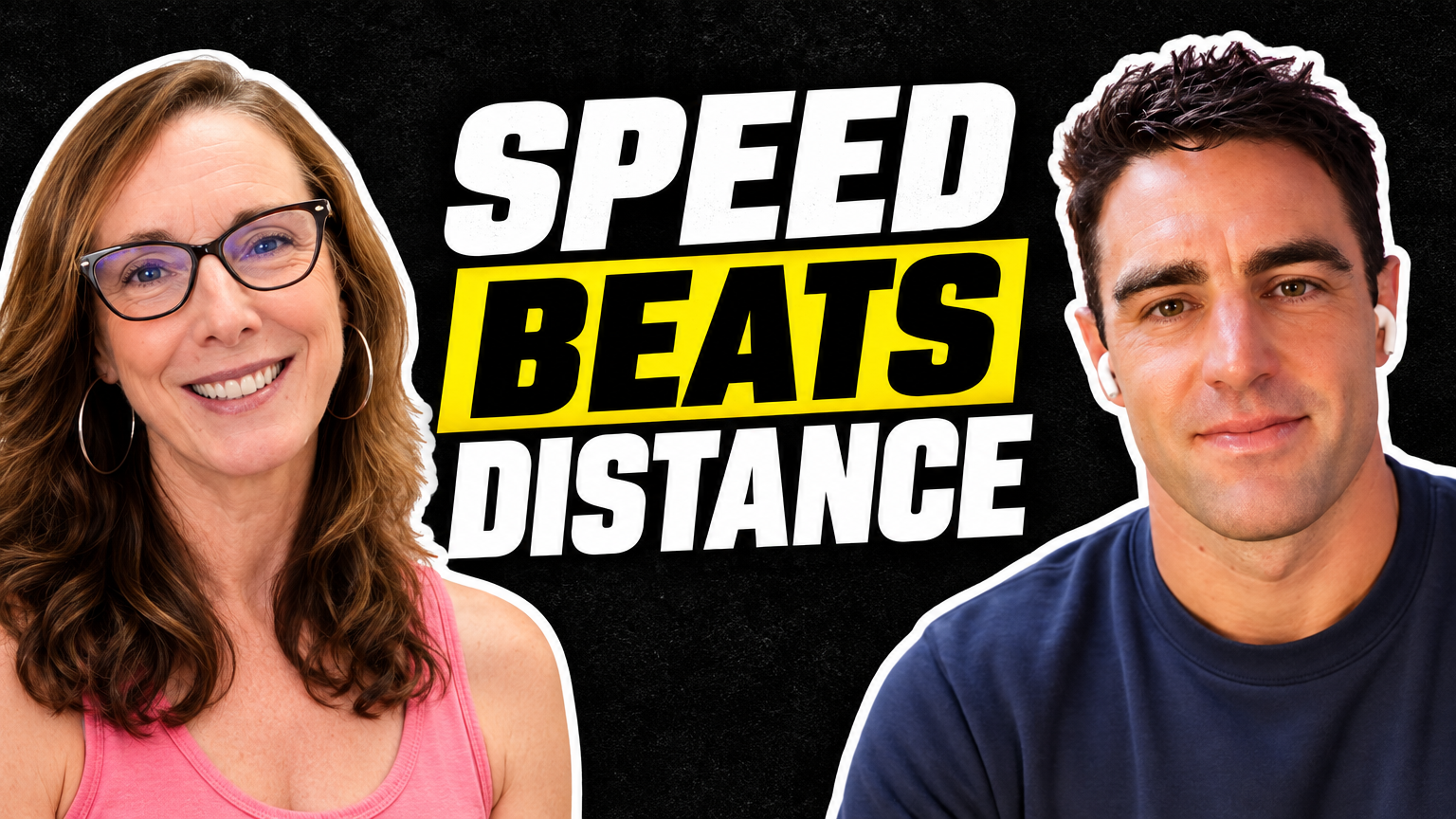








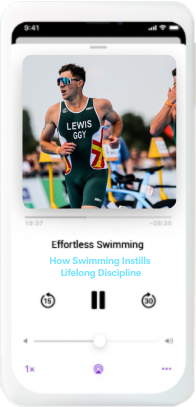
In today’s episode, I got professional triathlete Joshua Lewis to talk about swimming, training sessions, and most importantly, opening yourself up to opportunities and experiences.
34″42 Consistency is king
Coaching with Joshua, visit his website.
Follow him on YouTube!
In this episode
- 01:10 Swimming background
- 06:21 You’ve got to be able to prioritize correctly
- 10:34 Switching to Pro Triathlon
- 15:18 Coaching role
- 16:40 Putting yourself out there
- 18:49 Getting into a sport like swimming can be a big decision for people
- 21:07 Taking the first step is important
- 22:56 If you’re self-conscious, remember people don’t care
- 23:42 Efficiency in the water for the best speed
- 25:57 Have you found yourself going too hard in the swim?
- 28:33 Learn how to race
- 30:20 Training session
- 32:55 Start small, make it doable
- 37:25 Get in touch with Josh!
Links from this episode
- Change your technique and swim smoother, easier freestyle in the Effortless Swimming membership
- View our freestyle clinic schedule around Australia
This podcast is brought to you by NanoClear — our own range of anti-fog swim goggles, designed by Effortless Swimming with the anti-fog treatment bonded into the lens itself (not sprayed on, so it doesn’t wear off after a few swims). Check out the NanoClear range here and use code PODCAST15 for 15% off.
Transcript
Read the full transcript
Welcome to the Effortless Swimming Podcast to show that help swimmers and triathletes love the water, become a better swimmer and live a better life. Here’s your host, Brenton Ford. Welcome to the Effortless Swimming Podcast. My guest today is professional triathlete, Joshua Lewis. Welcome to the podcast. Thanks for having me. I got a text message a couple of weeks ago, a couple of text messages actually in a few emails saying, oh, this guy, Josh mentioned you in his YouTube video talking about an aspect of freestyle, like the catch and kick timing. So I had a look at the video and I thought, oh, that’s really cool that you’ve mentioned that. And you coming from a swimming background, learning and still picking things up. I love to see that from athletes of your level. So that’s how I came across you. And then we obviously got in touch and I wanted to get you on the podcast to talk a bit about what you’re up to, what you’re doing.
But also just to chat swimming in general, because you come from a swimming background, you’ve made it to a pretty high level in swimming. You’ve also competed at the Com Games in triathlon as well. So high level athlete in many sports. So I thought it’d be great to get you on to chat. So for those that are listening, what’s a little bit of background on your swimming career and then that transition to triathlon? Yeah. Well, firstly, again, thanks for having me. I can’t believe that people were messaging you in terms of trying, well, mentioning my YouTube video. It’s always a shock. I constantly get surprised when people have actually watched the videos. It still shocks me. So yeah, to have someone that I’ve watched multiple times on YouTube actually contact me is a privilege. So yeah, thanks. In terms of my swimming career, I’ve basically been swimming since I was two. I think it was, but competitively.
Yeah, it’s been a massive part of my life and I can’t really explain or go into detail about how much it’s influenced my whole career in terms of both education and sport. So yeah, I guess like in terms of highly competitive stuff, I’ve been to quite a few island games, which for those who don’t know, it’s a smaller version of the Commonwealth Games for islands rather than countries or bigger countries. And it’s one of those championship events where the whole team gets behind you. You’ve got your whole island. I’m from Guernsey. So I go and represent Guernsey, which is obviously a massive privilege in itself just to be able to represent where you’re from. And that’s every two years. So not quite on the four year cycle like the Olympics or Commonwealths, but it’s an unreal experience nonetheless. And it gives you that motivation to carry on doing what you’re doing carry on being a competitive swimmer because I think for a lot of people.
It’s easy to not push on through the elder years. If you don’t have those sorts of targets, if you’re not quite at the national level that you can kind of target and then go and compete. So it is really good from the islands from Guernsey to keep you interested. So I was massively kind of grateful for that. And that actually carried me through things like the youth Commonwealths, but also through to university when I went there because it kept me wanting to carry on swimming because I had that island games target. And I think the one where I was in first or second year of uni was Bermuda. So it was a massive kind of motivation for me to carry on because I really wanted to go out there and compete. So yeah, that was such an important part of education and sport because it kept my structure through my days and allowed me to study at the same time and be effective in both. So I think about it can’t be underestimated how much structure and kind of dedication and motivation it gives you to do both things and be efficient with your time.
So yeah, no, I really think that those early years of swimming have massively helped in all aspects of my life to be quite honest. And you finished swimming competitively at 24. And that’s six years after finishing school. Majority of people, myself included, stopped training the same amount that I was usually when I was sort of full time when I went to university. So when I was when I was 19 and I was still swimming twice a week, I think, but not of any great intensity or or volume. But if you can keep it going that sort of 18 to 24 mark like you for a lot of males like your peak is actually like late late 20s. Sometimes early early 30s as well. And so many swimmers do just stop because it is a massive commitment in terms of time and effort and sometimes priorities change as well. But if you can just even keep something going some sort of regular regular session or swim, it makes a huge huge difference going forward.
And as you said about the structure over COVID when there was like we couldn’t go to the pool when I lost that structure of actually of swimming having my regular squad sessions. That was really hard. I need something in place to just give me that give me that habitual sort of cycle to to get into. And it’s very hard. It was hard to not have that. So the fact that that kept you going through university and kept you on track. So you I’m sure studied well and got the results that you’re after. I think it’s a it’s a very important thing is that that structure. Yeah, 100%. I couldn’t agree more. And it’s just the kind of dedication as well to to whatever you’re doing. I think sport has a massive factor in that. So I was able to transfer that between education and sport and like the whole ability to be able to break down a goal was then also into into smaller chunks. For example, was something that you obviously do throughout your life within the sport because obviously you’ve got your end goal of a time or an achievement or accomplishment.
And then you’ve got to be able to break that down. And I was able to luckily that straight into my studies in architecture. So I was like, OK, what does it take to get this result? And I was quite good at breaking that down with the marking criteria and then being really efficient with the time spent doing that in order to get the results that I kind of wanted. And that’s what sports really good for is it’s such a clearly defined goal that you can have, whether it be time based, whether it be making a team. It’s very clear what you’re working towards. And also what you need to do to to get there. Like it’s not it’s not rocket science what needs to happen. It’s like I needed this many sessions a week. I need to hit these times over the next six months and maybe this sort of volume need to work on my technique in this way. So it’s very clearly defined. And I think sometimes outside of sport, it can be a bit more wishy washy and less defined.
So it’s easy to drift off track. If you don’t sit down and think about what it is you want your life to look like or you want your your lifestyle to be like, whether it be work or family and those sorts of things. And the times where I’ve spent like no phone, just sit down, piece of paper. I’ve got questions written out. What what do I want my family life to look like? What I want to be doing in three years, those sorts of things. If you actually take the time to sit down and write it, things become much clearer. And it is hard with the distraction of a phone. If it’s there all the time, it’s just it’s just hard to have those moments in that time where you’re thinking very deeply about things. This episode of the podcast is proudly brought to you by our sponsor, Form Smart Swim Goggles. They’re more than a pair of goggles. Meet the world’s most powerful swim platform. See yourself improve with Form Smart Swim Goggles, including a free one year membership when you purchase your goggles for only 249 US dollars.
They’ve currently changed up their offer where you can now get the goggles and you have one year membership included for free. And if you’d like to continue with the membership going forwards, it’s only 15 US dollars a month, where you get access to the workouts, training plans and custom workout builder. But you’ll always have access to the real time data in the goggles, so you never lose access to that. My favorite thing about the Form Goggles is having the instant feedback of what times you’re doing, what stroke rate you’re doing, and also the ability to see what your heart rate is. Because never before have we been able to have these immediate feedback heads up display where it’s actually telling you what your intervals are. So when I wear the goggles in training, I like that I know my split for the first 50 and the 100 and the 150. So every single lap I’m getting that feedback on what my pace is.
And I find it’s such an important tool for being able to not only have different gears where you can switch between the different speeds that you want to swim, but it helps you develop those gears and it helps you intuitively know how fast you need to go before you’re going to blow up or before you’re going to go a little bit too hard. So it helps you just get really good at judging your pace for when you do go to a race. And even if you’re not wearing the goggles in a race, it’s that intuition and that ability to develop your pacing that these goggles can really help with. To get your pair of Form Goggles and save 15% off, use our link formswim.com forward slash effortless or use the coupon effortless at checkout. And that will get you 15% off your pair of goggles using our special link formswim.com forward slash effortless or the code effortless at checkout. Yeah, I completely agree. And I actually think of what you’re talking about as dials.
So if I say I’ve got four different dials, for example, I might have more, but let’s call it four. And I’ve got my relationship, I’ve got my sport, I’ve got my business and I don’t know, social. You can’t have all those dials turned up to 10. You’ve got X amount that you can like dial them up to say they’re all at seven and that’s your kind of working capacity on all of those. If you need to push on and one of them, one of the other ones have to go down. So, yes, it’s getting the balance right. If you don’t want to balance, that’s absolutely fine. And sometimes you can’t have a balance, but it’s, it’s, you’ve just got to be able to prioritize correctly and having those priorities by doing what you’re saying and like jotting it down and knowing what you want and what your goals are and how to achieve them is really important to be able to prioritize what you want. And I think that’s something that I’ve had to learn over time to be able to do more effectively.
When you switch to pro triathlon to essentially full-time triathlon outside of your job, did you look at that beforehand and go, am I willing to commit the time and the energy into doing what it takes to become a pro triathlete? Because it is a big time commitment. It is not an easy sport to train for because there’s obviously a lot of moving parts. There’s three different sports. And what’s required is a lot of, a lot of hard work and, and physically pushing yourself very, very often, very regularly in those three different disciplines. So did you sort of look at that and go, yep, I’m willing to commit and do what I need to reach the goals that I’m looking to do? Because, you know, you basically look at what are those that are in the top of sport? What are they doing? And am I willing to make that commitment? That’s a funny one. Like, I don’t think I ever sat down and thought about it like that. I almost fell into it in a way.
So I don’t think I ever sat down and was like, I want to be a professional triathlete. That never really happened. Basically, for my fourth year of study, I had to go to London to work. So I was kind of unable to train swimming as much as possible. So what I ended up doing was pivoting into triathlon because I was able to cycle and run a little bit easier in and around London rather than not having a swim club or a decent pool around me. So the pivot to triathlon happened in that year. And then from that, I basically was relatively good in terms of the Guernsey triathlon scene at the end of that year of training. And they kind of put on my agenda or made me clock the fact that I might be able to qualify for the Commonwealth Games for triathlon. And that was like a big deal for me. So I then kind of went back to university in my fifth year and was trying to juggle study and training at the same time.
And to be honest, I knew that professional triathletes trained between that 25 and 30 hours a week. But I wasn’t physically able to do that with having to study like 60 hours of architecture a week, which is probably a lot less than the majority of my year group were doing. So it was a case of how do I kind of get the best result in architecture? Because I think I was I was like teetering on potentially getting a first, which is I think it’s changed now, but I was like, I think I know what it takes to get a first. But then at the same time, I really want to qualify for the Commonwealth Games. And again, it was that priority thing of this is what it takes for getting qualifying. This is what it takes for a first. How do I balance those? What do I want more Commonwealths for sure? Because that’s potentially a once in a lifetime opportunity. A first, will it actually make a difference in my life? Probably not.
So it was a case of transition or making that decision to concentrate a little bit more on triathlon than study, and then it did manage to qualify. And then when I qualified, I then went full into triathlon to focus on the Commonwealth Games. So it was like a weird transition. And then when I spent that year, basically, I had part time work, like just trying to fund myself to be able to do the triathlon. When I did that, it was almost like a seamless transition into, OK, now you’re kind of a professional triathlete because you’re almost full time. And then you then you just fall into the system of training with an international squad, because I was fortunate enough to have one almost built around me, not because of me, but it kind of happened in the same area that I was training. So like it formed in the same place that I was training. So I was training with the international triathletes. And then all of a sudden you’re on this conveyor belt, similar to, I guess, what happens in education quite often.
You just get conveyed through the system until you get to the end of university, say, and then you’re like, what am I doing with my life? But because I had the seamless transition of doing university and then conveying straight onto the triathlon scene, it wasn’t an active decision to become a professional triathlete. It was just the next step, I guess, in what I wanted to do at that time. Yeah, it’s interesting. It makes me think back to when I first started coaching. So I was at university first year, and I was living on campus at Melbourne University, and they had a swim squad that was training twice a week. And the coach there was was finishing up and someone I think said, oh, look, they got a coaching role there. You know how to swim like you’d be you might be good at that. So I took on this coaching role and my dad was is a swim coach. My granddad was a swim coach as well. But I never thought I’m going to be a swim coach.
It hadn’t entered my mind, but I did like teaching people. I did like working with people. And I think my brain was very much oriented in that kind of direction in the teaching coaching. Anyway, that’s what I really enjoyed. Just based on school. I wouldn’t shoot at people, but I helped them with different subjects and stuff like that. And I really enjoyed it. And then so I got this coaching role twice a week, enjoyed it. One of the swimmers there said, oh, we’ve got a master’s club. Our coach there is leaving. We’d love you to come and see if you want to do it and ended up coaching seven sessions a week there for about eight years. And at that time I started effortless swimming while I was at university and then just sort of started that was coaching for about 12, 13 hours there at this master’s club. And yeah, like same thing. I just sort of fell into it, but realized that I loved it and then just see what you really enjoy doing.
And you just sort of follow that, follow that path. So yeah, for me as well, it wasn’t just an active decision where I’m like, all right, what do I want to do with my life? You’re just, especially at that age, you just got to figure out what it is that you good at what you like and how you like to think. And what you’re doing at the moment is teaching architecture at university. And so you obviously sort of thinking that way as well. And you’re coaching triathletes as well. So probably very similar sort of mindset to mine, I imagine. Yeah, I’d say definitely very similar. And the way that you describe, well, I say falling into it. And I realized that I explained my transition into professional travel and it’s falling into it as well. But it’s far more, we should give ourselves more credit, I think, because we’ve both put ourselves out there to do things which we thought we might be good at or had an interest in and actually pursued it.
So I think that I always forget that I’ve put myself in the position to do these things. And whilst it is falling into place and things like that, it’s actually far more, you’ve given yourself the opportunities, you’ve put yourself out there, you’ve explored what you might be interested in. And I mean, I’d never have it any other way. I’ve definitely never been shy to put myself in positions like try and help other people. I was always like putting myself out there to like be a year rep or tutor people before I started actually tutoring after university. It was, there was an option to, I think, tutor younger years and I would always like put my name forward just because I enjoyed it. And then, yeah, it was, again, almost a seamless transition. I went for an interview at university, not for tutoring necessarily, but I think it was for a graphic design role. And then they were just like, oh, no, actually, we’d prefer you to tutor if that’s okay, your skills are more apt for that.
So I was like, amazing, literally amazing. That was what I’d prefer to do anyway. So it was like, again, falling into place, but you put yourself out there for the interview or whatever it was. And that’s where I really, really put my passion for teaching, which I very much find similar to coaching. I think we were saying before, like, teaching and coaching is a very similar sort of thing. You’re just delivering information to people in a way that they’re able to understand it and then also execute it. So, yeah, like for the coaching side of things and teaching, I absolutely love the puzzle of delivering information to different people in different ways so that they can actually achieve their goals. So, yeah, no, it definitely sounds a similar sort of kind of trajectory as to what you found with your teaching and coaching. And I also have to remind myself that people who are starting out swimming and it’s the same thing with triathlon is that can be a very big step for them.
If they don’t have a background in any of the sports or even if they’ve got a background in running, but they’re new to swimming or to cycling, it can be quite nerve wracking for them. It can be, people can be quite reserved and very conscious about how they look or in the water, what they’re doing, those sorts of things. So, getting into a sport like swimming or triathlon can be a big life decision for people. So, just have to remind myself that not everyone’s comfortable or confident walking into the pool and you don’t know how it works in the beginning. You don’t know that you’ve got to go around in a circle and get in the right lane and there’s all these little rules that we have to learn. And so even just some of those basic things can be life changing for people when they learn them. And in terms of putting yourself out there, I think it’s like those things that do, that you hesitate to do that are a little bit scary are the ones where you look back and go,
I’m so glad I did that. And some of those ones for me were when I started this podcast, which was about, I think it was about 10 years ago now. Like this was before podcasting was cool. I started the podcast because my coach said, look, you should do like start this podcast. And I was like, so I thought about it for six months and then I’m just like, I’ll just, whatever, I’ll do it. And I had a guest, Michael Clemont, who’s an Australian Olympian, and he was my first guest and I was so nervous talking to him. I was just asked, I was there like an interview, I just asked him questions and there was no back and forth because I’m just like, who wants to listen to me first of all? And then I can’t believe this Australian champions decide to come on my podcast. But I’m so glad I did because had I not taken that step, we wouldn’t be talking. Most people probably wouldn’t know about effortless swimming. And I wouldn’t have developed and grown as a person and as a communicator.
And I’ve learned so much from this podcast with guests I’ve had on and just improved my communication skills because of this. And we’re nearly 300 episodes in. And I’m just so glad I took that step. So it is those decisions that can be a little bit scary initially that you often look back at and go, God, I’m glad I did that. Definitely. And yeah, it doesn’t matter what it is. And I did the same thing. I think the biggest step for me was YouTube. And that is putting myself out there massively because it’s weird for one, staring into a camera. And two, it’s weird talking into a camera, but especially in front of people. I think that’s like a really, I found it a very embarrassing thing to do. So, but then I kind of had the two to three year plan of trying to like put myself out there trying to educate people, entertain people, whatever it is, inspire people to do those different things, enter triathlon, for example,
or help them out with certain specific things. But it was still terrifying. Like, I kind of, I guess, sandbagged it in front of my friends and which was like, yeah, so embarrassing, whatever. But I was just like, I know I have this end goal of trying to help other people. So it’s something I really want to do. But I still kind of wanted to diffuse it in the eyes of others, I think for a long time, until I started getting the affirmation, I guess, from other people when I met them or the comments on YouTube, being like, it is really helpful. We love what you do. Like, and again, like I said earlier on, like, it shocks me whenever people watch them or watch the videos and then comment or talk to me about them, because I’m like, it’s baffling that people actually are interested in what we have to say or what I have to say. Like, it does shock me every time, but it’s really nice. I do love it. It means everything to me.
Yeah, I think taking that first step is the biggest one, especially when you’ve got no followers, you’ve got no audience. It’s like a little bit nerve wracking. However, the good thing about that is no one’s watching you when you’ve got no audience. So it doesn’t matter what you say. It doesn’t matter how you do it. No one’s going to be watching you anyway. And so you can just get better over time. And it’s the same thing when people are new to swimming. Like, they’ll go to the pool and be nervous about it. People, what are people going to think? But no one’s watching you. No one cares how you swim. So it’s really just, it’s just you in the pool. And if you can just keep chipping away and keep doing those things that you need to do to get better, you will get better. So people are really only thinking about themselves. And that’s advice that I’ve taken on board the last couple of years that whenever I’m,
if you’re ever self-conscious about what you’re doing or anything like that, people do not care about you. They are just too busy thinking about themselves for better or worse. So that’s why I think filming yourself in public, talking to a camera in public, that’s only going to help in the long run. Now I want to just shift gears a little bit and talk a bit about swimming. So you’re obviously accomplished from yourself, still looking to improve like I think all the good swimmers are, all the good triathletes are. What are some of the fundamentals that you think about personally, not for your athletes, but for you personally, what do you always sort of keep in the back of your mind as you’re swimming? Firstly, I think technique-wise, it’s a bit of an obsession. I think that it’s so important with swimming, despite obviously having swam all my life and loads of things already being automated or intrinsic and just having a good feel of the water,
I still think that no matter what you need to be concentrating on what you’re doing and really focusing on technique because as soon as you start slipping up there and not concentrating on it, it really makes a massive difference as to what you’re doing. I think what I’m concentrating on primarily at the moment is still that timing, to be honest, and at different speeds. So making sure that the catch-kick combo or whatever you want to call it is really happening throughout the different speeds. So like the faster I get, I’m making sure that that’s still happening and doing it with different leg speeds, so not just a 2B but a 4B as well. I don’t think you need to go any faster than that for long-distance triathlon. For me, it’s all about conserving energy. So yeah, I guess that’s going on to the main point with triathlon specifically is it’s all about going as fast as possible for the least energy possible
because swimming is just one of the three disciplines and yes, you need to be at the front of the race as a professional, otherwise the race goes away from you. But you’ve got to do that for the least cost possible. So my current focus in swimming is just efficiency in the water for the best speed. And have you found yourself going too hard in the swimming in races in the past? Because when I had my brief stint in triathlon for a season, I really only cared about winning the swim. That was my main goal. So I learned a lot of matches in the swim to the detriment of my bike ride. But if I was racing pro, I think I’d be a little bit smarter about that. But have you found yourself going too hard in the swim at times? Oh, I’ve been burned so many times. So it’s a tough puzzle because as a swimmer specifically, you produce a lot of lactic acid because you are constantly working the VOT max system. And yes, you’re training at the different levels as well.
But I think because to go fast, you have to be able to produce lactic. That system is constantly being kind of used, improved, and to be a good triathlete, you have to kind of do almost the opposite in terms of training to produce less lactic for the same effort speed so that you can get out of the water and cycle a bike. But the biggest burn that I’ve ever had was swimming quite well in the lead-up to the 2018 Commonwealth Games. And I was getting hyped up by a fair few people, including the Brownies, to be honest. I’d done a bit of training with them in Australia and Nusa before the actual Gold Coast Games. And they were like, ah, you can lead us out or whatever. And they probably just completely had me on. But I started the race and I went full guns blazing. And I was like in the kind of line of just the head, I think. And then obviously just started tying up completely. I think going around the first boy at the far turn point,
I was just completely full of lactic acid. I was going backwards very quickly. I think by the second turn boy, I was five from the back. It was terrible considering that I could probably swim like a 55, 56, 100 meters, which is way faster than the majority of the other triathletes could do. But then they could swim 106s constantly. And I could by the end of the race was probably swimming like 120s, 130s and coming out like a bag of spaghetti. Was that the excitement of the race? Or was it because you’re like, ah, okay. Like the Brownies are saying, I’m, you know, I should be at the front here. Was it mostly that? Or was there part of that sort of excitement of the qualifying race? Both. It was a case of you’re in the Commonwealth Games, you’re excited, you’re amped up. But also I think I had a complete misconception of where I was actually at in terms of my thresholds or in terms of my actual swim ability. So yes, I was able to swim fast,
but I wasn’t able to swim 750 meters without putting in, well, without conserving energy for the rest of the race. And then with that experience, we are able to take that learning into other races where have you found now that you can just find that threshold and you’re just happy to sit at it and you’re not spurred on by trying to maybe make a breakaway or be the first out of the water? Yeah. It’s been a long painful learning curve. I’m going to call it throughout my draft legal career because I think draft legal and non drafting are completely different for me in particular. So draft legal, you can’t let the race go because if you miss the front bike pack, then you’re out of the race almost. So you need to be near the front. You need to be trying to make that pack. And I think that excitement or that kind of pressure to make it caused me harm because I was constantly thinking that I should be at the front of the race
and just not having the ability to. So I definitely had to learn how to race like you’re saying and just keep a lid on things, especially to that first boy so that I didn’t completely gas myself. And then I have learned that was the backend of my draft legal career. And so for people who don’t know draft legal is when you can like cycle in a little peloton, whereas non drafting, you have to keep your 12 meter gap or 20 meter gap and challenge events. But when I’ve gone into non drafting racing, it’s a lot easier for someone like me who’s notoriously a pool swimmer because there’s a thinner field of top quality swimmers. So you get a little bit more space around you. You don’t get clattered and I’m able to swim a little bit more like in a lane. So I’m able to swim a little bit more efficiently as well without being hampered because as soon as I get hampered by people, then I’m like panicking, building up lactic
and yeah, struggling for the rest of the swim essentially. And in terms of swim sets and sessions, people do like to hear what kind of sets people at the top level are doing. Are there any regular sets that you’d be doing and what sort of circles are you on? What sort of places are you holding? Yeah, we do some disgusting sessions to be honest. We do some quite meaty sessions. I think one of my favorite ones is we do all our main sessions long course. So one of them is 14 times 300 meters and we do it off of a, I think long course it’s a 85 base. No, 82.5 base. So we come in off of like a 330 ish and then we go on a 340 or a 355. So it’s a fart lack. So on one of the reps we come in on a 330, go on 340 and then on the next one we’ll come in on a 340 and go on a 350. Does that make sense? Yeah. So yeah, it’s a fart like over under and we do that for 14, 300s. So seven rounds of the over under and that’s a pretty meaty session.
That’s a solid one. That’s a challenge. And is that something you had to build up to if you sort of gotten better at the time with that? Yeah, definitely. I think it’s easy to look at some of our sessions now and say, oh, that’s fine. You know, three times 1500 descend is like normal. But when we look back over the past couple of years it’s definitely not something that we used to do. We’ve built up to it slowly over time and that’s testament to our coach Luke. Like he’s managed to trick our brains into how to do it over a long period of time. So yeah, maybe three times 1500 was never split up into that. Maybe it was split up into 250 meters 500 meters and then it’s three times 500 meters. Three rounds of that, et cetera. So yeah, notice it’s breaking up over time and then building up to it over time and not expecting to do fast times straight away and having realistic kind of expectations of that. And it’s been really good.
And like where we are now, I think is a shock to when freshers come and join us at university and join the performance squad because they’re like, what are these sessions? And then yeah, we just need to kind of like, you’re like, no, just start out like this and then you’ll be where we are by the end of your year. So yeah, it’s good. Yeah. And you might be listening to this going 14, 300. Like my, that’s like my whole week of swimming that much distance. But it’s, and we spoke about this on the, I spoke about this on the podcast last week is like, it’s just start, start small, make it doable. Don’t try and swim at places that you can’t sustain out of way. Like it’s all just gradually built up over, over time and over, over many, many years. So if you, if you can just have that patience to be willing to be at whatever time you’re at and you keep working on your technique and you keep getting to the pool on a regular basis.
Like the times will come down. You will get fitter and faster, but a lot of times people see what their friends are doing or other athletes are doing on Strava or on a podcast like this and go, Oh man, I’m not, I’m not doing enough or I’m, you know, I need to, to change what I’m doing. Yeah, maybe that’s the case. Maybe you need to, to do more, but you have a huge background in swimming. You’ve competed at a high level in triathlon for many, many years. And this is at the upper echelons of triathlon. So you don’t need to, to get there straight away. Just take your time and thinking of an athlete who’s been on the podcast, who lives near Josh Salley. He only started about 18 months ago now, started swimming and he’s already doing some pretty decent volume in his sets. And, but he’s taken, he’s been very regular with it, getting to the pool a couple of times a week and he’s consistently focused on his stroke and over that 18 months, he’s just built it up over time.
So you can fast track things, but you can’t fast track it without doing the work. It’s like, you just need that consistency over time. And it sounds like, I mean, you’ve had that consistency for many, many years. So you just, there’s no getting around doing the work. No, I couldn’t agree more. Consistency is king. That’s something that I try and teach in architecture when I’m tutoring or whether it be my coaching philosophies. Like the overarching goal is to be consistent. And that’s something that I’ve, I’ve had throughout my life, but specifically in triathlon is, is just keep turning up, keep doing what’s necessary, be patient. Like you say, that is the key. Focus on yourself, not on others. That is something that every athlete falls foul to I feel from time to time. And it’s one of the key things that I think that enables you to be consistent is to have the intensity control, the kind of whereabouts to be like,
this is what I need to do for myself rather than this is what someone else is doing. I need to copy that. So like, I don’t think that anyone should be looking, I very rarely look on Strava myself because I’m very confident in what I’m doing, the program that I’m doing, and don’t feel the need to kind of seek out what other people are doing to compare myself to others. I am a strong believer of what I’m doing is good enough. And therefore it doesn’t really matter what other people are doing because I’m optimizing every, everything possible for myself. So if other people have the same belief, yes, Strava is fantastic for social for all of that sort of jazz, but don’t be trying to compare yourself to others and what they’re doing to improve what you’re doing. If you’ve got a good coach, if you’ve got a good training plan, then you need to put full trust into that rather than trying to look for other ways of doing things or what other people are doing.
I don’t use Strava a lot at the moment because I haven’t been running heaps, but whenever I’m, if I’m ever on it, I’m just like, I don’t, I don’t want to see anyone else’s fade. I don’t care what they’re doing because I know it’s more than me. I just, I just want to see like, all right, where’s, where did I run this, this last time? Or what was the elevation? So that’s all I care about because seeing them, the only thing I could get from it is maybe some motivation where I’m like, I’ll stuff this guy like I’m fast. I’m fitter than him. Like, all right, I’ll do more. But yeah, really it’s just, if you’re focused on yourself, then you just keep working on it. That’s where the results will come. So Josh, I appreciate you being on the podcast and also for mentioning effortless swimming in your, one of your videos recently. And I’m glad you did because it’s put us in touch and great communicator. You seem like you had a good head on your shoulders and obviously
a very high level athlete as well. So I wish you all the best for your pro triathlon journey. And I’ve got no doubt you’ll go a long way because you’re very well spoken. You’re doing a lot of things with your triathlon, the YouTube working as well. So you good time management as well by the look of things. So I wish you all the best going forwards. Where would you like to direct people to if they’re listening to this and would like to follow you? Yeah, it depends where what people are interested in. If they’re interested in coaching, like please do drop me a message or visit our website entire PC.com. Or if you just want a little bit of motivation or insights into what I’m up to on a weekly basis, then my YouTube’s probably a good, good shout. I don’t know where you can find the link, but I think it’s at Josh underscore Lewis on YouTube as a URL. But yeah, that’s probably the best bet for people if they just want
a little bit of an insight into what I’m up to and maybe some tips. But yeah, like I said before, credit where credit’s due. Effort of swimming is a fantastic platform. I’ve learned so much from it myself. I direct a lot of my clients there as well for swim technique tips. So yeah, no, it’s been really nice to chat to you as well and get in touch and just hear a little bit more about what you’re up to. Yeah, I appreciate that. Thanks so much, Josh and great chatting. Likewise. Thanks for listening to the Effortless Swimming podcast. If you’d like us to help you become a faster, more efficient swimmer, go to www.effortlesswimming.com.