








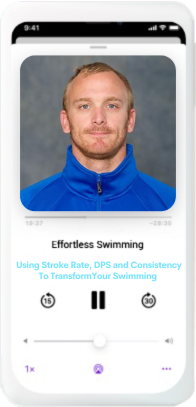
My guest today is Brian Johns who is a three-time Olympian former world record holder in the 400 IM and, the head of coaching science at FORM. In this episode, we will talk about improving your technique using FORM goggles and how important reliability and consistency are to transform your swimming.
In this episode
- 00:47 Best achievement: Coming back from injuries
- 03:52 Focus on the process and getting better every day
- 07:18 Get yourself in a squad environment
- 11:55 Understanding how DPS and SR lead to increase speed
- 17:34 How can you find the sweet spot with stroke rate and stroke length?
- 22:24 Applying progressive overload principles to Workouts
- 30:53 Applying race results to training and improvement
- 33:56 Changes to stroke rate and effort are very incremental
- 40:58 Has anything been interesting regarding the swim data that the FORM collected?
- 43:10 Knowing the fundamentals and the basics goes a very long way
- 44:06 Reliability/consistency are the key
- 45:25 Be mentally switched on
Links from this episode
- Change your technique and swim smoother, easier freestyle in the Effortless Swimming membership
- View our freestyle clinic schedule around Australia
This podcast is brought to you by NanoClear — our own range of anti-fog swim goggles, designed by Effortless Swimming with the anti-fog treatment bonded into the lens itself (not sprayed on, so it doesn’t wear off after a few swims). Check out the NanoClear range here and use code PODCAST15 for 15% off.
Transcript
Read the full transcript
Welcome to the Effortless Swimming podcast to show that help swimmers and triathletes love the water, become a better swimmer and live a better life. Here’s your host, Brenton Ford.
Welcome to the Effortless Swimming podcast. My guest today is Brian Johns. And Brian Johns is not only a three time Olympian, former world record holder in the 400 IM and has also coached a range of different abilities. But you’re now head of coaching science at form and forms obviously one of our sponsors of the podcast, which we really appreciate. And I’ve really enjoyed working with him over the last couple of years. So Brian, I’d love to welcome you to the podcast today. Thanks for having me. So to kick things off, your background in competitive swimming you’ve competed at a very high level for for many, many years there. What would you say is your biggest achievement or what were you most proud of with what you’ve done in the past with your swimming career? Well, I was pretty fortunate that I had a fairly long swimming career at the national team level. And so I went from being the youngest person on the Canadian national team
in 1998 to being the oldest person on the national team in 2011. So kind of had the full spectrum in between for me personally on in my swimming career kind of one of my more proud moments was to kind of coming back from injury. So I broke the world record in the 400 IM in 2003. And almost immediately after I tore my rotator cuff and swam through the next like year and a bit leading into the Athens Olympics. And then like overtrained and stuff like that. And it was a bit of a recovery to come back from that relearn how to swim properly. It wasn’t just about swimming hard, it was about swimming smart. And I know that’s something that you can relate to as well. And being able to take the lessons I learned from that took me about 18 months to get back to like regular training. And that regular training was about 70% of the volume that I was doing before I was injured. And then another year or so to come back all the way to the level that
I was at before and then in 2007 I swam at the World Championships in Melbourne and was the first Canadian to break two minutes in the 200 IM. So that was a pretty big deal for me. And then carried that success on to the Olympics and make the final in the 400 IM. And so it was like to get my highest peaks after a pretty big injury that’s kind of one of the things I was most proud of. Isn’t that interesting that the break the world record 2003, which in terms of achievements, that’s probably the greatest one, right? But then it’s when you come back from injury and you have to you have to do the hard things. You have to go through those hard times to then come back to that success that that’s what you’re most proud of. And I find that it’s just so it happens so often where it’s like it’s not necessarily the big things that people see or read, but it’s these other things that sees personal challenges that we we overcome that we end up
being most proud of. And you have to go through those difficult times or those there’s more rewarding when you have to work hard for it. Yeah, absolutely. Like the that’s kind of like the pieces I feel most proud of and it’s like funny looking back where it’s like that was like the individual performance I was the most proud of. But then of course, like you’re like on the national team for a long time or on a whole bunch of different clubs or universities or whatever happens to be. And it’s like the pieces that I find reflecting on is like the relationships I made, or like the surprise swims that we had or other things other than my like absolute best. It’s like I was bronze medalist at world championships. That was probably my highest like performance level and then breaking the world record. But like when I often think about like my favorite races, it’s like I was at the university games and we were expected to be
not in the top five in a relay. And we all swam ourselves and came silver. And it’s those types of things where it’s like you share those moments with people where you’re coming over some sort of adversity. And those are the things that kind of stick with you for longer rather than just like the single absolute best. And have you been able to take those experiences and relay those those onto the athletes that you’ve coached from all the different levels that you’ve coached? Because I know, especially when someone’s say young, they’re 17, 18, 19, and they’re very competitive and talking about national level athletes here. And it’s just all about, you know, want to get the gold or like I’ve got these high high goals that they want to achieve. And then perhaps they don’t don’t hit them. And they hit that roadblock or they go through that hard time. How do you explain that to someone, especially that age who’s hyper competitive and may not have the
experience that you’ve got under your belt and I think as you get more mature in your mid 20s, late 20s, and then into early 30s and so on, you just have a different perspective on things. How do you go about expressing that to the athletes? Yeah, like there’s a couple things there where my big focus, and this is tough for me as a swimmer, but the better that I did it, the better I was was to be just focused on the process and like being able to identify where you need to put your effort today to get a little bit better so that you’re just a little bit better tomorrow and be able to like identify those little things where it’s like, okay, I’m going to come today and I’m just going to get a little bit better. I’m not going to have a great workout. I’m not going to have a bad workout. I just want to get a little bit better today and then tomorrow a little bit better and the next day a little bit better and those incremental gains
like get up there and that’s where you really see your biggest improvements is where the like training day after training day just accumulates. You’re putting money in the bank and then you get to the race and you’re just withdrawing all the money so that you can spend it right in one spot and to be focused on the process and I’m just thinking about the collaborative atmosphere. I think this was a big piece that I focused on as a coach and I think that a lot of the best coaches out there don’t just like think about, okay, here’s my single swimmer. This is what I’m going to do with them and like they might have like the biomechanic background or bioenergetics or whatever happens to be in do like the exact right scientific thing. But the environment around that summer becomes so important to be engaging so that that summer is coming to like they might be doing literally the same workout every day. But if you’re providing an environment
around them that is exciting and can foster improvement, that becomes really more important thing to have that summer excited to improve. And so whether it’s like a group of like four or five that’s like some sort of elite program or like a universe, I always find like the university atmosphere works so well where we have like 25, 30 swimmers, maybe they get subdivided into your sprinters or distance or whatever. But you get those common like friendly rivalries where you’re trying to push each other that little bit further where if you’re by yourself, you wouldn’t have been able to push yourself that hard. But because you have some a teammate or somebody that you’re challenging or somebody that’s like a friendly competitor with you and you just get that extra push to find yourself somewhere where you couldn’t have taken yourself. Those like environmental factors end up being a big press on like helping those summers get
through the hardest times because you’re sharing that with other people. Yeah, absolutely. And I’ve seen that with a lot of summers that I’ve coached where maybe they were doing only solo swims, solo training, which you can certainly get good benefit from. And I think there are advantages to that as well. But get yourself in a squad environment or at least training with one other person. And you will get that competitive rivalry that will probably help you push a bit harder, be able to maintain your pace for longer. And it takes your mind off the session quite a bit as well because your mind isn’t just thinking about alright, this is what I’ve got to come. It’s you’re thinking about the other person next to you trying to stick with them or stay ahead, whatever it might be. It’s a good thing to be able to change up that environment. And I’ve seen this in some of the swim camps that we’ve done. We have run camps in Thailand for the last couple of
years and it’s basically a week. We call it how weak. I wouldn’t say it’s quite as hard as some of the how weeks that the elite squads are doing. But it’s swimming twice a day for seven days and people are getting pretty tired towards the end of it. But with that environment that you and culture that you foster at a camp like that where everyone’s getting up nice and early and we’re going through these hard sessions together, it really builds this camaraderie between everyone and you just it’s very hard to get that on your own. Yeah, absolutely. And like come back to like the things I took away from my own swimming. It’s like those types of moments like carry with you. And that’s where you can really learn about yourself. And those are the skills that you apply beyond the sport and like that that willingness to kind of like go that one more or like work within a group to help each other get better. Those are kind of the
skills that have definitely stuck with me as I get into like real person life as it were. And being part of like whether it’s an organization, a company, another swim team, like those are the pieces that really stick with you. Now you’ve you’ve been with form goals for about six years. Six is what I’m saying. Six months, I should say so. And so being part of their or head of coaching science. What’s your process? What are you thinking about when you’re looking at features to develop the workouts? Like how how are you taking your experience as a swimmer and a coach into the role that you’ve got now? Because I would imagine that you’re thinking, right, majority of the people who use this yeah, likely triathletes, but obviously a lot of open water and pool swimmers as well. But how can we get the best out of the people who are using our product? What can we do to make them faster, more efficient and get better results in there? There’s something
so what’s your what’s your thought process when you’re sort of looking at the future with with form goggles? Yeah, for for me, like the approach that I’ve taken kind of bringing that coaching perspective into form and being able to help swimmers get better using the goggles. Like I’ve had my a little bit of background of like master’s coaching or triathlon coaching where it’s like you have your eight lanes and on one side you might have like somebody preparing trying to qualify for Kona or like doing something like elite level triathlon program. And then on the on in lane one, you might have somebody who’s like adult onset summer learning how to do their freestyle properly. And you have this whole range. And the users that we have with our goggles definitely fit that full range of like very elite, very good triathletes and pool swimmers all the way to like maybe they like miss the water or haven’t swam in several years or just
trying to learn how to swim a little bit better and trying to use the goggles to get there. So any sort of like feature or concept that we have is trying to make sure that whoever is using the goggles in that full range is going to get something impactful out of it. I think for me like my background as a coach has always been so focused on like my main thing that I’ve always focused on as a coach is stroke reliability. And within that is things like technique, being able to apply that technique over time, being able to apply that technique over time at the pace that you want to race at. And so that always comes down to a technical foundation and everybody can either learn how to swim a little bit better with their technique or learn how to apply their pretty good technique a little bit better depending on what their goals are. And so kind of starting with that foundation, being able to build out from, okay, here’s how we can do to
make them a little bit better technically. Here’s how we can make them a little bit better in their pacing. And then just being able to build and build on that experience so that they can kind of take it where their goals want to take them. If they’re going to be super elite, then maybe they’re going to be more geared towards like the workouts and the plans that are going to get them there. If they’re geared a little bit more towards just like staying fit or using the goggles to get a little bit better. There’s metrics in there to help you and it helped guide you along to that improvement too. So what sort of metrics would you be looking at or do you think the majority of people should be considering? Well, for me, it always like comes back to the relatively simple framework of your distance for stroke and your stroke rate is your speed. And like that very like classic sort of DPS stroke rate speed equation where if you’re
going longer on each stroke or you’re doing your strokes a little bit faster, you’re going to get faster in the end. And so right now with form, we have we have real time stroke rate, which I find as a coach to be extremely powerful, along with the ability to either measure your strokes in distance for stroke. So either the meters for each stroke you’re taking or the number of strokes that you’re taking during a length, which is pretty much the same thing. And if you’re using those pieces in coordination with the time that you have, and within the form goggles, you can touch the wall, you see the time right there, or you see the running clock, you don’t have to look at find where the clock is and stuff like that. It’s all very easily seen in the goggles and be able to use those factors, the distance for stroke and stroke rate along with your time. Those are so vital to understanding how you’re swimming in the moment and how your future
improvement is affecting your swimming. And it’s like if you’re taking, if you’re with a coach, and they’re telling you, okay, let’s try and like add a little bit more catch up to your stroke, for instance, you want to have your hands a little bit closer together on the entry, just using an example. Well, in the goggles, you can see it’s like, well, my distance for stroke went higher, not a big surprise, but my stroke rate dropped a lot. How am I going to keep my stroke rate the same, keep the distance for stroke to become a better summer? And understanding how those pieces tie in together will help them understand how to swim better technically to help them be faster in the end. This episode of the podcast is proudly brought to you by our sponsor, Form Smart Swim Goggles. They’re more than a pair of goggles, meet the world’s most powerful swim platform. See yourself improved with Form Smart Swim Goggles, including a free one year
membership when you purchase your goggles for only 249 US dollars. They’ve currently changed up their offer where you can now get the goggles and you have one year membership included for free. And if you’d like to continue with the membership going forward, it’s only 15 US dollars a month where you get access to their workouts, training plans and custom workout builder, but you’ll always have access to the real time data in the goggles, so you never lose access to that. My favorite thing about the Form Goggles is having the instant feedback of what times you’re doing, what stroke rate you’re doing and also the ability to see what your heart rate is because never before have we been able to have these immediate feedback heads up display where it’s actually telling you what your intervals are. So when I wear the goggles in training, I like that I know my split for the first 50 and the 100 and the 150. So every single lap I’m getting that feedback on
what my pace is and I find it’s such an important tool for being able to not only have different gears where you can switch between the different speeds that you want to swim, but it helps you develop those gears and it helps you intuitively know how fast you need to go to before you’re going to blow up or before you’re going to go a little bit too hard. So it helps you just get really good at judging your pace for when you do go to a race. And even if you’re not wearing the goggles in a race, it’s that intuition and that ability to develop your pacing that these goggles can really help with to get your pair of form goggles and say 15 percent off. Use our link formswim.com forward slash effortless or use the coupon effortless at checkout and that will get you 15 percent off your pair of goggles using our special link formswim.com forward slash effortless or the code effortless at checkout. Yeah, I think it’s easy to over complicate what’s
required to get faster and I mean there is a lot that goes on when you are swimming and there’s so many different ways you can improve your technique. But if you just bring it down to the essentials, it’s it’s stroke rate and distance per stroke. So if we just always go back to that, we can make adjustments in either either direction. And I was working exchanging emails with with someone who has been doing this set five two hundreds set. And we looked at his data from about 12 months ago and today and his times were a little bit quicker than what he was doing about 12 months ago. And one of the things we saw is that his distance per stroke has increased quite a bit. And I think he’s taking on average about one second one second one stroke less per 25 meter length. So about two strokes less per 50. But his stroke rate has gone from 71 to 73 average down to about 67 to 68 strokes. So what we’re looking at is all right, if you can
maintain that same stroke length but have that faster rating, that’s going to be five to 10 seconds quicker for each 200. So a couple seconds quicker per hundred if you can maintain that. So just playing around with those numbers and it’s quite it’s quite fun to play around with that and see what the result would be. And if someone listens to this, if you strike rate 60 strokes per minute one stroke per second on average and let’s say you’re doing 50 strokes for a 50 meter length, you can get that down to 45 strokes per length, hold the same stroke stroke rate, that’s going to be about five seconds quicker per per lap. So just mucking around with the numbers there. And now it’s easier said than done. I think it certainly takes some some practice and some work to work on either of them. But it’s about finding that sweet spot between the two. And have you got any sort of advice for those listening about how they could find their sweet spot with
stroke rate and stroke length?
Yeah, absolutely. And like to kind of build off that point and carry it through to this is that like with the goggles we have real time stroke rate. And like, when I was swimming, it was like touch the wall, wait for the coach to bark it out to me. And to be able to see that stroke rate in real time as you’re swimming, I think is a big way to understand that relationship between distance per stroke and stroke rate where, okay, you’re doing a 50. And maybe like, you have a sense that it’s supposed to be like 60 strokes or like your stroke rate supposed to be about 60. But the start 70 in the end 50. It’s like, well, you’re not really training in a way that’s reliable, that’s going to affect your race. Or if anything, you’re actually like training in the opposite way that it might actually be hurtful for your racing. And if you want to be there, you actually have to learn how to be smoother at the start, hold on to it and
just like roll on that stroke rate. And so thinking about how to find that sweet spot for the stroke rate, I think it really comes down to understanding like, for me, the distance for stroke piece has always come first, where it’s like, the distance per stroke is your technique. Then you apply the technique to your stroke rate and that comes with training. And it’s like, in theory, you could tell somebody it’s like, go in and do 90 stroke rate. It’s like, well, they can physically do it, but not in a way that’s going to be helpful for their long term success. You have to be able to learn your technique. And then it’s like, okay, your technique right now, and your stroke count right now has yet 45 stroke rate. Let’s try and keep the same technique, hold the same stroke count, and bring it up to 50. And right there, you’re going to get some improvement. And then you might find that as you make some sort of other technical
improvement, increase the stroke rate, your distance per stroke may not increase like in the first length of the 200, but your seventh and eighth length do. And then that’s how you really get the technical reliability going from start to finish. So to find that like sweet spot of stroke rate, I think it comes really down to what are you training for? So if like you’re trying to train for like a 100 meter freestyle or a sprint triathlon or an Ironman, it’s a lot of different demands between that. So having the end goal in mind, know what you kind of need to go for that and then work backwards from there. Have your goal. My goal shouldn’t be x stroke rate. How am I going to train that here? And then you find that you’re accomplishing it a little bit earlier than expected, you can build it up and be actually better than you had anticipated. We do this set of 7 100s like a almost like a ramp test where in our eight week faster freestyle course, which
we’ve we’ve which we’ve just got added to. So if you’ve got form goggles, you can basically just add those workouts or those sessions to your to your goggles. Now, one of the things we do there in week a week eight, I think it is is the 700s test and we’ll get them to bump up their stroke rate by four strokes for each 100. And it doesn’t have to be for you could do it do it less. It might be three because four is a relatively big jump. But what we see there and if we start them on 56, I’ve got 56, 60, 64, 68, 72 and so on. And if you look at the the time and the strip time and the stroke rate and also getting to measure their perceived effort as well. And if you’re wearing a heart rate monitor, that could be the same thing essentially. But we find there’s typically a sweet spot there where some people will get to say 64 strokes per minute. And let’s say they’re times 130. And then they will go up to 68 strokes a minute, 72 strokes
a minute. But their speed doesn’t actually change because their distance per stroke is shortened so much. And they’re really just spinning the wheels. But the perceived effort is increasing. So then they’re going backwards. It’s not working for them. So it can help you find the sweet spot that way. And just, you know, if you can sort of, if you see that and you do a test like that, it gives you a bit of an idea of where you might be looking to sit, maybe a 1500 meter swim or a 1.9 K, K swim. And if you see when you when you’re doing this that there is no change in speed with any difference in in stroke rate, then we really just want to work on just some basic technique because the feedback that I get from a lot of people when they first start with me is I’ve only got one speed. I can’t go any faster. I can’t go any slow. I’ve just got this one speed. You can change that that can be fixed. That can be changed. But I think it just comes down to
knowing some basics of technique and making sure in training that you’re not just swimming at the one speed, make sure that you’re giving yourself the chance to actually vary your your speed and adjust it. And I know you like to do that with with some of the workouts that you’ve got with the with the form goggles as well. Do you want to talk a bit about like progressive voting and how you’ve set up some of those workouts in form? Sure. And just to kind of double back on that on something a little bit more specific around the stroke rate is like thinking about the 7 100s the set that very common set for like the elite summers would be like 7 200s classic step test where it’s like your last 200s supposed to be your 10 seconds away from your best time and you start your first one like 35 seconds away. But what I like to do and like that would be more about like we might measure lactate and heart rate and all that stuff. That’s
great and and all. But I found it more effective actually on the stroke reliability side where just take the middle five. So we’re not going to go to an all out effort at the end. But you’re also not going to swim like really really slow at the start you’re taking the middle five still trying to send. And the most important measures that I found was if you’re doing two hundreds and we usually did it long course but you do it short course to would be the third 50 first 50 you’re pushing off the wall you’re fresh things might not be like not reliable. Second one could be okay but you’re just to take down it’s that third 50 that like it’s a little bit more realistic to how you train at that speed on an everyday basis. And if you’re descending it’s like the first one is like this is how you usually train like an easy speed and moderate and strong and moving up. If you look at that third 50. What is your distance per stroke on that 50. What is your
stroke rate on that 50. And really trying to see where that breaking point ends up being through those five. Okay it’s like you said I only got one speed you can only dissent that like your first one slower your second one’s faster but the rest of the same. Well that’s your break and speed we’re going to start there. And then over time will find those gears and your breaking point is going to be a little bit later. What’s your stroke rate when you break there what’s your distance per stroke when you break there. And finding that like I find two hundreds to be helpful and finding the middle of it to be a little bit more realistic to how people are training every day. And be able to apply that into their swimming. And so kind of taking that point into like a progressive overload sense is like what I like to do is like find that breaking point and that’s I like your starting point. So an example might be I’m going to train for
Olympic distance triathlon. I know I want to break 20 minutes for the 1500 at the start. So right now I already know I need to go like 120 for my like per 100 pace all the way through. Okay that’s like my goal. I’m going to start I’m just going to make sure that I can actually swim that fast in the first place. I’m just going to do four 100s. I do four 100s at that speed. And then I’m going to progressively add some distance to it. And depending on who you are maybe you can add a little bit more quicker but might be four at the start. Now can I do eight. Can I do 12. Can I get closer to that full distance that I want to do for my goal. Great. You get to that distance. Maybe at the start you’re doing it on 30 or 40 seconds rest something that’s going to give you some time to recover. But you want to make it more realistic to the race the closer you get to it. So starting at 30 seconds rest now I’m going to do it on 20 seconds rest then on 10
seconds rest. Now instead of doing 100s I’m going to do 10 200s and then going to do like four 500s and keep on making it progressively closer and closer to the specific goal that you have in mind. And then like by the time you get there you’ve swum so much at that pace that it just becomes second nature by the time you get into the race. Yeah that’s that’s good. I was had to had a swimmer on recently who just broke the record for the Cook Straight which is swimming between the North and South Island in New Zealand. And he was talking about a very similar approach to to his training where they would that basically do that just he became very efficient at swimming 110 pace and he ended up holding that for the four and a bit hours that he did this Cook Straight swim which is just ridiculous but just but he took a similar approach. He just got to that point where he’d done it so much in training that he was able to do it very
efficiently and you don’t start by doing holding a going 110 and leaving on 115 and doing 100 of them. Now you might start with four with 30 seconds rest. So it’s a really really simple but good approach. I think to being able to I think first we’ll have the confidence that you can do what you need to do there but also just training your body to become efficient and become familiar with what it’s like to swim at that sort of effort and speed. Yeah. Yeah. Absolutely. And like the coaches here that I’ve worked with Tom Johnson as my coach in in Canada and Randy the late great Randy Bennett coached in Victoria for like Tom felt like he coached Brent Hayden to Olympic medalist in the 100 freestyle and he felt very deeply that he just needed to practice swimming at that speed. Now you’re swimming a hundred meters there and the speed is very high and you might not be able to do that every day. So let’s do it with fins. Let’s do it with paddles.
Let’s do it like just feel what it feels like to be that fast in the water and practice that over and over again. So the progressive overload might go in a different direction where it’s like OK we’re going to do like four twenty fives with all the equipment with lots of rest and do it. And then over time less rest you take the equipment away stuff like that and you get closer to it. And then on the flip side was Ryan Cochran who Olympic medalist in in the mile coaching with Randy. And it was like same type of approach where he’s trying to go fourteen forty for fifteen hundred. And it’s like well you got to hold fifty eights. So let’s try and do four on two minutes and go fifty eight seconds. And it’s like just start with knowing that you can do the speed and then finding the little ways to increase the challenge so that that challenge gets more and more race like the closer you get to it. And then by the time you’re there like you’ve you’ve done
all the work you know that you’ve done it and you’ve made it as specific as possible to the race that you’re preparing for. Now the one thing that someone listened to this might be thinking is well that’s that’s great. I I swim at two minutes per hundred and I’d like to get down to one forty five. That’s my goal but I can’t I can’t hit one forty fives yet. What would be your advice there. Yeah like you can even start shorter where it’s like you’re that might be the first goal. Well let’s try some fifties. You want to go you want to go one forty five. Can you go fifty two or fifty three seconds for a fifty. Maybe not yet. Try twenty five or twenty six seconds for twenty five. And like just know what it feels like to be that quick. And it’s like it’s OK to have success at the start. I know us swimmers just want to try hard all the time and like buttons for punishment but it’s OK to have success and be able to see you hold that pace in some way
with lots of rest in a short way. And it’s like OK yeah I’m capable of doing this. And then you just find that little tweak to make it a little bit harder next time. And so like what I find myself doing and like now that working at form and we are able to like you build a workout and you can put it into the goggles yourself. And it’s like what I find myself doing is like OK I’m going to start with something small and it’s like for me it might be 10 100s but it could be any set could be 16 25s could be 8 25s. And I’m just going to edit the same workout. And it’s so simple to just go into that same sense like OK last week I did this set I did 8 25s on 30 seconds rest it’s right there in what you wrote last time this time I’m just going to go in and I change it to 12 instead. See if I can do it again. And now I’m going to change it from 30 seconds rest to 25 seconds rest. And you’re just taking the literal same workout and you’re making it just a little
bit harder in little tweaks week to week and be able to over time incrementally gain your way to your goal. Yeah that’s good. I like that. And I think as well some is that around let’s say one 45 to two minute pace which I work work a lot with. There is typically things in your stroke that you’re doing that are creating a lot of drag or you’re just missing out on a lot of propulsion. So there’s things that you could improve with your catch and pull. So it might be worthwhile. Let’s say you do some filming get some analysis or you have someone just coach coaching you try and maintain that stroke change that you know is specific to you and is going to make you faster try and maintain that stroke change for 25 meters and then you might do a couple of those or maintain it for 50 because it’s usually going to feel quite often quite challenging quite difficult to hold that change in the beginning for more than 100 meters. It’s just your body is not
used to it. You use different muscles. It just takes time to be able to do that efficiently. So I think the approach that you’ve mentioned is really helpful for even just when you’re working on on something like a stroke change because the feedback I get so often is like when someone comes to a clinic we do underwater filming analysis we work with them quite often they’ll be quicker after a couple of weeks they’re like this is hard work like I just can’t hold it for that long. So if they take that sort of approach that’s how you can start to build up build up and develop that muscle memory and the ability to hold that stroke for longer distances is start small. Yeah and like the progressive overload concept like works for technique as much as it does for pace where it’s like OK you might be trying to overload like getting that progression for whatever your goal time is but it also works the same way on technique where it’s like OK I know I
want to improve my technique but like you said I might only be able to hold that stroke for twenty five and with lots of rest or it’s like common thing of like oh man this feels weird I don’t know if I can like coordinate myself that way for longer than a length or two and it’s like again it’s OK have success have a little bit of success and be understanding like there’s the little bit of change and then just try and increase the amount that you can make that change for longer and longer from workout to workout and like it’s it’s kind of crazy to put in perspective of like you’re trying to make this incremental change of like put your hand a little bit over here or finish out a little bit further back and it’s like I mean if you’re doing a four thousand meter workout and you’re doing thirty like strokes per fifty meter length like you’re talking about thousands of repetitions in a single workout it’s like swimming is so unlike any other sport
where maybe you can make a single change and you can see an immediate effect you can see that in swimming but you might not be able to hold it for the entire time so being able to like working with a coach understand what the change is first and then slowly over time increase the application of that change is so helpful. Absolutely one of the things I really like about so looking back at data from a session is I like to see because often I’ll swim at the goggles and I’ll mostly just be using my pace my times in training just to make sure I’m hitting the right the right pace and then post session I’ll look back and see OK that that was my stroke rate when I was stepping up the effort a little bit so I like to look at that way and if we’re doing like a descending two hundreds set usually if I’m at around sort of seventy percent effort I might be around sort of sixty sixty one strikes per minute and then when I’m starting
to almost like almost go max my stroke rate will be up around sixty six to sixty eight if it’s like two hundreds for example and one of the things that I I believe a lot of people don’t understand if they’re new to the sport is that these changes to stroke rate and effort are very incremental. I think people often go from here to here just straight away and it’s like no it’s just you just need to step it up slightly so and it takes it takes a lot of practice to be able to manage those little incremental this is an effort or or stroke rate and just and getting really good at that will help you just get into the right gear when you’re racing. But it does take time but it’s a lot less than what people actually think. Yeah. And like what I find with using the goggles and on a day to day basis now is like the information I’m getting in the goggles helps me stay kind of in the moment and how I’m doing a swim and like kind of coming back to the
process of swimming it the right way. So it’s like I usually focus on like my pace if it’s on a longer interval and my stroke rate my real time stroke rate where it’s like OK I’m doing like two hundreds. Am I keeping the same stroke rate the whole way. Am I just like swimming steadily. And for me I’m like closer to 50 52 and so it’s like OK as long as I’m like keeping it in at 50 I’m not letting it dip down like I know I’m just kind of rolling it through and then having that compared to the time and the time is like the same from length to length. I know that I’m following a good process of swimming well then go to the app afterwards and look at it. It’s like OK those are my actual numbers but I know that I need my stroke rate to be this for the race or next time this was like a long aerobic set next time I might be doing like a threshold set or a best average set. I know that I need to be here and just being able to go back
and forth from like look at the result interpret it and be able to apply that into your next training session so that you can be focused on. I just need to do this today and focus on the process of being a little bit better and then that back and forth between training a little bit better reviewing OK I need to do this next time and then bring it back to the next training session that back and forth becomes such a key piece to finding those gains from work out to work out. Yeah one of the ways that we use that with some of the Swimmers I coach is we’ll look at their race data. Let’s say I’ve done a half and just and see what their their stroke rate is and the time that they got obviously like distance per stroke that sort of thing is just it’s not not as relevant I think when it comes to the open water swimming side of it but we can really use that stroke rate and what their overall overall time was and what what I’ve seen with a
couple of Swimmers is like their stroke rate has been too too slow in their races. So we’ve used we’ve used that and so I’m thinking of a swim that I’ve been working with her stroke rate was I think low 70 72 from from memory and or not might mean like 68 actually and for her she needs to be up around that mid 70s to be competitive with those other girls that she’s racing against and in the last race it was I think 75 or 76 she had a much better swim she was quickest one she’s she’s done and so but we use that data from her race in her training and with her video analysis where we saw okay well this is this is what you need to work on with your stroke but we need to start getting up into those faster ratings because you’re just not going to be able to have that big enough distance per stroke you’re not tall enough your wingspan is not long enough to be able to hold that sort of distance per stroke at the stroke rate that you’re currently
at. So we’ve got to work on on these couple of things. Yeah I think that like using the real time stroke rate from the race into the training especially is such a key piece where if you’re thinking about just pace and it’s like okay trying to break 20 minutes I want to go 120 I’ll roll 120s in a pool maybe not because like 120s in the pool is not going to translate to 20 minutes in open water and so understanding like what the stroke rate is where like you said you can like go either way where it’s like yeah you look at the stroke rate and it’s like in training you can hold a higher stroke rate so maybe you got to be able to apply what you’re doing in training a little bit better into the race and you have the data to back it up there. The other way would be like okay that was your stroke rate in your last race come back now you’re going to understand what the pace is supposed to be in training to apply it to what you want to do here.
So it’s like okay we knew that last time you did stroke rate you did a 70 stroke rate it got you to 20 minutes but in in the pool that actually means like holding 118 and so next time it’s like okay I want to do 71 72 73 stroke rate that translates to 116 115 now you’re actually going to see an improvement on the open water that’s a little bit more realistic to the way that you trained in the water and applying it to the open water. And if you listen to this and thinking why is it faster why don’t I need to be faster in the pool to have those times in open water you’ve got the turns and you’ve got that push off the wall which gives you that extra speed in the in the pool. So if you can be a couple of seconds quicker well then what you or race target pace would be that’s that’s why because you have those turns and those push offs the wall and for someone who can turn well usually a short court their short course times will be faster than their
long course time. So going from 25 to 50 because you’ve got more more turns more chances to push off. And I mean you’re so your 400 I am world record was a 402 all right which is incredibly incredible. What was your PB for long course. My best is 411 411. So I did that in yeah so it’s like you’re talking about a one second per 50 difference just between a 25 meter pool and a 50 meter pool let alone trying to apply that to 1500 meters nonstop. I think that like it’s a good point on on the walls but the relating the stroke rate from the open water to the pool can also help you like individualize to that summer as well where it’s like OK maybe this summer was like former competitive summer they have to be a little bit quicker than you think to match the pace. Somebody else where it’s like can’t even do a flip turn and maybe that the difference between their push offs in the pool isn’t as great but having that stroke rate from one to the other is a
piece this objective that you can apply from one to the other and then wherever that individual ends up at that stroke rate in the pool that’s a good starting point and then you can kind of like move up from there however you feel like the goals are for that individual and with all of the data and all the swims that you know that you have there at form has there been anything that that surprised you or you thought oh that’s that’s interesting just based on based on what you’ve seen with all of this swim data that forms collected who has a tough one because there’s definitely been a lot of data that we’re mostly thinking about like we’re working on what we want to do in the future and trying to see like where where are we right now with the summers that are users that are using the goggles right now and what are the things that we can do to kind of push them to be better summers wherever they’re at and so we’re starting to collect a little
bit more data on things that are a little bit more specific that could be effective for technique it could be effective for how they pace and being able to measure how good of a pacer they are and it’s those types of things that are like new and novel where wow we might be able to really affect somebody from like a more literal weight on their technique just by measuring how they’re moving their head in the water and stuff like that it’s down the line but at the same time it’s like it’s pretty exciting to think that having these goggles on there like again I find like the DPS and the stroke rate if you just get that and understand that concept you’re going to go a long way and but to be able to get that like one little extra piece to get a little bit better really understanding how to pace well and understanding how to use those numbers to be better technically help a lot and be able and we’re starting to get new data of like wow we
might be able to have some tools here to get you even better and those are kind of the things that I’m looking forward to applying in the future. Yeah that’s that’s exciting and it’s I always have to remind myself that people who are newer to swimming they don’t have this background knowledge and information that we’ve had growing up swimming and learning from lots of different coaches. So sometimes just knowing the fundamentals and the basics go a very long way especially for someone who’s been swimming for only only a couple of years and those fundamentals that you talk about distance per stroke stroke rate the relationship between the two and also consistency because the best athletes in any sport are the most consistent. So if you can get very good at just being consistent with hitting your numbers whether it’s stroke rate or stroke count and aiming to hold the same pace across the board that you’re going to go a long way there. And
typically the swimmers that are winning races are those that don’t slow down but slow down the least towards the end of end of a race. And too often if I’m looking at people’s data they go too hard at the start. They blow up and then they’re just sitting a couple seconds below what they could be holding in terms of pace for the rest of the race because they just went out too hard. So just taking it easy thinking of that easy speed at the start and just keeping the heart rate in check just relaxing and then just settling into your speed is much better approach than just going helpful leather because it’s just you’re going to blow up and then you’re not going to be able to hold what you could hold. Yeah that consistency piece is such a key piece for swimmers especially where you’re going through the medium of water and it’s like the way that you are learning to move your body through that foreign substance is like it can be very
challenging. And so it’s like even just staying the same is a hard thing to do let alone build up off of it. And like the one more thing that I just add to that is like I consistency is like great. I like to think of it as reliability where it’s like are you reliable like are you the same summer at the end of a 400 as you are at the start of a 400. If I took a picture of you at the start and took a picture of you at the end could I tell a difference between the two and just being reliable from one side to the other and like just thinking of like triathlon and pool swimming examples of that where somebody like I mean Ian Thorpe is a great example of like OK yes he’s got the world record in the 200 and the 400 but he gets in the 800 he gets from the 100 and like any great swimmer can hit a range of these are not just a specialist in like one specific distance they’re able to if they’re good and they’re reliable they can do it over different ranges and
then on the triathlon side where you see people like like Christian Blumenfeldt and Gustav Eiden being able to go from like Olympic distance to Ironman that like completely different levels of demand but their reliability and it takes them from one to the other and those skills are able to transfer over from whatever the demand is from the race if you train in a reliable way and being able to understand like OK this is my stroke count when I do 100s it should be the same as 200s and 400s and thousands and beyond or this is the stroke rate that I’m training at and I keep it there for the whole interval whether it’s no matter the distance and so being able to have that understanding of reliability and consistency that really goes a long way to and it’s a good it’s a good challenge it’s a good challenge of your mental ability to stick with it keep switched on and obviously the physical challenge as well because if I’ve ever
drifted off through a session where I’m thinking about whatever’s happening that day or I’m daydreaming about something normally my times will reflect that so if you can just keep mentally switched on and I think the goal is to a great job of just keeping that in check because I think you like a pilot and you’ve got all the you got these numbers you got the dashboards and you’re just making sure things are staying where they should be so that you don’t crash same thing with the swimming you’re getting that instant feedback where you can in a way it is like you’re just this pilot and you’re controlling things and yes there’s a lot of effort involved their physical effort whereas a pilot just sitting there but I think it actually helps you just get keep keep your mind focused. Yeah absolutely that’s what I find it’s best as well where it’s like it can be like very overwhelming to see that much data but then at the same time it’s just like this
is just how you’re swimming at this moment and like you’re just checking the dashboard like you’re driving down you’re driving your car you’re checking it’s like yep I’m at the rate speed limit yep I’m in a good spot and you’re just giving a little check and you’re just on pace or you’re on track for whatever you’re trying to do absolutely. Brian thanks so much for being on the podcast we’re probably going a little bit longer than I said at the start but when I have someone like yourself who’s got great experience in competing and in coaching and you’re working on the data side of things with form there’s always a lot to talk about so I appreciate you being on the podcast and no doubt we’ll chat again and see what you guys are up to. Yeah absolutely thanks for having me and I’ll come back on anytime you want. Thanks for listening to the Effortless Swimming podcast. If you’d like us to help you become a faster more efficient
swimmer go to www.effortlessswimming.com.