








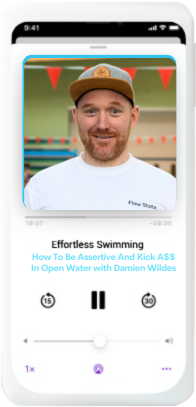
What if the secret to crushing your next open water swim isn’t just logging more miles, but learning to embrace the chaos, drafting like a pro, taking the occasional hit, and then surging ahead with confidence. Today on the Effortless Swimming Podcast, I’m joined by Damien from Flow State Swimming it’s premier open water coaching squad.
Damien didn’t learn to swim in a pool. He learned to survive and thrive in choppy conditions. Mastering tactics from course recon to aggressive positioning so that you never have to feel like a victim out there. In this episode, we’ll dive into the mental shift from passive paddler to assertive racer.
While your catch and glide sweet spot might unlock explosive speed, exactly how to build the suffer tolerance that makes hard efforts feel effortless. Hands-on coaching hacks for feeling the water and finding flow. And whether you are gearing up for your first triathlon or hunting a personal best in an open water race, stick around.
By the time we’re done, you’ll know how to swim hard, swim smart, and swim free. Know what’s required. Let’s jump in.
In this episode
- 02:07 — Introduction to Flow State Swimming
- 04:08 — The Tactical Side of Open Water Swimming
- 06:22 — Coaching Strategies: Propulsion vs. Glide
- 12:46 — Finding the Sweet Spot
- 17:19 — The Importance of Feel Over Pace
- 23:39 — The Hell Set: Pushing Limits in Training
- 34:04 — Success Stories: Progress in Swimming
- 41:38 — Conclusion and Contact Information
Links from this episode
- Get your NanoClear swimming goggles here and get 15% off your first purchase with code PODCAST15.
- https://effortlessswimming.com/camps/
- Change your technique and swim a smoother, easier freestyle with the Effortless Swimming membership
- Get in touch with Damien
- https://youtu.be/oRoYMUswKNI
Transcript
Read the full transcript
I personally find that the people who can swim really hard and really well are the ones who actually know how to suffer in the water and are comfortable doing it. I'm sure you've seen people when you say, well, we want you to swim in a top end effort and they come back in, faces aren't red. There's no real heavy breathing, but they're saying, oh, that was really hard. And you're saying, no, that's not hard swimming. You have more in you. And they say, oh, actually, yeah, I could go again. So the idea with the hell set is again, referring back to that swim literacy to put people in a position to suffer in a similar way to how they would when they go racing so that they know how it feels. They know how and when they can push them and what they're capable of delivering on. Welcome to the Effortless Swimming Podcast to show that help swimmers and triathletes love the water, become a better swimmer and live a better life. Here's your host, Brenton Ford. Not if the secret to crushing your next open water swim isn't just logging more miles, but learning to embrace the chaos, drafting like a pro, taking the occasional hit and then surging ahead with confidence today on the Effortless Swimming Podcast. I'm joined by Damian from Flow State Swimming Island's premier open water coaching squad. Damian didn't learn to swim in a pool. He learned to survive and thrive in choppy conditions, mastering tactics from course recon to aggressive positioning so that you never have to feel like a victim out there.
In this episode, we'll dive into the mental shift from passive paddler to assertive racer. While your catch and glide sweet spot might unlock explosive speed, exactly how to build the suffer tolerance that makes hard efforts feel effortless, hands on coaching hacks for feeling the water and finding flow. And whether you're gearing up for your first triathlon or hunting a personal best in an open water race, stick around. By the time we're done, you'll know how to swim hard, swim smart, and swim free. Know what you're required. Let's jump in. Right, there we go. Damian, welcome to the podcast. Thanks for having me. So, Damian, you're coaching out there in Ireland, working with a lot of open water swimmers and triathletes. And today I want to dig into some of your coaching strategies, coaching philosophies, how you like to approach things so that people can become stronger more assertive swimmers. And maybe just for those that are listening, if you want to give a bit of background on flow state swimming, which is your squad, your coaching business, and kind of what you stand for. Quite like that when you mentioned that off air before. Yes, flow state was really born out of just a low first competing the open water. I don't come from a pool swimming background. And the competing that I did do was always based on the open water and the bit that I always really liked. And that I was kind of surprised that people didn't pursue more was the real tactical side of open water swimming. So something as simple as reviewing the course before you swim,
understanding how you want to approach a turn, approach dealing with groups, drafting, all that sort of things. And what flow state is trying to do is prepare people for the open water. And when we talk about competing, it's not necessarily that we're looking for people to win races, whether that's at the top end or age group level. But it's just for people to be as competitive as possible, even with themselves. So we look at everything from people swimming at the right paces, we're working in the right zones, but when it comes to courses, how they're navigating it and put them in a position to race strong. But I suppose one of the things that I see also as being or a separating flow state from a lot of other coaching groups is that we're we're kind of actively pursuing people to swim hard, swim strong and in some cases aggressively really impose themselves in a course so that they can put themselves in the best position to perform as well as possible and that they're not subject to, I suppose, the circumstances that appear around them, but that they can kind of control the environment that they're in and put themselves in the best position possible to perform as well as they can.
Yeah, I love that. And one of the the models I've had in open water swimming that that I got from someone else was was don't be a victim. You've got to be assertive. You've got to be aggressive if you want to do well. And and it really like it open water swimming lends itself to that style of swimming rather than just being passive because you've got to you're going to be around other people. You're going to be dealing with challenging conditions. So if you can have that kind of mentality, even if you are outside of the pool, you might be very kind, very nice. You can still have that that dog attitude about you when it comes to racing. And I see that with like a lot of the if I've worked with any pro triathletes, lovely, lovely people out of the water. But I see it like you see it in their eye. You can see it when they get into competition that like they they want to win. And you need that about you if you really want to want to do well. So I think it's a really good sort of attitude to have once you get into the open water. I think even though, as you said, some people are great for others aren't like open water swimming is a full contact sport. And so if you want to get in the mix, you've got to prepare to take a hit. You have to prepare to give a hit if it comes your way. And I think unless you're willing to accept that that's there, you are more than likely going to have to fade back away from that competition because you're not going to impose yourself on those scenarios. We do a lot of race simulation work where we'll set up very short courses, open water, and we'll try and put in three or four turns. And we might kind of handicap our stages. So we've saw our swimmers first, faster swimmers coming through.
So we're forcing people to draft on the quickest line. The message always is if you want to get in the mix, prepare to take a hit. If not, go wide, avoid scrum, leave that go. But like that, some people absolutely love it. And we tend to find that the more people get comfortable with it, the more they actually pursue it. I think there's nearly more of a mental block that people just don't want to be in there. I think there's all these fears that they're going to get buried under the water and never resurface again. Whereas they realise that it might just be a bit of jostling few shoulders, few elbows, and they move on under the clean water again. So it's a great way of learning and a great way of prepping people for racing. Absolutely. Now, I want to get into some of the some of the ways you like to coach some of the key aspects you'd like to to teach the athletes you're working with. One thing that you mentioned before we jumped on this call was the propulsion versus the glide, like just finding the sweet spot there. So what sort of stuff are you saying with the athletes you're working with there? And what's the message you're trying to convey to them with that?
So I think generically, what I would see in a lot of the other people who are competing or getting into the open water is there's a lot of people who are either coming to swimming quite late. They may have never done it as a child or we get some kids who maybe and this is a more recent thing who were impacted by Covid who spent had spent time out of the pool and they're kind of coming back to it again.
That tends to be quite well drilled. They've de-sinformed, they know what they're doing. But for the most part, people who are coming to it later, they don't tend to have the understanding as to how they need to move to make it feel easy to get through the water. A lot of them may have come from, say, a traceman background where there's running or biking where as a basic premise to quick your legs go the faster you're going to go, that transfer of understanding to swimming just doesn't work because, yes, you're out of moving quickly, play a part in allowing you to move fast, but for the speeds that these people are moving at, that doesn't translate. And so what we're trying to do is bring people back to a center point of trying to have equal focus on streamlining as well as propulsion so they get that benefit of the drive through the propulsive phase and allow themselves to glide. And once that penny drops where they actually feel they can produce pace but also do it without feeling absolutely gassed, now you have someone in a position where they actually can start improving time significantly because their pace isn't reliant on cadence. It's reliant on propulsion. And then naturally, if you are propelling yourself, if you increase your arms and maintain the same shape, you're going to travel quicker. So that's generally where our swimmers start and what we're trying to move them to. It's such a key thing to get across and understand. One way that I've found it to get that point across, if I'm doing like an example video on the on the iPad, showing them the different positions that we're going for.
And when you think of someone at the top of their stroke, like they're on their side, they're reaching out, they're about to begin their catch, that position. I remember saying on a race club video where they had the velocity, they're like they had the velocity. The thing that measures velocity. And they showed that the fastest point in the stroke or it's equal to another part of the stroke, but the fastest point in your stroke is at the top of it. When you've finished pressing back with your hand, when you've reached out onto your side. And one of the reasons that that's the most fastest point in your stroke is because you're most streamlined at that point. And so like I say to them right here, this this is the fastest point in your stroke. So if you're coming in and just going straight down, trying to get your propulsion going immediately into the catch without extending out, you're missing out on that fastest point in the stroke. So we want to make the most of it and not make the most of it where we're just hanging out all day and just gliding and losing our speed. But we need to be patient through there. So we hold that streamlined for at least a little bit to enjoy the the fruits of your work with your catching your pull through. Well, and with that point, we've actually one thing that we do like to do like in addition to working on that front end because what we find is that it's out of sight, out of mind. As so many swimmers are focused on just kind of what happens immediately within their range of vision. So once that lead arm goes in front of the head, but they might have had a clean entry, once it goes beyond that point, you see that kind of soft elbow on the weak wrist and things start to slack off very quickly.
So once we get into a position where we have people holding that front end really well in that streamlined position, what we try and get them to do is feel that spike in acceleration but also the drop off to get them to catch and drive on the opposite side. So we get them to focus on that peak and trough in terms of pace, say, OK, you're fastest where you start to slow down. And now we look to start balancing out, find that middle line where you know that you can drive into into your streamlined position, feel that pace. But now where do we have to pull to allow yourself to carry that pace forward and feel like you're moving at an even speed across an entire length? And again, once swimmers start feeling that, I think there's a big transformation in their stroke very, very quickly.
And how do you go about getting them to feel that?
So we usually try and over exaggerate the positions on the proposal phase. So it might be someone just putting paddles on. In a lot of cases, we just try and eliminate the requirement for the head turn predominantly because if they get into a position where they are actually propelling themselves with that speed, breathing becomes so much easier. But if they aren't allowing themselves to feel that pace, the head turns problematic. So a lot of the work that we would do is snorkel on and focus on the floor and make sure the head position is right. And if we get paddles on or fins on where when they drive themselves into that streamlined position, they can actually feel themselves kind of cutting through the water. One aspect we do like to play with is actually where that strike, that strike position enters to. So when your hand comes over and enters into the water, that we're not aimless in that that our hand just doesn't kind of enter high or too low. And so even something as simple as fins on, rotate a position, snorkel on. As we kick through, you raise and lower your arm on the front end. So you can feel the resistance on the top of your arm. You can feel it coming through a streamlined position and then how your shoulder hinges at the top end. And they try and find that spot in the middle. And once they have that position, that's their strike point. Now we added the arm where I might just be to put on a paddle so that we over exaggerate the catch and propulsive phase. And once they drive through, stay streamlined on the opposite side, they can feel spike in pace and then as it starts to drop off and there's a rotation where they catch and drive on the opposite side. But it's really kind of focusing on a gear assisted catch up
that focuses as much on the streamline and rotation as it does on the propulsion. And because it's so segmented, people tend to be able to find that position relatively quickly. And can you go into a bit more detail about
how you get people to explore the finding that sweet spot where they're not gliding too long and they're not gliding at all? Because that's one of the things that I find a lot of people, it takes a lot of practice to get it. If someone is either, say, doing too much catch up, OK, just getting them to back off that catch up so that they keep their momentum in the stroke. And then obviously on the other side of that is someone who's just spinning the wheels and they've got no reach and rotation and there's no there's no patience in front. But particularly those that are doing catch up, I find for them, it's like trying to get that trying to get that continuity in the stroke. So would you have an approach for that for someone who's say doing full catch up stroke and we want them to ease off that catch up? Yeah, so we the way that we approach our swim and again dealing with the group that we're dealing with rather than go kind of drill specific, we like to work on progressions. We work on a single aspect of the stroke. And for the sake of this, we'll talk about streamlining. And we go through five or six steps that carries through a series of progressions that bring us back up to our full stroke. The first movement could just be as simple as again, find that streamline position on the front end, lead arm, making sure that we have our shoulder rotators.
The rotation of the side point, I think is a funny one because it's that differentiation between the twists of the body as opposed to a rotation that happens as a result of your extension through the stroke that naturally has a shoulder to come back. So once we have that position found when we have people moving through their stroke and we generally do swim in that catch up position, I think people find that quite robotic. So what we tend to try and do is when we have that robotic position, but we can see the glide, we can see the propulsive phase, we then just ask people to focus on a slightly more natural cadence where it feels a little bit smoother in terms of how it fits in with their their movement of what they feel is being normal. And then something as simple as that, just their timing, so trying to count in their heads. So we might say, look, we're looking for you to try and maybe achieve 12 to 14 strokes per length. That's what your aim is. So we're looking to pull it back from catch up, slotting your natural rhythm, your natural cadence and allow that to carry you with a balance between propulsion and streamlining. I suppose when you say it like that, it still sounds like a very complicated process. And both when we go through those four or five points, it tends tends to bring people along. Having said that, we always have those people who either stay and catch up too long or dropping too too too quickly. And in my experience, it's not something that's fixed in one session. It tends to be kind of over two, three, four sessions where they might start finding patches in their stroke across
maybe five, six, seven meters where they find that glide, they find that rhythm and then maybe they lose it because all habits kick in and it's just then trying to string those together. And so we have a lot of back and forth, a lot of dialogue with swimmers to make sure that they're finding the right positions and then focusing on the correct ones to benefit off the hard work that they're putting in. I find exactly the same thing. It's it takes quite a while to find the right rhythm for those streamers. Like it's several sessions. They'll get glimpses of it here and there, but it's certainly not fixed in one session. No, and we have with our clinics, like we do small, small group clinics. So it's only six people across two lanes. But before we ever get in the water, you kind of highlight. Look, this is in the case where we're looking for you to produce 100 meters of flawless swimming at the end of the clinic. If you're swimming and you're finding that you have patches of anywhere between five and 10 meters where things click golden. That's exactly where we want to be, because you know the feeling that you're striving for. So the next time you're in the pool, you know what you're looking for. You've seen the drills that we've been using to get you there. And then it's just about stringing those patches together and trying to make it as consistent as possible. And the key thing you mentioned there is that's the feeling we're going for. He's we're always in our head, you know, especially as we're going through through these drills and these key points. But it's the feeling. If you can just go get more of that feeling within your lap, then that's where the magic happens is when you're in that flow state. Like, I think it's a good name for a business.
It's like you just feel like things are flowing well when you're swimming swimming well and you're out of your head. So that's what it's all about. I think, though, unfortunately. Like it's kind of like a double edged sword. We've never had so much access to information. You can train as close to a professional as you want to as it stands with all the information that you have access to through your watch or through coaching systems. And the watch has caused such a huge issue then because if you're trying to get people to work on the rhythm and flow, but every time they leave the wall, the press and start. Every time they come back into the wall, the press and stop. And once the watch is there, there's a fixation on pace and people think it's kind of like a minimum time they have to be hitting regardless of what they're doing. And so all of a sudden, what should be a progression or drill set? People start losing sight of percent. Oh, my times are slipping. I need to kind of speed things up here. So the the watches, again, fantastic. If you're kind of doing distance and you're trying to track pace, but very problematic if you're looking for people to just swim consistently and steady with no distractions where they're literally just focusing on tiles in the bottom of the pool and that feel for the water. If I forget to ask people at a clinic that we run to take their watch off, quite often I'll see them doing like we might do our first drill progression and then we'll do like some fifties of swim, just trying to implement those things. And I see them check it every every fifties. Like, oh, that wasn't faster than what I normally do.
Oh, that wasn't fast and what I normally do. We go through the next one. Yeah, maybe they get a 50 where it's like, oh, it wasn't too bad. But then it's like the next one, it's the same or slower. Yeah. And so it's like, don't worry about your pace. Like don't worry about what time you're doing right now. We're going for a certain certain feeling. We got we're not looking at pace. Like it may improve if you improve these things. Like it may improve straight away, but there's a really good chance that it's not going to because you haven't quite got that timing and that that rhythm. So yeah, get if they can get rid of the watch, especially in anything tech technique related, you will like you'll just be so much more present in the water. And I find the same thing. If I ever wear my garment when I'm training, like there's that fixation on it. So if I do wear, I try and just not look at it whatsoever because then I end up trying to force the speed a bit much. And I find that my effort level goes up, but the the times don't really change with it. Whereas when I'm just I've got rid of it, I can generally go faster for for less effort than if I'm trying to force it. Yeah, yeah. And I'd see that as well, that people don't necessarily understand that correlation between pace through technique driven swimming. As opposed to pace through panic, time chasing swimming. So like that, we go through sets where you might have people who swim kind of steady state and then you ask them to ramp up the pace. And they find that all of a sudden the difference in time between their steady state and their higher effort is quite minimal. You're you're now ignoring technique. You're focusing on turning because you're equating your pace
to turn over as opposed to form. We want the propulsion. We want to streamline it. Yeah, I think exactly what like you said, there's that distraction from your form and your feel for the water when the watch is there, because you just feel like you're chasing time. I think the art of being able to read a pace clock and just count your lengths is very, very undervalued, particularly when you're just trying to hold form. I like to refer to something to swim literacy where people understand they're swimming. Like, I know if I was swimming well, I knew once I left the wall, if you're swimming hundreds, I knew what a 130, 125, 120 effort felt like. I may be plus or minus a second, but by the time I came in, I knew I knew how it felt so that that transfers the open water really well. You knew where your efforts sit. Whereas when we get people to remove the watch and maybe do efforts without the watch, the understanding of pace is quite limited and because they're so reliant on what's on the wrist to dictate how they should be moving, I think it's very different for people to gauge effort. And if you want to swim hard, the last thing you're going to be doing is checking your wrist to see what pace you're going. You're just going to be watching who's around you to see how hard you can go and whose toes you need to chase. At Effortless Swimming, our mission is simple. Make swimming more enjoyable. Whether you're training for your next race, swimming for fitness or just love being in the water, we're here to help you swim faster, smoother and with more confidence.
And one thing that can make or break a swim is your goggles. If you've ever struggled with foggy lenses mid session, you know how frustrating it can be. That's why we created the Effortless Swimming Hydro Clear Anti-Fog Goggles for long lasting crystal clear vision. I've been using them myself and the difference is night and day. And I'm not the only one. Deborah swam 36 kilometers down the Derwent River and the entire time her vision stayed crystal clear. No fog, no frustration, just an uninterrupted swim. So what makes a hydro clear goggles different? It's all in the technology. Unlike ordinary anti-fog coatings that wear off over time, hydro clear, super hydrophilic technology is built into the lens material itself. Here's how it works. Instead of fog forming as tiny droplets, water spreads evenly across the lens, creating a thin film that prevents fog from even starting. And the result? Consistently clear vision, swim after swim. And the durability? Our lenses are CNAS certified. Tests show that even after 2000 rubs with a wet cloth under a 200 gram load, the lens stays fog free. No gimmicks, just serious performance that last. Using them is simple. Just wet the lenses before putting them on and you're set for a fog free swim. Ready to see the difference yourself? Get 15 percent off your first pair of hydro clear anti-fog goggles with the code podcast at shop.effortlesswimming.com. That's 15 percent off your first pair of goggles
with the code podcast at shop.effortlesswimming.com. We also have a 30 day money back guarantee. So if you're not happy with the goggles for any reason, you can simply return them for a refund. Don't let foggy goggles ruin another swim. Try hydro clear today and experience clear vision from start to finish. Yeah, and let's talk about some sets and maybe like the recent hell set that you you did that I saw you posted on on Instagram. I think that's a really good way to to get people to to get off the watch and to to kind of see the results of their effort that they're putting in. So could you explain that the hell set that you did?
Yeah, so the hell set is what it sounds like. It's an hour or 45 minutes of pretty much suffering. But what we have to do is you're you're talking to make sure that people have the ability to swim at a sustainable pace, but then spend significant amounts of time in the red zone. I personally find that the people who can swim really hard and really well are the ones who actually know how to suffer in the water and are comfortable doing it. And I'm sure you've seen people when you say we want you to swim in a top end effort and they come back in, faces aren't red. There's no real heavy breathing, but they're saying, oh, that was really hard. And you're saying, no, that's not hard swimming. You have more in you and they say, oh, actually, yeah, I could go again. So the idea with the hell set is again, referring back to that swim literacy to put people in a position to suffer in a similar way to how they would when they go racing so that they know how it feels. They know how and when they can push and what they're capable of delivering on. So the set starts out relatively tame and it's a little bit deceiving because we would have go to a warm up, go through some progressions, make sure people are kind of targeting the water right and they're getting a good feel for the water. And then we go through just 10 by 100. And it's all of a very achievable pace, like all of 145, maybe all of 135 for the quicker group. So it doesn't feel in any way strenuous. It's just attritional because we're going through a kilometer.
Then we do 500 meters on paddles and fins just to build up a little bit of fatigue in the shoulders and then they get hit with a five by 100 best effort. And they only have 10, 15 seconds between each one. And this is where you start seeing whether or not people have the capacity to suffer and hold that pace. And you get people start having realizations during the session as well, where we some guys who are well able to swim, but maybe only doing one max two sessions a week and they come to something like this. They might only be covered in less than five K, but because of the intensity of the swimming, they go from maybe hitting like a one, say like a 110, 111 per 100 on that max effort. And then it slides right back to like a 117, 118, 119. How not having that fitness is a bit of a sore spot for them. So I go, OK, that's that's the weak spot at the moment. But we move on from them. We one thing in particular that I like doing, I call them Cat and Mouse one fifties, where we match you up with a similar pace swimmer. So say if me and you were swimming and we know that over the course of two, three hundred meters that you probably have 10, 15 meters on me by the by the time we get to that kind of 150, 200 meter distance mark. And so we say, OK, you're going to give me 15 to 20 meters on the first length. And I have six lengths to stay away from you. You have six lengths to catch me. And you'll never see people swim as hard as they do in that just full gas chasing them.
The effort was monstrous. But it's good fun as well, because you don't.
Yes, you are being chased, but there's a bit more purpose behind us. In terms of what you're trying to achieve as part of the overall set. And then when we move on from that kind of really real red zone, heavy work and seeing people hit max paces we get to what I think is probably the most interesting part of the set where we did and there's a series of sets in between this in terms of volume and kind of sets with equipment on where we do three, three by five minutes, unassisted efforts. So no watches. So people have no idea of what pace they're doing that to go purely or feel. And what we're looking for is they go fast, faster, fastest. And so in the first one, they kind of set their benchmark. If they've gone out too hot, they're going to suffer pretty badly in the next two. If they go too low, you'll call them out because, you know, they should be covering a bigger distance. But we had a big mix. We had one lane that pretty much just hit 12 lengths for all three. And it came back to that thing of people just not understanding their pace, maybe thinking that they're going hard, but they're just swinging their arms quicker as opposed to propelling themselves faster. We had two other guys in particular who whose increments were spot on like we went from, I think it might have been say 13 and a half lengths crept up the 14 lengths and 14 and a half. So they were gaining those increments as they went across those five minute markers.
But yeah, really interesting set. Fortunately, a lot of the same people are looking to do it again. So they haven't been completely put off. But a great way to learn how to suffer, which I think is probably something that a lot of people don't spend time doing. Yeah, I totally agree. It's a skill that you'd need to practice to really get to be able to suffer. And obviously some of that comes down to your experience and how long you've swum for, like somebody who's swum for a year probably doesn't have the ability to suffer for long periods in the water. But if you're getting a couple of years under your belt, then yeah, we want to be seeing something like that. Not a it's not a similar set, but a set where we have people suffer when we go to to Thailand for our how we camp. It's become a bit more like heaven week. It's not like hard training for seven for seven days. But we have some harder sessions in there. But one of the sessions is it's I think it's nine fifties dive walk back on about five minutes. So it's just max effort, essentially max effort fifties. And we do it as though first one's not not a warm up. But first time we just kind of do second one, we get the time. And then it's whoever is furthest away from that second time gets like gets out of the competition, but they still have to do it. But they're out of competition for the prize at the end. So I think we lose about three people per 50. And so a lot of people haven't done all out fifties from a dive and backing that up with lots of rest. Like they might have done fifties on the minute, fifties on one fifties.
But when you have a lot of recovery time that lactic acid builds up, it hurts, it hurts a lot. And so I really enjoy seeing people push themselves and suffer through that set. And we've had a few surprises, like people who I thought wouldn't do really well at that set actually actually came out on top and did really well. But that's like something like that is very, very challenging. And it's like it just sort of pushes you to that next level with your swimming. So yes, that's like that. I think a great it gives people the confidence that whether they get there or not, you know, but it gives them the confidence and the ability to go, yeah, OK, I'm actually like I can suffer here. I can actually push a lot harder. And I now see myself as this next level of swimmer. And if you keep doing that over years, then you find yourself doing some some pretty incredible things. Yeah, no, I absolutely agree. I think the there's a tendency, particularly, I think with the open water work because for the most part races, you're looking at a minimum of 750 meters that people tend to target the longer distance sets. And they don't really spend the whole lot of time in that anaerobic zone where they're really putting themselves into the red zone where they're struggling to breathe by the end of it. Like you're saying, lactic acid is building up and they're feeling an absolute joker by the time they come around to do the next one. But having the confidence then at the end of it, where they realized, well, I felt brutal, but I've actually managed to turn out some relatively decent times after maybe peeking on the first or second one. I think, like you said, people start having that confidence
and realizing that that kind of strong swimming, seeing the benefit and how that actually transfers into the open water work so that if you do have to chase the set of toes, if you're accelerating onto the boy or off the boy, that you have that capacity strength wise to put in those big digs, but then come back down to that kind of race pace effort and just kind of hold that. So I would find there's huge benefits in that anaerobic work that again, a lot of the kind of distance or open water swimmers I think tend to veer away from. Yeah, yeah, totally. It's the other part of that, too. The other thing that I like to do a lot of in training is an example we did this week was it was one hundred and fifty.
Was it one hundred and fifty strong like front end race pace? So what would be about a two K swim? Five or ten seconds rest and then we go on to two hundred and fifty recovery. That recovery is just like moderate effort, but like as quick as you can. Get that heart rate under control, keep good form and and then the next one is one hundred and fifty strong and then one hundred and fifty recovery and then fifty one hundred and fifty strong and then fifty recovery. And then we do that twice through. So like just being able to go hard, get the heart rate up, quickly recover, but keep your form that gives you the ability to shift gears when needed as you as you as you're racing there. Like it's that's a bit of an important skill for a lot of people to have. Yeah, I think it's something again that's probably underestimated. And we we we would do something similar and that we try and get people to spend a lot of time in that red zone. But then bringing it back down to that sustainable, maintainable race pace so that even though there might be fatigue, they can still find form. Inevitably when people race, I think they let fatigue get the better of them. And the first thing that they do is that lead arm starts to drop. And so we try and bring things back to a really simple point that when they get tired, like just think about your fingertips because your fingertips can't be engaged if your wrist isn't strong if your elbows are engaged, your shoulders not in the right position. So once you maintain that length rule for streamlining, at least whatever proportion you're putting into the water, you're going to benefit from it. But if our lead arm drops and you're trying to propel yourself,
now you're missing out on both aspects of the stroke. So going back to what you were saying with those sorts of sets where you have people who are fatiguing over the course of being on that upper end of their pace, but then coming back to swimming that kind of distance, that race pace and just learning how to hold up form, develop that strength and capacity for maintaining that position and holding the technique to the water is hugely beneficial. I'd love to jump into any story or example of someone you've worked with recently who you've seen make good progression, because I find that sometimes, and I know this personally for myself, is like, if you hear a story of someone who's gone from, say, to 20, down to two minutes or something like that, it's like, all right, yeah, it's possible. And just kind of having that belief that it is possible. Because I find sometimes people get stuck in their own head and they become their own worst enemy where they're like, oh, it's just tried so many different things and nothing's happening. And I'm just stuck at this one pace and I just don't know if I can actually get any faster. But we see it all the time. They have people to improve, often quite to pretty incredible speeds over the course of several years. So is there any examples that come to mind that people you've worked with recently? Yeah, we're quite lucky. We have a very broad demographic in terms of people that we're dealing with. And we've we've a very broad mix of backgrounds that people are coming from. So like with some people who have been very high performers and other sports that are coming across, they tend to do quite well because they're so aware of their biomechanics that it's easy.
They can take so much more information on and wouldn't go that they tend to adapt to it much easier. The point you're making at times, that thing of people being in that kind of north of 210 to 20, then making those big strides and bring it down to that two minute mark is very achievable with a few small adjustments. It's when you get kind of to the narrow end. So I always find that kind of sub 145 paces, really, where people start struggling to make some big inroads. We do have there's a couple of couple of cool examples. One of the guys Rob, who is currently training for the Ironman World Championships in Nice, he wishes it was Kona, but he's he's got to go to Nice. And he we ran like an athlete development program last year. And the idea was that we wanted to just try and engage a couple of athletes who are maybe performing quite well in certain aspects of what they're doing, but the swimming isn't where they needed to be. And Rob was one of the guys that we took on. And the swimming is probably up. He was probably doing well to be sub two minutes kind of around like maybe north between 155, two minute mark.
And we were working with Rob kind of remotely and things are moving along relatively well. He kind of got down south of like low 150s, high 140s. But over the last since Chris was there, we've actually had him in our lane training. And the lane training were very lucky because the group that are in that kind of buy into our ethos and the ethos being like swim hard, push, push each other, be aggressive when you need to be. He's slotted in there. And over the course of a couple of weeks, we've kind of seen those times drop to where he's posting like kind of sub 130s effort kind of swimming consistently. And we kind of have him down what should be sustained via sub 140s high 130s lowies. So where previously his target across the course of his Ironman swim would have been like if he could get sub two minutes. Whereas now we're saying we reckon like 140 pace, he should be out the hole. But if he gets to if he is a decent ready on him, if he gets onto a good pair of set of toes and if he navigates the course, well, there's definitely a few more seconds there for the taking. So it's been it's been great seeing that progression, especially with people who are who are hungry first. Like it's one thing to have someone who just wants to swim better because they want to swim better. That's absolutely fine. But I think then when you have somebody else who is training for a specific goal and they have specific targets in mind and you can see their confidence building in their swimming and they get more comfortable in the water, pace wise or starting to tease out a bit better. That's always really interesting to watch. Another cool one that we're working on working with
paratrooper athletes and Donica is fully blind. Donica lost his sight at 10. He never saw anybody swimming properly. And so like this guy is competed on the international stage. He has a guide and is swimming. It's actually incredible to get into a 50 meter pool with someone with absolutely no vision whatsoever and watch them swim up one side, come back down the other. He's cut all over his hands because he kind of navigates using the rope. But your coaching approach in that scenario has to be entirely different because his reference points are so different to what you're used to dealing with. And so when we got into that scenario, we're saying, OK, how do you actually teach someone who's never seen someone swimming before and you have to rely on your explanation to them as to what they're doing in the water so that they understand it. Because video analysis is obviously out the window, which is such a huge crutch. It works so well for people. But with Donica now, we've been working over the last couple of months. And I think even the last day, like we just had, there was one session in particular where Cross, I think, is set of hundreds. All he's looking for is for him to kind of hit consistent times at a steady pace. And I think we got him down to like a one thirty eight and he repeated that about four times in a row. And by the end of it, again, the comment was that he was able to produce that and it didn't feel overly taxing. It felt much easier than he had been swimming before.
So those sorts of gains are huge. It's fantastic to see that, particularly when the coaching environment is so entirely different to what you're used to. Can you give me an example of how you had to perhaps rephrase something that you would normally say to someone who can sort of knows what they need to do by some of what they've seen to work with that athlete?
So one of the big things that Donica would have been that kind of slightly struggling with was his catch. So engaging the water on the front end, like super early, as you've seen, that there's loads of people that catch the water really late, like almost under their chest. But it's trying to find that extreme position on the front end where we've like shoulder to cheek and we're getting fingertips pointed towards the bottom as early as possible.
And a lot of that I find comes down to people actually getting a feel for the water and understanding the creation of that leverage and really holding that water in the arm as they drive through. So I was looking and saying, OK, how do we actually explain the catch position properly? And a lot of it actually I find comes down to more tactile work. So I find that I get him to kind of put his fingertips down into my elbow and my fingers to then open his elbow and I get him to start leveraging back and forth, putting pressure through that. We then transfer that maybe to just fingertips on the wall and you're looking to just kind of leverage through the fingertips and get the elbow nice and high and then transfer that straight into the water. You use paddles and stuff to accentuate the feeling and make sure that it's a little bit more exaggerated, but simple things like that where you maybe have to kind of move him into position a bit more and be a little bit more hands on. But it definitely works. The flip side of that is it's incredible to see someone's ability with no vision to take on these pointers and put them into practice.
Choice, choice, my legs are a 50 meter pool. They're ice loaves. It's just it's it's an incredible, incredible drive and determination and incredible focus that you could see. You can see someone fatiguing over time when they're having to concentrate that hard on particular movements and aspects of technique. Yeah, well, that's that's a great, great story. It's it's good to be challenged in those ways to be able to have to figure out different ways to coach and get your point across. And yeah, it's that's really exciting. Well, Damian, I really appreciate you being on the podcast and sharing your expertise for those that are listening. What's the best way to follow you, get in touch with you? And yeah, and hear more, especially if they're in Ireland near Dublin. Yeah, so best place to get in touch is probably Instagram at flowstateswimming and otherwise website flowstateswimming.ie and all the contact details are through there. And look, we're we're we're just stoked to try and work with people who are looking to push themselves in the open water. We're we're very fortunate Ireland that we have some fantastic distance routes like the North Channel, the Fastness, Go Away Bay. But there's also the aspect where people want to race and we want to help people race and pursue times, push themselves and get into a position where they feel comfortable to be aggressive and push hard in the water. If that's you, whether you're a tracelier or open water swimmer, please feel free to get in touch
for a whole load of different types of sessions that people can get involved with. Yeah, great to meet new swimmers. Thank you very much for having me on. It's been great to chat through these bits and pieces and get your perspective of what we're doing. Yeah, likewise. Thanks, Damian. Great to chat. All right, thank you very much. Thanks for listening to the Effortless Swimming Podcast. If you'd like us to help you become a faster, more efficient swimmer, go to www.effortlesswimming.com.