








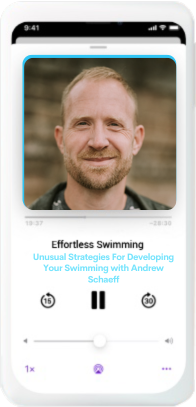
In today’s episode, I’m joined by Andrew Sheaff—coach, educator, and the author of A Constraints-Led Approach to Swim Coaching. We dive into one of the most important skills for adult swimmers and triathletes: learning how to self-coach.
Whether you’re swimming solo, training without feedback, or stuck on a plateau, Andrew shares a practical roadmap to finally break through. You’ll learn why progress isn’t about doing more drills—but choosing the right ones. We talk about how to create built-in feedback loops, what to do if you feel like nothing’s changing, and why slowing down and being intentional could be your fastest path forward.
Andrew also shares one of his favorite drills—“power pulls”—and how it reveals exactly what’s working (and what’s not) in your stroke. If you’re someone who trains alone, or you’ve been working hard without seeing results, this episode could be the turning point.
If you enjoy this conversation and want to dive deeper, Andrew’s Stroke Fundamentals course is a fantastic next step. It breaks down the key elements of freestyle technique in a simple, actionable way—and as a listener of the podcast, you can get 50% off. Click this link to get Stroke Fundamentals for 50% off
—> www.coachandrewsheaff.com/effortless
In this episode
- 01:58 — Self-Coaching In Swimming
- 04:06 — Setting Clear Goals For Improvement
- 06:22 — Effective Drills For Feedback
- 10:35 — Understanding Pressure and Technique
- 14:30 — Improving Rotation in Freestyle
- 21:00 — Identifying and Solving Problems in Training
- 23:43 — Mastering Breath Timing in Swimming
- 26:03 — Identifying and Addressing Common Mistakes
- 28:30 — Challenging Drills for Skill Improvement
- 31:01 — Integrating Skills and Training Effectively
- 36:16 — Creating Engaging and Purposeful Workouts
- 38:57 — The Importance of Consistency in Skill Development
- 41:24 — Fundamentals of Effective Swimming Techniques
Links from this episode
- http://pillarperformance.shop
- Get your NanoClear swimming goggles here and get 15% off your first purchase with code PODCAST15.
- https://effortlessswimming.com/camps/
- Change your technique and swim a smoother, easier freestyle with the Effortless Swimming membership
Transcript
Read the full transcript
you know, skills take a while to improve, especially if they're, you know, they're the big skills that really matter. Like people are working on them their entire career. And so that can be, you know, I think another mistake is if you bounce from thing to thing every week or so, you're never going to really, you know, spend enough time on something to really make a difference. So I think that's probably the other big thing that we didn't really discuss is you got to be consistent with what you're trying to improve. Because if you jump around, it's like, you know, whatever the chase two rabbits catching on that saying, it's, you know, it definitely applies here to welcome to the effortless swimming podcast to show that helps swimmers and triathletes love the water, become a better swimmer and live a better life. Here's your host, Brenton Ford. What if you could become your own best swim coach? In today's episode, I'm joined by Andrew Shaff, coach, educator, and the author of a constraints led approach to swim coaching. We dive into one of the most important skills for adult swimmers and triathletes learning how to self coach. Whether you're swimming solo, training without feedback or stuck on a plateau, Andrew shares a practical roadmap to finally break through. You'll learn why progress isn't about doing more drills, but choosing the right ones. We talk about how to create built in feedback loops, what to do if you feel like nothing's changing, and why slowing down and being intentional could be your fastest path forward. Andrew also shares one of his favorite drills, power pools, and how it reveals exactly what's working and what's not in your stroke. If you're someone who trains alone or you've been working
hard without seeing results, this episode could be the turning point. If you enjoy this conversation and want to dive deeper, Andrew's stroke fundamentals course is a fantastic next step. It breaks down the key elements of freestyle technique in a simple, actionable way. And as a listener of the podcast, you can get 50% off. Just check the link in the show notes to access the special offer. Let's get into the episode with Andrew Shaff.
So Andrew, one of the topics I want to cover today is how can someone who doesn't have a coach giving them feedback on deck to be able to give them feedback on how they're swimming? How can people make changes and self coach so that they can actually make improvements in their swimming over the course of several weeks and several months? Because I coach a lot of adults and they're not getting feedback from a coach on deck, so they have to become their own coach. So I want to get stuck into some of those topics there. In terms of what you see and the people you're working with, is that something that's really common, not being able to get feedback? Yeah, I mean, because even if you're in a coaching environment where regardless if it's a club swimming program, a master's program, or a collegiate program, there's going to be one coach working with a group of athletes and that group might be as small as five people, but it could be 30 people. And so a coach has one pair of eyes and even if they're doing their absolute best to interact with everyone and provide feedback to everyone, there's limits to what they can do. So the more that anyone can get better at kind of facilitating the change process, that's going to be really important because you do 25 meters, you're taking minimum 10 strokes and so each one's an opportunity and unless the coach literally has a microphone in your ear, which is not too common, they can't tell you what you're doing in every single lab or even every single stroke. So I think it's something that's really important and it's definitely a skill set that people can learn. And so I think, and it's not, you know,
anyone can get better, anyone can change, it's not tied to someone's talent, it's just it's kind of a process that people have to learn. Yeah, absolutely. And from the feedback from, say some of the clinics that we've run, when we've done something like wrong way, right way, with it, let's say a drill or a way of swimming, that has been like a good first step for people to be able to recognize when they're in the wrong position, when they're in the right position and building up that self-awareness. What are some of the other strategies and tactics that people can do to actually build this ability to self-coach? Right, so I think even before that step, what's really important is that you have to have a clear goal in terms of what you're trying to accomplish. And so, you know, you'd frame the question in the terms of making progress over, you know, three to four weeks. And, you know, you can make a lot of change in your skills in that timeframe, but you can't make a lot of change in all your skills. And so it can be really, really important to start off with, what do I want to actually improve? Because if you're not really clear about that, and like, you know, a pretty bad goal is, I want to improve my skills, or I want to, you know, improve my technique, like that doesn't mean anything. And so being really clear about that is really important. So, you know, like something like breathing, that's a really concrete skill that that's pretty, you know, specific, and you can make a lot of improvement with that, because it lets you know what type of activities you're going to want to do, because if you're trying to improve your breathing, it doesn't make sense to be spending half your time kicking like
they're not related. So I think that's probably the most important thing. And then once you have a clear goal of what you want to accomplish, it's picking activities that are going to help you get there. But more importantly, like picking activities that do have some sort of feedback built into them. And so, you know, certain drills make it a lot easier for you to feel what you're doing and how you're being effective. And when you do them poorly, you know that right away. And so like, like you used the example of kind of right way wrong way, and that's an awesome way to help people become more aware of what they're doing. But some drills have that built into it. And so like, you know, one of my the textbook example that I like is you've shown a paddle on your head, and you mess up your breathing, that paddle is coming right off. And in that situation, you don't need a coach to tell you, hey, that wasn't, you know, that wasn't effective because you know, as soon as it happened, I think being clear on the goal and then trying to pick the activities that make it easiest for you to feel the key skills is the next big step. Yeah, that's great. So let's set the goal, choose what you want to work on, and then prescribe the drills. And actually, one of the things that going through one of the courses that you've put out there, there's like, I've picked up a lot of good drills to show or to help identify that. And one example is in the freestyle section of your stroke fundamentals, the power pools drill. And so just to explain the power pool, actually, I'll let you explain the power pools and how that can be effective at giving you feedback on your catch and pull effectiveness. Right. Because I've started using this and it's, I love it.
Right. So, so basically what you're doing is if you're familiar with breaststroke, it's just a pull with both arms over the head, and you're just pulling down to the feet, you're on the surface of the water. And it works well if you use a pool buoy so that you don't really have to worry about kicking. And so what it can be really useful for is, and also if you're having trouble visualizing, it's like a double arm freestyle pull at the same time or a butterfly pull. And so what you can do is, the only way to move forward is to be effective with your arms. You're not using your legs. And because you've got a pull buoy in, for the most part, your body position is going to be pretty good. So that's not really going to be a limiting factor. And you're not going to be able to change it. So what you can do is, is now you don't have to worry about the recovery. You don't have to worry about the breathing. You don't have to worry about the timing. It's just kind of a pure pull thing. And so what you can do is you can go, I'm going to go 425s and I'm going to try to take less strokes each one. And so the only way you can do that is by being better at setting up your stroke, setting up your catch, holding it through, getting more out of each stroke. And what's valuable about the numbers is that, you know, I'm just making them up. So you took 15, the first one, and you took 12, the next one. Well, whatever you did, it was better. Something positive happened. And then, then it's just a matter of figuring out what, what changed. And so if you go 15, and then you go 12, and then you go 15 again, well, whatever you did, you stopped doing it. And so it's a, it's a matter of figuring it out. And that's really clear feedback. And you don't just have to use stroke counts. You could also just see, can I go faster each one? And so both either, whether you're using stroke counts or speed,
they're both giving you feedback about how well you're, you're, you're creating propulsion, but the feedback is a little bit different. And it's a slightly different aspect of, of, of the skill. And you could even go crazier and you can, you know, try to combine the speed and the stroke count and try to keep them both as low as you, as you can. And so there you're, you're in a situation where the only way to be successful is to use your arms effectively and you're getting very clear feedback about what, what works. And so it becomes much simpler to try to figure out what you're doing wrong, what could be better. And then you can just kind of play with that.
Yeah. So we do it in most of our clinics now is, there's one of the final drills that we do. And there's so many different areas that you can, this one, it can adjust to get further with each stroke. And obviously, like the catch is the most obvious one, you know, we want this good high elbow catch. We don't want to drop it. That's one. But then also where and how much power you apply. So a lot of people tend to just go for broke at the start and they muscle the catch. And that means that they're not like, they just don't get into as good a position and they're not set up to be pressing back yet. So we have them just think of it as smooth through the catch, strong through the back. So smooth to strong. And they find that like with sometimes almost half the effort they get just as far, if not further, compared to when they're going too hard at the start. And that's how a lot of the swimmers that I coach would typically swim. Like they're just trying to enter the water, pull straight back and just apply too much power. So getting them to experiment with that, where their arms are through the, like the path of the hands through the stroke, a lot of people are too wide at the back of it. So make sure that they're coming in through the center a bit more. But all these little things we're getting to experiment and feel how far are they traveling with each power pool that they do. And it's just so good at like ironing out some of those details because they've got the feedback of, they can see how far they're traveling, they can count how many pools it's taking them. So like even just something as simple as that, I think can be such good feedback, but the swimmer needs to be able to
just go, okay, like for this lap, like I'm just, I'm going to tune into the feeling of this. Because I know that a lot of their triathletes I work with, they just want to get to the pool, have a hard workout and, you know, get the fitness aspect of it. But if you can just slow things down and put that awareness into it, it makes such a big difference to the technical side of your swimming. Right. And a good point you brought up was that you're in, like, you know, a lot of times our instincts are wrong. And so it feels right to just apply pressure right away. And like you said, how could it be that it's half the effort, but you know, twice the effectiveness. And that's where it can be really valuable to have the concrete feedback. Because if you only rely on your feelings, a lot of times they're going to be misleading. And that can cause a lot of problems. And so like, when you can see, wow, I literally traveled twice as fast, but I, but I wouldn't have believed it based upon it how it felt. That can be super valuable because you need the proof that what you're doing is effective, because what your body is telling you is, is effective is not. And that's where, like, the feedback is really helpful, because it allows you to be like, all right, well, I wouldn't have thought that that would work, but it did. And I was able to repeat it. So it's not just a fluke. And then that helps you, you create change. That's, that's interesting with, like, what we think we need to do is often very different than what we actually have to do. Right. Right. So much with that, with the, with the catch, because a lot of times people feel like they're getting more out of it because they're putting more force into it. And if
they're pushing down or dropping their elbow, they feel like they're connecting with the water. Well, not connecting, but there's pressure there pressure. If you go through that, yeah, if you go through the catch, well, sometimes it can actually feel like you're not getting as much purchase initially, because there's less, less force on there. But yeah, if you're setting up, well, well, then you're going to actually have it going in the right direction. So it actually feels a little bit easier and lighter in a way when you do it.
Yeah. And like the name itself is in some ways misleading because it implies that you're trying to like, you know, do something forceful and like hold on to the water when really it's just kind of a simple repositioning. And then like you said, then you start applying pressure after that. And that's where people can get, can get messed up because it doesn't feel right. No, that's, that's it. And I can't remember if I bought this up last time, but I heard this from a coach and I don't know even if it's, if it's necessarily true, but I like the concept that's, you can only put six kilos of force on the water before you start to slip any more than that. And you're going to be ineffective with that extra power. It just doesn't go to actually moving your forwards. And so I think that concept of like, all right, I've only got this certain amount of force that I can apply. So I'm just going to sort of operate just below that. Then people find that they don't actually have to muscle their way through the, through the water and they're better off just having that, that more balanced approach. And that's why you see like really good swimmers, they just, they're not having to work that hard. It's like they've got good body position. They're very streamlined and then they're very effective with the movements that they're making. They're not pulling necessarily harder than the average person. It's like they're just much more effective at it. So just trying to go for that sort of approach is, is, is what we want to work towards. Yeah. Yeah. And I think to kind of build on what you said, like I think there's, there is a limit to how much pressure you can apply to the water. And at the same time, the more patient you are with applying pressure, you can usually apply more towards the, like, so the more patient you are, the higher
amount of pressure you can get to, but like, but if you try to rush it, like you said, or you try to go too fast, then, then you kind of lose it. And so it's like, it's, it's hard because we want to go, but like, we have to be patient with it. And we have to be like almost, like almost as hard as we can, but, but not quite. Now let's, let's go into some other sort of ways or drills that you'd, you'd use with people to give them the ability to know how they're, how they're going with these stroke changes.
Let's say perhaps it's, I don't know, maybe like rotation is, for me, like a big one, a lot of swimmers that I coach, they come in and they're very flat and they, they struggle to get the correct amount of hip and, and torso rotation. And so we want to just develop their ability to, to rotate side to side, but not go, not go too far. What are some things that people could do to help improve that and know how they're going with it? This episode is brought to you by Pillar Performance. Our new sponsors Pillar are a sports micronutrition company. And the easiest way to describe it is that while hydration and carbohydrates products will take you through to touch the wall as fast as possible, Pillar's mission is to get swimmers to the starting blocks in the best condition over and over again. I recently started taking Pillar triple magnesium after a friend had recommended it. And it's been a game changer for my sleep and recovery. I take one scoop 30 minutes before bed each night in the same way that you might start your day with a coffee. I finish it up with a magnesium and recover better for tomorrow's session in the pool. Pillar performance is used by some of the biggest names in swimming and triathlon, including Zack Stubbulty Cook, Jan Frodeno, Ben Canute, Ash Gentle, Taylor Nib amongst the host of other well-known swimmers and triathletes. Where Pillar differs from other micronutrition you may have taken before is both the quality of the types of magnesium and the tangible results that I see on my garment each morning. If you'd like to try Pillar today, head to pillarperformance.shop and enter code effortless for 15% off. That's effortless
for 15% off all first-time purchases. Or for anyone in North America, enter the same code at thefade.com. Right. So specific to rotation, one thing that I'd like to try to do is to keep people within the rhythm of the stroke or the timing of the stroke as much as possible. And so rather than you can have people just rotate all the way to their side and onto their back, I like to have them recover their arms under the water because that makes it easier to focus on what they're doing from a rotation standpoint and the timing tends to be pretty good. And that allows them to explore ranges of motion. And so what's tough about the amount of range of motion is, like you said, it's difficult to know how much you're doing and whether it's enough. And also it's probably a little bit different for people too based upon their buoyancy, how flexible they are. And so it's not like there's a magic number that you're trying to hit. So with the underwater recovery, what you can do is you can do something where like kind of going back to the stroke count. You can try to take less strokes, which will force you to rotate more and to be longer. And then you can alternate that with some where there's less, or excuse me, there's more strokes, which will cause you to be a little bit flatter. And by kind of exploring the extremes, that allows you to be more aware of kind of where you need to be. And so if you, if you tend to know that you need to rotate more, then exploring more at like really low and really trying to stretch it out. And then, you know, you can do some where it's a little bit tighter and you're more likely to find a
rhythm that feels good for you. And kind of going back to what we talked about earlier, you can start comparing that to some times too. And that gives you more awareness of, hey, if I exaggerate the rotation, what feels like exaggerated to me, I noticed that I can go a little bit faster and it's easier. Well, then that's, you know, that means you're on the right track. But let's say, you know, you really try to exaggerate the rotation, but you go significantly slower and it feels really labored. Well, then that's probably not going to be the right choice for you. So kind of exploring the options and then trying to get some measurement in terms of what's effective and the effort part is important too. Like we talked about earlier, if you can produce the same performance for less effort, that's great. And so that can be valuable too.
Yeah, for people to just go, okay, it's actually okay for me to go between these two extremes because quite often what feels extreme for someone is not that extreme. Like when they're, yeah, if they're too flat and then they try and go for a lot of rotation, it's very rare that they actually have too much. So like we, when we do our freestyle clinics, in the last filming that we do, I have them pick one thing to focus on. And I ask most of them to exaggerate that change a bit in order to actually see a change. And then they look at it and look, sometimes it's like it's looking really good, but still sometimes people just need more exaggeration of the change. So it's just, yeah, it's very unlikely that people actually go too far with it. So yeah, just being willing to stretch what an experiment and just try different things and operate within, yeah, these really two big changes will help you find that sweet spot. Yeah, somewhere in between. And I like in one of your videos I saw a little while ago, you're just talking about rotation for freestyle. And you mentioned like how much you need to rotate in freestyle. Well, number one, it's enough to be able to get the arm out comfortably, right? Because if you're flat, then our shoulders don't work very well. And then in the catch, well, it's enough to be able to get into a high elbow catch, use these bigger, stronger muscles through here. And if you go too far, well, you're not going to be able to hold your catch. And if you're too flat, well, you can't really use your lats and so on. So I think that I found that is a really good way to explain how much rotation we need, like enough to get the arm out, enough to get into a good and a strong catch position like that. Just simple, simple thought for me was good
to be able to convey that to other people as well, when we're explaining how much we need. Right, right. Because more is not necessarily better, because like you said, you're going to get out of like, you know, your elbow is just going to be your arms going to be out of position. And then two, it just takes more time. And so if your stroke rate is up by 50%, is 50% slower, because you're taking all this time to rotate, and you're not even you're getting in worse positions, like it's just not going to be helpful. And so, yeah, it's about finding the optimal. And so like, if you feel like you can recover smoothly, you feel like you can set up your stroke well, then you probably don't need to change anything. But if you know that you're just kind of like robot recovering, and you're not setting up your stroke well, then you need to explore. And that's kind of going back to the underwater recovery in the stroke counts. That's why I like putting a number on it too, is because, like you said, people think they're changing, but they're not. And so if you say to yourself, I'm taking whatever 12 strokes of the underwater recovery, I want to get down to eight, that's going to force you to really explore that range of motion, because you might think you're changing, but then the stroke count hasn't changed at all, because you haven't actually changed. And so anything you can do to like, make yourself do something different is going to be really valuable, because our tendency is any deviation from normal is going to feel really weird, and it's going to be like, I'm changing so much, but really not much changes happen at all. The kind of leads into the next thing I want to cover here is that someone who has been trying to improve or get faster over, say, six months or 12 months,
they've been working at a few different things, and they find themselves in the same spot. They were 12 months ago. Why could that be? And then what could they do to make sure that the next six months don't follow that same pattern? And I'm talking more about more like adult swimmers and triathletes. Right. So a lot of times it's not solving the right problem. So basically, if you're so in freestyle and your breathing is problematic, whether it's just you're pulling out of position, it's just slow, the timing's off, it's very difficult to improve anything else, because if every stroke, your head is getting pulled out of line, well, your body's going to be out of line, and if your body's out of line, how are you going to do anything with your arms? If they're just moving all over the place, they're not going to be effective. So making sure that you're addressing the right problem is really important. And two, with a lot of adult swimmers, spending all your time on your kick is probably also not maybe the best use of your time if your breathing's really bad, if your body position's really bad, if your timing's really bad, if your arms aren't really bad. It's not that kicking can't help, but if these other things aren't in place first, it's not going to make that much of a difference. And so
breathing tends to be the, you need to breathe. There's no way around that, you're going to have to do that. And so if you can't do that well, that's typically the first place to start, because every other skill is dependent on that. You can't manage your body position if you're pulling out of alignment every time you breathe, and you certainly can't pull. So once you get your breathing locked in, then it's a matter of can I swim with pretty good body position and pretty good alignment, because swimming's just so much harder if you're dragging yourself through the water, and you're going to get exhausted, and it really, really kills speed. And so that's probably the next thing to think about. And then if you have those things ironed out, then really go into town on what your arms are doing and the propulsion you can create with them is the next big step. So really a lot of times it's about finding the limiting factor for you, because if you're working on something that could be important, but will never be fixed because of some other problem, then you're just going to spin your wheels. And so that can be, it can be really valuable to, you know, one, take a step back and really think about what could be the problem or two, it's like ask someone for help that maybe has a little bit more experience, because, you know, all the work in the world, the best drills or strategies in the world aren't going to overcome working on the wrong problem. Yeah, that's such a great answer that. And with the breath timing, the two like really common ones I've seen the last couple of months, and I guess probably forever since I've been coaching really, but a late breath for triathletes. So for adults like just turning their head too late. And what
I try and teach at clinics is think about pulling into the breath. So as one hand is coming under your head, that's when you should start to turn. And so your head will start to turn as this hand is coming underneath. You want the mouth out of the water just as you're about to exit with that same hand. And then the most important part, I feel is that like the head comes back in, the eyes come back in towards the end of the catch there. So the eyes are back in as this hand is about to pass underneath the head again. Like that to me is probably the more important one. But if you get it right at the start, it's a lot easier obviously to, you know, to get that second part right. But yeah, breath timing, I had a clinic the other day where I think there was three of them that their breath time was just too late. Like they're either lingering with the head, so it didn't come back early enough. Or they just were just turning much too late. And it's like, if you're breathing every two, that's half your strokes where it's going to be thrown off. But then that second stroke where you're not breathing, well, it's everything's out of place anyway. It's out of sync. So that's a big one. And then obviously like lifting the head or turning too far. So yeah, that's, I love that answer because yeah, if you're working away at the wrong, the wrong problem, it's like you're in the same, the same place there. Right, right. And then, and then so once you do identify, go ahead, sorry. No, sorry. So once you do identify the right problem, then it's like, all right, what strategies are going to really make a difference here? And so like if you're working on your, your arm pull, it's like, there are things that are going to be pretty helpful. And they're ones that aren't. And so it's identifying the strategies that are going to be most, most useful for, for that particular problem. And then once,
once you do, once you find those, and that, and that, you know, that might take some time. But again, it's like there, there are resources out there, you know, most of them for, for free, just kind of have to do a little work. The second mistake I see is that rather than changing something that you know works or sorry, rather than sticking with something that you know works, people will change what they're doing because they either get bored or it feels like it's not working anymore. But what I found to be the most effective thing is if you find a drill or a strategy that you really like, change how you do it, rather than changing from strategy to strategy. And so like, you know, with the breathing thing, like just we talked about earlier, the pedal on the hat, on the head, if that works for you, don't do something else, keep doing that, but, but maybe add some speed to it. Maybe you start doing it with fins, maybe you do it with your, your hands closed so that it's harder to, to, to balance yourself when you breathe. So there's lots of different ways to challenge whatever drill or strategy you're doing, because just because you can do it, you know, using, using the breathing, just because you can breathe well in a drill when you're going slow, that's got nothing to do with, you know, your thousandth stroke in a race when you're, you're tired, people are swimming on top of you, you're in the waves, like those are two totally different skill sets. So you have to learn how to do it well. And then you got to keep challenging it because it's not going to get better if you don't continue to challenge. And I mean, if you think of Olympic level swimmers, they still do drills in their, in their warmup and in their session. And just to, to refine some of these, these aspects. And I think
what I've seen, like most of them for the, for the freestyle is a lot of them, like single arm freestyle, bred into the opposite side, other arm by the, by the underwater recovery freestyle or long dog is a really common one. And obviously scaling and those sorts of things like fairly simple drills, but there's a lot of ways that you can either challenge that drill or it actually takes a lot to do that drill very well, especially single arm, bring to the opposite side. Like that's, yeah, that's a very challenging drill for most people. Yeah. Yeah. And it's like, I think for the athletes, I work with it triathletes, adult swimmers, if I really like that drill because there's so much that we can work on with it. And so, you know, people might be choosing drills, but yeah, just make sure you've got the, that specific, specific focus. So for the timing, if they're doing single arm, bring to the opposite side, I just, I want them to actually try and get that breath very early, like to even encourage it to be earlier than what it needs to be. So when the hand enters, we want to start to turn the head and then bring that eyes back down even before they start their catch, just to overdo it a little bit, just to try and get used to that sort of timing. So eyes come back in before they start the catch and then they can, can pull through. And then obviously, like that will feel very extreme and it is, but then when they go to swimming, they're going to start to be able to, I think, move closer to that sort of breath timing. Can you talk, talk to some of the other ways that you would increase the challenge of some of the drills or how you would, you would shift them as someone gets better at it? Yeah. So, so like you said, some of them have a lot of different
points of mastery. And so kind of like we were talking about earlier with the, with the power poles, there's a lot of different ways that you could explore to help you get more out of that. And so just because you've made a little bit of progress there, doesn't mean you've figured it out. And so like you said, there's elite elite athletes that are still working on these things and not necessarily just doing them to do them, like they're still trying to get better at them. So, so from a challenge standpoint, you can challenge it with like, so some sort of performance, like you could ask yourself to go faster with it, like you can build, you could descend. Depending on what it is, you could say, I want to take less strokes. In some cases, take more strokes. So like in the example with the breathing to the opposite side, it's not, it's going to be easier to do it when you go slower. And so if you force yourself to take more strokes or to use a higher stroke rate, now you've got to make that breath happen a lot faster. You've got to be a lot more precise with it. And that's another level of challenge than just doing it at your own pace. So like if you have a tempo trainer, some drills, you can put the tempo trainer on and force yourself to, to speed it up. Different training aids can make the challenge different. So like sometimes you put a buoy in, sometimes you put fins in, you could wear paddles, you could hold the paddles upside down, you could close your fists, like a lot of different things. Sometimes you may be doing a drill with a snorkel because it makes it easier so that you don't have to breathe. Then you take the snorkel off and now you have a new level of challenge. Or if you're using fins, you take the fins off, now it's going to be more difficult. And then another way to do it is to add some fatigue to it. So you could start doing the drill and taking a lot less rest or like this can be fun too. It's
like you do 100 freestyle with pretty strong effort, you're focusing on whatever skill you're working on. And then you go right into the drill. And now you're starting to do the drill with your heart rate up, which is going to be more difficult and it's going to be more challenging. You're really going to have to focus. And then two, you know, this is kind of another mistake that people make is I just don't do the drill by itself. Do the drill, swim, do the drill, swim. And so like the example you gave with the one arm freestyle, bring the opposite side, like you could do two 25s like that build to add a little speed to it. And then you could go right into a 50 or 100 freestyle where you're trying to execute the same skill. And that's going to generate a little bit of fatigue too. But also, no one cares if you can do the drill. Well, you're doing the drill so you can actually swim well. And so if you don't practice going from the drill to the swim, like that's a missed opportunity for sure. Yeah, definitely. And like you do a lot of sort of calls with coaches, you put out a lot of content. Is there anything that stands out to you that's really resonated with the people who view your stuff or that you've been speaking to recently?
I think the biggest thing is that there doesn't have to be this distinction between skills and training. And so I think that's the like, and so for people that like to train, which is definitely going to be the triathlete crowd, which is great because fitness is a huge part of it, you don't necessarily have to give up the training and just only just swim easy and just perform easy drills. It's like, if you can find ways to integrate these two things, it's going to be one, a more engaging experience. But two, it's going to be more effective. And so just kind of using the example I just said, if you have a set today that you have to go 10-100, it's like, well, you could go four rounds of maybe a 50 or 225 drill and then do two 100s and then do that four times. And that's an easy way to just constantly remind yourself how to execute these skills a little bit better. But two, your heart rate is going to be up just the same way. It's going to be the same thing from a physiological standpoint, but you're able to get more out of the same thing. And so I think that can be a little bit of a perspective shift. And two, it can be a lot more exciting because now you can be a lot more creative in terms of how you write your workouts or write sets. Yeah. And when I've seen sets from some of the best coaches or those that have had the most success, there's often quite a bit of detail in those sets because they're keeping it interesting. They're challenging you in different ways with breath control or stroke count, whatever it might be. And you're working
without thinking that you're working in a way like the time flies because it's such an interesting and engaging set. And I think that's the real key to having someone get better at swimming without getting bored. So it's like, this is somebody who's coaching 10 times a week with the same swimmer. It's like you've got to spice things up and really challenge them mentally as well as the physical side of things. I mean, you've seen a lot of that. What do you recognize with those coaches who have the best buy-in from their athletes? So it kind of goes back to the have one goal thing from a skill thing is a lot of sets will have a very clear goal.
And it's one that you don't almost have to explain. It's just almost obvious. And those are going to be the most engaging sessions because you have one clear goal and then the work clearly relates to accomplishing that goal. And so that's going to be, you just have a focus set. And so instead of just doing 10-100s or whatever it is, we're going to do the 10-100s or something similar in a very specific way to accomplish a very specific outcome. And then I think it's very easy for swimmers to see this will make me better because I'm doing something that's clearly moving me towards my goals. And so I think at Effortless Swimming, our mission is simple. Make swimming more enjoyable. Whether you're training for your next race, swimming for fitness, or just love being in the water, we're here to help you swim faster, smoother and with more confidence. And one thing that can make or break a swim is your goggles. If you've ever struggled with foggy lenses mid session, you know how frustrating it can be. That's why we created the Effortless Swimming Hydro Clear Anti-Fog Goggles for long lasting crystal clear vision. I've been using them myself and the difference is night and day. I'm not the only one. Deborah swam 36 kilometers down the Derwent River and the entire time her vision stayed crystal clear. No fog, no frustration, just an uninterrupted swim. So what makes a hydro clear goggles different? It's all in the technology. Unlike ordinary anti-fog coatings that wear off over time, hydro clear super hydrophilic technology is built into the lens material itself.
Here's how it works. Instead of fog forming as tiny droplets, water spreads evenly across the lens, creating a thin film that prevents fog from even starting. And the result? Consistently clear vision, swim after swim. And the durability? Our lenses are CNAS certified. Tests show that even after 2000 rubs with a wet cloth under a 200 gram load, the lens stays fog-free. No gimmicks, just serious performance that lasts. Using them is simple. Just wet the lenses before putting them on and you're set for a fog-free swim. Ready to see the difference yourself? Get 15% off your first pair of hydro clear anti-fog goggles with the code podcast at shop.effortlesswimming.com. That's 15% off your first pair of goggles with the code podcast at shop.effortlesswimming.com. We also have a 30-day money back guarantee. So if you're not happy with the goggles for any reason, you can simply return them for a refund. Don't let foggy goggles ruin another swim. Try hydro clear today and experience clear vision from start to finish. The more that I would find myself as a coach having to explain why we're doing something, the further I am a way of delivering something that's going to be effective because it should be pretty obvious what the purpose of this and how this will help someone.
If we're going to work on our just sticking with the theme, our breathing, like our ability to breathe well with some endurance, that set that I mentioned earlier, like the 225s and then the 2100s, it's pretty clear what that's accomplishing. And so it's easier to do something like that than to just be like, I'm going to do 10, 200s and it's just like the goal is just to finish it. So I think, like you said, the more that there can be those little pieces in there and they're all geared towards, they're not random pieces, they're geared towards things that the swimmers need to work on. And if you're writing workouts for yourself that you know you need to work on, it makes a big difference. Yeah, definitely if you're writing your own sets as well or just having to train by yourself, it can be a challenge to get through anything more than about 2k if you've had to write your own set. So if you can do it in a way where you set yourself little challenges like holding a certain breathing pattern or stroke count, then the time will fly and you're not just focused on, all right, this is number three, let's do it, this is number four, get through it. And I say that from personal experience because it's like I would write my own sets and unless I've really got like a big race or a really big goal I'm training for, if I don't have that then it's very hard to like motivate yourself if you've written your own set and you're at the pool by yourself. So right, but I think a lot of people are in that in that situation. Right, right. And again, like just keep it simple. So like we talked about having the one big technical goal that you're trying to accomplish over a period of time. So just find one way, like one simple way to build that into your set
just a little bit. It's not like every single lap has to be super focused and super dialed in, but it's like if I've got zero technical engagement in this set, how can I go from it's at a one out of 10, how can I go to a two out of 10? You don't have to take it to 10 out of 10 and it's just like find one small thing that you can add to it. And then as you get comfortable with that, maybe next time you add a little bit more, it doesn't take much, but it can make a big difference. Yeah, absolutely. Ed, is there anything that we haven't covered that you think would be good to add in here or cover before we wrap up? I think that the other thing is just to be consistent with it. Skills take a while to improve, especially if they're the big skills that really matter. People are working on them their entire career. And so that can be, I think another mistake is if you bounce from thing to thing every week or so, you're never going to really spend enough time on something to really make a difference. So I think that's probably the other big thing that we didn't really discuss is you got to be consistent with what you're trying to improve, because if you jump around, it's like, you know, whatever the chase two rabbits catching on that saying, it's, you know, it definitely applies here too. So much so. I mean, I've had one focus since, I think it was November. So it's been, yeah, like pretty much four months with this one focus. And I think about three months in, it started to click for me. And it was just breath timing. Like just, I was, I was a bit slow to turn, bit slow to turn back. And so my right hand catch wasn't as good as it could be. And it was like,
I didn't really see results for a while. Didn't, I had glimpses of it, but like in sessions, but like, it just wasn't really clicking. But then eventually, like I raced a week or two ago, and I, it just felt so good. Like I felt like I could rate up very quickly and still hold water just in the open water. And yeah, but it just took a very long time. And I've been swimming for, since I was six or seven. And so it's like, it's taken me a good solid three plus months to actually see the results of the work I put in. And that's training on a very regular basis. So yeah, it's just, you got to give it time and just don't, don't jump around. It's tempting to do that. It's so tempting to do it. But you know, if it's that, if it's the one thing, if it's that big rock, or if it's the bottleneck that's stopping everything else from happening, then you might need to spend a good solid few months on it. Yeah. Right. Right. Right. And so like, like we talked about earlier too, it's like, it doesn't take that long to be able to maybe make a change when you're going nice and slow when it's 125. But like you said, you could probably do that within the first week or two. But like you said, it took, it took three months for it to show up for real, like in sessions. And that's where it's like, you know, you can really do this for real. And that's the difference is it doesn't take very much to make a change in a low pressure environment, but ultimately we need the changes to show up in a high pressure environment and pressure being, you know, psychology, physiology, race, all like, all that stuff. And so that's what takes so much time. And I think that's what people don't appreciate. It's like, just because you can do it slow today, does not mean you're going to be able to do
it in a race. You have to do all that training too. And like you said, that's months and that's for everybody. That's not, you know, that has nothing to do with ability level. It just takes a long time for the skill to be, you know, I guess ingrained to a level where you can perform it at a high level, you know, somewhat unconsciously. And that's, I think, the big, the big thing that people miss with them. Yeah. The analogy I made with a pro triathlete I'm coaching at the moment is like working away at one thing for a while. He's like starting to see those results a little bit. So it's like, it's just like correcting the course of a ship by like one or two degrees, just slight shift. And we're eventually going to get there. But just every single day, we've got to just keep course correcting. And, you know, eventually you'll, you'll end up there. But yeah, it just, it doesn't happen. It doesn't happen overnight. Right, right. Andrew. So for those that are listening, so for me personally, I went through your sort of stroke fundamentals course of six, 12 months ago, I can't remember exactly. But I love the kind of structure of this course. It's very, it's very simple in the fact it's easy to understand. And from easy to understand, it's easy to implement. And the way that you explain things, I've been able to take a lot from it and incorporate that into my coaching and my own swimming as well. And so, so for those that are listening here, we'll put a link in the podcast description. So we've got basically an offer for about 50% off that course for those that are listening and would like to go through that through the course. And I highly, highly
recommend it. I've been through it and learned so much from it. So we'll put that in the show notes. Anything you want to add about the, about that course and sort of why you put it together and how you structured it the way you did? Yeah, so mostly it's kind of taking it back to the, you know, the fundamentals of what people need to do to swim fast. It's, you know, because I think it could be very easy to get lost in the woods of I need to have a, whatever, 70 degree or 103 degree angle bend in my arm. But if you don't really understand why that's the case, it's hard to, to really commit to that. And so it's about discussing, you know, what really needs to happen. Like you said, in a simple way, that's not simplified necessarily, but just it's a, it's the simple basics of what needs to happen. And then you can better understand what needs to, you know, what needs to get better, why it needs to get better. And then it makes it easier to select activities to help those skills. And so that, that's kind of the, the thought process behind it. Yeah. Yeah. I really, really enjoyed it. And it's a good reference point. Like I've, one of our other coaches has sort of has gone through it as well, just as like, yeah, to, to give him that, that insight too. So it's been very useful. So if anyone is listening, we'll put that link. It's just, you know, our show notes, just for listeners of the podcast. So Andrew, thank you for being on there on the podcast. Love chatting with you. And as I said, I've learned a lot, learned a lot from you. And yeah, keep doing what you're doing because it's very important for the, for coaches and, and also swimmers who watch it as well. So thank you. Yeah. Thanks for having me. Thanks for listening to the Effortless Swimming podcast.
If you'd like us to help you become a faster, more efficient swimmer, go to www.effortlesswimming.com.