







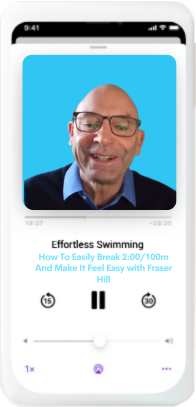
What if you could go from struggling at 2:20 per hundred to cruising at 1:55? Today’s guest, Fraser Hill, did exactly that, and he’s sharing exactly how he did it. Fraser started swimming as an adult, dabbled in triathlons, and eventually found himself diving deep into the world of technique, training, and open water swimming.
From joining an effortless swimming camp in the Maldives, to refining his stroke using simple but powerful cues, Fraser has transformed not only his speed, but his entire approach to swimming. In this episode, we talk about the key changes that made the biggest impact on his speed. The mental battles of open water swimming and how small tweaks like fixing body position and connecting the stroke led to massive breakthroughs.
If you’ve ever felt stuck in your swimming progress, Fraser’s story will give you some practical takeaways to help you break through your own barriers.
In this episode
- 01:48 — Swimming Background
- 04:25 — From 2:20 to 1:55
- 06:42 — You Need Someone Else Giving You Feedback
- 09:48 — Small Changes, Big Differences
- 13:19 — Openwater Swimming
- 18:29 — Next Big Improvement
- 27:06 — Drills
- 31:48 — Advise For Swimmers Who Are Struggling To Break The 2-Minute Mark
Links from this episode
- http://pillarperformance.shop
- Get your NanoClear swimming goggles here and get 15% off your first purchase with code PODCAST15.
- https://effortlessswimming.com/camps/
- Change your technique and swim a smoother, easier freestyle with the Effortless Swimming membership
Transcript
Read the full transcript
So more times than not, we're better off focusing on something earlier on in the process, whether that's head, body, rotation, length, like there's just other things that most people need to, to focus on. Um, and I had, I had someone, uh, messaged me the other day and they, they were going through that week course and they're like, well, like, this is, they'd just gone through week one and we, we focus on breathing and like, it's just, it's too basic form. It's too basic, but like, it doesn't matter where you're at with your swimming, like if you can, even if you make a slight change to breathing, you might find that you're actually a little bit more relaxed. You can actually, you know, conserve some energy. So like, if you look at the best in any sport, they are just masters of the basics. And so it's always good to just keep things as, as simple as you can. Welcome to the effortless swimming podcast to show that helps swimmers and triathletes love the water, become a better swimmer and live a better life. Here's your host, Brenton Ford.
What if you could go from struggling at two 20 per 100 to cruising at one 55 today's guest, Fraser Hill did exactly that. And he's sharing exactly how he did it. Fraser started swimming as an adult, doubled in triathlons and eventually found himself diving deep into the world of technique, training and open water swimming from joining an effortless swimming camp in the Maldives to refining his stroke using simple, but powerful cues. Fraser has transformed not only his speed, but his entire approach to swimming in this episode, we talk about the key changes that made the biggest impact on his speed. The mental battles of open water swimming and how small tweaks like fixing body position and connecting the stroke led to massive breakthroughs. If you've ever felt stuck in your swimming progress, Fraser's story will give you some practical takeaways to help you break through your own barriers. So, Fraser, tell me a bit about what your, what was your background in swimming, did you like to swim as a child? Did you start as an adult? Like where did swimming start for you? Yeah, I started swimming at university. 42, three years ago, I think I started just swimming in the pool, doing a few links and really enjoyed it. And then when I was working on, I'm a veterinarian, when I started working, I decided to do some of the mini triathlons, which are very popular in the 80s. And so it's like a swim 500 meters practice doing that. Then I've just swum for leisure for the rest of the time. The last two years, I sort of got more focused because someone said to me, do you want to go to a swim class?
I know how to swim, what would I need to do that for? But I went along with Finella Ng, she's here in Hong Kong and we did a four week course and I was like, wow, I can believe the difference. And she put us onto a series of YouTube videos and one of them was your effort of swimming. I started following it and I thought, right, I'll do the five day challenge. You know, that made a difference. And I did the eight week challenge. And then I was making some progress and I watched a lot of your podcasts and see how you analyze other swimmers. And then I did some of my own filming and I realized I'd fallen into a trap. You were talking about earlier where I watched my own videos and criticized myself. I should send them to you. Anyway, I must do that. And I realized, wow, there's a lot more I can do here. So last year I signed up, went to the course in the Maldives. And then, you know, that made another difference. So it's been really the last 18 months, two years. I've just focused, focused, focused on swimming. It's the only thing I've done. And just felt, get some improvement, wanted to do better. And then, you know, felt confident enough. Now I do open water swimming here in Hong Kong in the, in the, um, there are a lot of events, actually. So in the, in the master section, which I'm in the older section do quite well. So it's a lot of, you know, I really, really actually enjoy that. So I'm a new, my new thing. Um, but I'm watching a lot of your videos and podcasts. I've realized some of the problems I have, I've posed everybody has in them in the open water, I get frightened. I had a swim, two swims ago, it was really big chop and it was just terrifying. And I couldn't actually finish it.
So I've managed to overcome that next one was okay. But, you know, just is that variation. And when we trained on Utah taught us about how to swim with the group, but I still find getting swum over, getting booted in the start. I just find that dreadful side trying to hang back a little bit. So, you know, that stuff like that. So, um, but, you know, to be honest, I'm not trying to win a triathlon. I just want to enjoy what I'm doing, keep it going and maybe swim a little quicker.
Yeah. Yeah, definitely. Well, in terms of where you start, I think you mentioned before the call, you were around 220 per hundred. Um, you're now down to around sort of 155 and one of your goals was to get to a sub 20 minute one K swim, which I've, I've heard a similar sort of goal from a lot of other people who were around sort of your, your speed to 20. Um, and that's quite a good, good benchmark to, to get to where, what did you change over that time to go from two 20 to 155s?
Yeah, I couldn't crack 20 to 20 minutes until about 80 months ago. And I did that first course and it took me a year of training in the very last day of this, of the season before the pool shop. I managed it. So I was, you know, I can do it now. Basically a distant memory because, um, so many things I've changed, um, in my stroke, I had, you know, many, many things I was doing wrong. And I think I just got some thinking about the Maldives course. There was three, three key areas that I really changed things that I've changed in the last six months since that course. One was body position, which was, you know, far too low in the water. Um, hips are dragging, legs are dragging. And I knew in doing that, but I actually couldn't figure out how to change it, even though I've watched over and over. You're telling us how to do it. I worked with Gary Haring and then some of you, but it was really the other students on the course that we were talking about it. And someone said to me, it's like putting on a type pair of jeans. Kate, I think it was. And then now that I do this abdominal jeans on, which has, has makes a huge difference, plus something I hadn't realized. Gary Haring spoke about this. He said, he, when he started changing his core, it helped his back. And I've always had terrible lower back problems and that has improved as well. So there's a lot of advantages to getting, you know, that core position. Right. Um, and I think even still, I'm not really where I want to be. I'm not sure how to get even higher out of the water. Um, so this, this winter, actually, I've decided to go to the gym and see if I can build up some core strength and work on it that way.
Um, because I think that, um, resistance is a big part of my issue. I'm just got too much stuff hanging out in the back. You know, I've got to try and get it out.
So go ahead. So that was number one. And the, the very last day I, I got you to sort of take me through. You know, I said, you know, give me some more tips cause I thought it was my catch, but you picked up what I was doing wrong was, um, and this has made a big change as well. You call it soft hands or your elbow on a string, I think it is. And I was pulling my elbow out too far out and you got me coming up higher and further forward and coming in a little bit closer to my head. I was reaching too far forward. And I think that made actually a massive difference. I couldn't believe the difference that made. That's that one change. So getting my guts, my bum up, elbows further up. And then since I came back and you had talked about it, but I hadn't really, cause there's a lot of stuff. I couldn't connect all the dots at the time, but having watched a few other videos, you talk about the role of the hips and connecting the core and all that. And I've really tried to figure that out and when I do it, and I can do it occasionally, but I have to be thinking it makes a difference. But as soon as I stopped thinking, you revert back to your old ways. So it's a, so there's a three body position change. We had, what do you call it? Where your elbow comes up on the string thing that you've got to name for it. Yeah. Well, like just the recovery, it's kind of like, um, I mean, it's a high elbow catch, but, uh, in a way where the elbow is pointing up a bit more as opposed to behind you. So, yeah, just being a bit more open through the underarm and, uh, and bringing the shoulder out a little bit more because yeah, we've, we just need to rotate enough so that that shoulder can come out and then we can
get over comfortably because that also, uh, like that also helps kind of get into the next part of the stroke. And I was actually really listening to, um, one of the videos or podcasts we did with Ash Delaney, who was Carl Chalmers coach, and he talks about in the catch, you're like, you almost want to press yourself into the next stroke. So this one's sort of, you know, grabbing the water, pressing, and with this shoulder, you're sort of connecting over the top and driving that one forwards, but you can't do that if this elbow is too low and you're sort of just coming around too low with it or overreaching in a lot of cases as well. So, uh, yeah, there's so many different things that are connected that we kind of need to have all in place for it to get into this really good rhythm. And I do remember that, um, yeah, that like, you just looked a lot smoother with that change in recovery and entry in the, in the male beef. So that was, um, yeah, I remember that, that looking really, really nice in terms of like, sorry, you go. Yeah. Well, I think, you know, you just don't know that until someone tells you because you think in your head, I mean, I spent a lot of time getting my arms going wider and I thought, this is weird. I feel like I'm swimming way out to the side, but it was, if you look at the video, you're only just in the right position. So you really, what your brain is doing under the water and what your body is doing, you've got no idea to be honest, it's where you need an external pair of eyes.
Yeah, that's, that's right. It's just, uh, and it doesn't matter how long you've been in the sport for you, you just need to, you just need that external pair of eyes. And I know that from my own strength, just you need someone else giving you feedback in terms of their sort of, so the confidence you've got in the water, but also how you feel now compared to previously. What's that difference for you? What do you notice when you're swimming? Oh, it's massive difference. Um, before you felt, and when you talked about one time spinning your wheels, I felt like I was swimming my guts out and just not getting any faster. And then, um, but with, with, you know, being a part of this, I realized that just making small changes can make such a big difference. But the thing I struggle with the most is I'm overthinking it. You've got too many things in my head. And I learned something off Gary Hurring. He said, you go through a checklist. You think, right, what's my breathing doing? Work on that for a few strokes. Uh, where's my, where's my hips? Where's my legs? What am I doing here? Where's my hands? And I go through this mental checklist and then I'll spend sort of one length of each trying to do one thing. It's probably, I probably should do the whole session on one thing that I tend to do with this, but I can now think about that, but now think about that. But so it's, um, and when I, I think the one that I struggle the most with and I should think about it more is this, I think you're one of your students had a name for a needle, not noodle. And when I get this kind of very thin feel to myself, you can just feel the difference. You really feel like you're surging ahead. And I've actually forgotten about worrying about the catch, to be honest. I have to figure that. Okay. I think that's okay. If I think work on these other things, I'll probably
make more progress.
Yeah. Yeah, that's right. And quite often there, if, if you're not doing something else, right, then you're not probably going to be getting the, the catch, right? So more times than not, we're better off focusing on something earlier on in the process. Whether that's head, body, rotation, length, like there's just other things that most people need to, to focus on. Um, and I had, I had someone, uh, messaged me the other day and they, they were going through that week course and they're like, well, like this is, they had just gone through week one and we, we focus on breathing. And like it's just, it's too basic form. It's too basic, but like, it doesn't matter where you're at with your swimming. Like if you can, even if you make a slight change to breathing, you might find that you actually a little bit more relaxed. You can actually, you know, conserve some energy. So like if you look at the, the best in any sport, they are just masters of the basics. And so it's always good to just keep things as, as simple as you, as you can.
This episode is brought to you by Pillar Performance. Our new sponsors Pillar are a sports micronutrition company. And the easiest way to describe it is that while hydration and carbohydrates products will take you through to touch the wall as fast as possible, Pillar's mission is to get swimmers to the starting blocks in the best condition over and over again. I recently started taking Pillar triple magnesium after a friend had recommended it. And it's been a game changer for my sleep and recovery. I take one scoop 30 minutes before bed each night in the same way that you might start your day with a coffee. I finish it up with a magnesium and recover better for tomorrow's session in the pool. Pillar performance is used by some of the biggest names in swimming and triathlon, including Zach Stubble to cook, Jan Frodeno, Ben Canute, Ash Gentle, Taylor Nib amongst a host of other well-known swimmers and triathletes. Where Pillar differs from other micronutrition you may have taken before is both the quality of the types of magnesium and the tangible results that I see on my garment each morning. If you'd like to try Pillar today, head to pillarperformance.shop and enter code effortless for 15% off. That's effortless for 15% off all first-time purchases or for anyone in North America, enter the same code at thefeed.com.
And in terms of the open water stuff, so what was that process like for you in like beginning open water swimming and sort of where you are now with it? I was terrifying at the start, to be honest, it was, as soon as you got a bit of a wave and you missed a breath, you thought, I've got to get out of here and I was panicking, but I
can breathe on both sides. So I was just relaxed, maybe do a few breaths to get back into it. And then I finished, actually, finished my first race and I won it. And I thought, oh, wow, that one's a bit after all. And then the next three or four races were very smooth water and it was just a blast. I just had a really great time. And then I hit a big waves again. And I realized, wow, this is a bit scary. I mean, you have been over it before, but when you're out there and the waves of crashing over your head, it's just you. It's just, I don't know, it was a bit of a wake up moment that I think I'll just have to pick my races. I can't afford to be out there and the really big stuff because it's too, just honestly, too terrifying, really.
Do you think you would be able to get to that point where it could be comfortable in those sorts of conditions? No, not, no, no, no, no, race. I mean, I love playing in the waves, but, you know, when you're, when you're swimming out at a distance,
it was, you know, like a one meter, one and a half meter chopper. It was almost like you want to just surf back in and get out. I couldn't go for it. So, you know, 30 centimetres or something, and you can go over and see if you're going, but I couldn't find the boys. You know, you couldn't, if you looked for the boys and you got down under it, and you got on top of it and it was a bit spray. It's like, where am I? So that was, um, I mean, you've been over this before, but that was just really something I couldn't, couldn't actually deal with it, to be honest. I thought, uh, maybe this isn't for me. Then I did the next one and I was okay getting you. Yeah, it's certainly, um, it's certainly a real challenge in the open water and like building, building up to that kind of size of chop and swell, uh, takes, takes quite a bit of practice and experience. And I think, uh, it sounds like you went from level two or three to like level nine, maybe, you know, straight with, with the conditions out there. Um, because yeah, I think like, yeah, what the, what I try and do, uh, yeah, with swimmers is like, all right, let's, let's just try and progressively, progressively build it up if we can. And, um, like most people, um, they, I think, like, with your sort of experience and stuff, I think you could, you could certainly be comfortable out there. It may, do you think it might be more mental than anything? It was mental that day, I lost it. It was actually so bad they cancelled the race because the boys blew away and no one got a time. It wasn't right. They should have
canceled from the start, to be honest. But the thing is here in Hong Kong, genuinely, the water's very calm. When I go back to New Zealand, which I wanted to keep going with, I think, oh, it's often a lot choppier New Zealand. So I'll have to build up to that again. I've done a lot of boogie boarding and, you know, stuff mucking around the ocean. So I'm usually okay going out there. But, um, as soon as you lose a couple of breaths, I think you, you start to, your head starts playing with your head. I can't breathe in it. And then you kind of get to reset yourself. And that day, I just couldn't reset. Most usually I can't. It was an interesting experience to be honest. Yeah. I had someone asking about that last weekend. Some of the advice I gave them, like they said, they were quite anxious at the start and would tend to just kind of panic the first couple hundred meters. The first thing I said to him was just focus on the exhale. So often people are worried about when's my next breath. But for whatever reason, I think just by focusing on the ex exhalation part, the inhale comes a lot more naturally. And it just, I think it's a bit more calming. But the other thing that we often have to do in open water is if you miss that breath, I would just turn and breathe the next stroke. So let's say you go, if your breath on the left, miss it. Next stroke, just like turn to the right, try and get the breath there. If you get really unlucky, just go again. Like just, it's okay to breathe every stroke. If you need to for a point in time, if you do catch some water. And I've had to do that in so many
races, especially where it is choppy. So just quickly sort of throwing it to the other side and doing it that way. Are you okay breathing to both sides? Yeah. I've always breathed to both sides. I know if I look at this one, I'll do one breath, one breath, one breath, but then it gets in your head and you actually stop and you start to breathe stroke and then you sort of go again. So it's all mental. I know it's all mental because I know I can swim and I'm fine, but it's just going to, but I wear one of those form goggles and I can see my heart rate. And it's just absolutely through the roof, you know, it's about 155. And I'm going, wow, how am I going to calm this down?
Might be best not to know what your heart rate is. Yeah. Turn that off. Yeah. I'm going to get that down back. And in terms of the next bit of improvement in your swimming, if you were to get say under 150, where do you feel like that would come from at the moment? Yeah, I've actually got a goal of 145. I can do 145s for about 200 meters and then I've had it.
I'd like to do that all the time. And I think that will come out of the, you call it rock and roll, not rock and not rolling or something like that. So the shoulders and the hip, and I've tried, I watched in a little video, a British lady, she talked about the connecting sort of the body. And when I get the hip drive going, I can actually feel a big difference. And I'm a lot quicker, but I can't do it all the time. And I've just got to concentrate on that. I think I think that's where the next biggest improvement will go. Plus getting the hips up higher again, trying to get those hips higher. Because if I swim with this wet suit, you know, I'm sort of 140 when I've got that weight taken off. But if I swim back in my tugs, I'm back down to 155. So that's presumably where the problem is, is getting the hips up and then getting that connection between the stroke, the shoulder and the hip. And I can kind of feel it coming the odd time, but if I could give it every single stroke, I think that would be the biggest difference.
Yeah, interesting. That's good. Yeah, in terms of like the body position, like one thing that can help with it, like the core sort of switching on with the jeans, the jeans queues quite good. And it's also like a, it's a slight downhill feeling through the chest. And then it's like a drawing up of the belly button in a way. So it's like, and the mistake a lot of people make is they try and get their hips up. And I don't, if you're switching the core and you probably won't be doing this, but it will try and get the hips up by sticking their bum up in the air, but then it drops the legs. Yeah. Yeah. And so it actually makes you slower. So it's almost having to do the opposite of that where the chest presses and you're drawing your core up and kind of leaning on that chest a bit as one thing. And another one that actually can help quite a bit is in the, in the kick, if you think about the, just focus a bit more on the up kick. So the upward movement of the leg. So you've got a bit of active tension or engagement through your glutes and your hammies to draw it up. The down kick generally happens fairly naturally, but it will just kind of lift the legs a bit more because most people are a little bit bent at the, at the hips there. So sometimes that can help as well. So it's one to just, one to try. Because that's exactly what I did. I was pulling the hips out the wrong, completely the wrong way until I went to the course. I was just trying to lift the hips up and actually made it worse. So it wasn't until I learned about this kind of zipping up the jeans thing and that I got an improvement. So that was, that was really
valuable. Yeah, nice. And then the other one, like the rock and roll, like that sort of rhythm and, and tempo. Some, when I think of some of the, the members videos that I have been analysing recently, a few people have sent through videos and their stroke rates, like 48 strokes per minute, maybe 50 strokes per minute. And that's what they'd be just pretty consistently. And let's say they're like two minutes per 100 or they're about, for quite a few of them, they, if they were to just increase their stroke rate by 10%, they could probably do it with the same amount of effort, but their speed would increase along with it. So not to, I don't know what your sort of stroke rate would normally be, but like a lot of people would just, a 59. So that's, that's pretty, that's pretty good there. But it is good to kind of play around with that if you, if you can. Yeah, I was going to try and push it up to 62 this year and see if that could help because I mean, you said it's probably the lowest hanging fruit, increase your stroke rate. If your technique's not too bad, you know, increase your stroke rate, you'll get a bit quicker, but it's then it's getting fit enough to maintain it, I suppose. Yeah, there's certainly an element of fitness and sometimes strength there as well. Are you doing anything with that, like anything with paddles or that sort of thing in training? I used to do paddles and pull boys and all that. I just gave it away, actually. I didn't think it was adding any value, but this winter I'm doing a lot of gym work with a trainer trying to build up my, you know, back and shoulders and see if I can get a little bit more unfit of it while I'm,
while I can't get in the pool because it's cold and get back in the fall and April. But otherwise I just, I basically swim for to be fit and for enjoyment, but I've just become obsessed. Well, that's what I like to hear. I mean, it's a, I can, I think the feeling when you're, when you really get into that, that flow state, it's just, it's just such a, such a good feeling that you just kind of all want to always go back to it. I did a swim last weekend. It's called the rip swim. It's across the heads in Melbourne. So you start at point in the pan, you go to point line style and it's like, it's where all this shipping traffic is for Melbourne, which is one of the busiest ports in the world. And there's only about a hundred people that do this swim each year. And it was beautiful conditions, completely flat, glassy, sun was out and just the color of the water, it's about 50 or 60 meters deep at some points. And it was, it was just magical. Like I just, I was just at the time, it was a race, but I didn't care too much about the result, but I was just trying to enjoy being in the water and I had some good fitness behind me. So I just felt like I could keep going. I just met, I thought this is the best I've ever felt in a race before. And it's just, it's just such a, a great feeling to be able to do that. And I think the only way you can do that is with like, put the work in, do the training and then obviously enter in the event. But yeah, to me, that was such a, such a great feeling that I just want to get more of that into that sort of state.
It was interesting after I came back from the Maldives, because for the, for the Maldives course, I had trained hard up to it so I could be fit enough for the course. So when I came back, there was a race about two weeks later and it was quite, it was a bit windy, but I think I got the same thing on the homeward leg. I still had plenty in the tank. So I just, you know, I just went for it and it was just so much fun. I thought, wow, this is great. I'm really snowing fast and did really well on that race, but it was just having that fitness behind me and, you know, and the new stuff was really, really fun. But I enjoyed it. I really, really enjoyed it. You didn't feel like, oh my God, when's this over? I can, I can actually swim faster than that last third just to try to do a bit better. I think that was fun. At Effortless Swimming, our mission is simple. Make swimming more enjoyable. Whether you're training for your next race, swimming for fitness or just love being in the water, we're here to help you swim faster, smoother and with more confidence. And one thing that can make or break a swim is your goggles. If you've ever struggled with foggy lenses mid session, you know how frustrating it can be. That's why we created the Effortless Swimming Hydro Clear Anti-Fog Goggles for long lasting crystal clear vision. I've been using them myself and the difference is night and day. And I'm not the only one. Deborah swam 36 kilometers down the Derwent River and the entire time her vision stayed crystal clear. No fog, no frustration, just an uninterrupted swim. So what makes a hydro clear goggles different? It's all in the technology. Unlike ordinary anti-fog coatings that wear off over time,
hydro clear super hydrophilic technology is built into the lens material itself. Here's how it works. Instead of fog forming as tiny droplets, water spreads evenly across the lens, creating a thin film that prevents fog from even starting. And the result? Consistently clear vision, swim after swim. And the durability? Our lenses are CNAS certified. Tests show that even after 2000 rubs with a wet cloth under a 200 gram load, the lens stays fog free. No gimmicks, just serious performance that lasts. Using them is simple. Just wet the lenses before putting them on and you're set for a fog free swim. Ready to see the difference yourself? Get 15% off your first pair of hydro clear anti-fog goggles with the code podcast at shop.effortlesswimming.com. That's 15% off your first pair of goggles with the code podcast at shop.effortlesswimming.com. We also have a 30 day money back guarantee. So if you're not happy with the goggles for any reason, you can simply return them for a refund. Don't let foggy goggles ruin another swim, try hydro clear today and experience clear vision from start to finish. In terms of making some of those changes, so were you doing particular drills? Was it just thinking about it? Like what was the process for your each session? Yeah, I would do, I'll just do, I do it at lunchtime, I swim a kilometer one day and then the next day I would do some of the challenges from the eight week challenge where I work on my
sculling or do this or that or the other. Just mix it up that way.
But the thing afterwards was at first there was too much in my head and now I've sort of trying to just do work on one thing that week or one thing the next week.
The thing that's frustrating, like the first 100 meters I'll swim, I can do 129s, 130s and then it just goes downhill from there. So I don't know, just go out too fast. I think you've talked about this, you know, just ripping into it to try to slow down on the first one. But the very first 100, everything seems to click, the technique's good and then it just falls away. So I've got to try it. You've got any tips on how to stop? Is this in training or in a race? Is this in training? Yeah, just swimming, yeah, just every, you know, it's first 100, it's great, wow, this is fantastic. And then it just gets slower and slower and slower. Yeah, I think, because a few people have sort of asked about this, are you getting in the water and then pushing off or you're diving off the edge?
Push off. So there's a few reasons for it. One is when you're doing turns, most people typically are going to be a little bit slower firstly. So like first 100, the first 50 is going to be the fastest one just from that clear push off. But then also when you first start in your, like your heart rates, probably 60, 70 beats a minute. And so you can generally just swim at a good pace, the heart rates down and feel very sort of comfortable. And then it starts to pick up from there. So that's one. But I also think like, for a lot of people at the start of the session, they're just very relaxed, they're not trying to force things. And there's a bit of that going on as well. So whenever I dive in, I try and go through a bit of a body check or a checklist as well where it's like, all right, head position, where's that at? Make sure my body position is good and just sort of pressing the chest in a bit. But then like, my favorite thing is just in the recovery, thinking of my hand or my fingers, my hands, my wrist, just being soft, being relaxed over the top of the water. So it's just hanging. And then on the entry and the extension, just keeping that softness about it. And if I can carry that through a session, I'm usually swimming pretty well by the end of it. And just trying to keep that feeling going. Because yeah, any session that I've got in where I like maybe it's been like a stressful day or there's traffic or whatever it might be, I go in with that tension. And I am working a lot harder
for the same swim speed. So I think we like, I tend to carry some of that stuff into the swim. So if I can just kind of switch off a bit, it tends to tends to help.
Yes, I used to use the swim as a chance just to do, you know, think about other things, and it'll just clear your mind for the day. But now I'm thinking about the swimming the whole time. What am I doing wrong? What can I do better? You know, but the trouble, I mean, probably the good thing and the bad thing about those goggles is giving you real time feedback. So you know, oh my God, that was slower than the last one. What have I done? You know, if I change this, but the best thing is, if you change something, you go a bit quicker, you realize, oh, okay, that works. So I find that quite encouraging.
Yeah. Yeah, someone in the membership asked about that last week as well, and it's like the form goggles worth it. I said, well, it's the fact that I like about it is that you can tell whether or not the change you made was actually quicker. Like that to have that instant feedback is really helpful, especially if you are just focusing on one thing at a time, whether it's your head position or or your kick, you can have that, yeah, that feedback straight away. And that can be a good one because it might, might feel better, but it might not actually be quicker because it feels better because it's just what you used to. So, you know, maybe like you can tell whether that weirdness or strangeness that you feel because of the change is actually a good one. So yeah, I think it's, it's great. They have, I think they're really valuable for that. And in the open water, I don't use the swim straight because I find that confusing, but I just use it for the stroke rate. So I know that if I'm doing 59, then I'll go up to 60 and then come home at a 62. And I think, okay, that's good. So I know where I'm up to up to. Otherwise, you really don't know what you're doing sometimes. I think that that's the best part. Yeah, that's, that's great. And in terms of someone listening to this, let's say they're above that two minute pace per 100. Is there any particular advice or yeah, yeah, feedback or tips that you would have for people who are struggling to break that two minute mark? Yeah, if I mean, if you're in my age, like if you're over 60, and you've got, if you haven't got good technique, the first thing I do is either go to a course or do you do your challenge? But honestly, you get the most value
if you can just get beside someone for a while, even if it's just for an expert for a while, because you really can't. In my, I don't think in my mind, you can tell, work out what's wrong with yourself. You need someone to give you the kick in the ass and show you the right things.
Because I was thinking, I was just watching one of your podcasts before, and I think maybe I should get a coach for a little bit again and sign up with one of the locals and just iron out a few things because you can only go so far. And it was like the course, to me, found things that I wasn't doing right. So that's where I think that's the biggest value, go to the course or go to a coach or get someone, or I should, I should follow my own advice, I should send in my video to you and tell me, that's another way to do it too. But I thought it was all about the catch. And everybody thinks that if you get the catch right, you'll be a fantastic swimmer, but actually it's not. It's about the breathing, which I'm actually, we're all right on, I got that right. And then I think the biggest, my biggest problem was the body position. And if I had to get that core right, there's a few things that changed in the catch. And the other thing I was doing wrong was coming in too close to my head, I wasn't wide enough with my stroke. And once I changed those things, and then got a bit fitter, I can actually swim. I suppose it's hard to say, why am I better? And it's an amalgam of all those things. But the sort of the biggest change that I need to work on this year is getting that core up and getting improved my kit too. So yeah, lots of bits and pieces. But I think when I went to this course, and I learned that my stroke's too wide, and when I bought, too narrow, when I bought the stroke out wider, when I got a bit better angle on the, you know, I got, actually got the catch. And it made more sense. Because I don't know about you,
but in my time when we were taught to swim, you went in front, you made this kind of an S shape. And that's all gone now. And if you're going to get that out of your head, and then you'll go so much better. And then it's just, I think there's no end to the learning because I'm just trying to do this body rotation and hip engagement, which I think will make another big difference if I could just sort that out in my own head.
Yeah, yeah, gotcha. The, in terms of drills for like that, yeah, that rotation and connection and stuff, I think like unco drill or single arm drill with one arm by the side, breathing to your opposite side and wearing fins is a really good one for that. Because it sort of forces you to rotate enough, but not too much. And one key point that if I'm ever sort of coaching someone with that drill, I try and get them to turn their head as one hand's entering. So turn the head, get the breath, and then try and bring your head back down just as you're about to start the catch. So it's actually a bit earlier than what you do when you're swimming, but just get that breath very early and then come, come back with it. And you'll find that you're, it'll just kind of help
sink things up a bit and you'll, you'll be able to get the catch a bit better. But also just making sure you rotate to both sides because most people, when they do that drill, when they first start doing it, they're just like, they'll enter and they'll pull straight through. And there's no extension. There's no reach out there that you've really got to emphasize that. So that's a good one. And then I like the long dog drill as well, like underwater recovery freestyle. But the key point there to work on that connection and timing is don't let, don't let the lead hand pull through until the recovery arms come to about your shoulders here. So it's like, finish the stroke there on your side, bring this arm back through and then switch from there. And that helps you just feel this, this kind of core switching on through this transition at that part. Because again, most people are just like back and forth like that. There's no, yeah, there's no sort of timing with it. So they're two that are, that are often quite good. And whenever I've asked any like Olympic level freestyles, like what drills you do, pretty much all of them have said single arm and long dog. It's like, they're the two main ones, especially if you're working on those like things a bit further on in the stroke, which is like connection and timing and that sort of thing. So yeah, I think they're really good drills for, for that kind of thing. Single arm and long dog run it down. That'll be good to work on.
Yeah, we're just having the, I've just updated those videos in the membership as well with like a more recent version where it's done, done really well. So yeah, they're in the membership there. Fraser, appreciate you jumping on the podcast and sharing how you've gone from 220 down to 155. And I think for so many people that I talked to, that's something that they're aspiring to. And sometimes just feel like they're at a plateau, particularly around that two minute mark. So yeah, looking forward to seeing where you get to from here. And if you can get to that 145, well, that's a, yeah, another really good improvement in benchmarks. So thanks for listening to the effortless swimming podcast. If you'd like us to help you become a faster, more efficient swimmer, go to www.effortlesswimming.com