








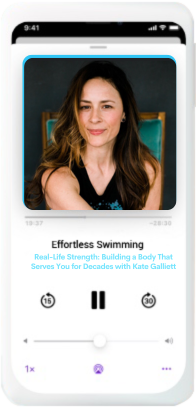
Imagine a group of busy parents hesitating in front of a pair of 25 pound dumbbells, unsure, even a little intimidated. Fast forward two years and those same people are confidently pressing 75 pounds, moving through life with more energy and far less pain. That’s the kind of change Kate Galliett creates.
Kate works with moms, dads, and everyone in between to build lasting strength without burning out. In today’s conversation, we’ll talk about why tiny consistent steps matter more than all out efforts. How tuning into your body can help you avoid injuries, and a simple morning habit. No fancy gear required that can boost your energy and sleep.
Whether you are juggling family work or a swim routine, I think you’ll come away with at least one idea to try on your next workout. Let’s get into today’s podcast with Kate Galliett.
In this episode
- 00:00 — Introduction to Sustainable Fitness
- 04:51 — Empowering Moms Through Strength Training
- 7:47 — Dads and the Importance of Listening to Their Bodies
- 10:42 — Fundamentals of Exercise Programming
- 14:43 — The Importance of Patience in Training
- 17:42 — Client Success Stories and Transformations
- 24:42 — Personalizing Health Approaches
- 27:29 — Finding Balance and Diet Exercise
- 30:57 — The Anti-Challenge Challenge
- 33:36 — Four Pillars of Health
- 36:58 — Understanding Circadian Rhythms
- 41:56 — Connecting with Nature and Gardening
Links from this episode
- http://pillarperformance.shop
- Get your NanoClear swimming goggles here and get 15% off your first purchase with code PODCAST15.
- https://effortlessswimming.com/camps/
- Change your technique and swim a smoother, easier freestyle with the Effortless Swimming membership
Transcript
Read the full transcript
And so I've had to really teach them about the fundamentals and the importance of listening to their body and specifically for dads is to learn how to, if you have this mentality where you're going to just hammer yourself to death in the gym, you're going to do 500 curls. You're going to bench press until you get hurt. You're going to swim until you're so crushed, your shoulder's killing you the next day to learn how to listen to your body better because you're a dad. And if you're not a dad, maybe you're a husband and you're taking care of aging parents or you have a spouse or whatever you got going on. You are needed by other people in this age of life. You are definitely needed. And if you're injured because you went to her in the gym because you saw some guy on YouTube do it and you're like, yeah, I'm going to do that too. You're not being as useful to your family as you could be. Welcome to the Effortless Swimming Podcast to show that help swimmers and triathletes love the water, become a better swimmer and live a better life. Here's your host, Brenton Ford.
Imagine a group of busy parents hesitating in front of a pair of 25 pound dumbbells. Unsure, even a little intimidated. Fast forward two years and those same people are confidently pressing 75 pounds, moving through life with more energy and far less pain. That's the kind of change Kate Galliott creates. Kate works with mums, dads and everyone in between to build lasting strength without burning out. In today's conversation, we'll talk about why tiny consistent steps matter more than all our efforts, how tuning into your body can help you avoid injuries and a simple morning habit, no fancy gear required, that can boost your energy and sleep. Whether you're a juggling family, work or a swim routine, I think you'll come away with at least one idea to try on your next workout. Let's get into today's podcast with Kate Galliott. Kate Galliott, welcome back to the podcast here on a couple of years back and we talked about becoming unbreakable, how people can listen to their bodies and make changes so that they are not getting injured consistently and just so that they can live a healthier, better life where they can do the things that they love. And typically the people who listen to this, the things that they love are swimming and potentially triathlon and just general health and fitness. So I wanted to get you back on today to talk about some topics similar to that, but basically how can we be living in a way that is not going to get us injured, that is going to help us be fit and healthy long term and how we can listen to our bodies. And I think you are the perfect person to speak to when it comes to those topics. That's nice to be here. Thank you.
Now, Kate, you've been working with a lot of people in your area at the moment. You're over in the US and two of the types of people that you've been working with that you mentioned before the call was moms who were afraid to go heavy with weights and then also a lot of parents or dads who are just used to going hard until they break and then they've got to take time off and then get back into it, but you're showing them a more sustainable way of approaching that. So which one would you like to sort of kick off with in terms of who you'd like to chat about first? The moms are, of course, I want to start with the moms. It's been wonderful. I've been building an in-person practice here in my town and the last several years have been great for that. Just with the people I've met and the type of work I get to do, which is kind of, as you summarize, they're really fun because it helps people who weren't previously, for example, like the moms who weren't lifting heavy, who weren't training, so to speak. They were training, but it was the little aerobics here, lighter weights there, this that or the other thing. It was intentional being active and working out, but not with a really specific intent with really structured programming. I hate to say it, and the audience here will already love this, but I hate to say it. We really have to be that mindful and intentional when we're training as we get older because there is no such thing as too old, but your body does need more directives as you get older because when you're not 20 and bouncing off the wall resilient where you could go out drinking at the bar on Friday night and then go hit the pool
or the gym on Saturday morning, too, your tissues do turn over more slowly. You need more direct inputs to tell those tissues how to respond, whether it's tendons, ligaments, muscles, and so on and so forth. Some of the moms I've gotten to work with are awesome because they were in that phase of like they're trying to do stuff, but it's not super structured for creating really distinct specific change. The changes they were going for was to be strong, but to get in better shape, kind of feel good in their body, but also to learn how to do this for a lifetime. And I think that's really important because I do think knowing how to train your body is important for a lifetime. I don't think you can get away with not learning that at some point. And thankfully a lot of the people listening here, of course, are very into like learning a lot of things about their body. So if anyone listening right now feels that way, don't ever lose that because I do think the smarter you are, the wiser you are, and the more you learn about what your body needs, the more capable you're going to be as things come up. You might be at the pool and you get a weird shoulder tweak. You might get something happening and the body starts to kind of go, oh, I need an adjustment here. And it's up to you to know what to do for that. So these moms were training, having a great time, but it wasn't super structured. And we started working together. And at first it was like starting with what we had, which wasn't even heavy weights. We didn't have any weight. We had what we had. We had like a 25 pound dumbbell, like a couple of things, you know, and slowly we started doing this work consistently of strength training with progressive overload, consistency in the exercises, not doing random stuff every
single week. And what happened was they started to really notice that the soreness was good soreness. It wasn't like, Oh, you just feel wrecked because you beat your body up doing a bunch of weird things. But also that they were getting stronger and then they were feeling more energized and their body was starting to change. And now we've gotten to a point where they've got all their home gym setups and they've got heavy weights and they're, they understand and appreciate and value the, the consistency that I was just speaking about that you have to have as you're training to take care of your body. And they've gone from the 25 pound weight was intimidating and heavy and like, Oh, I don't know what if I get hurt. I don't know. It's so heavy to they're hitting PRs. At the end of this last training cycle, we just finished a couple of these gals that they're, you know, inclined bench pressing like 75 pounds, which is quite a bit more than 25 pounds when we first started. So that's really cool to see. And I love that for women, especially because we get this, we're still, we're coming out of it. I think we're mostly out of it at this point, but we still, a lot of us my age and a little bit older got the messaging when we were younger, like don't get too bulky, don't have too heavy of weights, focus on aerobics, cardio is really important. But none of those actually create the change that we want. Most of us want as women, you know, is to have a high metabolism, have a shapely body that can perform well, that doesn't just look good or can do things, but it's both that we like. And so that's an important thing for these moms. And I just, I love that for them. And it's extrapolated out into so many other things. We went into, instead of just doing cardio for the sake of cardio,
to learning how to do zone training, training for a half marathon, having the best training program they ever had for their half marathon, no injuries and so on and so forth, how they eat, how they live their life, what they teach their families. It really has ripple effects. So any of the moms out there, get, get into it with strength training and proper training and all the activities and sports you like to do because it makes a huge difference. Now on the flip side, you mentioned the dads that I work with, I love the dads too, because they're same but different. They are saying that they've been busy. They've been kind of prioritizing other things just like the moms I've been there, like raising a family work and doing all the stuff. But where they're a little bit different is that the dads I've worked with are great because they, most of them lifted in high school and now they're in their 40s or 50s and what they know is what they learned in high school, which may not be great if you all remember being in the weight room in high school. And we've learned more, like exercise science has learned a lot more in 20-something years, right? So with the dads, it really has been more about getting them to appreciate the fundamentals a lot more rather than trying to kill themselves in the gym with 500 bicep curls because that's what they remember and that's what makes them feel that kind of energetic spunk like they had when they were in high school. And so I've had to really teach them about the fundamentals and the importance of listening to their body and specifically for dads is to learn how to, if you have this mentality where you're going to just hammer yourself to death in the gym, you're going to do 500 curls. You're going to bench press until you get hurt. You're going to swim until you're so crushed, your shoulders killing you
the next day to learn how to listen to your body better because you're a dad. And if you're not a dad, maybe you're a husband and you're taking care of aging parents or you have a spouse or whatever you got going on, you are needed by other people in this age of life. You are definitely needed. And if you're injured because you went too hard in the gym, because you saw some guy on YouTube do it and you're like, yeah, I'm going to do that too. You're not being as useful to your family as you could be. And so our efforts with dads is to say, I love that you have the passion already, but we got to hone in the fundamentals a little bit because we need you to train consistently and still be able to do your life where it actually matters that you show up every day like being a dad, taking care of the house, taking care of aging parents, taking care of your spouse, so on and so forth. So in the same way, they come from similar but slightly different places, but the success we've been seeing has been phenomenal and I'm so grateful to be a part of it. I mean, it's all my clients, it's all them, they put the hard work in. Let's get into some specifics in terms of how do you approach what exercises people should do, how often they should be training and what sort of reps, how many sets. Do you have a general approach that you would take with most clients? Yeah, borrowing some unique circumstances. I think everybody does well with basic programming, at least for a while. I guess that's the funny thing, isn't it? You've probably seen this with coaching. All the hot, flashy, sexy stuff shows up every couple of years and everyone's like, we're doing this wild, intense, crazy, really specific training program and at the end of the day,
and then it fades off. At the end of the day, what comes back is like, you've got to put the time in, you've got to put the reps in, you've got to do it consistently, you've got to do progressive overload, whatever that means and the activity that you're doing and beyond that, we're kind of just playing in the weeds and if that makes you feel joy about your training to play in the weeds, have at it, have a good time. We can do weird crazy stuff, but at the end of the day, everyone does well to start with full body training three times a week. If they're not swimming, if they are swimming, they're probably going to only be able to fit twice a week in. If you're more experienced taking that full body routine, turning it into a split routine where we're doing upper or lower on different days and then again, everybody does well in that six to eight rep range, especially for endurance athletes, I will say you already are putting in so much volume that I do, I do with endurance athletes try to shy away from anything higher than eight reps on leg exercises, back exercises, chest exercises, but if we're doing arms, that might be a little bit different, but because you're putting your volume in, you do want to think about your tendons a little bit and make sure you're not overtraining and creating tendonitis, but here's the funny thing. Man, I love the people who are doing research and exercise science right now because they're looking at all this stuff going, okay, all the bros have argued about rep schemes for decades. So who's actually right? Let's actually figure it out. Who's right? And the funny thing is that always comes back is they were all right. 15 reps was great. 8 to 12 reps, that was great. 4 to 5 reps, also great. Like every rep range worked for creating gains and change provided you were working up to within
one or two of your maximum. So when folks are thinking about strength training in the gym, sport training, whether it's on the bike or in the pool or running, figuring out what that represents for you. So in the gym, it's easy. Could you have done one or two more reps? Okay, then you did enough. If you've could have done five more reps, you probably should have kept going or made the weight heavier. But in the pool, you have to think about that a little differently, same with the bike and running. Maybe the goal is to say, could I have swum that just a little bit faster, or could I have bike that for just a little bit longer? Okay, well, that probably means you're working at that range of your body is going to create the adaptations that you want. So I don't want people to get tied up around the axle between 15, 12, 8, 6, 3, however many reps they should do. But I do think if you're working at a weight that gets you to within one or two of your last good reps that you could do reps in reserve is what we call them. You're going to see success with your program. So that's how I kind of approach that. Yeah, that's the progressive overload that you talk about. We've got to get to that point where we do break down and break the muscles down so that we can build and then continue. And it's one thing that I've found having been consistent for a little over two years now with my gym routine has been that I went too hard at the start and injured myself a bit with some of the exercises that I was doing, brought it back, and then I just built it up much slower than what I did at the start. And now, being two years into it, I feel like I am very hard to break with having built up this strength
through these different exercises. Now, obviously, I still do sometimes get injured if I'm surfing and I maybe wipe out or have to duck dive and it's with a big wave and a big board and I might jolt my shoulder. This episode is brought to you by Pillar Performance. Our new sponsors Pillar are a sports micronutrition company. And the easiest way to describe it is that while hydration and carbohydrates products will take you through to touch the wall as fast as possible, Pillar's mission is to get swimmers to the starting blocks in the best condition over and over again. I recently started taking Pillar triple magnesium after a friend had recommended it and it's been a game changer for my sleep and recovery. I take one scoop 30 minutes before bed each night in the same way that you might start your day with a coffee. I finish it up with a magnesium and recover better for tomorrow's session in the pool. Pillar Performance is used by some of the biggest names in swimming and triathlon, including Zack Stubble to cook, Jan Frodeno, Ben Canute, Ash Gentle, Taylor Nib amongst the host of other well-known swimmers and triathletes. Where Pillar differs from other micronutrition you may have taken before is both the quality of the types of magnesium and the tangible results that I see on my garment each morning. If you'd like to try Pillar today, head to pillarperformance.shop and enter code effortless for 15% off. That's effortless for 15% off all first-time purchases or for anyone in North America. Enter the same code at thefeed.com.
So I still get injured occasionally but it is much less often and I feel much more unbreakable having taken this very steady approach to increasing the weights. And you hit the nail on the head there like I think when across the board whether it's health, wellness, performance, sport, whatever you're doing, the vast majority of us need to take our medicine when it comes to patience with the process. Like we are ready for the results right now. We're like I've decided I'm going to get fit. Let's go right now. I've decided I'm going to do swimming so I better be good at it right away. I've decided I'm going to do a half marathon so I better have the fastest half marathon ever. That's not how body works. And you will get injured when you do that. Everyone does that. Everyone does that at least once which I think maybe that's a sign that it's like a learning thing you have to go through. I've done that too. But if we can say I'm in this for the rest of my life and the progress will happen provided I continue to push for that one to two reps left in reserve, which means your weight will have to go up over time or your reps in the pool will have to go up over time. If you do that consistently, the change does come and actually comes much faster than the person who does go balls to the wall right out of the gate, then they get hurt, they're off for three weeks, then they got to come back again, then they get hurt again. The steady, the tortoise wins the race, right? Tortoise on the hair.
Yeah, that's especially in the gym I think for anyone who has either not been in there much before or is just getting back into it. That steady approach where you think oh I'm actually going, I'm progressing too slow with this. I feel like that's the better option even with swimming as well. It's like don't expect to be, make a change to your stroke and don't expect to be faster straight away. If you have got the patience to stick at that change for two months or three months, you will come out the other end and go oh wow okay I'll look back three months and geez I've improved, but yeah it's just it is not as instant as you. It's not as flashy and exciting but I say that to my moms all the time like the amount of stuff they've learned in the last going on two years that we've been working together they're amazed at how many things have changed and I said to them just recently I said what would you have said if I on day one said here's all the things you need to change because we've done everything from like dietary nutrition changes we've done lifestyle changes we've done how they train we've learned about we've done all these things and they said it right out of the gate they're like we would have thought you were crazy like it would have been impossible to do all of those changes and I said yes exactly because everybody wants give me the whole thing give me all the answers right now I'm ready for the answers but in reality you're not you're actually not going to be able to take all of the answers on and do all of the things and go hard on everything right away you have to accept that you're going to go you know what my technique is not great yet in the pool but I'm working on it and I'm still not good at that drill that he keeps showing us to do but I'm going to keep working on it
and one day this is going to get better because that's what bodies do they respond they get better if you keep teaching them what to do what you mentioned there it's it's keeping it keeping it simple and just adding one thing at a time over the course of many months and many years and I mean I look at yeah like I have and how many sessions I've done at the gym I think it's probably it's probably getting close to 250 three maybe 300 sessions since I started at this at this keys gym and same for my wife she started Pilates when we moved down to the coast and I think she's nearly up to 400 sessions and just like the way that it's kind of come on very slowly where like she just feels so much better and it probably took a good 12 months to really notice the difference there so it's uh yeah looking back you see a big change but at the time it's it is a very slow slow and steady approach hundred percent is there a certain client that stands out to you who is has made a big change and has really changed that their life because of the stuff that you've been doing yeah 100% I have this one client that um this individual had
been on this path maybe you all can relate where when they found getting in shape the first time around something about how their brain works took them towards that place of being a zealot about it like kind of getting annoying and obsessive with about it like they're doing all the things they were paying attention to all these like in the weeds kind of details annoying their family members with how they're cooking differently and doing all these different things like really just like embracing it but to the degree where you're like oh geez okay take a break here but they thought that was what they needed to do at that point which I again I do get all these things I'm like oh I see bits of myself and that for sure from my experience in my history but they that's where they were at and they were constantly trying new supplements trying new routines trying new treatments trying trying everything that they would see online they would try it and then they sustained a couple of injuries and that's how they found their way to my path and so we started working together and at first of course we're like working on the rehab after the injury has healed kind of thing we're like okay we're building you back up and doing all that but of course through talking you know I'm picking up information about like you're taking like 50 supplements and you're eating a really like abundantly strict diet to the point where it's causing some detriment to your performance your health your well-being oh you're being really rigid about a lot of things okay so I'm gathering all this stuff so then I just started you know kind of talking about well hey you want to talk about some food today hey let's talk a little bit about this hey because of the training we're doing I'd like you to focus on some things and I just started throwing out little invitations
for this individual to try new things that I knew would take them the direction away from where they were going but I was like let's just see what they'll do because it's not totally up to that person to decide if they want to do something they're happy with it good I'm just here to invite them to do something different if they would like to and so over the span of two plus years this individual went from being like broken in their body despite doing all this rigid specific stuff they were still were very fragile in their body and very they had to follow the rules otherwise everything went haywire if they even ate one wrong thing their whole body kind of would react right we went from that to they are now same thing they are lifting so hard in the gym they are swimming that's one of my clients who started swimming they're walking regularly which was a very painful thing for them to do before they've reintroduced so many foods into their diet they're eating way more than they were before and have a thriving metabolism because of it we've gotten that supplement list down to like almost nothing which is a miracle because you know how it is like you see stuff online and an influencer will be like I take such and such supplement and they're compelling and so then you're like oh maybe I should buy that maybe I should buy that so we got all that pared down and they have such freedom with what they're doing they're still very passionate about learning so many things about how the body works they constantly ask me questions which I love but they don't feel like stuck if the family is going out for a restaurant meal or dessert or something like that they don't feel frustrated by the fact that they their body can't respond even when they eat a certain food they are just living freely and
training super hard and same thing if I had told that person in a year or two time I'd like to see you eating tons of food more than you are training really hard in the gym doing a bunch of sports you never would even think you'd be doing they would have been like you're insane I'm never talking to you again so it's been really incredible and we're still working together today and continuing we've knocked off all the goals that we were trying to achieve and now we're going okay the next thing let's build the performance now let's get you training at even higher levels and what else do you want to take on that's why they tried swimming because I was like would you like to try swimming sometime it's it's pretty fun and it's it's like you could be in the pool you can train hard you can do some cardio but it could be kind of unloading on your joints so that we're not running and walking too much you know and re-enduring anything or do anything like that I'm like okay I'll get that a try and then when I said and you know you do build muscle when you're in the pool you start to get that swimmer physique and they were like oh I'm into that perfect perfect so here we go now we're swimming and it's awesome I have good it like you said you see yourself in that client in some areas I am exactly the same probably 10 years ago I was into keto diet for probably two months or three months and then fell off that train and I've tried a million different diets and exercise routines and what I do get from that is like I tend to go very hard and almost colt colt like in some ways with the with the approach step out of it go back to where I was but I may I've added that knowledge of all right well this was one of the benefits from that diet or that way of approaching things and I can use that
going forwards and so now I'm a little bit more aware of it where I feel like if I come across a new approach whatever it is I'll just take the one or two key things from it and include that into my routine or maybe replace something I was doing and then just keep going on my way and kind of collect these different ideas or exercises and and just kind of yeah make these minor changes in the direction that you're going to hopefully end up in a in a better spot and now I'm more aware of it I don't go quite as hard on some of these new things that I come across I don't know if you're the same that was my story too and you I think I really do think some of these things nobody can teach you like someone listening today will be like yeah right okay whatever that's good for them but I'm gonna do it my way and then maybe in a year or two they'll be like ah yes I also was zealous and I did not need to be but that's how you that's how you do find that middle ground I do think a lot of people go want really hard one way really hard the other way and then that's how they find the middle ground and you get this wisdom from learning to listen to your body to try things to actually like with the supplements for example I've used to buy a million supplements so like oh I need this and I need that and now I'm like okay I'd like to try that supplement I'm gonna try it on its own for a month and just see what happens that a novel idea my gosh friend do you know how many times I tried supplements and didn't do that I was taking like five things at once and I really couldn't even tell what was working whereas now I'm like yeah like with that soon for me or no I do not like what that is doing for me okay I'm not going to continue that supplement you know it's taking really that personalized approach
take the knowledge learn from other people but then personalize it to yourself yeah yeah that's I'm exactly the same when I went keto for two or three months I made this dessert that was what was it it was it was either like coconuts I don't know if it was coconut milk but it was like it was almost like a frozen cheesecake type thing with a lot of no cashews so it was ground up cashews and some berries and stuff and and coconut oil and it was it was about this big it was would have had hundreds of grams of fat in it and I ate it in two nights and like because I'm like well I'm pretty I'm pretty hungry here and it's this is kind of sweet so it tastes good and like I finished it in two days I'm like what am I doing to myself like this is not healthy to have this much you know this much fat and all that at night so you know you can look back and laugh but I've thankfully changed most of most of my approach now because I think I'm a bit smarter with it yeah and just taking that sane approach is my really it's truly my favorite thing to do is to teach people like a sane fundamental approach to like how we can just take care of our bodies for a lifetime not be over the deep end like doing whatever diet and doing whatever training program because those things never last those are always a flash on the pan you might learn some things and that's what you should carry with you for the rest of your life but that like intensity can't exist for an entire life or if it does you're going to a hundred percent break down from that like I've definitely met some women who have done the super intense super hard never listening to their body just go go go do all the things try all the things
and their bodies are now rebelling like they are experiencing the effects of driving on adrenaline and cortisol for way too long over training for way too long under eating for way too long not listening to their body which is screaming at them like hey this thing in my back it's it's like not nothing you should do something about this pain back here you should do you know that they're dealing with it now and and some of us have to go through that you know we do have to hit the point of going and this really isn't working before we go okay let me try something different you know and that's okay if that's what happens well and one of the things you mentioned prior to the call also was there's a big there's a big element of people getting into fitness with like a 30 day fat loss challenge and things like that and I mean I think part of that is it's almost like a sales tool to get someone into a gym or with the trainers like hey you know you might feel you might look overweight and you know we can promise that you'll lose 10 kilos in the next 30 days so it's a bit of a sales tool it's obviously not a sustainable approach and it's probably not the right approach for people so what's your take on that yeah I was really tired of seeing those approaches and you know I owned a gym as well in Illinois so I get the idea I totally get it I can see where a gym owner might be coming from with that or where a coach is coming from with that but I'm so sick of those things because I'm like I said I'm like two plus seconds into this I've been around all enough to be like okay those things never last they're flash in the pan they don't teach you good long-term habits because whatever you did to lose however much weight in 30 days you're not going to be able to keep that up for the rest of your life and I know
some people think they will but you won't you will not you actually have to learn how to create a good metabolism exercise in a way that doesn't also rely on like willpower and hating yourself into exercising because I think that happens a lot with these challenges too people just turn into a competition against themselves which is not who you should be competing against you should be on the same team as your body and learning how to listen and work with your body with things you can do every day for the rest of your life so I got sick of it and was like you know
I would make a great challenge it would be like the anti-challenge challenge it would be great because what we're going to do is spend six weeks total but 30 days for a challenge but we're going to challenge ourselves to do really basic action items every day for 30 days because that's how you actually build change you actually build change by saying every day for 30 days I'm going to see the sunrise every day for 30 days I'm going to eat a certain food or a certain meal quantity or focus on having better circadian habits in my home every day for 30 days I'm going to do that and so that's what I did I built the transform challenge for my clients at first I just said hey guys I want you all to do this let's see what happens and the results were fantastic like it gave people that 30 day mentality which I think is very doable longer than that starts to get challenging but that 30 days wasn't like go crush yourself in the gym every day for 30 days and do such a restrictive diet that you can't wait to eat dessert as soon as you finish your challenge it was like do things that are going to stretch you a little bit they're going to like one of our action items in the transform challenge is see the sunrise every day just catch it for 30 seconds it's all you got to do and there's some specific rules around that but just go do that that's not hard fundamentally but it is if you live a modern life where you haven't been doing that where you haven't considered your circadian health at all for example and you're doing all this other stuff and you're on your phone first thing in the morning or on your computer or whatever that is hard and so my tagline for my clients whenever we do transform now I have a sign other people up for it now is we're
trying to make the bar so low we can step over it because when you do that that's how you create real change bj fog is a permanent habit researchers research are long before James Claire they kind of tag team buff each other um that's what he always said make the bar so low you can step over it is that exciting no but is that what you and I talked about like 20 minutes ago hey real quick in case you didn't know we work from is all around the world to help them become faster and more confident in the races and the training that they're doing so if you've got access to an underwater camera or a phone even recorded above the water then I work with people on a weekly basis where they send in their videos and I give them feedback and advice on what to focus on and how to make changes to their stroke so that they start moving up in the lanes in squad or getting better results and not having to work so hard so check that out at our effortless mean coaching membership which you'll find on our website at effortless mean dot com all right back to the podcast where we're like we just need to do the consistent thing showing up every day it might take you 12 months to see noticeable change but wouldn't that be better than having fits and stops and all that kind of stuff so that's what we do in transform we focus on four pillars of health food of course that's a big one we want to make sure we're eating all the right foods that support a lowering inflammation building a faster metabolism which is possible as you age I promise you that it is movement so of course exercise movement mobility things like that environment so creating both an internal and an external environment around us that supports metabolism and lowering inflammation and then circadian health as I mentioned light that's the fourth pillar that we work on
and those four all work together very synergistically to create a healthy body because you can't separate them out one by one that's the other challenge with challenge with challenges is if you do like a diet challenge for 30 days but you don't account for the fact that the type of light you're being exposed to in the morning and in the evening and even throughout the day is going to change how your body responds to eating carbs for example it will change how your metabolism works it will change these things that are influencing your food that you wouldn't even think about if all you're thinking about is doing a 30 day diet for food you know so that's what we do in the transform challenge and it's so much fun to teach this program because I feel like I'm getting to introduce folks to things they might have heard of before or know a little bit about or maybe know nothing about and going look at all this awesomeness about how your body works this is how your body works naturally we just have to get it back into harmony by doing some really simple things and that's your only job for the next 30 days is to do these simple but not easy to do for 30 days things and then let's see what happens after that and the goal is to then integrate it into your real life because that's the other thing I hate about challenges okay great you're done with the challenge now what like now how are you supposed to eat and move and live so in in transform we have an integration week where we say okay you finished the challenge congratulations now we're going to see how you uniquely are going to put this into your life how are you going to take what you learned about your body through those four pillars and apply it into your everyday life so it is doable for the rest of your life
and I now have like repeat people repeat people coming back because they love the accountability and the seasonal nature of the program and it's just it's just really fun not to be a salesperson for my program I just love it it's like one of the funnest things I get to do right now is teach that program very similar to with our clinics and say eight week course that we've got at go through the course we go through the clinic and this is you know this is wonderful with you've learned a lot hopefully but now what you know how how are you actually going to incorporate the stuff that we've gone through into your normal routine and like the easy thing for most swimmers or triathletes to do is incorporate something like six or eight fifties of drills and skills as part of their warm-up every session you're already going through your warm-up so we can probably just replace some of your existing warm-up with a few of the drills that's specific to what you need to work on and that's it you know like that just keep it as simple as that and that way when you train for the next six months you will have worked on something that's specific to what you need to do to get better you've you've been able to do some drills so you can hopefully set yourself up well for the rest of the session and like and that's it like it's it's simple it's achievable and we're not necessarily adding new things into what they have to do like quite often if we want to change a habit see the replacing an old habit or we're trying to strip back and we're trying to like the client you're talking about 30 50 supplements whatever it was and all these different exercises and things that they're looking at but if we just cut if we strip things back to the bare essentials then it's actually a lot easier
to maintain it and so I think that's such a such a good approach you know you don't you don't need all this stuff like just get get back to basics get back to fundamentals and you'll find that that accounts for 80 or more of what you need to be doing absolutely I couldn't agree more
and in terms of the circadian rhythm I want to dig into that a little bit more yeah can you talk about how what is it what is it that most people wouldn't know about circadian rhythm and the types of light that you think people should know about it because I'm I guess a little bit familiar with it but I probably don't know much about it yeah yeah for sure and I love that it's making it through to the mainstream now which is really great um so most people listening probably the least have heard of it you know if not if maybe they know a lot maybe they don't know much at all I have just heard the word or something like that but your circadian rhythm is the kind of the master rhythm that regulates everything in your body literally everything is being influenced to some degree by your circadian rhythm and that's essentially like you have a master clock in your brain and it goes out to peripheral clocks all in yourselves and that clock is being set by some really important things called psychibers which are essentially like specific inputs that when your body senses those signals it goes up we know what time of day it is and when the body knows what time of day it is not not on your watch just like on the wake sleep cycle it can work more efficiently so when we think about circadian health we want to first think about light for sure because our bodies are directly influenced by the kind of light we're receiving so if we're receiving natural sunlight shortly after we wake up that signals a hormone cascade to get going all throughout the day if we're receiving you know a blaring alarm clock with a really bright light and bright bathroom lights and none of it's natural and it's all very kind of blue lit heavy our body's going to get a
different signal where it's going to drive course all a little bit higher and have a little bit of a different rhythm as we start the day the thing is our digestion our training performance our ability to recover our immune system our hormonal health our heart our mind all of it is set on a circadian clock there's all influence with that so when we don't get things like our light environment and there's other things that also go into that but I'll just stick with light for now when we don't get that right when we don't consistently signal to our body hey it's this time of day because this is a kind of light you're getting the clocks kind of get a little discombobulated it would be a bit like if we took every clock in your house and set it to a slightly different time and then said okay I need you to get out the door by 745 in the morning but you don't actually know which clock is right and you don't know which one's running fast and which one's running slow and that will negatively impact your ability to get ready on time because you're like should I rush do I not need to rush do I have time to do my hair I don't even know our bodies are kind of dealing with the same thing and so anytime we see some circadian dysregulation we're going to see some sort of slightly less functional slightly less optimal situation occur and so for folks when they're first starting to learn about this the first thing you'll hear about is light but after that is meal timing so the simplest thing people could do listening to this podcast to start addressing their circadian health would be two things number one make natural sunlight the first thing you see in the morning which takes a little bit of intentionality because you might have to not open your phone right away or pull the computer up or turn the tv on you might need to go wait a minute the first place I need to go is to the
window pull the window open okay just gaze outside look at the light you don't have to stare at the sun don't stare at the sun we don't want you going quick just gaze outside get some natural sunlight okay now you can get started with your day and then eat breakfast within one hour waking up meal timing is the second most important signal to your circadian rhythm and when you do that consistently it signals two things like your body about how it should produce insulin throughout the day to manage your body's blood sugar response well how you should digest foods um how much digestive enzymes you should have available to be able to do that how your liver should work these are all going to be influenced by your circadian rhythm so if you could go get natural light first thing when you wake up and then eat breakfast within one hour of waking up you would do more for helping your circadian rhythm get on point then then I could even offer to you and beyond that there are other things you could certainly work on and they're important to get to over time but those are the most important signals to start your day on the right foot to make your whole body work well yeah it's uh I know when days where I have got the uh when I've done that not open the phone gotten that gotten that early sunlight eaten within an hour typically the day kicks off pretty well from there so it's uh yeah those those basic things go a really long way they really do and that's the thing with circadian stuff like it's right there for you and there's a there's a ton of science you can get online and look up circadian health and you'll be down rabbit holes with people talking about things that you're like what are you talking about it's so scientific now it's amazing because it's just coming to the masses but again it's simple can you live more closely to
your natural rhythm and what's it going to take to make that happen consistently hmm well um Kate I've really appreciated you being on the podcast uh for those that are listening what's the best place to get in touch with you if they're interested in perhaps the transform program uh or any of the other stuff that you've spoken about today yeah folks can find me at fit for reallife.com that's my home on the web and that's where you'll find transform um all my about me stuff anything you want to find it'll be at fitforreallife.com fantastic and what have you got coming up I know you're going into summer now so probably a pretty good time for for you and your clients it's much easier when the sun's up earlier and it's a little bit warmer so but what are you looking forward to in the next couple of months oh man well the training is not slowing down we've got transform going on right now so folks are really just diving into that whole realm and then all my clients are doing really well in the one-on-one sessions as well but honestly for me it's garden season so in between and outside of and around work and all the things it's time to be out in the garden growing my vegetables and taking care of the fruit trees and trying to bring in as much food as I can for the year you know that like whether people can have a big garden or just a little patio garden I think that's another really cool thing you can do that is totally not fitness-y it's not in the pool it's not gonna I mean maybe it'll make you better swimmer because it'll make you more like in touch you know but but growing something yourself because that does start to bring you closer to your natural world that you're living in your natural environment thinking about things like you know it's a little different down where you live but up here tomatoes don't grow except in summer
up here so then you see those tomatoes in the grocery store in January and you're like those where did those come from those can't possibly taste good it gets you in touch with like what food is around at certain times of year and what is nature telling me my body needs because it is your nature is always telling you what you need at different times of year so I'll be out gardening a lot this summer and enjoying all that outdoor soil time and encourage anyone listening to this that is totally not a fitness-y tip to give but there you go that's my tip throw a little garden if you haven't already fantastic look my grandparents they when they bought it when they built their house probably 20 years ago now they bought the block next to it so they got two blocks the second block is all garden that's fruit trees a greenhouse they uh they really went to town with it and um yeah they're always giving away vegetables and fruit and we come back with buckets of them so it's uh yeah it's really cool and it tastes tastes good too tastes a lot better oh yeah for sure for sure that's awesome I love that so there you go everybody plant a garden thanks Kate enjoy your uh your summer and appreciate you being on the podcast you too have a good one I'll talk to you soon thanks for listening to the effortless swimming podcast if you'd like us to help you become a faster more efficient swimmer go to www.effortlesswimming.com