







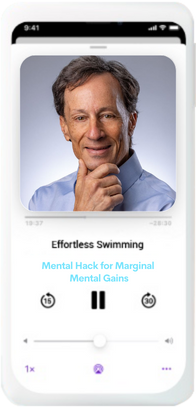
Joining us today is Dr Jim Taylor, who specializes in Sports psychology and is the author of Train Your Mind for Athletic Success. In this episode, we will talk about useful mind hacks that you can implement into your training.
Book Link:
Train Your Mind for Athletic Success
In this episode
- 01:51 The Concept Of Marginal Gains
- 07:47 Words Impact How We Perceive The World
- 11:16 “I Choose To Push My Limits”
- 16:07 Unfamiliarity, Unpredictability, And Lack Of Control
- 19:43 Smiling Is A Powerful Mental Tool
- 25:45 Fun Is A Powerful Mind Hack
- 28:39 Flow Not Force
- 31:46 Take Control Of Your Breathing
- 35:38 Celebrating The Daily Victories
- 40:14 Get In Touch with Dr Jim Taylor
Links from this episode
This podcast is brought to you by NanoClear — our own range of anti-fog swim goggles, designed by Effortless Swimming with the anti-fog treatment bonded into the lens itself (not sprayed on, so it doesn’t wear off after a few swims). Check out the NanoClear range here and use code PODCAST15 for 15% off.
Transcript
Read the full transcript
Welcome to the Effortless Swimming Podcast to show that help swimmers and triathletes love the water, become a better swimmer and live a better life. Here’s your host, Brenton Ford.
Welcome to episode number 275 of the Effortless Swimming podcast. My guest today, Dr. Jim Taylor, you’ve been on many times before and I always get great feedback when you are on the podcast, I think because you provide very valuable and useful advice that people can actually implement in their swimming or their triathlons, all to do with the mind. And on today’s episode, we’re talking about mind hacks for mental marginal gains. And I’m looking forward to this because you said that you’ve developed this in your work with pro triathletes and you’ve come up with a lot of new ideas working with some of these athletes. So I’m looking forward to getting into it. Welcome to the podcast. Great to be back, Brenton. I always find it a talk shop and share a passion for swimming and triathlon, for sure. I mean, you’re in the thick of it yourself. Your training quite a bit, you’re competing and you get to use a lot of
these strategies yourself, but then you also get to use it with the clients that you work with too. So I think that’s a great way to go about it. I see the same thing with my coaching. If I’m not swimming, and myself, I find I get a little bit stale with my coaching. So when I’m in the swimming regularly, training for something, I find I come up with new ideas as well. So I think it’s the best way to develop these things when you’re doing both. So let’s talk about some of these some of these mental, mental marginal gains that people can can have. What’s the what’s the basis for it? How much would someone expect to improve raising some of these things that we’re going to get into? Yeah, well, I totally agree about the fact that I’m competing at a high level as a triathlete and a lot of the stuff that I do, I consider myself my own first guinea pig. So I try stuff out on me. And if it works, then I’ll maybe suggest it to the athletes I work with, but it’s
also helped me in my own competitive life. So you know, I try to practice what I preach for sure. So let’s start with the concept of marginal gains. It’s a term that’s used a lot in triathlon, certainly in bikes with arrow wheels, shaved legs, arrow helmets, a bike, bike position, all those things. It also applies very much in swimming, whether it’s head position, you know, when you keep your head down versus up, it’s not a big difference. But if you take that difference in terms of maybe saving a second or two a lap, and expand that exponentially to a 10k swim or an Ironman distance swim, it adds up for sure. So these marginal gains are basically these small gains that make a big difference. Because the fact is, the things I suggest, I’m not going to, I can’t say that they’re going to help you improve by by 20%. You know, Brent, I’m thinking I’m pretty good at what I do, but I’m not a magician, that’s for sure.
But if it’s one or 2%, and if you do the math on that, again, it turns into big gains. And if you do a lot of the little things, they add up to more than a marginal gain. So I’ve applied this concept of marginal gains to the mind. Because as we all know, mine plays a huge role in our ability to perform our best in training or on race day. And so if we can add, you know, one or 2%, a little bit of percentage here and there in terms of our swimming and other aspects of triathlon, for example, then that’s going to really help not only help us get the most out of our training, but also to help us be as fast as we can on the swim when we’re when racing. So where would you, where do you think a good place to start would be with some of these things? Yeah, well, I came up with this idea about mine hacks. And I’ve always actually not liked the phrase, the word mine, the word hacks, because it’s sort of a sort of a
nouveau techie thing going on. But people seem to relate to it. And so I decided to call my ideas mind hacks. So I guess start with one sort of general sort of attitude as you enter training or race, where it’s, you know, it’s going to be hard. And our natural reaction, when something’s gonna be hard, something’s gonna be painful is to back away. Because on the Serengeti 250,000 years ago, when we first became homo sapiens, if we start to feel pain, discomfort, what was likely to follow was death. So we’ve evolved to not like to feel pain or feel discomfort. And yet in 2023, swimming triathlon, if you’re not feeling discomfort, you’re not improving, you’re not getting better. So the one thing to start and this is sort of what I would call sort of an attitude hack is that this is range of which you can look at a tough training session or tough race, the range is from I love it to I hate it. Now, there are some people who will with a
really hard swim workout will love it. But you can probably you can speak to this better than I, Breton, they’re probably maybe you’re one of these guys or there’s some athletes out there you worked with who they just love suffering. Incredibly. But but most people aren’t gonna love it. So because you hear you hear this, you play, you gotta love the battle, you got to love the work. I’m sorry, when you’re in the pool, and you’re doing 20 by hundreds or something like that at race pace. It’s hard to love it. The other thing to continue is hate. And if you can’t hate it because you hate it, you’re just not going to do it. So the starting place is this middle ground of I’m not going to love it for sure. I can’t hate it. So I’m gonna accept it. Because it’s part of the deal of striving toward my goals. So I’m just gonna accept it. That way you’re not going like, Oh my gosh, plus you’re not you’re not naturally going to be
going like, Oh yeah, I totally love this and you’re not going to believe it. So just going to a hard workout or a tough race with tough conditions. It’s like, you just accept like this is the way it is. I’m preparing for it. This is helping me get to my goals. So that’s number one, sort of your basic attitude or approach toward a tough workout or a tough race. So now let’s get practical. This has been some fascinating research in a couple of areas that that significantly improves your ability to push your limits to to reduce your perceived effort. One is your self talk. And I might have talked about this in the past, but but it’s been very clear that if you can think positively about something like during a hard workout, actually while you’re actually swimming and it’s hard, you will, your perceived exertion will drop, which means you can maintain your effort and you hurt less. So being very aware of your self talking, if you’re
going through the water going like, God, I hate this sucks. This is terrible. You’re losing time. Because the message you’re sending to your body, the mind of the body is, this is really hard. I don’t want to be here. And the body looks up and goes, Okay, well, we’re just going to ease up there. And so much of swimming is about having your mind overcome your body’s messages to you to stop.
And so so be aware of your self talk and having some things you can say to yourself that will keep you going. And it doesn’t have to be. I love this. I’m doing great. It might just be let’s keep going. Let’s keep working at it. Let’s keep pushing. And and this is going to help me get where I want to go. So really preparing some some some some little self talk sentences can be really helpful. Because when you’re doing a swim workout, and it’s really hard in your body screaming at you to stop, it’s it’s hard to just sort of go, Okay, so what do I need to do here? You can’t think that rashly when your body screaming at you. But if you have them already in your pocket, metaphorically speaking, then you can easily pull them out and go in. Oh yeah. And I’ll share one with you toward the end, which for me has been a real game changer for me personally as an athlete. So so that self talk is really important. Another thing related to words is what I call
power words develop power words. There’s words that make you feel strong. So it might be strong. It might be easy speed is one Olympic swimmer and a gold medalist a number of years ago, sort of famous one in swimming, coming up with words that make you feel good, like fast, strong, powerful. Yeah. Before you talk about what’s the one that you’ve used before, which I’m curious as to what that is. It made me think of the other night I was out at the beach with my two young kids. And the waves were picking out, they’re getting pretty big and sort of breaking words reasonably shallow. And I’m out there with my my kids, they’re six and four. And only in the last six months, they’ve really got quite comfortable out in the ocean. And if they got picked up and dumped or held under or they ducked under a wave and then it pulled them back, there was a lot of fear there. But I’ve changed the, tried to change the story for them. We’re like, this is
fun. How good is it when you get picked up and you get drawn back under the water and it’s like a roller coaster ride. It’s good fun. And so now whenever it happens, they come up and they’re like, wow, that was really cool. That was that was so much fun as opposed to this is a dangerous place to be. And yeah, and it’s unsafe and I’m scared. It’s so the stories that we tell ourselves can really change how we experience something. And and those those words that you have in your pocket can can really make a big difference. So what’s that what do you like to use in training? What’s worked well for you? This episode of the podcast is proudly brought to you by our sponsor, Form Goggles. They’re more than a pair of Goggles meet the world’s most powerful swim platform. See yourself improve with Form Smart Swim Goggles including a free one year membership. When you purchase your Goggles for only two hundred and twenty eight US dollars.
Now they’ve currently changed up the offer where you can now get the Goggles and you have that one year membership included for free. And then if you’d like to continue with the membership going forward, it’s only 15 US dollars a month where you get access to their workouts training plans and their custom workout builder. But you’ll always have access to the real time data of the Goggles. So you’ll never lose access to that. So if you’d like to swim without stopping to look at a pace clock or your watch and get live metrics right inside your Goggles, including your time, distance, pace, they are right there in your Goggles with Form Goggles. I’ve used these for over 12 months now and I’m a huge fan of these Goggles and use them for a majority of my sessions and find them very helpful, especially for gauging my time, my effort and my pace. And I think it’s a very helpful tool for the majority of swimmers that I would normally work with
to get your pair of Form Goggles and save 15 percent off. Use our link, formswim.com forward slash effortless or use the coupon effortless at checkout. And that will get you 15 percent off your pair of Form Goggles using our special link, formswim.com forward slash effortless or use the coupon code effortless at checkout. Yeah. Well, just I want to build on the story about your kids. And this applies to all of us is that the words impact how we perceive the world. And so if you’re saying, oh, this is going to be really fun, then you start perceiving the world that way. And that generates different emotions and different physiology. And so it generates excitement instead of fear, for example, like with your kids or before a race. And there’s been some really interesting research that shows that that if you experience anxiety before a race, if you can reinterpret that as excitement, it changes your motivation, it changes your confidence, and it
changes your actual performances. Even though the same underlying physiology is there, there’s no difference physiologically between excitement and fear, but you’re reinterpreting it. And that causes you to view the situation differently, which creates different emotions and different different different performance, different behavior. So so that’s a really powerful one. Since we’re on the topic of words, I guess I’ll give my special sauce, my secret sauce away. It was about two months ago, I was on my indoor trainer and having a really, really hard ride and hard intervals. And I was not doing well. And the last five minutes of these 15 minute intervals, I was the first one might my power start to drop. And by the way, I had this experience in the water as well, doing laps, doing intervals in the pool. And then just I just had this idea pop into my head. And I said, you know, I choose to push my limits. I choose to push my limits.
That’s my secret sauce. I choose to push my limits, not for particularly exciting or anything, but all of a sudden my perceived effort decreased, my wattage went back up. And so I started experimenting with this and myself. And any time I was again in the pool on the road running or on my trainer, I would use this. And when things got hard, I would say this. And every time I was able to maintain or increase my pace. And I’m thinking like, whoa, this is powerful stuff, because it’s obviously you’re smirking, because it’s such a simple thing, right? But there are a couple of really important elements to this idea of I choose to push my limits. So first of all, when when we start to hurt our body’s evolutionarily, again, send signals to our mind to slow down or stop to ease the pain. But what happens is as a part of our primitive brain, called the amygdala, and it’s responsible for filtering in the world and determining very quickly
whether any threats. Because then we have the fight or flight reaction and we run away or fight or whatever what have you. So what this does is when I make this statement, I choose to push my limits. What happens is is that I’m rerouting that information away from my amygdala, which is all about like this, and into my prefrontal cortex, which is involved with executive functioning. It’s a very popular thing with kids these days, kids development. And it basically involves the ability to consider options, weigh risk rewards, and most importantly, make choices. And by making that choice, I’m actually removing the stimuli that’s getting into my primitive brain that’s causing me to ease up. Also, my mind is telling my body, we’re not going to die. I’m in control. I’m on top of things here. Because when you make a choice, that means that you do have the control to dictate how the situation situation is going to go. So I really encourage your
listeners to try this out next time they swim or do something else, maybe related to a triathlon that’s hard is just say to yourself, I choose to push my limits or the way I put it is I choose to dot, dot, dot. You might have some other phrase you like to use. I choose to pursue my goals. I choose to to give my best effort, whatever it might be. And simply by saying that, I believe based on my experience, and I’ve tried this out with some of the pro-trafflates I work with, that it makes a big difference. I mean, it’s remarkable how much it works, how effective it is. Yeah. And I was smirking for that exactly. It’s very simple. But a lot of the times I’m thinking of stroke changes, technique changes, like there’s nothing that is going to be brand new. Doesn’t it be flashy? It’s the simple things, the foundational things that often are the biggest drivers forward. So I can I can see why that why that works. And the thing
that I love about any sport really, but particularly swimming or or triathlon, you get that opportunity to push your limits on an almost daily basis and to have that opportunity to be able to do that and have that feeling of being completely spent or sitting there for half an hour, an hour and a half at a relatively high heart rate. That to me is an exciting thing to be able to do on a daily basis and to feel that. And I think a large part of the population don’t do that. And they’re missing out on a on a really big opportunity to not only feel good, but test themselves. And that can make you a better person in terms of family life, business work. Like it’s just it’s such a great personal development way to do it. So that’s what I really love about about sport, and particularly these more aerobic based sports. And we get to try things like that where you know, where else would you get to say I choose to push my my limits
and actually play around with that, actually test it out. Right. Right. Yeah. I did my first open water swim of the year in Aquatic Park in San Francisco Bay and on Friday. And the water is 49 degrees. So that’s really cold. But I went in the same approach as with a group of elite athletes that are speaking at a camp. And I talked to them about this idea about love, love for versus hate versus accept. Because if you accept it and you anticipate it, there’s tons of research that shows that it’s less of a shock. And I don’t mean just cold water, but I mean any new potentially unpleasant experience. And another thing you’re talking about that’s really relevant here is that by doing it every day, you gain experience. So there are three things that human beings don’t like unfamiliarity, unpredictability, and lack of control. And again, for evolutionary reasons, if we experienced that on the Serengeti 250,000 years ago, we’re probably going to die
right away. And so we’ve learned that we want to stay in our comfort zone, which is familiar, predictable and controllable. The nature of pursuing personal greatness in any sport, including swimming and triathlon, is you have to experience those three things, unfamiliarity, unpredictability and lack of control. But with experience, that which is unfamiliar, that which is unpredictable and uncontrollable becomes that. So for example, after the pandemic hit, all the pools were closed out here, of course. And so I swim in Aquatic Park like 30 times over the next couple of months. And I will tell you Bretton, there was not one moment of joy, for sure, because it’s just cold. But what it did was after, I don’t know, 10 or so, it’s just like, okay, it’s gonna be cold. And the fact is you’re going to have those kind of challenges when you get into races. So it’s that everyday experience, which makes things familiar, predictable and
controllable. And also the fact that, oh, yeah, I survive, I’m okay. Then those difficult conditions that you experience, maybe in a race, and it might be cold water, it might be warm water, I’ve raced in 82 degree. And when I was in Abu Dhabi, I was sweating in the water last November at the World Championships. If there’s a wicked headwind, white caps, I’ve experienced that doing escape from Alcatraz, then it’s like, oh yeah, this is just part of the deal. Plus, it actually at the end, as you suggest, it feels really gratifying. It feels great, because you overcame the challenges. But ultimately, Bretton, what you’re overcoming really is yourself and your own perceived limitations. So there’s tons of power in that. And the more you do something, the more you get comfortable with it. And even though, like now, for example, I’ve been doing triathlons for quite a while now, even though I have a hard workout coming up, and
I have one right after our conversation today, it’s like, oh yeah, it’s gonna be pretty hard. But that’s part of the deal. And that’s why we do it. And in an hour, it’ll be over. And I’ll feel better for it. So again, a lot of that is like these little mind hacks about how you approach, approach tough workouts, or tough days in the water. That made me think of the thing called the rip swim here in Melbourne, which I did recently. So a couple of years back, I did a swim where you swim across their heads to the entrance to the Port Phillip Bay in Melbourne. And it there’s, they do it on slack type, but there’s a lot of water, a lot of water moving. And it’s, it’s something like 80 meters deep. It’s, you know, it’s, it’s not a, not a safe stretch of water by any, any means. And the first time I did it, I was quite a little bit anxious. And when I was swimming, you know, I was, I was thinking sharks, I was thinking, I just, I was
keeping an eye on what was, what was around me. And I was, I was quite nervous. Even going through the swim, there was a bit of anxiety. And I did it again a couple of weeks ago. And I had, aside from when I first jumped in and we were lining up to start this, this race, there was a little bit of that. But then afterwards, it just felt like a normal race. And I didn’t have that. And it’s just that experience, doing it a second time. And then I could just get into, to race mode and go for it. And there was no other thoughts in my mind apart from, okay, how’s my pace? Am I going in the right direction? Just all those general things you’d have if you’re racing. But because it was the first time a couple of years ago, yeah, there was those other other fears, those other thoughts there. So if you can get more familiar with the situation by putting yourself there on a regular basis, then you can move yourself in a direction where
you can perform a lot better. Right, absolutely. So another mind hack has to a smiling and in two ways. Now, I think I did talk about this a while ago in one of our earlier ones, but I’m going to add a little twist to it. So smiling is a very strange thing. It has a tremendous impact on our physiologies and our emotions. So a lot of people think, well, you’re smiling when you’re happy. But it also goes both the other way, where if you smile, it makes you happier. And there’s been a lot of research that’s found that if you simply force yourself to smile, your mood lifts, and you feel less pain for a couple of reasons. First of all, as we grow up, what do we learn how we’re feeling when we’re smiling? Well, life’s good. I’m happy on so on. Also, smiling releases neurochemicals endorphins, serotonin, dopamine that actually make us happier and our natural bodies, natural painkillers. So this is a little hard to do in swimming,
but I do it every day. And when I’m in the pool is I’ll actually smile during a workout. And obviously, after let’s say I’m doing a set of 100 or 200 or whatever, I’m hanging at the wall, and I’m breathing hard. I’ll smile. And I don’t mean to be like be having a great time because when you’re stuck in wind and I train part of the times of the mountains of Northern California at 7000 feet. That’s really a plus. I can assure you there’s no joy there either. But but but simply going like this, smiling is a motor skill. Simply raising the side of your mouth produces those same feelings. Now it’s not the same as actually genuinely feeling those those emotions, smiling for genuine reasons. But even when you’re hurting, you can often find reasons to smile. Like I’m pushing my limits. I’m challenging myself. I’m getting stronger. I’m pursuing my goals, whatever it might be. So when things get hard, simply forcing yourself to smile. And you should
this is a great just life thing. You know, you’re driving the road and you’re stressed out because the traffic just forcing yourself to smile. Because it’s hard for our bodies to think and our minds to think and feel in ways that are inconsistent with what the messages our bodies sending us. So if I’m going like this, it’s hard to be really angry. Because the message my mind is getting from my face is, Oh, wait a minute. But you’re happy. And so so it goes OK. And then it makes makes the physiological changes. So simply smiling is a great tool to use in the water, on the bike, on the run, when things get hard, force yourself to smile. And all of a sudden it’s like, well, you know, you actually feel better. So that’s part one of the smiling. Part two is this. There’s been some fascinating research done in a human performance lab where they have a cyclist on an indoor trainer with a TV screen, and it might be something like Zwift or
something like that. And and they would flash smiley faces below the level of consciousness. So so the people riding and looking at the screen can’t see the smiley face consciously. But the mind picks it up. It’s called subliminal messaging. And what they found was that when people are exposed to subliminal messaging that is of a smiley face, they actually go faster and have lower perceived effort and can push harder than if they see a frowny face or no face at all. Now here’s the problem with swimming. You can’t put a smiley face maybe in your goggles or something. But you can pick you can picture the smiley face, because that’s just like putting it on that screen in your mind’s eye. And when I do my effort, my training cave, I don’t like to call it pain cave as sort of negative connotations. But I call it in my training cave. I printed out a smiley face and put it up above my TV when I’m doing indoor workouts. And so when I
swim, I’ll also, in addition to smiling periodically when it’s getting hard, I just pop that image of the smiley face in my mind. Now, realistically, is this scientifically proven to be able to just put a picture in your mind? No, but but I think it works. And if anything else, it’s a placebo. And so I’m going to stick with it. So smiling has this really powerful tool that that we can use. And if we use it on a regular basis and we train ourselves to use it during those hard times, we’re able to get more out of ourselves. Seeing I’ll talk to form goggles and get them to have a button that you can push and then every every 10 seconds to have a little flash of a smiley face in the in the lens, that’s the way to go. Well, well, it’s funny you say that because I like you have a relationship with form goggles and I’m talking to them about building in a self talk and a power word component to it. So where you can where you can actually program in your
power words or the last length, things you things you don’t want to put up there to so you can remind yourself like finish strong or something like that. So so we’re totally the same wavelength there. Yeah, that sounds good. But yesterday I was out I was out surfing at a break near home. And there was probably eight, nine guys on this on this one break. And everyone was you know, kind of they were just all sort of serious and a few salty dogs there and like just not, you know, not not this happy sort of cheery environment. And so I was when in there and everyone’s serious, no one’s sort of smiling, not many people sort of chatting with each other. And then about half an hour in I’m just like, you know what, I’m just gonna I’m just gonna enjoy this. And I’m gonna like smile each time I get away. I’m just gonna be out there and and just be sort of happy. And then over the next half hour, you know, vibe got pretty good out there. People are
starting to chat. I was talking to a few others and I’ve had that happening at other times I’ve been out surfing where if I’m in a good mood, and like genuinely in a good mood, smiling, you know, chat to people, then I have a much better time. But it seems just overall that other people have a better time as well. I’m not saying that you guys are having a good time surfing because I’m out here smiling like I’m not, I’m not, I think that’s the case. But, you know, the, yeah, the environment there can change when you know, when other people are happy. So I try and carry that into the water when I can. Yeah. And yeah, makes a big difference. Yeah, Brent, it’s a good point. And another smiling is one powerful mental tool. Funny is another one. And I love the way you put it in terms like, yeah, I can see surfers, you know, some of the all salty dogs can be pretty dour and that sort of thing, and especially you’re on their turf and
so on. But, but if you can make yourself have fun in the pool or in the open water and in your friendly with other people, simply smiling at other people, being friendly generates positive emotions, which changes your physiology. So the more the more swim coach can can can create a fun environment. That doesn’t mean fun doesn’t mean unfocused. It means just being able to enjoy the experience and especially since the experience from wall to wall might not be always that fun. When you stop in and you’re recovering, you have the opportunity to make it fun because if you can raise your level of enjoyment, then can express that, then it’s hard for other people not to feel that too. So I think with a swim team, creating a culture of fun is a really powerful mind hack as well. Because invariably, if you’re having fun, you’re in the moment, you’re not worried about the next set, which is going to hurt. You’re not thinking about the last
set, which really hurt. You’re just like, oh, yeah, this is really great fun. And so that can lift everybody up as a group, not just yourself as you as you found out with your surfing.
And so came out and who was on the Olympic team in 2021. She trains under a Dean Boxle, who’s a coach here in Australia. And they did a thing, was it about six months ago now, five months ago, he called it the car wash. So that was like getting back into training start of the season. And it was like a couple weeks of the car wash where they’re just washing off all the dirt, all the rust and, you know, framing it that way as a as a fun way to get rid of all the cobwebs and get fit. And then there’s another coach. There’s a coaching Melbourne, Johnny Vanwis, who a lot of swimmers that I’ve had come to clinics have, they train with him. And he’s got a nickname for everyone at the squad. And when they walk in, it’s like, hi, like fastest doctor in Melbourne or whatever it might be. And as like great vibe, people want to go there. It’s early in the morning, but they want to go, they want to be there and part of that that environment. And that
makes it fun. And people are happy to push themselves when they have them from like that, for sure. And then that’s the collective power of creating a culture in a club, whether it’s a master’s program or kids program or in league program. And if everybody’s having fun, a it hurts less. And times go by fat time goes by faster, and you perform better. And it’s like win, win, win, win, win for sure. So so and a coach can certainly help with that. But also the athletes themselves can take upon themselves like, you know what, this is hard, but let’s make it fun and hard because it’s fun and hard is way better than unfunded hard. Yeah, that’s right, because you’re going to be doing the work anyway. Why not? Why not make some fun of it, right? For sure. For sure. Good. A couple more. One is one of the top PTO athletes I work with. He came from a swing background. And and he he knows that when he’s really pushing it, that he realized that
that he can’t force it. So another this might be a key like a good power word or just a good thing to keep mine, this idea of just he would say, I need to flow, not force. So I need to remind my mind and body to flow through the water. And he also he talks. It’s fascinating. This is the difference between people who grew up swimming and people like me who didn’t grow up swimming where like you guys have a relationship with the water. And this is what he talked about. It’s like like he works with the water. He’s not pushing against the water. He’s not pulling the water. He’s working with it. And when he does that, he’s so much faster. He was telling me about this one really tough workout he had a couple weeks ago where he was getting tired and he didn’t feel very good and he was like fighting the water. And it just wasn’t working at all. And then he finally goes, oh yeah, flow. And so he focused on that and the entire workout changed. He put up good
numbers. He felt much better and it was a totally different experience. So just a small thing and especially for inexperienced or relatively new swimmers, you can feel like you’re fighting the water. And Lionel Sanders is famous for his challenges of fighting the water and yet you watch the top triathlete swimming and whether it’s Brownlee or Ferdaino. And what you see is there is that flow to it. And if you can develop that relationship of the water and think of water as not something you’re fighting against or resisting, we’re trying to pull, but you’re working with it and you’re flowing through it. Then again, that changes your physiology. It changed your mind and it actually changes how you move through the water. That’s interesting. You bring that up. I had the guests I had on last week, Brent Best. He was doing some work with the up and coming sprinters here in Australia. Those that are looking to qualify for the 2028 LA Olympics
and they were doing 25s, I think it was and they were getting them to change their tension. Their perceived tension. So he’d have him go 25 meters. Pull as hard and as fast as you can. All right, let’s get times. And then let’s go to 90 percent, 80. I think they went down to perhaps 60 percent. And he found that at 60 percent perceived tension or force, I guess they were only point to slower for that 25 meters. Now these these guys are training for 100 freestyle. And so what they’re looking to get them to do is in that first 50 they want to be relaxed so that they can come home. And that might be point to slower in that first lap. But you’re going to gain much more than that on the second lap because you’ve you’ve kept some energy in reserve. And it’s right. Just more power, more force does not equal faster in the pool. I mean, I would imagine I’m not great at cycling but I would imagine the same thing if you’re if you’re cycling that you cannot sustain
maximum power very, very long. You’ve got to find that sweet spot. And if you’re thinking flow, not force, I think that’s a great cue, a great mental cue that you could use. Very much so, very much so. So two more that I want to share, I suppose. The first is breathing and breathing, yes, is a physical thing. And for me, it’s probably the most powerful physical slash mental hacks, tools we can use because breathing has not only a huge impact on us physiologically, but also psychologically and emotionally. And of course, there’s the whole, you know, Zen Buddhism and the whole meditation thing with breathing, all really great stuff. But the fact is, is that that we just like with smiling, if we can control our breathing, even when it’s hard, these let’s say you just did a super hard set and you’re just gasping for air, your body is getting the message that your body’s sending the message your mind of like, we’re about to die now,
we need to stop. And so everything is the body’s directive is to back off. And if the mind goes along with that, then sure. But if you can send, if you can take control of your breathing, even when you’re gasping for breath, you can still control your breathing. Not only are you going to recover faster, but you’re also sending a message to your body that, okay, we’re not going to die, we’re in control. And this goes back to that control thing I talked about a while ago. And so simply even when you’re gasping when you’re really hard to breathe, taking control of your breathing instead of like going to go again, it helps you psychologically because we like to be in control and we hate being out of control and breathing, especially in swimming because at least with running a bike and you can breathe whenever you want, but you can’t do that in the pool. You have to only, you can only breathe certain times like when you take your head out of the water.
And so that helps a lot as well as it helps get more oxygen into your system. It settles your physiology down. So you recover more quickly and then you can have a good next set. So that is one of those tools. And the thing about breathing is we don’t think about breathing as a tool because we don’t think about it at all because we just do it without thinking about it. We don’t have to, at all. I mean, imagine if we had to really think to breathe, it’s like you stop and breathe and it’s like, oh, I have to breathe here. Oh yeah, because that wouldn’t work very well. So a really great exercise is maybe when you’re doing your warmups and your cooldowns initially to really focus on your breathing. And then when you, when during the workout, the main sets, when you get to the wall to really focus on, okay, let’s take control of the breathing. And that’s something that I do all the time. And I find it makes a real difference
in my ability to recover. And just, I just feel better because I’m not gasping for anymore. I’m in control.
I’ve found that happened in a hard sets where let’s say I’ve got 20 to 30 seconds rest. It might be doing 200s. And we’re working reasonably hard. If I touch the wall and the person behind me touches the wall and we’re chatting, whatever chatting about the weekend and talking, talking, talking. And I haven’t had that chance to just control my breathing. The next interval is usually that little bit slower. And I haven’t had the chance to get that under control. And from the get go, I’m just kind of having to work on just slowing the breathing down. And so I’ll tell you a bit quicker. So yeah, when you hit the wall, it’s just like, all right, let’s get that breathing under control. And then you’re much better off for the next interval. And it’s the only thing that we can really control physiologically is our breathing. And it’s easy to forget because it happens automatically. And the only time I see people forgetting to breathe
is when I’m running clinics and they’re concentrating so hard on trying to change their catch or their rotation. And they’ll take a few strokes and they’re like, oh crap, hang on. Oh yeah, that’s right. I’ve got to breathe. And so that’s the only time I see them forgetting to breathe but that’s when you’re in the water, not out of the water. That’s where it happens naturally. For sure, for sure. That’s great. So I guess the last thing I, the last mind hack for mental marginal gains I would share is for after the workout. And this is to celebrate the daily victories. So we focused on our training so much in terms of the physical gains, like getting stronger, getting faster. And that’s a key part of the training because if we don’t develop ourselves physically then we’re not gonna be able to actually literally go fast in our swim races or in our triathlons because the reality is in both swimming and triathlon, you can’t fake speed.
You can only go as fast as you’re trained to go. So there’s that emphasis of, okay, well the purpose of training is of course to get physically fitter. But it also is important because every time we train, there’s the ability to get mentally stronger. And so a lot of most people when they finish a workout, they’ll sort of get out of the pool and go change and go off to work or life or whatever it might be. But it’s really important, I believe, and this is something clubs can do really well, is to take 15 seconds, 20 seconds and just stop and celebrate the daily victories. And the way I put it is that, and again, we might have talked about this months ago, but it’s like putting money in your confidence bank. And so the idea is that every time you work out, you are getting fitter and you’re also gaining belief in that fitness because you might be stronger, but if you don’t believe you’re stronger, you’re not gonna go out at that pace you’re capable of.
So it’s not just having the fitness, it’s having the belief that you’re of that fit and that you can hold that pace. And so with that confidence bank, what happens then is with that recognizing, celebrating the daily victory, you go money in the bank, baby, money in the bank. And I encourage, I do this with some programs and they actually do that after workouts. And you have to say, baby, otherwise it doesn’t work, Brent. But the idea is recognizing, oh yeah, I just got stronger. And you’re putting, every time you do that, you’re putting money in that confidence bank. The goal of which is to accumulate a really big sum in your confidence bank and then on race day, what do you wanna do? Make a big withdrawal. And you can’t write checks you can’t cover in swimming or in triathlon. And so just taking a couple of seconds and going like, whether you wanna say money in the bank, baby, money in the bank or Ka-ching or Way2Go
or some of my athletes, Olympians, they will imagine themselves on the top of the podium with the Olympic music, dum, dum, dum, dum, dum, dum. And seeing the metal going around their neck. And so they just won the gold medal for that workout today. And that, it does a couple of things. First of all, it rewards the effort. And it also reminds you why you work so hard. Because you need to have a good reason to tell your body why you’re hurting so much. And so simply doing that after a workout, that recognition, that celebration, that money in the bank, baby, what you’re doing is you’re showing that it was worth it. That it hurt, yeah. Last couple of hours of however long you’re in the pool, it hurt, but it was so worth it. So the next time you come around to the pool for another workout, it’s like, oh yeah, let’s go for another Olympic medal here in today’s pool. And of course, the victory is you did the workout.
And you tie that into there why, by the sounds of it, like why are we doing all of this? It’s not just for the sake of it. There’s something deep down that we wanna achieve, that we’re aspiring to. So you’re tying that celebration into their why, I’m guessing as well. Yeah. And what I’m gonna suggest, Brenton, is let’s save the why to another podcast, because that’s a really deep and powerful topic to delve into. And it’ll take more time than we have for today. Is that okay? Let’s do it. Okay. So, Jim, I appreciate you being on the podcast. Again, these episodes are great. And we’ve talked about a couple of things today. We’ve talked about you choose to do the workout. And for you, you say, I choose to push my limits. And you can change the way you perceive hard work. Talked about smiling, and the effects that that can have on your training, and on how, on your perceived effort. We talked about flow, not force. So can’t force your way to get fast.
You’ve really gotta relax in order to perform well. Talked about how you can control your breathing to lower your heart rate and control things. And then celebrating the daily victory, celebrating each session. And next time we’re gonna get into your why, which is for me, that’s one of my favorite topics. I love to delve deeply into why someone choose to do something. So I’m looking forward to getting into that. Jim, where can people find out more about what you do and get in touch if they have any questions about what we’ve covered today? Sure, sure. Before I share that, I wanted to make one final point that in talking about all these mind hacks, all these mental tools, you can’t just save them for the race. Like everything else, you need to build it into your training. Make it a part of your mental training as a part of your overall training program. And so literally every day, if you might have a specific mental focus for the day,
or you might just make it a habit of every day I get out of the pool, I’m celebrating the daily victory. Or I use my power words every time where I’m gonna picture that smiley face on my lens every time. What’s most important, just like the power of swimming is not going to the pool every couple of weeks. It’s going in every day or four or five times a week, depending on your schedule. It’s consistency that’s important. Because when you have consistency, you ingrain all these capabilities inside of you, mentally or physically. And that’s where the power is and that’s where the benefits come. In any case, people learn more about me like everybody else, of course, I have a website and drjimtala.com, drjimtala.com. You can follow me on Facebook, Twitter, Instagram, LinkedIn and people have questions or comments. My email is on my website under contact. Feel free to reach out, I love getting queries. And swimmers are obviously a curious bunch
or your swimmers are a curious bunch because I hear from them with a degree of regularity asking me questions and I’m happy to answer questions. So I just appreciate the opportunity to share my passion with you, Brent, because you obviously have a similar passion and I’m always happy to come back and share more ideas. Fantastic. Thanks again. Looking forward to the next episode. Thanks for listening to the Effortless Swimming podcast. If you’d like us to help you become a faster, more efficient swimmer, go to www.effortlesswimming.com.