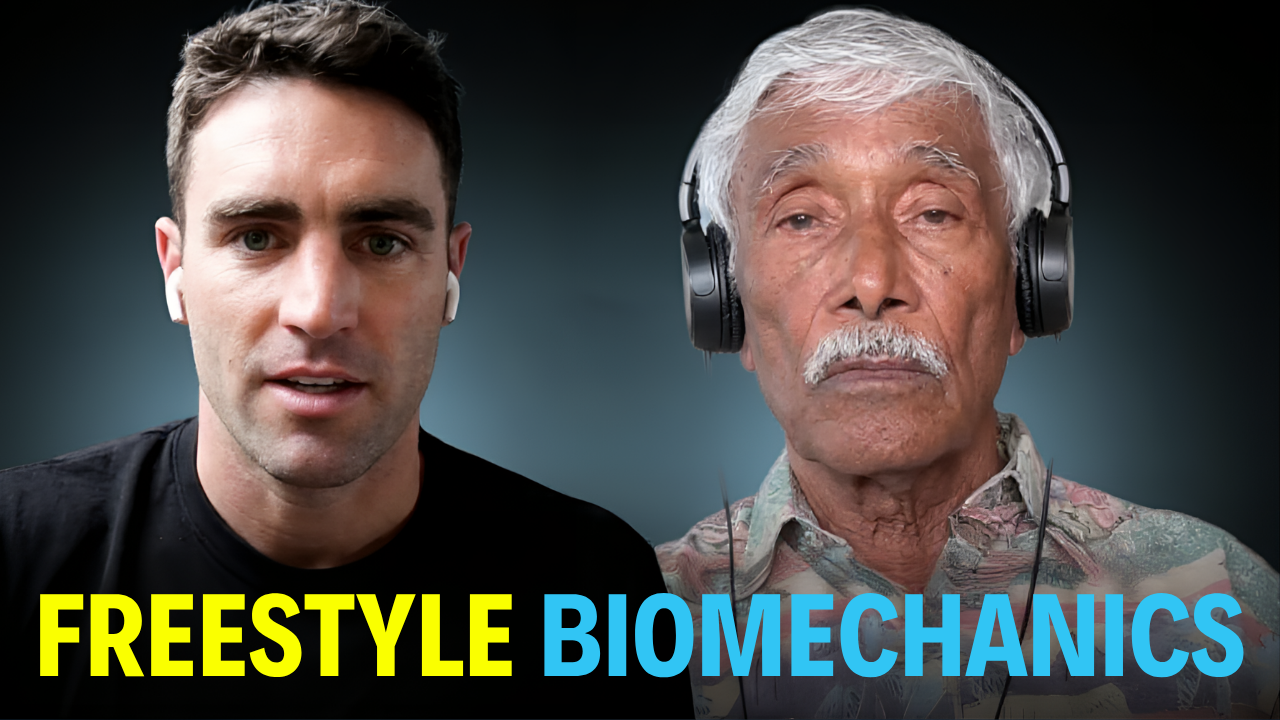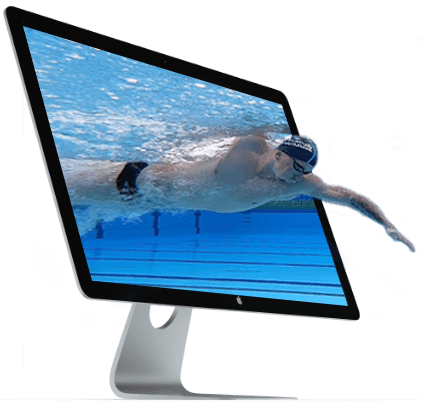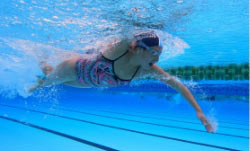








Trent Grimsey is an open water swimmer, he is an Australian team member and most notably he has recently broken the English Channel world record. He went 6 hours 55 minutes, breaking the old record by 2 minutes and 50 seconds. We chat to Trent about the Channel swim but also his training, technique and how he avoids injury doing so many km’s in the pool.
Keep up to date with Trent:
Website
Facebook
Twitter
Transcript
Read the full transcript
Welcome to another episode of the Effortless Swimming podcast. This episode we’ve got Trent Grimsey on a video call and Trent’s an open water swimmer. He’s an Australian team member and most notably he’s recently broken the English Channel World Record. So he went six hours 55 minutes breaking the old record by two minutes and 50 seconds. So we’re going to chat to Trent about the channel swim, but also going to talk to him about his training, technique, how he avoids injuries doing so many Ks in the pool. We’re going to talk about diet and wetsuits and open water swimming in general. So welcome to the call Trent. Hey, thank you very much and thanks for having me on the show. Let’s get into by starting with how you transition from pool swimming to open water swimming and why you made that move. Definitely. Look, I was a pool swimmer pretty much all my life until probably 2008 and I think there was I swam the Olympic trials for the 1500 and 2008 and I placed
third behind Grand Hacking and Craig Stevens in the 1500. I actually swam under the A qualifying time, but they only took the top two there. So that was quite frustrating for me. And I guess after that, I just I had a little bit of a break maybe a month off and just reassess things and math on swimming and just become an Olympic sport. So I was toying with the idea of making the switch from pool to open water swimming then and look, I thought I’ve got nothing to lose. I’d try it for 12 months. If I don’t like it, I can easily go back. Or if I like it, I’ll just stay doing open water and marathon swimming and look that 2009 was I guess my first year of really swimming. I was serious open water and I’ve got some really really good results. I want some really big races overseas and I want a silver medal at World Champs in the 25K. So I think it was probably after that that I decided marathon swimming was for me.
And if you look at your achievements or your achievements in races over the last couple years, there’s just it goes on for pages, the amount of races that you’ve placed in. So what’s your motivation behind doing so many races when there’s such big distances?
Look, I just hate not being the best at something. I figure if I’m going to do something, why not just give it 100% and just give it my all so I can be the best. It’s what motivates me is wanting to be the best and knowing I’ve got people chasing me, wanting to try and knock me off. And you’ve definitely got that now with the English Channel world record. Can you tell us a little bit about how that came about and what inspired you to set that goal of setting the channel record? Oh, definitely. Look, I think it was like back in 2009, I won my silver medal at World Championships and it was the first time I’d ever swam that distance 25 kilometers and I was probably on the plane on the way home. I remember thinking, wow, this is like, I mean,
I think like the longer the ultramarathons is probably my thing now. And I guess it was just the next step. It’s like every marathon swimmer’s dream. It’s not only to swim the English Channel, but to hold this record. So when you got home, I didn’t really know much about the English Channel. So I Googled as much information as I could about it. Then I found out you have to book a long time in advance. If you want a good tide, a good pilot, a good spot in the tide. So I remember I booked in 2009, then I booked it for September 2012. So only a couple of months ago.
And I mean, I just continued on with all my normal races and probably 12 months out from when I was meant to swim the channel. That’s when I really started to, I guess, knuckle down and swim longer kilometers, change my diet a little bit, tweak the small things I needed to tweak to swim a fast English Channel.
And so you said it three years out and then you got sick in 2010? Yeah, yes. And then so you came back from being sick and is that when you started to focus on it? Or was it sort of 12 months out? When did you start to train for the channel? Yeah, solely for the English Channel is probably after World Championships in 2011. Kind of everything I did, every race I did, I did it knowing I was going to swim from the English Channel in September. I actually left Australia two months before I swam the English Channel and I did a different marathon every weekend in a different country for the eight weeks leading up to when I swam the English Channel. And I think I did this to prepare my body because swimming fast marathons is not like running. You can’t just swim one off and expect to swim fast. So with swimming marathons, you needed to do quite a few.
Your body adjusts to them, it adapts to them. And these marathons I did, most of them were in cold water, specifically to get my body ready for the channel.
And so your training schedule leading up to the channel, was that how many sessions in the pool were you doing a week? Or in the open water? Yeah, leading up like six months out from the channel. I think I took it up to 11 sessions a week, three gym sessions and a hell of a lot of dry land.
I mean, it’s all about fitness really. The English Channel, you just need to be as fit as you can and hope for a good day. And with your sessions with a all of Robic Base, how many Ks are you getting up to a week? Yeah, I was doing probably anywhere between 80 and 90 kilometers a week, leading up to the channel, a few probably bigger than 90 kilometers.
But yeah, most of it was a Robic Base. We took quite a few of the sprint sessions out because we obviously I mean, don’t need when I’m swimming as like seven hour race, I obviously don’t need those sprint sessions. So yeah, we took them out and changed them with some of Robic sessions. Yeah. And now, so what’s your training for world championships next year? Yeah, that’s my big goal for next year world champs. I’ve obviously got a few races before then, like I’ve got the Australian Trials in February where they pick the team. So obviously I want to swim world there to swim the 5K, the 10K and the 25K. So we qualify in February for the events we want to swim in June. Yep. And so with your training now, is that training for the 10 or the 25K?
Yeah, well, swimming Australia don’t actually have a 25K at our nationals. So it’s a little bit ridiculous. So I’ve changed my training to swim a fast 10K. Like since I got back from the channel, I had a little bit of a break and everything we’ve done now is to prepare to swim a fast 10K. So we’ve put those sprint sessions back in. We’ve apt another gym session a week and I’m starting to trim down a lot more too. So it’s at our Australian nationals, we do swim the 5K and the 10K. Then out of those people that make the team, you need a top two both of those races. And then out of the people, the four people that are in that team, they give the 25K spot to those from us. Okay. Yep. So it’s all for the 10K. So now you’re doing so many Ks in the pool. How do you avoid injury?
How do I avoid injury?
Look, I’ve just got a really good physiotherapist, I think. I see him every week. I get a massage every week too. So I get a physio every week, massage every week. And I’ve got a personal trainer we do.
At the moment, we’re going through a strength phase, but it’s really good. You make sure I do all the machines, all my weights properly, proper technique and stuff like this. And to be honest, I’ve never had any bad shoulders that have kept me from not swimming or anything like that. I’ve been really fortunate with injuries today. So hopefully I can keep it that way. Yeah. And so with your technique, what are the things that you focus on when you’re in the pool? With my technique? Obviously doing math on swimming and stuff, it’s good to be efficient. But probably a lot of people that have seen me swim, I’m not super efficient. I’ve got a pretty high stroke rate.
But I think it’s all about rhythm, to be honest. I’m a rhythmic swimmer. I swim fast. When I’m in good rhythm, I’ve got good rhythm. And so that’s something I really work on. It’s not so much stroke, it’s more just my rhythm. And how do you go about finding a good rhythm for yourself?
Look, again, it’s just something, just practice and training.
I mean, you obviously have that different rhythm for different speeds you’re doing. And just working those different speeds and training. And with your kick, do you focus much on your kick being a math swimmer? Or do you focus more on the pool?
With my kick, we do a little bit of kick and training. We don’t do too much. I’m not a great kicker. I mean, I’m okay. I can kick like 135 cycles probably the fastest. I can kick per 100.
But I mean, we do a little bit. We do enough to, that if I ever come down to a sprint finish, I’ve got my kick there. But at the end of the day, it’s, I don’t think kicks, it’s not one of the most important things being a marathon swimmer. Yeah, yeah, absolutely. And so with your training sets, what would you say one of the toughest sets you’ve done in training is? One of the toughest sessions. Remember, I was leading up to the channel, it was probably four months before I was swimming in this channel. I did 100, 150s on one 145 cycle. So that’s one 10 pace, 15k at one 10 pace. So that was tough. Well, I think that that’s that tops off the toughest session that we’ve had on this podcast. That’s for sure. Okay. Speaking to Ollie Wilkinson, who’s also done the channel and he’s done the New York, the Manhattan swim.
He quite often does 10 month thousands, which is probably pretty common for marathon swimmers. But yeah, that’s that’s a quick pace. So that’s awesome.
And now in terms of race strategy for the longer distance stuff. So for the, you know, anything over 20ks, how do you pace one of those races? Yeah, look, all those races, like the longer races, it’s all just tactics, to be honest.
It’s it’s kind of the first, if you’re swimming a 20 kilometer race, the first like two thirds of the race, it’s just it’s swimming easy, pretty much just staying in the pack, seeing what the pack’s going to do, seeing who’s trying to break away. Then it’s the last, probably third of the race. It’s just kind of go balls out and give it everything. And I hope no one else can keep up with you. So yeah, these longer races, it’s all all tactical. If someone breaks away, you try and see who it is. If it’s someone you think’s not going to be a threat, you don’t bother chasing them. So you know, the pack will catch them. But if it’s someone who’s going to be a threat, you’ve obviously got to work work hard to get them. So look, every race is different, but it’s it’s most of the time. It’s it’s two thirds of the race is probably very easy. I could swim back stroke or breaststroke and still be in the pack.
And it’s the last last kind of third of the race. It’s it’s it’s really fast. And so do you look to draft a lot of the time? Or do you sort of take it in turns if there’s a big enough pack? Oh, it just depends if the people that are in the pack, if they’re your mates and they want to work with you, if they want to work together, yeah, we’ll take turns. But if it’s people you don’t know and no one else is willing to pull their way, I’m not going to pull my way. I’ll just sit at the back of the pack and let someone else do all the work. So it’s a bit like cycling. They’ll the pack exactly like cycling. Yeah. Yeah. And then what about the shorter stuff? So if you’re doing two, three kilometer races, how do you go about pacing those? Do you do a similar thing or you just go for it from the start?
Yeah. I mean, it depends on the course and conditions and those little races from a favorite. I love seeing those two and three races.
They’ve kind of my bread and butter up here in Queensland. That’s how I make most money on the weekends doing those type of races. But look, it’s every race is different. It depends what competitors in the race. You can’t swim. If you know you’ve got a competitor in the race and you know his weaknesses, you can’t swim to exploit his weaknesses. Yeah. Yeah. Well, one of those competitors is your brother. You come from a pretty amazing swimming family. So you obviously know your brother’s back to the front when you’re racing those guys.
Yeah, definitely. But if I never win a race, I want my brother to win a race while we’re competitors. I still get really excited when he swims well too. So it’s not overly competitive with my brothers and I. So your work as a team, that’s pretty awesome. And now with your diet, what’s your sort of diet look like each day? What kind of foods do you avoid? What do you like to eat? Look, honestly, like the amount of kilometres I swim, I can pretty much get away with eating anything. But to be honest, from Monday to Friday, I try and eat as healthy as I can. And then on the weekends, I just eat whatever I want normally. It’s like a bit of takeaway, a lot of takeaway on the weekends. But Monday to Friday, it’s normally pretty healthy, like lots of vegetables, lots of fruit.
There’ll be no real takeaway from Monday to Friday. But yeah, on the weekends, I can eat whatever I want. That’s pretty much what I stick to. Yeah, that’s good. Eat well during the week and then reward yourself on the weekend. Definitely, definitely. And now with your wetsuits, what do you do? Do you wear a sleeveless or a sleeved? And what sort of things do you need in a wetsuit for it to be comfortable for you? Yeah, look, I honestly don’t do many races in a wetsuit. This New Zealand series I’ve been doing, they’re all wetsuit races. So I’ve had to start wearing a wetsuit for these races. And what I prefer to swim in a sleeveless wetsuit, I think it is a lot faster swimming with sleeves.
But look, it’s with a wetsuit, I think, honestly, just the more often you wear one, the more comfortable you’re going to be in one. I absolutely hate wearing them. I know I don’t wear them enough. But in training, leading up to a race, I wear maybe one or two times a couple of days before I go over and race in it. But yeah, if I had my way, no one would wear a wetsuit. Especially coming from Queensland, it’s not like down here in Melbourne where every race is pretty much with a wetsuit. Oh yeah, no races in Queensland. You’re allowed to wear a wetsuit. Yeah, it’d be much too hot. And do you change a technique at all when you’re wearing a wetsuit?
Oh, I try not to. Obviously, it’s a lot higher in the water. And I mean, it makes me kick a little bit more because my legs aren’t down so much. But I haven’t really noticed too much of a change, to be honest. Yep. Yep. And well, you’re a professional marathonist, so you’ve got a number of sponsors that help you out. So you can continue to train full-time and do those sorts of things. So who are the sponsors that help you out with that? Oh, definitely. I hope I don’t forget any of that. It’s Book Finis. My main swimsuit sponsor. They’ve been great to me these last 12 months. Strathbind Sport and Physiokare. The College of Health and Fitness. Pre-Max.
Putting you under the pump now. Yeah, look, it’s going to be awkward if I do forget any. Look, they’re my main ones anyway.
Oh, that’s great. And where can people find out more about you and keep track of your progress with your swimming? Oh, definitely. Look, I’ve got a website. It’s www.trendgrimsy.com.
I put all my race results. I keep a blog. I’ve got links to my Facebook and my Twitter on that website as well. So yeah, log on to my website and you’ll find everything. Yeah, and when people go in there, they’ll see the huge amount of races that you’ve done and it just keeps getting updated weekly. So that’s, it’s awesome, the amount of races that you’re doing. So yeah, so people that listen to this jump on to www.trendgrimsy.com because there’s a lot of good stuff on there. So thanks for being on the podcast this week, Trent. And best of luck in February for the national championships and then in June with the World Champs. Okay, look, thanks very much and thanks for taking the time to talk to me. My pleasure. Thanks again. Yeah, bye.