








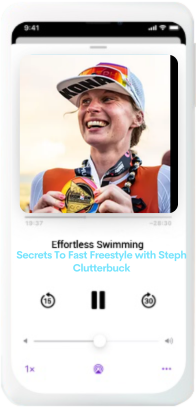
In this episode, we sit down with professional triathlete Steph Clutterbuck to break down the real secrets behind efficient freestyle swimming. Instead of grinding harder in the water, Steph explains how better technique—especially rotation, body position, and connection—can dramatically improve your speed.
We dive into why many swimmers struggle with a flat, disconnected stroke and how that leads to wasted energy. Steph shares practical tips on how to stay long in the water, engage your core, and create a smoother, more powerful stroke.
If you’re stuck at a plateau or feel like swimming faster requires exhausting effort, this episode will completely change your approach.
0:11 – Introduction Overview of freestyle technique and common mistakes swimmers make
0:20 – Why swimmers struggle to get faster.
1:10 – The problem with swimming “flat”.
2:10 – Why a flat stroke wastes energy.
3:15 – Importance of body rotation.
4:20 – Timing and coordination.
5:30 – Catch vs whole stroke.
6:40 – Staying long in the water.
7:45 – Using your core in freestyle.
9:00 – Common beginner mistakes recap.
10:10 – How to swim faster with less effort?
Transform your freestyle to be effortless and smooth with online video analysis:
https://effortlessswimming.com/courses-membership/
Try the new Nanoclear Anti-fog Goggles: https://bit.ly/nanocleargoggles
Follow Steph on Instagram: https://www.instagram.com/stephclutterbuck/
Transcript
Read the full transcript
Welcome to the Effortless Swimming Podcast to show that help swimmers and triathletes love the water, become a better swimmer and live a better life. Here’s your host, Brenton Ford.
A few years ago, I came across a clip of Steph clatter back in the water that completely stopped my scroll. At the time, her swim videos were being shared and ripped off by hundreds of other accounts because of how easy she made it look. Fast forward to today, and she’s not just a viral highlight, she’s a pro triathlete who consistently clocks top 10 swim splits on the world stage. Today, we’re going beyond the Instagram reels to break down the actual mechanics of that stroke. I started swimming. I think I must have been three or four years old. I joined my first swimming club when I was seven or eight years old and started racing when I was nine or 10 years old. So for me, it’s been a very, very long time staring at the black line at the bottom of the pool. But I’ve learned a huge amount and Stephanie shaped me of who I am today. I started to think about my technique. Honestly, probably only as an adult. Like I remember when I had a, I had like a
10 year period where I didn’t swim. So I stopped swimming when I was 19 and then started back up again. Oh, maybe it was less than that. Maybe it was six years when I was training for a triathlon. When I was younger, it was definitely technique was forced upon me by coaches. So I had a coach that would walk down poolside with a wooden stick and would hit your head if it was too high, would hit your bum if it was too high. Like it was, I don’t want to say hands on because that sounds really weird, but it was quite physical coaching to help you understand body movement and body position. And as I got older and started to understand how to move my body to get a result, that’s when I was able to actually think about technique in a way that was a little bit more than, oh, I need to put my head down or pick my head up. And certainly now as a triathlete where I’m swimming less and I need to get more and more out of my stroke and I’m swimming open
water rather than in a pool. It’s added in a whole another layer of complexity that I’ve had to dial into how I’m thinking about my stroke. In terms of head position, I seem to decide to change it pretty much every session. So in the pool, I can get away with having my head slightly lower because I have quite high body positions. So my body stays quite high. My bum is quite high out of the water. So I don’t need to keep my head high necessarily. Like it kind of balances out. You add in the wetsuit and it almost brings my legs too high and it throws off how I’m used to swimming. So I have to have my head a little bit higher when I’m open water just to try and bring my bum down a little bit more. So it’s different swimming with a wetsuit than swimming with a swimming costume. And I probably have a different challenge than a lot of age groupers where they enjoy the wetsuit because it keeps their legs up. Whereas for
me, I kind of want them to drop down a little bit more. I like to think of myself as a log when I’m in the water and a log that is able to roll with the flow because rotation is obviously a huge part of the swimming stroke. So it’s all very well staying long and tall in the water. But if you can’t hold that as your shoulders and your hips are rotating, it’s kind of useless. So it’s from like the base of my skull all the way down through to my toes. I want to keep long but stay connected so that as I’m driving my hips to force the rotation, I’m able to kind of breathe and move my head as I need to without disrupting the flow at all, just like a log that is rotating in the water. So the role of kick for me is basically non-existent. I have never been a kicker. I was a back stroker. So it was never really part of our stroke. For back stroke for me, it was always about balance and that absolutely translates to freestyle as
well. So I lean into a two-beat or a four-beat kick if I absolutely have to. But I would much rather kick less, but I have quite big kicks because they’re there to stabilise me. My typical breathing pattern is two or four. So in a race, it can be, well, it’s usually two, two, four and siting on the four. Yeah, I just rotate to the right and I breathe every two or four. I try not to search for the breath when I’m breathing. So I really want to make sure that my head is in line with my body and I’m breathing into the pocket. I don’t want my head to be causing any sort of ripple through the rest of my stroke. So it just kind of shifts to the side of my shoulder rotation before moving back and doesn’t come out of the water too much. So I absolutely, like if I can get away with it, I’ll have no eyes out of the water. Like it will just be my mouth kind of poking out and coming in. With open water, it’s slightly more difficult
because you tend to have a little bit kind of more chop to contend with and you have people around you swimming. So the breath might look a little bit bigger, but as much as possible, it’s the smallest breath that I can get away with. So my stroke is long. It is long and it’s actually pretty slow and I think that’s just come from years of being in the pool with perfect water conditions. So I’m able to keep it long and stay really quite efficient with it. And I keep my hands really relaxed. I think that’s really important. So I will absolutely have space between my fingers. Quite often, my hands will be slightly kind of bent as well. Like it’s just really, really relaxed. And it’s a change that I’ve been trying to make for open water is to actually increase my cadence a little bit. And that’s not by ripping my arms through the water. It’s just by reducing the micro pauses that I’ve developed through years of swimming in the pool.
For the catch in the pool, I try not to think of them as a pool. I like to feel as though my hand is static and I’ve got like a nice bend in my elbow and I feel strong and powerful because water doesn’t respond like air and you can’t rip your hand through if you want to swim faster. Like you have to be able to keep your shoulder stable, your elbow stable, your hand nice and locked to then utilize the force and almost make the water solid underneath your hand and like lock all the molecules together. So that’s how I like to think about it. It becomes more and more challenging the faster that you swim and equally the faster that your arm turn over is.
My recovery over the top of the water is absolutely everything you’re told not to do when you’re a kid. I remember it being drilled into me that you need to have a high elbow, low wrist, strag your fingers along. My hand is up in the sky. Like I have a really loose recovery. I think it’s the only way to describe it. So obviously my elbows stay high, but my lower arm is absolutely higher than my elbow. And for me, it actually just, it creates a lot of freedom in the shoulders rather than forcing an elbow bend when one doesn’t want to be there. So for me, the finish of my stroke is really important and I like to feel as though I am really like intentionally ending the stroke out by my hip or like the top of my quad. And if I do that properly, it almost like flings my arm around. So then I just let it carry on. And it’s efficient for me. It works for me. And I’m not intentionally swimming with relatively straight arms,
but it’s just been an outcome of the pull that I’ve developed. Swimming out of water is something I actually still, I don’t wanna say struggle with because that makes it a thing, but it’s something that I’m definitely not comfortable with. And my speed just doesn’t translate or isn’t yet translating from pool swimming to open water. The primary focus has been increasing the cadence and recently the change in head position just to try and actually be able to kick my legs a little bit more because I default into like solid, steady swimming, but it’s basically I’m on pace for a half distance, which it’s not the end of the world, but it’s not ideal. Whereas if I’m able to feel like I can utilize my legs a little bit more by bringing my bum down, then hopefully that will have a positive impact and I’ll be able to translate pool to open water. I think the biggest lesson that I have come to realize that I learn as a youngster
because it’s difficult when you learn, when you learn to swim and you learn to race at such a young age, they become things that are just ingrained in who you are and how you act with water. It can be the smallest things that you don’t realize, like if you don’t have pointed feet, then you are literally anchoring yourself down to the bottom of the pool. And if you’re swimming with fingers together, that means that none of this is capturing any water because there’s too much tension. So all of those little things about how we can interact with water to ensure that we are able to utilize the limbs that should not be in water to the best effect has been quite revolutionary, I think, as an adult. If I could do more, I would. I live a fair drive away from a pool, so I like to swim four times a week. Four sessions a week, they’re all about 5K in length. Swimming is also really important for me in terms of the postural orthostatic tachycardia syndrome regulation,
which I’ve been diagnosed with, so it helps keep my nervous system in theory a little bit more stable. And I like to have these 5K swims. The majority of it will be easy. And if I am swimming at speed, I’m not really searching for it. Like my favorite session to do is tempo threshold, like big chunks, like 400, 300, 200, 100, twice, where you get really uncomfortable really fast and you just kind of hang on for dear life, but you’re not ever hitting VO2. So I’ll have probably two solely aerobic swims a week, one that is pool focused and then one that is a session of intensity. So whether that is hard 50s or the kind of tempo threshold work, it’s just got a bit more of a focus to it. But actually the majority of my swimming is, it’s like aerobic, but leaning on easy. I think the biggest thing that I’m working through at the moment is, like, it’s not really a mistake, but I’m having these like, and it’s not anxiety attacks,
but I’m hyperventilating about three minutes into the swim and I’m having to stop and grab a paddleboard, which is weird and unusual because I have no anxiety around swimming, but I just calm my breathing and carry on. So these hour days are so long in the mid and long distance triathlon space that these mistakes feel so much less of a big deal than when your race is two minutes and everything has to be absolutely perfect and there’s no space for it, which for me has been a huge point of personal growth. Like I don’t have to be perfect anymore and actually if you just expect not to be perfect, then you’re probably gonna have a better day because you’re gonna stress way less about the stuff that’s going wrong. General advice I give out swimming is learn how to relax, properly relax in the water and understand what it’s like to do a somersault in the water and dive down to the bottom and swim underwater without moving, not doing front crawl,
just understand how to exist in water and then also find your balance points. So for me, my chest is a huge one, like you fill your lungs with air and it becomes the point at which that your body can move around with your head and your legs and I think it’s one of the reasons that I’m able to keep my legs so high is I know how to utilize this kind of center piece of my body and a lot of people don’t. Like if you fill your lungs with air, it’s gonna float, it’s like a life jacket. So hold the air there and also don’t rush your breathing. So you don’t have to breathe in and out while your head is out the water. You can breathe in while your mouth is out the water and then let the air out slowly as your head is under the water just to be ready to breathe again. So slow everything down, relax everything and the water will feel a lot less intimidating. Thanks for listening to the Effortless Swimming Podcast. If you’d like us to help you become
a faster, more efficient swimmer, go to www.effortlesswimming.com.