







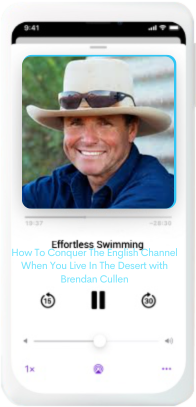
In this episode, Brendan Cullen recounts his remarkable transformation from a non-swimmer to successfully completing the demanding English Channel swim. He reflects on how mental resilience, disciplined training, and a strong sense of community support helped him overcome one of the world’s toughest endurance challenges. Brendan also shares how his rural upbringing shaped his mindset, and how personal motivation and strategic preparation played key roles in pushing beyond perceived limits.
00:50 Introduction to Brendan Cullen: The Desert Swimmer
01:50 Brendan’s Unique Background and Journey to Swimming
05:27 The Decision to Swim the English Channel
06:55 Training and Preparation for the Channel Swim
10:48 The Day of the English Channel Swim
24:17 Reflections on the Journey and Lessons Learned
24:40 The Impact of Open Water Swimming on Life
30:37 The Release of Brendan’s Book: The Desert Swimmer
Transform your freestyle to be effortless and smooth with online video analysis:
https://effortlessswimming.com/courses-membership/
Try the new Nanoclear Anti-fog Goggles: https://bit.ly/nanocleargoggles
Check out Brendan’s website: https://www.brendancullen.com.au/
Instagram: https://www.instagram.com/the.desert.swimmer/
Transcript
Read the full transcript
it would probably come after the swim because I always had my why and I just knew I had to get there. I understood the support before I left but not to the extent once I finished and it was extraordinary. But I read two books, The Happiest Man on Earth with Jet Eddie Jakku and The Tattooers of Auschwitz, both Holocaust stories. I’m not a reader as a rule of thumb but I just can’t believe what they had gone through, what they were put through and I remember standing on the beach in Dover before the swim and thinking about that and I’m thinking I’m not forced to be here.
Welcome to the Effortless Swimming Podcast to show that help swimmers and triathletes love the water, become a better swimmer and live a better life. Here’s your host, Brenton Ford.
Welcome to the Effortless Swimming Podcast. My guest today is Brendan Cullen, also known as the Desert Swimmer because recently, well, 2022 successfully completed the English Channel without coming from much of a swimming background and living a long way from the nearest pool, a long way from the nearest beach, but you’re still able to successfully swim the English Channel. So I want to dig into a bit of your story, how that came to be and then how you managed to successfully complete that swim because when I look at the English Channel, I think that seems incredibly hard. I don’t know if I could do it yet. Without much experience, you’re able to have a successful swim. So firstly, Brendan, welcome to the podcast. Yeah, good on you. Thanks very much, Brendan. Lovely to chat with you, mate. So tell me a bit about your background in swimming and where you live because I think
it’s not the swimmer’s capital, the swimming hub of Australia where you are at the moment. Yeah, look, I learned to swim very young and then I didn’t swim at all. So, you know, basically five or six years of age and then stopped swimming from that point until about 42. So and swimming has never been my sport. It’s always been running. But look, I live on a Shevan cattle station about 60 kilometres outside of Broken Hill and I’ve been managing properties for the best part of 20 years. And prior to that, I worked on my parents’ place. So I’ve been chasing sheep and cattle since I was 16 and I’m 52 now.
Back in 2015, I was watching my brother and water swim and travelled from Broken Hill to Sydney and I thought I’ve got to have a piece of that. And anyway, I decided to join up with the Broken Hill Aquatic Swim Club in town and that was the start of my swing journey. And I sort of haven’t held back since. So I got to, I finally, look, I went to the pool. I spoke to the coach and I said, any chance I can swim with you guys? He said, yep, no worries. And the oldest person there was about 15. I thought I was going into a master’s clinic and he said, jump in, have a swim. So I did and he said, mate, you need a lot of work. So and he was right. So and from that point on, I just started swimming. And for two reasons, it was good for my head space. And it was a little bit different than running, of course. And secondly, it just gave me the opportunity to catch up with, you know, friends and my brother and have that different conversation, you know, as opposed to talking about sheep and cows and
the weather and, you know, I like to bum the, the open water swimming community and the swimming community in general, such a special place to be.
And being so far from the coast, how did you develop those relationships with the open water swimming community? Yeah, it’s a good question, actually. I did a, I used to travel down to Melbourne a bit. My in-laws are down there and my, I went to the Brighton Bars, actually, and there was a English Channel Qualifier down there. And there was a brochure on the wall, an eight hour, a six hour and a two hour. It was about 87 kilos at the time. And I looked at it and I thought I might have a crack at that. And the fellow who was running the Qualifier was Mike, the tractor Gregory. And I just said to him, is there any chance I can come in and do the two hour? And he said, yeah, mate, no worries. And the water had to be 16 degrees and less. And I said, come down at 5.30 and have a swim. And I said, that’s in the dark, mate. He goes, yeah, so I’m swimming in the dark. So I rocked up about half past seven. And he said, oh, it’s good to see you here.
So I jumped in and I swam for a couple of hours and, and finished my two hours. And I was frozen to the core. And as I was getting out, Mike looked at, looked at me from above. And he said, oh, I’ll jump in with you for half an hour. And I knew his credentials and knew how good he was. And so he got another half an hour out of me. And I was even more frozen to the core. But that sort of started our relationship as a, as a coach as a friend. And my open water swimming really, I mean, that’s when it started to get serious. I find it so funny that you saw a brochure on the wall and thought, oh, that’s a good idea to spend a couple of hours in the cold without, yeah, just on a whim. That’s
weird, bloody weird, mate. But what a, what an interesting, I mean, guess what a, what a journey that’s taken you on from, from that point, because was that the point that then you decided or things came about where you decided, okay, the English Channel is something that I might actually target here. Yeah, well, fairly enough, probably not. It was just, I think, just that relationship with Mike Gregory just blossomed over the years. And that was sort of around about 2017, 18 somewhere in there. I’ll take a step back. 2015 I was diagnosed with depression. And I need to change my life prior to people before 2015, I probably would have said no to most things. But with the late temperature, what did it get down to in winter? Nine degrees. So yeah, that was cold enough.
You know, I remember doing a swim down in Victoria when it was cold and Mike looked at me and he said, mate, you got to put a bit of weight on. So I went from 87 kilos to 97, you know, before the channel swim and you know, to protect your organs and just look after yourself a bit. And funnily enough, I loved it, you know, putting on weight and you know, getting fat and fast at the same time. You know, it was, it was a thing for like normally, if you’re exercising, you’re trying to strip it down with open water swimming, certainly for the channel. It was important to put a few kilos on and I actually enjoyed that side of it. But also had a nice bath here I used to jump in and, you know, regularly get in there and sort of set at about five degrees and get in between 10 and 20 minutes, just depending on the time and what I could handle. And I know the channel was never going to be at five, but you know, you just make it that little bit tougher for yourself.
You know, 18 doesn’t feel so bad for a long period of time. That was my theory anyway. What’s the special diet to put on 10 kilos? Just eat whatever is in front of you, mate.
I actually hired a multi-sport nutrition lady up in Queensland. She was incredible because I think one of the things for me was my lack of knowledge around feeding and, you know, energy-based foods and that type of thing. So for me, that was super important. I just felt quite lost in that side of things. She was great. Christy Robson, her name is, and she just set a guide for me and I sort of followed it mostly. But yeah, I had a lot of ice cream, you know, double bowls of pasta, whatever I could get in my gullet. Because one of the things in my role as a pastoral sort of farmer is that, you know, you’re on your feet all day and you just don’t factor that into your, I suppose, your sporting life. And so, you know, not all days are, you know, physically difficult, but some days are and then you add that swimming component or running component on top of it and you’re burning up so many calories. So, yeah. But yeah,
eating for me, I mean, pretty healthily, just, you know, your normal veg and your meat and stuff like that and pasta. Yeah. Yeah. Well, that’s, I mean, but yeah, being out on the farm all day, you would just, you would need to be eating so much when you’re including the swimming as well. So, I mean, there’s such a thing as farmer’s strength. Do you feel like, I mean, I guess when you are living that, you probably don’t notice it as much, but do you feel like the physicality of what you do for work has helped with the swimming? There’s no doubt about that. Certainly a core strength. There’s, you know, just your lifting most of your life and just using your muscles most of your life. But I will say one thing, when I started swimming, I was activating muscles I’d never used before, you know, and, you know, there was certainly fatigue there. So, I suppose, I suppose I sort of go hand in glove once you start swimming
and you’re still working on the property. You do become reasonably strong, but definitely helps your core working on a farm. But yeah, I just remember, you know, through here, my lats, you know, through my chest, I was burning up big time when I first started. But, you know, naturally swimming built muscle through my chest and shoulders and my arms also. So, it felt good. It felt good. And you, when it came to the
swim itself, it was a three year build up towards the swim from the moment that you’d sort of decided to do it. Yeah. So, we started in 2019 and we were in the water 2022. It was close to go in 2021, but COVID got in the road and we decided to call it.
Look, it was probably a blessing in disguise for me because it gave me an extra 12 months to train. But all I could think of at the time was, jeez, I’ve got to get through another winter. No. And so, I’m glad that went, you know, went by. So, you know, by the time I got to England, you know, I think I was more than ready. But if you’ve never done this sort of thing before, you’re always wondering if you’re doing enough, certainly from my perspective. And, you know, Mike was setting me,
you know, a swimming plan for the week and, you know, what that looks like. And if I didn’t meet the kilometers I used to sort of think, jeez, that’s going to let me down. And he’d just say, mate, you’re doing enough, you’re doing enough. And then if I found a day where I could get into the water and he’d set me five Ks, I’d do eight just to make up for those lost kilometers. And probably more so to help me mentally as opposed to physically,
which is very important. I mean, you need to have your eye before you start something like this. And literally my eye was just, I’ve got to get across the other side. I want to see if I can nail this. And so it was always sitting there. So once you make that decision, then you have to fully commit. And yeah, through Mike’s tutoring and training and me just being the student, I gave him all of me. He had total control, both through the training process and during the swim. And it’s a matter of allowing those people to
you know, come into your life and give you some direction. And without fighting it, just they asked you to do something, go and do it. Anyway, that was my philosophy. And that that wife of you of just wanting to prove to yourself that, yeah, or challenge yourself that you could get to the other side, where does that come from for you? And is that something that you kind of see with other areas of your life? Yeah, yeah, absolutely. I’ve always been stubborn and I’ve always ran and
I don’t know. There’s something about distance, natural endorphins through sport and never giving up. And I always said that if I had a crack at the channel, you would have to pull me out the water because I’m not going to get out voluntarily. Now, you know, through my work life, I’ve had quite a few challenges as you do in the rural industry with droughts and floods and muddy fires. And you know, there are good times, mind you, but you can go through some pretty ordinary experiences and you sort of bring that into your life. And I think that creates a steely result. But it can become an issue if you allow things to get on top of you. So which I did at one point, I’ve got a long rap sheet. And but I’m hard to stop if I if I put my mind to something, you know, and look failure is failure or if you don’t make it so be it. But for me, not giving something ago would chew at me. You know, it would sit with me. So
it’s a matter of just making the call and getting stuck into it and seeing where you end up. So my why was literally, right, I’ll see if I can get to the other side. It was really that simple. And let’s let’s go to the day itself. So it was quite a long day out with with some strong currents and and much longer distance than the physical distance itself. So take us through the English Channel swim. Yeah, it was quite extraordinary. I picked a team that was going to be there for me if I didn’t make it. Some good mates and Mike, my coach and my oldest daughter, my wife and my sister-in-law were back on the back in the harbor when we started the swim. Sea Leopard Charter were taking me across the channel and we basically come out to the harbor. We parked about 300-400 meters from the beach. I just did my goggles, jumped in, swam to the beach and got out onto the beach. And you have to be away from water before you
start and literally put my hand up and said, all right, I’m right to go and let’s go. And they blew the siren and started swimming. And it was quite rough, quite windy at the start. And I thought, shit, this is going to be long. It’s going to be a long journey. And
swam up to the port side of the boat and I was getting flogged up a bit. And after about an hour, hour and a half, I come around to the starboard site just away from the wind. And there was actually a couple of boats there at the time that actually turned around and went back to the harbor. I didn’t know that, of course. And so I was getting fed every half hour. And that was, I’d have goo, baby food, ginger tea with honey, flat coke. I mean, that’s just powerful stuff. That is stamina, gatterade, whatever I could get in my body that had a bunch of energy in it. But once again, I gave myself over completely to my team because they were the only ones that were going to get me across there. And I was in their capable hands. And in fact, I remember the captain cooking a feed of bacon and eggs on the boat. And he washed the bloody frying pan out in front of my nose so I could just smell, I could smell the bacon eggs in the water.
That’s just cruel. Anyway, swimming along, I got to about the eight hour mark, I think, I had to do an eight hour qualifier. I had a rough idea how long I’d been in the water, but I had no idea how far or how far France was away. And kept swimming. And I reckon about the 10-12 hour mark in there, I looked up and I could see France. And I just, I couldn’t believe what I was looking at. And I hear this voice from the boat, put your bloody head down and keep swimming. And I remember swimming for over 10 minutes. And I looked up again and put your F and head down, you know, because what, you know, one of the things is the landmass doesn’t get any closer, you know, you’re still a fair way away. Interestingly enough, also, as I rarely spoke, hardly spoke at all. And I was getting fed with a lanyard and a, you know, a bottle, about 300 mils of fluid and whatnot, each 30 minutes.
Anyway, sun was going down. And I was looking over my right shoulder and it was starting to disappear. So I changed from UV goggles into clear. That was a battle I must admit, you know, just floating in the water because I don’t float naturally and put the light on. And I started swimming next to the boat and I always imagined on these boats that they have these huge bull lights that had shined out and open up the side of the, you know, the ocean with a big light. Well, in this case, it wasn’t like that. And so you sort of feel when you’re swimming in the dark that you’re actually drifting out of the light a bit. And I remember a few times that the boat was getting away from me and I was thinking, oh, this doesn’t feel good. It just didn’t feel right. And about the, about three hours out, I started to get crook. I remember just remembering my nose filling up with mark and all the rest of it. And then
my groin started playing up. And, you know, there was a few things going on, but they were counting my strokes from the time I started to basically the time we got towards the end. And my stroke rate didn’t change from the time I started right through. It wasn’t effective, though. It wasn’t. There’s no way to be effective. I remember my coach saying to me, you know, push, push, you’ve got to push. And he always said to me, yeah, there’ll be a stage in the swim where you really need to dig deep. So I did, and I did that for about an hour, hour and a half. I was probably swimming at about 65%. And then I upped it to about 75 at a guess. And I thought, I can’t sustain this. And I knew in myself that I was blowing up. And anyway, I got caught in what they call the Channel Swimmers’ Graveyard. The Channel Swimmers’ Graveyard is, you know, basically you get close to France and you’re trying to swim towards the nearest
point, Cap Grinne. And you get caught up in these rips and then they, they spear back out up towards Belgium somewhere. I had no idea what was going on, but they saw one of the buoys in the water just slapping up and down. They actually thought it was a shark. And it was just the, the size of the rip that was going through. Anyway, unbeknownst to me, I just kept poking along.
And I remember, I remember looking at Mike and I’m thinking, they’re doing a lot of rummaging around. I’m a Collingwood supporter and Mike’s a Carlton Football Club supporter. He’s rummaging around. And next thing I look at him and he’s got this, got this Carlton Football Club jersey on. And so I’ve looked at it and I’ve given him the bird from the water and they, they wanted a reaction out of me because I basically never spiked. So Mike just said, yeah, you know, he’s going all right. And anyway, getting towards the end of the swim and once again, I had no idea where I was at. He called last feed. And he’d always said to me, he said, you know, when you hear last feed, that’s the last feed before he hit France. And there’s footage of me looking at him because I had blue tack in my ears. I couldn’t quite hear what he said. And I was looking at him and I thought, this is the last feed. It was a surreal feeling. And I was pretty busted up at that point.
Mike stripped off and jumped in the water with me. Part of the CSA rules are, is that you can jump in with a swimmer, but you can’t swim next to him or in front of him. You’ve got to sit behind him. And he was swimming behind me and Sea Leopard was shining the light towards France that was on. And I swam for about 20 minutes to half an hour once he called that last feed. And I started to need like another feed. And so I had no idea what was going on because pitch black. And I said to Mike, I’ve got to go in for a feed, mate. And he said, keep swimming towards the light. I said, no, mate, I need a feed. And he said, just keep swimming, mate. And right, I, no worries. So I just kept swimming and
and then this amazing thing happened to me. My left fingers scraped through the sands of France. And I got the biggest shock in the world because I wasn’t ready or prepared for that. I didn’t know what that was going to be like or whether I’d actually make it. And then he yelled out to me, mate, stand up, stand up and get out. And I thought, standing up is going to be interesting. Anyway, I stood up and literally walked out and got clear of the water, put my hand up and I blew the siren at 3am in the morning. And 17 hours exactly and covered a distance of 64 kilometres. Yeah. And we embraced and it was a surreal experience. It was amazing. And then I just had this brain thought. I thought, I’ve got to go and get some pebbles for my kids. So I started rummaging around on the sands of France looking for bloody pebbles. The things you do after 17 hours in cold water, and Mike said, you’ve lost the plot, mate. He’s chasing me around for five minutes.
And he got me back onto the boat eventually and got back on the sea leper charter. And then they basically stripped me down, put some warm clothes on, tucked me into a bean bag. And I woke up at 6am in the morning back in Tobarba. It was just a hell of an experience. Three years of training and managed to make it was extraordinary. They say that it’s about the journey, not the destination, but was there any particular moment within that build up or in that swim where you look back and it’s the most,
the thing that you appreciate the most about that whole experience for you? It would probably come after the swim because I always had my way and I just knew I had to get there. I understood the support before I left, but not to the extent once I’ve finished. And it was extraordinary. But I read two books, The Happiest Man on Earth, with Jet Eddie Chacoux and The Tattooers of Auschwitz, both Holocaust stories. I’m not a reader as a rule of thumb, but I just can’t believe what they had gone through, what they were put through. And I remember standing on the beach in Dover before the swim and thinking about that. And I’m thinking I’m not forced to be here. I’ve chose to be here. And then I also thought about some of the big days that I’ve had or weeks that I’ve had working in some pretty trying conditions. And I just thought to myself, let’s just go to work. It’s only going to be a few hours. Let’s just go to work. So that’s what was rattling around
in my head. And really that, they were the stories I kept telling myself.
I was told that counting might be good for you, count from 100 and then 100 back to one. I tried that and I failed dismally at that. I can’t do this. So yeah, but once the swim was over, I couldn’t believe the support and around that. And I found it really hard to understand all that for quite a while. But I do understand now where I live, where I come from, what I’d achieve. But it was a really good new story coming out of COVID. And let’s face it, COVID was horrible for most people. So people clung onto that, especially our local crowd out of Broken Hill and beyond to be truthful. So yeah, huge amount of support. And you haven’t just stopped swimming from that point. You recently successfully swam the Catalina channel as well. So it’s not something that you were just sort of one and done with. What’s open water swimming given you? And what have you learned about yourself and just about, I guess, maybe about life with open water swimming?
Yeah, one thing, I mean, you know, our bodies are bloody powerful, aren’t they? I mean, incredibly powerful. But our brains, like, they’re so much more powerful than our bodies. I mean, we can, I learned a lot about myself on that swim. I learned that I had a lot more in me than I actually thought I’d ever have. So to know where your limitations are would be very difficult because you can push yourself to extraordinarily, extraordinarily, extraordinarily, you can just push yourself. And so I still don’t know what that looks like, knowing what I achieved. But the open water swimming community is is massive for me and the swimming community, because, you know, I talk a conversation around farming, whatever it may look like, you know, daily to friends and neighbors and whatnot. And for me to be able to shift that conversation over to open water swimming and talking open water swimming, talking swimming in general, it’s a different conversation. So
and it’s such a positive conversation. I just don’t know anyone in the swimming community that’s a negative individual. It is such an extraordinary place to be and live. And look, I it’s something that has to be part of my life now, but also the eating component, Brenton. I mean, after a big swim, mate, you can just, well, after a workout, you can sit down with your mates, have a coffee, have a food, you know, have a good chat about your life and then go back to work. And that’s a big gift you can give yourself. I love the community full style. Yeah, something I can relate to with the food afterwards. And then also, like, you know, we don’t normally go out for breakfast after, but it’s like just chatting in the showers after training. It’s like 10 minutes and you’ve done your workout. You’ve had sort of a good social session with some friends. And you’ve got those natural endorphins as well, just from the swim.
So it’s such a, yeah, I found when I couldn’t swim for a couple of weeks or a few months through COVID, like I really missed it. I really felt like something was missing from my life. And it’s just, I think once you really get hooked, it’s hard to, it’s hard to go a week without swimming, if not a couple of days at a time. Yeah, I agree. And such a good challenge you can set yourself. I mean, it’s can become personal and you can set yourself these little goals, whether you swim 100 meters or, you know, you want to swim 10 Ks, you know, and I think the Strava and Bloody Garmin have got a lot to answer for in regards to that. But it’s really healthy for you. And the other thing I like about swimming is it’s all shapes and sizes, you know, no matter what you look like, just get in there and get a pair of bathers on and go for it. And there’s no judgment. You just get in the pool and have fun. And I think
that’s pretty cool because let’s face it, your bloody stripping down into your jocks, aren’t you?
Call them bathers, but you know, you can call them whatever, but you’re really exposing yourself. And some people feel uncomfortable, but they put their bathers on and they’re empowered. They get in the water and they just do their thing and become really comfortable in that, in that space. I think that’s a wonderful thing. And just recently, a couple of weeks ago, actually, so you just had a book released. Tell me how that, how that came about, because it’s, I’m sure you would have thought a couple of years ago, like there’s a book, like you releasing a book, like that’s not a thing that’s going to happen. So tell me how that all came about. It’s called The Desert Swimmer. And I was lucky enough to be chosen by Rebel Sport in 2024 for an ad called Sport is Calling. And it really encapsulated my swim life in a minute and a half. And the producer of
that ad then introduced me to a bloke called Paul Mitchell, the ghost writer of the book. And I, you know, I’ve always thought, you know, how do you write about yourself? I mean, I couldn’t do it. And I needed someone else to find a narrative. And Paul was very good at that. And so we made the choice to have a crack at it and put a book proposal into some publishers. And lucky enough to, for Alan, I’m willing to come on board and they’ve published the book. And, and the way the book is written is as I step into the water in Dover and start swimming towards France, I actually take you back to the age of seven of my life. And the chapters bounce from my swim back to my life and swim back to my life. And I’ll take you through not only my swim journey, but I take you through my life, boarding, living on sheep and cattle stations, talk about my family and what it’s like to live through droughts. And just there’s a whole
lot of subject matter in that book. But, you know, swimming is probably the instigator that got me the opportunity to be able to author this book. You know, Brent and I wasn’t the best student at school, mate. And here I am. I’ve got this bloody book in my hands. And I really can’t believe that it exists. But it took me a week and a half. I had the book sent to me and it took me a week and a half to open it up and look into it. I needed my family around me because I was excited, but I wanted to share it with them. And I’ve got adult children. I’ve got 25-year-old and two 20-year-olds, twins. And I just wanted them to be with me. And most of them were. And it was just a surreal feeling to be able to author a book. I still shake my head and think, my God, this is out there. If only your teachers could know about this. Absolutely, mate. Absolutely.
Well, we’ll put all the links in the description for this podcast. Or if you’re watching on YouTube, we’ll put them in the description there. So you can grab a copy of Brennan’s book.
Yeah, mate. I appreciate you jumping on the podcast. It’s great to hear about, I’ve been involved in swimming since I was quite young, but really in the last 20 years doing a lot in terms of the coaching and then more so with the open water swimming community. And it’s something that I had no idea about as a junior because I was all about pool competition. But it’s something that I’ve really fallen in love with, is racing in the open water and just enjoying longer distance swims. And it’s really drawn me away from the pool than I used to have as a kid. So I can certainly see the appeal. And I think there’s such a good community around it. So I appreciate you jumping on the podcast, sharing just a small part of your story. And there’s a lot more there that will be in the book. So Brennan, I appreciate you being on the podcast. And yeah, all the best with the future swims that you’ve got coming up too. Beautiful. Thanks very much, Brennan.
And look, you do a wonderful job with your podcast and teaching us all how to swim from afar. I mean, I watch what you do and it’s extraordinary. But also, just if I can add that, but you’re one of the rare species that don’t drop off at the age of 15 and keep swimming through your life. And I think that’s extraordinary. And a lot of people swim because it’s hard work when you’re young. And you can see why people drop out, but then they come back in and they find their love for the sport. So it’s been awesome to chat, mate. I’ve really, really enjoyed it. Yeah, likewise. And I don’t think I appreciate having stuck around in swimming. I just think, how could you not keep swimming? It’s just such a fun thing to do. But my dad was my coach. And I think a big part of that was with my parents that they never forced me to swim. It’s just something that we did. And it was never like, that wasn’t good enough, never questioning results or effort or anything like that. And so
I’m trying to do that with my kids, where it’s just enjoy watching them being in the water and then they can do what they choose to do with it. And yeah, and I think that’s what makes people want to stick around when there’s no judgment or criticism around them as a sports person in their teenage years. So yeah, so I’m trying to bring that to my kids, but then also some of the kids that we have come to clinics and things like that too, because it’s not about how good they are at 16 or 12 or whatever it is. It’s like, well, if they continue swimming, when they’re in their 20s and 30s and 40s and onwards, to me, that is success as a swimmer, because it offers so much more later on in life, which we can see in your story. Yeah, yeah, I agree with you, mate. Absolutely. Thanks. Thanks, Brendan. Great to have you on. All right, mate. Well, all the best. Thanks for listening to the Effortless Swimming podcast.
If you’d like us to help you become a faster, more efficient swimmer, go to www.effortlesswimming.com.