








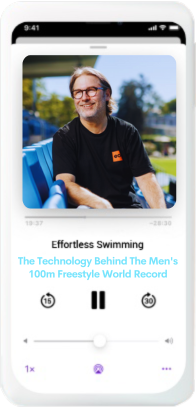
Jaimie Fuller is the founder of EO, the creators of the SwimBetter device, which measure the force and direction of a swimmer’s hand movements. These devices were used by gold and silver medalists in the 100m freestyle, Pan Zhang Lee and Kyle Chalmers, in the lead-up to the Paris Olympics. Tune in now!
In this episode
- 00:00 Introduction
- 02:08 Top Swimmers Using eo SwimBETTER
- 05:55 Downward Force in Swimmers: What the Data Reveals
- 9:34 Measuring Force and Direction for Stroke Improvement
- 16:31 Remote Coaching and Real-Time Feedback
- 20:29 Analyzing Brenton’s Swim
- 25:40 Finding Your Unique Handpath
- 28:04 Understanding Force vs. Time
- 39:04 The Role of Hand Size in Performance
- 40:27 Launching a New Program
Links from this episode
- Grab your own eo SwimBetter device today
- Change your technique and swim a smoother, easier freestyle with the Effortless Swimming membership
- Do you want to work with me personally to improve your technique? Join my swim technique coaching here
- View our freestyle clinic schedule around Australia
This podcast is brought to you by NanoClear — our own range of anti-fog swim goggles, designed by Effortless Swimming with the anti-fog treatment bonded into the lens itself (not sprayed on, so it doesn’t wear off after a few swims). Check out the NanoClear anti-fog swimming goggles here and use code PODCAST15 for 15% off.
Transcript
Read the full transcript
The next day I got this really lovely message from the Chinese thanking me for the tech because Pan Zhan Li, who not only won the race, but smashed it, you know, he won by over a second and smashed the world record. They let me know that he’d been using it regularly in preparation for the games and they even sent me some screenshots of some of his data.
The big opportunity I think is with the distance guys, because the whole point about these things is they can help you identify areas to improve your stroke and, you know, it’s self-explanatory that if you can improve your stroke and then you’re swimming one, two, three kays, whatever, that little improvement on every stroke really builds significant. Welcome to the Effortless Swimming Podcast to show that help swimmers and triathletes love the water, become a better swimmer and live a better life. Here’s your host, Brenton Ford.
In an electrifying turn of events at the Paris Olympics, Pan Zhan Li shuttered the men’s 100 freestyle world record, clocking in at a blistering 46.4 seconds. The buzz didn’t stop at the edge of the pool. It rippled all the way to Jamie Fuller’s inbox. Shortly after Pan’s victory, his coaches reached out to Jamie with a note of gratitude, acknowledging the instrumental role that EO’s innovative swim better devices played in this achievement. These cutting edge gadgets provide precise feedback on the force and direction of a swimmer’s hand movements, offering insights that are nothing short of revolutionary. Caught somewhat off guard, but immensely proud, Jamie reflected on the fact that the Chinese swim team had been integrating these tools into their training regime. However, he hadn’t realized that Pan himself had been harnessing the technology to refine his strokes to world record perfection. I reached out to Jamie and invited him to join us on this episode
of the podcast to dive deeper into the story behind EO’s swim better devices and cover Pan’s journey to the top and even pinpoints and tips for swimmers of all levels looking to enhance their performance. How exactly do the EO swim better devices dissect and improve a swimmer’s technique? Can amateur swimmers and triathletes benefit from similar technology? And what should they look for? And what are some common pitfalls in freestyle that even experienced swimmers can overlook? Welcome to the effortless swimming podcast. My guest today is Jamie Fuller from EO Lab. He is a big part of the team that brought the swim better devices into into production, something that I’ve had a little bit of a hand in and I’ve been testing and using over the last probably 18 months now. I think Jamie and no big deal with me using it. But what we saw of the Olympics was that some of the fastest swimmers will be fastest swimmer in the world over 100 freestyle
was actually using the device in his training leading up to the Olympic. So I want to get you, Jamie, on to the podcast today to talk a little bit about that and what you’re seeing and how people are using these swim better devices to improve their swimming. Sure. Thanks, Brenton. So we have a partnership with Col Chalmers. And when Kyle won the silver, of course, I was overjoyed for him for three consecutive Olympics medal, but a little bit disappointed that he didn’t hit the gold. And then the next day I got this really lovely message from the Chinese thanking me for the tech because Pan Zhang Li, who not only won the race, but smashed it, you know, he won by over a second and smashed the world record. They let me know that he’d been using it regularly in preparation for the games and they even sent me some screenshots of some of his data. So that was particularly pleasing. And then it was followed up a couple of days later
from an order with an order from David Popovich, who came third. So we had a we had a very good games and coupled with that, the 50 as well, because we’re done a little bit of work with Cam McAvoy and Ben Proud and purchase them too. But I got to say is as great as that is with the sprinters, the big opportunity I think is with the distance guys because the whole point about these things is they can help you identify areas to improve your stroke and, you know, it’s self-explanatory that if you can improve your stroke and then you’re swimming one, two, three kays, whatever, that little improvement on every stroke really builds significant. Yeah, it’s exactly right. The if you’re taking 4000 strokes in your Ironman swim, well, then you’ve got a lot more opportunity to, you know, get 5%, 10%, probably more for most people to be able to increase their propulsion and just get more out of every stroke. So that and that’s why I love working with needed to long distance swimmers
is it’s we’ve just got a lot more time to be able to improve the stroke where in the sprint, things just go so quickly. So I can tell you from my personal experience and I’m not I’m not a swimmer, but it got me into the pool and it got me it challenged me sufficiently intellectually to not just understand the process and understand how they work but to apply it. And so I went through the journey and I took eight minutes off my 800 time. So for and don’t get me wrong, I went from being like ultra shit to shit. But but still, you know, and we know that when we talk about the triathlon world, you know, and I don’t want to be disparaging to the majority of the people that are listening to this, who might be triathletes, but the reality is the swim is their weakest leg. And I might add not only was I able to take eight minutes off my time, but in doing that, I was able to reduce my stroke rate from 29 strokes a minute down to about 23.
So in applying the changes that these things had revealed, I was able then to be able to dramatically reduce my stroke rate, dramatically increase my distance per stroke. So my distance per stroke was gone from to 1.4 metres to 2.2 metres. So my effectiveness and my efficiency is so much better and carving off eight minutes. So that sort of for my mind, that’s the holy grail when it comes to triathlon, that if you can get out of that water feeling fresher and ideally faster and get onto the bike, then it’s happy. And what stood out to you over the last 12 to 18 months of working with different people across all different sports, right? Like very top level swimmers, people like yourself for almost almost very new to swimming. What are some things that you’ve seen across the board in terms of what the devices are showing you? Like, is there anything that sort of surprised you or you think that would be good for people to know?
So there’s a whole bunch of things. And if we’ve got four hours, I can walk you through a whole heap of stuff because I’ve engaged at the highest level with like literally Olympic gold medalists down to through NCAA swimmers at college in the US down to working with swim clubs and triathletes. And I’m seeing a whole bunch of stuff. But primarily what I tend to see is way too much downward force that’s going on with swimmers because we’re able to present the data. So let me I’ll just give you a 30 second overview.
So these things work on the principle of Newton’s Third Law. And Newton’s Third Law says for every force or action, there is an equal and opposite reaction. And in swimming terms, that means if I want to swim forward in that direction, I need my hand pushing backwards in that direction. It’s really very simple. So when you think about it, if my hand is doing this laterally or doing a lot of this either down or at the back end of the stroke pushing up, that’s not sending me forward. So not only do we measure the amount of force that you’re pushing through the stroke, but we’re able to apply it and tell you what directions you’re pushing that force in. We can split that stroke up, that lap up, that swim up. We can split the data up and tell you not only that, we can give you some goals to work towards. So for example, for distant swimmers, we think and I say we think because we don’t have years of research
because these things haven’t existed before. But we think that a distant swimmer should be 70 to 75 percent propulsive and it’s not unusual to see swimmers or athletes who are only like 35, 40 percent propulsive. And primarily, yeah, I think we’re going to look at some of your data soon. But primarily the challenge is that it’s pushing. There’s a lot of downward force being applied. And when I say distant swimmers at 70 to 75, it’s different to sprinters. So a sprinter, we’d probably want to see at 55 to 60 percent. And the reason is we know with a with a distant swimmer, we’ve got the high elbow catch and we want to go from this position at the end of the glide into that position quickly and effectively and efficiently so that we can become as propulsive as we can. The sprinter, on the other hand, has got a straight arm and because of their straight arm, they’re going to generate a lot more downward force.
And so I see a lot of distant swimmers with this straight arm and they’re wasting all that energy and wasting all that force because they’re getting no benefit from the hand pushing down. And then you couple with that as well. What I also see is a lot of them. The first move is the drop of the elbow and the moment you drop that elbow like that, that hand has got to travel further down and you will generate a huge amount of downward force totally unnecessarily before you get into that propulsive position that’s going to push you forward. So it’s it’s really quite a basic thing but done incredibly cleverly and intelligently and then presented so you can analyse the data yourself. What screens do you like to look at the most like for you, maybe for your own swimming? What’s most useful for you? And then what are you seeing other coaches or athletes using with the with the data? So easily the most important one is the force field
because the force field is where we apply those forces in the six directions. And the beauty about it is you can look at it with both hands combined and then you can separate the left and the right hand because again, it’s not unusual and particularly with triathletes. The left hand and the right hand are on two completely different journeys. And so when it comes to diagnosing where you are, it’s very simple. And so once you what you do is you take your your baseline or your benchmark. Where am I? Where’s my data? And I look at that and then I have an idea of where I want to get to. And then I can look at, OK, so what changes do I need to make? And then the other critical, really critical thing that I’ve learnt the hard way is you can only change one thing at a time. You can only focus on one thing at a time. You know, it’s such a difficult sport, there’s so much going on. And we’re only talking about the propulsive component
through the hands and the forearm. We haven’t talked about kick. We haven’t talked about body roll. We haven’t talked about drag head position. So there’s a whole bunch of other stuff. But the biggest contributor to propulsion is the hand and the arm. And that’s why we started with this. So it’s the force field for me. And I’ve got to tell you the best coaches and the best results we’re seeing is when the athlete puts this at the end of the lane at the shallow end. So they put their mobile phone at the end of the lane. They do two laps and they stand in the shallow end and they download the data while standing in the pool. And within 10 seconds, you’ve got the force field there and you’re seeing where your force application is. And then you say, OK, well, I’m, you know, 42 percent propulsive. Now I’m too much down. OK, I’m going to make a change. And you go and do another two laps and you download it and you’ll see you’ve gone from 42 to 45.
Oh, OK. That worked well now, but I’ve got to go more. And you get that fast feedback loop and very quickly you will see the changes that you’ve that you’ve been making with your technique. Instantly, you’ll see it as objective data on your phone.
That’s what I was thinking when I recorded this morning. I recorded and then I had to get back home to the kid drop off and everything. And then I was looking at my data and I thought, man, that’s like I wish I just stuck around and just downloaded it quickly to the phone to check it and then try and work on it. Because particularly with my left hand, which we’ll go through in a moment, I’ve got so much opportunity there to just to press back more. Like it’s it’s coming into the center too much. It’s pressing down too much. And I think and it’s very quick to download to the phone. Like it takes no time at all. It’s a really simple process. And I know it’s gotten quicker since it since your first launch. Like it’s it’s very quick now. So yeah, so that’s that’s what I feel like I need to do to start to really see some of those better or higher numbers for the propulsive forces, because they’re they’re a lot lower
than than what they should be. And one thing I actually noticed when I filmed myself and another guy, Sam Shepard, so we were doing a video for some wetsuits. And he was I was drafting off him and he was drafting off me for some of these videos. And he’s like he was just off making the Olympic team for long distance for like the 10 K or 20 K. And I was looking at our footage and I’m like he’s just working so much easier than I am because he’s just a bit more relaxed through the reach. And then he gets a better angle, whereas I’m just I’m putting too much force on in the beginning. And a lot of that’s going down. It was so obvious with the videos. And then obviously it’s coming through in the data and saying it there. And you’ll see I mean, you ask about what are the key ones that I look at, certainly the force field is the first one. But then the consistency. And I look at the consistency as opposed to the hand pass.
And particularly when we’re dealing with triathletes. I mean, if you’re dealing with someone like Kyle Chalmers, you’re going to get a consistent stroke so you can analyze and look at some interesting stuff from one stroke. When you’re dealing with triathletes, you’re going to get a bit of variation happening across the lap anyway. So the consistency chart is where we add. We literally stick every stroke of that lap on on top of each other. And there you can get a very clear indication and and there are a lot of things that you can see. So, for example, it’s it’s not unusual to see the left hand doing a normal sort of a question mark, sort of reverse question mark and goes out a little bit, then comes in and push back. And the right hand might be sweeping completely across the right hand side of the body.
And that tends to happen with the breathing, you know, because as the breathing goes to the left, the right shoulder twists around and it also dips and you suddenly see huge asymmetries both looking at it from side on as well as from top down. And you can read into that exactly what’s going on. Because we know the objective with breathing is to have the smallest rotation of the head you can do. And that’s why when you see the best swimmers in the world, they’ve only got the corner of their mouth sticking out of the water because it’s all about how do I get that breath and keep my shoulders straight and keep my body straight? I don’t want to be rotating or twisting. I just want to be turning my head slightly. And it’s one of the big things that I see very regularly with triathletes. And then finally, we’ve got this other screen, the last chart, which combines everything, which combines the whole data split
with the hand path and with the timer. And you can move the timer down and you can see exactly where the hand is at and where you’re losing your propulsion and you can read into it. It becomes very, very easy to read. And one of the other things, Brenton, that’s important is if anything, people get a little bit daunted, they find there’s so much data and they think, oh, it’s a bit daunting. How do I interpret this? I do one-on-one sessions with people who buy the system and we do a teams or a Zoom call. We spend an hour going through it and I show them exactly how to go chart to chart and read through. Because it’s just all new stuff, right? Like, we’ve just never been able to see this sort of information. And yeah, and I think that’s what I love about the front screen, that initial screen with the force field where you’ve got your percentage of forces in different directions. Like, that’s just a good overview to see
generally where the strike’s going and you can kind of just break it down and get into as much or as little detail as you want from there. So, yeah, really, like, it’s, yeah, it’s really impressive what you’ve been able to do with with these things. So, I would be interested to, if we can go through my data here. I will. And just before I go on, just for any coaches that are listening, where we’re getting some great results, particularly with triathletes, is the ability to remote coach. Is the ability for a swimmer or a triathlete to use these anywhere in the world and a coach to be anywhere in the world and they share their data a bit like what we’re doing. We’re going to do with you now and the coach can then either do a session, a real time session and go through the data with the athlete. Alternatively, the coach can record it, do a screen recording and walk it through and then send them the link and they can see it.
And with the feedback we’re getting from coaches and athletes in the United States, I was on a call the other day with a coach in Boston and he was talking about how sensational the times have been for his guys that he’s coaching on the West Coast when he’s been able to walk them through this.
This episode is brought to you by Pillar Performance. Our new sponsors Pillar are a sports micronutrition company. And the easiest way to describe it is that while hydration and carbohydrates, products will take you through to touch the wall as fast as possible. Pillar’s mission is to get swimmers to the starting blocks in the best condition over and over again. I recently started taking Pillar triple magnesium after a friend had recommended it and it’s been a game changer for my sleep and recovery. I take one scoop 30 minutes before bed each night in the same way that you might start your day with a coffee. I finish it up with the magnesium and recover better for tomorrow’s session in the pool. Pillar Performance is used by some of the biggest names in swimming and triathlon, including Zack Stubble to cook, Jan Frodeno, Ben Canute, Ash Gentle, Taylor Nib, amongst the host of other well-known swimmers and triathletes.
Where Pillar differs from other micronutrition you may have taken before is both the quality of the types of magnesium and the tangible results that I see on my garment each morning. If you’d like to try Pillar today, head to pillarperformance.shop and enter code effortless for 15 percent off. That’s effortless for 15 percent off all first time purchases or for anyone in North America. Enter the same code at thefeed.com.
And while you’re bringing that up, Jamie, one of the things that I heard Mike Bottom, he’s a legendary swim coach, I remember he mentioned on a call there was like a training call for the coaches was that it’s like if you tied him with the video because you can sync up underwater footage with the data. He said you can see when you’re getting a really effective stroke, right? So it’s not just about seeing where the gaps are and where the holes are. You can see when you’re doing a good stroke and we can see what you did in that moment and then looking to replicate that. So I thought that was an interesting way to look at it as well, because my mind typically just goes to what are the faults? Where can we improve with people? But we also want to look at, well, at times you might be taking some really effective strokes with high percentage of propulsive forces. So what do you do in that moment? And then how can we do more of those?
Absolutely, and the ability and I’ve got a file up here I can check up in a bit if you want to see it where we can easily sync video and data. And you can see exactly on the charts what the hand’s doing. And you can see that replicated on the video. And it’s important for some coaches, I know, because a lot of coaches I work with tell me that one of the beauties about the system is they speak to their athletes until they’re blue in the face and the athlete either just says, I don’t believe you. I’m not changing or they nod their head, but they internalize that this guy’s full of crap. And so when you see the data, then suddenly the light goes on in the in the athlete and they say, OK, but occasionally you’ll get one that even says, I don’t believe the data. And then when you put the video on as well and say, this is what I’ve been telling you, this is what the data shows and look, you can see it in the video.
Then there’s no way they can. Yeah, that’s exactly right. So this is from a swim this morning. So if you are listening to this podcast, we also post these podcasts on to why actually it’s going to be a video on Spotify and YouTube. So you should be able to see the data here that we we’re pulling up. So this is a hundred meter swim that was around about threshold pace for me. So time wise, it was I think about a one thirteen one fourteen from start to finish there. So I think it might say one twenty three here. It was a recording time. So yeah, so that’s that that time that we show is from hands going into the water to hands coming out. So if you’ve got a period of time, if you put the hands in and you take five seconds or whatever before you push off, then it doesn’t it doesn’t necessarily recognize the push off. It recognizes where the hands go in. And likewise, when you finish, if your hands stay in the water,
it’ll keep the clock will keep ticking up.
So this is the the first screen we see. It’s just a quick summary of the two laps, as you can see here. And the orange is your left hand, the blue is your right. So as you can see, Brenton, you’re pushing a little bit more through your right hand than you are through your left. It’s total force. And this is your stroke rate. So lap one, you were thirty two point seven and lap two, you were thirty one point two. So you can see your stroke rate slowed down a bit. And if you want, you can click on this little icon and you know you can look at your stroke rate, how it fluctuates across the lap running across the top there. And you can see every stroke, the amount of force that you’re pushing. But that’s just average force per stroke in every direction. It’s total force. This is the force field we were talking about, mate. This is where the six directions that the hand can move in the water, as you can see. And this is your opportunity here, buddy, a thirty seven point two percent
repulsive and, you know, that should be over sixty. You know, that should be pushing seventy percent. And when we look at where you’re losing it, you’ve got a big chunk of hand drag. And hand drag is at the front end. If when you’re gliding, you’re dropping your wrist a bit and you’re presenting the palm of the hand to the water in front of you, which obviously acts as a break. So you don’t want to have that. This is your big opportunity. You’re downward. You’ve got a good almost twenty. You’ve got between twenty and twenty five percent, probably twenty five percent that you’re able to shave off that downward force. And if you’re able to get that down to seventeen, your propulsive will then be at sixty percent, right? That’s. And so when I was talking about, you want to you want to focus on one thing, you prioritize them because you’ve got a bit you can take out of your lateral stuff, too, because laterally, you’ve got eighteen percent there.
And ideally, you want to have eight percent between the two for each. So you’ve got ten percent there. So you could you could immediately looking at this, you could take four percent out of your hand drag or sorry, or prioritize. You could take your twenty twenty to twenty five out of downward. You’ve got about ten percent you can take out of your laterals. And you’ve got four percent out of hand drag. And hand rate, mate, should be the easiest because it’s literally just those fingers aiming slightly downward during the glide phase.
But this is the big performance improvement is coming out of the down. And I’m sure you’re going to probably I’m probably jumping ahead here. But when I was looking at it between the left and right hand, that hand rate was really only on one. I think there’s your right hand. You’ve got almost no hand drag on the right. You’ve got eight and a half percent on your left. And that’s why when we look at this little graphic here, you’ve got that going forward here. That’s your left hand. That’s your hand rate. Anything north of this dot this point here, anything north is bad. Ideally, this graphic, what you’re looking for is you want it to be narrow and you want it to be deep because this is a two dimensional graphic. A quick snapshot of where those forces are going. And you can see that here you’ve got all this stuff sticking up above that center point. You don’t want to have there. And that’s primarily that hand.
Yeah, if I go back to your left, she’s Brenton.
Yeah, am I doing anything with some left arm? It’s just along the ride. You get twenty two percent propulsive and forty seven percent downward. You know, that’s a that’s a lot. And then you’ve got that eight percent hand rate. You’ve got a big opportunity there. And then you’re right, you’re fifty percent propulsive and thirty six down. So you’ve got the only thing you’d work on with your right hand is getting some of that downward out. And there’s, you know, fifteen percent you can pull out of there. And that’ll take that into your sixty five plus almost seventy percent. Yeah, if you get fifteen to twenty percent out of your downward, but your left hand is the one that you want to focus on. Yeah, it’s a lot hanging fruit there. Yeah, I mentioned consistency and consistency is where we get to look at your hand path for all the strokes in that lap.
You’ve you’ve you’ve got great consistency in your depth. That means you’re not getting a rotation of your shoulders. You’ve not got one hand going deeper than the other, which is terrific. You’ve got a similar a similar hand path going on in here between your left and your right. Interestingly, Brenton, it’s sort of the opposite of most most hand paths I see most hands pass I see go out, come in and then go straight back. Your first move is in and then out a little bit. So you’re coming in and then pushing back from here. But there are nothing stands out here. And it’s and there’s no that’s the other thing that everybody says to me is, oh, can you give me Kyle Chalmers hand path? And I’ll just copy that. It doesn’t work that way, right? I mean, we’ve all we all need to find our own hand path. And whilst, you know, at a very surface level, you might think, well, you know, if I’ve just got to have my hand pushing back,
I just need it to be straight. That’s not the answer either, because it’s about how we how we switch on our muscles and the best place for our arm to go and our hand to move in order to be able to switch on the muscles in the shoulder and the arm and the and down on the lats. That’s what gives us our power and drive. And that combined with the ability to hold that water and drive the body for that’s the holy grail. And so there’s no such thing as saying, well, you know, Brent, and you’ve got to change your hand path because this is wrong. There’s no wrong or right. The only thing that I really look for when it comes to wrong and right is asymmetry. And as I said before, if you’ve got, you know, one where the left hand’s going out and then coming in and the right hand’s coming in and across or vice versa or something very, very asymmetrical. That then means you need to question is this is an injury? Is it is it a breathing fault?
Is it some other technique? And again, breathing very, very easy to diagnose, put a snorkel on and then do it again with a snorkel. Take the head rotation out. Take the breath out and see what happens. Yeah, interesting. That’s something I should do, I think, because I mean, I breathe to my left. I was breathing almost every two for this hundred. And I think that’s why you see a little bit more power on that right hand is when I bring my head back, I tend to add a little bit more power and connection that way. So it’d be interesting to see what it does without with the snorkel on. So that’s something I’ve got to test. Yeah, very easy to do. And like I said, if you particularly if you if you’re standing in the pool and you and you do two laps and then download it and have a look, you can see this chart straight away and you’ll see it instantly what your what your symmetry looks like. And I have I have seen I’ve seen guys, particularly triathletes,
they’ve been able to then go and see a physiotherapist or a or a PT and then find out that they’ve got flexibility issues or injury. They’ve got an injury on the shoulder and that’s reflected in a different hand path between each hand. Yeah, interesting. Yeah. I’ll jump to force versus time because it’s important when you consider all these other ones that we’ve been looking at. These are all summaries. So this is showing us a summary of what’s going on, either a summary of the lap or a summary of the stroke. Again, just quickly, if I go back to the force field, you can even click on this button and we can look at the every single stroke. We can look at what’s going on with your forces, you know, left, right, so on. So this is this is a summary, even this is a summary of what’s going on with the stroke. Whereas when we get to the force versus time, this is the first time we get to be able to look at what’s happening inside that
stroke. And you can see instantly, Brenton, because the blue is your right hand and the gold is your left hand. There’s three things that stand out for me straight away. First of all, the absolute force you’re pushing on your right versus your left. Look, you’re right speaking up here, you’re six to seven and your left is peaking down here between two and three. So there’s immediately something there. The second thing that I see is what we call these double peaks. And because we’re looking at the propulsive view, we’re seeing the propulsion start to generate and then something’s happening and you’re losing it and then you’re finding it again and you’re finding a big peak, the second peak on the particularly on your left hand, where you’ve got that difference in the peaks. Oh, sorry, right hand on your left hand, you’ve still got the double peaks going on, but you’re not getting that second peak as high on the on the left as you are on the right.
The other thing that I noticed straight away is, and I’ll just turn the right hand off and we’ll look at the left hand, your hand glide, your hand drag, sorry, which is happening during the glide, and it’s very easy to see the three phases on in here, right here, that little straight line on zero, the hands out of the water. It’s not detecting any force. So it’s in recovery. So right there is where the hand is exiting the water. Right here, it’s entering and this is your glide. And look, you’re going negative in your glide. That’s because that left hand is doing that scoop motion. And you can see it’s on every single one of these. You’ve got a big, big glide challenge there. And then at the end of the glide here, now you’re starting to get propulsive and you’re generating your propulsion, it’s dropping off and it’s going again. So you’ve got a very clear hand drag that you can resolve. The beauty about this chart, when we look at it on the
platform, and you can do this on the on the platform, not in the app, in the app, you can see it just like what we’re looking at, but on the platform, we can look at multiple vectors simultaneously. So what I’ve done here is I’ve selected lateral as well as propulsive. So we’re looking at, I’ll blow it up a bit. And it’s no surprise to me that we’re seeing, it’s almost like a mirror between the lateral force and the propulsive force, Brenton. So you can see your propulsion goes up, comes down and goes up again here. And this red line, this is your lateral force. And the lateral forces are very easy to read. When it’s positive, such as here during the glide, that means the hands are facing outwards. Where it’s negative, which is happening down here after you start pulling, the hands are facing inwards. So we can instantly see in here as you’re gliding, you’ve got the hand drag happening here. But at the same time, that hand is facing outwards.
So your left hand, when it comes into glide, it comes in thumb first. It’s not coming in flat. It’s coming in like that facing outwards as you go through. And then it squares up here. And then you’re starting to pull and you’re catching here. And as you’re catching, you’re also generating this negative force, which is coming inwards, right? So that’s inward force that’s going on there. And then look here, you see down here where it’s bottoming out, that bottom out, that’s an indication that that hand is changing directions. And it’s no coincidence that where that’s changing direction, you’re falling off the cliff propulsively. See that here, here. And then here, where it changes direction again, it bottoms out propulsively. So you can see very clearly on here, Brenton, very clearly, like I said, it’s like a mirror, isn’t it? You know, all these little moves that you’ve got in your propulsion are a mirror of a reflection of
what’s going on laterally. So that whole, which and what it falls down to is this, in fact, let me just go to, we’ll go to your next chart, because this is the one where we bring it together. And so if we pick a stroke here and we’ll go for your overhead view and I’ll put on your lateral, let me see what we got. And then what we can do here is we can move this slider. And so that red dot moves to show you your hand position on your hand path and the red line moves to show you what forces are being generated. So if I go straight to here, you’ve got this thing happening right here, buddy, where your hand at this point, which is coming straight through pretty much is suddenly changing and it’s changing here. It’s so in this initial part right here, where it’s generating some inward force, that’s telling me that your hand isn’t pushing directly back or it’s pushing back, but it’s not facing back. It’s slightly angled.
And because it’s angled, you’re getting some lateral force as well as propulsive. And then when we get to this point, it’s now rotating that way and that rotation, that slight rotation is causing this propulsion to fall off the cliff. And then when we come through to here, and this is where you now are going to push straight back where you’re getting very little lateral force, but you’re getting that second peak and it should show up even more on the right hand. Right. And so here you’ve actually got this physical move inwards into the centre line. It’s only a small shift inwards, which is generating a bit. And then right here, right here, that hand is now going to rotate a little bit. And as it rotates, it comes off the cliff. And then here it changes again and it pushes straight back and you get it. So you can effectively look at your hand path and you can look at the forces that you’re generating and you can see exactly
where in that hand path you’re getting those changes.
Yeah, it’s pretty obvious that I think from that transition to maybe a slight, it’s almost like an in-sweep there, isn’t it? So yeah, the transition sort of between the different phases of the stroke, I’m really losing that hold of the water there. So. And that’s where you’re going from pulling to push sprinting. That’s exactly it as you’re transitioning. So you’re pulling and then as you’re pushing, you’ve got that hand rotated. And there’s a very good reason, mate. And it’s this.
If you think about it, if you’re pushing maximum force directly down or directly back to your feet, if you get to a point where your muscles can’t cope, something has to give. Either your muscle explodes, which doesn’t happen, or your hand slips. And the moment it rotates and slips, now it can now it can get through the water easier. And that’s exactly what happens. You know, your hand can rotate a little bit. It can now slide through the water. It backs off the force or the pressure that’s on your shoulders and on your muscles. And then it enables you to complete the stroke without it blowing up, which then can come back to, well, what do I do about it? Well, dry land. You know, how do I build my muscles up and how do I get stronger in the gym so that I can take that extra pressure and force?
I think what I feel and see in any underwater footage I’ve done as well is that I could, I probably try and force it a little bit much through the front end of the stroke. And on those times where I do just back off the force by maybe or power by 10, 15 percent, then I can typically hold better positions. I can hold it easier. And, you know, while I may not have as high a peak force there, the impulse would be, I’m imagining would be would be greater, which is kind of what we’re going for that sort of field in area under that, that blue line, right? Like, that’s kind of what we want to maximise the impulse. Exactly. Under here, because the amount of force of the impulse you generate is the square area under this little blue double peak. And so, and obviously made this two ways of increasing that, you can either go higher or you can go wider. Now, there’s a limit to how wide you can go because you can’t hold the water for that long, obviously,
particularly at a higher stroke rate. But what you can see is this valley, that’s lost propulsion. That’s purely lost propulsion. On the on the other side, though, you’ve got your downward force, which is what’s below here, the negative in the purple is actually quite low on the right hand. Whereas when we look at the left hand, you’ve got a lot more downward force that’s been generated. Look at this, right? You’ve got and here you’re not only generating this hand drag. You’re also generating a lot of downward force through that glide as well. So I would suggest your left hand as well as being angled where your wrist is dropped. You’re also dropping like that. So it’s generating hand drag and it’s also generating downward force as you’re going through.
Yeah, so it’s amazing that I can swim at all looking at that, right? Like that I’m moving forward. But that’s the thing that I love about this is to me, it just shows me how I’ve got a huge opportunity to get a lot more out of my existing stroke. And, you know, and the thing with it too, like it’s it’s all sort of relative, I find, to the to the person because, you know, someone who would have higher percentage propulsive forces doesn’t necessarily mean that they will be faster than someone who has low percentage forces because there’s a lot of other factors there. But if you just use it based on your own data, based on that benchmark swim that you’d start with, then you can really start to tweak and refine your own stroke. And I think going about it that way is what I’ve seen can work really well. And look, you make a great point, mate, because the idea of and you make the point that this is about your data comparing you
with you. It’s not about comparing you with somebody else. So if we talk about triathlete
mindset where effectively, you know, you could call this system, it’s like a power meter for swimmers and every triathlete knows about power meters for bikes and you can compare your power output on the bike in terms of watts per kilo. Right now, you can’t do this with this because you’re the amount of power that you produce. It’s not just a function of the kilopascals that we’re measuring. It’s also the square area of your hand. So here, this is actually going through right now. We’re developing through machine learning a calculation of hand size, i.e. your paddle. And so then we’ll be able to combine it because with the pad, with the amount of force that you’re generating with the size of your paddle. And then we’ll be able to tell you how many Newtons you are pushing yourself. And then you can start to compare with others or what’s that you’re pushing because you can appreciate a big guy with huge hands and a small girl with small hands.
They might hit the same amount of force, but because he’s got hands that are like dinner plates, he’ll be pushing a huge amount more force compared to a small girl or woman. So it’s important that our next step is to combine the two. And then you’ll be able to talk about, OK, how do I, how do I compare? Yeah, exactly. Well, Jamie, that’s really helpful. Thanks for the coaching session for myself. I’m always grateful for that. But I’m sure that those that are that are listening as well, it’s probably just giving them a good insight into maybe some opportunities that they have in their own technique. Is there anything that we’ve covered that we haven’t covered so far that you think it’d be worth mentioning? Look, there’s a couple of things if I can and I’m mindful about timing, Brenton, but we’re just launching a new program right now, which we’re starting with the super elite in in swimming and it will work its way through
to age group and then to try athletes. And the whole purpose of this is to accumulate data for particular distance, gender and stroke. So we’re starting with 100 meters, men’s and women’s. And we’re going to collect their data to qualify. You’ve got to meet a certain criteria. So in in this one, it’s it’s men’s got to swim under 53. They’re going to have a PB under 53 100 and women is under 58 100. And so what we’re going to do is we’ll get all that data and it’ll be conducted under specific circumstances. So everybody’s got to start the right same way, stop the same way, wear their race suits, not use fins or pull boys or that sort of stuff. Right. They’ve got to have the hands go in the water at the same way and come out the same way. What they will do is that will give us a whole bunch of really interesting data that we can then rank from fastest through to slowest and then look at all these key metrics and then pump it through some
interesting machine learning software and find what’s the weighting of each of the different metrics, whether it’s I mean, you could already get distance for stroke and stroke rate. But what we’re really keen to look at is absolute force in conjunction with percentage propulsive. And so to be able then to look at that and then what we’ll be doing is we’ll be then providing that back to our partners who participate. They will then get all that data or all that global data set, but it’ll be anonymized. So if there are 100 athletes in there, they’ll go from fastest down to the slowest at 100 and then you’ll be able to track all of those different metrics across and within that anonymized data set, you’ll see your own identified. So you might be the seventh fastest swimmer on there, but you might have the third highest level of absolute force, force, you know, that the 15th distance per stroke and the ninth of percentage propulsion
and all that sort of stuff. And so we really believe that this has got the capacity to provide intelligence and insight that hasn’t been done before that will build out across all the distances from fifty three to fifteen hundred and strokes as well for butterfly and backstroke, which we already do. And then we’ll do age groups. And once we come down the age groups, then we’ll get into triathletes as well. And so as we build that out, that in itself, I think will be really insightful because you’ll be able to see where I sit in context to people who are in the same sort of range. The other piece as well that we’re building is intensity factor and training stress scores, TSS, because ideally what I’d like to do is to be able to work with someone like training peaks and to integrate so that you can do an eye for a TSS swim and you can upload that data into training peaks because we know with training peaks, they do a great job of
displaying your your data for running and cycling, but there’s very little for swimming. So if we can have that common language, which then becomes an entryway into with training peaks into the rest of the stuff, I think that will be quite powerful as well. Unreal. That’s exciting. I remember when I first found out about the technology and start to see how it could be used. I was thinking down the track with data analytics and just being able to use all this machine learning type stuff, it’s like to be able to pull in that that data and then like spit out what’s really important here. That was something that I thought that’s really exciting. So it sounds like you’re heading down that path now. And the key the key thing, as you know, is if you want to be comparing, you’ve got to make sure it’s all captured under the same circumstance. That’s why we’re having to be very anal about these are the rules. This is so, for example, they’re all pushing
off. It’s not a dive start. And like I said, when the hands go in the water, the clock starts. So it’s got to be hands in and go instantly. And likewise, when you finish, touch the wall, hands come out of the water instantly. So we then collect the data so that you can truly relate all of the data time wise and rank them and then look at all the other stuff. Because there’s no doubt in my mind, and I know again, we’re not talking about kick and we’re not talking about drag, but just propulsively and certainly, you know, Panjan Lee in the hundred meters to to win up by 1.08 seconds, you know, for the first time since 1928, but there’s been a more than a one second gap. We will see some pretty amazing stuff. And I’m all of the elite coaches that I’m talking to in the National Federations that so far they’ve all been really positive about wanting to see what that global data set looks like and what their people look like within.
Yeah, yeah, and I can imagine why, you know, it’s just an amazing swim to to see that. So, yeah, looking forward to seeing what’s to come. So, Jamie, I appreciate you jumping on the podcast. I know you’re a busy man. So thank you very much. And for anyone who’s interested in getting a set of these devices, I’ll include the link in the show notes. And yeah, Jamie, thanks again. Good on you, Britain. Thanks, buddy. Thanks for listening to the Effortless Swimming Podcast. If you’d like us to help you become a faster, more efficient swimmer, go to www.effortlesswimming.com.