







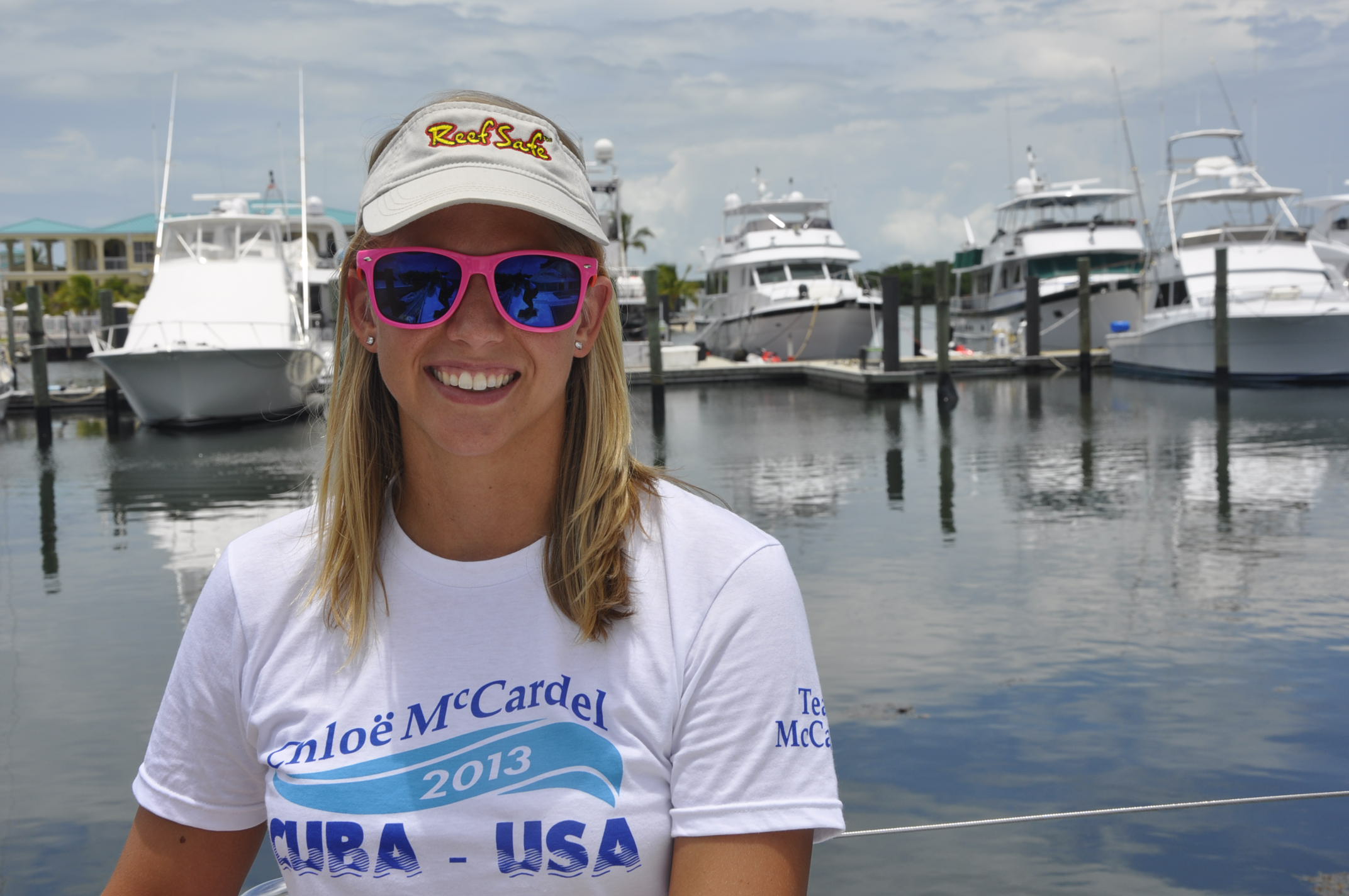
 Today’s guest is ultra-marathon swimmer, Chloe McCardel. She has successfully completed a triple crossing of the English Channel. This is something that hasn’t been done for the last 25 years. She’s the fourth person in history to do it.
In this episode:
01:23 – When Chloe Fell In Love With The English Channel
02:40 – Did you ever think of giving up?
05:00 – Swimming in Loch Ness for 6 Days
06:20 – How To Boost Your Confidence With Training
13:30 – Funding, Press Release and Media Coverage
14:49 – A Politically-Charged Swim
18:22 – My Love-Hate Relationship with My Training
21:30 – The Life of An Athlete: 99% Hard work
23:35 – The last 12 months has been special…
28:56 – Building lifetime relationships through sport
Have you dreamt of swimming the English Channel?
Swim the English Channel in September 2016 in a 4 or 6 person team with Chloë as your coach! Expressions of interest close October 25th, apply directly via email with Chloe (chloe@chloemccardel.com). Pace required to apply: 2.5km an hour minimum (only need to be able to sustain for one hour at this stage) but 3km/hr+ is desired.
Chloë McCardel is a professional marathon swimmer / coach / speaker and ambassador. She holds the World Record for the longest solo unassisted marathon swim and has swum 13x English Channel solo crossings (6x Single, 2x Double & 1x Triple Solo Crossings). In 2014 and 2015 she successfully coached 57 swimmers (as solos/in relays) across the Channel.
Email: chloe@chloemccardel.com
Website: chloemccardel.com
This video was created by one of Chloe’s 2015 relay teams:
Transcript
Read the full transcript
Welcome to Effortless Swimming, the podcast for swimmers, triathletes and coaches. Join Australian swim coach Brenton Ford as he reveals the latest techniques and information to improve your swimming. Let’s dive right in. Welcome to the Effortless Swimming podcast. My name is Brenton Ford and today’s guest is a close friend of mine who I’ve had on the podcast twice before. It’s ultramarathon swimmer Chloe McCartle who has successfully completed a triple crossing of the English Channel. And it’s something that Chloe has attempted twice before but not made. But just recently she completed the triple crossing and it’s something that hasn’t been done by a person for 25 years and close the fourth person in history to do it. And so we look at what she did differently this time compared to her last two attempts. I think it’s really interesting hearing what changes she made and the reason why they actually helped her get across.
We also look at her day-to-day life and how she brings herself to the pool or the ocean to get her training done when it can be so monotonous and challenging. We also have a look at what Chloe’s doing now to help other swimmers get across the English Channel for those people who are looking to challenge themselves with a cold open water swim that’s as challenging as the English Channel. So listen in, here’s Chloe talking about how she got started in Ultramarathon swimming. Well I fell in love with the English Channel in 2009 so that was the first year I went over there and I was trying to do a double solo crossing. Unfortunately it wasn’t successful that year but in 2010 I did complete the double solo crossing and from then on I’ve had in my mind a fixation to do a triple crossing. Most years I’ve tried so in 2011 I tried, 2012 I tried both were unsuccessful. 2013 I was so exhausted from trying that I went and did another swim, Cuba to the USA that wasn’t successful.
And then 2014 I just did a solo English Channel as a training preparation for the Bahamas World Record that year. And then once I got that Bahamas World Record I was like ready to go back and attack this triple crossing. And then this year I was lucky enough for everything to fall in line and we were successful which is fantastic. So it’s now 2015. So six years ago you sort of started to look at doing this. And I mean after the first two attempts where you’re unsuccessful did it ever cross your mind that maybe you shouldn’t go for it again? Did you ever think about stopping? I didn’t. I always knew that I would need to succeed at this before my swimming career ended. Otherwise I would feel like it would be something that was unfulfilled like a major title or not so much title but something that’s really important to me. So I knew I had to do it at some stage but it got to the point after 2011 and 2012 that I was just so exhausted from 365 days a year thinking about this
and most of those days training towards it in the pool and the freezing cold water and I just needed a break. So that’s why in 2013 I went to a warm water swim and 2014 as well. So I think that break was really good for me to just change my focus for those two years to warm water because it’s a different type of training and that allowed me to kind of recuperate and then bring out all the big guns because I did change a few things leading into this triple attempt and I think that time away was really beneficial in the end. What things did you change from the last two to this one which was successful? Leading up into this one I did in the last week between the end of June and the first week of July I did three single crossings of the English Channel in seven days. So that was like doing a split triple English Channel crossing but over the course of a week so I was doing the same distance that I would swim for a triple crossing.
So that was good building up my aerobic capacity while adding to it as well but also becoming more comfortable and familiar with the idea of this triple crossing because mentally it’s a huge thing to get your head around. So I just became very comfortable being out there. It became like second nature, like going home or going to work, just something routine. And another big thing I did was I went to Scotland and swam in Loch Ness for six days up to five hours a day and that was 11 Celsius. So the channel was, I was predicting it to be about 16 Celsius. So to swim in 11 Celsius is considerably colder and that gave me I think an extra edge against the cold because the cold was the hardest challenge for me of all the challenges that you’d expect coming into a triple crossing. Yeah, that’s something that I spoke about in the last podcast with professional triathlete Josh Anberge. It was just in training you’ve really got to be doing stuff that’s harder than what you expect to do in your racing.
And for you that was going to a colder temperature and also just getting familiar with swimming the channel just like it’s an everyday thing. And I remember sort of watching your Facebook as you were doing those one crossings and three of them for the week. And I couldn’t believe it. I sort of opened up my Facebook in that day. I just done another channel crossing and then a few days later another one again. And just from watching that it just seemed like you were able to do them very comfortably. And I mean it may have not felt that way but just from a mental point of view, did it make it a lot easier mentally to do the triple? Yeah, I think so because having done those three single crossings by the end of it I was confident because I wasn’t exhausted. I didn’t need to sleep it off for a week or anything. I gained a huge amount of confidence from it. It’s not just the physical benefit of doing a split triple crossing over a week but confidence wise it was really good.
It was good to, for example, swim into France. I had two opportunities to swim that last kilometer or three quarters of a mile into France. The tides are very strong around France and you need to fight them to get in most of the time. And I had to fight really hard on those singles. And that was good because the day they had to do the triple it was between August 8th and 9th. The tides were horrible but I’d had that mental preparation of horrible entries into French land. Two of my three crossings earlier in that season they were horrible as well. When you’ve been there and done that in a fairly recent time frame it becomes more familiar and I guess you’re more comfortable and you’re more able to get your body in a position to achieve what you need to achieve. And this is the first triple crossing in 25 years so why hasn’t someone done it for that long? Why has it been such a long standing swim? It is interesting because the other three triple crossings that were done were done within a space of about four years.
So three different people could swim triple solo crossings at the end of the 80s and 1990 but then yet there was this just big void for a quarter of a century. And I can’t explain it. Obviously swimmers who are really tough and really experienced can do this swim but for some reason for the last 25 years haven’t done this swim. So I don’t think it’s a lack of ability. I think maybe it’s some other X factor and I can’t put my hand on. Obviously it’s extremely difficult. I’ve tried two other occasions and haven’t got there but I think it’s more than the difficulty. Maybe it was a mind block or maybe people felt like it had been done. They didn’t need to be achieved again. I’m not quite sure but the swimming community are pretty excited about it which is good and there are still people trying. It’s a very small number trying to do a triple solo and hopefully this will give them extra confidence and extra stimulation to go and achieve.
That would be wonderful. Someone could do that in the next few years and not have to wait another 25 years for it to happen again. Yeah, wonderful. Say a flurry of a few more swimmers doing it or at least attempting it. It’d be interesting to say what happens but we were talking about earlier but it’s just such a huge accomplishment just with the water temperatures and the distance that you swim and you look at Everest and how many people climb that and you look at all these other sort of challenges that are really big challenges that are out there for people to go after and this is one that has only been done by four people ever and it takes a special kind of person to be able to do it and I love how you’ve come back after two unsuccessful attempts and I remember the one three years ago when you had the crew from 60 minutes sort of following you on your journey and there with you during the swim and unfortunately didn’t make it
but you had the courage to go back and do it again after sort of everyone saw that you had to get pulled out or after one and a half crossings and you’ve gone back. I think it’s just awesome because most people would think well, maybe it’s not possible, maybe I can’t do it but you’ve stuck at it and done such a great job and as well as doing the Bahamas swim last year the world record distance swim there I don’t know how you do it and I don’t think I’ll ever understand but it’s just awesome watching you accomplish those things. Thanks, Brenton. I remember when we first met it was at a swim squad here in Melbourne and just sort of going to regular sessions and you just kept sort of plugging away at the session and just holding a very constant pace and then I think it probably took me five or six months for someone to say this is what Chloe does and I had no idea until a few months and now you’ve gone on to achieve these huge things
so it’s really good to see and with the media that you’ve had after the triple crossing how have you sort of found that you’ve been received by the different news organisations around the world? Well, it was nothing like the Cuba USA attempt I did in 2013 unfortunately that finished after 11 hours from extremely excruciating information from box jellyfish or Eurocandy, we’re not sure which one but that went global so we had 30 million Google hits at the end of that CNN, BBC or Wanting Interviews so that was truly a worldwide swim this swim didn’t make as big of an impact as I would have liked I really want to share my journey with as many people as I can because I feel that’s the way it’s my vehicle that I can inspire people so it was disappointing that it didn’t really get a lot of international coverage it got good TV coverage in Australia I believe it’s hard to tell because I was in the UK still at that time
so that was good there wasn’t much at all in the newspapers you’ve got to understand from my perspective being a marathon swimmer that I don’t get any support from the VIS, the AIS so I have to find not only the pilot’s fees the channel swimming association fees, flights, transfers the same to get my husband over in England we were over there for 8 weeks this year in Europe but I’ve also got to find the PR behind all this which just seems like an extra cost at the end of the day so we don’t really have the funds to push the message out there and be as available for the media as really we should be so I did my best I was up in London twice within 24 hours of finishing the swim to do live satellite link ups to Australia but as far as pushing that message out there it’s unfortunate but you do your best, you come with what you’ve got and that’s what I do on a small budget yeah well no it’s pretty awesome what you’re doing with
a very small team there so why was the Cuba USA swim so big was it purely because of where it was and the American press getting a hold of it well Cuba up until only a few months ago was categorised as a terrorist country by the United States of America because of the whole Cuban missile crisis and Fidel Castro issues so America has this intriguing relationship with this country that really is just 100 miles away it’s not very far away and obviously there were issues with refugees trying to paddle their way from Cuba to get sanctuary in the US, things like that so politically it was a hotly kind of charged issue so if you bring a swim between those two countries you’re bringing the spotlight back onto all these huge issues so I think politically it was a very charged swim and the fact that a lady who was very famous in the USA was also trying to complete that same swim and at that point she hadn’t completed that swim
Diana some of you may have heard of her and she was very very good at working up the media into a frenzy about this swim so we piggybacked a lot of that coverage and a lot of that interest in that swim yeah that’s interesting isn’t it and then with the Bahamas swim is that something that was on your in your sights for a long time and for those that don’t know what we’re talking about we actually did a podcast I think after you did it or maybe beforehand but basically the longest, 124 kilometres is that right? that’s correct yeah 124 kilometre non-stop swim and that was over in the Bahamas which is the longest that anyone’s swam unassisted is that right? that’s correct so no stinger suit, no wet suit, no flippers no snorkels, no shark cage I had no current to push you and yeah so I mean with that swim was that something like which would you prefer to achieve be that or the triple? oh now you’ve really got me Brenton
it’s like choosing between two children isn’t it? it is you’re asking me which sibling I love the best which try I love the best sorry they’re very equal because I mean the world record no one’s done in history so that’s pretty special but then a triple crossing was probably my first love you know that that was what I’ve loved since I’ve started I love the idea of it even if I wanted to do it I was just always in awe of the three people who’d done it I was like they’re the most amazing swimmers I can do think of in the whole entire world so I always looked up to them whenever I started researching in this channel swimming so that was my first love but I do love them equally yep good answer when you sort of set your sights on a swim whether it’s the triple or the longest distance do you find yourself acting or getting out of bed with a little bit more spark I’m just sort of thinking to when I’ve picked an event that I’m training for
and it’s maybe something I haven’t done or it’s going to be a big challenge for me I find that it’s just things really change and it’s so much easier to get the training done to eat well and I find that family and coaching and business everything really starts to come together because you’re just on and with this big thing a couple of months away or even a year or two away you can really just there’s something changes in you do you sort of find the same thing happen to you? I guess what you’re trying to say is do I get the extra kind of spur of motivation or direction or focus
it’s a hard question because the training that I do is quite intense and it can be really monotonous and it drags me away from other things I love so I have a bit of a love-hate relationship with the amount of training that I need to do I need to do it to get myself ready and prepared but do I bounce out of bed every morning leading into one of these swims? not always, no because I don’t know what the outcome is going to be trying to stay positive but I’ve had times where my whole year has been geared towards trying to complete a triple crossing and when that hasn’t been successful it just felt like the whole year’s been a waste I haven’t moved forward, I haven’t achieved anything so I have all these thoughts running through my head and it’s not always roses and happy days some mornings are still really hard but when I get lovely supportive messages on Facebook or emails or this year, well last 18 months I’ve been coaching swimmers
across the English Channel funnily enough that motivates me a lot whether they’re doing a relay crossing or a single crossing a very different goal than mine even though it’s in the English Channel their motivation and their happiness and their love of their training camps or our Skype sessions that’s actually given me a lot of motivation that I wouldn’t have had this year so that might have been one of the things that have changed this year I’ve had a lot more positive vibes around me and I’ve been involved in so many amazing journeys that that’s given me an extra positive spin on all my training and all my journey yeah that’s an interesting thing I guess the training for something like what you’re doing compared to 200m freestyle for example although if you’re training for a shorter event you’re not going to love every minute of it it’s still a lot easier to sort of go and do the training because it’s much shorter
you’re not in the cold water it’s not as monotonous as what you might have to do I think it’s an interesting distinction between those two kinds of training because I mean I saw when a friend of ours Matt Harry was training for the channel it was a real grind he would get to the sessions that I was coaching and he’d just kind of be an autopilot just wanting to get through it because it was just one of the six sessions for the week and two of them were over 10k and he was just really really grinding it out and then you’re doing that but on steroids sort of thing you’re doing that and it’s you’re having to go even longer and further than what he was doing so I think that’s interesting I mean it’s a bit like you see on people’s Instagrams or Facebooks and put up all these lovely pictures and life’s amazing and this is what’s happening but when you sort of look at the background of it a lot of maybe hard work or a lot of quiet time
where just the day to day stuff is being done so I think the life of an athlete can be very glamorous in some aspects but the majority of it is hard work Yeah I’ve got to agree that 99% of it is very hard work and not glamorous at all like when I was on TV with have you been paying attention to my hair and makeup and they’re like oh make sure you wear something that you would wear to a dinner party like a dress and I was like this is so bizarre I can’t even imagine the last time I wore a dress I had my hair and makeup done I didn’t even recognise myself That’s yeah it’s funny when you get athletes who aren’t used to going out to social functions whatever they’re just used to training and wanting to sleep in on a Sunday and so to get to bed early it’s a very different thing than what a lot of us are used to
with the coaching side of things so is it the last two years you’ve been doing that or the last one?
Well it kind of grew very big the last 12 months so the first year was more like a pilot run for me I was just going to see how far I was going to work and how far I would take it so year one was 11 athletes in three relays across the channel and then this year the season’s just coming to a close soon but my athletes went very early in the season late June and early July so there was 43 of them who successfully crossed the English Channel so seven relays 41 people in those relays so you’re averaging about six or seven no everything’s six sorry and then the two solos as well so that in and of itself has been a full time job the last 12 months but obviously been really special and I love doing it and once again I’m winding up for the 2016 channel relays that are going to go across and are they still like how long do people need to how long out do they need to book and organise these things how do you work the channel relays well right now
it’s just expression of interest for those that may want to join say relay in 2016 I’ve even had some people reach out who hoped to swim the channel or maybe they’ve already booked with a pilot to swim the channel in 2017 and 18 and they’re inquiring to be able to swim in a relay for 2016 to help them prepare and get ready and get used to the cold water training and the nutrition etc etc so I’ve got quite a few of them who have inquired about that and some of my relay swimmers from 2014 and 2015 have actually gone on to do solos or doing solos in the future which is quite interesting so yeah I mean it’s just about my email is on my Facebook and my website and then I send out a questionnaire just so I can get a quick snapshot of the athletes background then we do a Skype session and I share more information about what the program is about but I think what makes the relays that I run different from most relays is it’s a really intensive program
for example we catch up in person or via Skype once every month and for the Australian relays we do quite a lot of camps and intensive programs to make sure we give them every single opportunity so it’s not a relaxed approach to swim in the English Channel because I want to maintain such a high success rate and I want everyone to have a wonderful journey and experience a team experience but success has shown to be successful the last two years so I’m pretty confident with the direction that we’re heading and I’m really excited about all the new people I’ll get to meet for the 2016 group yeah that’s awesome and I think the best way to start Channel Swimming would be to do a relay I think back to competitions and just pool competitions and you love your individual races but as soon as you’re doing the relays there that’s when you perform far better than what you do by yourself and just the environment and the culture within that team
is what really makes me a lot of fun so if you’re doing that for the channel what better way to enjoy a meal and a beer on the other side of the channel with four or five or six of the people that you’re swimming across with that’d be a really great achievement and to do it as a team it’s just so much more fun that way I think yeah and that’s the feedback that I’m getting from all of my swimmers and a few of them having you might have heard of this Brent and you’ve probably possibly experienced it yourself you know when you achieve a big event it’s like an Olympian goes to the Olympics and then they have this down period a month or two later so I’ve now got these swimmers they’re like oh my god it was so awesome but now now we don’t know what’s next so I’m a bit depressed
so it was obviously a really good experience if they’re having withdrawal symptoms and they’re they’re plotting future adventures together and a lot of them didn’t know each other before this experience and that might have been something they were a bit nervous about because they’re in this team with people they haven’t yet met but by the end of it they’ve created these new friendships which hopefully will last a lifetime and they’re now starting to organise meetups with each other what swims they can do in Australia or international and it’s grown a life of its own so even though I might have introduced them into the team they’re now off doing their own things together completely independent of me and they’ve created this this great this team experience that is external of me that is no longer about me at all it’s them carrying on and going on their own tangent happily which is great from my experience it’s not just about the swimming
it’s not just about each hour leg they did and reaching France which is great but it’s about all those other things that you can’t put a price on they’re just intangible I found the same thing when I ran the Hell Week swim camp in Thailand last year which we’ve got coming up in October again we had 20-odd athletes and a lot of them still if they’re close together they still swim together they still talk over email meet up at swims when you spend that much time with someone or you go through such a hard experience with someone it’s very difficult not to form a very close relationship and I think sports the best way to do it going through those hardships is you really find out what a person is about when you do that when you meet up with them you always just think back to that hard time that you’ve been through and you can be very honest with people you form those ties and bonds you might talk about stuff that you wouldn’t talk about with your close members
of your family because you’ve got that shared experience that’s what I’m looking forward to in the swim camp in October is putting people through their paces for a week with one to two swims a day and some open water swims and strength training and you really get to see what people are made of in that environment and you come out the other end and you’re feeling completely bugger but you feel like you’ve accomplished a lot and a lot more than what you would probably feel like if you’d just gone for a week long holiday to Thailand you’d gone to England for the week just to sight see Exactly, so you get much more value but more value than just doing pure training because anyone could do a few sessions or ten sessions a week in a pool in Melbourne because you’re in that hot house environment where you can, it’s just you know work or life distractions and they can just focus on those specific things and they can put their energy into that
and work together to get through the week I’m sure it’s going to be a special experience for everyone going through that this year and what a great way to get heaps of training in if you’re hoping to be in a relay in 2016 or a solo in any other year after it’d be great for athletes who want to do longer marathon swims to jump into your camp for sure. We’ve got a couple of swimmers who are training for the longer swim so to them coming along and I coached, I did a sort of technique and video analysis session with your guys who did the relays and the solo swims in the past couple of months so I’m looking forward to your group of swimmers who are going to be heading across next year in 2016 so for anyone who’s interested in doing a channel relay, getting in touch with Chloe so Chloe do you want to let people know where to best find you and get in touch and inquire about doing one of the channel relays? Sure, well probably via email is the best way
so it’s chloechloe at chloemaccaddle.com and my surname’s M double C-A-R-D-E-L dot com and if anyone wants to join our camps for example so we do intensive open water camps we’ve got one in Tassie in April around Anzac Day next year another one in Sydney in the middle of the year July school holidays a lot of cold war training in both camps you can get your qualifiers for the channel that’s open to those that aren’t even on the program so they’ll be coming up too so if you email me I can put you on our database so you can find out about any other activities that we’re running that you know you can come along to even if you’re not signed up just from the channel I’ll provide those links in the post for this podcast so go to effortless swimming dot com to find that and I think it’s important to sort of stick to what you’re good to and that’s why anyone who comes to me and they’re asking about swimming long distances or the channel or any cold water
swims I’ve got no experience in that so I don’t pretend to so I prefer everyone your way because you obviously know it very well so if people are interested in that sort of thing I think the best place to go is to someone who has that experience and I think you’re a little overqualified but it was awesome to see you make the channel and I’ve known you for I don’t know maybe the last seven years or so maybe the last seven years if not longer so it’s been awesome to be watching you accomplish all these things over the last couple of years and yeah it’s it’d be good to see what you achieve in the next few years as well so Chloe thanks for being a part of the podcast for I think the third time now you’re such a good guest that you’ve been on here the most I’m a repeat offender you are for very good reasons thanks for coming on the podcast and no doubt I’ll have you on again soon thank you Brenton thanks for joining us on Swimming Podcast
to get transcriptions, bonus videos and to be the first to hear about new episodes go to SwimmingPodcast.com