








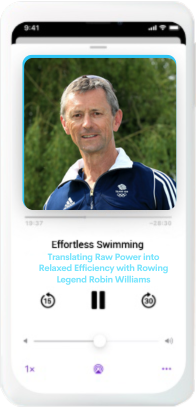
On this episode, we’ve got a guest who’s been at the sharp end of elite performance for over 50 years — Robin Williams.
Robin’s a former Cambridge rower and the coach behind multiple Olympic gold medal crews. He was actually recommended by one of you — a fellow listener — and once I dug into his story, I knew we had to get him on the show.
This episode kicks off with a promise: We’re going to uncover the lessons Robin has learned from decades of turning raw athletic power into smooth, relaxed efficiency — and show you exactly how to apply those insights to your stroke in the pool.
We’ll dive into his athlete-centered coaching philosophy, how to give and receive feedback without offense, and even explore some over-speed training hacks — no speedboat required.
A few standout moments to listen for: 🟡 The “spoonful of sugar” analogy that helped an Olympic champion transform clumsy pulls into effortless power. 🟡 A game-changing moment in Lucerne 2012, where one of Robin’s crews found an extra half second — and turned silver into gold. 🟡 And yes… the brutally honest feedback that once branded him “a gerbil on steroids.”
Plus, Robin shares three no-talent-required habits that any coach or swimmer can start using today to supercharge their training culture.
Let’s dive into this powerhouse conversation with Robin Williams.
In this episode
- Timestamps:
- 00:00 — Introduction and Background
- 01:03 — Evolution of Coaching Philosophy
- 02:13 — The Importance of Feedback in Coaching
- 05:10 — Coaching Techniques and Communication
- 08:15 — Power, Relaxation, and Efficiency in Rowing
- 13:08 — The Connection Between Power and Rhythm
- 17:18 — Finding the Balance: Tension and Relaxation
- 20:43 — The Role of Technique and Performance
- 23:29 — Optimizing Performance for All Athletes
- 28:16 — Breathing Patterns and Oxygen Efficiency
- 31:10 — The Importance of Aerobic Training in Rowing
- 35:13 — Drills for Enhancing Rowing Technique
- 39:41 — Exploring Speed and Performance in Rowing
- 45:41 — Mental Toughness and Team Dynamics in Rowing
- 48:28 — Building a Positive Culture in Sports Coaching
Links from this episode
- http://pillarperformance.shop
- Get your NanoClear swimming goggles here and get 15% off your first purchase with code PODCAST15.
- https://effortlessswimming.com/camps/
- Change your technique and swim a smoother, easier freestyle with the Effortless Swimming membership
Transcript
Read the full transcript
but when you when you're working harder trying to race or go faster particularly at the beginning of the stroke as the ore goes in you have to it's like lifting a weight in the gym you know you have to brace really hard so and also breathing is very is very linked to posture in rowing so in the we call it the recovery phase when you're coming forwards to begin you know to begin a stroke it's important to sit sit in the right way sit tall so the lungs can fill properly and you you're in a you're in by mechanical good position with posture and length at the at the beginning of the stroke so breathing is definitely part of that as you inhale it helps posture welcome to the effortless swimming podcast to show that help swimmers and triathletes love the water become a better swimmer and live a better life here's your host Brenton Ford
welcome to the effortless swimming podcast my guest today is Robin Williams a former Cambridge rower and coach of multiple Olympic gold medal crews robin was recommended to me by a fellow listener of the podcast so i thought it'd be great to get him on and this episode kicks off with a promise we're going to uncover lessons from 50 years at the sharp end of elite rowing and translate them straight into your stroke robin has spent decades perfecting the art of turning raw power into smooth relaxed efficiency and will dive into his athlete centered coaching philosophy how to ask for feedback without a fence and how over speed hacks and over speed hacks you can use in the pool with no speedboat required a couple of moments you might listen out for the spoonful of sugar moment it's a simple analogy that helped an Olympic champion go from clumsy pools to effortless power he also talks about a moment that happened at in Lucerne in 2012 where one of his crews gained an extra half second in the dreaded third 500 of a two kilometer race to search from silver to gold and don't miss the brutal feedback that once branded him a gerbil on steroids plus the three no talent required habits every coach and swimmer can implement today to supercharge their culture let's get into today's episode so robin thank you very much for joining me on the podcast I'd like to give those that are listening a bit of a background on how this came to be so we had a listen at the podcast Mike Taylor sent me an email and said
I love the conversation you had with Nick Winkleman and and Bobby McGee and someone who I think would be great to get on is Robin Williams so yourself who has a lot of experience in rowing so I'd love to chat today about maybe some similarities or some things that we can garner from rowing that can translate across to swimming and also the aspects of coaching how coaches coach how they can be more effective because I think there's a lot to be had and a lot to be improved when it comes to how coaches get their message across so welcome to the podcast robin thanks for joining me thanks very much Brenton good good to be here so in in terms of let's say coaching philosophies and the way that you've developed your way of coaching over the years how would you say that your what your approach and your style is like perhaps compared to what it was in the early days of your coaching I think it's a it's a constant evolution is one thing I think you know we were saying recently that as you as you get better and better as a coach of course you pick stuff up but it's difficult to get feedback people tend to get better education or more courses that sort of stuff and they become more qualified if you like but that doesn't necessarily mean you become a natural better coach so I've become really interested in that I always say to other coaches when I'm with them or mentoring them I say you know you your job every day is to tell these athletes how to swim better or row better or be better who helps you who tells us where we're where we're going a bit astray or whether we're doing things really well so in recent years that's what I've been doing
and I found it very rewarding I mean I've had a quite a long career in rowing I've been at it for over 50 years now believe it or not as a rower and then as a as a coach so it feels like it's it's brought things around to a full circle in a way and putting something back into I think coaches are so important because they steer the whole process athlete-centered but coaches are I think key to helping them get to where they're trying to get to in the shortest amount of time if that makes sense yeah absolutely what are some of those actually how would how should a coach go about asking for feedback because it can be I know personally like I uh depending on who it's coming from I'm going to be receptive to it or not and it can be hard to hear sometimes but often the feedback that is hard to hear is the stuff that we we need to hear so as someone who may want to give feedback to a coach what's a good strategy to approach them
I think you obviously have to have the right kind of relationship because it can be quite intimidating or even threatening to have somebody come up to you and say why did you say that why do you say it this way or that wasn't very good you know if if things are too blunt and you'd just be defensive straight away so I think you have to accept the right tone and normally when I go with other coaches I I generally do at least sort of three visits the first visit is a sort of getting to know you visit so there's some trust and you have a discussion about what are you seeing what are you trying to do and then it builds from there so I think it can take a little bit of time but the more honest the coach and the and the and the mentor can be or even a coach and a coaching buddy it could be a co-coach you know the more honest you can be the better the feedback because we'll all say oh brilliant well done that was fantastic because it's nice to hear and what's not to like but nobody's perfect and you know even the best coaches in the world can and should still improve but the question is is how if you're often say I use the example in rowing you know Jurgen Grobler was a legendary coach I mean he won gold medals that I think eight or ten consecutive Olympic games I mean it's astonishing record really and he's a sort of a figure of authority he runs a you know a very strong program and he's got he's got his strong methodology but I wonder how many people would actually maybe ride along on the bike beside the rowing lake and say hmm not sure about that Jurgen you know or even question him
it's much less likely to happen the more senior you get so I think that's interesting
but I'm working a lot at now at sort of club and intermediate level and it's very it's much easier there because you know I've been to five Olympics and I've got a certain track record and a bit of age in my favor so people feel quite comfortable I've finished my real competitive coaching so there's no threat there either you know what I mean but if I go into the national training center it's much tougher you know I'm not asked to give that kind of feedback to them but I watch them coaching and they're brilliant coaches I mean they're winning gold medals Paris last year you know is very successful but I still I still think there's that feedback could be given to those coaches they should want it it's just a question of how how you do it but I think it's really key you know and what about in terms of ways to ways to coach so one of the things I spoke on the podcast with Nick will comment about is using cues stories metaphors as some of the the ways that you can get your message across are there any particular things like that that you've come across in your time that you've used coaching that you've found to be really beneficial as there's actual coaching techniques or in terms of yeah coaching techniques well I guess in the early days I was I had a New Zealand coach mentor Harry Mann who's not with us any longer but he was a big influence on me and I thought he was a fantastic coach it was in the days when I was coaching Cambridge University in the University boat race which was a big deal in rowing in the calendar I did 11 years
there and Harry used to come over and visit and do some coaching and I basically tried to sort of copy his coaching style and it didn't work at all for me you know in fact I had athletes say to me that I don't you know that you were bombarding me with things I didn't follow what you were saying they gave me all this sort of really negative feedback and it made me question I thought I was doing it just like Harry that clearly I wasn't so I think you have to be original you have to be yourself but you can also sort of project the bits of yourself which are useful for coaching you know I think we all have this ability sometimes coaches say oh you have to just be you you can't be something you're not and that's true but you know if you're a naturally quieter sort of more passive kind of person then maybe you have to kind of rev yourself up a little bit and deliver a bit more passion and a bit more energy or maybe vice versa you know and I think this is where the feedback comes in because if if you know if another coach says Robin you know you're like a kind of a gerbil on steroids you know kind of thing you know way way too busy well I'd say okay well if that's how I'm perceived that I need to quieten myself down you know so it's how others perceive us so I've learned I don't have a particularly strong voice for instance so communication for me is tricky you know and in rowing as opposed to swimming pool you're quite a long way from the athlete so you need to work out communication
if it's verbal vocal you've got to choose what to say how to say it at the right time so that the row the rowers would hear it or you use a megaphone or a radio communication so communication is a huge thing for us because they're on rivers and lakes and it's quite quite difficult and I often say to coaches you know I don't know if swimming coaches actually get in the pool with their from as maybe they do but you could do feasibly and certainly with young kids that's sort of how you help teach them to swim but in rowing you can't do that you have to do it all through description you can't even really demonstrate because you're riding a bike and there in a boat so I think I've learned a lot about that you know on the on the communication side and I had one one athlete some years ago who said told me to my face I don't think you're tough enough Robin so I found that quite hard to hear but at the same time I thought well fair enough you know that's something I'm going to have to listen to so I think being being honest with yourself and not being trying not to be offended by feedback as long as it's sort of not malicious feedback of course and uh and I think the other element Brenton is that I've always when I was a rower I used to just enjoy with such a passion I worked in London I'd finish work and I'd race down to that river as fast as I could because it's where I wanted to be and I think sports should be enjoyable I don't know the word fun is I don't know if you know serious competitive swimming you'd call it it's a serious business but
but there should be satisfaction enjoyment and it shouldn't be you know I don't know what's the word a sort of a to grinding a negative process so I think coaches have that ability to bring atmosphere and and set the right tone and in a way that's our job because athletes will get tired or fresher have ups and downs because that goes with training I think coaches are there to kind of help steer that level straight course and you know that's part of our job as well so you know I always feel like I need to enjoy my coaching as much as you need to enjoy your swimming or your rowing yeah those are sort of broad lessons but they're things that I think go quite a long way absolutely in terms of the when you got the feedback about not being tough enough what did you do following that how did you change the way that you were coaching well I think it depends a little bit on the athletes that are in front of you because you know my at that time my assumption was to the athlete like well you're here training hard at national level I expect that's a given I don't expect to have to tell you to be tough or to try harder because that's a basic level that you have to bring to training every day because that's what everybody else is going to bring who you're going to compete against I therefore gave myself permission to be a little more relaxed and laid back whereas I think what the athlete wanted was somebody who's going to kind of bang the drum a bit harder and you know a bit more yeeha you know which isn't really my style so much but I thought well okay appreciate particularly
if you come into competition time you know the race briefing in rowing again it's quite tricky because you might have um you know it's mostly crew so you've got more than one person stood in front of you to be briefed for your race so you might have you know it could be a four or you know you could have an eight you know and you've got to look at a group of people in front of you and deliver your briefing in a way which presses the right buttons for each person you know and somebody they'll obviously some will be a bit up and some will be a bit lower um so I think when it came to race briefing I would make sure I checked in with this with this athlete and gave gave them the sort of you know thought you know the appropriate
type of wording and framework and um but I had um the two women I coached particularly through 2012 2016 Olympics Helen Glover and Heather Stanning it felt I didn't need to be like that with them in fact Helen was quite a revvy kind of person who would you know you'd have to hold her down a little bit and Heather was very very even you know so um and they were so tough on themselves the coach didn't need to be tough on them as well mostly so I think it depends a bit on the athlete really and it's again it's a judgment thing but um but it's not like one style of coaching fits all I guess is the lesson you have to you have to work out what's best for those athletes that are in front of you. Yeah which is it takes a while to get to know the different personalities and the different athletes knows what know what makes them tick and and the best way to to get the most out of them and it takes quite a bit of quite a bit of time right so I want to go into some of the technical aspects of rowing and see what we can take from rowing into swimming because I it's in in water there's a lot of common things I think there so I'd just love to get your take on a couple of topics if we can can go into them and the first one is the connection between power relaxation and efficiency so in in swimming one of the most common things that I see from people who come into the sport quite new quite fresh is they really try and muscle their way through the water and when you get to that more elite level things are smooth they are
they have this sort of controlled chaos in a way and it's it's quite a different approach once they they get really good and experienced in the sport so what was your what would what did you see at that that top end of rowing between power relaxation and efficiency
this episode is brought to you by pillar performance our new sponsors pillar are a sports micronutrition company and the easiest way to describe it is that while hydration and carbohydrates products will take you through to touch the wall as fast as possible pillar's mission is to get swimmers to the starting blocks in the best condition over and over again I recently started taking pillar triple magnesium after a friend had recommended it and it's been a game changer for my sleep and recovery I take one scoop 30 minutes before bed each night in the same way that you might start your day with a coffee I finish it up with the magnesium and recover better for tomorrow's session in the pool pillar performance is used by some of the biggest names in swimming and triathlon including zack stability cook yarn for dino ben canute ash gentle taylor nib amongst the host of other well known swimmers and triathletes where pillar differs from other micronutrition you may have taken before is both the quality of the types of magnesium and the tangible results that I see on my garment each morning if you'd like to try a pillar today head to pillar performance dot shop and enter code effortless for 15% off that's effortless for 15% off all first time purchases or for anyone in North America enter the same code at the feed dot com yeah look I'd say it's exactly the same as you've just described it actually mostly with less experienced rowers they they they kind of add complications they they they make it they make it more complicated than it should be but of course for the movement to look simple you've got to have very high competence so
I guess the you know that I mean rhythm is is a huge thing I'm sure you know I'm sure it is you know in swimming too but in rowing it's a massive thing and it's a very it's a word which people use a lot so when you talk to a crew after a race you know if the race has gone well and they're giving you feedback they'll all they'll always say oh we had a fantastic rhythm or if the race hasn't worked out they'll say yeah the rhythm was bad or it fell apart you know and they'll say these things and then you say well tell me then describe then what you mean by that by the rhythm and then they often get a little stuck and they can't quite put it into words so it's quite important that therefore in my world you know you do try and define good good rhythm because in rowing because there's a work phase and there's a there's a glide or recovery phase you know I suppose I'm trying to sort of think of a definition in a way which would be succinct here without going into big spiel but essentially that you know the power needs to be fed through in a progressive way so it's not bullying and tight and tense like you let your saying is well in swimming you're not muscling it a rowing or is pretty long you know so at the beginning of the of the stroke the loads are the highest and the leverage is greatest so if you try and over muscle that part then it doesn't reward you with any speed so there's there's a kind of a there are sweet spots in the stroke so that's definitely part of it the changes of direction at the start and the end of the stroke are very key so that the rhythm is not broken up by the ends where you're leaving or joining the water so I think
there are sort of parallels there with swimming um the power that you can deliver will help help to generate the amount of glide that you get so out of that what you get is the sense that if the rhythm is strong then you can row in a more relaxed way and if you can be more relaxed then sort of neuromuscularly or neuroly speaking you could you could execute better skill level so the people that muscle their way through don't give themselves a chance to be relaxed and sort of in control of their movements um therefore their skill level is lower so there's a there's a complete sort of correlation between these things but in in rowing I mean that you know you've got the person obviously they've got a boat that they're sitting in probably with other people as well and they've got the oar and then you've got the things all moving in different directions and so on so if you if you I don't know if you're listeners have seen pictures of of rowing eights but you know rowing eight is a weighs nearly a ton with all the people in it you know a big a big heavy big open weight men's crew it goes 20 feet per second through the water or more you know they're going quite fast and they just look like in some ways like they're like a kind of like a walk and who like they sort of physically just pumping this thing along but actually you know the the weight of the of a boat is about the same as one rower okay the weight of a racing eight is 90 to 94 kilos something like that about the same weight as one rower and there are eight rows plus a cocks in the boat so in terms of synchronicity given that you're you're all moving in one direction
then you've got to return to begin another stroke if one rower is even a hundredth of a second off time with the others for that moment on there on the loading point you feel the weight of boat is doubled and even for a hundredth of a second or a few hundredths of a second that's catastrophic you feel it in your muscles in your body you feel that I've met this sort of deadness you know so I think these are the intriguing things about water sports because there's this interaction between us and the water and and how you deliver power but also have feel and relaxation and they they appear sort of contradictory in some ways but they have to be brought together for it to work it's that dichotomy of tension and relaxation and it's about finding this the sweet spot in in between there and an analogy that I use in swimming is that in terms of how much we want to how much force you want to apply in the water it's almost like if you pick up a glass of water you're not going to grab it as hard as you can you're going to grab it with just enough force to keep the shape and hold it so you can lift the cup up or the glass and it's a similar thing with when we're extending forwards going through our catch in our pool it's like we need just enough tension and force there so that we we hold our shape and form but we don't need anything above that because then it's wasted effort and I imagine a similar thing applies through the rowing stroke as well yeah actually I did an interview with a guy called jack bowmont who stroked the gb men's
quad in the tokyo olympics and they got a silver medal and he was describing this sort of pickup point to me and he said he said imagine if you've got a bowl of sugar then you put a spoon in if you try and scoop out more sugar than the spoon can hold it just falls off the spoon and it's the same with your hand going in the water or the ore going in the water you know if you just if you're over ambitious the water just falls off you you know you you can only take the certain amount and I thought I really like that image because a lot of rowers will will snatch at the water or try and just get as much as they can get and you know I know as a not very good swimmer I'm sure that's what I do too you know in the pool I still I'm one of these sort of recreational swimmers that all the old ladies go passing me by like doing nothing and going twice as fast it's really frustrating even though it's a rowing coach I'm trying to tell myself the same messages that I would tell my rowers and then come on Robin you're swimming work this out you know but I that's where the coach comes in I need that feedback in the pool to get any better because I I sort of swim like that rather than like that I'm not energy efficient for sure you know so even though in theory I've got an idea of what I'm trying to do I clearly am not doing it well or it sounds like you you swim like I wrote I I wrote I wrote in college for I think it was just one year and I made the A the A crew because I was fit from swimming and we made it through our first race and then we're looking to qualify for the final
and I was the one in the eight that caught a crab and just ruined our race and I felt so bad I had no rowing experience before this but the amount of training that we did and you know just letting the other seven down and the coach I just felt I felt so bad but it was when everything was humming along and everyone working together it was such a great feeling just no one's talking you can just you can feel it you can hear it and I imagine you've had more than a few probably thousand hours of hearing that that noise is the they always leave the water and they click up and come back it's a yeah I I worked out that I think I coached that women's coxas pair for six years through two olympics cycles and I think I saw them do four million strokes thereabouts in that time you know and I often say you know it never got boring because they were great to work with and there was a sort of synergy between crew and coach with kind of mutual objectives and I always sort of felt that I mean rowing you know it is a physical sport there's no doubt that you might be technically not tip tip top but you could still win if you've got amazing physiology and you know it's a power endurance sport but they were I think the best rowers are intrigued by the the nuances and the sort of the the you know the the better we often say no technique is your gearbox you know your your
body is your engine or the physiology is your engine but your technique is your gearbox so especially as they were middle-sized athletes they weren't the biggest most powerful ones there so they had to really optimize the accuracy and then the synchronicity and so on of that technique so we had lots of these sorts of conversations with them about it's almost sort of philosophical really isn't it like how you think about what you're trying to do in the pool or on the river I often say to coaches you know that if you can get your athletes to sort of get their approach right the concepts in their head you know what are you trying to do you've done half the coaching job because they are then searching themselves whereas you know sometimes they just wait to be told the next thing oh okay and I'll do that now because you told me that should make me better but I think when they've internalized it and they're really trying to understand it and develop the thinking themselves I think that's the best most rewarding situation for the coach because you think now we're we're all we're trying to solve this together and they give the coach feedback the coach gives you feedback and it's this mutual lovely mutual cycle um it's a sort of real kind of meeting of minds in that sense I had a had a parent call me this week saying that they wanted to bring one of their kids along to a session to a clinic that where we do underwater filming and analysis so technique is is the main thing that we specialize in and they're frustrated because the coach that the kids got at the moment said but they don't do any sort of technique work the coach just said
they'll like they'll find their way and they'll find the most efficient way to to get to the end and in a way that is true but if you just leave someone to their own devices they are going to take a lot longer to get to that point and they're probably missing some really big gaps obviously I'm missing some really big things in there in their stroke and probably need some feedback and some guidance there so I think it's like the truth is somewhere in the middle you know it's people need a bit of direction you've got to steer the ship in the right direction then they can sort of go on that path and then you have to shift you have to steer it again and make sure it's still going in the in the right direction it's not um you can't just leave it to it to its own devices or it's just trying to get from point a to point b without a without a compass it feels like yeah I think that I think that's so true you know and I think also um I mean that's exactly true that if people were pretty much uncoached they could probably get quite a long way through experimentation and trying error trial and error and sort of copying other swimmers but it would take them longer so I think the coach can shorten down that process by helping them avoid the obvious sort of pitfalls and and and that's part of big part of the coaching job is just to help people streamline the process but I think um I've all because I I rode they have we have a lot we have slash had a lightweight category in rowing I was my race weight was 70 kilos and for for lightweight women it was uh 57 58 kilos and so
basically you're all the same size height weight and pretty much power so you had to look for what's going to be the edge here because I can't just be six inches taller because I won't make the weight you know or I can't be 10 kilos heavier obviously because it's not allowed so it made that's always made me think about you know the the the rowers who are or the sports people who are sort of maybe good but not not amazing how how you can help the sort of the average more average person if you like still achieve a really really good standard and maybe achieve their dreams and so you know I think I think a good a good coach can help those people a lot the people who are given granted you know the perfect body for swimming or for rowing or whatever their sport is they've just got that head start and other people because you know they've got the longer arms or they've got the better born with a better genetics but but there's a lot of people out there who can still win their medals and still perform at a really really high level if if they optimize everything else they've got and you know I had um there was a female lightweight rower um she won a gold medal in in 2012 at the at our Olympics in London she was um Sophie Hoskins would it be about maybe five feet five or so and at the time you know with the thinking was oh we need to find lightweight women who are more like five eight five nine tall you know tall lean good leavers and and probably in 2010 I think it was she came up to me and she said I'm look I'm training in the team I've given up work for
the time being to try and make this happen am I wasting my time because it seems like they don't want athletes like me and and I said to her well no you're not wasting your time if you if you can show show your speed and we can help you and and use you you meet the selection criteria why wouldn't it be you and I wasn't her coach her regular coach I have to say and that Paul Reedy who's actually an Aussie who was coaching him he he delivered them to that gold medal in in London but she was maybe not I mean she's a very good athlete but maybe not your sort of um what's the word sort of you know the target body shape that the document says these are the sorts of athletes that you need and I think sport is fantastic that there are so many people that there's no normal really you can be all kinds of shape sizes and physiology and still do really really well as long as you understand yourself and you get good guidance and help from your coach and people around you it's so true I mean you look at the Steph Curry in the in the NBA and obviously it can help to have some of these you know these height and limb length and that sort of thing it can absolutely help but you can also find a lot of examples where people have succeeded without that and I mean for me with the athletes I work with it's a lot of people who are doing triathlon as a bit of a challenge or it's it's their sport that they choose to do kind of recreationally and one of the things that I always come to me with is like especially men who are maybe 40s and 50s they're like I'm a sinker I just cannot float like I just
I just don't I don't float so I know I'm not going to be a very good swimmer but what they haven't been taught is well how to how to use their lungs which is obviously got the buoyancy and how to kind of shift that center of mass forward so that they can bring their hips and their legs up like they just they don't know what they don't know and that just either been told or they just believe that they're a sinker and so that they'll never be able to swim well but there's a lot of people who have maybe got a heavier build or don't have great mobility but they can still swim very very well so I think they've just got to take that into consideration and know that it's no excuse to just kind of stop trying or to limit themselves because there's a lot of other examples where they have succeeded with the same build. Yeah yeah yeah it's so true. In terms of I mean rowing I think one of the most aerobically challenging sports that I've done and seen just some crazy endurance feats that these guys are doing and in terms of the sort of breathing and like breathing patterns oxygen efficiency could you talk a little bit about that and what you see there with rowing because I think swimming particularly like a 400 medley or a 1500 freestyle also very challenging events where people are under a lot of pressure for a long period of time so what was your yeah what did you learn there? Yeah you know it's an interesting one because I think in rowing it gets overlooked a lot because you're sitting in a boat as opposed to having your head in water and you know you
can kind of within reason breathe as you choose but when you when you're working harder trying to race will go faster particularly at the beginning of the stroke as the ore goes in you have to it's like lifting a weight in the gym you know you have to brace really hard so and also breathing is very is very linked to posture in rowing so in the we call it the recovery phase when you're coming forwards to begin you know to begin a stroke it's important to sit sit in the right way sit tall so the lungs can fill properly and you you're in a you're in by mechanically a good position with posture and length at the at the beginning of the stroke so breathing is definitely part of that as you inhale it helps posture if we're in a seated position obviously as opposed to being horizontal and when you're rowing at a steadier pace it's quite easy to you know you can exhale and inhale again before the next stroke but when you're up at pace it's you know as you're describing in those sort of more sprint events or medley events where you're changing strokes there comes a point where one breath per stroke cycle is not enough you can't bring enough air through through your system so you have to you have to get you have to get two breaths in but I think I mean there is a bit of research on it I know I got a somebody I know down in Bristol who's actually I think she's a physiotherapist by trade but she's been looking at diaphragmatic breathing in rows and believes that there's there's some improvements that could be made if people looked into it more in in rowing actually and I think
actually rowers who quite often if rower gets a combined injury they'll send them off to the pool for some rehab you know and they always come back saying oh actually you have an enforced breathing regime in a swimming pool which which actually helps a lot when you when you're not in the pool when you're back in a back in a boat so I think swimming helps rowing but very much in that sense and when you're swimming just nice and steadily and there's not too much of an oxygen demand it's okay you know you can do your bilateral breathing or whatever one of the first problems non-swimmers find when they try and go harder is that the the rhythm goes to to pop because they have to work out suddenly well okay I can no longer breathe in that pattern and that becomes the sort of overarching problem until you know until they solve that so um yeah so I get you know I guess I guess in rowing the training side of rowing is geared towards building a big sort of cardiovascular resource because it's you know it's a sort of six or seven minute race you know and then you've got you've got the oar and the and the the drag on the boat you know there's loads load on your body and you have to produce I think open weight men are something like 500 watts of power over a over a 2k race you know it's quite a lot of power that you've got to produce so that sort of volume training is important so we're we're we're rowing around probably like when swimmers are doing just the sort of volume distance stuff you know low cadence um uh to just create this aerobic base
the problem is that so we do a kind of 80 20 split normally in a top typical rowing program 80% of your training is sort of aerobic volume stuff and 20% would be um crossing over into that sort of anaerobic and higher end stuff but the actual sort of speed work side of things is a relatively small part of the program and of course that's when the breathing challenge really comes in as it does with technique and everything else so it's a big challenge as to how do you give the the the the performer the experience of what it's like at the intensity end of the sport when actually almost all of the training is done kind of down the other end or in the intermediate level so it's quite a challenge but we do have drills and things which we bring in to try and to try and help solve that and teach them what are some of those drills that you do um well we we do um things like you know so like short strokes so for instance the full a full rowing stroke i'm trying to sort of think i mean we measure it in terms of the the arc that the ore travels through normally which is sort of 90 degrees if you've got the just the one or but in terms of distance the handle travels something like it's about six feet sort of 180 centimeters something like that so if we if we want them to do so if you say right do the whole stroke but i want you to up the cadence and up the power they're going to get fatigued quickly it becomes hard very very quickly i think you use about 85 percent of all of your
muscle groups in rowing almost every muscle is engaged so everything's producing lactic acid there's very little chance to sort of flush stuff through you know so one of the things we one of the things we do is say okay well if you row like one quarter slide or one quarter of the stroke the back quarter you can effectively practice the whole of the back part of the stroke but at a higher cadence but without carrying the physical sort of penalty or workload with it so you you can be up at a racing cadence just on that part of the stroke and you could do that for you know several minutes if you want so you're producing the speed of movement and the flow and the rhythm and the and the all the kind of biomechanical stuff in just that section of the stroke so i think a lot of sports do this you know runners they do they do kind of high high knee lifts and sprints and this you know short sprints or short step work it's the same principle really so you take a compartment or a piece of the stroke and try and and and drill that and then of course you've got to put it into the whole thing again at some point which is always going to be more difficult but i mean that's typically what we do but we try and make them sort of you know really functional drills because what we find is that if you do a drill at so low effort low cadence that's fine to just get the correctness part of it but it doesn't mean you'll do it up at pace when you're working hard
quite often people drills can look quite pretty and quite nice when they're just sort of incomplete control and calm so we always say you have to stress test drills so whatever the drill is you then i i normally say okay now do it still with a low cadence but put more power in to see does your body now tighten up or can you maintain competence and then have the power and the cadence because that's ultimately what we're trying to do when we go out to race so that's a sort of the process for drills that we use not to just do them for the sake of doing drills but to do them because we're looking for a specific outcome. I had another guest on recently andrew shave who's an american swim coach and we spoke a lot about drills and he mentioned something very similar where it's okay we might go slow might go easy because we might need to work on a particular movement and one for swimming is is the catch it's that initial movement it's a big one one of the drills that we do in our clinics is is just that catch movement like just just practicing that horizontal just get them to bend their elbow and point their fingers down because most people just do it the wrong way now it's all well and good to do that slowly with fins on and everyone gets it right doing that but then we need to build it up with the speed and the power and ultimately people will fail at doing that at speed that yeah initially if they don't have a great catch it's going to take a while to build up to that but yeah you do need to to really just push it and and do it at faster speeds or whatever it might be
so we advocate a lot for drills and I think a great way to do it is part of your warm-up in swimming and that can help set you up but yeah it does eventually have to be done at speed or really have to challenge yourself throughout the drill can you do can you do like over speed drills in swimming yeah so one yeah you can so basically a lot of people a lot of sorry coaches will give something like 15 meters of over speed where they're looking for the swimmer to get their rating up very high let's say it's like 110 120 strokes per minute individual strokes and have very little hold of the water so they're basically spinning the wheels let's say it's freestyle for example so you can and the tech the technique will suffer a little bit but they do it just so that when they eventually come back down the stroke rate will feel easier and they've kind of just like fired up the neuromuscular system so yeah you can but I guess it's a little bit different to rowing you can't really do a half stroke in freestyle anything like that no I mean it's a tricky one in rowing because I mean you don't want to do half strokes or quarter strokes you you want to practice the whole thing but but like you know runners can do it usually because they just run downhill or if they're doing resistance work they can drag a parachute or a car tire or or another person or something like that behind them you know you can you can resist or assist cyclists can do the same thing because they can easily over over spin the legs downhill
uphill you know so in it's an interesting one because in rowing you know if you take a like the the the target speed for a from the open men's eight to olympic target is five minutes 17 you know but nobody's ever gone that fast but they've got to 518 it's it's territory nobody's ever experienced but probably in 10 or 15 years time somebody will do 517 or 516 so it'll happen the question is how do you how do you sort of preempt it or make it happen you know how do you how do you find out what it's like to go to speed that nobody's gone before so we've tried towing boats at speed but the trouble is you know if you have a long rope or something to a speedboat you know it's going to be very very long otherwise the weight from the speedboat upsets the rowers because they're in wash and also a rowing boat the speed kind of slightly oscillates because it's not you know there's two phases to the rowing stroke so it's you can easily resist because we add straps around the boat or you know you can do that obviously in the pool as well so adding resistance is quite easy and quite straightforward you just swim in a t-shirt or something but the assist I think is is is a bit that fascinates me because you're trying to say to somebody it's like a simulation you know if you could swim as fast as I'll say Michael Thorpe because he's a name that is it might know Richard Thorpe I can't remember who was the famous Ian Thorpe it's the ASEAN and Michael Thorpe it's all my first things wrong Ian Thorpe
like most of us will never experience swimming that fast but if you if you could be going through the water at the speed that he went through the water it would be mind-blowing so I find that kind of that side of it's quite intriguing how do you give the the the rower or the swimmer the experience of going faster than they're capable of going because if you can show them what it's like they might be able to solve the processes that actually the necessary the speed of the although technique of the catch at the muscle contraction whatever you know so it's an interesting one at effortless swimming our mission is simple make swimming more enjoyable whether you're training for your next race swimming for fitness or just love being in the water we're here to help you swim faster smoother and with more confidence and one thing that can make or break a swim is your goggles if you've ever struggled with foggy lenses mid-session you know how frustrating it can be that's why we created the effortless swimming hydro clear anti fog goggles for long lasting crystal clear vision I've been using them myself and the difference is night and day and I'm not the only one Deborah swam 36 kilometers down the Derwent River and the entire time her vision stayed crystal clear no fog no frustration just an uninterrupted swim so what makes a hydro clear goggles different it's all in the technology unlike ordinary anti fog coatings that wear off over time hydro clear super hydrophilic technology is built into the lens material itself his artworks instead of fog forming as tiny droplets water spreads evenly
across the lens creating a thin film that prevents fog from even starting and the result consistently clear vision swim after swim and the durability our lenses are cnas certified tests show that even after 2000 rubs with a wet cloth under a 200 gram load the lens stays fog free no gimmicks just serious performance that lasts using them as simple just wet the lenses before putting them on and you're set for a fog free swim ready to see the difference yourself get 15 off your first pair of hydro clear anti fog goggles with the code podcast at shop dot effortless swimming dot com that's 15 off your first pair of goggles with the code podcast at shop dot effortless swimming dot com we also have a 30 day money back guarantee so if you're not happy with the goggles for any reason you can simply return them for a refund don't let foggy goggles ruin another swim try hydro clear today and experience clear vision from start to finish yeah that actually reminds me so they we do have like rubber not rubber bands elastic cords that people will swim against and then they can also get pulled in by the coach so they can go over speed that way and I know at the AIS in Canberra I don't know if they still got it but they used to have a electronic device at the on the roof and they attach it to the swimmer at the hips and they would actually get pulled along at speed and I had some friends who had used it and they said it's just swimming at world record pace at the time
was like a 48 second 100 freestyle they said it just feels unbelievable like it just it feels feels so quick and like it is just it's mind-blowingly quick and and one thing I've noticed when I've watched Olympic level swimmers compared to even just very good swimmers it's there's a whole another level to it and I imagine this is something that you've seen in your in your coaching like there's just you know you watch someone who can swim very very well but then coming across the bit like the top point or 1% in the world it is just you notice it you can see it you can you can just see something different about them is that something that you you've noticed in your time coaching yeah definitely I mean I think when I was working at the national training center with the national team there you collect so much data in training that you sort of know your speeds and it's an outdoor sport so you have to factor in water temperature and wind direction and things like that plus the fact that crews change a little bit because somebody might have a small injury one day so they change change somebody in the boat but there are lots of variables but on the whole you you build up this body of data so when you go to compete you know already that you're in sort of final a territory or podium territory you know you know that you're in there with a good chance of of having a having a crack at the top top result but I think I mean in my own case when I was rowing I think the early stages of people are you know as you get better at a sport you think I've got a chance of winning
and then it becomes like a very good chance of winning and then it becomes a very small a very small chance that you might lose that in other words you're more likely to win than lose and I think those swimmers and performers who are just out in front the chances of them losing are really small and it would usually be something like you know maybe something like a slight they've had a slight head cold or maybe just on the day there they've got some other little stress or something going on it be some some sort of interference like that I remember there was a race we did with the with the women's pair in Lucerne in Switzerland one year and we had big rivalry with Kiwis actually and they had this very good women's pair that were trying to beat us and I'd said to the two to the two Brits over 2000 meters we'd split it down to 500 meter chunks and you get split times for that and I said to them you know you're quick off the start you have a very good transition into the mid part of the race and the third quarter which is where all actate kicks in and it starts to really bite hard I said you know they they they're they're sometimes a bit quicker than you there you know why why should they be quicker than us if we're better we're better you know being better off the start is about some dynamics and sprint and so on the transition into rhythm we can do with that so if we're fundamentally faster we're faster anyway they took that on board and in in that particular race in the third quarter of the race they took another half a second off the Kiwis
and we got to the end of the race and we I was I was sort of really quite tearful because it was such a brave hard thing for them to do but I said you look at those results and the opposition there's no weak link they can analyze in your performance because in every quarter of the race you've had a superiority even if it's been by a width of a fingernail and I think that's what the top performers do is they they can they can just judge those pacing and those fine margins I mean the touches on the end of the pool amaze me but the person who's won they know they know that they're winning and that they're always going to win and it to a you know just watching from your couch at home I mean it's mind-boggling how slim the margins are but the winners win you know yeah it's I imagine at that level too a lot of it a huge component of it is going to be the mental side of it and not only the mental resilience but also just the the confidence and knowing that you've done the work and almost seeing your competitors as as no we're like they're not as good as us like we having that sort of confidence and I see this in a lot of the top performers like some of the top Australians from as lovely lovely people but when it comes to racing they flick a switch and they are like they hate losing they absolutely hate losing and I you know I think that that kind of almost has to be the trait of of those that are going to win a gold medal they have to have
a little bit of that in their mentality where where they just hate to lose what did you see with the with those two great britain rowers so something something like that that sort of mental attitude definitely I think what I I don't know how it is in swimmers but I think a lot of rowers I think that that they they're sometimes quite sort of like understated type people you know that they're sort of not necessarily quiet you know what I mean they're they're not like you know how like boxes they basically goes with the trade you stand there and you say I'm gonna you know knock you flat and you're you're terrible I'm great you know it's very outward kind of toughness bravado
you know I think a lot of rows have have that it's very much an inner in inner toughness so like like you're saying with a lot of your swimmers you know they're just regular people conversationally and away from the sport but when they get in when they get in the boat or they they're on the water they just have some extra level of toughness and and self-belief
I think I think another thing that plays into rowing a lot which I love is is the loyalty aspect so I was doing a bit of work with a spanish a couple of years ago and we had a two person crew and generally the first round of the race didn't quite work right you know so we we switched the order round and and and it produced a different sort of slightly different psychology in the boat and you know they would try harder harder for each other than they could individually if that makes sense if you put them out individually they'd push hard but when you're in a crew with another person or other people you'll drive yourself to the very very very limit for the sake of other people and I love the fact that it brings that out of people you know people will work hard for other people not just for themselves and in the single skull in rowing which is I guess like being an individual swimmer there's an element of kind of you've got to be slightly mad to do it really you know because it's it's super super tough I mean on your own you've got nobody to sort of help you along or give you an encouraging call so that they're they're a breed almost you know in their own really the single scullers which I think is you know
sports where you are the you know an individual person I mean it's it's that's how you have to be but I think crew rowing is I love that dimension because yeah you know I can think of more than one rower who could achieve something extra in a crew boat because they've got this interaction with their crewmates and they'll they'll they'll kind of go to the end of the earth for them you know literally sort of in a in a physical mental sense in a race it's very much the same in in swimming I know like the like the coaches the and the swimmers as well they they just all look forward to the to the relays like talking about the Olympic Games it's just you see a lot of incredible times swam in those relays and yes like people are a bit faster because they've got a a flying start you know it's a they don't have to leave when the buzzer goes they can leave a bit earlier when someone's coming into touch but outside of that like you just see some some absolutely crazy times because yeah those people put themselves aside and it's just doing it for the for the team and it's I just love watching the relays at the Olympics for that for that reason and the fact that Australia is fairly competitive at the moment also helps with that it's nice to watch yeah yeah for sure Robin so when you're like you go around and run workshops and clinics and things like that for the coaches and you've done this with throwing and and just for coaching as well are there any particular messages that come to the
front of your mind that you try and get across every time you're you're doing these like some some real things that have just kind of been there that are that are fundamental that you think all all coaches or all rowers should should know this yeah there are actually and I've learned a lot from doing it because you know I get to see a much bigger variety of of clubs and rows and coaches than I than I used to when I was just doing my national job so there are three things really Brenton so the first thing and they're in order actually the first thing is sort of the culture like when you go to a club and you walk through the door of course every club feels a bit different but the atmosphere the buzz just the joy of being there the sense of understanding what the club is about these sorts of things I think count for a lot
so from a from a performers point of view or athlete point of view there are clubs you know the best clubs you go through the door and straight away you feel welcome you understand if is it a participation level club is it a high performance club you know but you understand what you're in there to do and therefore you understand your role and people support you and you've got like-minded people so I think the whole cultural thing is is huge I think the thing that then stems from that is the actual coaching because in clubs and any club or any crew or any athlete that's doing well is inevitably going to have a coach there that's working hard and producing those results and when the coach leaves that club for whatever reason quite often the club will drop a few levels until you have another inspiring coach come along so I think the culture and the coaching sort of go together because the coach is there so every day and you know your attitude and the energy you bring to coaching is part of the culture of the club you know if you were a good coach in a club with weak culture it's like pushing a broken down car it's hard to get things to happen so culture coaching and then the third thing I think is that is the training and technique so I think you know they follow from each other and so those are the three main ingredients and they're pretty obvious I suppose when you think about it but in reality for all sorts of reasons it does vary quite a bit when you when you go around different regions and different different parts and usually because
people just you know they're working hard in their own situation because they have done for many many years but they don't always have the perspective that says an outside person like me you can bring in and say like I had one the other week where they were it was a really simple thing actually this is sort of slightly cultural so that it was seven in the morning they all turned up for training the coach did the briefing and and then my assumption was okay we've done the briefing now we go rowing but half of the half of the group went back in the changing because they weren't changed so half were changed and half weren't
and I said to them is that isn't you know why is that and he said well you never thought about it you know we just turn up and brief and so it brought in an extra 15 20 minutes of dead time or sort of faff you know and I said well if you just got everybody changed do the briefing go rowing you're going to gain 15 minutes towards your training if you want it and that accumulates over time these little sort of efficiency things mount up you know and at club level where people have got jobs and they're fitting their sport in and around life and other things you know it becomes quite important so they're often quite obvious things but they don't yeah will we see them yeah but when you're when you're when they're in it you they don't they don't see it right it's just the way that's been done and then not not aware to it and just take someone like yourself to open their eyes to something super obvious that that might be cool because of NTRs actually no talent required that you've probably seen those but there are sort of slides and I like that you know things like turning up on time being prepared bringing energy you know helping out etc you know these are things that
should be embedded in the culture of a sports club before you even start your training session because they don't require talent they just require attitude and full thought really so I think that kind of stuff goes a long way and I one of one of my mentors was was talking about like what you know what is what's culture it's well it's it's basically about like it's how people almost feel or how they associate with with the club and that's just all these little things that all these little things that happen it's like saying hi saying goodbye when you when you turn up it's having a smile on your face it's it's getting there on time it's encouraging your teammates it's like it's all these little actions that that build the culture and it's nothing that's that's difficult it's just it's all these little little things that that add up that everyone can do just these small actions so when it and when it when it gets shown or when you get told that like that's that's how you do it it becomes really tangible and it's not this thing it's like all right we need a good culture it's like well it's just all these little actions like you know we can do this doesn't matter how how bad your rowing team is or how bad your swimmers are they can all contribute to this this good culture so and my dad was my coach growing up and so from when I was about 11 I think he started coaching me and he he was adamant that everyone says hello to him on the way in goodbye on the way out we use each other's names just little things like that and it was just such a like I was 11 I was 12
I was like god why is he making such a big deal of it but I can see now that it was a really important part to building the the club up and having people enjoy it and having people look back at that when they're 30 and going well wasn't that such a great time that we spent together so yeah all those little things are really really add up yeah yeah definitely Robin thank you so much for your time I appreciate you jumping on here and particularly being in the UK it's always hard to organize a a time but I appreciate you getting on nice and early for the podcast and I'm looking forward to showing this without our listeners because I love getting fighting lessons from other sports because there's obviously a lot of crossover but there's things that we can take from it from other sports that will help us in swimming so thank you very much for sharing all that you did on the podcast and it's been a pleasure Brenton nice to meet you and not that early for me but it's a little bit later for you in Melbourne there so thanks for making this happen it's been enjoyable my pleasure thank you thanks then bye bye thanks for listening to the effortless swimming podcast if you'd like us to help you become a faster more efficient swimmer go to www.effortlesswimming.com