








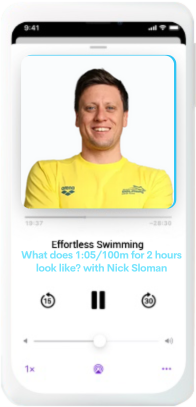
Imagine holding a 1:05 pace per hundred for nearly two hours—no walls, no turns, just pure precision. Every stroke efficient, every breath controlled. How do you sustain that kind of speed without breaking down? What should your catch feel like? And how do you stay smooth when the ocean, the pack, and your own heartbeat are all working against you?
In this episode, we dive into the story of Nick Sloman. He’s not the biggest guy on the start line, and he wasn’t a childhood prodigy. But over 12 years, he turned sheer efficiency into his competitive edge. After missing Tokyo, he rebuilt himself—not by training harder, but by learning how to swim smarter. His insights on feel for the water might just reshape the way you think about endurance, technique, and what it really takes to go the distance.
01:07 Head position
01:46 Posture And Body Position
02:20 Kick for balance
03:29 Breathing Pattern In Training And Racing
03:54 Catch and cross-body connection
05:20 Video analysis
06:02 Stroke rate
06:22 Open water swim technique
06:48 Stroke changes in open water
07:30 Sighting
08:03 Drafting
08:27 80km a week!
09:13 Hard swim workouts
11:52 Hardest race
13:30 Rest when you’re ___
Join a camp:
https://effortlessswimming.com/camps/
Try the new Nanoclear Anti-fog Goggles: https://bit.ly/nanocleargoggles
Transform your freestyle to be effortless and smooth with online video analysis:
https://effortlessswimming.com/courses-membership/
Follow Nick’s journey here: https://www.instagram.com/nick_sloman/?hl=en
Watch on YT:
https://www.youtube.com/watch?v=Lohe5CMAOQs&t=637s
Transcript
Read the full transcript
Welcome to the Effortless Swimming Podcast to show that help swimmers and triathletes love the water, become a better swimmer and live a better life. Here’s your host, Brenton Ford. Imagine holding 105 pace per 100 for almost two hours. No walls, no turns, just precision, every stroke efficient, every breath measured. How do you move that fast, that long, without falling apart? What does your catch need to feel like? How do you stay smooth when the ocean, the pack and your own heartbeat are fighting you? Nick Sloman isn’t the biggest guy in the start line. He wasn’t a child prodigy but through 12 years of work he turned efficiency into his edge earning his place at Paris 2024. After missing Tokyo he rebuilt not by swimming harder but by learning how to swim smarter and the way he talks about feeling the water might just change how you think about endurance and technique forever. Hi, I’m Nick Sloman, five-time Australian open water champ,
five-time world championship representative, also six-time surf race champion as well. Something that I’m really trying to work on at the moment, I know Craig’s really anal about my head position. I struggle with trying to keep it down because in the open water I’m always constantly looking up and so my head position is generally fairly neutral. I’m always trying to look down at the tee or at the sand in open water. It might not always be like that. Under fatigue I generally look up a little bit but I’ve been trying to try and obviously relax the traps and try and keep my head as neutral as possible. I know I want to try and keep my legs as boring as possible so for me trying to suck my my hips up a little bit almost like ass to the sky when I and sort of chest down that way I can sort of stay on top of the water because in open water you you’re trying to almost be how fast can you swim slow essentially and that allows you to
swim long distances easily but also just trying to stay on top of the water is where you want to be. A kick for me is more about balance. I know historically I’ve had a quite a strong kick. I’ve been really trying on limiting the kick for longevity of my career as well as trying to have that change of gear and that last sort of 1000. So for me it’s it’s a soft sort of three beat I would say. I’ve been working on trying that the one beat so one kick per stroke and and obviously when I’m picking up the pace it’s it’s going to be quite frequent six beat kick. That’s what I’ve been trying to do sort of the last sort of six months. I’ve really been trying to focus on efficiency. I know Singapore was was one to sort of really highlight my inefficiency when it came to my heart rate and and stuff in comparison to everyone else so I’ve been really trying to work on trying to limit that kick try and swim as fast as I have been but with less propulsion from the legs.
It’s pretty stable like it’s it’s to the left I know it’s a it’s probably not the greatest habit to get into but just see if I can reach out on my right arm and get purchase on that. I find that I’m a little bit more balanced and if frequency of breath is very important for swimming long distances every two years. I’ve been working recently on trying to get pressure on the outside of my hand. I know that I have a tendency to kind of push out on my stroke so that’s something that I’ve sort of thought about is getting the pressure on my outside of my hand and almost pulling across myself because I want that cross body connection. Obviously I’m a smaller guy so I want to be able to use my whole body rather than just my arms and legs to get as fast as I can so that outside of the hand will allow me to kind of pull across and use my other hip to. Hey real quick in case you didn’t know we run swimming camps around the world from the Maldives,
Thailand, Japan with Sundays, Galapagos Islands plus a bunch of new locations for next year. So if you’d like to join us at a future camp and improve your swimming and explore and experience some of the best locations to swim in the world then go to effortlesswimming.com forward slash camps. We’ve got all the dates and locations listed there. A question I get all the time is I’m not that quick will this camp be suitable for me? We have a wide range of speeds and abilities come to the camps so as long as you can swim a kilometer there’s a very good chance that these camps will be suitable for you. And if you’re not sure just get in touch with us and we’ll make sure that we do find you a suitable camp. Thanks for listening let’s get back to the podcast. Get purchased on the water. When I was a junior there wasn’t much technical expertise it was more how hard can you go for as long as you can. Now that I’m obviously moving with Craig
we’re analyzing it a little bit more and just trying to find that one percent.
Obviously when I was younger I’d look at videos and look at
champions when watching them on TV and just trying to almost copy them and almost have a habit of almost picking up what they’re doing and their bad habits almost. So over the years I’ve kind of just almost trying to find my own technique and what works best for me and finding little cues like the outside of the hand and that one beat kick and just trying to find as much efficiency as I can essentially. I’m quite high typically over a 10K I’ll sit at 40 strokes a minute towards the end maybe up towards 50 typically sitting around that 41 42 right on average. My head position is probably one that Craig’s most anal about. In open water it probably doesn’t matter too much because you’re constantly looking up to sight but in pool you’ve almost got to be perfect or as close to perfect as you can and that head position allows my arse to get up and have a better body position so that is what I’m when I’m in the pool is probably what I’m focusing on the
most. The rule that I kind of work against is when I’m heading into the chop I want to rate up with my my arms and then when I’m going with it I want to rate up with my legs. Typically that’s worked best for me. Higher rates I know I can get in a better rhythm even though it may be inconsistent chop or anything like that I can find a little bit more balance with a higher rating. When I’m going with it I can relax a little bit more and conserve in that way but I also want to lift up my back end so that I’m actually catching those runs. I would say once every 10 strokes it would also change on the length of swim as well and how many people are around me. If it’s a large pack and I’ve got guys either side of me it’d be less and maybe in a relay it’d be even once every three or four strokes because the line is very important you don’t want to be swimming too far off course when time is of the essence so I guess it just depends on
on the the distance and and what I’m trying to achieve. Again it depends on what I’m trying to achieve. If I’m quite fatigued and I know the people around me are in a better position then I’m probably going to stick to the hip try and slow them down but if I want to conserve as much energy then I might drop to the feet so they can swim a bit quicker and again it it just depends on what I’m trying to achieve.
Earlier on in my career I was averaging close to 80k a week it’s a little bit less now it’s probably around 70 70k a week. In Hungary I got close to 100k and half of that was other strokes it’s just the Hungarian training regime they just love doing obviously different strokes with different muscle groups and stuff like that and it was probably the most mentally taxing period of my career but I learned a lot from that from an endurance perspective and there’s a reason why they’re the best in the world. It’s like a a make or break situation.
I quite like the more challenging sets I just feel like from a mental perspective I feel like I’ve achieved something so I always liked doing the 31s even though like it was extremely tough the 31s on 140 just best average as much as like in the moment I’m probably hating myself but I just feel like I can get the most out of that from an endurance perspective probably more so now that the set I did this morning was two three hundreds paddles pull buoy just relaxing A2 and then off the back of that 400 best effort and we do that maybe four or five times I try to hold under a minute if I can on my best days I can hold 57 58 and then on my bad days it’d probably be around that one minute 101. Of late I’ve really been trying to hit out more heart rate zone rather than a pace so with my sort of zone two work anywhere between 130 to 140 beats per minute maybe like a 108 107 my strength is really in that 170 to 180 zone
where I can sort of hit down to that 101 102 pace historically I’ve been able to hold that for pretty much all day and then anywhere in the red zone would be anything under a minute uh yeah it’s um I think it’s a an in thought set that’s where we did nine four hundreds we start on five and we drop 10 seconds each time and they do it in sets of three so we’ll go five minutes for 50 for 40 back up to 450 and then for 40 for 30 then go back up to 440 for 30 for 20 and the idea of that is to start at a one a two a three and then a two a three threshold a three threshold the o2 max and by the end of the set I’m hitting close to four minutes I would typically start at an a one maybe like a a 440 like 110 pace and then it will be dropping maybe five to 10 seconds each 400 the couple in in recent years um swimming in the in the sand in paris was one of the toughest um for its own like environmental reasons like it we were swimming against a current that was
over one meter per second so it was good while you were going with it but when you came back into it there was only really one spot where you could sit and it it was very physically demanding another one would be Singapore just just went um we were in temperatures outside of like 36 degrees plus and in the water it would have been over 32 degrees on average um I ended up being over 180 beats per minute for one and a half hours so that was tough physically um I left that almost on a stretcher there’s been many races where I’ve been pulled out and and taken to hospital it’s almost one of those things that I sort of don’t know when to stop um I yeah just find a whole another level of of you know focus and in can push myself past what’s physically capable of myself and yeah those races really spring spring to mind with with physicality and and also like mental fortitude as well um you kind of get to halfway and you think oh
shit am I am I gonna do it or or whatnot and yeah those those races of recent times have been extremely tough uh I guess it’s just um what my old coach JR used to instill in me is is discipline like you rest when you’re dead essentially mentality and and it was all those sort of work that I did leading into it I didn’t really want it to go to waste so you know there was 11 years where I didn’t really take a break bigger than two weeks and that was forced because of hotel quarantine so it those times sort of spring in the back of my head and basically tell me not to give up and just to keep going thanks for listening to the effortless swimming podcast if you’d like us to help you become a faster more efficient swimmer go to www.effortlesswimming.com