








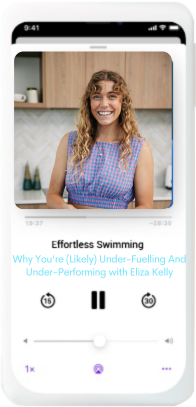
Discover the nutrition secrets that could make or break your next long swim—are you fueling properly?
Swimmers and endurance athletes often overlook crucial aspects of fueling, leading to fatigue, poor recovery, and even injury. In this eye-opening episode, registered sports dietitian Eliza Kelly shares behind-the-scenes insights from a 55-kilometer open water swim, revealing how altitude, heat, and unexpected challenges demand real-time nutritional adjustments. Her experience coaching elite swimmers and triathletes will change how you approach long training sessions and races, ensuring you stay energized and perform at your best.
00:11 Introduction to the episode and guest
01:12 Eliza’s background and work with swimmers
04:23 Details of the 55 km swim in the Kimberley
05:38 Managing nutrition and hydration during hot swims
07:27 Electrolyte and sodium considerations
09:20 Adapting nutrition in real-time during a swim
12:13 Lessons learned from the Kimberley swim
14:39 Common nutrition mistakes athletes make
19:06 When and what to eat during long sessions
22:45 The importance of fueling and avoiding hunger
29:59 Iron deficiency in swimmers and endurance athletes
31:06 Testing and optimizing iron levels
32:26 How to connect with Eliza for nutrition support
Transform your freestyle to be effortless and smooth with online video analysis:
https://effortlessswimming.com/courses-membership/
Try the new Nanoclear Anti-fog Goggles: https://bit.ly/nanocleargoggles
Get in touch with Eliza:
https://www.fluidperformancenutrition.com.au/
Instagram: https://www.instagram.com/fluid_performancenutrition/
Transcript
Read the full transcript
Welcome to the Effortless Swimming podcast to show that help swimmers and triathletes love the water, become a better swimmer and live a better life. Here’s your host, Brenton Ford.
Welcome to the Effortless Swimming podcast. My guest today is Eliza Callie. And Eliza is a registered dietitian and sports dietitian. And we met up in the Kimberley on basically because she was up there to help support Andy Donaldson, who we’ve had on this podcast a number of time, who is an ultra marathon swimmer, world record holder. And he was doing his 55 kilometer swim down the Ord River. And we were on the same boat together for that swim. And so I want to get Eliza on today to talk a little bit about some of the things that we saw in person in real time on through Andy’s swim and some of the things that had to change halfway through with his nutrition. And then covering some topics that Eliza’s worked with a lot of swimmers and a lot of marathon swimmers, some of the main mistakes they make some of the gaps in their nutrition. So how can you as a triathlete or a swimmer, make sure that you’re fueling the right way so that you can
recover better and ultimately perform better with your swimming. So Eliza, welcome to the podcast. Thank you. What an introduction. We did literally meet in the boat.
Yeah, that’s a 12 hours together, you get to know someone reasonably well on a boat for 12 hours when you’re going down the river. So you’re the partner of Andy Donaldson. And so you’re kind of along for the swim there. But you’re also a registered dietitian. And it was interesting to see you kind of have to respond to what you saw Andy was going through on that swim and then maybe change up the nutrition plan a little bit. So I think that’d be really good to cover here. But before we get into that, you yourself for a summer, and you’ve worked with a lot of swimmers as well. So can you just give us a quick introduction about your background and who you typically work with? Yeah, for sure. I think my, I guess, as a quick overview of my journey into being a dietitian and sports dietitian started off with my background of rowing, which that originally sparked my love for community, sports, how can I go better, move faster, move together as a team. And then
that sparked my interest in sport. And then I went down the sports nutrition. And then through that, I kind of when I went into private practice, saw a lot of different rowers come in, which I’ve now realized are actually quite similar to pull swimming training. The load is actually quite high at similar hours, things like that. And then that also prompted to boot quickly onto triathletes. Because when I finished rowing, I then picked up cycling classic. So then that tripped and fell into triathlon. And then I saw that in my client base as well. And I just always had a really big interest in the longer distance. I do see also, I see also team and shorter, but I love that journey of planning a long distance event, because there’s lots of different things to think about. Not just how do I get from A to B as quick as I can, what curveballs do we have to also consider. So and then that kind of actually doing some
talks for a swim club here called eSwim, the coach kind of cornered me and said, I made a comment like, Oh, I’ll do a roto swim one day. And she’s like, Why not this year? And I was like, Okay, and then that kind of that’s how I met Andy. That’s how I made a lot of friends and tripped and fell into the open water swimming community. And I found my way onto the boat there. I hope that’s a nice little summary. So that’s kind of shows in my work and clientele of who I see as well. Yeah. And I think that’s a great introduction. And in terms of like the interest that I found for me with coaching, it’s like I was always interested in technique and how can I personally get better. And so I was always watching videos and DVDs and always just trying to improve as a swimmer by improving technique. And then that fed into my actual work as a as a coach when I started off. And it sounds very similar for your nutrition journey as well.
It’s like you got an interest yourself. So I think that’s a provides a lot of motivation to want to learn and be able to grow and improve as a as a dietitian. And if we fast forward, so if we go back to the being on that boat. So just a quick overview of that swim, it was 55ks down the Ord River in fresh water. That’s about 28 degrees Celsius. And this this swim, it’s in basically it’s quite a hot place. It’s it’s very it’s a dry heat, but the sun’s out. And it’s essentially very different than what Andy had done in the past. Yeah, he’s used to these cold water swim. You don’t have to worry about getting sunburned and things like that during the North Channel and English Channel. So this was something that was very different. And so it seemed like just that not necessarily the preparation for it, but just like the the planning for it was very different than what it would be for those other swims. And so we saw
some different things happen to him throughout that swim that we that you kind of had to account for in terms of his feeds and stuff like that. So can you take us through what you noticed was happening, how how you ended up sort of dealing with it and changing the feeds and that sort of thing? Yeah, it was actually a really interesting experience to be a part of. It was kind of like a live case study. So I know he is my partner, but if I think from a like a work, a work perspective, it was really interesting to observe because this is the first big swim I’ve been with him on. So seeing how professional, well him and also his handler, Jay, they do a really good job and they’ve done it quite a few times before. But as you said, it’s been, I think it was only one hot, one other hot swim in the Ocean Sevens. I can’t remember which one, but it might have been Japan, I think, yeah. Yeah. And but other than that, it’s been
pretty cold. It’s been the total opposite, the opposite environment. So this type of swim as we started, it all started fine. We started in the dark, so that was OK. And it was tracking along well. And one thing I think we knew it was going to be hot. But as you said before, the 28 degree water along with just like open, there was no, there’s obviously no shade. So it’s pretty, it was pretty intense. And we found it even sitting on the boat until we put up that makeshift shade and then it just cooled off. And so that was us getting shade. He’s swimming and not getting shade. So he was, I think his speed plan was looking around about. Every every 20 minutes, 30 grams of carbs and around around the 20, 300 millifluid ish doing his awesome technique. But then as we were going, I started kind of getting a bit concerned if he was replacing enough sodium or enough electrolytes that he was losing, because that’s a common thing I’d see in swimmers
is we kind of forget that you’re still sweating because you’re in water. And we can actually, everyone’s has a different individual sweat rate. That’s the first consideration. Then everyone has an individual sweat sodium loss as well. So as we were in the boat, I was kind of just looking at him and going, like trying to wrap my brain of ages of a while back when I was asking him if he’s had a sweat and personalised sweat tests. And I was like, why didn’t I think about this yesterday? But to double check everything, like dot the dot across the T’s dot the I’s. But he started kind of, I overheard when he was talking to Jay, I think, him saying he feels a bit lethargic. And I just that kind of started my brain of going, Oh, no. Okay, have we accounted for the sweat loss and also sodium loss? And then I started second guessing how much sodium is he getting per hour? And then is that split up evenly across the feeds?
So not just in one, one bolus or like one time is it spread out because it not only replaces what we’re losing through sweat, but also helps us absorb fluid more efficiently. So that when he’s getting that shot down, is he actually holding on to that? Or is it going straight through as well? Because that’s another really relevant consideration. So yeah, he was feeling lethargic. And then I think that’s when the conversation started of talking to the other boat because there was two, two boats and that all the feeds were on the other boat. And I was with you on this boat. So that’s when we kind of, I jumped. We kind of was like, get, get me on that boat. But I just kind of, we came around and I hopped on and had a discussion with Jay, which was really helpful just to say, do we need to increase the sodium? Or it was actually more spreading it out over across the feeds, making sure each one definitely had electrolytes in there.
And then up the carbohydrates a bit as well, because he was feeling a bit, so energy was going was lower and he was feeling lethargic. When you’re in that situation as the swimmer, you don’t necessarily clock it yourself yet. And I think that’s the main things that we were kind of noticing because his form looks good. He has good technique, but it was more what the swimmer is saying. And then also chatting to Ryan and as we were getting a bit nervous going, can you ask him some silly questions? Just to make sure kind of like checking for hyperthermia that making sure they’re not getting too cold, is he getting too hot? And then eventually, so we swapped the feeds and then also we actually, which was run more by the other boat was getting him up close to the boat to get some shade, which was pretty, which was good. But upon reflection, I think a few things, which is really good upon reflection, there’s, we’ve learned a lot through that swim
and therefore going forward on hot swims, what can we do more in the lead up to make sure he’s starting really hydrated and then get on top of that earlier? I think we knew it was gonna be hot, but not that hot. If that, I don’t know if I explained that well. Well, I think also towards the end, I think there’s like a mixed up some of the nutrition a bit as well, just to kind of change up the flavor and the taste and what he was consuming as well, because it’s 12 hours is a long time to have the same type of nutrition. So I think that ended up getting changed a little bit too. And I think also just in terms of like sun protection, I don’t know how much like zinc and like sun cream and stuff will end up getting used. So it’s like, that’s it’s like on reflection, there’s you learn so much. And I think back to like my first and only Ironman and my first and only Roto swim, I looked back and go, oh my God, I wish I knew this beforehand.
And maybe I wouldn’t even have taken that advice, but like I learned so much by doing it. And yeah, so for me, that was the second like a marathon swim I’ve been on the boat for. One was probably, I don’t know, 15 years ago with a friend who’s doing I think a 30 or 20 something K swim in the Bay in Melbourne. But this was definitely the longest one. So for me, I found it really interesting just to kind of see one of these in person, which I hadn’t hadn’t done before. So yeah, really cool experience and just to see how you got to react in in real time. That was actually was a very good point as well. Towards the end, he started going, no, I don’t want that. Which as we, I think as a part of the support crew, that’s something really, you really need a clock early if they start turning back feeds. It’s not a great sign. And it’s also, but it’s good to problem solve in that moment. So what else do we have? Is there a different taste?
Is there a different potentially texture? Water in water and long swims is a bit different, but still, I mean, it wasn’t a race for time. So he could have stopped and had something to eat rather than actually just shutting it down kind of thing. So it depends on the race, the event, how they’re feeling in the moment and just being adaptable. Because the thing about these, which I’m sure we’ll go on later is one thing I really like to emphasize with the endurance athletes, but also ultra endurance is you train to a certain distance and we can prepare as best we can. But from here to here, we don’t know completely how your body’s gonna react. So we have to make sure we have problem solved and thought about all the possible scenarios that can happen. And then what are our plans in place? Because we can’t get to, if something’s going wrong or something changes, stressing about it and freaking out and going to a spiral isn’t gonna help the situation.
It’s going, okay, we need to accept what’s happening. And then what can we do? What are our steps to move forward? And something like an ultra swim, you have a great support. I don’t think I realized until on the two boats with the wealth knowledge on those boats, I was like, this is awesome to be a part of. Yeah, and it’s everything I realized on that boat as well is it’s important to have people. So Andy and Jay have worked together a lot. It’s like you need those people who will tell you how it is or kind of obviously they gotta work with you and you’ve gotta be agreeable and stuff. But like when you’re in the moment and you’re 10 hours into a 12 hour swim, you’re not going to be thinking 100% clearly and you won’t know exactly why you’re feeling the way you are or exactly what’s going on. And so you need that support crew to be able to problem solve and do the thinking for you. And yeah, that was a big realization for me with that swim.
So you’ve worked with triathletes and swimmers. So I’m sure you’ve come across a whole lot of common mistakes that you see people make or gaps in their nutrition. Things that people probably don’t know or don’t consider. What are some of those things that you’ve seen across the board with a lot of the athletes that you work with? Yeah, I’m gonna start with a bit of a boring one, but it’s so important is I think underestimating how much you need to fuel throughout your training, really. Cause that’s where kind of we gotta get the most successful or how we’re gonna develop the most and show up the best we can on event day is having a successful training block that we don’t get sick or injured. It’s actually completing the training. And to do that, we have to eat enough, fuel our training. So make sure that every time you go into a session, we’re going in well-fuelled, well-hydrated, knowing that we’re gonna use energy and sweat.
And then afterwards, make sure we refuel after and then have enough throughout the day. Cause most of the athletes I see, I do see some professionals, but also a lot of everyday athletes that perform really well, but they don’t, I think the gap is they don’t classify themselves as athletes, so they don’t treat, even though they’re doing the same training load as an elite athlete, but these guys are getting paid and they can nap all day. These guys have a family and have to go to work all day. So I think it’s making sure that you’re firstly accepting that you’re doing an awesome thing and your training load is really high and we need to make sure we’re matching that with food. Cause if this gap turns into, well, if it prolongs over a certain amount of time, that’s where we see weird things happen, like getting injured, getting sick frequently, changes to our hormones. It affects every prolonged low energy availability,
affects all aspects of our body. So yes, fueling our training. So I think one thing would be making sure on heavier training days, you’re eating more. If you want specifics, go see a dietitian, but rule of thumb is fueling in and around your training more on heavier training days. So double session day, we’re using more energy. Our muscles preferred fuel sources glucose, which comes from carbs. So we need to make sure we’re fueling up and recovering well after. And then keeping it and keeping it simple as well. I think for these busy athletes, so everyone’s busy. So going, what are simple ways to add more into your day? If you have two breaks in work, can you add two, can you add three snacks instead of two or one? Or if you know work super busy, can we have liquid nutrition? Just getting it in, and that’s gonna help us in the long run. So one is definitely overall eating enough, which I see from adolescents and professionals,
to be honest, eating enough and then utilizing your training to practice race day strategies. So I’d say also gut training for these ultra or endurance sports and also ultra endurance sports, we can’t expect our gut to be able to tolerate something if we’ve never tried it before. So never try anything new on race day. Golden rule. We wanna make sure we’ve test and trial everything in training so that we are not coming up on into some uncharted territories or going, oh, that gel looks good. I’m just gonna have that halfway through my iron man for the first time. And I still see it. I made that mistake before. Yeah. Cliff bars on the ride. I thought, oh, they look yummy. So I’ll buy those. Yeah. Yeah. Yeah, made that mistake once. Yeah. And I think as well, like as an adolescent, as a teenager growing up, there’s no way we fueled enough through training, like doing a seven K, eight K session where the majority of it, you’re like working your ass off
and like no fuel whatsoever throughout that, throughout that two hour session. And I don’t know how we made it through, but somehow we did. But yeah, there’s not a chance that we were, we were fueling nearly enough, but I think there’s a lot more education around it these days and it seems to be more, more accepted, more known, but it doesn’t mean that you don’t have, a lot of some is still not fueling enough. I mean, it’s just, yeah, it just happens. At what point or what duration of a session would you consider having something within the session? Mm-hmm. So we store a certain amount of, where we wanna always go in well-fuelled and then going in well-fuelled, we use that energy in our training, but we also tap into our stored energy called glycogen and that lasts about 90 to 100 minutes of continuous movement of seven to 8% intensity. So I would say anything over the, if it’s for swimmers, running is a little bit different,
but for swimmers, I would say like 90 minutes, if that, you can get from A to B fine, but if it’s 90 minutes hard or a priority session, and if you’re also clearly hitting a wall at some point, that’s a really good indicator that you would benefit from having something within because the benefit of topping that up is it is energy for your muscles to use and we want an efficient session. So all it is is just making sure there’s energy available for our muscles to get from A to B well and have the stress and the stress come from the actual training session itself, not from your muscles running out of fuel. Knowing your own body, I would say for priority sessions, if it’s at that 90 minutes to two hours, then you could definitely benefit from something. And then if it’s within that 90 minutes to two hours or even one hour to two hour mark, you could just go lower and like 30 to 60 grams of carbs and then anything over the two hours,
that’s when we start increasing it slowly. But I always tell my kids the adolescence of like have emergency snacks in your back. Then you can run there, if you’re really hitting a wall, then you can run there and grab it. But it’s, I know there are a lot of barriers, like swimming, now having the experience myself of being in a squad. I was like, you can stop and have water. Like you can, there’s no excuse, like kind of thing. And then my first experience in a proper squad, I was like, looking at the clock, like, and there’s stuff everywhere and my water bottles over there and I’ve gone through the whole session and I don’t have anything. So I’m like, okay, there is barriers here, but we can also work around them and just try our best. But yeah, having that problem solving mentality, yes. And also the other thing with pool swimmers is the load is actually wild. It’s almost like an endurance training. So it can be four or five hours a day of swimming
for even just like the speed. So it’s making sure we’re fueling that and to have quality sessions. So we’re not ending the session, we’re not crawling to the end of the session and we’re not ending the sessions starving and ravenous. Yes. It always comes back to bite you. I think like I on a day where like a day I might go, might swim in the morning and it’s like a threshold session and it’s like, it’s a hard, it’s a hard main set. Like it might be 2100 is best average. Then I’ll run with a friend for 40 minutes and then I might go for a surf. That’s like be a big like Friday. And on the days that I don’t like, I know I just don’t eat enough. I’m like, I’d be fine, it’d be fine. And then by like three o’clock I am just, I’m looking for any chocolate, like anything I can get my hands on and I end up just eating crap. And so for me it’s, yeah, I just try and make sure that I feel enough because it always comes back to bite you.
And for me that comes to just having more like sugary, more processed food because I’m just, I’m ravenous and there’s nothing that I can do to kind of satiate it. And so yeah, it ends up just being poor nutrition or fueling. And that’s really common. I think it can also cause a bit of food noise and a bit of head noise. I find that with a lot of my clients that are new to open water swimming and to well, distance swimming. So they have never trained for that long or hard in their life. And they’re like, I’m hungry all day. And then I can’t concentrate at work kind of thing. So that’s actually one really big, one tweak of having something within, make sure you’re fueling your session, your two hour session and then having something that balanced breakfast within the hour after that has protein, has enough carbs, that helps later on in the day because when our brain is yelling at us or getting, having sugar cravings
our muscles prefer to run off glucose. Our brain only runs off glucose. So it’s not just necessarily screaming for like sugar. It’s like, I need energy man and you have not given me enough today. You’ve used me and now I need more. So, but then in today’s society it’s like it comes out with a sugar craving. But if you think about what where glucose comes from it also comes from sourdough and pasta. But it went in that moment when it’s intense we go for something that’s gonna get us, get it quick. So it’s not our fault. It’s just, that’s what happens. So it’s just being, having that curious mindset and thinking, yeah, what can I tweak tomorrow? Tomorrow’s a new day. What can I add to my training or add to my day afterwards? Cause also the busy, busy schedules like rushing from training to something or even double sessions is rule of thumb always having something between sessions. Not just for yourself there. That’s an awesome fun day.
But, and the other thing is yet when we enjoy our sport all of it is still sport and it’s all movement. So it’s all using energy but we don’t kind of classify it as that. But all moving from like pool to land or pool to gym, always having something between and getting into that routine. A few things that have helped me over the last couple of years is like having staples, having the same, something easy that I can throw together or having the car. So I get like these blue dinosaur protein bars. I just keep those in the car for after training. Just something easy on the way home before I have proper breakfast. It’s having like I normally have a sushi bowl for lunch. So it’s just like rice, tuna, cucumber, avocado. It’s just like something easy to throw together and it covers most of those, those macros there and that way it’s just, I know that if I’m short on time or if I am a raveness, I can throw that together pretty quickly
and just having those quick go-tos has made a big difference with making sure I do eat better and not resort to the more sugary stuff. And you waste money as well. I find if I’m the type of person that if I’m hungry I will go buy something straight away. Like, but knowing your capacity that week as well takes the pressure off. So going, I get a lot of clients put pressure on themselves and go, I must have everything fresh, homemade, no packaged foods. But then if you think about your capacity that week, if you’re a busy parent that’s also trying to train for Roto Channel Swim or something big or an Ironman, yet have kids busy, work full-time, that capacity that week is low. There’s no point putting extra stress or even then shame and guilt after if you’re not doing enough, like you’re doing a lot. So going, what can I lean on? Tuna, rice cup, bag salad mix, like that is actually fine. There’s a lot of really good convenient options
that we can call upon in those times because something’s better than nothing. And then, so what do, yeah, what do we have? Build your set, your environment up for success. Don’t underestimate the car snacks. That’s actually great. Having a little car snacks is a great hack and always having something in your bag because yeah, it does save money and it also helps you still feel like you’re fueling your body well because even if we grab those extra foods, it’s not necessarily horrible but we’re probably missing a meal to have that. So then we are probably underfueling as well. So yeah, knowing your capacity that week, if it’s a low capacity week, then calling upon those packaged foods that are still very nourishing and very fueling. And then if you have on a week, your high capacity, you can make homemade everything and homemade bars and meal prep. But there’s no point beating yourself up for trying this. No, that’s right.
And I think having the, like having that resistance to and trying to sort of fight the convenient option, like it just makes it worse. You know, like I’ve done a lot of like meal prep in the past and on a Sunday, you know, it’s like plan for the week and make some like music bars and granola and all this sort of stuff. But I haven’t done it for a while because I’ve just, I just haven’t. But then I think if you put the pressure on yourself and shame yourself for doing that, it only makes it worse. So just accept, all right, I’m busy this week. And yeah, I may have to resort to these more convenient options that aren’t perfect, but they are better than nothing. And it’s a little bit like the, like you mentioned with getting through training. Like the thing that stops most people performing on race day is that they’ve gotten injured or they’ve had to stop training for two or three weeks or four weeks because they’ve gotten sick.
And yeah, that’s what’s gonna impact you more. So just trying to train and be consistent is gonna get you so much further than trying to be perfect on everything. Yeah, I think people quick to the, I mean, like everyone we want kind of quick. We forget about the basics sometimes. So I normally, especially when educating adolescents I have this like priority pyramid and the bottom is just eating enough. And then we go to macro nutrients, micro nutrients timing around training. And then the top is supplements because a lot of them, especially I’ve noticed young kids coming out of conflict. Adolescents, teens going straight to the supplements. And I’m like, are you eating any food? There’s no point having your creatine if you’re not having enough carbohydrates. Like, but you can, it’s potentially something to talk about once you’ve gotten all of this correct. And then that’s the cherry on the top or it’s supplementing something that’s missing.
So it has to be used with a purpose and an intent not just a waste of money because they can also be expensive for your parents. Yeah, definitely, definitely. I was my, I think my dad who’s a swim coach and he was saying back when we were growing up we’d like, we’d often get our iron tested and he’s had that done recently with all of the, with all the swimmers in his squad at the moment. And it was something like, I think the ferritin levels should be at 50 as a minimum or something like that. And there were, and something like 80% of them or 90% of them were below that. And so what, I don’t know how much you know about like iron ferritin levels, but like is, how common is that in swimmers or endurance athletes? What causes it? How can you, how can you make sure you’ve got enough iron and enough ferritin? That is a very relevant topic. And I think I talk about it nearly every day because it is really common. So yeah, ferritin is our stored iron
which is a bit more, it’s a better measure to test as an indicative of our long-term iron storage. So when we look at ferritin, me with my dietitian or my sports dietetic brain on, I clock it at 50. And when it’s going below that, I’ll flag it with the athlete if they bring in their blood tests. If you’re just getting it done by the GP or the doctor, there’s ranges are slightly different. The bottom end could be 30 or could be 20, but I normally find 20 or 30, you’re still feeling pretty bad because not only it doesn’t just reduce your energy levels, the purpose of iron is to transport oxygen around your body to active working muscles. And we want, when we’re swimming, we need oxygen to the active working muscles. So it can affect our performance as well, even if we’re not necessarily feeling super flat. So definitely the things I’ll check for is like our iron, our B12 and even vitamin D, which is kind of wild for the pool swimmers
because well, some people train inside and then go work inside or train in the morning, even if it’s an outside pool, it still could be low vitamin D, which is quite wild. So they’re the things that can really affect our performance and our energy levels. When we’re talking about our iron, we get it through our diet, through a few different types of food. So there’s two types, there’s our heme iron, which comes from animal based products. And that is more readily absorbed by the body. And what we think about like red meat, that’s why they say you need to eat more meat kind of thing when you think about iron. And the other one is called our non heme iron, which comes from plant based sources, which is a little bit less readily absorbed by the body, but there is certain ways we can enhance absorption, like having it with a source of vitamin C, they can help absorption and having it away from things that inhibit absorption,
like our tea, coffee, high amounts of calcium. Like if you had a, you wouldn’t take an iron tablet and a calcium supplement together kind of thing. Or you wouldn’t take your iron supplement, drinking a coffee. Ideally you want to separate them for absorption, but requirements are just quite high, to be honest. It goes from adolescents, males and females, like eight, like the levels eight for requirements a day milligrams. And then for females, when they get their period, it goes up to 15, and then after 18, it goes up to 18 milligrams a day and guys stay at eight. So eight compared to 18, it’s actually a lot to get in your diet. So I find the common cause is rather higher losses, which could be through a heavy menstrual cycle. So more bleeding, it could be athletes just working hard. They don’t actually know what. So there’s these levels, but we don’t, there’s not a specific level, if you’re an athlete that you should strive for,
it’s just, we want adequate iron stores probably a bit more. So, but there’s not a specific level yet that they’ve figured out. We just know it’s high. I just get my athletes, if they can do like a yearly blood tests to make sure it’s going up and we can try optimize it as much in our diet as we can. But then sometimes we do have to supplement in times of heavy training or maybe if they have a really heavy cycle and then look deeper into why aren’t you absorbing it? If your, if our diet is perfect, where’s it going, what’s happening? So then we look down the path of something like celiac disease can be quite common with chronic low iron or is there something happening with our cycle? But then we have the medical team on board as well and we can all collaborate together. But long story long, it’s good to check your blood tests if you’re an athlete. Yeah, that’s really good. And it’s, I would imagine that small test pool
is probably pretty indicative of what would be happening with a lot of, at least adolescent swimmers, but also probably adults swimmers who are training consistently and triathletes as well. So I found that very interesting. So that’s, it’s good to know and something that I don’t think probably gets considered a lot, you know, like iron deficiency necessarily, probably by you, because that’s your will, but not by your average Joe, not by like, yeah, average person. And runners as well is actually, that’s a good little point to add on to that is runners, it’s really common as well because your foot strike also, well, that reoccurring foot strike also enhances your iron losses as well. So if you’re a runner, a triathlete,
then that can also increase your requirements too. How’s that, how’s that work? That sounds like a bit of a strange thing. It’s weird, all the little blood vessels on your feet, they kind of, they, well, I don’t think that’s actually the proper term, they don’t burst, but that’s how I describe it because I’m a very visual person and they regenerate as well. So it can increase your iron losses. Interesting. First time I’ve heard that, the last one. Little addition. Yeah, yeah, there we go. Well, Eliza, appreciate you being on the podcast. For anyone who’s listening to this and they are looking for some help with their diet or nutrition or they’re experiencing any of the things we’ve kind of covered here, what’s the best way to get in touch with you? Probably through either Instagram or my website, I would say, and then through there, just submit in inquiry or ask me any questions. I would love that. Excellent. What is your website and Instagram?
True, that’s a good point. It’s Fluid Performance Nutrition. That is my website and my Instagram. I always freak out when I’m put on the spot. It’s Fluid Underscore Performance Nutrition.
Great, we’ll put that in the show notes for everyone. So yeah, great to catch up again after being up in the Kimberley and I appreciate you sharing your insights on the podcast. I’m sure this would be relevant for a lot of people who are listening. I know I’ve got some good stuff from this, particularly on the iron as well. I haven’t had mine tested, but I would imagine it’s probably low. So might get a blood test. Thanks for having me. Awesome, thank you. See you later. Thanks for listening to the Effortless Swimming Podcast. If you’d like us to help you become a faster, more efficient swimmer, go to www.effortlesswimming.com.