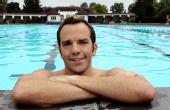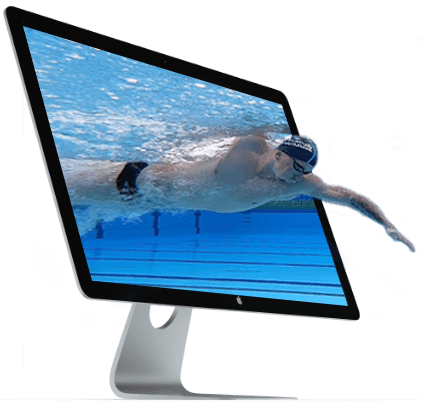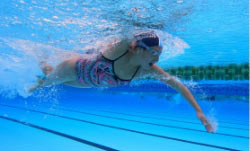








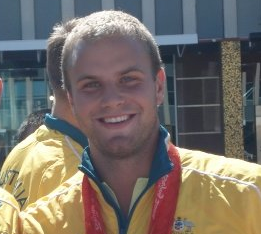
In this episode we look inside the mindset and training regime of top level sprinters. Our guest, Olympic butterflyer and freestyler Andrew Lauterstein talks about:
- The feeling of being in an Olympic final, the pressure and nerves before a race and he breaks down his 100m butterfly final in the 2008 Beijing Olympics
- Racing with the strategy of ‘not trying’ so that technique, rhythm and feel fall into place easier
- Why starting your catch early in the stroke can lead to faster sprinting
- What to focus on in butterfly for a smooth and powerful stroke
- Why he now does straight arm freestyle rather than bent arm freestyle
We cover much more in this episode of ‘Sprinting Power’ with Andrew Lauterstein. You can listen to the Effortless Swimming podcast above or by subscribing to us in iTunes.
Transcript
Read the full transcript
Welcome to Effortless Swimming, the podcast for swimmers, triathletes and coaches. Join Australian swim coach, Brenton Ford, as he reveals the latest techniques and information to improve your swimming. Let’s dive right in. Welcome to episode number four of the Effortless Swimming podcast. My name is Brenton Ford and this is the Sprinting Power episode, where we talk with Andrew Lodestine, who’s a silver and bronze Olympic medalist. He specializes in the 100 freestyle and butterfly. And we’re going to talk to him about what he does in training, the number of sessions that he does, what kind of work he does in the gym for more power, the kinds of things he eats for faster recovery and to fuel his training sessions and his races. And he also touches on a very good pacing strategy for any 100 metre events. So let’s cut straight to the interview. This is Andrew Lodestine, who’s an Olympic silver and bronze medalist.
How did you get started as a swimmer? It all started with just the house sports through school. So I never really did swimming lessons as a kid. I was always able to watch someone swim in a swimming lesson and then kind of go to the next lane, next door and copy. I had an older brother who was doing swimming lessons, but I’ve never liked being told what to do. So mum said that swimming lessons just weren’t for me. So I’d kind of pick the brains of the swimming teachers from a side and then jump in and paddle up and down on my own. And then essentially from the house sports in grade four, grade five, grade six, I made the state team and then just kind of progressively up the amount of training that I was doing until in years eight and nine, I started to get a lot more serious about it. And you’re also a good baseball player when you were young. And I know it was in your teenage years. How old were you when you had to make that decision to go full-time swimming or full-time baseball?
Yeah, I think it was when I was 16. In the end of 2003, I beat Matt Welsh and Joshua Watson. This was four months out from the Olympic trials. And I beat the two guys that were the red-hot favourites to make the Olympic team. And I think that’s when it clicked that I was a pretty good swimmer and I should start taking a lot more seriously. In that one swim meet, I dropped four seconds in the 100 metres backstroke and then dropped another two seconds three months later and just missed the Olympic team as a 17-year-old or 16-year-old by 0.2 seconds. So I think it was, yeah, that was year 11 when it came to the realisation that, hey, I’m pretty good at this swimming thing. Let’s give it a real crack. And then I knuckled down for the next year and in year 12 made my first world championship team. I remember seeing that race at States when you beat Matt and Josh. And the whole crowd was just in awe of how quickly you’d gone.
And did you even expect to go that time, like were you doing those times in training? No, not at all. It was absolutely out of the blue. I was just a regular 16-year-old down at Lawn for New Years two days before and then came back and beat these two Olympians. And I was up on the lane road celebrating. I remember my coach Glenn was running around on pool deck and then the controversy of the two guys not turning up for the medal presentation just added to the drama of it all. So it was a pretty magic little moment. And I even can remember there was a big photo in the Herald Sun of me celebrating as well. So this baby face 16-year-old who a couple of days before was just chilling out in the beach in Lawn was all of a sudden in the back page of the Herald Sun. So it was quite a change in those couple of days. Oh, I bet. Yeah, I remember that was just an awesome race. And that’s sort of where it started. Is it when you thought I should really give this thing a crack?
I think so. Yeah. Once you beat the swimmers of that caliber and with the Olympics just around the corner. Yeah, I decided to really give it a crack and more so give the backstroke a try because beforehand I had been more predominantly a freestyler and a butterflyer. So I decided that I’d stop those two strokes for three months and see how I’d go at the backstroke. And then after just missing the Olympics I pursued with the backstroke for another two years. And then in 2007 after probably not making the continued improvements that I was hoping to make I decided in 2007 to go back to freestyle and butterfly and to suss out where I am in the world rankings in those two disciplines to see what events that I thought I had the best chance at come Beijing. So then in the end I stopped swimming on my back and qualified for the freestyle and the butterfly events in Beijing. And I think that was the right decision to experiment in 2007
because coming away from Beijing with three medals in freestyle and butterfly it was obviously the right choice. You got bronze in that hundred butterfly behind Phelps and Cavage. So what was it like swimming in that final? Because there was such a big race because that was the one where Phelps just touched out Cavage and was it your first Olympics? Yeah, first Olympics and I’m the individual event and what a spectacle it was. I was actually involved in Phelps’s first and seventh and eighth gold medals. So it was a pretty amazing experience the whole Beijing but that hundred meter butterfly final just thinking about it now has just given me goosebumps. So I can’t remember a hell of a lot about the race except that when I was up on the blocks and you hear Michael Phelps do his trademark kind of back slap I can just remember my legs absolutely trembling. I felt like I was going to fall in all shaking so much and then once that gun went
and I was in the water it was automatic. So I think that’s what it comes back down to is all that training that I’ve done in the past that no matter how nervous you are once you get in if you’ve done the work in the past the racing comes automatically and that’s such an amazing feeling when you’ve given everything you can in training and that when you come to racing that’s the easy part. Yeah, that’s right. It’s all the hard work and training isn’t it? And then racing is kind of the reward that you get for doing all that hard work. Exactly. And that’s what my parents often said about that’s the reason why I chose swimming is because you put in the hard work and training in it and then you go and compete in a race and get given a time and that’s relying on yourself. There’s no giving off a quick handball to someone else who can either kick the goal or kick the behind. It’s all up to you and the preparations that you’ve put in in the past.
And from that time that you’re given in that race I guess the thing that I liked is you can either continue to do the same thing or make changes to hopefully improve you for the next time that you step up and race. You’ve recently moved to Melbourne Vic Centre with A&Pope and what’s your training schedule look like now in terms of how many swim sessions, how many gym sessions are you doing and anything else that you’re doing outside the pool? At the moment I’m doing a change between seven, eight and nine pool sessions depending on pretty much how I’m feeling. When I was in Sydney I was, so I’ve been in Melbourne for six or seven months now and I made the move because I kind of over-trained myself in Sydney. I was just going above and beyond what I was supposed to be doing so the move back home to be with my parents was more about balance and going back to basics and so at the moment I’m just trying to listen to my body
and if I can get through the eight or nine pool sessions I will but if I need to take one off and recover to come back for the next pool session I’m sure and faster I will. So yeah, so it’s the seven, eight or nine pool sessions depending on feel and then I’m doing four gym sessions a week. They’re shorter than what they were in the past so now I’m going kind of one gym session, upper body, the next one’s legs and core and then one upper body, the next one legs and core so I’m not hanging around the gym, mucking around. When I’m in there it’s never more than an hour and it’s very specific to the upper body and to the lower body so my whole body isn’t always fatigued when I’m rolling into that next session. And then apart from that it’s just the recovery type things. I see Cairo once every fortnight and I get weekly massage and weekly physio and then we’re lucky enough to have the ice baths at the Victorian Institute of Sport just across the road from training
so I try and use the cold ice baths twice a week as well. And when you’re in the gym is it more heavy weights, less reps kind of work or do you go the other way? Right now I’m going low reps and heavy weights leading into the meat so working a little bit more on the power but earlier on in this season I was doing up to four or five sets of 12 reps so I guess I’ve left that up to the gym instructor to work out the purization more of the gym but definitely at this stage I’m working a lot more of the power and trying to be explosive with a little bit of contrast training as well so going for some heavy squats into some squat jumps and then also kind of in the upper body from like a bench press into pull shots with claps so really working that, the strength and then contrasting that with the explosive power. Oh that’s good. And in terms of swimming training what do you reckon is the hardest set that you’ve ever done in the pool?
The hardest set I’ve ever done. I think mentally for me the hardest set that I’ve ever done I probably used to do ten four hundreds every Monday morning and I reckon I did that. I started training with Glenn Baker in Melbourne when I was 13 or 14 and I left him when I was 21 so seven years and every Monday morning was ten four hundreds. That I would say is my most red set. Seven years you did that. Most Monday mornings would be the ten four hundreds. And that was the session that Glenn would go and have a sleep in too so we’d write ten four hundreds up on the board and then walk away and have a nap. So I bet you’re glad you’ve changed your Monday morning sets. Yeah, very much so. And your freestyle, I don’t know if you’re doing straight arm freestyle before but now you’re doing only straight arm freestyle as opposed to bent arm. What’s the advantage of that for you and why have you chosen that type of freestyle?
I started probably doing straight arm freestyle two or three years ago. Actually I was doing straight arm freestyle in Beijing as well. It was more the fact that I was probably concentrating too much on bending my arms and I wasn’t able to get them over and get my rating up high enough. So it was more of a freedom thing and then also the elasticity of that I was able to create that kind of whipping effect like through the accelerating the end part of my pool and then really whipping my arm over. To be honest, I don’t think that much about how straight they are or where kind of how high they are above the water either. I’m more focused on creating like a constant circle of power with my catch in the water. So when one arms then exiting the water for the recovery phase that I’m already onto the catch on the other arm and then when I am entering out the front that it is in the right position and that I’m getting on the catch really quickly.
So in regards to what they’re doing above the water it’s always a surprise as to how straight they are when I see video footage of me swimming above the water because I definitely don’t feel like they’re that straight to me. This is pretty much just on what they’re doing with the pool and the timing. Yeah, exactly right. Yeah, pool and timing. And what about your butterfly? What are the things that you concentrate on for your technique wise when you’re training and when you’re racing? For me, my best friends are when I’m relaxed and my timing’s on. So for me, it’s the timing of the kick. Often when my butterfly is not on I’m trying too hard with my kick. So the kick action for me is more about just it’s not so much creating a whole lot of power out of my kick. It’s more of just helping me maintain my rhythm and helping me get my hips up to get onto that catch at the front of the stroke. So having for me the two even kicks
as well as another thing that I focus on. So the one kick when my hands enter and then the other kick as my hands are entering keeping them the same size and really working the up kick as well. And you’re a sprinter so you’re mostly doing your 50s and your 100s. So how do you pace your 100s? Essentially, my best friend going off Beijing my whole race plan was just don’t try. I know that as soon as I start to force my stroke I get stiff across the shoulders and start to rip at the water and not get my catch. So for me it’s that relaxed rhythm with really good power and hold out the front. So for me my goal is to essentially hold a 51 stroke rate the whole race. So not really changing too much throughout the race with not a whole lot of a race plan. For me it’s kind of building into the wall at the 50 and then setting up that rhythm off the turn and then holding it all the way through to the end. That’s good. And then in terms of your diet
what do you typically eat? Do you tend to eat pretty well? Or do you just let it get you? That’s one thing that I’ve definitely improved since I’ve moved back to Melbourne in the luxury of living with mum and being able to do all the shopping and the cooking. I’ve been really good at just really good fresh fruit and veggies and meat really. That’s pretty much my staple diet at the moment. Anything that’s not in a package I’m pretty happy to eat. I think the less that my food’s being tampered with the better so try and eat the free range chicken and organic where possible. Keeping everything healthy and that was one thing that also led to me getting a little bit sick was that I probably wasn’t fuelling my body as well as I should have. I was trying to lose a bit of weight so I wasn’t fuelling myself at the right times. I was kind of not eating before training because I thought that was going to help me lose weight
whereas now I tailor kind of the amount that I eat around my training sessions so like when I’m doing a double pool and a gym in the one day I’m really making sure I’m getting enough protein and carbs in that day and then on the days where I’m not doing as much work probably cutting back a little bit on the amount of food that I’m eating so the nutrition side for me is definitely an area that I have improved and something that I’m actually pretty stringent with. I’ve really cut back on, you know, I’ve found out that I’m lactose intolerant so I’m not having any dairy and then also I’ve cut back a fair bit on the amount of gluten that I’m having as well because I had a DNA test and they figured out that, you know, the amount of carbohydrates and starchy type foods I don’t really need in my diet so I can survive on a bit more of a Mediterranean style diet of, you know, the meats, the seafood and veggies. And what about supplements?
Do you have protein powder after gym or training or anything like that? Yeah, I use a massage protein powder after the gym sessions and then also the harder sessions in the pool and then also supplement a little bit of branched chain amino acids and I’m also doing some beta alanine loading as well, leading into trials and then I’m still experimenting with bicarb loading which I’ll do, which I’ll trial again at Victorian State Championships but in the past that’s upset my guts a little bit so I’m trying it, trialling a different supplementation plan with the bicarb this time around so yeah, I dabble in a few bits and pieces supplementation-wise. I remember hearing from one of the girls at the VIS about the bicarb soda and it’s a lot of bicarb soda that you need to take isn’t it to get the effect? Yeah, the supplementation plan that I’m trialling this time around is three hours out from my race I’ll take 11 tablets,
two hours out I’ll take another 11 tablets and then an hour out I’ll take another 10 tablets I’m not sure exactly how much bicarb but when you’re having 32 tablets or whatever it’s a lot of tablets to be gone Yeah, that’s right Have you found it’s made a difference or are you still waiting to see the results of it? Yeah, I’m still waiting to see the results of it but there’s scientific proof that it does something of benefit and for me even if it is a bit of a placebo effect I’m going to do whatever I can to hold on at the end of that race come trials Yeah, exactly right, you may as well try everything and even if it is the placebo effect you’re still getting the benefit there so that’s exactly what about after swimming do you know what your plans are once you finish up with swimming? Well at this stage I’ve started doing some work with the swimwear brand engine so I’ve started helping out with events and a little bit of product development with engine
and that’s one of my passions away from the pool is swimming and that swimwear brand engine so I know that I want to do some travelling where I’m not going to and from a hotel to a black line so to really get out and possibly travel for a good six months and then also the other passion that I’ve got outside of the pool is coffee and cafes so potentially opening a cafe with another couple of swimmers which is somewhere different but that’s something that sounds like a lot of fun and something I can see myself doing for the rest of my life Sounds good Well thanks very much for being on the call with me and giving all these great tips because I know I’ve got a lot out of it and I’ve no doubt everyone who listens to it will be able to get a lot out of it too so good luck for Olympic trials and I’ll see you on the weekend at States and it’s been really good chatting with you Beautiful, thanks Brendan Cool, thanks mate
See you soon
Let’s recap on some of the things that Andrew mentioned the first one is swim to how you feel so he said that he does seven, eight or nine sessions a week depending on how his body is feeling so if he’s had a hard week and he’s not able to back up the next session take one or two sessions off that week which I think is a really good way to go about your training because if you’re going to go to a swim session and you’re just going to train rubbish then it might as well just take it off recover and just come back to the next session ready to go he also mentioned his racing strategy for the 50s and 100s is to not try so what he means by that is not to go out there and swim easy, it’s to go out there and relax and just let your body do its thing that you’ve been training for to force yourself to swim fast that’s when you stiffen up and your muscles are tense and you’re not able to get that relaxed flow and rhythm that you’d normally have
if you go out there and relax in a race he also talked about contrast training in the gym where he’ll do some heavy exercises whether that’s deadlifts or something with the arms whether it might be bench press and then he’ll go straight into a lighter exercise so if he’s doing bench press he’ll do some heavy weights and he’ll go straight into push ups with a clap and that’s a good way to get that little bit more from each of your exercises he also talked about eating well and the less that his food’s been handled the better so he said that prior to this year he was not really eating much before he would train so he didn’t have the fuel to keep his body going because he thought it would help him lose weight but you need to have that fuel available for your body to use during a training session or it’s going to be very difficult for you to get your good times in training and get the benefit from it so if you can eat just a little bit
enough to fuel yourself for that session then that’s the best way to go he also talked about racing is the only benchmark so you can do as good of times as you want in training but the only real benchmark comes down to racing so it’s a good indication of where you’re at and what you might need to work on after you finish racing this has been the sprinting power episode of the Swimming Podcast thanks again for joining me we’ll be back next week with another guest talking about sprinting and don’t forget to go to the iTunes store and rate the podcast and leave a comment if you like and we will see you back here next week thanks for joining us on the effortless swimming podcast to get transcriptions, bonus videos and to be the first to hear about new episodes go to swimmingpodcast.com