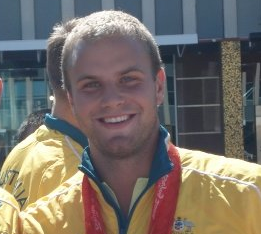








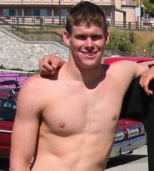
Our first US guest is a current world record holder and backstroke champion. Peter Marshall reveals how he broke three world records in backstroke. Like a lot of age group swimmers, Peter started out doing lots of miles in the pool. He was a distance swimmer in his early years but converted to a sprinter after making some changes to his training. In the podcast he chats about what changed in his program and how his gym workouts shifted focus. We cover race routines, psychology and developing power in the water.
Transcript
Read the full transcript
Welcome to Effortless Swimming, the podcast for swimmers, triathletes and coaches. Join Australian swim coach Brenton Ford as he reveals the latest techniques and information to improve your swimming. Let’s dive right in. Welcome to the fifth episode of the Effortless Swimming podcast. It’s great to have you back. My name is Brenton Ford and today’s guest has won 14 medals across major international competitions, including 10 gold, 2 silver and 2 bronze medals. That’s spanning the World Championships, the Pan American Games and the Pan Pacific Championships. He’s a backstroker and he currently holds the world record for the 50 backstroke short course. And he’s a former world record holder of the 100 backstroke world record in short course pool. And he retired from swimming last year, but he’s had a very successful career and to still hold a world record is a fantastic achievement. The guest today is Peter Marshall, who’s an American swimmer.
And we go into a few things, including what his gym program is like when he broke that world record. He talks about how he did a lot of miles as a kid and as a teenager and then moved it to a more quality and speed based program. So look out for those things. Here’s an interview with Peter Marshall. How did you get started as a swimmer? Gosh, it’s been years, but my so in the US, there’s all these local neighborhood pools and swim clubs. And essentially I have three siblings. I’m the second in line and my older sister started swimming and she basically dragged me into the sport as like a five and six year old. And oh man, I like didn’t want to go to workouts, but I really liked competing. So I did really well at competing, even when we didn’t even train or anything, but essentially through the summer league neighborhood pools. That kind of got me into the sport and kind of from there, I progressed to the local club organizational level out here in the US.
And then you just kind of step up the ladder to college and then onto the national team and continue swimming as a professional with speedo and tier. And what was your training like when you were competing? Well, it varied a lot throughout my career. It’s, you know, when I was an age group swimmer, it was probably we did a lot of yards as age groups from all through high school. We trained, you know, two, three, four, five, six, seven, eight, nine, we did nine workouts a week. We would probably go, I’d say on average about God, nine, nine thousand yards of workout. So we were really put in yardage as as high schoolers, probably from, I guess, like for 15 to 18. And then in college, kind of the same, same routine, but less yardage, same amount of workouts. But we worked in some weights and some like plyo plyometric exercises and I did a little bit more sprint work. And at that point it started to transition to a little bit more quality over quantity.
And then as after I graduated, we just continued to focus more on quality. And I really think that’s where I excelled was getting away from some of the longer workout routines to focus more on what I was better at with like the sprinting. You know, I didn’t necessarily need to put in 8,000 yards, 10,000 yard workouts anymore. I needed to focus on, well, gosh, that’s from for about 50, 55 seconds. And let’s focus on that and then get rid of some of that long swimming. So that’s what we did. Do you think the long swimming helped you when you were younger just to get, I guess, a better feel for the water? Or do you think you would have gone just as well if you’d done less miles when you were a teenager? Yeah, gosh, that’s always a question that I think about. I mean, there’s definitely something to the feel that you get just from putting in sheer amount of hours. I think that will generally help you do well at anything.
You just spend massive amounts of time doing something you’ll progress. I do think, though, that there’s a lot of wisdom in making sure whatever you’re spending a lot of time doing, that it’s pinpointed to, you know, your final goals. And I think that I think that I probably would have stayed away from some of the massive amounts of yardage and maybe mixed in a little bit more quality with some of that longer yardage stuff. I mean, it’s impossible to say it really right. That’s kind of the fun about asking the question. But yeah, I think it helped me. I think ideally maybe I would do it a little bit different if I did it again. But obviously worked well for me, you know. Yeah, yeah, that’s right. It all turned out well in the end, didn’t it? Yeah. And when you started to do more sprints and more quality work, what type of gym work were you doing with that? Do you think your gym work was important? Um, I guess the first part, when did I start doing more,
more sprint oriented, like racing and workouts was what got to college. So when I was, you know, from the ages of 18 through, gosh, I mean, the rest of my career really, but first started when I was about 18. Before that I was doing, I mean, I’d spend the mile, I’d spend the four and I am, I would do the 500 free, I would do every single event. And my coming out of high school, what I was recruited for was probably the 200 backstroke, the 100 backstroke. But I swam 400 I.M. I was even recruited to swim 400 I.M. as a young teenager. So I started the sprint focus in college. And then that’s also when I started the more intensity in the weight room. So I’ve had a progression of training styles in the weight room as well. We basically trained like American football players in college for the first couple of years. We were doing, we were getting pretty big. I felt like for swimmers. And then, I mean, trying to break down those exercises.
We were doing a bunch of presses and squats and, you know, leg press. I mean, just kind of bulkier exercises. I would say we’d go max 12 reps till you burned out on every exercise. And I think I’m not sure that’s necessarily the best for swimmers. But as I continued to progress as a collegiate swimmer, we transitioned some things and focused more on longer duration exercises mixed in with some Olympic lifts. And I think that helps a lot for some of the short course swimming that we do in the U.S. But also the Olympic lifts and some of the longer circuits that were more aerobic really helped for the long course training. After I finished college, I transitioned to a new swim program. And with my new coach, we worked on, it was kind of a combination. We did a circuit workout in the weight room where every weight exercise, it was usually on machines, was all high rep, all high weight. As high weight as you could handle and as quick as you could do it safely.
And I think that was probably the best weight routine I had. So we would go through three exercises, a total of nine times, so three times on every exercise. And we’d be doing 30 reps on every machine nonstop. And it was, yeah, it was a really, really brutal workout, but it was more finely tuned, I think, for races where you do 30 strokes. Or I think that fit my race style better. Yeah, so it’s just really specific exercises, with a very similar number of reps for what you’re doing in a race as well. So like you talked about, the specific kind of training is what worked best for you. Yeah, definitely, I think that, I mean, I even picked some routines that I think really worked well. So we do, we do like a chest press, and then we do some pull-ups, and then we do the other one, then we do some triceps. And it was, you know, you just think about your 50, you think about your 100 the whole time you’re doing it.
And you get through however many reps in about three minutes, and you’re totally gassed. And then you have, you know, four more circuits to do before you’re done with the workout. But it’s, yeah, it was, I think that stuff helped me. And I could see the correlation between what I was doing in the weight room, and then how that was going to pay off in my swims. Because I could, I could see, okay, if I can bust out 20 reps on the weights, that’s really going to transfer it into my 20 cycles in the pool when I’m racing, or when I’m doing my leg extensions or lunges. Okay, I’m doing a specific number on the weight machine, which is a similar number to the amount of kicks I’m going to do off the wall in my 100 backstroke, or, you know, whatever it may be. So I think seeing the correlation was really helpful for me, because a lot of times, I didn’t necessarily understand where some of my coaches were coming from with what I was doing.
And for me to more fully understand this weight routine and how it was going to transfer help me push harder in the weight room. Yeah, I think it’s good to, for a coach to be able to explain to them is why they’re doing the sets or the gym work and just how it actually relates to their races. Because I think sometimes the coaches don’t, they’re not able to link that up with why they’re actually doing it. So, you know, if you can, it provides a lot more motivation for the swimmer. Oh, gosh, especially in swimming, too. I mean, all my, all my siblings and I, we all played sports. I mean, my brothers played lacrosse and football and my sister played basketball and everything. And it’s so interesting for me to see like the difference between swimming and a lot of other sports is, you know, football, soccer, whatever. Those are playing sports. You go play that. There’s, it’s not a training sport. It’s not like triathlons or swimming or track and field even.
In swimming, it’s, it can get very monotonous in training. And I think it should be part of the responsibility of the coach to keep workouts creative and active and engaging for the swimmers. And definitely one of those ways is to make sure that whatever those your athletes are doing is an intelligently designed workout. I don’t think that swimming sometimes has a tendency to put in workload over kind of intelligent training. And again, I think that the more coaches can focus on the intelligently designed workouts, the better they’re going to have results. Yeah, that’s a, that’s a great point. I absolutely agree with you. And because I mean, it’s just so easy to say you got an hour and a half workout. It’s just so easy just to fill it with whatever takes up the time. But if the coaches put a bit of thought into it, it makes a big difference. Oh, yeah, totally. And when you’re racing, say you’re your backstroke, whether it’s the 50 or the 100, what, what is it your focus on?
Um, you know, it always depended on which, what type of venue the competition was, what point of the season I was at. But I mean, I can, I guess you can take like your training races in the middle of the season, building up to the pinnacle race at the end of the season. And in those training races, you’re, you’re basically always thinking about how’s this going to prepare me for the end of the season. I’m going to work on, you know, three elements of this race at this meet. And then this next meet in two weeks, I’m going to work on these three elements. And then you start as the, as a season progresses, like, okay, I’m putting it all together. I want to put it all together. And throughout that process, I think you’re continually racing kind of the same guys. And, and there’s definitely a mental strategy to how your season progresses with your competitors. So I think, you know, me, me and some of my coaches would, you know, just be like, okay, well, he’s going to swim the race this way.
And if you can beat him at this meet, that’s going to put this little seat of, you know, maybe doubt in this other guy’s mind. And maybe you’ll have more of a competitive edge at the end of the season. But so those were kind of the training races. And then I think those prepare you for the end of the season when, when while you’re still competing, it’s, it should be more of a rehearsed routine where you don’t have to think about what you’re doing as much anymore. You shouldn’t have to, your coach shouldn’t have to say to you, all right, well, you’re going to take 13 kicks off your 50 wall, and then you’re going to build to the finish. And that stuff is just, you don’t really talk about that. You more focus on the competing side of things. At least that’s how I did it. I kind of at the end of the season wanted to think about less and simplify things so that I could just work on. Yeah, just kind of gutting it out when I needed to.
And hopefully the other stuff was second nature by that point. So you sort of, you practice the races during the training races and then when it comes time for the end of the season ones, it sort of just all comes together and it’s just about just letting it happen. Yeah, definitely. And I know a lot of, I think earlier in my career, we’d also do, you know, multiple races during the during the training meets, you know, you’d have four or five races during a final session in the middle of the season. And then, you know, at the end of the, at the end of the season, you’re cutting it down to one, two races a session. And yeah, I think that’s another thing you got to think about too is I as a sprinter, I wasn’t ever looking forward to a large volume of racing and at a swim meet. I wanted to focus on, you know, two, three races at this swim meet and really putting everything ahead into that because I knew I only had so much to go around.
And when you broke the 50 backstroke world record, the most recent one, what did, did you see yourself being able to swim that quickly? Or was it, was it a bit of a surprise that you managed to go that quick? What was it? Well, yeah, so I guess that race to put that racing context, that was when we had all those, those suits. So they’ve since gotten rid of, but I’m sure we’ll come back at some point. But that day in Singapore was I think the final stop of the 2009, 2010 World Cup series. And the World Cups are kind of different than most competitions I’ve ever been to. But that day I knew if I could re-break the world record I had previously set in that World Cup series that I had a really good chance to move up in the World Cup standings. So, I mean, I kind of had a routine that I went through every, every big meet that I wanted to swim particularly fast at. And especially on the World Cups when you’re jet lagged, my routine involved a little bit of coffee, about a water bottle full of coffee at a certain.
I mean, I always drank about a water bottle full of coffee on these races right now. I was jet lagged about 30, 30 or 45 minutes before my race so that I would be sweaty and a little bit shaky before my race because I knew that would help me swim my fastest. And then I have my mental state that I got in with certain types of songs that I’d listen to on the iPod. And yeah, I just kind of get myself in a place where I could feel like, alright, I’m going to explode through this race. I know the two things I need to do better in Singapore than I did in Berlin or wherever it was. And the 50s are great race though because it’s just, you know, explode. Explode through the fit, explode on the start, explode through the wall, get your kicks out and then explode through the finish. And I love that stuff. I mean, that’s probably the hardest part about being retired is it’s hard to have that competitive spirit, I guess, outside of the pool.
But I think they answered your question. Yeah, yeah. No, that’s great. So you just stuck to the normal routine that you use for your big races and everything just sort of came together. Yeah, I did. It was a fun race. I remember that one in particular. Even if it was with those suits, it’s always fun to break a world record. I mean, that never gets old. No, I bet. And what about goal setting? Was that part of your training strategy? Did you usually sit down with your coach and talk about what you wanted to target for the next six months or 12 months? You know, sometimes we did and sometimes we did. And I think I always had goals in mind before every season, whether I vocalized that to my coach or not. I definitely think that stuff’s helpful. Some of the things that I did was I would just write myself signs and put them in my locker so that every day I want to, before a workout, when I put my suit on, I could see, here’s my goal.
And I would make sure I read it out loud to myself and then I would get in the water and work out. But yeah, I think those goals and kind of written reminders, the more you can see them, the more you can remind yourself, the better. You’re going to be able to focus throughout the season. And yeah, because it’s a grind through some of those workouts in the middle of Christmas training or those training camps. You got to be able to remind yourself of what you’re working for. Yeah, I think that’s great writing down whether it’s your goal time or why you’re doing it and just putting it somewhere where you see it every day. So it just keeps the motivation up and reminds you why you’re doing it. Yeah, I think the other thing I remember is kind of the more vivid I could make my signs, the more images I could put on there, the better that would get stuck in my mind and help me focus on it. So I wouldn’t just write it with black ink on a white piece of paper.
It would be a particular color. Like it would be in gold so that I could focus on winning the gold medal or breaking a world record or whatever. And did you visualize your races at all? Did you ever lie down and just picture yourself swimming in those races? Did you rehearse it in your head before you did them? Yeah, you know, I never deliberately set aside 10 minutes to go sit in a dark room or anything, but I would have my moments where before races I’d go sit in the hot showers and think through my race and kind of get myself psyched up to race. But I would never run through an entire race in my head, but I would run through elements of it. I would run through how I’m going to feel when I’m kicking off of the third wall in 100 or what my start is going to feel like. And I would always picture the ideal. So on the start I would always think about this entry. I mean, I have a really clean entry and it’s just going to have one of those kind of like pebble in the breaking the surface, very little splash.
And I would just think about the sound that that would make as I would do my start or just how powerful my legs would feel as I’d come off the wall on my third turn. Yeah, those things. I never ran through an entire race like there were coaches that told me we’re going to start the stopwatch or we’re going to start the stopwatch. Close your eyes and I want you to run through a race and then tell me when to stop the stopwatch and we’ll see how close you are to your final goal time. And you know, some of that I understand what they’re getting at, but I could never do that in my head because I’d get to hung up on these details. Maybe because I’m a perfectionist, but I’d be like, oh, I’m running through the race and oh, but I didn’t do that exactly perfect. So I’d restart my race, you know, and so I just learned to kind of focus on different chunks and visualise it and not worry about maybe how long I was taken to visualise.
Yeah, that’s good. And the last question I have is, do you think you learned some skills or traits that you’ve developed through Swimming that you’ve applied into, just applied in life, whether it’s getting up early for practice and just working hard towards something? Do you think Swimming is a good sport for that kind of thing? Most definitely. Most definitely for the discipline side of things. I mean, you definitely know how to set goals. I think you definitely know how to work hard. There’s absolutely no way to wake up for workouts before you go to school for about 10 years straight. And then you have to be disciplined. And that’s probably one of the number one things I’ll pull out of the swimming world and apply to whatever I do next. I do think that you need to enjoy what you’re doing. So that’s one of the reasons I retired was because it was just, I didn’t have the drive, I didn’t enjoy it enough to continue doing it.
And I think that people should infuse as much creativity into their swimming as they can. And yeah, but of course, there’s so much that I can take away from the sport of swimming to the world outside of the swimming pool. Yeah, I think swimming is a great sport for the discipline and I think the friends you make as well. Some of my best friends have come from swimming just because you’ve got the same sort of values and you know what it takes to… You know, not many people are willing to get up early in the morning, five mornings a week and do that for years on end and it takes a certain type of person. So you can find some pretty good friends through that if you’re doing the same thing.
Yeah, definitely great friendships and you spend that many hours with anybody, you’re going to be friends with them. Yeah, that’s right. That’s exactly right. Well, thanks so much for being on the call with me, Peter, and I’ve got a lot of good things from what you’ve talked about. So I appreciate it very much and I wish you the best with whatever you choose to do next. Yeah, thanks. My pleasure, Britain. Yeah, talk soon and thanks again. Some of the main points that Peter mentioned in the interview were the first one was that as a young swimmer he did a lot of kilometers in the pool and a lot of hours in the pool. And later on he moved to a quality and speed based work training program. And he’s not sure if he could have got to the same level he got to had he not done those long hours in the pool as a teenager. And that’s the argument that’s out there is can someone become a good swimmer without doing a lot of hours in the pool but more quality and speed type of work as a younger swimmer.
So that’s still up in the air but Peter did a lot of kilometers in the pool and then moved to a sprint based workout. He also talked about having a specific gym program, so making it specific to your race where he would work out for the same time that his race would go for. And he’d work the same kinds of muscles and do the same kinds of movements as he does in a race. And he also talked about making sure that your workouts are targeted towards what you’re doing in a race because he said he had the most motivation when his coach was able to explain and show why he’s doing all those things in training. And the last thing he mentioned was having a routine for racing. So when he broke that world record he’d been through that same routine many times before where he’d had a lot of coffee and he’d listened to his music and he’d have that routine that he’d done many times before. And I think that’s a really good thing to do because if you can get into that zone early on then it makes it a lot easier to have a good race.
And if you can practice it, keep it consistent then you know what you’ve got to do for your next race. So thanks again for joining me for the fifth episode of the Effortless Swimming Podcast. I’m Brenton Ford, go to the website at EffortlessSwimming.com or SwimmingPodcast.com where you can get some videos, you can get articles and other resources that will help you with your swimming. Tune in next episode where we’ve got a very well known Australian who is an Olympic gold medalist, he’s a former world record holder and he’s a very well known and very well liked swimmer in Australia. So looking forward to that next podcast. Thanks again, see you next episode. Thanks for joining us on the Effortless Swimming Podcast. To get transcriptions, bonus videos and to be the first to hear about new episodes, go to SwimmingPodcast.com.