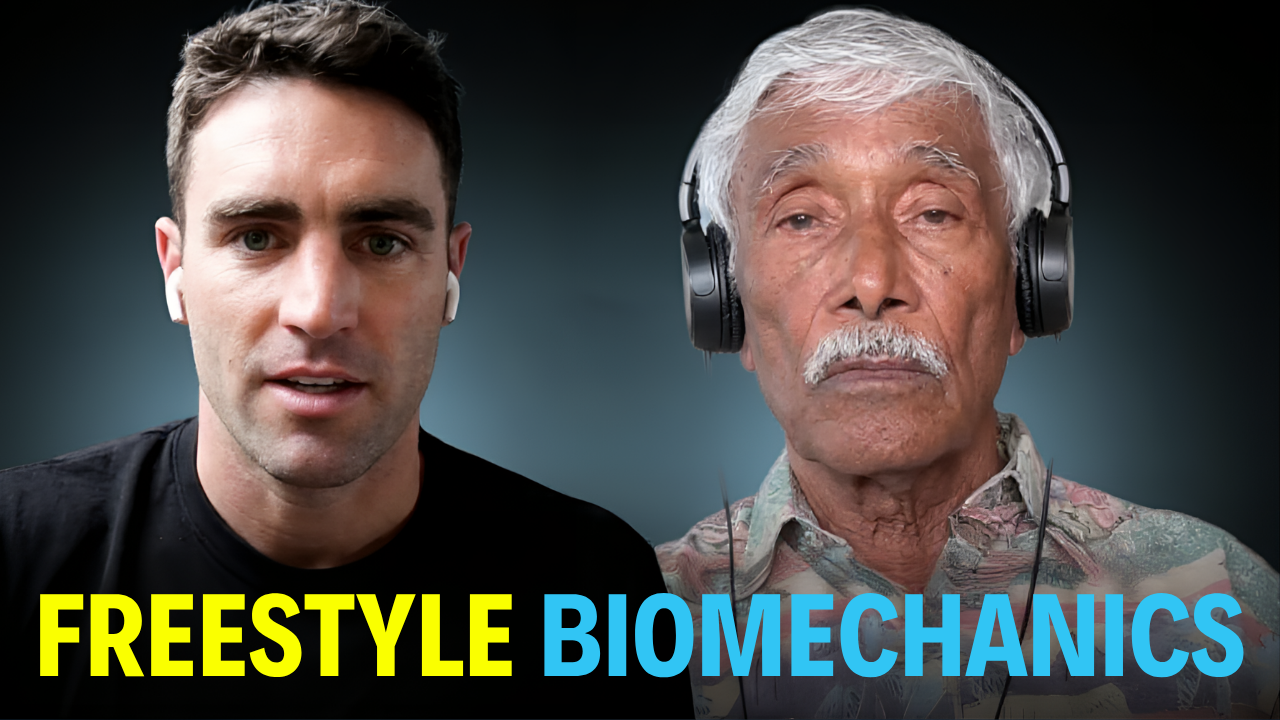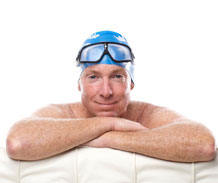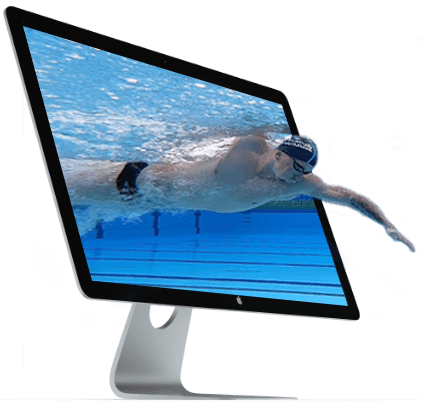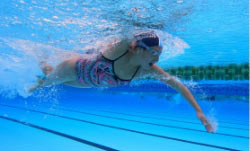








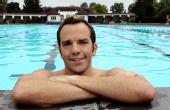
We take a look into the world of marathon swimming. What motivates distance swimmers to do the huge miles week in week out? How do they prepare for big races? We talk with the 45km Manhattan Island swim world record holder, Oliver Wilkinson about:
- Training for distance events and the number of kilometers he does weekly leading up to a big race
- What he eats the night before to ‘carb load’ and how he refuels during a race
- Finding the right stroke rhythm quickly
- Which aspects of his technique he focuses on in training
- How hard he works his kick in long distance swims
- Dealing with the mental challenges in cold water and endurance races
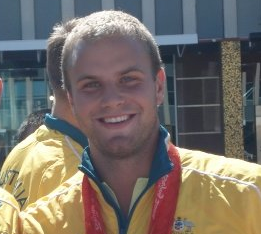
Ollie has trained with my squad in Melbourne for over 12 months and has recently moved backed to England. He has completed the English Channel and has placed in numerous long distance open water races such as the Rottnest Island swim in Western Australia. You can keep up to date with what Ollie is up to at his blog.
Tell us the hardest training set you’ve in the comments section below!
Transcript
Read the full transcript
Welcome to Effortless Swimming, the podcast for swimmers, triathletes and coaches. Join Australian swim coach Brenton Ford as he reveals the latest techniques and information to improve your swimming. Let’s dive right in. Welcome to the open water domination episode of the Effortless Swimming podcast. My name is Brenton Ford and today we have a very special guest who is the world record holder for the Manhattan Island Swim. Which is a 28.5 mile race, which is 45 kilometers if you’re here in Australia. It’s a 28.5 mile race around Manhattan Island in New York. And they hold this event each year, but it’s not open to anyone. You must be invited to compete and they invite only the very best marathons from around the world. And the guest we have on today was invited to the world record attempt just a few months ago. And he managed to sneak under that world record time to be the new world record holder.
And the guest we have on has also crossed the English Channel and he’s competed in a series of long distance open water events. And he’s one of the very best marathons fromers going around today. And we are very lucky to have him on. And he’s going to talk about fueling your body for long distance races, finding your rhythm in open water. So if you’re a triathlete or you do a lot of ocean swims, it’s important to find your rhythm during the race. And he’s going to talk about how you can do that quickly and settle into a good rhythm. He’s also going to talk about the technique he uses for distance swimming. So it’s not like a sprint technique where you’ve got a short fast stroke rate. He’s going to talk about what he does in training and in a race to get his technique right for the open water swims. Olly Wilkinson has trained with my squad for just over a year. He’s now moved to England where he’s training and working.
But when he was training with my squad in Melbourne, he was one of the hardest trainers we had. And he does some of the craziest sets I’ve ever seen. Some that I wouldn’t want to attempt myself by any means because they’re very long sets. They’re very difficult sets. And you’ve got to have a lot of persistence to be able to get through them. And he’s going to tell you about some of the sets that he’s done in our chat with him. So let’s cut to the interview. He’s the world record holder for the Manhattan Island swim, Olly Wilkinson. How did you get started as a swimmer? Way back when I lived and grew up in Liverpool in the UK, my mum took me to the local pool just to get us… One of four brothers and she took us all down to get us to learn the basics of swimming. And we got spotted by a local club coach who taught me how to get us into club swimming. And that was at a fairly young age. I think we were probably five or six or something like that.
And started doing club swimming in Liverpool. And I guess that was the late 70s, early 80s or something like that. And just went from there, club swimming. We moved to Australia in 1988 and joined Melbourne Vic Centre. And swam with Nicole Livingstone and Michael Clem and a few people around that sort of era. And did a lot of club swimming. And that was the main thing. I got into master swimming after university. And it wasn’t until then that I started doing a little bit of open water stuff. Just my first job was in Adelaide and they had a few ocean races in the summer. I started doing a few of those and quite enjoyed them. And that was it really. That was it for ocean water swimming until 2009 when I started thinking I’d like a bigger challenge. And I’ve been thinking about doing a half Ironman or something along those sort of lines. But I sat down and thought, you know, if I’m going to train and spend all this time
doing something, I might as well do something I’m half decent at. And I’ll just swim and I won’t worry about the running and the cycling. So that’s when the idea of doing the English Channel sort of came into my head. So were you always a distance swimmer? In the pool I was really. 400s and 1500s I was better at than the shortest stuff. Not too bad at 200s. But tended to get better results. 400 meters I guess when I was swimming for Melbourne Big Centre was probably my best. I just about got the national qualifying time just before I packed it all in. But I wasn’t tall enough probably to be a good sprinter. And what about your training schedule for when you’ve got your big events like the Manhattan Island Swim and the Channel Crossing. What’s your training schedule look like? I try and do between 45 and 60Ks a week. So I swim pretty much every day. Maybe have one easy day or a recovery day. And I do a mix of pool swimming and open water swimming.
With most sessions during the week I’ll pool swims of a reasonable intensity. Maybe sort of 5K sessions a couple of times a day if I can. And then the longer stuff, open water continuous stuff on the weekends just trying to get longer tempo work on the weekends when I’ve got a bit more time. So I’ll do two, three, four hour swims on the weekends. That sort of stuff. And what’s the hardest set you’ve done? I had a good set we used to do in Melbourne with Peter Thompson. We used to do 10, 1Ks. So it was a 10K set. I did it with Peter and Chloe McHartle a few times. And we used to do K straight, K straight, 10, 100s just to break it up. Then a K straight, K straight, 10, 100s and so on. And you do that until you’ve done 10Ks. With people like Peter and Chloe you’ve got quite a bit of competition. So that was tough because you’re pushing yourselves along for two and a half hours in the pool. And the pool stuff always seems to be a bit more of a grind than the open water which is a bit easier.
Gee, that’s a massive set. The biggest set I’ve done was 80, 100s and that seemed to take forever. And it’s alright when it’s broken into 100s but doing 1K straight, that’s got to be killer. It was quite good sort of, I think it was quite good mentally because you’re pushing yourself quite hard for a K. And you’re trying to hold the same times as the session wears on. And doing it with some good swimmers will always push you along a bit. But I’ve done six hour open water swims which are tougher for the other sort of reasons. In the Melbourne Bay or down in Dover Harbour when I was training for the channel. And you’re getting cold and you’re getting bored and tired. And in Dover Harbour it’s fairly grotty water as well. So those are tough for different reasons. And how much preparation do you give yourself for the big swims? How many months ahead do you start to train for it? It’s varied a bit. I’ve had a reasonably big sort of build-in to most of the ones I’ve done so far.
The channel was about nine months. That was from a real sort of base of not doing very much up to the English channel. And since then I sort of ticked over. I guess I like to have probably a six month build-in to the big ones that I’ve been doing. Some of the longer distance swimmers are Johnny Van Weezer. He talks about having a three month build-up to his big swims. But he’s been doing it a lot longer than I have. So probably six months. Most of my big swims next year are sort of August, September, October time. So I’ll start building up probably in sort of February, March time. And what about when you’re racing? What goes through your mind for that six hours or 12 hours? What do you guys have a longer in the water for? What do you think about? Mostly I think about how I’d like to get out. It’s a real sort of mental battle. I think some people talk about sort of zoning out and just sort of, you know, being in some sort of meditative state, but I’ve never managed to achieve that.
You know, you try and sort of stay in the moment a bit. I focus on my technique, just trying to make sure that I’m swimming efficiently. You do tend to sort of go through all sorts of mental phases where you’re feeling tired and your shoulders are twinging and your feet are cramping and you’re sort of struggling a bit and you just got to dig in and tell yourself it’s not over till you finish sort of thing. Like I said, in training sessions I’ll think about all sorts of random stuff just to sort of try and keep the time ticking over. But in a race or in a big sort of swim, you’re pretty focused. You’re sort of trying to concentrate on the moment and what you’re doing and your technique and making sure that you’re keeping your tempo up and you’re not sort of drifting off into losing your focus too much. But I have to say, it’s not easy. It’s a bit of a mental game. Yeah, I bet. And what about when you’re in the race, you’ve obviously got to have
a pretty decent technique to not be swimming with really sore shoulders. It’s obviously going to get sore but you’ve got to have a good technique so you’re not hurting after 30 minutes. So what sort of things do you focus on technique-wise in training?
I think efficiency is one of the things that I’ve always tried to maintain when I’m swimming and I think I’ve always had a pretty efficient stroke. So a lot of it is being smooth through the water, getting your rotation going, making sure that you’re minimizing your sort of stroke count per lap. I have quite a big kick. I do a lot of leg work which drives the momentum as well. But a lot of it is about maintaining a sort of efficient stroke and trying to make sure that you’re maximizing that all the time. And when you are doing a big open water race, it’s about getting into a rhythm. So you need to replicate that in training, getting into a rhythm that you can maintain. In a tempo you can maintain hour after hour. Yeah, even for the 400 or 1500 if you’re in the pool, it helps so much if you can get into that rhythm because if you’re not then you’re just working an extra 10-20% harder and your times generally aren’t going to be your best.
Yeah, that rhythm is important. You’re a vegetarian, so how do you go about putting on weight for the colder swims? Yeah, it’s a bit of a challenge. In fact, I’m a vegan so I’m even stricter than a vegetarian. I’ve struggled. The most I can generally get up to is about 82 or 83 kilos, which I did for the channel and I did this year for the New York Swims. And it’s eating a lot of high fat, high calorie foods. I don’t even eat dairy products, so I’ll have a lot of soy ice creams and crisps and good fats as well, nuts and avocados, dark chocolate, anything that I can eat that’s reasonably high calories, pizzas.
I try and have the healthy fats as much as I can to get the weight on a little bit. I have to admit, I’m not anywhere near as chunky as a lot of open water swimmers get, but it’s just about got me through. The channel was not comfortable, but I managed to get there, so that’s the main thing. So you were at about probably just the minimum weight, I guess, the minimum heavy weight you could be to get through it? Yeah, I think so, and I think I did suffer. I wasn’t as heavy as a lot of people are, and I got pretty hypothermic in the channel and it was pretty cold, and that slows you down as well, so it’s a bit of a balance. You do want to be able to maintain the core body temperature or your muscles start stiffen up. I was probably a couple of hours slower in the channel than I might have been otherwise, just because I did get pretty cold and had to sort of get through it. But there’s also a vanity component to it. You don’t want to get too fat.
How much weight do you lose after doing the channel or the Manhattan swim? I don’t lose that much during the swim. I weighed myself after I did the English channel. I know a lot of people talk about losing kilos and kilos in weight during these big swims, and I weighed exactly the same after the swim as I did at the start. The funny thing was three or four days later, I weighed myself again and I dropped three kilos, and someone could probably explain that. I don’t know whether it’s an increased metabolism or fluid retention or what it is during the swim, but I didn’t lose anything actually during the swim. I drink a lot of high-energy drinks and I take a lot of high-energy gels on, but I think if you’re getting the balance right, you shouldn’t be losing too much during a cold swim anyway. You’re not losing a lot of fluids. Maybe more in the warmer climates, you might sweat a bit more. But I’m not quite sure of the physiology behind it,
but I think if you’re getting your nutrition right, you shouldn’t be losing too much weight. What about the night before a race? Do you carboload like a lot of people talk about? Yeah, big carboloading. Lots of pasta. I’ll try and eat that if I can for five hours before a swim as well. Try and get as much carbs in as I can before the race. That’s pretty important. You’ve got to have good reserves there in place. I think the nutrition during the swim is also really important, getting the energy in early. I’ve sort of learned through trial and error that in these long swims, you need to be taking the food on fairly early on in the race and getting it in and keeping it down. Otherwise, at some point, you will definitely run out. How often do you stop for a gel or a drink to keep yourself going? Every half an hour, I’ll stop and have something. I usually start with a gel and a drink at the half hour, and then at the hour, just a drink, and then at the hour and a half, a gel and a drink again.
So I’ll sort of alternate the gels hourly, but some drink every half an hour. It’s high energy drinks. If I’m doing an ocean race, I won’t have electrolytes, just because there’s so much salt in the water anyway. But if I’m doing a lake swim or a freshwater swim, I’ll generally have an electrolyte, high energy electrolyte drink. I haven’t had that one before. That’s a good tip for the people doing the big ocean swims. I don’t think it matters for shorter ocean swims. Even for rock nests, I generally have an electrolyte drink. But certainly for really long ocean swims, if you’re in there for seven or eight hours, you don’t necessarily want lots of sodium in your electrolytes. There is the potential to get too much salt in your system, so I generally recommend for the long ocean swims, long sea swims, to just stick to pure carb drinks. Okay. What is it the motivation to do these big races? What’s the draw card? Because it’s obviously a lot of training.
It’s hard work. I can imagine the reward is great once you’ve finished, but why do you put yourself through so much pain? I can’t enjoy. I just enjoy doing different swims. I enjoy doing the challenge of doing something different. It is a bit sort of masochistic. I don’t have any great plans to go back and do some of the long ones that I’ve done before again. I think the English Channel was definitely a once-off. But doing a different swim in a different place is quite fun. New York is a spectacular swim to do. There’s so much to see as you swim around. The Molokai Channel is a fairly famous long distance swim in Hawaii, 42K. It’s even a running marathon distance as well. It would be a fun one to do to finish up on the beach in Oahu. It would be a good challenge. There is a sense of pushing yourself. I suppose you can pay yourself to other swimmers as well. You see what other people are doing. There’s a big open water swimming community out there.
There’s a lot of big races. There’s what’s called the Ocean 7 and the Triple Crown, which are a grouping of big long distance swimmers around the world. It’s nice to take a few of the big ones up. I think a lot of people would be wondering, how do you fit this in around full-time work? You can’t just be assuming you’ve got to earn a living too, so how do you fit that in? Sadly, it’s just a hobby really. It’s a challenge. With anything in life, you’ve got to balance yourself, haven’t you? I fit in my swims before work, sometimes at lunch, sometimes after work as well, and then get the long stuff done on the weekends. You’ve got to look after yourself. You can’t afford to get too tired or too run down, because everything starts to suffer then. It’s a bit of a balance trying to keep your priorities right and make sure that all aspects of your life don’t start to suffer. You’ve got to build these things up slowly,
so your fitness and your tolerance improves as you go along. I’ve got a fairly busy full-time job, and at the end of the day, I suppose it is a hobby. If you enjoy it, then it’s not too draining or tiresome, so that’s the end of the game. I know you’ve got to go soon to go to work, so thanks very much for joining me on the call. I’ve learnt a lot, and it’s good to catch up with you, because I haven’t seen you for a couple of months since you’ve moved back to England, but hopefully you see you next time you’re in Australia. Good luck for your Hawaii swim if you can organise that. Thanks, Brendan. I’m looking forward to being back in Eastern, getting a few powerpoint swims in. Yeah, that’d be great. We’ll talk to you soon, and thanks very much. Thanks, Brendan. Cheers, mate.
Thank you so much for joining us. We’ll see you in the next video.
Thanks for joining us on the Effortless Swimming Podcast. To get transcriptions, bonus videos, and to be the first to hear about new episodes, go to swimmingpodcast.com.