







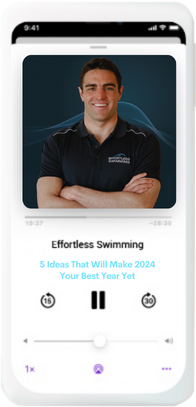
Ready to level up your swimming game this year? In this episode, we’re letting loose a treasure trove of ideas that will make your swimming better than ever before. Whether you’ve been swimming for a long time or are just starting out. Tune in now!
In this episode
- 00:00 Introduction
- 00:25 Infinite Games in Swimming: Finding Joy in the Process
- 03:09 The Concept of Play: Incorporating Fun into Swimming
- 05:06 Investing in Experiences: Rethinking Financial Planning for a Fulfilling Life
- 10:35 How to Be Honest About Your Strengths and Weaknesses in Training
- 12:09 The Power of Habits: Transforming Your Life as an Athlete
- 14:09 Training Solo? Effortless Swimming Membership Has You Covered
- 16:13 More Exclusive Interviews with Pro Triathletes: Insights and Inspiration
Links from this episode
- Die with Zero
- Atomic Habits
- Galapagos Swim Trip 2024
- Change your technique and swim a smoother, easier freestyle with the Effortless Swimming membership
- Do you want to work with me personally to improve your technique? Join my swim technique coaching here
This podcast is brought to you by NanoClear — our own range of anti-fog swim goggles, designed by Effortless Swimming with the anti-fog treatment bonded into the lens itself (not sprayed on, so it doesn’t wear off after a few swims). Check out the NanoClear range here and use code PODCAST15 for 15% off.
Transcript
Read the full transcript
That kind of mindset, I think helps a lot when it comes to improving as a swimmer, whereas if you’re looking long term, to me, that’s going to make you do the things that will help you develop as a swimmer over the course of 12 months, 24 months longer than that. And that’s what I’ve seen with the athletes that I work with who have had the most success. Welcome to the effortless swimming podcast to show that helps swimmers and triathletes love the water, become a better swimmer and live a better life. Here’s your host, Brenton Ford.
Hi, Brenton here. Welcome to episode number 314 of the effortless swimming podcast. I wanted to start off our very first episode for the year with a few ideas that will help you take your swimming to the next level over the course of the next 12 months. The first idea is infinite versus finite games. This is an idea I got from Simon Sinek in one of his books where he talks about finite games are games that have a clearly defined set of rules and players and an endpoint. They’re games that you can win. Something like talking, swimming, training for an Ironman. You’ve got the date, you’ve got the distance and you know what time you’re going for and you’ve got that clearly defined set of rules. That is an example of a finite game. Infinite games on the other hand are things that you can’t win. There’s no defined endpoint. They’re ongoing, they’re adaptable and the aim is for perseverance and improvement rather than that clearly defined endpoint.
So you can’t win at marriage. The aim is to stay married. You can’t win at business. The aim is to stay in business and you can’t win at health. The aim is to stay healthy for the course of your life. Now, I think certainly in swimming, you do need those finite games where you might be targeting a race. But if you have the approach of swimming being an infinite game, a game that you can’t win, the aim is to be able to continue swimming. To me, that’s not only a user word healthier approach to it, but I think it allows you to have that mindset where you’re willing to enjoy the process a lot more and you’re not looking to force things too much. And that kind of mindset, I think, helps a lot when it comes to improving as a swimmer. Whereas if you’re looking long term, to me, that’s going to make you do the things that will help you develop as a swimmer over the course of 12 months, 24 months, longer than that.
And that’s what I’ve seen with the athletes that I work with who have had the most success. They’re ones that have been willing to think long term and looking at swimming as an infinite game is a great way to be able to do it. And when I think back to what I’m doing with my swimming, I firstly don’t want to get injured. I don’t want to do anything that’s going to stop me from swimming. And a couple of years ago, I came off my mountain bike and I couldn’t swim for about two months or three months. I couldn’t surf either. And so the two things that I love to do the most I wasn’t able to do. So I’ve hardly spent any time on the mountain bike ever since. Because it stopped me from doing those things that I love. So it made me change the decisions that I was making, the things that I was I was doing. So now I look as at swimming as that infinite game that I just want to be able to continue doing it. And part of that, too, is just making sure that I’m strong enough that I don’t get injured.
So I’ve been going to the gym consistently two to three times a week for the last 18 months now. And that’s made a huge difference to to just not getting injured through my shoulders back. Those sorts of things, places where occasionally things can come up. The second idea is the concept of play. And a couple of years ago in the podcast, I spoke about the concept of play and how you can incorporate that into your swimming for more enjoyment. And when we’re thinking of swimming as something that’s fun, playful, it’s much to improve. I heard it a quote. I can’t remember it exactly, but it’s something about you want to be sincere in your actions, but not overly serious. So if you think about playing a game of cards with a friend, you want them to be sincere in their approach where they’re playing it. They want to win, but they’re not overly serious. It’s not much fun if they’re super serious and and not enjoying it.
You know, that’s not much of a game to to play. So the same thing applies when you’re approaching your swimming. You want to be sincere in your actions, but not overly serious with it. And you think about any training buddies that you might train with. It’s the ones that are sincere, but not serious, that are good. They’re good fun to be around. So when you do that, you treat those activities. You treat your swimming as something that’s enjoyable rather than a burden. And let’s say I’m in a bad mood and I’m looking at all these things I’ve got to do. If I’m thinking about how serious it is about I have to get all these things done. Then I don’t often do them and I don’t do them with the same sort of joy. But if I just look at it and go, all right, I’ve got to get these things done. This is great that I have the opportunity to do these things. Then they tend to get done quicker and I’m in a much better mindset when I’m doing them.
So I think looking at swimming as it’s something that can be very fun, can be playful with it and you’re sincere in your approach, but not taking things too seriously. I think that helps a lot when it comes to improving your swimming. And I’ve mentioned it many times on the podcast and it’s just about in terms of going fast, you’ve got to stay relaxed. You can’t tense up and fight the water. And when you’re looking at swimming from that concept of play, that’s a great way to stay relaxed as you’re doing it. The third idea is a concept I got from the book Die with Zero. And if you haven’t read the book or heard of it, the summary of it is that if we look at things, let’s just say in terms of financial, we tend to save all of our money and spend most of it in the very last few years of our life. And if we look at most people, they tend to spend the majority of their wealth that they’ve accumulated in the last two to three weeks of their life,
just looking to prolong it for another few weeks or another few months. And the author makes the case that we’re better off spending more of our money in the years when we can use it more, when we can use it better. So 30s, 40s, 50s and even 60s. When you’re physically more able to do more things, you’re able to travel more. That’s a better time to spend more of your wealth, because as you get older, you tend to spend your money a bit less because there’s less things that you’ll do. And I think of my Nan, who’s 93. So she’s not going to travel overseas. She’s not going to even traveling interstate. She’s just more limited with the things that she’s able to do. So can’t spend as much money as she’s gotten older. So what that’s meant for me, what I’ve thought about there is that, OK, financially, I’m probably better off spending money on experiences now when I’m younger. And part of that is we’ve got this Galapagos swim trip
that we’re running in May. And this is a place that takes me a day and a half to get to from Australia. And it’s something that about 10 years ago, I saw that this is a place that we could go and run a swim camp. And the opportunity arose where I thought, OK, we can actually run a swim camp here. But let’s just book it. Let’s just organize this trip and go because this is something that we there’s probably going to happen once in my lifetime. And if I don’t do it now, when am I going to do it? So just looking to bring forward some of those experiences and things that maybe that I’ve thought of and had put off and just bringing them forwards and doing them now. And while it might cost a bit of money to do, it’s like, well, yeah, I’m probably not going to do it when I’m in my 70s. So just bringing those experiences forward. So to me, that book made a good point of not only the financial side of things in terms of when to spend your money.
But the other part of it, too, is just similar to what I talked about in idea number one with infinite versus finite games. It’s about your health as well. So when it comes to having a good life, it’s when we get injured, when we get sick and we can’t do things, then there’s very little quality of life. So you’re better off investing your time and your money in the things that will help that will keep you healthy through your later years in life. So for me, that was making sure I’m doing the strength work required, the mobility work, doing the physical stuff as well with swimming and running, so doing the aerobic work as well. But then also just in terms of treatment. So I hurt my ankle running the other day. So immediately I went and saw the physio. He just said, all right, rest it for the next two to three weeks and see how it pulls up. And whereas typically I would just continue to run on it, wouldn’t get it treated, wouldn’t get it looked at.
And I’d find myself three months down the track where I can’t run for three months. So just investing time and money into the physical and health things. That’s a good investment of money and time. So the book Diver Zero, some really good concepts and ideas that before actually listening to the full book, I would have disagreed with the concept. But there’s a few things that I’ve started to adjust in my life just based on what this book presents. So I think it’s a good one to read. Before we dive into the rest of today’s podcast episode, this episode is proudly brought to you by Form Smart Swim Goggles. They’ve been a long time sponsor of the podcast and they are my go-to goggles when it comes to tracking my training sessions and being able to see what’s happening in real time through the goggles. And we know swimming is a highly technical sport, but without the guidance of a coach on deck, identifying and addressing technique flaws can be a challenge.
They’ve recently added a new feature to the goggles, Head Coach. And this addresses that problem head on. It gives them as improved access to their technique awareness, focus skill development and in-app education and analysis. Head Coach provides real time visual coaching via the Form Smart Swim Goggles augmented reality display. During and after a swim, Head Coach provides swimmers with technique feedback using two types of metrics. Form Score and Head Coach Skills. Form Score is a measurement of overall swim efficiency ranging from zero to 100, defined by your pace and your stroke length. Head Coach Skills encompasses five key areas that will help you identify where to focus on improving with your efficiency. Head roll, head pitch, set pacing, interval pacing and breathing time to neutral. And after completing a session, you can check back in on the Form App to track your progress. And Head Coach provides swimmers from beginner to expert
with an unprecedented level of data-driven guidance and understanding, enabling you to boost your performance and your speed. Get your pair of Form Smart Swim Goggles today. Click the link in our podcast description or use the code Effortless on Checkout to get 15% off your Form Smart Swim Goggles. The fourth point is to look for what’s missing. And we we did an episode on this a little while ago where I mentioned being completely honest about where you’re at with things where I was looking at my at my strength and did some strength tests, realized I was in the lower percentages of strength in a few different tests that we were doing at the gym that I go to. And initially, yeah, I’m going through my head, all right, what? Well, OK, that can’t be right, because I’m not in the bottom 20% of strength for this exercise. But basically, that’s what the data was saying. And I just had to be upfront with it. And then I was able to adapt and start to work on that.
And that’s starting to increase with these certain strength tests that they’re doing at the gym that I go to. Same thing was for when I used the swim better devices. I looked at my catch on my left hand side. Propulsion was low 20s, when ideally it should be 50, 60 to 70% somewhere in that sort of range. So just being looking for what’s missing in my stroke, in my training and making adjustments for it. And there’s probably one or two things in your own swimming that you might that might be lingering in the back of your mind. And you’re thinking, yeah, OK, this is something that I need to address. But maybe you haven’t addressed it. And when I talk to most people, when I think of it myself, there’s a couple of things there that I wasn’t willing to take on board and make any changes to. So just identifying what’s missing in your training or your performance and what can you do to to adjust it? The fifth and final one is is habits.
And we’ve done a podcast on the book Atomic Habits, which I think is a great read for any athlete, not only for their sport, but just for general general life. If we look at diet, for example, you’ve probably got 10 meals that you would eat on a consistent basis. And if you change those 10 meals, you can change your life when we think of diet and diet and health. It’s just those habits that we’ve got. And we can think of it in terms of swimming as well. There’s probably there might even be five or six workouts that you would do on a consistent basis. And they might be really good ones for you. But maybe they need to change. Maybe they could be improved. So if you change those five or six workouts or and you change those 10 exercises that you do at the gym, that way you can really change the way that you’re that you’re swimming. So we can look at the things that we’re doing is a set of habits that are probably quite simple in terms of what we’re doing,
like those 10 meals, and we can change those. And over the course of time, that is going to have this compound effect where we can be in a completely different place in the next six to 12 months if we change those things. So for me, it’s helped me to keep it really simple and doable in terms of making changes to things if we look at it in that type of type of lens. So when it comes to swimming, there’s a few things that we do. Number one, OK, what drills are you doing? What’s your warm up look like? So maybe we need to change your normal warm up. And when I for me, my warm up is generally pretty similar. Every single session that we do, it changes slightly, but it’s pretty similar in terms of we’ll do about 600 fins of choice. Then we’ll do some kicking, some sculling, some drills, and then we’ll do a little bit of speed work or progression work just to get the heart rate up at the end. That’s this. That’s the process that we follow.
So if you were to change your typical warm up every session, that might change your swimming for good. And then obviously the workouts as well. So if you were to if you’re not sure what to do, we’ve got a bunch of workouts that you can just follow along with inside of our effortless swimming membership. And you can just follow along with those and find your eight to 10 workouts that you typically go through, especially if you’re training on your own. And that can help set you up for your next six to 12 months. We’ve also got the mobility and the strength side of things as well. So maybe there’s maybe I’m doing any of those. So if you were to just add in a couple of them, then that can also help just make a difference down the track. So they’re the key ideas that can help you make two thousand twenty four your year, infinite versus finite games. Swimming can be a long term thing that you can’t that you don’t win at.
And if the aim is to just continue to be able to swim, you’re going to make those decisions that will help you do that. The concept of play, play, if you look at swimming as something that’s fun, that’s playful, then it’s much easier to have the approach of enjoying the process and also kind of doing the things that you need to do to get better. The third one was the concept of dire with zero. So just bringing forwards those experiences and those things that you’ve been putting off and looking at investing your time, maybe your money in the things that will help keep you healthy and keep you moving and keeping you able to do those things that allow you to swim. Number four was looking for what’s missing in training, being completely upfront and honest with yourself about where things might be lacking and where you can improve and get better. And number five is habits, changing those couple of key workouts
or the drills or the exercises and mobility work that you’re doing. And that can make a big difference six to 12 months down the track. If you enjoyed this episode and you haven’t left us a review, I’d love it if you could leave a review on Spotify or Apple iTunes, wherever you listen to this podcast. It means a lot to help other people find the podcast. Thanks so much for listening. We’ve got a whole bunch of great episodes coming up. The first couple of episodes we’ve got we have a range of pro triathletes. Some who have made some massive improvements going from being an age group to a pro triathlete and some really good lessons in there. And then, of course, we’ll have a whole bunch of interviews, solo episodes like this for 2024. We release one episode every week. And thank you to everyone who says that they listen to the podcast. I’ve met so many people at the pool, just randomly that say they listen to the podcast.
So that means a lot to me. Thank you so much for listening. I’ll see you next week on another episode. Thanks for listening to the Effortless Swimming Podcast. If you’d like us to help you become a faster, more efficient swimmer, go to www.effortlesswimming.com.