







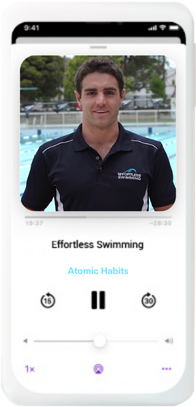
In today’s episode, I will dive into a book called Atomic Habits by James Clear. I wanted to explain some of the concepts that I found incredibly helpful for achieving the goals that I set myself.
00:46 Maldives Swim Camp
02:31 Understanding How Habits Are Formed
03:54 Favorite Quotes From The Book
05:19 Habits Need To Be Effortless
06:40 Make A Habit Attractive
10:00 Less Friction
11:36 Make Your Habit Satisfying
13:24 It Takes Time To Build A Habit
16:33 Make Good Habits A Part Of Your Identity
Need a proven plan to improve your swimming? Get the 8-Week Faster Freestyle course inside our Video membership:
https://effortlessswimming.com/training-and-membership-plans/
Clinic Schedules:
https://effortlessswimming.com/freestyle-stroke-correction-clinics/
Maldives Swim Camp:
https://effortlessswimming.com/maldives/
http://formswim.com/effortless
Transcript
Read the full transcript
Welcome to the Effortless Swimming Podcast, the show that helps swimmers and triathletes love the water, become a better swimmer and live a better life. Here’s your host, Brenton Ford. Welcome to episode number 230 of the Effortless Swimming Podcast. On today’s episode, I’m going to dive into a book called Atomic Habits by James Clear. Now, you might be aware of the book, you might have read it yourself. I want to explain some of the concepts that I found incredibly helpful for achieving the goals that I set myself. It’s also helped me with my swimming coaching to help other people develop habits so that they actually change their technique and I’ll talk a bit about that. And it’s also helped with a lot of other areas of my life as well. So it’s called Atomic Habits by James Clear. Before we get into that, I want to let you know about our Maldives swim camp that we’ve just released this week. If you follow us on Instagram, you might have seen this, it’s at Effortless Swimming.
We’ve now opened our Maldives swim camp, which is a five-day swim camp that I’m hosting in the Maldives in September, September 5th to the 10th. Each day, we’re going to have a technique focus session where myself and a few other coaches, we’re going to be working with you on a one-on-one basis and as a group as well to improve your technique. We’re going to teach you some of the concepts that you will have heard on this podcast and in our YouTube videos and also some things where you wouldn’t have heard them before that reserved for just our in-person stuff. And we’ll also have an open water swim each day where you’ll get to enjoy the beautiful sea life, the coral reefs and just the incredible climate that the Maldives had to offer. The water is about 28 degrees, so it’s a little bit warmer than the pools that you probably swim in. And the sea life there is incredible. I visited the Maldives in 2019 and I thought this is going to be such a
good place to have a swim trip and manage to organize one for this year. So there’s not going to be many spots available. So if it is full by the time you do visit the website, then just add your name to the waiting list and we’ll let you know if anything does become available. So you can check that out at effortlesswimming.com forward slash Maldives or just through the links on our Instagram as well. So I’m really looking forward to that trip. It’s going to be a great trip for anyone who wants to improve their swimming, have a bit of a holiday and go to an incredible place for swimming and swim with a group of other athletes. So it’s going to be a really good fun camp. Now atomic habits, so this book helped me basically understand how habits are formed and what we can do to build long lasting chains of cues and cravings, responses and rewards to create systems that will help us achieve our goals. So the way that I would would often think of achieving a goal,
it’s like you set your goal and then kind of your work backwards from there. Okay, how many sessions do I need to do or how much will I need to improve each month to be able to swim at this speed? So I would sort of work backwards from there. Now this book takes a slightly different approach. So if we were to summarize the book in a few sentences, real change comes from the compound effects of hundreds of small decisions or habits that over time accumulate to produce remarkable results. And to achieve our goals, we need to first build systems made of single processes and habits that will take us to our goals. And habits are the compound interest of self-improvement. That’s the good and the bad things that we do each day and every day that compound over time to create real change. So it’s basically just goes to show that what we need to set up are the right systems and processes each day or each week to achieve
the things that we want to achieve. Now a few good quotes from the book are that success is the product of daily habits, not once in a lifetime transformations. And I think of the swimmers that I work with that have had remarkable results. They’ve stuck at this at these daily habits of swimming three, four, five times a week, doing a few drills within their warm-up and having the right technique focus. Maybe they’re doing some strength, correct strength training in there as well. And it’s just having these habits that develop over time and they’ve stuck with them for long enough to be able to see those results. Time magnifies the margin between success and failure and it will multiply whatever you feed it. Good habits make time your ally, bad habits make time your enemy. And the last quote is goals are about the results you want to achieve. Systems are about the processes that lead to those results. So there are a couple of my favorite quotes.
There’s four laws of behavior change that we can use to create good habits and break bad ones. So like a single habit, if we think of a single habit, it’s made up of a cue, a craving, a response and a reward. So these components are formed according to the four laws of behavior change, which are this. So with our four laws of behavior change, we want to make it obvious, make it attractive, make it easy and make it immediately satisfying. So let’s dig into them. To make something obvious, the habit needs to be effortless for us and require no active thinking. So for example, at night, each day I want to take, I’ve got like a magnesium supplement and a zinc supplement that I want to take. I’ve got that right next to this packet of herbal tea that I’ll have each night before bed. So when I see the herbal tea packet, I’ll see the supplements. And so I see the two of those and now I’m in the habit of having those
supplements, whereas if I put them in the bottom drawer or I put them above the fridge in a cupboard that I would rarely open, well, I’m probably not going to have them. That we’ve got to make it obvious. So that’s it. It’s quite an easy one. The other thing that’s obvious is I’ve got two massage balls, my foam roller and my so-right, like a self-massage type thing. It’s next to the TV. So if I ever at night I sit down to watch television, well, I’ll often sit down, see the stretching and mobility equipment there and go, OK, get off my bum, get on the ground and just start to roll around on the massage ball or use the foam roller. So I’ll often do 10, 15 minutes of some mobility work at night. And that’s just because I’ve made those things that I want to do. I’ve made them obvious. The second one is to make it attractive. So if a habit is unattractive, we’re likely not going to have enough willpower to do it over and over again.
So therefore we’ve got to come up with some ways to make a habit attractive, even if it’s something that’s difficult, like going to the gym or studying for a long time. So one of the things that I did recently was I was watching Ozarks, which is a TV show, and I was watching the last season. But I also wanted to make sure that I would row on three or four times a week. So I’ve got like a Concept 2 rower and I wanted to make sure I did that three to four times a week. So what I did with the TV show was I said, OK, I can only watch this show when I’m rowing. And I was really looking forward to getting on the rower, putting in some headphones, putting my phone up on the rower and watching 30 to 40 minutes of this TV show because the rowing, which is a hard exercise, that was linked to this TV show that I wanted to watch. So that’s it. We can make something attractive by linking something more desirable to it.
This podcast is brought to you by our sponsor, Form Goggles. Form combines the world’s smartest goggles, real-time metrics, and guided workouts to make swimming fun. It’s the game-changing membership that’s redefining swimming. Form Smart Swim Goggles feature a transparent display that shows your time, distance, and pace as you swim. And with the monthly or annual memberships, you get a huge library of guided workouts that give you workout instructions and tips as you swim for an incredible workout. The Form Goggles are very much like what a Garmin does, but it’s right in your goggles. So that display of time, pace, and distance is something that I really love. So for the majority of the workouts that I do, I’ll wear my Form Goggles because that way I can hit the exact speed and pace that I want to hit. So every time I do a turn, it’ll tell me what my speed was for that turn, and it’ll tell me my cumulative time.
So if you’ve ever got any sets that we need to hit a certain pace, or we need to progressively get quicker, then I know exactly whether I’m on track or falling behind. So that’s one of the main reasons that I love the Form Goggles and use them nearly every swim that I do. I have a lot of clients as well that use these in the open water to tell them what their pace is, because it can be a really hard thing to gauge when you go open water, but the Form Swim Goggles will tell you what your pace is when you’re swimming open water, which is a really beneficial thing to do, especially if you find it difficult to not go out too fast or to sustain the same speed across a 1K or 2K swim. The other thing I really like about the Form Goggles is that the Form Swim app, it breaks down everything about your session. So for a lot of sessions, I’ll look back and see what was my stroke rate, what was my stroke count for certain parts of the main set.
And with that feedback, you can see your progression over time. So as you get fitter, as your technique improves, you can see those things getting better. So I really like to have a detailed analysis of each swim that I’m doing, especially as we can see those improvements. And when you purchase your Form Swim Goggles, you can save $15 off the purchase price by using our coupon code Effortless on checkout or go to formswrim.com forward slash effortless. That’s formswrim.com forward slash effortless. All right, back to the podcast. The third one is we’ve got to make it easy. So the less friction there is between you and the habit, the greater the chances are that you’ll actually do it. And this applies to things like packing your swim bag the day before or preparing a meal or a healthy meal so that you don’t go and order something that’s unhealthy after swimming. What I do here is that I will pack my swim bag the night before.
I’ll make sure I’ve got my bathers, I’ve got my towel, got a drink bottle in my bag and that bag is right next to the front door and I’ve got my clothes out and my shoes out for that next day, which is basically right next to my bathroom. So I can get out of bed, still be half asleep and just get dressed and then I can walk out the door and there’s not much thought that has to go into it. So that makes that really easy to do. The other thing that I’ve done is there’s this type of bars called blue dinosaur bars and I think they’re really tasty, they’re good for you and there’s no rubbish in them. So what I’ve done there is I bought them in bulk, I bought a lot of them in bulk and I’ve put that in my swim bag or in my car to have after swim training each time that I go. And that way I’m making sure that I have something healthy and when I’m quite hungry and maybe fatigued as well, I’m not looking to stop off at a cafe
and get a croissant or get something that’s unhealthy. So if we can make those things easy, then we’re more likely to do them. The other thing is we’ve got to make something, we’ve got to make it immediately satisfying. So our Bramie Awards immediate returns. So it’s good to come up with something simple that brings us joy right after we do the habit. So for swimming, for example, that blue dinosaur bar, it’s immediately satisfying as well. So I’ll be looking forward to that health bar and also like a coffee afterwards. I’ll often link a coffee with going to the pool. So I’ll have that straight away. And I know a lot of people do this as well but it makes that immediately satisfying. So I’m really looking forward to doing the swim and then also looking forward to that bar or that coffee. So there’s a couple of things that we can do there to make sure we actually change the habit. So let’s say, for example, you wanted to make sure that you did a bit of mobility work
because you were really tight through the shoulders and you know that you’re restricted with that and it’s impacting your swimming. Well, making it obvious, maybe you’ve got to put your foam roller next to the TV. How can you make it attractive? Well, maybe you’re not allowed to watch TV without first doing that or without doing the foam roller at the same time. So you can link it to watching TV. You can make it easy, kind of just like we’ve talked about, it’s right there next to the TV. And to make it immediately satisfying, well, maybe you say, okay, after I have, after watching TV and being on the foam roller, well, then I can have this cup of tea afterwards or your dessert that you have. So there’s a few different things that we’ve got there to make sure that we actually change your habit. And it takes time to build a habit or to break a bad one. And that’s why most people quit halfway. So what I started to change with coaching, for example,
is that people are busy. They probably don’t have, they may not have time to add another swim session into their weekly routine. And so I wanted to make sure that they were actually doing the things that they need to do to change their technique. So what I started to recommend was to do a couple of specific drills for them as part of their warmup. So they don’t, they’re just changing a little bit of their warmup. And it only needs to be 200 to 400 meters of drill swim because it’s a small enough amount where, okay, you’re not going to get sick of it. You’re not really having to change a whole lot of what you’re doing. You might actually be doing some drills already. But if you do this small amount of drills each session, it’s the frequency of doing it that will actually get you the result. It’s not the amount of time spent doing it. It’s the frequency. And so that way, if people have only got a small amount of it to do
and they don’t really have to sort of change the existing, their existing schedule or routine, then they’re more likely to stick to it and not quit halfway. So that’s why we started to change what we recommended for people to do in order to improve their stroke. If you adopt the systems first approach instead of focusing on goals, that’s how you’re going to achieve it. So goals are about the results that you want to achieve, but it’s the systems, but the systems are about the processes that lead to those results. So what I did earlier this year, I sort of looked at what I want to do with my health and fitness. So what do I need to do on a daily basis? Well, that means on a daily basis, I need to either swim, run, surf, we’ll go to the gym, I need to do something. And so how am I going to fit that in? So I looked at my week and said, okay, Monday, Wednesday, Friday are the days that I’ll swim in the morning. On the other days,
I’ll make sure that I’m doing one of those other activities at a certain time. So I’ve developed this routine and that’s eventually become habit. So if we think about the system first, rather than focusing on just the goal. Same thing for, let’s say like the podcast, I wanted to make sure that I was producing a podcast each week and in order to do that, I’ve got this schedule and I look at that. We’ve got our schedule dates and I just make sure that I’ve got enough podcast interviews lined up in my calendar where we’re going to stick to that weekly schedule. So yeah, and just making sure that I’m contacting people about doing interviews and that sort of thing so that we actually stick to it. To form good habits, you’ve got to make them a part of your identity. And I’ve seen this in play over the last 20 years where I see myself as a swimmer. So if I go a week without swimming or even like two or three days without swimming,
I’m getting a little bit edgy. I need to get to the pool because I see myself as a swimmer. I’ve seen this in the last year or two as well since we’ve moved to the beach where I see myself as a surfer. So something that I want to do on a daily basis if it’s good at least or at least every second to third date, the latest would be go for a surf, get in the water because I see that as my identity. And if I don’t do that, then I feel like I’m letting myself down. So a few of the things that it says in the book is like the goal is not to become a reader book. The goal is to become a reader. The goal is not to run a marathon. The goal is to become a runner or the goal is not to learn an instrument. The goal is to become a musician. So we can almost trick ourselves by developing an identity that fits with the habit that we want to form. And obviously, yeah, I’ve seen that in play for the last 20 years as a swimmer where I would travel, when I traveled to the US
to do some clinics, I would be looking, the first thing I’d look at was where’s the closest pool in the city that I’m in because I want to make sure I’m trying to swim each day. And if I didn’t swim each day, then I would feel as though I was letting myself down and yeah, I was missing out on an important part of my identity there. One of the quotes from the book that’s quite good too is it says, over the long run, however, the real reason you fail to stick with habits is that your self image gets in the way. This is why you can’t get to attached to one version of your identity. Progress requires unlearning and becoming the best version of yourself requires you to constantly edit your beliefs and to upgrade and expand your identity. And another one is that your identity emerges out of your habits and you’re not born with preset beliefs. Every belief, including those about yourself is learned and conditioned through experience.
And I see this a lot with people who will come to clinics. I’ll get a lot of swimmers from, particularly say from the UK where they don’t necessarily learn as kids and they’ll say, I am from, I grew up in England, so I’m not a swimmer. And one of the things we want to try and do there is just reset that belief where that doesn’t become part of your identity. I understand that’s maybe why you didn’t learn to swim as a kid, but if we want to start to forget that and your identity can be, I am a swimmer. And that happens all the time with people who have that habit of swimming and they learn how to do it, they get better and then their identity starts to change. So we see that quite a bit. I hope you enjoyed this episode of the podcast. If you do want to join us for the Maldives swim camp, go to effortlesswimming.com forward slash Maldives. Otherwise, I’ll see you next week with another episode. Thanks for listening.
Thanks for listening to the Effortless Swimming podcast. If you’d like us to help you become a faster, more efficient swimmer, go to www.effortlesswimming.com.