








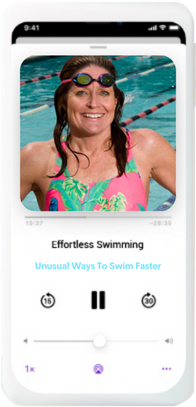
So excited to have Eney Jones back again as our guest in today’s podcast episode. Eney is an open-water swim champion and a former triathlete. In this episode, we’ll talk about coaching, drills, split tempo, and ways to swim faster.
01:22 Online Analysis
05:43 Power Phase – Power Diamond
07:18 Your Catch Is Dependent On Your Body Type
10:05 Scapular Mobility Is Important
10:43 Superhero Posture
12:50 Office Chair Swivel Drill
22:53 Split Tempo
27:55 Galloping Stroke
29:17 Breathing
33:46 Eney Bouy
34:55 Using Resistance Band
39:29 Get Your Mermaid Resistance Band
44:58 Contact Eney
Eney Buoy
Mermaid Resistance Band
Get in touch with Eney Jones
Form Goggles:
http://formswim.com/effortless
Transcript
Read the full transcript
Welcome to the Effortless Swimming Podcast, the show that helps swimmers and triathletes love the water, become a better swimmer and live a better life. Here’s your host, Brenton Ford. Welcome to the Effortless Swimming Podcast, I’ve got a guest who’s been on multiple times before. I’ve got my good friend, Eni Jones. Eni, welcome back to the podcast, it’s been a while. Thank you, yes it has. We were, I think we’re all set up to do the NUSA swim camp in 2020, you’re going to come along and that was going to be, I think, sort of middle of the year. And yeah, I was looking forward to having you there and obviously all of those things happened and yeah, that never quite went ahead but we were just talking before the podcast that you’ve moved up to the mountains since, you’ve moved from Boulder up to Christabute and you’re living a lovely life up there by the look of it. Yeah, it’s been really nice but I’ve always wanted to come to NUSA so I still
have it on my list. And actually I still have my ticket. Do you really? Yeah, well I know you’ve been off to Australia a couple of times and yeah, NUSA is a wonderful spot which I think you’d love, especially being an avid open water swimmer like you are. If you’re swimming in frozen creeks and river beds, you’ll enjoy the warm water up in NUSA, that’s for sure. Yeah, I think so. One of the things that you’ve done a little bit more over the last two years is a bit of online analysis and for those that are listening, if you haven’t heard any previous podcast, any incredibly good swimmer and incredibly good coach and I’ve learned a lot from you just different ways to teach some of the aspects of the stroke and you’re an out of the box thinker and so I’ve learned a lot from you over the last couple of years that we’ve gotten to know each other and you were saying that with the online analysis that you’ve been
doing recently, there’s four parts of the stroke that you tend to look at. Could you delve into what those four parts are? So what’s that process when someone sends you a video, how you look at it? So people, yeah, they’ll send me a video and I either like it from the front or the side, but I look at the catch, which is in the front of your stroke and people don’t realize your catch is dependent on A, your body type, B, the conditions, C, if you’re sprinting or doing distance because if you’re sprinting, you actually want more in the front of your stroke and less in the back. So I work on catch and activating catch. So if you’re an ITU swimmer, triathlete, you really need to have more in the front for that explosive power. The next phase I look at is the power phase, which is at the shoulder. And I call it happy family. The dad is the shoulder. The mom is the elbow and the kid is the wrist. Notoriously, people do not have their happy family in line.
And that being said, at the shoulder, you want the shoulder, elbow, and wrist together. But there is, we have talked about this before. There’s 41 degrees with you can work with here that makes almost that Superman logo. But a lot of people stray out to the side. So then they’re in their shoulder in that power phase. And once you’re there or once your hand, I call it the kid or the elbow, is in front of the wrist. Once the wrist is in front of the elbow, there’s no way to increase that power without stressing that shoulder. So at the power phase, there are so many things that people can do. And one is what you just got out of the water doing, surf paddling because you can’t surf paddle with your elbow leading the way. The last phase is the propulsion phase, which is pushing back. And that in a long distance event is usually pretty long. In a sprint, you probably don’t press back as much. And the last phase that I look at is called, people call it the recovery.
But I call it the return because you’re dealing with two different elements. You’re dealing with water that’s 800 times denser than air. So you can actually make up time through the return that people don’t think of. And I trademarked a term a while ago called split tempo because you’re dealing with water and air. So often, if you time elite swimmers, they have a different tempo underneath and a very different ratio through the air. And sometimes it’s different between right to left, which creates more of a gallopy stroke. So I’ve had fun through the years being in the lab, just going through hundreds of swimmers and just documenting and measuring and putting it together. Because there are so many different ways that people can do things. But those four things, the catch, the power phase, the propulsion phase. And then the return or the recovery are what I look at. So there’s different drills that people can do.
And a lot of it, the first step is creating awareness. And I think listening to other coaches, because I’ve learned a lot from you because as a teacher, researcher, there’s so many different ways you can teach and research and listen to how other people are saying things and then how someone is learning. Yeah, we’ve covered quite a bit there. I think like one of the things you talked about there was the power phase. And for those that are familiar with like our five day catch challenge or some of the terms that we look at, like you call it one happy family. When you’re looking from the side, you’ve got the shoulder by hand aligned all on top of each other. And we call that phase the power diamond and power diamond because as you said, that’s where you’re applying the most power. And I’m working with this device that’s going to be released in I think one or two months time where it actually measures the force of the hand.
So all the way through the stroke and over the top it measures the force. And you actually see it when you measure when you line it up with video that that peak in force is when the hand is directly underneath the shoulder, essentially. So it’s really interesting to see that spike in the force at that point. And through the catch, like, yeah, it comes up a little bit with that that force, but it’s it’s not that much compared to that that peak phase underneath. So when someone’s trying to muscle their way through the through the catch, it’s you just don’t see that with elite swimmers. And I actually see it with swimmers that aren’t quite as good. That that peak in force yet still under the shoulders. But sometimes it’s quite high through the catch because they’re putting a lot of pressure downwards or trying to just rip hard too early. So with a good with a good swimmer, you’ll see that it’s this kind of almost gradual build up through there in terms of the force.
And then it’s it’s less towards the end of the stroke, obviously. But yeah, it’s just very interesting to to to see that. And you also sort of you talked about the catch that it can that it will change depending on, say, someone’s like body body type. Could you talk a bit more about about that?
Well, so often with like move motion movement creates power and motion. But your catch is not just reaching straight forward. If you actually can hike your other hip and I call it salamander obliques, you can get more reach out of the catch. But that being said, someone that six six is going to be able to reach a little bit more and not, you know, than someone that’s five two. So the catch can’t be the same. But I always feel like it needs to be a cross connection cap and catch from the arm to the hip to the opposite leg. So it does really look like a superhero taking off and reaching through the whole body rather than a flat arm in front of you, which I think is beautiful and will work in flat water. But if you just place your arm and then set and then press, there’s not a lot of speed, but it’s very pretty. So I do think the catch changes on the condition and body type. And I think the more people have body
awareness and can engage some of their bigger muscles early work so that it’s not just a shoulder press down.
Yeah, one of the things that I know you sort of focus a lot on is making sure that people are using their lats and becoming becoming aware of that. And what I’ve found over the last couple of years with some of the ways that we’ve taught the catch and so on. A couple of things that have made a big difference with people who weren’t necessarily using their lats and those stronger muscles around the back and shoulders compared to those that that are. Is those that weren’t a lot of them are pulling very straight with their arm. There’s no bend in the elbow. So that’s the that’s the first thing and it’s quite a quite a clear one. The other one can often be if people are trying to get a high elbow catch or early vertical forearm, if they are rolling that shoulder forwards, you just can’t access your lats very well at all. So you’ve got to and the way you explain it, superhero posture, chest out, relax your shoulders back a bit.
So through that power phase, if you’ve got the right posture, then your lats can can be used. Whereas if you’re hunched over, you’re rounded, you just don’t have access to it. So that can be a big difference between someone who’s able to use those stronger muscles is just that the general absolutely. And also people don’t realize that scapula mobility is really important. And I think I told you this once, but when Michael Phelps first got on a program on the T box, he was stretching forward, back and so many swimmers just swing their arms forward. But to have that mobility through your scapula is really important. And you know, you’ve seen people, you know, swimmers can grab either arm back and get that mobility in their scapula. And also it opens their diaphragm and it creates a better posture anyway.
There’s so many references to say superheroes or Superman, like the the way the three that I can sort of see just immediately are when you finish reaching forwards and you’re on your side a bit, that’s that. It’s like Superman flying position. Then you’ve got that superhero posture with the chest out, which I know you’ve I think you’ve trademarked that that term superhero posture for swimming. And then you’ve got that like that Superman S logo, the power, power diamond. Yeah, there’s just so many references to it that I think it’s a good cue for people to to use for those really important parts of the stroke. Well, and the interesting thing is when they studied superhero posture, they found that if people stood with their chest inflated and their hands on their hips for two minutes, it actually increased their testosterone and lowered their cortisol. So to me, that’s so interesting that posture can affect hormones.
And and I’ve even had people go through the grocery store, because if you go through with bad posture, no one really talks to you. You know, and if you go through with good posture, everything opens up. And, you know, so it’s kind of interesting how it opens the whole world around you. And even when you take it to good posture and open water, if I lift my chest and open my chest, it actually lifts my shoulders and even keeping a neutral neck. It makes sighting easier because I’m higher in the water and it makes swimming easier because I’m higher in the water. And that doesn’t mean you can’t swim low, but it’s so much easier to skim across the surface than to swim, you know, really low in the water. I saw a video you posted this morning of a drill that I hadn’t seen before. I assume this is one that you made up because, you know, I think I’ve seen probably most drills that have been created. But this was a new one that looked like a lot of fun.
So if you can combine fun and something that’s useful, I think that’s that’s a sweet spot to be. And so can you talk a bit about this drill that you work with? Yeah, I will. I actually make up a lot of drills and it’s really fun for me sometimes to put them out there and then years later, see them being used. But this one is called office chair swivel and you sit on a kickboard. You fold your legs back and cross your ankles and squeeze the board. And then you lift your chest and you use your forearms pressing back, but you navel swivel side to side to get your hips out of the way and then just go down and back on the pool.
There’s a drill that I also love called
catch and release where you take a paddle without any straps on it. And you press down with your knuckles on the top and then you release your fingers underneath so that you have to press back and then you grab it. There’s one that I do called electric slide, where once again, you have a paddle with no straps and you press down and then you widely skim across the top of the water and then reset your catch. So it’s teaching people how much easier it is to be on top of the water. You know, and also if you’re not pressing back, you lose your paddle. But the office swivel drill is really kind of a fun drill because I couldn’t get people to actually kind of navel swivel. The buoy helps a little bit because you have to squeeze my buoy to get the hips out of the way. You can’t just pull like you’ve had an epidural. So it kind of engages your core. But this office swivel actually gets your navel to swivel. And I’ve even done it in an office chair with rocks in my hand.
And if you have a chair that can swivel, you can go all the way across, you know, your office floor. So did you post that on your Instagram? Was it both on Instagram and Facebook? Oh, I’ll repost it through our Instagram and check out Amy’s one, which is, I think, at Amy Jones. Is that right? Yeah. And I might repost on the one as well from from your page because, yeah, it’s a good one. And I think it like for you, some of the things that you focused on a lot is obviously that that catch and connecting it up with the hips, which is a really important thing to do. So it’s, yeah, I’d like people to give it a try. And what did the girl say who you had doing it afterwards? Well, she they thought I did a clinic early on this year with some girls and she people, it’s harder than it looks in a lot of ways. But you do kind of you’re able to get it going and move forward because it really engages balance as well, because you’re squeezing the board.
So it really is engaging your core. You’re not you can’t just sit flat on a kickboard. Without moving. But it’s corrected. One of the biggest things I see is people and especially living at 9000 feet, people either linger, breathe or they breathe way too late. And so the opposite arm where not the arm they’re pressing through, but the arm in the front, they never get that catch going because they drop their elbow and they’re almost looking back. And some of this stuff that I’ve been teaching has been it’s hard because it Red Cross teaches breathe back into the pocket, but they did that for safety. But then what happens is you’re in your shoulder and you can’t get in your lat. So you need to have a tight discipline breathe in the front. You know, and Red Cross, I mean, the Navy Seals teach press down because they say you don’t need to do that to lift your legs. But if you engage your core, it doesn’t matter where your chest is,
you can lift your legs. And so there’s so many things that I can relate it to, like swimming in Pilates mat where you’re using your lower lumbar, you’re stretching through your chest and you’re kicking and using your arms like that, where you’re using your whole body. So sometimes these drills help, at least for me, teach things that I have to undo a lot that’s in people’s head, you know, that they’ve learned this way or that way. And then now their shoulders hurt or they’re not getting any faster or it’s or they have to do so much yardage. And that’s what I realize with triathletes is, you know, the swim is so small, you don’t you can’t be in the back. I mean, you can in smaller races, but if you really want to perform, you need to be as fast as possible with the least amount of energy and the least amount of training time. This podcast is brought to you by our sponsor, Form Goggles. Form combines the world’s smartest goggles, real-time metrics
and guided workouts to make swimming fun. It’s the game-changing membership that’s redefining swimming. Form Smart Swim Goggles feature a transparent display that shows your time, distance and pace as you swim. And with the monthly or annual memberships, you get a huge library of guided workouts that give you workout instructions and tips as you swim for an incredible workout. The Form Goggles are very much like what a garment does, but it’s right in your goggles. So that display of time, pace and distance is something that I really love. So for the majority of the workouts that I do, I’ll wear my form goggles because that way I can hit the exact speed and pace that I want to hit. So every time I do a turn, it’ll tell me what my speed was for that turn. And it’ll tell me my cumulative time. So if you’ve ever got any sets that we need to hit a certain pace or we need to progressively get quicker, then I know exactly whether I’m on track
or falling behind. So that’s one of the main reasons that I love the Form Goggles and use them nearly every swim that I do. I have a lot of clients as well that use these in the open water to tell them what their pace is, because it can be a really hard thing to gauge when you go open water. But the Form Swim Goggles will tell you what your pace is when you’re swimming open water, which is a really beneficial thing to do, especially if you find it difficult to not go out too fast or to sustain the same speed across a one K or two K swim. The other thing I really like about the Form Goggles is that the Form Swim app, it breaks down everything about your session. So for a lot of sessions, I’ll look back and see what was my stroke rate? What was my stroke count for certain parts of the main set? And with that feedback, you can see your progression over time. So as you get fitter, as your technique improves,
you can see those things getting better. So I really like to have a detailed analysis of each swim that I’m doing, especially as we can see those improvements. And when you purchase your Form Swim Goggles, you can save 15 US dollars off the purchase price by using our coupon code Effortless on checkout or go to formswim.com forward slash Effortless. That’s formswim.com forward slash Effortless. All right, back to the podcast. Yeah, yeah, that’s right. There’s there’s a lot of things that people will hear and then take them to the extreme. For example, one of those is with the reach. I think, you know, it’s it’s great to be long in the stroke, but too many people see overreach as well, where they’re reaching as far as they can, pushing as far back as they can. And the arm out the back is straight. So they’re almost locking their elbow out there. And then they lose that bit of balance where the shoulders will rotate too far and so will the hips.
And then we get that spray of the legs. So it’s like it’s like the the three bears approach for a lot of the things is like, you don’t want too much. You don’t want too little that somewhere in between is is good. Same with that pressing down at the chest and head position, where sometimes people with their head completely submerged in the water. There might be 10, 15 centimetres of water above the back of their head. And the only way that you can actually get a breath from there is you’ve either got to turn all the way and be looking to the sky, or you’ve got to eventually lift back up. So you’re much better just the top of the head above the water because then you can turn to the side, get the breath quickly, come straight back. And it’s if if you do that contrast swim of like, you know, all right, push your head down so it’s completely under the water and your chest is mostly under the water as well.
Do that and then swim with the head above just above the water. It you’ll feel so much better. And we had one or two summers this week ending in clinics who who made that switch. And the first thing they said was like, well, so much easier. It’s like, well, yeah, that’s yeah. So sometimes it’s a matter of just knowing the right things to to do. And it is easy to take some things a little too far, I think.
Yeah. And sometimes even the way
they’re interpreting it. And that’s where sometimes I think the videos of themselves are really good because people think they’re doing something. And it’s not until they see themselves that then you can diagram it out or point it out and and give them away. I try to give people a way to feel it, whether it’s, you know, with rocks or shells or weird drills. And and then they can actually feel one of the drills I like for catch is where you’re pressing one kickboard down and one is up so that you’re activating underneath your armpit. You’re not straight out, but then you can grab over the end of that front board.
And there’s some I’ll send you a great photo of almost the arc in Katie Ledecky’s catch. It’s just you can almost see that there’s a line through her whole body. It’s not just a straight arm, you know, reaching forward. One of the things you mentioned earlier was that the split tempo and saying that people can make up a lot of time above the water. Can you talk a little bit more about about that?
Yeah, so that was something I had a hard time teaching because so many once again, people kept reflux for years. People talked about distance per stroke and then you’re going, wait a minute, I’m looking at Janet Evans and she’s so tiny. And unless DPS, unless it’s golf, you know, and you’re not adding it in, you know, there is something to being deliberate under the water, but there’s no reason to be super deliberate above the water. And I wasn’t sure how to teach this and we were in the Bahamas and you’re not allowed to eat the little tiny conks.
But somebody had eaten out the little conks and I thought, oh, I can make something from them. And I was swimming back to the boat with the conks in my hand and they were filling up underneath the water but then draining through the air. So it was creating this tempo, this split tempo where I was faster through the air. And to me, that was kind of a breakthrough because I get so many cyclists and runners that are super deliberate on there. It’s almost like they’re a metronome above the water and below the water. So they’re just as slow above the water as underneath and to teach people to let go and re-engage was really hard. So using the shells was really good or sometimes I could use biscuit sand dollars and they’re the sand dollars that look like a biscuit, but they have a hole in the bottom, so they fill up and they drain. And so the other thing that it also teaches people to do is to use their forearms because proprioceptively we’re so connected to our hands,
but there’s more surface area in our forearms. So to actually get them feeling it without thinking about it has been really important. And then it’s been very fun to watch the Olympics and nationals and worlds, you know, with a stopwatch and actually, you know, because everything’s taped and you can tape what one arm is underneath and as opposed to the top and the ratio difference between sprinters and distance swimmers. It’s actually been really fun. What what is that? The between like on average, everyone’s different. But what is that for, say, a distance swimmer? What’s that ratio of time spent under water with a stroke compared to time above? You know, I don’t have the stuff in front of me, but it’s actually the, you know, the sprinters have a bigger ratio, do you know what I mean? They’re much faster through the air than distance. And, you know, that usually the longer the distance, a little more relaxed in the air.
But the nice thing that I think is that people never think about working when something’s easy, you know? And that to me, I just think, wow, that’s a great way to get your arm back up there, you know, without controlling it. And part of it is, you know, we teach a high elbow because you want the elbow higher underneath, but it really doesn’t have to be, you know, unless you’re in a super crowded Ironman swim and you only have this much space, you could really open your chest in and spread out. So, but that being said, it’s nice to not have a locked arm, you know, a straight arm because then you’re only accessing shoulders and traps and deltoid muscles. So, yeah, but I’ll get you some of the numbers because it actually is really fun, even with worlds coming up, to just sit with a stopwatch and measure. And then, you know, and then you also see sometimes, especially in open water, more of a gallopy stroke. So meaning, you know, horses gallop
because they get more reach without control. So with open water swimmers, sometimes you’ll see one arm almost straight and then the side they breathe on with a bent elbow, which almost gives them a little more time to breathe, but it creates like a loping kind of a gallopy stroke. And so that’s been actually really fun to watch. And then going into the resistance bands and the core, it’s been great at the Olympics to watch people actually change their kick and go from a four-beat crossover to a six-beat kick in the same event. And with bands on their ankles, just gives people more awareness and it’s more work, but it also teaches them where their legs are and what their legs are doing. So one of the things you mentioned there is that that loping, galloping stroke, something that I often need to coach people through is going from thinking they have to be symmetrical every stroke, the same catch, the same pull,
the same timing. It’s like, no, some people do some that way, especially those who breathe every three, that’s fairly common. But there’s a lot of swimmers and I’d say probably the majority of swimmers that I work with would be better with an asymmetrical stroke where they may be longer on one side or they’re just breathing to the one side. So it’s okay to not be completely balanced or even on each side. And like for me personally, that’s a much better swimming, breathing to the one side and I am longer on that side when I breathe. And to me, I can get a much better rhythm, especially in the open water for it. So yeah, that’s something that’s quite common as well. And I mean, you see it in adults if they’ve learned to swim through maybe some learned to swim classes where they’ll get taught breathe bilaterally, which I’ve got nothing wrong with breathing bilaterally, but they’re just taught everything has got to be exactly the same.
But once someone gets that certain level where they can swim comfortably for a kilometer or so, then you might start to look at ways to make them a bit faster where they can get into this rhythm that they find best for them.
Well, and I do think having access to the other side is important. But what I see that’s really common is when people are taught to breathe bilaterally, you’re naturally lower in the water and so you’re pushing more water. If you’re breathing one side, sometimes it’s easier to get up on top of the water. And the other thing with that is, I’ll teach people to density breathe a lot. So if they’re, say a wave’s hitting them, you can get hit by a wave and just breathe in the air because air and water are different density. You don’t need to swallow everything that’s there. And so people don’t really work on that, but I’ll have people put water in their mouth and then say, okay, just pull in the air. It’s really subtle, pull in the air. You can have water in your mouth and pull air in. You don’t need to breathe back in this back pocket. So that, I’m happy to hear you say it and I’ve watched you swim enough that I love how you swim.
And I think we teach perfection a lot, but I’ve always said there’s really no points for perfect. It’s not diving and people don’t go, oh, that is so beautiful because different things work for different people, but there are easier ways to do it, but you have to look at why things were taught the way they were with Red Cross. They’re thinking about safety and breathing back in this pocket back here. With the Navy SEALs, they’re trying to be low and flat in the water for 12 hours and not be seen or shot. So they’re trying to be super, super low. With the bilateral breathing, I think it’s just access and I don’t know, it seemed to me in the 70s and the 80s, it was like, okay, three, six, five, seven.
All of a sudden we were doing these breath-holding things and longer and I do think we’ve talked about this before. One of my favorite books from this two years ago and I have it to send you. It’s called, Breath, have you read that book?
Is it James Nesta? Yeah. Did you read the author? I haven’t read it, but I’ve heard a lot of people say that’s a good book.
Well, it talks about some of the things that we’ve talked about, like with breath, breathing in, counting, holding, exhaling and then having nothing and counting and really having your breath do more for you than you’ve actually just being more cognizant of it. And so to me, it’s helped me swim in icy streams and when I’m getting, I’ve swam in the water park in January where ice is shooting out of the water park but just to realize everything that your breath can do. So it’s not, we don’t really have to have this regimented thing but there is such a calming essence and a power essence that comes from breath and being aware of it. And so even, I sometimes tell people to,
I’ll look at, they’ll use a tempo trainer and we’ll try to connect it to music or something so that it’s almost like a breathing waltz, like a one, two, three, one, so that they’re not focusing on how they’re feeling, they’re just, it’s almost like teaching rhythm. And so sometimes you can teach the rhythm through the breath. But I like breathing on one side and I know that it’s not taught that way but I just think comfort is super important. And I think sometimes the more comfortable you are, the more speed you can have because you’re not controlling what you’re, you’re not limiting what you’re doing.
You mentioned earlier the resistance bands for kicking. So, I think it was last month or earlier this month, you sent me a box with a couple of Eni-Boys, which I, or Eni-Boys, which we call them here in Australia, my favorite poor boy to use, which you designed, created them there, kind of like two empty bottles, which can be filled up or kept empty, but it’s basically a poor boy that’s, to me, he’s got the best float, nice and narrow in the middle where you can keep your legs quite close together because there’s some poor boys that have got like a, I don’t know how I would call it, maybe like three inches, four inches wide and then your legs are sitting out, outside your body line, it just doesn’t feel good and you can’t connect your, like you can’t use your core very well or your hips very well with it, but yours is, if anyone asks about what poor boy to get, that’s the one, the Eni-Boys. So, you sent me a couple of those,
so thank you for that, but you also included some of these little resistance bands and you’ve been using them a bit to help people kick, so they’re not kicking like they’re running or cycling, so they’re bending their knees too much to help them kick like a swimmer. So, how long have you been using them for and what are you doing with people to help them to get them to use them and kick correctly?
Well, I’ve been using them, we’ve all used bands when we pull and I told you sometimes when people breathe, their legs spread out, so some of it’s been awareness, but we’ve started twisting them and using them for resistance, so it’s made kicking harder and it’s made a tighter kick because so many triathletes and runners that I work with are very knee drive oriented, they either look like they’re running or on their bike and so they are not kicking, their so ass is tight and they’re not kicking from their core at all and it’s not a tight kick, so they’re not super, they’re actually easy bands because I didn’t wanna make them too hard, but you can twist them, but then you can horizontal kick or even vertical kick with these bands so you’re not having this huge kick, you’re doing a tight, tight kick and then during a kick set, you can also, if you twist the band, teach a crossover kick or have people do a two-beat crossover
or a four-beat crossover or even a six-beat kick and then they get a tighter kick and then if they’re swimming with them, they have to use their core a little bit so that their legs don’t sink and people have taken bike tires for years, but to me it’s really helped get rid of that knee drive and teach people where a kick should come from. So whenever I would say tight kick, sometimes I would get a long like scuba kick rather than teaching a flutter kick. So to me, it makes it a little harder which just creates more awareness so then when you’re doing a kick set and you can tell them what kind of kick to do, it’s not just, you know, we’re kicking, it’s like, oh, okay, I’m doing this kind of kick. And what should they, let’s say someone has just got their band on, they’ve twisted it and they’re swimming, what should they be feeling for when they’re doing it correctly compared to when they’re not doing it correctly?
So when they’re doing it correctly, you would feel more in your core and thighs. If you’re spreading, if you’re spaying your legs when you breathe, you’d actually feel more tension like in your IT band. You know, because some people don’t even realize that they’re doing that at all. So it also can even, I always say, one of the most important kicks in swimming is an up kick. And we rarely work on an up kick. You know, I’ve never heard coach say up kick, up kick, but that up kick is really hard, especially for triathletes because their so muscles are tight, they’re sitting, we’re sitting a lot, they’re riding a bike or running. So to actually have that up kick. So this kind of just increases the awareness and makes you really feel that up kick in the back of your stroke, if that makes sense, does that? Yeah, I like it because there’s two things that I will see with a lot of up kicks. And so if you don’t know what an up kick is,
it’s basically just when the foot is moving upwards in that kick motion. So not the down kick but the upward motion. Two things that I see, one is that people, they will often have their toes pointed down throughout that entire up kick. So the surface of their foot is facing against that oncoming water. So it creates a lot of drag and that will drop their legs. So trying to get them to keep the toes somewhat pointed at least in that upward motion is beneficial. And then just having some of those upward kicks come from the hip, come from the glute rather than just bending at the knee. So being able to teach that, it sounds like that can cover it pretty well. Plus if you put some fins on, let’s say you’re using some DMC fins, which will encourage you to kick correctly, I think that could be a really good approach to fixing an up kick that’s not coming up in the right way.
Yeah, oh, definitely. What’s there on your, you’ve got those bands available on your website. They’re pretty fairly inexpensive from what I saw. What do you call them on there? I mean, what’s your website for people who are listening? Oh, it’s just on the enibooie.com website and they’re just called mermaid resistance bands. So the nice thing is you can use them for stretching, travel. You don’t have to use them in the water, but they’re really great with DMC fins. I found them really great, not only for pulling, but I was surprised how much I love them for kicking. And I like being able to twist them and make them harder or easier. So yeah, it’s been a nice way to kind of teach people
to use their hips and their glutes and their full leg and paint the back wall with their toes rather than have their feet straight down and their knees bent. It’s made out of this like, almost like theraband type material for the resistance bands. One of the things I don’t like about the traditional swimming bands, like if you cut up a tire tube, for example, some of them are quite a very small. And so if I’ve got one where my ankles and my feet are really close together and I can’t move them at all, I can’t quite get that movement through the legs and through the hips to be able to swim like I normally would. So my feet are just dropping really low if I’ve got a very tight band, but something with a little bit more give where you can actually move your feet slightly up and down and kind of coordinate your catching and kick better. To me, it makes a world of difference with being able to swim correctly with a band.
So I think any band that’s really tight, it can actually just, yeah, it can be good for strength, I get that, but I think it can be more harm than good in many ways if you’ve got the incorrect type of normal swimming band. Yeah, and then when you, so all your clinics are back happening now in person? Yeah, yeah, we are back running. So myself and the coach Mitch up in Sydney, he runs all of those ones. And we’re back up and running, which is great because while I enjoy the online coaching, I was like 18 months without any face-to-face stuff. I was going a little bit crazy, I think. I wasn’t coming up with many new ideas and I was just sort of a little bit, I think, stale because it’s when you’re actually working with people face-to-face where you can come up with new ideas and hear what people are saying and it’s been good to get back to it. So we’ve been running pretty much back to full capacity since November or December, which has been great.
And you were saying earlier that you, it’s almost sort of back there and pools are opening and all of that. Like, has it taken that long?
It’s taken a while and things are, I still feel like things are a little slow, but part of the stagnation could be me. Like I became very internal and not interacting as much. So it just feel like things are getting going, but it feels like we’re going right now, kind of from zero to 60 pretty fast. You’re like, wait, wait, there was part of the reflection and the slowness that I really liked. So it’s gonna be an interesting kind of adventure going forward. I know, I feel the same thing where there was, there was parts of it where I had, there was no responsibilities, essentially, apart from keeping the kids alive and all of that. But there was nothing that we could do for a while and looking back, there was parts of it there where life was very, very simple and there’s something certainly to that. But I think for me, I wanna be out there and doing stuff and being able to coach and actually be able to do what I love with coaching.
But it also, for me, meant that it’s, say yes to less things and just to the things that I really wanna do. Cause it just made me reflect on some of those things that I was doing that maybe I’d moved on or I just wasn’t, yeah, like I just wanted to just stick with the things that I really do love. And if I keep doing those, then I’m going to be better at the things that I’m actually doing and not spread too thin as well, which happens pretty easily. And it happened pretty quickly once we started with clinics. It’s like, oh my God, it’s like going from nothing for 18 months to then being fully booked with stuff is like, I mean, I’ve gotta dial it back and just simplify a bit. Yeah, no, absolutely. So yeah, it’s been, it’s been, it’s been interesting.
Any, I wanna thank you for being on the podcast again. So for those of you listening, we talked about a couple of things, but if you are listening and anything sparked an interest, check out Amy’s Instagram, which is at Amy Jones, which we’ll put in the show notes. And also if you’re looking for a good pool boy and you don’t have one of Amy’s yet, highly recommend it. Like everyone, I mean, I’d say most of the top pro triathletes have probably got one of your pool boys. And those that probably just don’t know about them yet, I’d say, oh, they’ve got a sponsor and they can’t deviate from their sponsored equipment. But I think the pool boy is great. And those bands, I think a lot of athletes would be able to get a lot from. So where’s the best place to get in touch and get in touch and find out more about you?
Yeah, so either at anyjones.com or inibooie.com. And then even if they don’t send, if people wanna send in a video, that’s fine. But yeah, I think social media or Facebook or Instagram is perfect. Sounds good, we’ll have to, I think next year I’ll likely have another NUSA camp. So can use that ticket then. Oh, good. And yeah, we can do another camp together, which I’m looking forward to. Cause we got to do the Hawaii one together, which was great. And I was looking forward to that NUSA one. But I think, yeah, next year I’ll probably start that back up and we’ll go from there.
Well, thank you. Thanks, Amy. Thanks for listening to the Effortless Swimming Podcast. If you’d like us to help you become a faster, more efficient swimmer, go to www.effortlesswimming.com.