







How long does it take you to warm up in training? We share our favourite pre-training routine to improve shoulder stability and reduce the chance of injury.
Transcript
Read the full transcript
Welcome to the Effortless Swimming Podcast to show that help swimmers and triathletes love the water, become a better swimmer and live a better life. Here’s your host, Brenton Ford. So if you feel like it takes you a long time to warm up, if you feel like after a 10 and a half, 2Ks, you’re finally ready to go, then you might want to look at including a before training routine. For me, it used to take me about 1,200 to 1,500 metres to really feel like I was warmed up. But now in the last 6 to 12 months I’ve added this to every swim that I do and I can really get going in about 400-500 metres. I’m ready to go and get stuck into the main set if I’m short on time. I can warm up with 400 or 500 metres and I can kind of hit the pace that I want to. So a couple of things that I’ve added. I used to teach just doing arm swings and leg swings and all this sort of stuff. They’re really good. They’re much better than doing a static stretching. They’re much better than doing nothing.
But we went to Helwick probably three years ago now. One of the Fina coaches over there, Miguel Lopez, who I’ve developed a good relationship with now, he’s an excellent coach. They have a lot of national team coaches come in and actually swim at the pool at Tanyapura over in Thailand. So he gets to come across a lot of different athletes, coaches, physios, biomechanists. They have the Dutch team physio come over and show them the routine that he takes the Dutch national athletes through. And a lot of it is just very slow, very controlled movements and not wanting to go too far outside your normal range of motion. So he sort of says, stick within about 10% of your natural range of motion. So if you think of bringing your hands up behind your back, you don’t want to go too far because if you go too far, it can kind of tear the muscle and it can have a higher chance of leading to injury. So with any of the movements that you do during your warm up, don’t go too far outside of your comfortable range.
So some of these just basic exercises that he has his athletes do now and I like to include these when I’m training. Some simple ones are just sort of internal external rotations moving slowly through that. So I’d normally go 30 seconds or so of that. Also you can go on the ground in almost a bridge position on your knees and your hands and you put one foot forward. So opposite. So you go left foot back, right arm forward and you move through that 10, 15 times. So some of these are very similar to some yoga movements. But I found that really good just for warming up and reducing the chance of getting any injury. The second thing is using TheraBands. I mean, I’m really using a lot of TheraBands these days. 90% of sessions that I do, I’ll do at least four or five minutes of TheraBand work. So the one that I like to use is this red TheraBand or red resistance. It’s $15 or so on Amazon. You can find them anywhere.
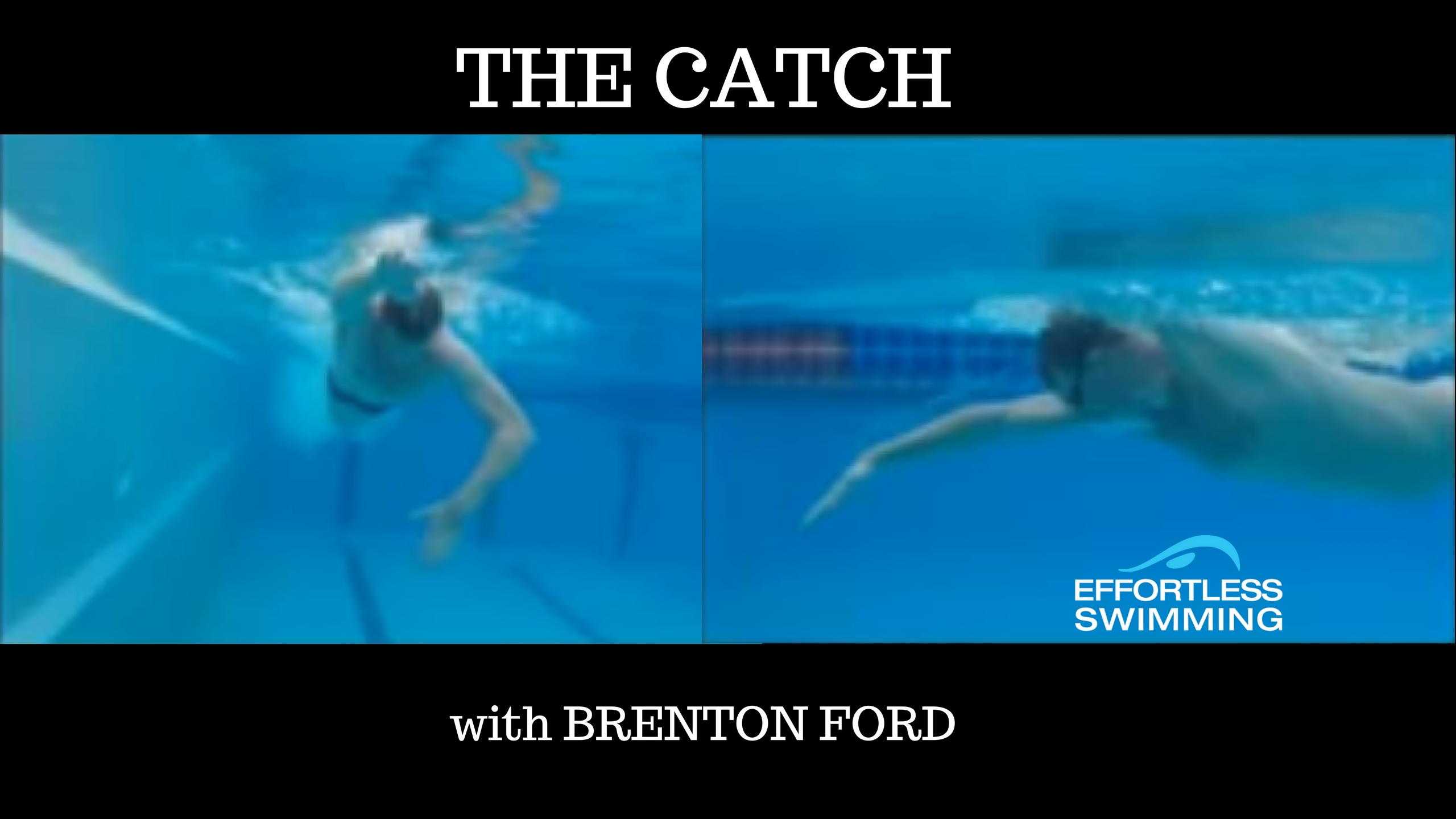
Get about six foot. That’s probably what you’ll need. And I’ve got a routine, a five minute routine that I go through and I posted that in the Effortless Swimming Membership which goes through six or seven different exercises. But I found that to be really useful for two things. Number one is scapula stability and control. So when I start to get fatigued towards the end of a session, I find that it’s hard to maintain good form because I don’t quite have that swim strength to be able to kind of maintain a good catch and a good pull through. But using the TheraBands, one, it’s great for warming up. But number two, just developing strength to be able to sort of keep your shoulders in the right position and particularly have a much better catch. So a much better catch. You can see this exercise down the bottom here in that picture. So I normally sort of start, you know, one of the exercises is with the arm out in front
and you just move it down, keep this elbow up, move down to there and then you’ll end up pulling through. But it’s really about keeping that elbow forwards while you go from out in front to the fingertips pointing down. And I mean, you’ll feel that, you’ll really feel that in the back of your shoulder here. That’s the whole idea because it’s, you know, the whole catch motion, it’s quite an awkward movement. You don’t do that anywhere else. There’s nothing else that you probably do in day to day life. We’re actually going through a similar sort of movement to what you will when you’re catching, when you’re swimming. So that’s why I, yeah, that’s why I’ve decided to do a lot more of that. And I found out with the athletes that I coach is, yes, you can develop some strength just by swimming more, but it’s difficult without actually using TheraBands or like the pulley cable type system. Very cheap solution for that.