







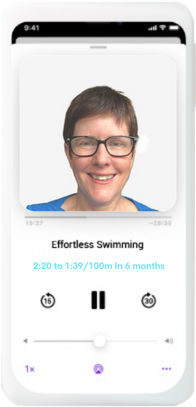
In today’s episode, we sat down with Brigetta Hamilton to talk about her impressive improvement over the last 6 months. Brigetta attended one of our clinics in May starting at 2:20 pace per 100. She got her time down to 1:48 and now she is at 1:39. Find out what she did to improve!
00:51 Swimming background
01:17 Were you able to swim comfortably without stopping when you started swimming?
03:02 Does your cycling background help with your swimming?
05:10 When you are working on going faster, what do you usually think?
11:15 Developing Intuition
14:34 Your feel for the water looks so much better
15:59 Rocking side to side and recovery
18:35 What’s your next goal?
20:35 Try the sight and breathe method
21:23 When you relax, you swim better and quicker
Change your technique and swim smoother, easier freestyle in the Effortless Swimming membership:
https://effortlessswimming.com/training-and-membership-plans/
Stroke Analysis Membership:
https://effortlessswimming.com/stroke-analysis-membership/
View our freestyle clinic schedule around Australia:
https://effortlessswimming.com/freestyle-stroke-correction-clinics/
Form Goggles:
http://formswim.com/effortless
Watch the full video on YouTube:
Transcript
Read the full transcript
Welcome to the Effortless Swimming Podcast to show that help swimmers and triathletes love the water, become a better swimmer and live a better life. Here’s your host, Brenton Ford.
Welcome to the Effortless Swimming Podcast. My guest today is Brigetta Hamilton and Brigetta. I met you earlier this year at a clinic that you came to here in Melbourne. And I’ve seen you twice since then where you’ve come along to some follow up filmings. And I wanted to get you on the podcast today because I’ve been so impressed with how much you’ve improved this year. And especially considering you’ve only started swimming since May. So when you started in May, you said you’re around a 220 pace per 100. And you’re now down to low 140s. You said you’re 139 this morning, which is a hugely impressive for anyone, but especially having started in May. So welcome to the podcast. And what got you into swimming to start with? I was a cyclist and got COVID quite badly in December and just thought, ah, I’ve had enough cycling. It was too much on my system. And someone suggested swimming. So I thought, well, I’ll swim at school. Can’t be that hard. Got into the
pool and look like a frog in a blender flailing away. And then realized nobody was just gliding past me. Men, women, children. This is like unbelievable. Yeah. When you did start swimming, were you able to like swim comfortably without stopping? Or were you having to stop after a couple laps, get your breath? Like, how was it for you when you first got into it? I probably started off about 500 meters. It was my goal to get at least a 500 continuous swim. But I’d be able to do a meter a length and then I’d have to pause for 15 seconds or so and do the next one. So I think I did that for at least a month of just back and forth and trying to build up distance. My arms really sore, fatigue and aching. I did an open water swim just to see how I would do it. And I did in the shallows. And I think I did 300 meters. It took me about 35 minutes or 45 minutes. So it was really slow going and you must look back at that now and like recognize how far
you’ve come and think, wow, okay, that’s a big change because watching your your first video, I watched it just before just to get a reminder of sort of where you were when you first started. Like I wouldn’t say you weren’t swimming poorly at all. Like you had some really good things happening with your stroke. But the hips and the legs were quite low. The breathing was quite high. Three was quite wide. And at that time, like your counted the strokes to there and it was 22 strokes for for that lap that you the first lap that you did in the first filming and fast forward to your last filming that you did basically you’re doing the same stroke count. But your stroke rate is much higher. So you’re able to maintain the same stroke count with a faster rating, which is kind of the goal. So if you were to just do long and slow strokes, you could probably go, I don’t know, 18, 19 strokes, I’d imagine. But now you
just your hips are higher, your legs are higher, your recovery is much better over the water with a higher elbow. And then a couple of other adjustments that you’ve made and it looks as though that maybe cycling background that you’ve got coming from another sport is really starting to come into your swimming now that you’re getting a bit more experience and you’re doing it regularly. Is that something that you can feel now? Yeah, the endurance from having done endurance sports for so many years, that definitely helps with that that longevity and staying in the zone and staying at that certain pace. It’s still, even though I was fit, I had to get swimming fit. So the the cycling and and I think a bit of rowing in that as well, it didn’t really translate into pool fitness or the swimming fitness as well. And I also never realized how technical swimming actually is. And it, it’s, I mean, you get in a bicycle and you cycle, you’re thinking about
one thing or you’re running, it’s one thing. With cycling, I find, I mean, a swimming, I find that work on one part of my stroke and the race goes out the window or I get something else right and something else goes wrong. It’s just the whole time you’re swimming, you either concentrating on the catch, the pool, leg position, hip position, your head position, how you’re breathing, how you’re recovering, it’s like chaos in your head. So that it was a long and the other thing was it took me a long time to realize how much that the technical aspect of swimming makes a difference in your stroke. So I mean, as the faster I went, the more my technique went out the window. So it was, you know, I would see these people passing me, I think, oh, well, I just have to pick up the kicking pace or I have to pick up my cadence and I’d flail around like a washing machine and not get any faster. It was so frustrating. It’s those things that actually make you
like really slow you down usually because it goes against what you think you need to do. And I sometimes, I see that at the pool, if I’m swimming, maybe say a little bit faster than someone, sometimes that person will go, oh, all right, I want to try and stick with him for, you know, for this part as he’s passing me. And then they’ll like, you’ll see the rating go up, you’ll see the kick go a little bit faster and harder. But then they might pick up the pace for two or three seconds, but then they’re going to drop off because it raises the heart rate. And in order to get faster, you have to relax and maintain good form. And it’s a little counterintuitive. So what’s that been like for you? So now when you’re working on going faster, what are you thinking about instead? It’s still in my mind, even this morning at squad training, there was someone I was chasing and I don’t, I noticed I was trying to pick up the pace, pick up the
kicking speed, pick up the cadence. And I actually, they pulled away from me and I thought, oh, you’re doing it again, you know, slow down, take a breath, lengthen the stroke, get that proper catch, get the grip, wash your feet in. As I settled back down into that, that gap narrowed again. So it’s, even now, intuitively, I just want to go faster and harder. And I’ve got to, you know, it’s hugely frustrating when you, and I don’t know if time is the only mark of a good swimmer, but that’s the benchmark I’ve been using. And it’s so frustrating when you take that 25 meters, and for me it’s 25 meters, I just don’t see my speed over 25 meters, not getting any better. That needle just sat there for about four months, I mean, no matter what I did, until I actually, I just happened to be scrolling through Instagram and I looked up and there was a photograph taken underneath the swimmer and he was stretched out, you know, he’s a full
extension and on the side and I thought, goodness me, it was, it was beautiful, you know, the whole, his whole body was in line, feet were in line, his arms were in line, he was like just this sliver through the water. I thought, well, so I just started doing that, you know, just really stretching into, what a difference. Just that extra couple of inches, my cadence hasn’t gone up, but my breathing rate has come down, I can actually turn the other day to breathe and I saw a bow wave and I thought, oh, a bow wave, how exciting. It’s handy to have something like that to strive for. I think of that position that you’re describing is the base position where your one arm’s reaching forward, you’re rotated, your hand’s just pressing back past your hip, that’s the position that if you return to every single stroke on your left side to right side, it’s when you’re most streamlined, it’s when you’re longest and if you just think
of your swimming as going from your left base position to your right and you’re just trying to move well between the two, then it seems like a movement where there’s not a position to stop in, but there’s a position that you’re always returning to rather than feeling like it’s this treadmill that there’s no stopping, there’s no actual position where you can feel comfortable or relaxed in, but thinking of that longer position, that’s when swimming feels good, when you’re getting good length on that side, you’re rotating the right amount and one of the things you’re initially doing, I think, was you’re a little bit flat and then had to work on… Like a barge, I think, where you was? A bit, and in a kind way, but it gets the point across where a barge is just going to, they’re quite slow through the water, but you need to get on your side a bit at least, and initially when you made that change, one of the comments you
said was you’re going a little bit slower and same with your recovery, when you try changing your recovery, initially you’re a bit slower, but then it seemed to come together after a couple of weeks. I don’t know what suddenly works or what suddenly doesn’t, so I take on board the feedback and then I head off to the pool, you know, the wheels spin away to the pool, plan to the pool and think, right, I’m going to make this change, it’s going to knock seconds off immediately and it’s like, ah, so I think sometimes you’re concentrating so much on that change that you forget the rest of the techniques, so I would concentrate and say the rotation and I found out I was over rotating a bit, or my suddenly my breathing wasn’t there because the rotation was on my side and the timing went out. It’s only when I managed to bring together my kick timing, that stretching, getting my head in the water, getting that catch right, getting all these seven or eight
things that go through your head the whole time, it’s when I actually managed to get all of those in a bundle that it’s not moving forward. If I concentrate too much on one thing, I would forget all the other things and then slow down again. So it was trying to incorporate the new learnings and feedback but not lose the rest of the stroke as well. So it’s, and those drills are really good because you can isolate a piece of the puzzle and you can just work on it and then that feel of the water, those ones are just amazing. You know, I think one of your feedback sessions were doing an underwater something or other to fill the water and it’s just fantastic. You know, when you actually, suddenly you realise when you catch, when you can’t actually feel that water pressure against your hand and the catch you realise your arm’s in the wrong position. It’s just these tiny little bits of feedback you start recognising from your body.
So as soon as I can feel I’m not pulling on the water and it’s not, it’s not like I’m grabbing the water and pulling it back. I know my catch is wrong, that I’ve dropped my elbow or something because it’s coming back too easily. So I’m starting to get more in tune with when it’s right. I can feel it in the water, which is, it’s amazing. This episode of the podcast is proudly brought to you by our sponsor, FormGoggles. They’re more than a pair of goggles, meet the world’s most powerful swim platform. See yourself improve with FormSmart swim goggles, including a free one-year membership. When you purchase your goggles for only $228 US dollars. Now they’ve currently changed up the offer where you can now get the goggles and you have that one-year membership included for free. And then if you’d like to continue with the membership going forwards, it’s only $15 US dollars a month where you get access to their workouts, training plans and their custom workout builder.
But you’ll always have access to the real-time data of the goggles, so you’ll never lose access to that. So if you’d like to swim without stopping to look at a pace clock or your watch and get live metrics right inside your goggles, including your time, distance, pace, they are right there in your goggles with FormGoggles. I’ve used these for over 12 months now and I’m a huge fan of these goggles and use them for a majority of my sessions and find them very helpful, especially for gauging my time, my effort and my pace. And I think it’s a very helpful tool for the majority of swimmers that I would normally work with. To get your pair of FormGoggles and save 15% off, use our link formswim.com forward slash effortless or use the coupon effortless at checkout. And that will get you 15% off your pair of FormGoggles using our special link formswim.com forward slash effortless or use the coupon code effortless at checkout.
It’s got to be a good feeling, right? Where you said initially, when you first started swimming, you were probably the slowest in the pool or one of the slowest. And now you’re starting to become one of the fastest in the pool, which has got to be a nice feeling. One of the things you mentioned, not yet, not yet. Give it some more time. But one of the things you mentioned though was the intuitiveness that you’re starting to develop. And it’s the thing about swimming, especially when people first begin swimming as an adult, is they’ll normally go to YouTube, maybe a podcast, maybe ask some friends about, what should I be doing? And then they get inundated with a lot of information and ideas and they try a lot of different things. And then you need to pass the information and see what’s relevant to you. And you’re up in your thinking brain a lot as you’re going through these changes. And you talked about, think about seven, eight different things
trying to put them all together. But then the more you do it, you start to get that intuitive feeling for things. And that’s when things tend to start. They come together a lot better because swimming is an activity where you really want to be feeling for it and not intellectualizing it too much. But you kind of have to go through that in the beginning. Find to be able to adjust some of those big rocks that we want to change in your swimming. And I think my husband is so tired of me getting to bed next to me at night and all I’m doing is staring at your podcast or your videos and trying to work out just the one little nugget. And it’s quite amazing. You post something, you watch three or four podcasts of Swimmers Stroke. And suddenly it’s just that one thing that is one swim is doing wrong, that you’re doing wrong as well. And you explain it and think, oh, that’s what’s wrong. And it’s so exciting. You just want to put your bathers on
and head off to the pool immediately. It’s like, I’m going swimming at five o’clock tomorrow. I need to try this. So nice when you watch over and over and you see everybody. And I have to stop myself now at the moment at the pool as well. If I see someone swimming past and they’re crossing the midline or something and I’m like, don’t tell them, don’t say anything, don’t say anything. So it’s so nice. You start to recognize it, don’t you? Yeah, you do. Yeah. And one of the other things that I quite like too is that when you, like you mentioned initially, you got a bit slower with some of those changes. And I think I might have said, maybe just try doing it to 50% of what you were doing. Like, just don’t try and change it extremely. Just do 50% of it. And maybe that was one of the things that helped it come together. But it’s good to get that feedback from people. So when you do a clinic, I like encourage people to say,
let me know how things are going a few weeks down the track. Even if it feels like it’s not happening or even if you have gotten a bit slower, let me know because then we can start to adjust things and find what might be the issue. And some of the main things that can cause people to not get faster straight away is when they change their stroke, like you mentioned, another thing might fall out of place, which is really, really common because they’re concentrating on one thing, but they might have forgotten something else really important. Another main one is that the stroke rate can come down a lot because people are thinking so hard about things. Their stroke rate is way too low and so they’re just never really getting that speed. But one thing that I noticed with your recent video is that your catch and pull, your feel for the water looks so much better. You’ve got a really nice pace of your arms moving through the water.
It’s got a bit of that slow to fast and it looks like you’re not rushing it at any point. You’re not muscling it at any point there. You’re just timing that really well. Whereas in the beginning, that first video that I saw, it was quite stop-and-start, wasn’t it? There’s like a big pause at the end of each stroke. And now you’ve got this… I think I’ve seen somebody, some video somewhere that they said reach and pull, so I was like reaching and pulling, but I didn’t realise I was actually stopping until you pointed to that. But I think the most… Yeah, you said, boy, it looks so much better now. The most valuable thing I have found is that the picture you have in your mind as you’re swimming of what your stroke and what you actually look like, when someone videos it or gives you feedback, is not at all what you’re actually doing. So until I realised or came across the internet that you actually have these feedbacks,
it was… It’s quite a revelation because suddenly you look at yourself and you think, but why am I doing that? Or my arm’s going round instead of over. And I think one of your feedbacks were as I was stroking through I was coming all the way around and the time it took my arm to all the way around versus coming over, it made a massive difference. Just that one observation, which I had no idea I was even doing that. What did that first one look like compared to what you thought you were doing? Yeah, I thought I was Michael Phelps, you know.
It was, as you said, I was completely flat. I don’t think there was any rocking going on whatsoever. And my arms were coming round and then crossing in the midline. And finally enough, I could never understand how come I couldn’t track straight in the pool. You know, I was zig-zagging all over the pool and it was only when I started looking at rotation and you were talking about that rock effect so it’s not just a complete rotation. So first I tried the rotation and I over-rotated it completely. And I had fins on just trying it out and I kind of went turtled up and down. And then in one of your podcasts, you mentioned it’s more baroque. So I started doing it just like gently rocking and suddenly it just came, you know, and I could feel my stomach muscles for the first time that I was using my stomach and I wasn’t using my chest to actually haul myself around because before that, I didn’t realize you actually, you know, should engage your abs and that.
So it’s taken me a long time to actually get my stomach muscles, butt muscles and my legs to move myself instead of my hip, my shoulders trying to move myself. And all those things, as you get the kick timing right and everything right, it’s almost like a little corkscrew. You just start gliding and it is effortless. I mean, some days I can go to the 50 meter pool and I just do a warm-up, you know, say 400 meters. And I’m not even out of breath and it’s just, and the times are okay, you know, and start up at about two meters or one minute 50, just warming up. And I’m not out of breath at all. And I can see people next to me that say sort of, you know, raise pace or whatever when they’re charging up and down. And for every six strokes of theirs, I’m just doing one, you know, it’s just such a lovely feeling. It’s amazing when it comes together and it’s so nice. Yeah, I know the feeling you’re talking about and it’s just something that always draws me
back to the pool or in the ocean. And especially if you have a good session where you’ve got a nice flow to your stroke and your times are good and you just feel like you’re holding lots of water without even to work for it, it’s a very good feeling. And it’s such a great workout as well because as you mentioned with the core, for example, it takes a while to be able to hold your body in the right way and use your body the right way and develop the muscles to be able to do that. But yeah, it’s like it is. There’s a lot of core, hips, glutes, all of that’s involved when you’re swimming correctly. So if you feel like it’s all up a body at the moment or maybe all in the legs for some people who are kicking too hard, when you get the whole body working together like you’ve been able to do because you’ve now got the right rotation and you’re not having that energy come around so wide and flat over the water and you’re being a bit more direct with things,
that’s when you get… Yeah, I think that’s a big reason for why you’ve had such big improvement in your stroke and probably how it feels as well. So for you, what are you looking at, say six to 12 months down the track? Are you swimming something you’re going to continue with? Because obviously you come from a cycling background. It’s my passion now. I absolutely love it and get quite grumpy if I haven’t been in the pool on a day. I did my first open water swim about two weeks ago with a 2K, not a race, just a group swim and the sea was harling and brown and I thought, ah, and I was flailing around like I just managed to get out to where the course started and I kept getting smacked in the face with the wave and I was doing the head up, pounding away and getting nowhere and I thought like, you can swim, just calm down, put your head in the water and swim like you do in the pool. But it took a while, so I think I’d like to get my open water swimming up,
pace up again and my confidence. I did try the sighting because I’d obviously been on YouTube and I heard this crocodile r-things where you pop the r’s, I just have a snapshot and my body’s so used to, as soon as my head comes up breathing, so as soon as I pop my r’s, a lung full of red sails, coughing and gasping and choking in the ocean, wasn’t a pretty sight, but I loved it. So once I’d settled down enough, it took probably half a kilometer for me to get calm enough to enjoy what I was doing and then I started passing people, you know, it was great and that wetsuit gives you a certain amount of buoyancy so that gave me a bit more confidence. So I think that’s my next goal is to see how comfortable I can get an open water swimming, how comfortable I can get with lots of people like the Mass Start, because that also worries me in the pool, you know, it’s just yourself in a lane so you get in there and it’s all calm
and you can see the lane markers below you so you track fine. And so that sighting’s new and getting used to waves and the currents. I mean, I really enjoyed it when the current was behind me, it was just surfing into the beach, but when you’re flying it other way into it, it was quite different. And also that, you know, the sea’s quite murky and you can look around and you think, all I can hear is that Jor’s cello music starting. Jum, jum, jum, jum, jum, jum. God, don’t think about it. Don’t think about it.
So that’s, yeah, that’s great. That’s the next next challenge, is getting comfortable and more proficient in the open water. And with the sighting, if you’re not already, try the sight and breathe method. So look up the dent on the next stroke turn to breathe and that way you can keep your rhythm going well. I think we’ve got a video on YouTube. Yeah, I was wondering about this. Yeah. So, yeah, just the sight and breathe, just look up how to sight and open water, effortless swimming on YouTube. And I think that the video that I made a couple years back will pop up. But that’s a much easier way than just going head up freestyle for a few strokes. It’s this way, use your sight on one stroke and then you turn to breathe on the next one. And so it’s hard. Don’t really lose much speed at all. By doing it that way, it’s much easier than just, just eyes up. And yeah, being in the open water, it’s a challenge with being comfortable
and being able to relax out there. It’s like I love to surf and the surf’s been reasonably big the last couple of days. And you can, if you’re out there and it’s, and it’s big and maybe get held down, there’s two ways to approach it. It’s like, well, this is scary and like I could be in trouble here. Or when you’re relaxing, you just breathe through it and you’re like, well, how cool is this that I’m out here, the sun’s shining? Or even if it’s just, it was hailing the other day and it had to hide under the board out there. But it’s like, how cool is this that we get to go through this challenge and be out in nature? And I think if you have the same approach when you’re swimming, it’s just like, even if it is howling onshore, it’s choppy, it’s bumpy, when you’re relaxing, you just like take it in your stride, you swim better, you swim quicker and it’s just a different mindset going into it. And it sounds like you’re really
taking that on board when you’re going to the open water. Yeah, I’d like to, I did the two kilometer, my goal is to try and, not this year, but probably next year, get up to a five kilometer open water swim in a reasonable time. I’m hoping for two minutes, okay, we’ll see. I’ve just realized the time is up in the open water and the pool is vastly different. So we’ll see how it is. It can be a bit slower in the open water because you haven’t got the tumble turns or the flip turns. So you do get an increase in speed off the turns. But yeah, I can’t, if it’s within a couple seconds per 100, then that’s usually, then you’re in a pretty good range with it. So Brigada, thanks so much for being on the podcast and I really enjoyed working with you and continuing to work together in the future too. So yeah, well done on the improvement so far. Not done yet, there’s still a lot more that I’m sure we’ll see come in the next couple of months.
So thanks so much for being on the podcast and looking forward to seeing how you go in the next few months from here. Yeah, thanks, Brenton. Awesome. Thanks for listening to the Effortless Swimming podcast. If you’d like us to help you become a faster, more efficient swimmer, go to www.effortlesswimming.com.