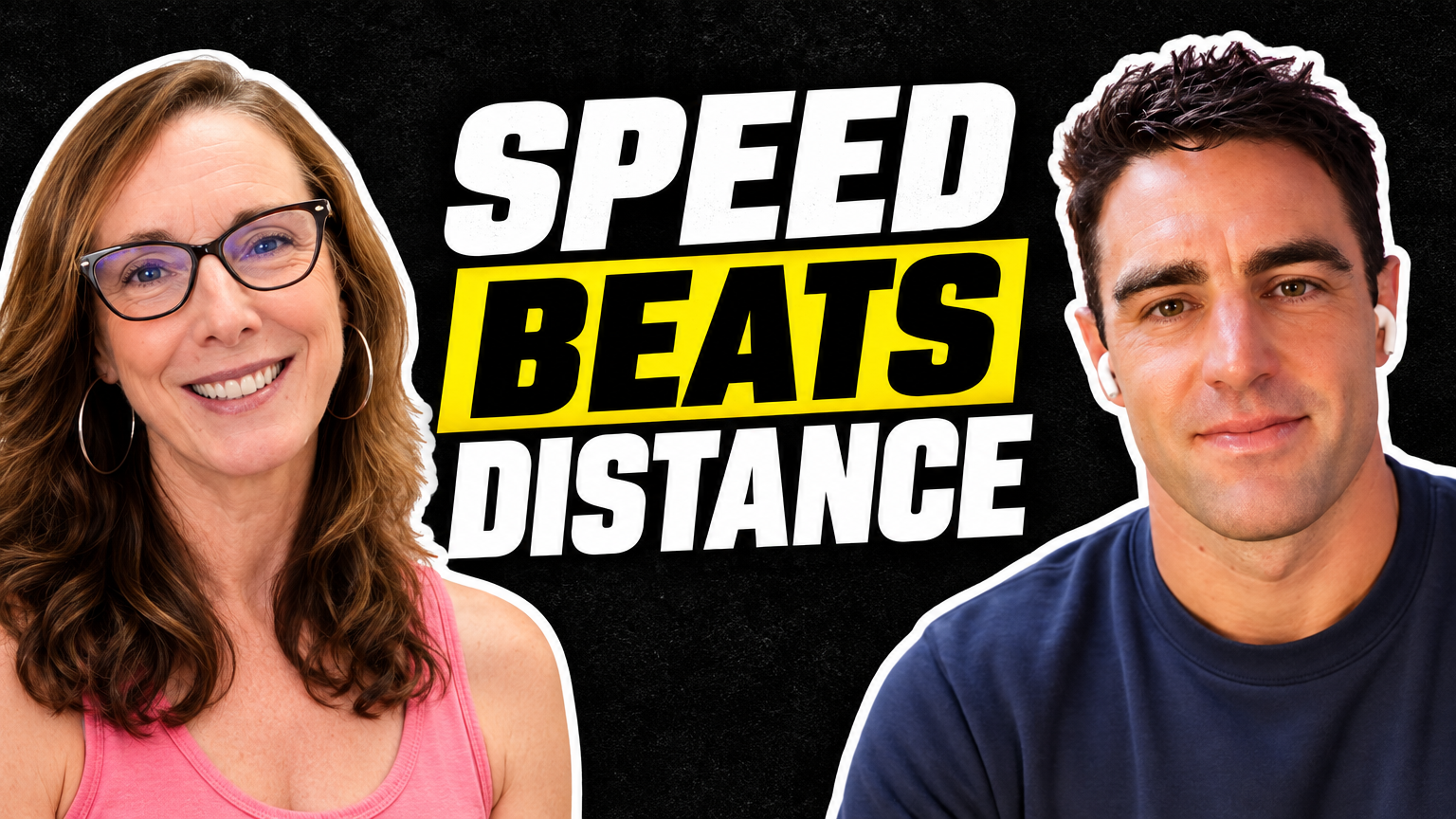









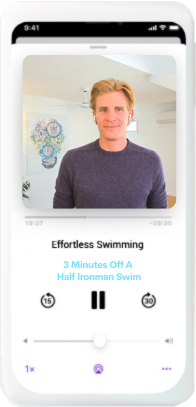
My guest today is Seb Wichmann, who attended one of our clinics in 2022. He was averaging around a 2:05 to 2:10 per hundred and said he was happy to survive a 1K swim at the pool and has now got himself down to around a 1:45. Tune in to the episode now!
In this episode
- 01:02 What challenges did you face transitioning from cycling to triathlon and swimming?
- 02:02 In the beginning, did you teach yourself or did you have a coach to help you?
- 02:59 What techniques did you learn from the clinic that you can apply to improve your performance going forward?
- 05:52 How often have you been getting in the water?
- 07:00 How long did it take you to start seeing results with those changes?
- 10:27 What motivated you to persevere and not give up?
- 11:14 Did you initially believe that you could develop a love for swimming, or did you find it to be a less enjoyable activity compared to cycling?
- 17:33 Did you have moments of success followed by setbacks, or were there variations in performance across different training sessions?
- 20:15 Do you feel any different when you go to the pool now compared to 12 months ago?
- 24:13 What advice would you give to someone who was in your shoes 12 months ago?
- 30:00 How to apply “squeezing the butt cheeks” as a beginner?
Links from this episode
- Change your technique and swim smoother, easier freestyle in the Effortless Swimming membership
- View our freestyle clinic schedule around Australia
This podcast is brought to you by NanoClear — our own range of anti-fog swim goggles, designed by Effortless Swimming with the anti-fog treatment bonded into the lens itself (not sprayed on, so it doesn’t wear off after a few swims). Check out the NanoClear range here and use code PODCAST15 for 15% off.
Transcript
Read the full transcript
Welcome to the Effortless Swimming Podcast to show that help swimmers and triathletes love the water, become a better swimmer and live a better life. Here’s your host, Brenton Ford. Welcome to the Effortless Swimming Podcast. My guest today is someone who attended a clinic in mid-2022 and was averaging around a 205, 210 per 100 and said he was happy to survive a 1K swim at the pool and has now gotten himself down to around a 145 and a little bit quicker in terms of threshold pace and a 125 to 127 for an all-out 100 and has seen a really good improvement with technique and times and I’m still continuing to see some improvements as well, which is fantastic. So I want to welcome Seb Wichman to the podcast. Welcome to today’s episode. Thank you. We were talking about this earlier. I said don’t know if I’ll get the German pronunciation, but it’s close enough. So you come from a semi-professional cycling background, you said, and doing triathlons,
a half-ired man coming up in cans. So talk to me a little bit about what it was like coming from that cycling background to triathlon and swimming and if you had any challenges there when it came to swimming. I see a lot of cyclists just, they will kick like cyclists. They have heavier legs from that muscle build up and they find it’s a bit frustrating initially. Is that something that you encountered? Swimming was for me, Brandon, like a fish out of water really, you know, it’s kind of as you described. I’ve never actually focused on training my upper body at all. Everything in my life in the past has been just training my upper or my lower or my legs obviously. And you know, swimming for the first time, I had to, I had to just focus on suddenly using my torso and I just didn’t know, I’ve never really learned how to swim. I didn’t know how it all works. So it was really finding my own feet, so to speak, in the water, trying to kind of understand
what it all means and trying to feel the water and none of it is something I have really. Did you teach yourself or did you have a coach or someone help you in the beginning? I’m not sure if that’s because I’m German, but initially I went into triathlon just looking to find a challenge and knew I’m strong on the bike, knew I’m very weak in the water and I love the science behind things, right? And so early on, I visited your clinic as well, which I absolutely loved. Just a technical aspect, we sat down and just looked at video analysis. And so I really quickly seek out mentors to just learn from and to improve. And I don’t do that to, you know, to do anything more, but to learn and to just figure out how to get this thing called swimming to the best of my abilities. And you were one of my coaches, obviously, right now. And I have another coach I’m working with that’s helping me, you know, on a consistent
basis to just constantly improve my swimming, which is super important. And what did you take away from the clinic that you’re able to use going forward with your technique? Was there anything with your own stroke where you thought, OK, I’m doing it this way, we can see in the video, this is how I’m doing it. But I know that the best swimmers, the fastest swimmers are doing it another way. Yeah. You know, I think that when I came to your swimming clinic, I really truthfully had no idea what I’m doing. I just knew I had to to kind of, you know, move my move my legs and kind of do something with my arms. And so, you know, and then the whole the whole aspect of technique obviously comes to play. And, you know, the thing that I kept focusing in my mind are those kind of pillars that you kind of taught me, which is kind of to really make sure that I don’t look too far forward to have a to have a kind of relax and almost like heavy head in the water.
We focus also on I had a very wide kind of reach, so to speak, elbows hitting the water first. And, you know, I kind of shorten this up a little bit rotation and then really eventually work under for my catch at my on my catch as well to making this, you know, making this as best as I can. But it’s just a progress, as you know, nothing comes just by itself. You just start somewhere and then as you improve on something and you focus on something else, this first thing falls again off the boat, so to speak. And you have to revisit it as it’s constant learning, which is great, which I love. Yeah, there’s you’re never going to stop finding things to improve with your with your swim strike. And then that’s one of the fun things about swimming in many ways. And like looking at and we did a YouTube video on your kind of before and after and you look at the video and some of those things have changed really nicely.
There’s there’s still some things there that that we can work on. And and when you when you look at it, like you look more, I’d say you like your stroke is definitely longer in the water, you’re now in that front quadrant, which is which is great. And you just look like you’ve got kind of better, better rhythm and stuff going. But I think when people like someone who doesn’t know swimming that well, they might just swim recreationally and they haven’t seen themselves swim, they might look at that before and after and go, there’s, there’s not that much difference, right? Until we sort of slow it down and break it down and say, well, actually, you’re doing this. And we’ve made a change there. But the end result is about 20 seconds faster per 100. So I think when people look at the visual changes over time, to the naked eye, it doesn’t look like a whole lot. But in reality, there’s quite a bit there. And if you’re swimming 20 seconds quicker,
well, yeah, it might be fitness. That’s certainly an aspect of it. But it was fitness and strength. But also that like the technique, even these subtle changes can make a big difference. But it takes a long time to ingrain them and to do it consistently.
Yeah, absolutely agree. What’s your what’s your weekly routine been like for swimming? How often have you been getting in the water? You know, with triathlon, as you know, it’s, you know, I thought cycling is challenging and difficult, but triathlons are totally new game, you know, it’s kind of trying to combine three sports, one of which on my end is kind of okay, you know, and I haven’t really focused like, hugely on swimming as per se, like, you know, have a massive swim block, for example, four times or five times a week. But I do swim very, very regularly. And I do swim when I swim with a lot of intention and with a lot of constant in my mind, constantly reinforcing what I’m working on in that moment kind of feeling the water kind of seeing myself from above almost, you know, looking down upon me, if you will, and just seeing where my arms are at and just constantly being with the stroke if this makes sense. And so I have been going in
the water probably about depends probably three times a week. So nothing, nothing huge, but just this consistency over time just starts yielding dividends, which is great. How long did it take you to start seeing results with those changes? This episode of the podcast is proudly brought to you by our sponsor, form smart swim goggles. They’re more than a pair of goggles, meet the world’s most powerful swim platform. See yourself improve with form smart swim goggles, including a free one year membership when you purchase your goggles for only $249 US dollars. They have currently changed up their offer where you can now get the goggles and you have one year membership included for free. And if you’d like to continue with the membership going forwards, it’s only 15 US dollars a month where you get access to the workouts, training plans and custom workout builder, but you’ll always have access to the real time data in the
goggles. So you never lose access to that. My favorite thing about the form goggles is having the instant feedback of what times you’re doing, what stroke rate you’re doing, and also the ability to see what your heart rate is. Because never before have we been able to have these immediate feedback heads up display where it’s actually telling you what your intervals are. So when I wear the goggles in training, I like that I know my split for the first 50 and the hundred and the 150. So every single lap I’m getting that feedback on what my pace is. And I find it’s such an important tool for being able to not only have different gears where you can switch between the different speeds that you want to swim, but it helps you develop those gears and it helps you intuitively know how fast you need to go before you’re going to blow up or before you’re going to go a little bit too hard. So it helps you just get really good at judging your pace for when you
do go to a race. And even if you’re not wearing the goggles in a race, it’s that intuition and that ability to develop your pacing that these goggles can really help with. To get your pair of form goggles and save 15 percent off, use our link formswim.com forward slash effortless or use the coupon effortless at checkout. And that will get you 15 percent off your pair of goggles using our special link formswim.com forward slash effortless or the code effortless at checkout. It probably took a while to be honest. It probably took me, you know, probably after we met in, I think let’s say June, July last year, which is now whatever it is, what’s the 10 month ago, let’s say, you know, you kind of initially you’re still not stuck, but you know what to do in theory, but practically the muscle haven’t caught up yet in terms of you having the strength. I remember in the beginning that my, especially my left hand because I’m right hand
on my left hand constantly just, I just couldn’t pull through the water in that, you know, in my mind is something that I just worked on to just working on the strength part. But then you start combining strength with technique. And I would say that the initial kind of next stage probably came, you know, probably five months after, four or five months after where we saw in terms of speed, in terms of time, noticeable change, you know, in the beginning, you know, straight away out of the clinic, so to speak, I felt that I mentally again knew what I had to work on. And I kind of constantly focused on that. But again, you don’t have the strength necessarily. And you know what to do, but you can’t necessarily put them to practice straight away. And then through repetition, eventually you develop or I developed speed and you’re just trying to just be more streamlined and everything eventually comes a little bit together, which in my case, yeah,
was the case, but I still got to work on it as well, which I’m excited about. Never stops. What made you stick with it? Like, how come you didn’t just go, this, this doesn’t work? You know, I’m just going to keep doing what I was doing. I’m not saying any improvements in time. So that’s a waste of time. What made you stick with it? Yeah, it’s a good question. I think one part that I know is that when you know what to focus on and when you have a vision and a goal. And for me, I have my vision on my vision boards. You know, it’s a goal to go to the world championships in 70.3 probably next year. When you have a coach that really guides you through it. When you have a mentor like ICU, being a mentor, we have met each other in person, but also I’m watching your YouTube channel probably every day. I’m listening to videos and I’m just almost like what I’m eating. I’m just, you know, clicking on a random video and just picking little
things up. And some videos I watch multiple times because, you know, again, when you’re swimming, you then remember, ah, and you kind of start reinforcing it’s just this world you enter that I absolutely love the technical aspect of swimming, which is, I think one reason why swimming has become not my strongest discipline, but in my mind, the discipline I feel challenged by the most. And therefore I love the most as well, which is kind of interesting to looking at that dynamic. Did you think that this was something that you could come to love? Or when you first started, did it feel like it was always going to be a hard slog and less enjoyable than the running or the running? Absolutely. Yeah. Swimming to me was an absolute struggle. Like I, you know, I still, I still can feel how my core and my legs just were sitting in the water, you know, just like dragging myself along. And this is not enjoyable, you know, it’s kind of you
see other swimmers or when I watch, observe other swimmers and you, I get really excited and I’m like, I’m an awe of swimmers that just glide through the water. I’m like, how does this work? Or when swimmers just come past me, when you’re just going full steam in the water, and some are just with a, with a lower stroke count, just suddenly comes past me like, how does
this work? And so yeah, so I’m really, you know, at all, which is, which is awesome.
I want to talk a bit about the, so just before we jumped on the call, you said that you just did a new PB for like a half Ironman distance swim in the ocean. So you weren’t racing a half Ironman, but you did the distance and just saw what time you could get. So prior to, well, when you, when you message me, I can’t remember when it was a couple of weeks ago, perhaps, but you said you’d just done a half Ironman distance swim in the ocean, you got, was it 32 and a half, 31 and a half, 31 and a half. Yeah. Yeah. So 31 and a half. And then I did this YouTube video last week and talked about, okay, what’s the next thing that you could probably focus on and talk to a bit about the exit. You said you just did another PB that was about two seconds quicker per 100. Yeah. Yeah, in two seconds. Do you want to talk a bit about that change? And yeah, well, it adds up 30 and a half instead of 31 and a half. So it’s not insignificant. So talk to
me a bit about that, that change and what you were focusing on and what you’re doing beforehand with the exit. So, you know, like June last year was my first half Ironman. I did a, I think 34 and a half pristine conditions. You know, obviously there was a lot of people around. I’m not sure how you can compare this. And so three weeks ago or so I had in my race plan or prep for the next race, I had a race effort with wetsuit in the ocean, which again was, you know, flat, really good conditions. And I did a 31 and a half. And I thought that was pretty good. When I looked at it, I saw all those moments where my pace just slipped off the race pace, you know, to a two or to a five even. I didn’t really know why that is. And a couple of changes you mentioned, which I really focused on was just simply on the right side, my hands exit to speak. So what I saw or what you alluded to is that my in the in the actually catch phase and in the in the exit, my
hand slipped, kind of more vertically, whereby I lost the pressure of the water. Or, you know, and so I think, like, initially, in my earlier days, that was due to just have not having strength. Some it has to give somewhere, right? And so where it gave until now, and I still I’m still working on it is this last third of the quadrants to exit. And even though I mean, you tell me but even though this is not where the main propulsion comes from, it’s to me super important for stability and for rotation, all this on the other sides, and to be able to to glide and to lengthen the opposite arm because you have still pressure on the water. And so this is what I’m working on now. And just this just slipped before. And so I just did one little change, which was to constantly just keep pressure on the right side, not slipping, not for the for the hand to slip. And so with consistency, applying all to this consistency piece to constantly
keep the pressure up, I did another. So 138 another two seconds per 100 meters off the half Ironman, which is about 45 seconds all up. So that’s a significant little little change of money right there. You know, that’s that’s maybe the difference between, you know, you know, later group or group before that that comes or goes on the bike, right? So it was pretty cool, actually pretty cool to see that’s exactly right. Yeah, that’s that’s great. It’s a really common one, the exit either people yet hand turning in and coming out a little bit early and just losing that pressure. And that’s really hard to get it get a good reach and roll into the catch comfortably. Typically the arm will just drop down a bit soon because you lose that propulsion at the back. You’re going to pay for that somewhere and it’s out the front. So and then on the other side of that sometimes I see people pushing back as far as they can with a lot of exertion
at the back almost where they’re flicking their hand out the back. But that’s unnecessary because as you said, it’s not there. It’s not where you get most of your your propulsion. So I have heard coaches say, like, like, put like put as much power through the back of the stroke as you can. But to me, it’s like that’s that’s kind of wasted effort. Because most when you measure the force, most of it’s just underneath the shoulders and the and the chest. That’s where you’re applying the most power. So as long as you just clear the hips, go just past it and keep the palm facing towards your feet. That’s that’s kind of all you all you need. Otherwise, I think muscly, you’re going to fatigue quicker than what you need to there. But as you said, without that swimming background and swim strength, it’s initially like it’s just hard to keep the stroke that little bit longer because like through it uses your triceps a lot. And, you know, most people
probably aren’t using them as much as they would when they’re when they’re swimming. So it does take a bit of a bit of time and and awareness as well about what’s what’s required to to maintain that length. Did you find so with that change, it sounds like it’s come together pretty well already. But did you find that when you’re making these changes in your stroke that was it on some strokes, you were like, yep, I’ve got it. And then it started to fall away. Or was it just like you’d have some sessions where it wasn’t working and and somewhere it was? What was that like for you? How consistent were you? It’s just incredible, you know, like, it is just one day it’s off. One day it’s on. It’s you never know quite nowhere lands. I had one session late last week where I thought that is just feels so great. And you know, like I love I always focus on ending the session well. And even if it’s just 25 meters to cut, you are exhausted and you’re
always trying to end the session well to keep in mind what the stroke should feel like, even though you’re super fatigued. You know, but the truth be told, some sessions are really good in terms of you just honored your course switched on just over the over the barrel, you just have a lot of, you know, pull underwater, you feel extreme line, you just feel on top of it. And some other sessions for whatever reasons, maybe you’re fatigued or maybe you haven’t slept well, it’s just you’re just a little bit off. And so I think that what is to me important, at least, is that you always give it your best shot, right? So way, whatever, wherever you feel the fatigue, you just trying to pull yourself together and just, you know, maybe end the lap well, or whatever, it’s just, you know, constantly just, yeah, erring to to do the best you can. And that’s not that’s not always great, but it needs to be good enough, sort of speak enough for yourself,
at least. I think the important thing there is that you use on those sessions where you feel rubbish, don’t get out and go, oh, there’s a waste of time. It’s like keep going with it. You’ve got to finish that. You’ve got to still do the session or at least the majority of it, because even if your time’s rubbish, your technique is not nearly as good as it could be your hips and legs as thinking like you, you’ve just got to have that consistency and expectation that some sessions will not be great. And maybe your technique is not going to be as good as you’d, you’d like. But as, as you said, just maybe take a bit more rest or try and just maintain your form as, as best you can. But as long as you just keep that consistency up and you’re looking at like this, I think it’s like a walking up a, up a mountain with a, with a roller coaster where you’re always going to have this upward trajectory if you stick with it, but you’re this, so this, this yo-yo
where it’s like you go down, comes up, goes down, comes up, that overall trajectory will be upwards as long as you just stick with it. And I think that’s an important thing to, to, you know, to note. And so for you, when you go to the pool, is that do you feel any different when you go to the pool now compared to 12 months ago? Look, my coach, this is a while ago, my coach eventually said you now look like a triathlete. I still don’t know exactly what that means, but I think this, you know, initially when you go into any sport, there’s just certain muscles are just not there. And I pretty much looked like a little chicken finger thing to some degree, because I’ve never really trained my upper body. I think naturally I have muscle, but I’m also a vegan or kind of 89% raw vegan. So it’s also difficult to really build heavy muscle or build muscle that, that we build after you, you broke it down through intensity, for example. But, you know,
nowadays I go in the water, which is lovely, where before, you know, I almost was, I wasn’t anxious, but I felt quite conscientious about not being able to swim well or swimming slowly, and especially when you go into squats, right? So you suddenly have swimmers in there that have been doing this for a while. And it really took me took mentally a little bit of an effort to just say it’s okay for you to not be any great right now, you’re just starting up, and you just stick with it, you enjoy the process and
consistency wins in the end, right? And to, you know, 10 months fast forward, I still don’t compare to the pure swimmers in the squat that I’m going to that go like, you know, 110 or 120. But I hold myself in a, in a fairly fast lane now. And that is just really good to see progression or people that come and comment on my stroke, I say, hey, you really improved a lot. You know, that means really a lot from for me, coming from people that have been swimming for quite a while. You know, because I love the sport and I work on it mentally and physically, almost on a daily basis, even if it’s just watching a YouTube channel from from effortless swimming, right? So, and it’s just a nice compliment for sure. Yeah. Yeah, that’s excellent. And even though, even though small comments about about your stroke or your technique or seeing, OK, I’ve moved up, I’ve moved up a lane or I’ve moved up a place here, like that’s, that’s all you need.
You just want to see that, that progression. It’s, it’s those little wins because you know how much work it can take to do that. And you know what you’ve put in as well, to be able to see those improvements. And as you said, like it doesn’t happen overnight and it’s not going to happen instantly. But if you’ve got that long term view, like you have and you’ve got that, that big goal of making world champs for for half Ironman, I think you’d need that, you need that kind of goal or ambition to really keep you on, on the right path. And yeah, it doesn’t have to be world championships. It might be for other people, it might be a certain time or it might be getting to a certain lane in the squad, or it might even just be like swimming a certain distance for someone. But if you’ve got something to aspire to, that’s going to drag you out of bed early in the morning, wake up at 440 most mornings to go swimming. And it’s just like
and I love it though. I’m like, yeah, I’m not I don’t want to sleep in. I just want to get up and get at it. And I really enjoy the feeling of having a good session and coming home from it. Totally. And just even, you know, even if we take all goals away, right? Even if it’s not us or, you know, whoever was watching right now, you know, like to me, even going in the swimming pool or going in the ocean or, you know, getting early up, as you just said, Brandon, right, into having a good start into the day, that maybe already an awesome goal to have instead of sleeping in or whatever. It’s just this lifestyle you create and this consistency and routine that makes you just be tomorrow a better person, right? Which is awesome. Yeah, absolutely. And would you have any advice for someone who was in your position 12 months ago? Maybe feeling like that they can feel they sit low in the water, maybe a little bit frustrated with that swimming?
What sort of advice would you give to someone who was in your shoes 12 months ago? Yeah, it’s a good question. I think, you know, this initial to overcome this initial hump to be able to not any more feel your drag your feet literally in the swimming pool, I think is a is a is a big one. And to me, the number one point that kept me alive was just start to love the process, right? Start to enjoy the art of swimming, start to just see the good in it that comes out of you going through the struggle. I think like anything in life, you know, overcoming struggle and challenges is what I live for at least. And so I think, you know, specifically, you know, have good mentors, have a plan for the session. You know, I remember in the very beginning, Brandon, I would literally just go swimming without having any focus, without having any guidance. And that doesn’t make a whole lot of sense either, because I think that if I wouldn’t have
attended your clinic. And if I wouldn’t have, or if I don’t continue to watch your YouTube channel every day, or if I don’t continue to have a coach that keeps me on my toes, I don’t think I would have progressed that much at all, because you can only see so far, right? Or you can, you can see far further by standing on giants came before you, so to speak, right? And to be, to be able to leverage of people like yourself that have been doing this for a while and to learn from it. And to improve through that process, I think it’s invaluable. And so, you know, one thing that I’m still working on, and that I wish I would have done earlier for sure, it’s just working on my core, for sure. You know, to be able to really pull yourself forwards into the water, so to speak, that was missing a lot in the beginning, you know, taking, you know, like, I would say like the heads, the head position and just to relax the heads. I mean, there’s so much to it, but I
would say the head position,
starting to feel the water and then kind of look at consistency and working on your core, although probably those three or four points I would have loved to have done probably earlier.
And what, what are you doing to, to work on your core at the moment? So I have twice a week physiotherapy sessions where I work with my physiotherapist on specific core exercises. So we go through the whole body, most of it is trying to alleviate, you know, weak spots in the body, but it literally exercises I do on the, on a roller where I alleviate my, my pelvis on the roller. And then with a ball in between my legs, then I stretch out and I just go through the motion of stretching the ball out while squeezing and then just really focusing on activating my deep core and then also doing up and down movements. That’s kind of off the, you know, off the training. And then while you’re training also to constantly be just to constantly intentionally focus on switching on your core. It is so easy. Like when I did the 1.9 K race effort just a couple of days ago. So I really pulled hard for my, for my, you know, for my ability, so to speak. And
I felt last 300 meters, I started to slip and I had to really pull myself together in that moment, say, no, you’re not going to slip. Just you just keep being strong. And just I pulled myself again forward and just had this initial, there’s not a inertia coming through. And yes, my lead were quite so afterwards, which I think is a good sign, but it’s really it takes mental, mental intention and mental awareness around where is your core right now. When you’re running, run tall, right, switch on your core, move yourself a bit forward. I’m just really using your glutes and your your core to just strive forward the same recycling. It’s so easy just to sit on the bike. No, activate your legs and just really drive. Right. And so it’s this constant intentional kind of action and being aware about where core is at. And then just keep focusing on it and keep strengthening it. Such a huge thing. Sure. Yeah, absolutely. One of the things I like to do in
the pool is I like to experiment. I like to go back and forth between some of the mistakes I see when I’m filming people, some of those common ones, and then go back to what is what is good technique just to experience what it feels like from their end and just see if there’s anything I can uncover in terms of how right how could I teach this a bit better? Or is there a drill we could do to sort of make make this change in that the engagement of the of the core is is such a big one that’s very subtle. And I think when you know you’ve got it, it’s when you feel like so, you know when you’ve got it basically because you will feel yourself sitting higher in the water, things will feel a little bit tighter and narrower and things will be much better connected. And I often see that newest from as a kind of like beginner surfers and what beginner surfers will do is they’ll be on the board, they’ll have their feet hanging off the end of the hanging off
to the side of the surf board and their legs are really wide apart and it’s sort of out there just to help keep them balanced. But they’re wriggling around a lot and they’re very ineffective with their with their paddling. Beginners surfers are very much the same. Their feet, their legs are out really wide apart. So I’m not talking up and down, but with ways that they’re out quite wide. And again, it’s just sort of trying to keep them balanced in the water. But there’s no core engagement. There’s no hip glute engagement there at all. But when they can bring it in and squeeze feels like you’re squeezing the butt cheeks together a bit and just like suck the time in a little bit when you’ve got that, then everything else is just so much easy. That’s that’s a huge bottleneck for so many beginners winners that I see. Do you think if I wouldn’t mind just throwing a question back at you, would you because I remember like it wasn’t like it’s easy
said in theory to do that, right? Sweden, the butt cheek and just active any your core. If you would have told me this eight months ago or six months ago, like, I’m not sure if I would have had the core to really do that because you saw exhausted already with the all the other stuff you’re doing in the water. Like, how would you how would you go about that as a beginner here? So to reapply this? Because one thing in theory, things actually practice.
Yeah, that’s that’s exactly right. I think part of it is certainly strength and just some some basic exercises out of the pool can can help. And some of those would be ones that you’re doing yourself now or even just like lying on your back hands under your bum and just just doing some small freestyle kicks lifting your legs just just off the ground and just keeping that quite small. Like that is hard work. It’s hard to do that for more than 15 seconds for most people, I’d say. So just you can develop some course rank there. You can develop your kicking a little bit that way. And then even just like if you go on all fours. So you’re on your knees around your hands and then just alternate like lift the leg up, bring it back and then even just alternating left right leg, trying to keep the body straight. Most people can’t do that without arching their back. So I think even just developing control through those sorts of movements can can help as well.
And then just going into like some some front kick or even side kick, just thinking about being long from your fingers to your toes, switching those two things on and trying to be long and then going into some swimming as well. So just trying to hold that that that long position with them switched on, start with the kick and then go into some swim. So just trying to build up from there is how I’d approach it for a lot of people. But you’re right, it certainly takes time and there’s so many other things to think about. But holding the body is one of the holding the body correctly is one of the first things that I think people should learn how to to do. So like for me, the first couple of things would be like head, body and kick and just getting that part that main part of your body. Don’t get that right. Get that right first. So said, thank you so much for being on the podcast. I’m glad you reached out a couple of months after the clinic and said,
oh, look, this is this is great. This is what I’m at now. And I’m glad you’re stuck with it because not ever not everyone sticks with it. They get frustrated and they go, look, this doesn’t work. I’m going to just keep doing what I was doing. But it’s unlikely you’ll see any improvements if you keep doing what you were doing, aside from any fitness gains. So I’m glad you’re stuck with it. And I’m excited to see where you can get to with it. You know, sub 30 is not far away for that half Ironman swim. And there’s you can absolutely get under that that 30 minute mark and and beyond that because there’s there’s still some really good things that we can work out in the strokes. I’m looking forward to working with you in the in the future and seeing where you can get to with your swim. Thank you so much. And I look forward to seeing you in one of your next clinics as well. So I took enough. I’ll be up in this soon. Yeah, not not a hard place
to convince me to come to. Don’t worry about that. Yeah. Well, thanks again, Seb, and all the best with your swimming. Thank you so much, Brandon. Take care. Thanks for listening to the Effortless Swimming Podcast. If you’d like us to help you become a faster, more efficient swimmer, go to www.effortlesswimming.com.