







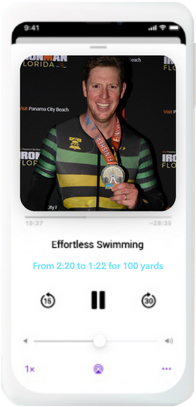
In today’s episode, I wanted to get Matthew Tones on the podcast to talk about how the 5-day catch challenge and 8-week faster freestyle course helped him get from 2:20 to 1:22 for 100 yards.
00:55 Swimming Background
03:10 Training Sessions
06:30 Started The 5 Day Catch Challenge
08:16 Immediate Results
10:15 Better Entry
11:02 Feel For The Water
12:05 Swimming With A Purpose
18:23 Training For A Triathlon
21:09 Gold Coast Open Water Swimming Club
21:54 8 Week Faster Freestyle Course
23:48 Swimming Knowledge
26:08 Power Diamond
32:27 What’s Next?
RECOVERYAIR JETBOOTS Therabody
5 Day Catch Challenge
Form Goggles
Watch the episode on YouTube:
Transcript
Read the full transcript
Welcome to the Effortless Swimming Podcast to show that help swimmers and triathletes love the water, become a better swimmer and live a better life. Here’s your host, Brenton Ford.
Welcome to the Effortless Swimming Podcast. My guest today is Matthew Jones from Philadelphia. Matthew, welcome to the podcast. Hi, Brenton. Thanks for having me. You made a comment in the eight week faster freestyle course that we’ve gotten. You mentioned the improvement that you have made in the last year going from 220 for 100 yards swim down to a PB about 122 for 100 yards, a little bit quicker than the way you started. And you said a large part of that was from going through the catch challenge and then the eight week course. So I wanted to get you on the podcast to talk about how you went from 220 down to 122. And yeah, and how that came about. So what’s your what’s your background was swimming or like, why did you start swimming a year ago? My background is no swimming. I grew up in first 15 years. I was in New Zealand and until I was 25, I was in Australia. So I always grew up with like a pool in my backyard and me and my
brother and friends would sort of ride to the river and play in the river. But so I was comfortable with water, but I’d never in my life actually swum lengths in a pool. And so for some reason, I decided I was going to do 70.3 Atlantic City Ironman. And I looked at on the you know, the stats since 1.2 miles, I thought, Hey, I can swim in the pool. I can handle that. And so I just train the bike in the run and then and thinking, I’ll just jump in the pool, you know, maybe a month or so before the event and touch up my swimming. And then this was 2020 COVID struck. And so everything was cancelled. And so I thought, Hey, I’ve got an extra year. I want to do a full Ironman. So come January, I decided it’s twice the distance. I better revisit my ideas about swimming and decided to get in the pool is I live in Philadelphia says January was freezing cold. I had to go to the YMCA. I got in the pool and I could probably barely swim two lengths. And I thought
I’m in a bit of trouble here. So I’ve been organized. There needs to be a warning, like a warning label on Ironman or on triathlon entry forms saying, like, do not start swinging like four weeks out from your race, you might need a little bit more time. Well, yeah, I mean, I’m a member of the local tri club and it’s very social. And now that I’ve been through it, it amazes me how many people share that attitude. Like, I just pick up swimming a little bit here and then I’ll get it done. I think it’s kind of disrespectful to the sport. Pretty widespread. Yeah, you certainly not alone in, you know, in starting starting like that. So you went to the pool, you was struggling to to sort of go further than been too lapsed without feeling tired. What was the what was the process like after that? How often were you going to the pool and what sort of were you following a program or what did that look like? I kind of started out just jumping in the pool, I think
three times a week and just building my stamina, I guess you could say I approached it much like you would say running cycling, we just do more of it, you get better at it, which I later discovered is not the case at all. And I just go there each day and I maybe add an extra length or something like that and keep building, building, building, but I kind of felt like I was hitting a roadblock like my stamina was getting better, but my pace was just going nowhere. And it just wasn’t making any sense to me. So I got a some lessons from from the pool staff and they were not that fantastic. And I just kept on going and then like I chatted to this guy in the pool in the lane next to me and it turned out he was from this club and doing the same event, which was Eagle Man 70.3. And he’s like, Have you heard of this effortless podcast effortless swimming YouTube channel? And I said, I’ll give it a look. And I’m a stay at home dad, I got
lots of time. So I just sort of started devouring your YouTube content and watching videos constantly. And and what pace were you at when you roughly when you had that conversation? Where are you stuck at? I was around, I would say 220. Like, and so so the way that I sort of approach everything is I have a long term target and I have a short term target. And my short term target was two minutes. And I thought, Hey, if I can get to two minutes, I’m getting somewhere. But I just wasn’t getting anywhere. Like, I think I got it down to 210 and the effort to go from 220 to 210 just seemed enormous. And and and so I was look at the videos and I’d see like, you know, I think Sam Long saying, I’m a pretty lousy swimmer, I do one minute 15. And I’m like, Oh, my God, what’s, what’s the difference between between 210 and one minute 15 that I’m not getting and it was just just sort of got incredibly frustrating. And what did you learn from the YouTube videos? What did you
pick up that helped you bring the times times down to like, what was it 140? Where were you one? I’m down to about two minutes. I think you mentioned that. So yeah, what was it that you changed? I think one thing that I picked up was this idea of reaching to start with. So I was very much kind of in the windmill pattern and this mentality that I just spin the arms faster and get the cadence going in your swim more. So you swim faster. But at the same time, I’m even now one of my focuses is efficiency. So because I have to be able to do the Ironman swim, I didn’t want to burn all my energies, turning the arms over. And I think it did naturally get faster with just continually doing it. But I was at this stage, I was probably going to the pool four times a week. And it was just a massive chore. Like, I loved being on the bike and I loved running. But it was like, I hate I was going to the pool at so five in the morning, I hated getting up, I hated going
there, I hated in the pool, I hated the shower after I just hated everything about swimming. And it was just, I just knew it wasn’t right. Something had to change. Did it did you enjoy it any more when you started to make your stroke longer and reach out? Or was it still a bit of a grind?
It was definitely still a grind. And I think the big difference was the certainly the first program I did, which was the the five day faster freestyle is a five day faster freestyle. The other challenge? Yeah. And that was kind of funny, because I think it was I didn’t know it existed, even even though I’d watched a lot of the videos, I didn’t know such a thing was out there. Because I’m the sort of person that I’m I’ll do the work. I have no problems doing the work. But when it came to swimming, I just didn’t know how to do the work. And, and those questions like, hey, you do this set at 60%, do this set at 70%. And I didn’t know what 60% or 70%. Well, I sort of had one speed. And I talked to people and I was like, do I go faster by swinging my arms faster? And, and I couldn’t really get a good answer. And, and so I, I think I was complaining to my wife, like, this is really frustrating, I’m going nowhere, like, I put an hours in the pool, I
better off just putting those hours on the bike and making the time up there. And it was like, some, a lot of people probably know now, Facebook kind of stalks you in five minutes later, this, this freestyle call starts popping up my Facebook ads. And I was like, what’s this? So I’ll give this a try. And immediately, I saw a massive returns because pretty much it was five days and something I think it was two things specific each day to focus on. And pretty much everything to focus on was like the opposite of what I was doing. Everything I was doing was completely wrong. That’s funny. It’s a, it’s a, did you progressively see improvements along the way? Or was it like, or did it stay the same for a while? It was immediate. Like, I think I was hover by this stage, I was hovering around two minutes. And I completed, especially the first, probably three days. I think I knocked 20 seconds off immediately. And like, because
I’m really meticulous with, you know, keeping records and so on. And I saw, well, this is amazing. He’s like, promising five, was it five seconds and five days? And I was going to give feedback. I thought, no one’s going to believe me. And so I was really impressed. And so then kind of knocked that big chunk off. And then as I sort of continued with it, it says five days, but I sort of built those exercises into my routine continually. And then it sort of kept coming down from there. Do you, were you entering too far out? Is that one of the things that you were doing? Yes. Yes. So now that I’ve actually, and I’ve been through the second course, I realized I was kind of treating it like with kit gloves, like, and very delicately, like finding that perfect little spot just to slide my fingers in. And it’s almost like my arm was acroplaning onto the surface. And and then I think the first exercise was use a kickboard
and enter it, you know, hold the kickboard at the front of your tip fingertips and enter behind. And I’m like, this is weird. This is like, probably 15 or 20 centimeters shorter than what I was doing. Yeah. And it was just completely different. Like, I’m quite big. I’ve got like a body for swimming. I’ve been told I’m six foot four. But and so to not reach like that was just took a bit of getting used to. Yeah, it’s a funny one, isn’t it? The feedback that I get from people who go from what we’re reaching to then entering fingers first and then reaching under the water is it it sometimes feels wrong because you’ve got that resistance of the water or that, you know, drag being created as you’re reaching forwards in the water. But it’s, yeah, so it’s kind of counterintuitive, you think, Well, this has got to be slower, because I’m pushing against that water. But you actually, you get much better, like, sort of driving
momentum forwards with that with that better entry as you reach forwards in the water, because otherwise, all of that momentum seems to sort of dissipate when you land on top and you just go downwards. So yeah, it’s a funny one to get used to. But I think it’s good with that kickboard in front because it just forces you you can’t can’t get it wrong with the kickboard. Yeah, yeah. And I think and what sort of what ended up doing was basically reprogramming programming my entire stroke in the five days where I kind of, I guess it went back to the start. But it’s like one step back to take about 10 steps forward. Because then I could start to do my, you know, three or four days a week, but actually have something to work to work on. So for example, my one thing that I really enjoyed was the when you put the hands in, you mentioned the bubbles, get the bubbles off your hands. And so I’d watch these videos from, say, Lionel Sanders, where his
coach is sort of telling me, you got to get the feel for the water. And I could never understand. And apparently this is a common problem, understand what feel for the water meant. And especially as I do this longer, you can kind of see these things happen with with the bubbles. So I can I can kind of sense my hands, if that makes sense, sliding in more now, rather than just reaching out and just hoping I did it right and pulling back. Yeah, it’s so much more enjoyable when you when actually know what you should be be doing in there. It’s like, you know, it’s like getting in the car and then just like having no destination, but you know, you need to drive. All right, it’s just like that’s what it’s like without having any specific things to work on. But as soon as you go through, say, the course of five day catch challenge, it’s like, all right, well, I know I need to get my hand in this way. It’s like, Okay, well, I know that this first
destination I need to get to. And did did you find it more enjoyable with your swimming after knowing what you should be doing there? Did it? Did you start to enjoy going to the pool at all? Yes? Yeah, I started to to go with more of a purpose. So I was following a training plan for the Ironman and it prescribes X number of swimming X number of rides and so on. And I was kind of like, okay, it’s three three one hour swims or I’ve chopped off my three hours week complete. But I started to actually go there and think about like, what am I actually doing in the pool? And, and I guess the other thing that sort of came about from this was, there’s a very good sort of open water coach, John Kenny here, I actually went to meet him. One of the problems I have is that I live in the city in Philadelphia and there’s no pools, you’ve got to drive about 45 minutes or an hour to get to a pool. So I decided to I was really super frustrated. I’m going to go
and see this guy. And one of the piece of advice he gave me was to basically cut my lengths right down. I was doing you know, 800 to 1000 without stopping to build the stamina. He’s like, just just keep it to 100 200 maximum, you know, 300 400. And so I could come back and I would go to the pool with the these the five five day challenge. You know, the activities to do, I’d work them into like a warm up that I do each day. And I could spend 100 yards thinking about, okay, what am I doing with my hand this time? Alright, what am I doing with the pool on this one? And I could isolate it. So it felt like I actually had some sort of structure once I once I shortened my reps and and my swimming really improved that as well. This podcast is also brought to you by TheraBody. Now I’ve been a big fan of TheraBody ever since I started using their products four years ago to help with my recovery after swims. And their latest product is TheraBody’s
revolutionary new recovery air jet boots. The recovery air jet boots are the world’s most advanced pneumatic compression system ever created. And for years, runners, bikers and everyone who spends hours on their feet have had to suffer through leg pains and aches after a hard day. Clinically proven treatments like the compression boots pro athletes use have always been out of reach. And the recovery area is a groundbreaking pressure massage for everybody anywhere with their bodies exclusive fast flush technology. Recovery air flushes out metabolic waste more fully and brings back fresh blood to your legs at three times the speed of competitors. Faster cycles means faster recovery. So you don’t have to wait for legs to feel great. TheraBody’s recovery air jet boots are the first of its kind. They’re truly wireless for anywhere on the go recovery, boosting circulation and radically reducing muscle soreness. And thanks to
recovery is super intuitive, easy to use one touch controls recovering faster is a breeze. The reason I like the recovery air is because after a big day of being on my feet from coaching or from running or doing other more leg based exercises, even after swimming, I find that these work quickly. And TheraBody to me is the leading brand in recovery products like this. And they make the products to last, they make them to work. And so they’re not these cheap rip offs that we see some other competitors coming up with. So I’m a huge fan of the product and using the recovery air. They also have 250 professional sports teams exclusively use TheraBody products and they’re trusted by world class athletes like NBA All-Star Paul George, superstar footballer Trent Alexander Arnold and champion golfer Colin Morikawa. Sit back, relax and recover. Go to TheraBody.com slash effortless to get your TheraBody recovery air today, starting at just
$699 or as low as $59 a month with a firm. Plus with recovery air is 60 day money back guarantee and free shipping. There’s no risk. TheraBody.com slash effortless.
And so before you were just basically going to the pool swimming continuously for the session and that was that was it. Was there? Yes. Yeah. So there’s no intervals. Yeah. Yeah. So it’s like, I mean, I was keeping intervals of about a thousand. But like my long swim for the week was basically, oh, how far can I swim in 45 minutes or how far can I swim in an hour? And I look back now and I think it’s so silly, like such a waste of time. No, but nobody was guiding me at the time. Yeah, look, it’s a it’s a it’s a mistake that most people will will do coming into the sport, especially coming from running and riding where it’s like get out there and do 50 K in the bike or something like that or the 10 K run. So yeah, it’s a different approach. And the the barrier that that the people experience there is they go, well, but if I stop, like, isn’t that but then I won’t get as fit. It’s like, well, if you’re not stopping,
if you’re doing a thousand yards before you have any sort of rest, good chance of techniques probably breaking down and you’re going to be swimming worse and trying the wrong things as opposed to, you know, you’ll take 20 seconds rest and your heart rate might come down a little bit. Like that’s not going to be the least of your worries because your technique is going to be much more important. And so I guess on that as well, one metric that I was sort of and I’ve always tracked is my swolfe score
because I’m not so much concerned primarily of how fast I can swim 100, but like I want to swim, you know, a longer distance in the most amount at least amount of time or conserve an energy for a bike and run. So I was concerned for efficiency as well. And once I started to do that, corrected my stroke, my swolfe was coming right down as well. And that’s even now still coming down, which is kind of a more important metric for me than how fast I can swim 100 yards. And so you’re training for a couple of triathlons this season. Do you want to talk about the events that you’re training for? And then perhaps what sort of training you’re doing at the moment for those events? Yep. So I’m doing Eagleman, which is a 70.3. I do that in June. That’s the first major one of the season, I guess. And then I have me and my friend are sort of doing a challenge together where we’re doing a full distance Ironman, Maryland in September.
Then we’re taking a road trip in a week later doing full distance in Chattanooga in Tennessee. So two full Ironmans in a week and a 70.3. Plus I’ve got a few, I’ve got an Olympic and I think five sprints thrown in there as well. Plus I’m a trip to Australia for two months. So I’m kind of busy, but my training is,
because it’s so cold here, I have to go to the YMCA and swim. So I go down there quite early in the morning. I’m sort of playing around with times to try and find when the lane’s the least busy. But it generally tends to be early in the morning. And once the weather finds up,
I tend to ride my bike. So I build the swim into my bike ride. I’ll ride for an hour out to this creek. It’s called a creek, but it’s actually a river, I think. And they do open water and swimming out there. And I’ll probably swim for an hour out there and then ride home again. I’ll do that probably once a week during the season. And then my trip to Australia, my parents actually stay on the Gold Coast. And I’ve been told there’s this brand spanking new like aquatic center on the broad water across from their place. So I intend to swim there quite a fair bit as well. So I’m hoping to swim every day while I’m overseas, but at the moment, it’s about four days a week. Is it, are they at Southport there? Yes, yes. Yeah, that’s a great, great pool. They had the Com games or the, I’m trying to think, I think they had the Com games there. But yeah, terrific pool. That’s where we run clinics when we go up to the Gold Coast.
And usually a fair few lanes available as well. So yeah, you’ve certainly enjoyed that. With COVID, I haven’t been able to get back for a while. Yeah, I can imagine. Yeah. But I’m looking to, I don’t think you can swim in that broad water, but I’m certainly going to be in that pool. Yeah. Yeah, it’s, I don’t know. Yeah. I don’t think, I don’t think they do much swimming in there. I don’t know how. Yeah, I do try and build in a bit more of the open water stuff because it’s so much different to the lanes. Like I find lanes can only get you so far and then you need that open water as well. Yeah, there is a club that I’ve seen a bit on Facebook and it’s like Gold Coast Open Water Swimming Club that seem to go out, I don’t know, a couple of times a week at least and they could be good to join as well. They swim down there on the Gold Coast. So yeah, it could be good to jump in with them. Looks like there’s quite a several dozen
heading out at a time. So there’s that and also,
Phil Clayton runs a group down at Tully Creek there. So there’s another, yeah, there’s a few sort of open water things that can be done there, which is. Oh, look it up. I grew up swimming in Telebudger Creek. Oh, did you? Yeah, nice. Yeah. Well, I think they’re there most morning. So you’ll be able to probably fit into something there. Oh, great. And in terms of the eight week course, is there anything but in particular that helped you with your technique from the other aspects of the strike that we focus on there? Well, yeah, the eight week course, I thought it was good to
integrate with the plan. So it had the activities and then it had the plan. And it also introduced a few other things that I’d never heard of before, like the Serape effect, which I’m ridiculously uncoordinated. So I don’t think I really mastered that one particularly well. But for whatever reason, I did find that I was again improving what I was doing that because I think it changed up my, my, the way that I approached my reps and particularly with the timing intervals of the plan and so on.
And I sort of discussing it with a friend. And I think if I was honest with myself, I probably wasn’t working as hard as I should have been in the pool. And I think the way that it was laid out, it kind of just forced me to push a little bit harder. Yeah. Well, I mean, I think it’s hard to work hard in the pool when first of all your intervals are 800 to 1000 each as well. Because it’s just like, you just don’t get that rest to be able to change, change pace. And, and with how those workouts are structured, there’s a lot of variable pace where as you said, it’s like 60, 70, 80, 90%. Like you, yeah, you’re sort of forced to put in a bit more effort and to be more mindful of what, what pace you’re going. Do you check your times on the stop clock or on your Garmin or anything like that? I use a Garmin watch.
And I mean, I’ve sort of had the same watch the whole time. So my Garmin files are pretty, you know, getting pretty big now. But yeah, just on what you were saying, it’s, I mean, for me, as I consider myself a very new swimmer, this idea that you can say, do a 50, where you swim hard for 50, swim easy for 50. And then swim again. It’s like, I didn’t even think of something like that.
Where it was like, okay, I just belt out 100 and I’ll just have a break and belt out another 100 and have a break. And it was things like that that I felt really,
really started to make me think about managing my stamina, if that makes sense. And, you know, when I could look ahead and see what the workout was, I can sort of, okay, I’ve got 100% to divide between this. And I think that’s what really built it. And coincidentally, I’d been trying to get fast at running and I was building in speed work into my runs. And then I sort of started to think, why can’t this principle work and swimming as well? Then I started to apply that with, and when I say apply, I mean really sort of just push myself a bit harder and swimming. And then my time started to come down again.
Yeah, really, just that simple stuff, it really increases your swimming IQ, where you just, I think you first of all, realize how little you knew when you first started and then you realize how much there is to learn. But then it just, it gives you this knowledge where you, yeah, you can sort of just pull on these different things that you’ve learned along the way. And then you can discover where you can find more speed, whether it be through technique, whether it be through training a bit differently, or maybe putting in a bit more effort here and there. And yeah, it’s just like, but it’s, you’re just not going to know that stuff when you first start. So I mean, being a year into it, or maybe a little bit more now, it’s good to see you becoming familiar with how elites from as well will train. And some of those technical things that the people will get taught in a squad as a kid or as a teenager, which sometimes it’s hard to get as an adult.
Yeah, I mean, that’s a good point. You can really tell the difference, I think, generally speaking in triathlon between somebody that swam in high school and somebody that didn’t. And just on those points that you mentioned, it’s like another example, it reminded me, is the power diamond activity from the catch challenge. I kind of did it. Oh, Brenton showed us this. We do this. I’m doing it. I kind of feel stupid going up and down the pool doing this. I get it. This is where my hands are meant to be. And then later on, our triathlon club actually organized a swim session with a coach that has an infinite pool, infinity pool. And he pointed out one of my problems was that I was generating all my power from my shoulders and not engaging my lats correctly and had me engaging my lats. And so then when I came to do the eight-week challenge, I faced this power diamond again. And I do the power diamond. And suddenly I realized, hey, I can move my shoulders
and this power diamond and actually engage the lap position with the power diamond. And suddenly it was like a light bulb goes off. So when I do the catch and pull, it’s just like…
I’ve done the YMCA. That’s one of my favorites. But it’s like this whole process just suddenly just made so much more sense. And this one isolated thing that I do, sort of just a jigsaw piece that just clicked in the place. So before you were in that power diamond phase, which for those listening is when you’re going through the catch and the pull and your hand’s about to… Well, it’s underneath your shoulder. It’s about halfway through the pull.
Your shoulders were sort of up here near your ears, were they? Like they’re too much up here. Yes. So I wasn’t in the correct position. Got you. So I had to drop them to get to the lats, so that I could then… Is it called the pull to go through? Yeah, it’s sort of the beginning of the pull. It’s that first phase, the pull. And it’s that part of the stroke during the power diamond where the most force is applied. It’s through that part of the stroke. And so if your shoulders are up near your ears, like you’re hunching your shoulders, like you’re saying, you’re using your upper traps more and sometimes through the front of the shoulder as well if you’re rolling the shoulder forwards, rather than the lats and those stronger muscles around your shoulders. So that’s a good distinction to make there. And there’s a lot going on through those different parts of the stroke. And a question I get a lot in clinics is,
where should my shoulder be when I’m reaching forwards and then going through the catch and then here? And it’s like, well, it’s so much to think about that, okay, you could probably think about it in the YMCA. You could probably make those changes with your shoulders, but you want to make sure the shoulders are still relaxed and they’re still moving. They’ll come forwards when you’re reaching. They’ll still be a bit forwards as you go through the catch, but then they’ll make their way down as you go through the power diamond. So it’s like, I find it sometimes a bit of a challenge to, how much can you simplify this while still explaining what needs to happen? It’s quite an interesting observation to make and it’s a great one that he picked up on it. And what did you notice when you made that change? What did it feel like for you?
Well, again, another part that it sort of fixed up was,
I think I was bringing my arm too wide for the pull. So when I bring my lat, it sort of brings my arm closer. So I think you call in your videos, you call it Tracing the Body. So I was too far wide and when you go back to the lat, you can bring the hand much closer to the body and trace the body.
It was kind of an epiphany for me in that when I looked at my results, a lot of my fastest times, I don’t mean my fastest, but my top 10, seven of my top 10 would be like in my warm-ups rather than in my sets.
It was like an epiphany that I realized when I was the most relaxed
and not trying to force things was when I was swimming the fastest.
And so when I, this power diamond, I can, it’s kind of like relaxing the shoulders into that position. And I think I was spending too much time just trying to force the position and force corrections and force my hand through when it’s actually kind of a very natural sort of movement once you get used to it. And it’s kind of like slow down to speed up. And I think that made all the difference. Do you think, do you feel like you are trying to continue the high elbow further than further past that position? Like were you trying to have a high elbow catch that keep it through to the power diamond and further through there? Yeah, I think that’s a good observation.
Because I see it quite a bit that sometimes we’re so focused on getting a good catch out the front that we want to try and hold that catch, but all the way through the stroke under the water. And that’s where people end up really wide. But once you’ve got that catch, let it go. Because you’ve got to let the hand come in and the elbow will actually sort of drop a bit like to move back inwards. And that’s so it moves in a more natural position. So it’s a really, really common one when people are hyper focused on the catch. So yeah, there’s a lot of moving places there, isn’t it? Yeah, because when I started, I’d never heard of high elbow before. And that was kind of a novelty for me. And I was like obsessed with high elbow. So it’s like just step back a little bit from that. Yeah, yeah. And it’s, I mean, when you’re thinking about the stuff, a lot of it, you’re very conscious of it. And so it can be, you know, not feel that natural or fluent.
And then after a while, you can then just allow it to be a bit more subconscious so you can just swim. And it’s happening without you needing to think too much about it. And that’s when I think you start to move a little bit more naturally through the stroke. But yeah, when you’re learning something new, it’s always that those conscious movements aren’t the most natural or they don’t feel the best. But sometimes you’ve just got to go through that to get to that point where you can do it without thinking much about it. Yeah, I agree. And looking forwards, what excites you about your swim over the next couple of months? What are you aiming to achieve in terms of pace or perhaps how you’d like to feel or where would you like your stroke to get to? Well, I think now because I did Ironman Florida last year, which was probably the worst swim I’ve ever done in terms of quality of swim. Had a DNF rate of I think it was 23% and I survived.
So my stamina is I have no problems with my stamina. Like that was always one of my concerns is like, can I finish the swim? I’m 100% confident I can finish the swim now. So I’m trying to sort of I have sort of two figures. One is like my fastest 100 and one is what I’d call my say iron distance 100. And I want to kind of bring those two closer together.
Yeah, nice. And so do you have a pace in mind that you’re looking to get down to? Well, my I mean, for the sake of Florida, that was in September last year. I was swimming in about one and a half hours for the 2.4 miles. I ended up it ended up taking me 2010 because of the conditions. But I kind of feel one and a half now is my minimum. I certainly want to go under that Eagleman. I swam 40 minutes last year.
And so I want to get that down closer to probably 33. I think I can do 33 this year. But I probably long distance. I’m looking at around one minute 35 per 100 for the Ironman.
Yeah, fantastic. Is it per 100 yards? 100 yards. Yeah. Yeah, I think that would get me about an hour and a quarter.
Yeah. Yeah, that would be that’d be about right. Yeah, one hour or 120. Well, that’d be that’d be a good, good achievement, especially from starting out at your 220s. And down to down to that to be a great result. So any, any final thoughts before we finish up the podcast here?
No, I mean, the only thing I would say is it’s watch and learn. Like to be honest, pretty much everything I know, 90% of what I know from swimming is from watching your YouTube channel and your, your courses. And because I don’t have really access to coaches and so on. But it’s like, I understand, I try and understand why I do things. And I think it’s there if you, if you want to do it. Yeah, it’s, I find the same. Like I, for me, you know, I’ve swam since I was young. So I’m most of this stuff is somewhat natural, but I still have to think about technique. But for me, that the learning for me is in surfing, that doesn’t necessarily come naturally to me. But there’s, you know, there’s some coaches there that I’ll listen to. And it’s, yeah, it’s just, it’s great when you get some information that makes a difference. You feel the difference. And just, and for me, it’s like, all right, I want to, I want to keep getting better at this.
I want to keep learning more. And, and it’s just so much fun when you, you know, when you understand like, yeah, why, why are you doing something? And then, and then what the, you know, what the elites or what the pros are, pros are doing and trying to work towards that. So it’s, yeah, just, it makes a lot more enjoyable than just getting in the car and driving around the block several times. Yeah. And I mean, I think as well, I had a rookie, common rookie mistake. And then I used to, for lack of a better term, disrespect swimming, take it for granted in some, in some ways. And so when you realize how technical it is and how much you have to learn, you get a much greater respect for it. And it’s the sort of thing, if you put in the work, you get the reward as well. Yeah, absolutely. Yeah, you certainly appreciate when you watch someone like, like Florian Wellbrok who I did a video on recently or Dan Smith, like it gives you great appreciation
for the swimmers that can swim like that. Because as, as much as it looks like, it’s just like, that looks pretty easy. Yeah, you certainly understand that it’s not and it takes a bit of work to get there. So yeah, Matthew, I appreciate you jumping on the podcast and sharing your experience over the last year or so. And good luck for those races and that back-to-back eye, man. That’ll be a lot of fun. I look forward to hearing how you go. Thanks very much for having me. Thanks for listening to the Effortless Swimming Podcast. If you’d like us to help you become a faster, more efficient swimmer, go to www.effortlesswimming.com.