







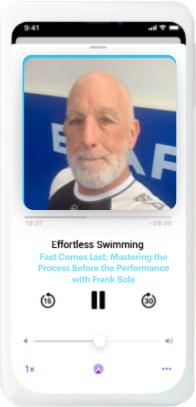
What happens when a veteran swim coach, who’s spent years refining adult swimmers and triathletes, returns to coaching high school kids? In this episode, Frank Sole—coach, educator, and lifelong student of the sport—shares how “water is water” no matter your age, and why the principles of balance, buoyancy, and body awareness remain timeless. Frank dives into the biggest crossover lessons he’s bringing from Masters swimmers to juniors, the importance of teaching athletes to “own their technique,” and why he tells even his fastest swimmers to slow down and swim well, not fast. We also explore how Frank’s coaching philosophy has evolved over decades, the power of habit over outcome, and the surprising results his athletes are getting—not just in the pool, but in their lives. Whether you’re a coach, a swimmer, or someone who’s passionate about getting better, this episode is packed with wisdom, stories, and the kind of gold you can take straight to your next session.
In this episode
- 05:16 — Focus on Process Not On Outcome
- 19:17 — Mastering Breathing: A Coach’s Perspective
- 21:01 — Mastering Breathing Technique
- 21:59 — Coach Check In Routine
- 37:03 — Evolvong Coaching Philosophy
- 39:16 — 18 Minute Rule
- 40:36 — Embrace Ignorance Seek Growth
- 41:15 — Evolving Mindset: From Close To Collaborative
Links from this episode
- Get your NanoClear swimming goggles here and get 15% off your first purchase with code PODCAST15. https://shop.effortlessswimming.com/
- Change your technique and swim a smoother, easier freestyle with the Effortless Swimming membership
- Get in touch with Frank
Try PILLAR today, head to pillarperformance.shop and enter code EFFORTLESS for 15% off, or for any North American listeners, enter the same code at TheFeed.com.
Want to really transform your swimming? Join us on a swim camp in 2025 in the Maldives, Galapagos Islands, Whitsundays or Thailand: https://effortlessswimming.com/camps/
Transcript
Read the full transcript
First of all, patience. Take a deep breath. We'll get you there. But this is a process, right? If we, I've got to convey to a young swimmer, if we're focused on the outcome versus the process, you focus on the outcome. You may do well at an event, and you're going to be very disappointed lots of times when you don't hit your best time. But if you stay focused on the process, you're constantly building towards that outcome. So that hasn't changed. I don't care whether I'm coaching a fourth grader or somebody who is swimming in the Pan-An games as a U.S. master swimmer. So that's the similarities between what I'm doing now and what I did do.
Welcome to the Effortless Swimming Podcast to show that help swimmers and triathletes love the water, become a better swimmer and live a better life. Here's your host, Brenton Ford.
What happens when a veteran swim coach who spent years refining adult swimmers and triathletes returns to coaching high school kids? In this episode, Frank Sol, coach, educator, and lifelong student of the sport shares how water is water, no matter your age, and why the principles of balance, buoyancy, and body awareness remain timeless. Frank dives into the biggest crossover lessons he's bringing from master swimmers to juniors, the importance of teaching athletes to own their technique, and why he tells even the faster swimmers to slow down and swim well, not just fast. We explore how Frank's coaching philosophy has evolved over decades and the power of habit over outcome and the surprising results his athletes are getting not just in the pool but in their lives. Whether you're a coach, a swimmer, or someone who's passionate about getting better, this episode is packed with wisdom, stories, and the kind of gold that you can take straight to your next session. So, Frank, welcome back to the the podcast is the third time that you've been on here. One of the things I wanted to jump into today is you've recently started coaching a high school team again, which was your sort of original how you started coaching. But then you went to a lot of masters coaching, but now back to high school is what would be some of the things that you've taken from coaching masters athletes over the last few years, that you are now incorporating into teaching the high schools. And what are those things that you're starting to focus on now? And has that approach changed for you over the years? You know, Brent, and excuse me, first of all, it's good to be back with you. Again,
this is I think our third time together and I appreciate the energy and camaraderie between the two of us. But yeah, I mean, you know, going club, you know, I grew up in New Jersey, Jersey Shore League, high school club teams, YMCA, and that was a good part of my life for say 15 years. Then I moved out to Arizona and got, you know, triathlon, open water swimming, and a lot of masters years under my belt as a master's coach. And you know, I come to the realization that water is water is water, right? A body in the water will whether it's a master swimmer or a younger swimmer is still going to need to pay attention to the laws of, you know, hydrodynamics, they're going to need to learn balance. You just got done doing a piece on that on Instagram. They're going to need to learn mobility, hip rotation, how to kick, and how to breathe. So I take a lot of what I've learned from when I was a high school coach into my master's because now I'm dealing with adults. Now I've gone away from masters so much, but I still have a lot of my triathlon clients and open water swimmers who I work with, but going back to my roots, young swimmers, I am living in the Florida called the Villages and I am the director of youth club swimming here and a high school coach also who answers to a head coach for the high school program, but I run the club, the club program. It's great to be working with fourth, fifth, sixth, and seventh graders again, really getting them excited about the sport of swimming and bring up another generation. So I see so many similarities between
US master swimmers, high school swimmers and young swimmers. Again, as I shared with you, water is water is water. There's just the laws of physics that still have to be applied. And but what I will tell you, the high school swimmer, it's so cool to be around that club and high school event again, you know, being on deck for high school meets and the cheering and the, you know, the camaraderie and being at districts and our team won districts and the boys and the girls, which was kind of unheard of. Generally, you win one or the other, but we took districts in both. We did well in regionals and had a great strong showing in states, but being around that energy of those young swimmers is really what got me excited again, if that answered your question. But, you know, you learn a lot working with adults, right? You know, there are a lot who are very willing to say, I want to learn how to swim better. And then they have that fixed, there's others who have that fixed mindset, but no, no, you know, I've been coached. I know how to do this. And you get to learn what you, how far you could go with a US master swimmer or an adult swimmer. High school swimmers, a lot of 99%, they want to learn, they want to get better. How do I get fit? That's all there. How do I get faster coach? How do I get faster coach? How do I get faster? First of all, patience, take a deep breath, we'll get you there. But this is a process, right? If we, I've got a conveyed to a young swimmer, if we're focused on the outcome versus the process, you focus on the outcome, you may do well at an event, and you're going to be
very disappointed lots of times when you don't hit your best time. But if you stay focused on the process, you're constantly building towards that outcome. So that hasn't changed. I don't care whether I'm coaching a fourth grader or somebody who is swimming for in the Pan-An Games as a US master swimmer. So that's the similarities between what I'm doing now and what I did do.
And in terms of focusing on the process, one of the things that I've done last year and this year, in terms of just setting goals for different life goals, business goals, coaching goals, all that sort of stuff, it's not setting what's the end result that I want, certainly thinking about it, but it's what are the habits that I need to do, like what are the things I have to do every week to achieve that? And if that's the thing on my goal list, it's like go to the gym two to three times a week or swim three times a week, whatever it might be, that's been so much more attainable than this thing way out in the distance. And it keeps it just really simple and it's doable for people. You're 100% right. I apply it in my own life. I literally have a journal that where I will literally check off virtually through the course of a day, all these things that I want to get done in a day and the X, the cross means that it's gotten done. So it's all process every day, habit, chop wood, carry water, chop wood, carry water, do it every day. If it's three times a week, do it every day. There's certain things that I just will not go to bed until I've done those things. And I try my best to convey that to young swimmers. They like, they like results, right? They want, so what's your goal this year? I want to hit a, I want to hit a state time. Okay. Are you willing to do this, this, this and this to hit that state time? Meaning I call it like Monopoly. You get to get out of jail cards, right? You know, again, Monopoly, how many practices will you not miss, right? Or English, but you only miss two practices in eight, nine weeks? Okay.
Too, too many, but you get my point. So it's, I really want my athletes to focus on the process. If we do that, the outcome generally will take care of itself. As an ex-high school teacher, I would tell my kids go home and study every night, read 10 minutes. By the end of the week, you've got an hour's worth of reading done. You take your quiz, you take your test. And all of a sudden you're getting your B's. You're getting your B minuses. You're getting your C pluses. You're A's, but it's all about the process where we hear that, but there's so much truth to that, Brenton. It's so true. Focus on the process, my friend. Create tablets. Yeah, exactly right. And are there any certain particular things that you're really drilling into the, the swimmers at the moment, like in terms of like technical things, what's your coaching style? What's your coaching approach like with the athletes? Again, I'm going to go back to the video you just did on Instagram in regards to balance. I am a true believer and I've always coached this way. And I will continue this coach this way is that you must take care of the vessel first, meaning the body. The body has to be balanced. It has to understand buoyancy and body position, right? I heard a coach use these terms and I've used them for years and I take no credit for them. Stay athletically long, stay athletically taught. And I teach athletes that, right? If you are six one, I want you swimming like you're six four. If you're five, five, I want you to swim like you're five, seven. I don't care technically, you know, what, what God has given you in regards to length, but I want you to swim
long. I want you to use your body. I want you to swim from your body first and we'll add propulsion, right? So I will always tell my athletes, always protect the integrity of the vessel. I could be a tugboat with a big engine and I think I'm a fast boat, but I'm still a tugboat with a big engine. We'll follow where I'm going. So I see swimmers drop hips, poor body position, poor timing, and they're adding additional propulsion that elevates dragon resistance eight times. And I don't care if you're who you are, an Olympian or just a club swimmer, you're going to lose every single time because water will win that battle every single time. When you can keep the body long, maintain the integrity of balance, meaning as I'll use your term, as the Aussie say, bring to keep the bum up. You're creating a more hydrodynamic body, minimizing dragon resistance. I will spend as much time as necessary. We in my club program, the last 10 days, that's been the focus that has been the absolute focus with fins without fins. Anything I can get them to do is stay long in the water and minimize dragon resistance. My definition of swimming is get from point A to point B in the most efficient effective manner as possible by simply minimizing dragon resistance and adding the right amount of propulsion. Meaning where you're at, right? I can't swim right now, say Frank can't swim at 90 strokes
per minute and add that kind of power in my rapping and catching effect. So right now, if I can only swim at 52 strokes per minute, but swimming efficiently, let's celebrate that.
This episode is brought to you by Pillar Performance. Our new sponsors Pillar are a sports micronutrition company. And the easiest way to describe it is that while hydration and carbohydrates products will take you through to touch the wall as fast as possible, Pillar's mission is to get swimmers to the starting blocks in the best condition over and over again. I recently started taking Pillar triple magnesium after a friend had recommended it and it's been a game changer for my sleep and recovery. I take one scoop 30 minutes before bed each night in the same way that you might start your day with a coffee. I finish it up with the magnesium and recover better for tomorrow's session in the pool. Pillar performance is used by some of the biggest names in swimming and triathlon, including Zach Stubble to cook, Jan Frodeno, Ben Canute, Ash Gentle, Taylor Nib amongst the host of other well-known swimmers and triathletes. Where Pillar differs from other micronutrition you may have taken before is both the quality of the types of magnesium and the tangible results that I see on my garment each morning. If you'd like to try Pillar today, head to pillarperformance.shop and enter code effortless for 15% off. That's effortless for 15% off all first-time purchases or for anyone in North America. Enter the same code at thefeed.com.
Let's celebrate that. And then I could start to add the engine piece to it. Now let's talk about propulsion. But again, if we're a tugboat with big propulsion, you're just a tugboat with big propulsion. Makes sense? I mean, that's just something I just cannot stress enough to young swimmers, to older swimmers, master swimmers, maintain the integrity of the vessel always. Yeah, it doesn't matter the age or the experience of the swimmer. It's always going to come back to that. And one of the things that I like to do at clinics is in the beginning, we always start with that with body position and balance. And I have them go through a couple of exercises, some wrong way, right way exercises, just to experience the difference between the two. And then I have them go through this bit of a checklist in their mind, where they push off, go 50 freestyle, they check in on the head position and making sure they're long from head to toes, checking on the body and the posture, make sure they're using the lungs to help support them and letting the water support them, which it can do if you hold yourself correctly. And then just making sure the legs are doing the right thing, not kicking too big, not kicking too hard, but just there to support you as well. And when they get all those things in place, they're very much like a needle. They're long, they're streamlined, and then everything becomes so much easier. And typically when people go through that, they're feeling pretty good, they're moving quicker, they're moving easier through the water. But it's easy to get distracted with other things like the catch or how much should I be breathing, all these sorts of things.
But if we always just come back to that, getting that vessel, getting the body to be long and streamlined, everything else builds from there. So yeah, that's always a place to start. And whenever I dive in, I just subconsciously I kind of go through that checklist. But it's conscious now because I'm aware that I'm doing this checklist, but it's always just been that thing of like, all right, where's this, where's this, where's the legs, and making sure that's all correct to begin. Couldn't agree with you more. And again, that's why our philosophies are so in tune with each other. And the same thing I do, as soon as I'm in the water and I'm warming up, you know, warm ups, five, six, seven, eight hundred yards. And I can start to feel, am I in the right position? No, I can feel myself, my heart rate's going up, what's wrong? Well, I'm working too hard. Well, is it my balance or am I not breathing? No, my breathing's fine. It generally goes back to the fact that I am dragging myself through the water, being frontal drag, warm drag, my wave drag is elevated. The amount of oxygen now that needs to go to the muscles is being robbed from the heart and from the, from the lungs. And it's just a runaway, a snowball effect. And people say, well, I just can't swim fast. No, let's get you swimming lean, long. And like you said, you're just lengthening out the body. And once we do that, I will always tell the swimmer Ironman athletes, if they feel like the wheels are falling off at, you know, 1.2 miles through halfway through, go back to buoyancy and
balance and body position. Am I over kicking? Like you said, in the world of triathlon, we hear all the time, how do I get a stronger kick? You don't need a stronger kick. Your kick is fine. Kick is designed to maintain the integrity of the balance of buoyancy. That's what the kick is there for. It is not, we're not trying to move you forward. At the Olympic level, the kick only really accounts for about 10% of propulsion. In our level, we want a strong, solid two-beat kick. If you're great at a six-beat kick, great. But I want my swimmers to understand if they're going to be swimming a distance event, I want them to think and swim like a distance swimmer. You're not swimming 50 freestyle. You have to think that way and act that way. So as soon as you come out on deck, if coach Frank wrote you, your workout today is three by 1,500 with a three-minute break in between, I need you thinking like a distance swimmer. I need you thinking long in the water, two-beat kick, or my stroke rate. I am not swimming like there's an alligator behind me. That's a pun joke because I live in Florida, you know, alligators. But you get my point, right? I mean, it's all relative and how you coach that athlete and how receptive that athlete is. And to hammer home, your point is the more you pay attention to this stuff, you don't need a coach on deck. Most of the time, you're going to start to feel it inside. Maybe next length of the pool, you're going to count strokes. You went up three, four strokes. Something has gone wrong. Something has gone wrong. Maybe you're timing, you're buoyancy. Again, balance is off. But bottom line is,
as coaches like you and I, that's my job is I want to convey that to the athlete, whether it be a young athlete, any of my athletes getting ready. I got one getting ready to swim Catalina Islands this, we're coming up this August. Think like a distance athlete. Think like a swimmer. Think like a distance athlete all the time. That's what you got to tell yourself. So when I talk to my young kids, you're a sprinter. Think and act like a sprinter. Okay. So bottom line is, I'll keep my sprinters away from my, from my, my 500 people because I don't want those two ever. It's like oil and water because guess what? I got a sprinter in this lane and a 500 swimmer in this lane. Guess what this 500 guy wants to do? He wants to swim like the 50 freestyle, right? But the bottom line is teach your body to what I will always say is learn how to know your environment, proprioception, a fancy word. Know what your body's doing in an environment. Own what it is doing in an environment and have the ability to make the necessary corrections when that time comes. My hips are starting to drop. Am I kicking too hard? Not kicking hard enough? Am I not rotating? I tell you what, a part of where I've gotten the balance piece, I go all back way to total immersion. I will give Terry a lot of credit for that. He taught, uh, taught me early on to swim from your center of balance, which is right at that T here, right at the sternum, leaning how to lean into the water a little bit as you rotate that pressure, pressing the armpit a little bit into the water helps to elevate the hips versus our center of gravity,
which is about an inch above our navel, right? All of that because our large muscle groups, our legs, our hips, our glutes, all heavy muscles. It's going to drop. It's going to drop. I think you did one of the little example that one of your videos where you're just lying there in the water and eventually all of this starts to drop, right? And especially if I'm not breathing right, now my lungs are like a buoy, all of that's floating up too. So it's timing, breathing, balance, buoyancy, but all of this, it takes a lot, a lot's going on, man. And like you said, now I got to think about the catch. You got to be kidding me. So that's a little answer and say, we will spend a lot of time, a lot of time on this. Don't care. I tell my high school swimmers right now, my club swimmers, I don't care about speed. I don't care how fast you're going. I care how fast, excuse me, I care how well you're doing it, not how fast you're going to do it. Fast and as they say in Italian, men's a men's technique, not good, right? Fast with great technique. Man, the world's your oyster as a swimmer at that point. Yeah, that's exactly right. And I know you're doing some online coaching. And so what would be those things that you are trying to make the swimmer aware of so that they can self-coach and self-correct and they build that proprioception when you're not there to give them feedback or have eyes on them outside of them sending you footage? Man, we spend a lot of time on balance, buoyancy, body position. The other one is breathing. I find young athletes, master athletes, senior athletes,
college athletes, most of them were never taught how to breathe. I am working with a gentleman right now, 65 years old. And his note came back to me when I gave him some breathing assignments to do. He goes, I'm almost embarrassed to say that at 65 years old, no one has ever taught me how to breathe properly. We're born, nobody teaches breathing. We just assume that breathing in and out through our nose or our mouth is normal. And we see that many times I'm standing on deck and I'm looking at a video of an athlete, and you could just see that the breathing pattern's off, right? I mean, you got that classic, as they rotate, they're blowing out, they're breathing in, and you know, they're holding their breath into water. But those are the things that I like to work on. Balance, buoyancy, body position, breathing, right? I will have them old school. I mean, if they have a Garmin or Apple Watch, check their heart rate. But if they have to go old school, right now, if it's an older athlete, I don't want you any higher than 128 to 134 on your heart rate, check it. If you're too low, I need you to kind of, you know, again, pretend there's an alligator behind you, right? But he's far behind, but he's not trying to run you down. So those are the things I try to do. And then we start to work mechanics, the technical proficiency. I'm an old school coach. I know a lot of key coaches talk about reaching, wrapping, or excuse me, reach, catch, pull, and push. There's a term we used to use calling wrapping the water. And I still use that term. We come in, we wrap the water, unwrap the water. So we extend,
we want to feel that water under our armpit, we want to wrap the water and unwrap the water. When I use those terms, they seem to take that, that, that corrosive feeling of those, gotta reach, wrap, pull, and push, boom, right? And they say, I gotta push the water behind me. Wrap the water, drive the body, unwrap the water. And I undoubtedly will have come back, athletes come back to me going, oh my God, that was effortless. I didn't have any trouble breathing. And I actually watched my times go down three or four seconds per hundred. And I'm saying, we're on the way. We're on the way. So that those are the things I want them to learn. And it takes time for them to be able to self coach themselves. And I got no problem with a coach, an athlete texting me, sending me an email many times during the week, Sunday afternoon, Sunday evenings is a big night for me to do Zoom calls or phone calls. Checking in, how's it going? Good. How'd this go? Good. How'd this go? Good. How's the back feeling? Good. Okay. You know what? You've been stressed a little bit at work. I'm going to tell you not to go swim tomorrow. You could almost hear a pin drop, you know? Take a deep breath. It's okay. That's part of the process is letting the body recover, rejuvenate, regroup. And nine times out of 10, they come back to me going, I slept an hour and a half later this morning. And I felt like I got caught up. So those are the things that I incorporate in coaching my athletes. Get to know the athlete.
Get a feel for where they're at. Great communication like you do. You're brilliant at this. Great communication with the individual. Be able to, after time, you get to know them before they even call you or send you a video, what you're almost going to see. But the videos that they send me, it's critical, right? I think people like you and I have been doing this for so long. I've been at this for 27 years now. I would always love to see underwater video, but there's a lot of, I hate to use this word, there's a lot of assumptions I can draw just by what I'm seeing on top of the water, what's going on underwater, water refraction. I can see a little bit, hey, he's crossing under his body. He's got thumb down and his palms out. And then I can work on making those corrections, drill sets. I'd like to create the drill right into the body of the workout, right? Six strokes drill, six strokes swim, six strokes drill, 25 drill, 25 swim, 50 drill, 25 swim. You get creative with it. But as long as the athlete is getting it, and I'm finding at the younger level, Brenton, is that one swimmer in lane three is grasping it. That same swimmer in lane four is struggling mightily. But I'm blessed to have enough coaches that we could pull that swimmer aside and go, let's back them up a little bit. If we got to get them swimming with a PVC in their hands, because they're wind milling their arms and they're not staying anchored out there, or they're cupping in their hands too much, you get to learn, you get to feel your athletes,
you get a real sense. And I take a lot of pride in knowing my athletes and where I need to take them. So a lot of pleasure out of doing that when you're not on deck with them. You know what I'm saying?
At Effortless Swimming, our mission is simple. Make swimming more enjoyable. Whether you're training for your next race, swimming for fitness, or just love being in the water, we're here to help you swim faster, smoother, and with more confidence. And one thing that can make or break a swim is your goggles. If you've ever struggled with foggy lenses mid session, you know how frustrating it can be. That's why we created the Effortless Swimming Hydro Clear Anti-Fog Goggles for long lasting crystal clear vision. I've been using them myself and the difference is night and day. And I'm not the only one. Deborah swam 36 kilometers down the Derwent River, and the entire time her vision stayed crystal clear. No fog, no frustration, just an uninterrupted swim. So what makes the Hydro Clear Goggles different? It's all in the technology. Unlike ordinary anti-fog coatings that wear off over time, Hydro Clear Super Hydrophilic Technology is built into the lens material itself. Here's how it works. Instead of fog forming as tiny droplets, water spreads evenly across the lens, creating a thin film that prevents fog from even starting. And the result? Consistently clear vision. Swim after swim. And the durability? Our lenses are CNAS certified. Tests show that even after 2000 rubs with a wet cloth under a 200 gram load, the lens stays fog-free. No gimmicks, just serious performance that lasts. Using them is simple. Just wet the lenses before putting them on and you're set for a fog-free swim. Ready to see the difference
yourself? Get 15% off your first pair of Hydro Clear Anti-Fog Goggles with the code podcast at shop.effortlesswimming.com. That's 15% off your first pair of goggles with the code podcast at shop.effortlesswimming.com. We also have a 30-day money back guarantee. So if you're not happy with the goggles for any reason, you can simply return them for a refund. Don't let foggy goggles ruin another swim. Try Hydro Clear today and experience clear vision from start to finish. Yeah, so we do every fortnight, I do like a coaching membership call where people send in their videos and I had one yesterday and we had 20 odd people sending their videos through. And I'd say, all right, this is the one thing I want you to focus on for the month. This is a drill or two drills that I want you to incorporate into your workouts. And it's interesting watching, when they write in, I ask them what are they being working on? Where do they feel they're at? Where's their pay set? And often people will say, this is what I think that I need to work on. This is what I think I need to work on. And particularly if they're quite new, usually it's the wrong thing. Usually it's like, you know, they've got an idea. They think, all right, I think this is what's the issue. But it might be too far down the line. Yeah, it might be, I feel like, okay, my elbow is dropping in my catch. It is, but the reason it's dropping is because the way that you're breathing is you're looking too
far forwards or you're lifting your head or you're over rotating, whatever it might be. So let's go back further down the line in those initial things. Let's get those dialed in and then we will build up to the catch. We'll work on that, but not yet. Yeah. And I love that approach. And I really work hard at that. So I will look at a video and I may look at it three, four times to say, what do we really need to address here? Is it the dropped elbow or is it the poor body position and the timing? And if we took care of those things, all of a sudden you fix this and all of a sudden these little things, these other innocuous details fall nicely under and all of a sudden they have success. But if I will always say, look, A, B and C, when I coach you, A always has to come before B. B always, this is not up for debate before C. Once we get to D, E and F, we can kind of fool around with those letters. You know what I'm saying? We could fix this because I, but if you do not have the fundamentals of ABC specifically under your belt, I could fix all the dropped elbows in the world. But if, if my timing is off, now my shoulders are plowing through the water. Now I'm, my form and frontal drag is gone exponentially high through the roof and we're no better off than we were. So it gets that way. So if you don't mind, I'd love to share something with you. Okay. Not that I do this, but my phone is sitting right here. I have a athlete I've been working with for over a year now who is a US master swimmer.
He swam in a US master's meet in Florida today. His exact words, 112.2, fastest time in two years, broke my old record from last year of 115.2
hundred fly. But this is a guy, when I write workouts for him, he just, he just, he just does what I asked him to do. Take a day off. He does what I asked him to do. 4,000 yards tomorrow, he does what I asked him to do. Today we're only doing 1500 with a focus on walls. That's all I want you to focus on is walls. So when you see something like that, that's exciting. That's exciting. Okay. And as coaches, now you and I get text messages like that gone. I was off my best time. No, that's part of the process too. You're not going to always get best times, but we've worked on breathing. We've worked on body position. This is a gentleman who would swim, fly all arms using virtually no body and his kick was just too much knees and we had to break that down. How did we do that? We went into the gym and we started doing a lot of Pilates and we started doing a lot of yoga stretches and we started doing nothing but a monofin to get the feel for the body. What do you want me to do? 20 by 50 on 20 second break with a monofin. Swim a 300 cool down, get the hell out of the water and go home. Okay. Got to love those kind of athletes, right? Got to love those kinds of athletes. So I thought how appropriate that this came in through this conversation that is like good job, Frank, but the athlete is doing what I'm asking him to do. It just reassurance as coaches that we are writing workouts. We're doing our tapers properly for these athletes
and have them prepared to go out and perform. Again, master's level, college level, Olympic level, high school level, club team level. And it's like we've seen, we've been there for a long time. We've seen a lot of things, seen a lot of different athletes. Jen have a pretty good idea of what's going to work for someone. Not always the case, but I have a pretty good idea. And so like I compare it to my, my two kids do Jiu Jitsu, the oldest one, he's stepped up a class. So he's kind of going against this kid is a little bit older. And yesterday, the instructor was giving him some advice while they're trying to take each other down. And my son's trying to trip, he's trying to do this trip on the other kid. And he's just too far away. Like he needs to get in, he needed to get in close, need to wrap his one hand over the top of the other and he needed to get in close to be able to do it. And he kept like trying to get him to do it, kept saying, get in close, getting close, but he kept trying to trip him from too far away. And eventually when he listened and took the advice, it worked. But before that, he's just, he's still trying to trip, but he's just too far away. Nothing's happening. And so like if you, yeah, if you can just listen to your coach or your coaches, you're probably going to have success over the long term. So that's great to hear. Yeah. It's like, it's so good to see masters swimmers who may have swum as teenagers. They can still hit lifetime PBs, many of them. And maybe, and if they were really elite, okay, maybe they're not hitting lifetime PBs, but they're getting faster at 45, 50, sometimes 55 and beyond, like it's,
it happens. And down here in the villages, they have a master's program here. And it's amazing. I mean, mind you, it's a retirement village. So the youngest person on the team is 55 years old. And they've got, they have a couple guys 82, 83 years old, but they swam
Eastern Illinois, Anford, they swam at some small divisions to school, and they're still living their passion. And you're staying healthy while they're doing that. And we know the body, mind, relationship, keep this, keep this and this working together. Okay. I mean, a little hard to explain it to a 16 year old kid, as he's walking by you on the way to practice eating a McDonald's hamburger and a bag of french fries, right? Going, dude, this, this, this was the best meal that you could pick before you get into practice. You're in the water in 15 freaking minutes. And I would say, if you throw up in my freaking pool after eating that, you know what I'm saying? So it's good to see that the, the love for swimming is still there at whatever age. Again, you know, bringing young swimmers up, whether it be Jiu Jitsu, if that's their love for swimming, triathlon, we know here in the States, USA triathlon is doing a phenomenal job at the college ranks. I think they have over 40 plus maybe more, I'm sure they do more triathlon programs for females here in the States. So they're introducing a lot of these younger people to triathlon, open water swimming, if they were big pool swimmers, but bottom line is your point is well taken is that is when we can define a plan of action for a swimmer and as coaches, be honest with ourselves going, this is not working. Is it
the athlete or is it me? Let me go back and rewrite this workout. Let's try it again
because we're not perfect. I don't care who you are. You, me, any coach is going to make mistakes, but we have to own up to those mistakes and saying
nobody got hurt. Nobody died here. We just go back and figure out what we need to do. Right? So that's it. I'm always, always doing that. I have my journal here. I'm always, always writing my workouts in this journal and then writing notes as a follow up to that day's practice for my club team gone. This was an awesome practice. I want to do the same one two weeks from now. I want to use this as my test set because they loved it so much. And you get there, you see their energy, right? Some practices, as you walk away, go on. This was a tough one. This was a tough one. It could have been better. If you conveyed what you needed to get done, I would always tell, you know, I tell my master swimmers, same thing. Not every practice is going to be like, you know, all right, we're having fun out here. Coach, we're not having fun. Fun? What the heck said we're having? We're not supposed to have fun. We're supposed to swim. You know, it's my big joke to them, but I want them to have fun, right? I don't care if it's a master's, it's a triathlete. I want them to enjoy the process because if they're enjoying the process and they can see some results starting to develop through that process, their confidence level is going to start to go up. Wow. My times are going down. I'm feeling stronger. I'm feeling better at this. I want to show up again tomorrow. If they're not feeling confident and they're not seeing a process, that could get disheartening, right? I mean, you and I both know that. So the line is, that's my focus and that's the energy that I put out there. That's been my philosophy. My philosophy has changed a little bit over the years,
but I still believe that if I can connect with that person one-on-one, great communication, show that athlete I truly care, which I do. Every one of my athletes, I don't care who you are, do I care about that athlete and do I want to see them succeed? They're going to start to see that and that's what I see in your coaching. It's clear. When I'm watching an Instagram or you and I are talking off the air, the passion's there and any of your athletes know that. I've talked to athletes who you coach and they couldn't speak more highly of what you have done in their lives. That's what I said to you early on. As coaches, we don't care who connects with them. As long as somebody connects them and they're really moving themselves forward through this process. I appreciate that. Thank you. Yeah, absolutely. And how has your philosophy changed over the last five, 10, 20 years?
I believe when I was a little bit younger as a younger coach, I was very adamant it was going to be this way and we're going to only do it this way. I've learned to embrace some information from my athletes. Let's go with triathletes, specifically what's working for them. I'll give you an example, right? Here we go. We are off the wall. We're going to get that high elbow, fingertip dragged, thumbed up the side and we're going to drive those fingertips into water. That's great. You're 48 years old. You got the shoulders are locked up like a bank on Sunday. You're going to have to modify what you want to do with that particular athlete. So we may have a three-quarter recovery, throwing that arm out there a little bit more, a la Janet Evans straight arm into the water and you start to learn to work with the athlete and where they're at. You know, as well as I do working with a lot of the adults athletes, shoulder surgeries, maybe they've been sitting at a computer for years and internal rotation is so, so bad. And now you're asking to open up peck major, peck minor and getting those lats engaged, that's going to take time. So I work with the athlete where they're at at that time. How did I learn this? I will tell you, I had the absolute blessing to work with a lot of challenged athletes at a place called Ability 360 in Scottsdale, Arizona. And what I found out as
as much as these athletes want to swim, they have very, there were many strong limitations coming out of wheelchairs, shoulder issues, a lot of military who were injured in Iraq and Iran in the Middle East. And you learn to work with them and saying, here's the vessel I have. Now, if they're more like a tugboat, I'm going to get them as efficient tugboat as I could get them. And that's where my I think my philosophies change. I get yoga coaches, you will do it this way. Another thing, I challenge myself every single day. And I haven't missed a day in well over a year. 18, there's this 18 minute rule. Say, if you study something for 18 minutes, a day at the end of the year, you will know more than 90% of the people in your field. Every day for 18 minutes, I read something on swimming every single, every single day, 18 minutes, whether it's watching one of your videos, watching something, a fascinating book, I literally just finished up. I don't know if you know this one, the biology of swimming. I would recommend any swim coach, any swimmer to buy this book. I read it cover to cover, every word, every word, even the boring words, every word. And I'm reading his second volume right now. If it's swimming, I will learn something. But that's what I do. That's how I change my philosophy. I don't know everything. There's some pretty smart people out there
in this industry who know more than I do. I was very blessed two years ago through U.S. Masters or through ASCA to become a fellow, a fellow of 2023. I was in a room with seven other coaches
and I felt like the dumbest man in the room. And that's what I wanted to be, because I wanted to learn from them, right? Mentor taught me years ago, you go in a room like that. You want to be the dumbest guy in the room. You want everybody smarter than you to learn from them. And they brought in coaches from some names that I don't recall, but a coach from Georgetown, from North Carolina, from Virginia back then, an assistant coach, and they would come and talk to us as fellows to educate us on the project we were working on. So learn, learn, learn, be open, be willing to say, I don't know everything. Be honest with yourself. If you screwed up with a workout, you made a mistake, be honest with yourself. And just as Carol Dweck and her great book Mindset, Have a Growth Mindset versus a Fixed Mindset. No, always done it this way. This is the way we're always going to do it. I don't care what Bretton does, I'm not doing it that way. And then you step back on, damn, Bretton knows what he's talking about. I will try that with my squad. I will try that with my squad. So that's how my philosophy has changed. I think as I've aged, I've become more open
to hear from other coaches. Years ago, I wasn't so open. It's that young man's mentality, a lot of testosterone flowing through my body. Now I look for coaches to talk to, look for these opportunities to be able to collaborate and to share and to get educated. Yeah. Well, Frank, it really shows through speaking to you. The passion shows through. The knowledge shows through and the fact that you're still so interested in it, you're open to new ideas and studying every day. It's really evident from chatting with you. So it's great to hear you're keeping really busy over there in Florida. Doing a lot of different things swimming-wise, which is fantastic. So it just really expands that the breadth of knowledge and working with all these different types of athletes, you have to become really good at everything in a way, the really advanced skills, the more basic skills. And I think having that width of knowledge, it just means you've got so many tools in your tool belt that you can pull out when you need them. So, great to chat again. Those that are listening, so you've written a book which will include in the show notes, which we covered a little bit on the first podcast that we did together, but we'll make sure we include that in the show notes as well. And what's the best way for people to get in touch with you? Well, believe it or not, I don't have an email. I don't have a website anymore. I've gotten to a point where I didn't need it and I was getting too many inquiries in it, but you go right on Instagram and try Soul. If you type in Try Soul and you want to send
me a note, you have a question. I'd be more than happy to do that. Even if you have no problem adding my email address, you can certainly do that. And if somebody wanted to reach out to me and I will always respond back to people because again, the passion to educate and help swimmers to become better at this in this sport. That's my whole goal in life anymore. So, yeah. Fantastic. Well, thanks again, Frank. Great chatting. Always good seeing you, my friend. Always good friend. See you next time. Stay well. Thanks for listening to the Effortless Swimming podcast. If you'd like us to help you become a faster, more efficient swimmer, go to www.effortlesswimming.com.