








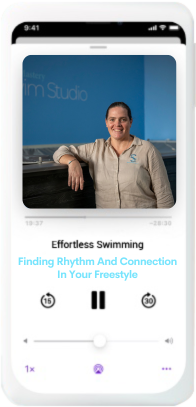
Today, we’re excited to welcome Tracey Bauman back to the podcast! She was a hit on episode 338, where we discussed making swimming more comfortable and efficient. In this episode, we’ll dive deeper into building a strong connection between your torso, legs, and arms, and the importance of good posture and alignment. We’ll also explore the benefits of experimenting with different kicking techniques, how body rotation affects propulsion, and finding the right balance between stroke rate and stroke count. Tune in now!
01:33 Building the Body from the Inside Out: The Key to Connection and Timing
5:35 Breaking Down the Catch
11:00 Visualizing the Ideal Arm Position for Faster, Safer Swimming
14:38 Understanding the Role of the Kick
19:56 Choosing the Right Kick Type and How to Execute It
30:00 Finding Balance and Power through Body Rotation
37:23 Stroke Rate and Cadence
43:32 Why Chasing Times Isn’t Always the Answer
46:45 Get in touch with Tracy!
Website: https://www.swimmastery.online/tracey-baumann
Instagram: https://www.instagram.com/swimmastery/?hl=en
Facebook: https://www.facebook.com/officialswimmastery
Buy the book (The Swim Mastery Way) and save 10% using the discount code SWIM10:
https://inhousebookstore.com.au/products/the-swim-mastery-way?_pos=1&_sid=f59356e26&_ss=r
Get SwimMastery’s Minimising Shoulder Injury in Freestyle course for 10% off with the code EFFORTLESS10:
https://members.swimmastery.online/product/minimising-shoulder-injury/
Change your technique and swim a smoother, easier freestyle with the Effortless Swimming membership:
https://effortlessswimming.com/training-and-membership-plans/?el=blog
Do you want to work with me personally to improve your technique? Join my swim technique coaching here:
https://effortlessswimming.com/stroke-analysis-membership/?el=blog
View our freestyle clinic schedule around Australia:
https://effortlessswimming.com/freestyle-clinics
Try PILLAR today, head to pillarperformance.shop and enter code EFFORTLESS for 15% off, or for any North American listeners, enter the same code at TheFeed.com.
Watch the episode on YouTube:
Transcript
Read the full transcript
There’s so many cues out there on YouTube and coaches telling people to look down and it’s fascinating how just that cue in looking down in the water can really break that entire whole what I call non-negotiable hull of your boat position and so you know helping people to really understand that they just have to be long rather than put their head in any position is I think makes such a difference and that’s the best way we can keep people’s shoulders safe but also to allow them to tap into those larger muscle groups that I talked about. Welcome to the Effortless Swimming Podcast to show that help swimmers and triathletes love the water become a better swimmer and live a better life. Here’s your host, Brenton Ford.
Welcome to the Effortless Swimming Podcast. My guest today is someone who I had on only a couple of episodes ago Tracy Baum and welcome back you are on episode 338 and we got a really good response from your episode because I think we talked about a lot of topics that are relevant to the majority of swimmers out there and how they can be more comfortable, more relaxed and just more efficient with their swimming so I wanted to get you back on to go a little bit further into some of these topics and on today’s episode I want to talk about how people can work on the connection and the rhythm in their stroke the different kick types and also looking at cadence and stroke rate and when and how to increase it so firstly welcome back Tracy. Thank you so much for having me back it was a lot of fun last time so I’m looking forward to some more learning between the two of us today. I want to start with connection
and timing because this is one of the pieces of the puzzle that can be hardest to put together I think for a lot of people and you know you can have a maybe a good kick and a good catch but if they’re not connected very well you’re going to be missing out on a huge a huge opportunity there to swim with ease and speed and grace so this is a really important topic that ties everything together so how how do you see the connection and timing and freestyle kind of working together what are some of the key components for you? I think that the first thing that I always say to people who start swimming with us is when we look at swimming we have to and I think I touched on this on the last episode is we have to think about building the body up from the inside out so when we come to looking at connection and certainly connection between catch and the legs I try I try to stay away from the word kick for I think I explained in the last episode but
we’ll get on to that later on in today’s episode is if the middle isn’t connected and if the engine like I like to say that the body is actually the engine that we need and the limbs are kind of like propellers then then the propellers can’t work so that you have to have both working together and so the connection really comes from making sure that you have firstly attached that torso to the legs and you’ve got that in place so talk about kind of knitting together the the area around the pelvis to attach the legs to the torso and then doing the same through the scapula with the arm again knitting them together and through doing that and making the whole body move as one unit one single connected unit then what happens with the the catch and the press the lengths pressing at the back will always be connected and synchronized then to the whole body rotation if we try and separate those out then what happens is we have these singular body parts that we’re trying to kind of connect
up from the outside in and it’s it’s not always as successful and it certainly can not be as powerful because we tap into smaller muscle groups whereas if you are able to use the engine of the whole body you’re able to tap into the largest sling systems out through throughout the body which it’s really used to using in everyday life and it reduces the risk of of injury so you have suffering the inside out always I say to people you want to learn the timing and connection well first of all let’s get your body into one unit and when we’ve got it into one unit then you can really time those those things to it yeah you’ve got to always be holding or holding the body correctly or switching things on through the center first else there’s going to be that that disjointed movement from the top half to the bottom half so that’s always such a great place to start and when we run clinics we always just start with that all
right let’s let’s hold this midsection of the body correctly let’s make sure we got good posture a big part of that is what you talked about last time getting the head away from the the toes and just yeah maintaining good good posture and an example of this is had a swimmer at a clinic recently who had been trying lots of different things and like really just struggled to keep her heart rate down to move forwards much at all and we filmed her and her head and shoulders were 15 20 centimeters below the water so she’s really just trying to bury her head down to get her hips up so hips are up high but then her legs were down quite low so it was like this you know like a triangle or a pyramid the shape of her body and so what we worked on was just getting that connection holding holding the body straighter and just trying to get that to work together because then the connection became so much easier for her
and not only did her body position overall improved then she’s starting to feel these things these things work together so let’s say someone’s got that part of the the puzzle where would you then start to work with them to help them to feel that that connection are there certain drills or are there certain cues or things that you would have them think about yeah for sure so you know just just on that just to go back slightly to that the person that you had in your clinic with bearing the head I think this is such a really important um topic and just want to touch on it because I touched on it this in this week’s mastery Monday that we do on on Mondays is this so there’s so many cues out there on YouTube and and coaches telling people to look down and it’s fascinating how just that cue in looking down in the water can really break that entire whole what I call non-negotiable hull of your boat position and so you know helping people to
really understand that they just have to be long rather than put their head in any position is I think makes such a difference like you say so if I was then to go on to starting to teach them how they connect up with the with the catch per se you know timing synchronization with the catch I tend to get them to get in touch with the with the feel for the water we do have drills that we use to break down the movement of the catch and the timing of the catch so we’ll get them into a streamlined position making sure that their rotation is absolutely perfect so we want to always make sure that the rotation is never more if you were to get a protractor help them like 30 degrees because otherwise if they rotate any further off of that point they push the scap back into the into the spine and they actually then can’t get it physiologically on it anatomically can’t get a catch because of where they’ve put their where their scapular is ended up by over
rotating so they’ll always lead to either a dropped elbow catch or it will lead to injury because they’re still trying to get a high elbow catch with a compromised scapular position so we start off with the correct rotation and then we have them really so seeing sending their fingers their fingernails forward so they’ve got the the correct connection if you like that lego piece between the arm and the torso being across the scapula then we have them just think about folding and it just having them feel that they have to maintain if I do it in in in this angle here in this plane sorry here we want to be able to maintain this angle here as they fold over a ball and while they’re folding over a ball they want to literally have this ball but the most important thing we get them to think about in this position is that they maintain that 30 that 30 degrees level of rotation I never talk about degrees but for want of a better
way of describing it today and then when they are ready to do the synchronization point that they’re already in that point of applying pressure at the moment that they engage their engine which is their rotation because what we’re trying to teach the the swimmers is that their engine is not the pull which is why for us we have a swim mastery swear word book and pull is number one on the swear word book because the movement or the connotation in the brain connected to the word pull is that I’m going to grab something I’m going to pull it and look at what my happens to my elbow it does the complete opposite of what we want the elbow to do in swimming it actually drops the elbow and the brain connotates if that’s even a word pull with that movement so if I tell the swimmer to pull I’m always telling the brain to do the wrong thing so then the swim is getting mixed messages okay you’ve got to pull but you’ve got to have a
high elbow and the swim is going your butt and the brain is going your butt so we kind of take the words that confuse the swimmer’s bodies out of the equation which why we call it catch and hold and so we get them into that position they catch and hold and then at the moment the moment the rotation starts we’re sending a message to the body that the rotation is the engine and this is just a holding tool it’s just holding and applying pressure to the water in order for the whole body to rotate past that set point if you like so that’s how we start building building it up but the amount of rotation is the key if they over rotate it can’t happen lots of lots of good points there so one that you mentioned there and for those that are just listening Trace was demonstrating with the with the arm extended and you’re going to set the catch so you’re bending or you’re folding at the elbow just with the upper part of the arm
and the and the body you’re saying you don’t want that angle to to change so that angle of the shoulder and I really like that point because if I’m demonstrating on video what I want someone to do at that point we just want that little bit of a movement where the upper part of the arm doesn’t move much like it’s just it doesn’t move much at all and you’re getting that bend at the elbow and people will look at that and go I just don’t have the mobility to be able to do it and yes maybe you’re really tight because we see people like that but I think like everyone can still get some sort of movement in that sort of position and it might not be perfect but it’s going to be sufficient to still get a decent hold of the water and yeah and I think the most important thing about this position and it’s it’s the thing that I’m one of the things that I’m most passionate about you know in terms of injury prevention which is you know what what swim
mastery is all about on that note I have a discount code for all your listeners for our injury prevention course so I must remember to give you that at the end is the fact that when you get into that position and I will remember this is a podcast so getting into my rotated position and I’m demonstrating it standing up so I have my streamline up in the air and as I fold I literally imagine I’m folding over a ball or over over a wall if you like but it’s a really high and what happens is as I fold over that that it’s not it only is it okay but join mechanically my hand must come inside of my my shoulder line and what if we keep the hand on the shoulder line we’re putting the the shoulder joint the shoulder go to lintel compromise position so it’s about understanding that we start in our streamline position down one line as we fold over the ball this elbow as it as the arm internally rotates the elbow
goes slightly outside the line and the hand actually comes slightly inside the line which makes the catch pathway happen kind of I always say thumb goes along the same line as the eyeball down the pecs down the inside of the the front side of the hip rather than trying to keep that catch pathway in line with the shoulder which then will create definitely impingement so and and send the swimmer in the wrong direction because it it’s not what the joints want to do so you want to think about what position we would put our arms in if we were going to climb a really high wall and we would automatically go into that exact same position that I’ve just talked through and demonstrated and that’s the best way we can keep people’s shoulders safe but also to allow them to tap into those larger muscle groups that I talked about so it’s safe and stronger therefore we’ll end up being faster once they’ve figured it out yeah well an exercise that I’ll
sometimes have people do at clinics is we’ll get them into to partner up and go into a good catch position and we’ll get what the other swimmer to just hold their forearm and then we’ll have them them press against that nice and they can feel their lats working and then we’ll have them drop the elbow you know in that in a poor position and then they’ll sort of press against them and they really feel the top of their shoulder load load up and so you can see with that mechanically better position then they can actually use those stronger muscles and they can feel it and that’s such a fantastic way to get people to have that that contrast of feeling what what you want them to do versus what you don’t want them to do and it really gives that that’s a really great way of giving them that picture and I love the the concept of you know holding and just moving your body past it or the concept of of anchoring because it’s very common to see people
trying to muscle their way through the water or pull their arm through but it’s not that the concept that we’re going for it’s that and I think you may have mentioned it last time but I love the the cue of a ladder on the bottom of the pool and you got rungs on that ladder and we’re just placing a hand on it moving past it and you’re always going to have some slippage you know you’re not going to be perfectly anchored with the arm or holding it in the exact same spot but we want to work a little bit towards that and that’s what you see the best rooms in the world the world do and especially when they when you feel like you’ve got that hold and then you initiate that rotation you really get a get a sense of it where does the kick come into that for you what do you do you have or the the legs where do the legs come into that for you this episode is brought to you by pillar performance our new sponsors pillar
are a sports micro nutrition company and the easiest way to describe it is that while hydration and carbohydrates products will take you through to touch the wall as fast as possible pillar’s mission is to get swimmers to the starting blocks in the best condition over and over again I recently started taking pillar triple magnesium after a friend had recommended it and it’s been a game changer for my sleep and recovery I take one scoop 30 minutes before bed each night in the same way that you might start your day with a coffee I finish it up with the magnesium and recover better for tomorrow’s session in the pool pillar performance is used by some of the biggest names in swimming and triathlon including zack stability cook yarn for dino ben canute as gentle tailor nib amongst the host of other well-known swimmers and triathletes where pillar differs from other micro nutrition you may have taken before is both the quality of the types of
magnesium and the tangible results that I see on my garment each morning if you’d like to try pillar today head to pillar performance dot shop and enter code effortless for 15% off that’s effortless for 15% off all first time purchases or for anyone in north america enter the same code at the feed dot com so so kick happens to be a now freestyle swear word book and we do all four strokes so the only stroke that I actually use the word kick is breaststroke all the rest of of the the strokes kick is on this one marty swear word book just because again and I think I mentioned this in the last podcast but just for anyone who didn’t listen to that again the brain’s connotation with the word kick the movement pattern that the brain wants to do and I can imagine that 90% of everyone who is listening to this is has the image of picking something probably a ball and pulling the heel back and you know winding the foot through and and picking the ball or
something and obviously that’s exactly the movement that we don’t want in swimming what we want is to have the legs just as an extension of that frame that starts at the shoulders and that we’ve knitted together at the pelvis and the legs are just part of that however they also are have to and are anchors and they also act as a counterbalance to the rotation so it was interesting I’m in the middle of doing several different coach trainings at the moment and I was doing one coach training call last night and we were talking about flutter and and and what it’s for and obviously there’s a lot of information out there that would suggest that your legs or the kick is there to keep the legs up and whilst whilst the legs if you do nothing with the legs they will sink I was explaining to to the new coaches who are who are training with me at the moment I was explaining that we have to have a leg action in order to press or connect at
the back end with the water so that we can use our engine and and using again the analogy of the outboard motor you’ve got the engine and you’ve got the propeller propeller on its own I eat catch and kick doesn’t do anything and the engine on its own without propeller doesn’t do anything just so so it’s this really this marriage of these two parts that that have to go together so when I talk about legs I talk about using them as a tool to press and counterbalance so it and it doesn’t matter which kind of movement or how many movements necessarily they are doing with their legs so long as that’s their job and that’s their intention is that they’re staying behind the body they are pressing water behind them in order to send them forwards and they are never together they’re always a part to be a counterbalance for the rotation and the other the recovering arm on the other side that’s that’s great I think
a one thing you mentioned there was you said they’re always either behind you or behind the body so you know picturing filming someone from the side they’re not obviously you know below you and I was I was talking to the guy Ash Delaney the other day who’s just started coaching Carl Chalmers and he said if you look at Carl’s kick he actually comes out of the water quite a bit because he’s sprinting and his feet actually come out quite high but you look below the water below his body line no not it’s just it’s all staying within that body line so he’s very streamlined very very efficient and that counterbalance action is yeah that’s you see someone who rotates too far the legs will will splay and like you see it splay because it’s it’s trying to stop you from going even further it’s trying to counterbalance you at the back but obviously that’s not a good movement below yeah and it’s just like this big parachute that just
goes out behind you each time and for anyone who’s doing that it’s just such free speed to gain when you make that that change we had a few summers at our clinics on the weekend where they were going really wide and going really far on their side and and I said it’s the only thing you take from today is you know you make that change your flatter keep the kick together you could be five or ten seconds quicker if that’s all you took but there’s always more than that so yeah it’s uh yeah exactly right and you mentioned it doesn’t matter not necessarily how many kicks or what your your bait is like it’s and obviously that can can change can you talk a bit about the the two four six baits what do you like to sort of do in terms of teaching that or recommending a certain style for a certain person where’s that fall for you so first and foremost so I don’t I don’t sit on any I kind of sit on the fence with this a little bit because I’m not
in any one camp what I’m about is what is best for the swimming in front of me and for some swimmers who are in front of me it’s definitely going to be a flattensill and I think there’s there’s so much information now out there on youtube and people spend a lot of time watching youtube and going to the pool and trying to do things in their stroke that they’ve watched on youtube right and then they come to you for lessons I’m sure you’ve experienced this so much yourself and haven’t quite got the message and so they come with this like oh I’m doing let’s say a two and two beat we call it a two beat press and you know it’s this real huge massive scissor scissor the literal kick because it actually actually is a kick because they’re using quads and hamstrings and they’re just winding themselves up and doing this massive kick in order to rotate and then ending up in this streamlined position that the legs pin together behind them and
they’re like oh it’s going so great and I’m going in it’s not going so great because you have got no counterbalance you’re putting that parachute like you were talking about up and putting the brakes on it’s like it’s like riding your bike holding the brake on and you’re disconnecting your entire body and just loading up tiny and smaller muscles so you get enough fatigue quicker you’re gonna risk injury and so so for people like that I would absolutely definitely recommend that they break it down and start learning a really well integrated well timed flutter first even if they want to do the two beat I think the only way through to a really great two beat is if they can do a very well timed and connected six beat so flutter and I I don’t go in the middle I don’t touch four beat at all because it puts the legs into the wrong place and then if you do four you haven’t got the pressing leg in the right place
because it’s on the other side so a four beat only really I think one of the Olympians they doesn’t have to mind right I think Sun Yang Sun Yang did a one two three which ended up being a four which ended up with the legs in the right place for the next one but if they just did because a true four beat is one two and then one two but then they don’t have the pressing leg in the right in the right place so it doesn’t become connected that really can only work if the cage and pelvis isn’t connected and they’ve got a bit of a twist and therefore then the legs can kind of do their own thing but if they’re connected all the way down the body and they have that shoulder to feet one unit then a two or a six is what I what I go for so I’m having that and it’s really interesting because when you connect the body up and you have them send their head away from their feet and you get that long line like you were talking about
you doing with your client this weekend at the clinic and you start to observe their legs with the connection through the body it’s fascinating to to to watch because their legs start to just fall into place because they kind of can’t not because they’re now connected from the inside out I was doing a lesson yesterday with with one of our fetches in the studio and she got in in the pool and she started sewing and her legs what literally all of us quite normal in the endless pool where people will start off they’ll get a bit flustered because they’re a bit not used to it and after sort of 20 seconds and I was videoing her and we have all yeah over and I know what cameras on the swimmer at any one time and it was so fascinating that once I gave her just send your books or your head away from your feet through the machine and that’s all I said to her and then we filmed her again and she went from this crazy undisconnected
discombobulated leg movement behind her to this most amazing well-timed two-beat press and I hadn’t even talked to her about legs and said anything about it legs I just gave her back her middle line so I feel very much that if we get people connected from the inside and then give them the instruction of really sorting the legs out from the thigh bone then they will start to develop what’s best for them either a six-beat or or a two-beat and I often find that sometimes they can switch they should be able to easily switch between the two so when I come on to what I recommend to to answer the last part of your question it very much depends on the the technique of the person executing the the flutter or the two-beat press so for marathon swimmers and long-distance swimmers if they have a really well connected well-timed two-beat press absolutely that’s going to use less energy no there’s no two ways about it that that’s
going to use less energy if they don’t if they have a really discombobulated two-beat press is probably going to use more energy than if they just did a really great flutter so what I say to people is be open to exploring both ends of the spectrum and and through that exploration of both ways so if you’re really into a flutter try a two-beat and if you’re really into a two-beat try a flutter and there’s so much learnings to be had from your from your own body for your own body to learn from practicing those those two and feeling the connections and really making sure that whatever happens is that every time you rotate you’re pressing on the correct leg backwards whether it’s a two four six ten twelve eight twenty I don’t know it doesn’t matter how many so long as you’re always pressing water back at the moment that you are rotating and not using the press to rotate so those are kind of some of the key messages that I talk about when when talking
about how many yeah good so you mentioned going from two to six and and playing with that it’s not a continuum but playing playing with those different ways to kick and I think that’s such a good way to do it especially for the longer distance swimmers because as you said a two-beat is going to be more efficient if you do it well and in the ocean you’ve got the salt water and you’ve got that extra buoyancy similar with the wetsuit on and a lot of people will just gravitate naturally to a two-beat kick if they’re swinging those those longer events so they might not necessarily use that in the pool so that’s where you can have this slightly different stroke from when they go from pool to open water so it’s good to be able to you know to mix that up and then depending on the speed and the effort that you’re putting in that can change as well and it can change within a race as well so just giving people these different
gears that they can shift shift between adds a lot of different yeah different ways for them to be able to change their speed within a race and yeah you might not start with that if someone’s learning to swim but for someone who’s got some experience you can you can certainly give them these different things to try and exactly for triathletes I think it’s so important that they you know certainly if they’re doing anything more than an olympic distance so olympic carve or iron man you know they they really want to be doing really great stuff with their legs because they could have a lot of stuff to do with their legs after them after the swim swim bit so they don’t want to be have getting their legs in the way in in that water and at the same time they’re also racing and they they want to you know they want to use their strongest discipline to you know make up make up the numbers so being able to give them the tools to you know so the large
part of the the swim part of the race to to have a nice relaxed connected to beat and then when they just want to kind of take over some people just at the end of the race or at that beginning to have them be able to turn on that that six beat and really make it into something that applies pressure in the right direction and kind of just gives them this kind of outboard motor to send them past without going into the quads and hamstrings which are really oxygen heavy muscles is such a powerful tool for triathletes so yeah learning both this is excellent for them for sure
and in terms of the four beat for some people i’ll have them try and develop it and the way i would normally teach it would be rather than like the you know one two one two i find that can be can be hard for a lot of people and and what i’ve seen doing some filming with with some high level swimmers is especially at that like 800 1500 sort of pace if they’re using a four beat a lot of them will just will do one two three four so it’s one kick and then three kicks yeah with the strokes so that has worked with some people that i’ve that i’ve coached and like i had a young kid who i was working with he triathlete and he had was kind of like a three or semi like four beat four beat kick that he was using before that it was but it was just kind of all over the place it wasn’t well connected so we got that rhythm and and that timing to be better where we went to the one two three four and actually the way it sort of ended
up was and the way i had him think about it when he was going fast was actually it was one two three four one two three four so it’s it’s the same thing but just in his mind that’s what helped him sort of connect it and he ended up like taking off two or three strokes per 50 and it was about a second and a half quicker so just like kind of using what he was he was doing for getting that to be better timed and better connected and and you mentioned at the end there with the with the with the last you know using that to help help with the rotation so just timing it with the rotation so could you talk a bit more to to that and how that works in for people yeah so so and i think this is probably exactly what the the student you were just talking about probably felt so in the UK used to work a lot with competitive swimmers and they used to come to the embers pool they used to do all their training with their club
they used to come for technique sessions in the embers pool and they would come with this i don’t know i don’t even know what to call it this there were lots of lakes going there were lots of lakes happening at the back of their body lots of splash and i would be filming because i don’t have all the cameras on them and under the water i’m seeing the the back end of their body is just kicking up and down i’ll just use the words that they were actually doing they were kicking up and down and the front end of their body was rotating because they’d been told to use their shoulders to rotate so they had this completely disconnected body so this front half was rotating the back half was doing can’t make my hands do that up and down and nothing was talking to anything else but everything was working really really hard and they were effective they they were you know that some of them were the the best in it you know nationally and they were they were really really effective and when when i
spoke to them about the idea of the whole body being being one unit and that the legs are simply used to as as if so so how i teach it is i have them stand on the floors upright and i have them just go on to their fronts of their feet their balls of their feet and just swivel and then i have them as they swivel i have them send their head up to the ceiling as they swivel so they can just feel that kind of anchor as they swivel but it’s the whole movement of the swivel of the whole body i.e the rotation in in the water that is pressing off of the water at the back end in order to send the head forwards so when we then play around with that and we go okay so one two three and what i do is always click i go one two three and it doesn’t matter how many numbers you count after that but so long as the one is on that rotation one blah blah blah one blah blah blah and they get that idea that at that moment that they’re rotating they’re always
pressing with the leg that’s on them underneath them if you like it’s behind them and underneath them on the bottom and then they get this beautiful anchor where as they rotate they press they press on the water here and they press the water behind them and send their head and fingers forward and they get this amazing amount of propulsion by by finding that thickness in the water that as swimmers get better and better they start to understand and start to think about and then if you key that with the catch at the front end with the rotation then they’ve got these amazing almost concrete blocks that they can press on hold on and push on at the back end in order to rotate and generate and send and direct the energy forwards so i think that it’s it’s it’s a really important thing to help the students understand what it is that we’re looking for and then what happens is it it just be it just happens often what i do is i will say to them right so that i
for for the next swim i want you to do i don’t know six to eight strokes just with my breathing just focusing on whole body rotation so and shoulders to feet and just rotate your head and fingers forward and i’m just going to observe what happens and it’s the only time i’ll say to them don’t use your legs and because i just want to observe what happens and then i video and i have them just do that but the whole focus is in whole body sending head and finger nails forward and i video it and they i said did you use your legs and they’re like no they were just pinned together for sure and then i played the video straight back to them and they’ve got this most amazing either two beat or this very well timed flick flick press press on that rotation because the body if it’s connected will always look and find an anchor and if we can rely on the body to find it rather than trying to instigate it it’s going to be better and well timed more
better well timed because we’re not trying to break up body parts so that’s kind of how i how i try to let it evolve as a default or byproduct of great connection down the body and pressure that ties in really well with what i’ve with what i’ve seen coaching and especially when it comes to the legs so if someone’s thinking about their legs you know if they’re thinking much about them the rest of the stroke tends to fall apart and it’s just like it’s too much going on so we we don’t want to have to really think about the legs at all we want that just to naturally come into its own yeah so if you do those other things you’ve talked about if you if you get those in place first generally it will come into its own we’re not having to be thinking about what’s what’s happening at the back so yeah it’s interesting to hear your take on that because i just see that so so often so i love to yeah love to see it explained in a in a different way
because yeah yeah we all we’re all working with similar people and we just yeah and so we’re going to see this the same things so that’s yeah a great way because we’re we’re all what i love about swimming is we’re all human and for the most part we all have 206 bones in our body and for the most part we all have 360 working joints and the the body and the skeleton and the joints are so amazing they they they they work and if we allow them to work we tap into allowing them to work in the right way and kind of don’t get in the way of that natural process they they do beautiful things and they do amazing things and i think i think if we can really trust the skeleton to do what it’s designed to do it it just does amazing things and i see that all the time especially with the legs it’s fascinating it fascinates me every time all these years later it still fascinates me i was blown away yesterday when i when i saw that it just is so cool i love it one thing that’s
that’s somewhat related to it is when i was talking to astra kahl’s kahl charmers cage one thing he mentioned that i that just like a small yeah a small sort of just offhand comment that he made that i found was really helpful was that when he’s working with his swimmers he he gets and it’s very similar to your pros actually he says you get some to think about their shoulder and then connecting that with with the hips so there’s cross-body connection through here but yeah you know provide they’ve they’ve set their catch you know they’ve got that hold you know don’t think about like holding through the the arm necessarily it’s like if you can stabilize that shoulder if you think about the shoulder and connection with the the hip and the rotation so it’s just that’s easier to think about because obviously the arms connected to the to the shoulder if you get the shoulder right you’ve got that stability
then you can get that connection so these little small like comments that i get from different coaches i yeah i just sort of add them to my my teaching toolbox and yeah use use them if necessary so yeah that’s that was an interesting just offhand comment that i heard him heard him say and just to sort of finish up here we’ll just talk a little bit about stroke rate and cadence what’s what’s your general approach to to work with people there and increasing speed and all that sort of stuff yeah so it’s and this has been this is a another huge battle this is such a big world when we when when we come on to this it’s like a massive topic and i have literally spent the last two weeks or three weeks talking about non-stop because i’ve been doing an advanced coach training course where we introduce the metrics and tempo and stroke counting in gears and and everything and to the coaches so it’s been it’s been a wonderful exploration of all
of these things in these things in depth the last few weeks and it’s been really exciting to watch the coaches get really excited about how how speed can evolve and it was something that i always learned from from terry amongst many many other things is speed happens as a by-product of doing the right things with your stroke and then increasing tempo without losing form and i sweep you know as i’ve gone through the years and that and played with that that thought process and and played around with the the increase in tempo and stroke count it’s been a really interesting process and i think that through the years there’s been some very very mixed messages that have come out yeah all over the place and you know what i want to say more than anything else is stroke count SPL is important for sure tempo is important for sure it was permitted important for sure the all these things are really really important that they are dangerous
in isolation so if we just focus on tempo or strokes per minute in isolation we are asking for trouble in our stroke if we just focus on strokes per length in isolation we are asking for trouble in our stroke because one’s going to create these these swimmers who are creating massive dead spots because they’re trying to get their stroke count down to zero or you know silly numbers that they just shouldn’t be doing and just focusing on tempo or strokes per minute creates these windmillers that are becoming more and more inefficient because they’re after just tempo rather than figuring out what that’s actually doing to their stroke so say for me it’s always building on this happy equation of of three things strokes per length tempo and rpe and if i can work with my client and i can start to play around with stroke count i can start to play around with increasing and decreasing tempo because there’s things to learn for us in both ends of that
spectrum and always get them to tell me what their rpe is ready to perceive as which is obviously their own measure then i’m going to have a byproduct of speed so i’ve been doing lots of virtual coaching since since COVID since lockdown and it’s blown my mind i’ve worked with people that i’ve still never met and i’ve been sending them sets and i’ve been virtually coaching them and i’ve been writing you know all sorts of gear sets and tempo sets and stroke count sets and with these these two people in particular that i’m i’m thinking about it was only after two years that i started to add any time into their sets so i never gave them time as a measure we could always work out time because it’s just a maths equation yeah if you’ve got the length of the pool you know that bush else then SPL and tempo is going to give us the time but i never asked them to look or think about time in all that in all in over the two year period and what was
really fascinating is that when they started with me they had their watch that i don’t let my students use stroke counting with the watch because it’s completely inaccurate and they’re not in there in their heads there it means nothing is that and all what’s happening in that length so they have to count their own strokes and what started happening they looked at their watch at the beginning they were doing like 157 100s you know just over an Ava and then two years later they started looking at their watch and they were doing sub 140 so they couldn’t swim they all their things it didn’t matter whether it was just a warm-ups were more anything all of their 100s were sub 140 and and we hadn’t even talked about speed so for me speed is something that is a byproduct of getting great getting great technique getting great connections in your body and then playing around with increasing tempo and seeing what happens and incrementally increasing
that equation because that equation will always result in speed if we do the opposite and we go and chase speed then sadly we turn into terrestrial mammals again and you watch someone it’s fascinating you watch someone who you have them do I don’t know three repeats 350s if you like the first one slow medium fast and you give them that instruction and it’s fascinating to watch what happens differently and if you video them on the fast one their stroke completely changes and their arms and legs disconnect from their body because they now suddenly going to go fast and they lose all of that beautiful connection and therefore they just become exhausted and start just turning the water rather than moving through it so we want to have speed but with great connection and great rte rate of perceived effort so that a keep the shoulders safe most importantly but also so they can swim further and further and further for longer and longer and longer both in terms
of distance but also in terms of age lots of stuff there that’s a great way to think of it because we there’s no point focusing on the the results it’s about the inputs and and they are the three things that that’s just it’s kind of as simple as that it’s like when we look at speed you know it’s just it’s the history things that are going to to make the difference and I think yeah I’ll see about this this today it’s let’s say someone’s a two-minute swimmer and they want to get down to let’s say they want to get down to that 150 like they’ve just got this goal of 150 in mind but you know long term but they could be like a 140 or a 130 swimmer in terms of pace it might be they might be able to get to a 150 quicker just by like you know maybe maybe going harder and spinning the wheels and just like you know going for it but and that can happen quicker but long term if they just focus on the right things there’s good connection
good technique the right stroke they will then be able to get to the 140 or the 130 but if we just kind of yeah exactly but if we’re just chasing that that speed and that certain result well you might be doing some things that will long term you’re not gonna you’re gonna have worse connection and a worse stroke so if you can have that patience of just being able to keep chipping away and chipping away and not worry about what your times are doing then like that again just when I see swimmers who have done clinics it’s those swimmers who have had the patience just to keep working at it and they come back six months later 12 months and they’re the ones that have improved not often the ones who are just like who are chasing a certain certain time they’re doing willing to do whatever it takes to to get that even if it means just like getting a getting too scrappy with the stroke so it’s a really interesting mindset thing for me I think I might have
mentioned on the on the last podcast I had I’ve had someone who had been working with the last two years and the focus has been totally on on getting faster getting faster getting faster and with their hundred time they in two years I have taken maybe one second off like nothing then they did some work with with me and literally all I worked on was their their frame their streamline position their amount of rotation and nothing else we didn’t even talk about any of the propulsive phases of the stroke nothing and then they went back to their club and sent me a text and said I’ve just done five consecutive 100s on 123 seconds after you know just fixing their frame like really simple stuff and yes I spoke to them a few weeks later and they still they’re still doing 123 123 24 but two years they could take only one second off and for me that was it was I think the difference was is that they surrendered to the fact that they have to
not going to pull certain kick sets they have to actually work on the connection of their their frame and what’s important and it was really fascinating to hear the difference in the outcome when the mindset changed yes absolutely I see that a lot when if we ever do stroke count work where we might like sometimes I’ll get people to do just normal swimming swimming how you’ve always swam all right but takes you 25 strokes for a 25 all right now let’s just work on the the frame the head position body position that’s usually when the biggest reduction in stroke count comes yeah as we work on catch and pull yet sometimes but that’s I think a bit more of a long-term play but the biggest improvement can come from the really fundamental and basic things like you like you just mentioned there so Tracey for anyone listening what is the best way to get in touch with you where can they find you what do you how can they they work with you
yeah so my website is swimmonstery.online I think that this discount code that I gave last time for the book the swim mastery way that I’ve written is still in place perhaps we can just link that and keep that going for a bit so they can find that on amazon or the link that hopefully you’ll put under this podcast and then I also have we’ve done a swim mastery prevention injury prevention course and I would like to offer your listeners a 10 cent discount code off of that which I’ll send you the details for so the code will be effortless 10 all in capitals but I’ll send you the details for that and then there’s opportunities to virtual coaching that they can sign up for online and we have some camps coming up we have turkey and grease coming up we have some exciting things happening down in Sydney that we’re going to release at the end of this week we have a clinic happening in Boston in October so if anyone in
America come and find us there and yeah hopefully we’ll see some of you around fantastic thanks again Tracey we’ll chat again on another podcast there’s still a lot more we can cover so thank you again my pleasure thank you so much thanks for listening to the effortless swimming podcast if you’d like us to help you become a faster more efficient swimmer go to www.effortlesswimming.com