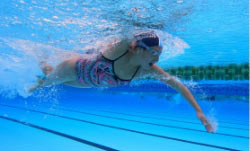









In today’s episode, we’re diving into a Q&A session where I will answer your questions submitted on Instagram! Tune in for helpful tips and insights on how to improve your swimming.
In this episode
- 00:48 I tried adjusting my head position, but my legs still sit too low. Do you have any recommendations?
- 02:42 How do you keep your hand up and gliding during the reach phase?
- 05:26 How do I ensure I feel my lats during a workout rather than my traps and upper back?
- 06:47 I went from a 1:45 to a 1:32 pace in four months, thanks to you. Now I’m hitting a wall. Any advice?
- 09:04 Can you explain the timing for rotation in catch phase?
- 13:18 How long does it take to go from being a leisurely swimmer to a highly competent swimmer?
- 15:48 How do you improve the skill of feeling the water?
- 19:20 When I push hard on the pull, it speeds up my entire process. How do I keep the cadence regular?
- 22:20 First focus priority, kick or catch?
- 23:25 Why is swimming focused on rep time cycles instead of work-to-rest ratios?
- 24:38 My stomach drops but my head and legs are up, resulting in this weird U-shaped form. How do I fix it?
- 26:31 Send your questions!
Links from this episode
- Change your technique and swim a smoother, easier freestyle with the Effortless Swimming membership
- Do you want to work with me personally to improve your technique? Join my swim technique coaching here
- View our freestyle clinic schedule around Australia
- Get 15% off our 8-week Faster Freestyle course by using the code 8week15
This podcast is brought to you by NanoClear — our own range of anti-fog swim goggles, designed by Effortless Swimming with the anti-fog treatment bonded into the lens itself (not sprayed on, so it doesn’t wear off after a few swims). Check out the NanoClear anti-fog swimming goggles here and use code PODCAST15 for 15% off.
Transcript
Read the full transcript
If you find that your arm drops, particularly when you take a breath, more than likely you are over rotating.
The thing with body position is it’s somewhat tied to your head position, but it’s not the only factor. The biggest factor is how you hold your body and it’s your posture. Welcome to the Effortless Swimming Podcast to show that help swimmers and triathletes love the water, become a better swimmer and live a better life. Here’s your host, Brenton Ford.
Today is more of a Q&A episode where I’ve had people submit questions through our Instagram. If you’re not following us on there, go to ateffortlessswimming and we post a lot of regular content on there and from time to time we’ll put out stories where I’ll get you to submit questions for our Q&A episode of the podcast. Now, our first question comes from Nick and Nick said, I tried adjusting my head position, but I feel like my legs sit too low. Any recommendations? The thing with body position is it’s somewhat tied to your head position, but it’s not the only factor. The biggest factor is how you hold your body and it’s your posture. So if you have really poor posture where you’re hunched over and rounded through your shoulders, you’ve got a big bend through your waist and you put your head down. It’s not going to lift your legs up. You’ve got to have this connection through the middle of your body first to then really have any impact on what your legs are
doing. So the way that we would normally teach this is think about getting your head away from your toes. So you’re long through the spine and through the neck.
You want to suck your belly in a little bit, squeeze your butt cheeks together slightly. So there’s a little bit of tautness through the midsection. If you do that and then have your head in the right position, which I would normally teach as being 0 to 45 degrees and keeping your head like an iceberg, 10 or 20% of it above the water, the rest of it below. Then you will generally have quite good body position. So you need to make sure that you actually have the right posture and hold your body right first. I just from a recently at a clinic who had very low legs. I’m talking like 40 centimetres, 50 centimetres below the surface of the water because she was pushing her head down super deep and her shoulders really deep as well. And the hips are up high, but the legs are low because she was like this is this pyramid or this triangle in the water because there was no connection through the midsection. So then when we change that up, we got that posture, right?
Then the head position was able to impact the rest of the body. So it’s not just about the head. There’s other factors there that we need to consider. So we always really just want to work on those few things together. It’s head and body together. The next question comes from Domo Ag who said, how do you keep your hand up and gliding during the reach phase? Now if you find that your arm drops, particularly when you take a breath, more than likely you are over rotating. It’s difficult if not impossible to keep your arm extending and reaching forwards. If you’ve over rotated because it puts too much strain on your rotator cuff and just physically it’s very hard to keep that arm extended. So you always want to make sure that you’ve got the right rotation and something that might be causing you to over rotate is how you’re breathing. So if you’ve got a big lift and turn of the head and you’re looking up to the sky, that might be causing you to
over rotate. So we need to consider the breathing in that as well and trying to look directly to the side, maybe keeping part of that bottom goggle in the in the water as well and keeping the head centered. So imagine you’ve got this skewer through your head, neck and spine. And when we go to breathe return the skewer so the head turns, but it’s not coming much off that line if at all. So that’s often the main cause of someone struggling to keep their arm extended. Another thing that I often see there too is that if you are entering at with at full extension. So you’re coming over the water reaching out as far as you possibly can and entering with your elbow first you’ve kind of got nowhere else to go and you’re just going to drop that arm down. So I would teach most people to enter with their fingers first have that elbow bent so it’s raised above the water. So they’re entering at about wrist length is good.
You know if you’ve got your other arm in front you’d be entering somewhere about in line with your wrist and then having that last bit of extension or reach happen in the water. So sometimes how you enter as well can be a factor and the drill I’d normally do there and the one that we teach on the first day of the five day catch challenge our online course is we get them to do one arm freestyle with a kickboard and that kickboard that you’re holding the back of out in front will force you to enter fingers first because if you overreach you’re going to hit the kickboard and struggle to get the hand in the water. So that’s a good way to just get that dialed in and force yourself to enter in the right position. So that’s another factor to consider. So there’s certainly other things but if you follow the right process if you’re going through the stroke and say our five core principles that we’ve got inside of our membership.
You know we want to start with breathing making sure we’re relaxed and breathing properly. But then we go on to posture head position body position and go through these things and then everything else can come together because you know if we just look at while my arms dropping down so I’ve got to focus on the catch. There’s probably other things causing it. We’ve got to go through them in the right order. The next question comes from Lou one Leo. See she said he or she said how do I ensure I feel my lats during a workout rather than my traps and upper back to me. It sounds like you’re probably hunching your shoulders too much so I’ll come across some swimmers who are trying to really hunch their shoulders up around their ears and they’re trying to cover their ears as they’re going through their reach and their catch. So that’s just it’s not putting your shoulders in the in the right position. So if you’re not feeling your lats it’s probably
just again that posture or what you’re doing with your your shoulders through the reach and catch. So think about that length first get your posture right get that right number one then as you’re reaching forward your shoulder will sort of come up near the side of your face just near your cheek. So your shoulder blade is just going to slide along your rib cage and that shoulder should stay near the side of the face but not covering your ears. I see some people teaching this like cover your ears with your shoulder as you go through your catch but it’s it’s just not where you see the best swimmers in the world and it causes you to use your upper traps way too much so that to me is a pretty common cause of that happening. It’s just how you’re how you’re holding your shoulders through that part of the stroke. So just look to try and keep try and keep yourself relaxed free mobile and not hunching too much through the stroke.
The next question comes from Derdan H. She said I went from 145 to 132 pace in four months thanks to you now hitting a wall any general advice. So there’s a couple things with that you having made that improvement in four months it could likely either be you’ve improved your technique and that’s helped you make that change. Perhaps you’ve increased your fitness but I’m saying I’m guessing if you’ve said it’s been thanks to maybe our videos that’s probably more to do with technique more than anything else. So what you might look to do from there is just lock in those improvements in technique build some fitness around that and then depending on what your goals are to but and then looking at what would be next. So what did you work on what did you change if it was better head and body position that could account for a pretty big improvement in a short space of time then you might need to look at the the next thing.
So making sure that your kick is effective and not causing you to slow down maybe you need to look at making sure you’re rotating correctly then the recovery and then the catch and pull. So I would follow those five core principles follow that same order and and go through the stroke that way but then you want to just make sure that you’re building some some fitness around that too. So if you’re swimming once a week then maybe you look to increase that to two maybe three times a week but it all just depends on your goals. If your goal is to doing all that hundred as fast as you can it’s going to change in if you’re doing a triathlon and looking to hold a one thirty two pace across a fifteen hundred meter swim. So really just just depends but that’s like that plateau is very normal especially if you’ve taken thirteen seconds per hundred off your times you’re going to probably stick to that for a little while before
seeing the next round of improvement. So being okay with that and expecting that to happen like that you just need to sort of be okay with that now not to say you can’t get faster keep working on some things and and keep trying to find areas of improvement but knowing that it’s it’s very normal to hit a bit of a plateau for while before making that next improvement. I think that mentality and mindset around it’s a big a big factor. The next question comes from S. Chalek they said can you explain the timing for rotation and catch phase. So on your as you’re reaching forwards and you’re on your side and you’re about to begin your catch we want to make sure we’re rotated 30 or 40 degrees number one. Now while you’re still on your side you’re going to go through the catch so you’re going to you’re going to bend at the elbow you’re going to have your fingers pointing down and then you’ve set yourself to be able to hold
or anchor in the water at that point. Now from there we’ve then got a good hold of the water where we can then begin the rotation back onto the other side and connect everything up now with the timing of that it’s going to be timed with a kick on that same side that you’re doing the catch on. So when you’re let’s say you’re on your right side your right arms in the water you you’ve set your catch around that time we should see your right foot doing this small movement down and that’s going to help you move on to the other side and we want to feel like we’ve got this connection from our arm and our shoulder across our body through to our opposite hip as we go on to the other side so we want to make sure that’s our that’s our timing. The mistake I see people making with their their timing is that they will be say on their side and they go through their catch and they’ve gone and they’ve gone through their their pull and their arms almost back
towards the hip before they start rotating back so we want to get really good at that sort of timing where we’ve just finished our catch then we’ll have this small kick as we then go back onto the other side. So that’s what we kind of think of as like a three-quarter catch up where we’ve always got something in front of our head a very common thing I see with 30 40 percent as we come to clinics is they’ve got nothing in front of their head so they don’t have that three-quarter catch up or front quadrant timing so I think just generally a few ways to think of that is you want to be a little bit slower out the front as you’re reaching forwards and then you want to accelerate a little bit out the back so it’s slower and out in front quicker out and back so that we get this change in speed we don’t have this constant steady turnover of the arms it’s going to be slower once we’re in the water and reaching through and just beginning to catch and then
it will speed up a little bit that can help you have the timing that we’re after in the stroke this podcast is proudly brought to you by form smart swim goggles the smart swim to is the next generation of forms award winning augmented reality technology they haven’t integrated heart rate monitor for constant real time heart rate monitoring which allows you to accurately train your heart rate zones which is the first time that you can do this in the pool something we’ve had when biking and running but the first time that you can now do it in the pool another huge feature that they have released is the swim straight feature this is something that allows you to swim in a straight line without needing to site it’s a digital compass in the Google display and it’s race approved by world triathlon USA triathlon as well as other leading race organizers and athletes are already shaving valuable time off their swims by swimming straighter I’m a huge
fan of these goggles I’ve used them for the last couple of years and it’s something that I use each and every week and even just the simplest features of being able to see your splits after every turn makes a huge difference to not only the way that you train but the enjoyment that you can have in the pool and the new smart swim to has a reduced tech pack size by 15% making them slightly smaller the new ice seals fit a wider variety of facial structures and the new straps and anchor points have been moved and adjusted so that it has a more stable fit there’s additional features which I haven’t mentioned like the head coach workouts training plans as well as integrations with training picks Strava and more this is something for all abilities and levels of swimmer and available worldwide from form swim dot com forward slash effortless and to get 10% off the smart swim one goggles use the code effortless swim on check out
that’s form swim dot com forward slash effortless and use the code effortless swim on check out for 10% off the smart swim one goggles
now the next question comes from Richard Richard nearly says how long does it take to go from being a leisurely to highly competent swimmer this is different for everyone depending on what their sporting background is their age how much time they’re spending in the water so I’d say like with with intentional practice if you’re swimming an hour a session three times a week you could expect to make some really good improvements in the space of 6 to 12 months going from being leisurely to to very competent 6 to 12 months for some people that will take longer for some people that will be shorter but I think having a you know giving it at least 12 months is is what you should expect and for many people that that can take longer and it depends on what you mean by highly competent so you know if we’re talking like two minute pace down to maybe 145 okay maybe that’ll take you might take you 6 to 12 months or if you’re thinking highly
competent is being like a 130 pace while that might take that might take a bit longer that might take two years if you’re coming from a two minute pace obviously depending on the on the swimmer so it normally takes longer than what you think it will you know most people are coming into things whether it’s like you know whether it’s like starting a business whether it’s at swimming and you know expecting to see this huge change and it certainly can be relatively quick but if you are just if you are happy to just work on the process and the stroke and not actually worry too much about your times the times will come anyway that’s a consequence of the imports as a consequence of you doing the training putting in the the effort and focusing on those things so if your time focused that’s not always the best approach I think it’s best to just work on perfecting and improving your stroke and feeling this this connection and then looking at you know looking at becoming
that highly competent swimmer so yeah it’s it’s different for everyone and you know for some people that it can take three or four years and a big part of that too is just how often you’re swimming as well so if you’re swimming once a week for an hour it’s going to take you a while it’s going to take a long time to I think see see those improvements because if you’re doing three sessions a week instead of one well you’re going to fast-track that if it ends up being four again you’re going to fast-track that so it just depends on how much you yeah how much you’re committed to it how much you you really want it and how much time you you can spend on on improving your swing the next question comes from Gigi to lad he said how do you improve the skill of feeling the water so in terms of feeling the water there’s two main things I’ll be thinking of there it’s that connection and feel that you have on the hand and on the forearm of the water
so it’s that that proprioception and and that feeling of connection through the hand and forearm which is your main paddle in the stroke so that’s one factor the other factor I think is the is the timing and connection through the body how everything sinks together so we need both of those things how you can develop the the feel is a lot of either sculling drills or like short dog paddle or doggy scoop drills I think they can be some of the best ones to to help develop that sensation of pressure on the hand and forearm so front scale is where you’d have your arms directly out in front you want to point your fingers down at about 45 degrees make sure your elbows are bent and you should be scaling out outwards and inwards with the hands now a mistake that people make here is they try to do a breaststroke skull or a breaststroke pull it’s not a breaststroke pull it’s like a little figure eight with each hand so you’ll you’ll make this little figure eight
sort of sculling or scooping motion with your left hand and the same thing with your right hand and the concept that we’re going for is you want to try and keep that same piece of water on your hand and your forearm outwards and inwards so it’s like you wouldn’t lose that same piece of water and that way you’ll develop this pressure constant pressure on the hand outwards and inwards now a lot of people will just be pushing I’m turning the hands outwards turn the hands inwards and they’re going to be losing that pressure so you’ve got to have this very subtle figure eight or it’s like infinity sign with each hand as you’re doing the skull so that’s that’s one way to do it the doggy scoop drill is where you’ll have your arms fully extended in front and then you’ll go through this catch motion with your left hand where you’ll do this scooping catch motion down to underneath your shoulders and you’ll come back through the middle of the body
and you’ll do the same thing on the right so you’re going left right left right and that that’s a similar thing where we want to try and have that constant pressure either on your left hand either on your right hand but they would be my to go to drills to develop that connection and that feel now the other part of that that feel is having everything connected and working together and a big part of that comes down to what I mentioned at the start with the posture making sure we get that right first but then just making sure that we connect up the the movement of the catch and our shoulder with the rotation of our body which I referred to a bit before so that’s the other element of it because if things are disjointed and disconnected through the middle of the body where you feel like your legs are doing one thing and your arms are doing another thing there’s no concept of feel there we have to try and you have to work things together
so that’s that’s how you can improve on on each of those things so if you are slower than a 150 to 2 minutes per 100 if you if you’re around that pace or slower you might want to work on the second element of that which is the sort of connection and the posture and then if you are like a sub 145 average swimmer maybe 130 then you can work more on the feel for the water aspect with this with the drills you can do both no matter where you are but that’s like that’s where the more low hanging fruit would be depending on on your pace now the next question is from liar Bill he said when I push hard on on the pool it speeds up my entire process how do I keep the cadence regular my guess and you know being a triathlete Bill I reckon you might be going too hard within your within your catch and pull so I don’t know I don’t know how true this is but I heard this from from another coach you said you can only put five kilos of pressure
on the water any time so if you’re trying to muscle your way through and you’re putting 10 pounds of pressure or force on the water five that is wasted effort because you’re going to be slipping through the water so there’s only so much force we can apply until we actually slip through the water so we need to be somewhat measured with how much force we’re putting in and where we apply it as well so your catch needs to be the setup phase of the stroke where we’re just looking to to press on the water get a bit of feeling a pressure there but then we will start to build up the pressure as we our hand comes underneath our shoulders so that’s where it will be the most as we’re coming underneath our shoulders and then we need to accelerate out past the hip but not too much either so just being somewhat measured with it think alike swinging a golf club if you do your happy Gilmore and whack as hard as you can you’re probably not going to be as in control of it
so it’s more about the technique and the control of it and making sure it follows a good line that’s more important than the pure force that we that we put into it so a couple of things I always keep in mind with that is the slow to fast that I mentioned earlier so we’re slower in front a bit quicker out the back use the catch as the setup phase and the pool or the press is more of the power phase and also just making sure that we don’t look at that in isolation we don’t want to just be thinking of the arms it’s how does that connect with the rest of your body because we need to make sure that we’re that we’re rotating at the right time and connecting our catch without with our hips and the rest of our body there so it’s not just all separate we need to work those things together I remember talking to to someone who used to work I think it was for speed and she knows used to work for I think swimming USA and she said they did a test where they measured the force output of elite swimmers compared to
like mid range swimmers and they found that the more elite swimmers were actually putting less power or force on the water than some of these mid range swimmers and the reason that they were faster is because they had better angles with their catch and pool they’re holding more water but they had a little bit less force and it was better connected as well and they had less drag because better body position better alignment and those sorts of things so force is one element of it which is important but there’s so much more that goes into it so we need to consider those things as well now the next question here is so Peter said I’m an amateur self-taught adult swimmer first focus priority kick or catch and self-taught so I would just go back to the five core principles and I keep mentioning it but just go back to the five core principles go through it in that order so number one we start with breathing we want to make sure that we can be relaxed and comfortable in the water
so if you have this short shallow panicked upper chest breathing it’s very hard to progress from there so we just want to get comfortable breathing first of all then we start then we go on to the head posture and body position okay so we get that dialed in making sure we’re reducing drag we can float and balance well in the water then we can start to move on to the the kick and the rotation after that then we can look at the recovery over the top of the water and then the catch and pool and then we can look at rhythm and timing and connection so just follow that order and actually we’ve got the we’ve got this freestyle check list that you can go through that covers things in that order so we’ll put a link to that in the show notes the freestyle technique checklist and you can download a copy of that that’s kind of got the right order so focus things on things there all right now the next question is why swimming focused on rep time cycles
instead of work to rest ratios 90 to 30 seconds rest I think with swimming because we’ve got the the pace clock and we’re often doing yeah we’re often working off the pace clock it’s pretty common to know roughly what would be coming in on and that way we can just hold a an interval of say like let’s say we’re coming in on 120 and we’re leaving on 130 it’s easier to hold that on the pace clock whereas if we are looking to do say a minute 20 of of work and we want to take 10 seconds rest well if you come in on 122 or 123 and then you’re leaving on the 132 or 133 that’s just that gets a little bit a little bit messy that way so I think that’s probably probably why there are sort of like depending on the set you do you will have some like work to rest ratios but yeah more times than not it’s it’s just going to be based off intervals instead now the last question is from TPH 4M said my stomach drops but head and legs are up resulting in this weird U shaped form
how do I fix it so some of that comes down to posture and I think core strength as well so when it comes to posture you’re probably sticking your chest your belly too far out we want to try and be relatively straight through the body so head away from the toes lengthen through there like I’ve mentioned a few times on the podcast so we need to try and be straight rather than just really going chest out and I like that I like to think tall and proud but I’ve had some swimmers take that too far where they do go chest forwards and they create this big lower back arch the other aspect of that too can just be head position if you’re looking too far forwards and your chin comes forwards your lower back will typically have this big lumbar curve in it so that’s another thing to consider just make sure you’re looking in the right position the other factor there is is core strength so the water is this unstable surface that we that we’re operating in
and so it takes a good amount of core strength to hold ourselves flats and so straight in the water and not that you need to be like big and muscly but it takes it takes a certain amount to sort of hold that over a long period of time and your core is not just your your six pack it’s all these muscles around there as well so all of that comes into your core strength so looking to develop that and build that is is another important thing to to look at so there’s sort of them they’re the main things that I’d consider when it comes to yet your body position so posture get that right get the head position right and then maybe you are just lacking some specific core strength to hold that over over time so there are all the questions for today’s episode if you’re not following us on Instagram go to at effortless swimming and you can follow us there and if you’ve got any questions you want me to answer on another Q&A episode
then either send it through to our support desk support at effortless swimming dot com or just send it through on Instagram and I’ll make sure to answer it on our next episode thanks very much for listening I’ll see you next week on another episode we have another guest Tracy Bowman she was on a few episodes ago great feedback from her episode so I’m getting her back on to talk about a few of these things that we’ve covered a bit today with the connection the timing and the rhythm as well as what type of kick to use and when so that’ll be in next week’s episode of the effortless swimming podcast thanks for listening to the effortless swimming podcast if you’d like us to help you become a faster more efficient swimmer go to www.effortlesswimming.com