







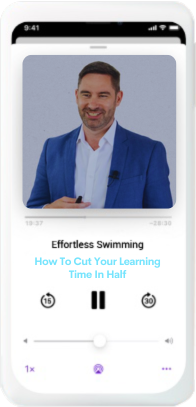
James Anderson is an Australian-based international speaker, author, and educator passionate about helping people become better learners. In today’s episode, we cover how to fast-track our improvement as swimmers, when and how to use feedback on our technique, as well how to develop the skill of learning for better results in our swimming, work and family lives.
In this episode
- 02:53 Introduction to Learning and Learnership
- 04:27 Understanding the Difference: Being Taught vs. Learning
- 26:41 Different Levels of Learners
- 08:57 Differentiating Between Acceptable and Unacceptable Mistakes
- 12:05 Active Learning and Intentional Practice
- 14:56 Developing a Growth Mindset and Embracing Feedback
- 18:42 Transforming Feedback into Actionable Advice
- 24:32 Changing How You See Feedback
- 34:32 Comfort Zone vs. Learning Zone
- 38:25 Frustration as a Sign of Growth
- 45:43 Why Some Swimmers Get Faster Immediately, While Others Get Slower
- 47:20 Cultivating Habits of Mind
- 50:28 Get in touch with James!
Links from this episode
- Website
- Get James Anderson’s book Learnership here
- Change your technique and swim a smoother, easier freestyle with the Effortless Swimming membership
- Do you want to work with me personally to improve your technique? Join my swim technique coaching here
- View our freestyle clinic schedule around Australia
- Get 15% off our 8-week Faster Freestyle course by using the code 8week15
This podcast is brought to you by NanoClear — our own range of anti-fog swim goggles, designed by Effortless Swimming with the anti-fog treatment bonded into the lens itself (not sprayed on, so it doesn’t wear off after a few swims). Check out the NanoClear range here and use code PODCAST15 for 15% off.
Transcript
Read the full transcript
Muhammad Ali was asked once, you know, how many sit-ups do you do in a session? 500. He said, I don’t know. I don’t start counting until it hurts because it’s only the ones that’s hurts that count. And I think that’s a good sign. If you can just do it, then you’re not getting better. It’s the ones that make you go, oh, I’m not sure. How do you do that? It’s the ones that push whether that’s pushing you mentally or pushing you physically. It’s pushing you past your current boundaries. We find ourselves saying to ourselves that, you know, I really struggle with my swimming. I really struggle with my catch. The things we’ve got to remind ourselves is we don’t. We’re struggling with our catch at that moment. And make it about a point in time rather than a description of ourselves. Welcome to the Effortless Swimming Podcast to show that help swimmers and triathletes love the water, become a better swimmer and live a better life.
Here’s your host, Brenton Ford.
Welcome to today’s podcast episode. On today’s episode, my guest is James Anderson. He’s an Australian based international speaker, author and educator who’s passionate about helping people become better learners. And one thing that I’ve been really interested in as, as I’ve been a coach and as I’ve seen thousands of different people learn and grow as swimmers is how can we actually become better learners? It’s a skill that people can develop and how can someone do that so that they see faster progression and more long term progression in their swimming? So that’s why I brought James on the podcast today and James actually attended a clinic a couple of months back and we’ve been going back and forth. And I thought it’d be great to get him being an expert in how people learn to share some of the things that he’s learned over his time. Where he has seen people go from having this fixed mindset where they’re set as they are and there’s no way they can change to becoming what he calls agile learners.
People who see themselves as not being in this steady state that’s fixed but being a state where they can actually get better and they can grow and how they can develop into an agile learner. So let’s get into the episode with James Anderson. Hello and welcome to today’s episode of the Effortless Swimming Podcast. My guest today is someone who recently attended a clinic and we’ve just been in touch and this guest today is actually an expert in how people learn. And one thing I’ve been interested in over the last couple of years as a coach is how do people learn and how can I as a coach teach things in a way that people will retain information, be able to use it and be able to improve their swimming. And so just looking through what you teach James and those things that you do on a day to day basis, I thought it’d be great to get you on so that the listeners can actually become better learners so that they can improve their swimming.
I think there’s a really big connection between those things. So welcome to the podcast James. Thanks Britain. It’s great to be here. It’s what we just said about learning. A lot of people sort of come to coaching sessions, whether they’re for swimming or for whatever they’re learning about and they expect to be taught like it’s the teacher’s role to teach you to do stuff. And the whole idea that, you know, we’ve got quality teachers like we’ve got people like you out there doing great jobs, you can organize structure things, talk about what, identify what needs to be done and all the rest of it. And the idea a lot of people bring to learning is that they’re just the consumers. They’re just going to do it. And one of the ideas that really struck me when I started my work around what I call Learnership was a quote by a guy by the name of John Holt who said, learning’s not the product of teaching. I’m just going to pause there for a second.
Learning’s not the product of teaching. Just think about that for me. That puts us out of a job. Okay. We both teach for a living, but learning’s not the product of teaching. Learning is the product of the activity of learners. And when you realize that, that when I come to you as a as a student to be coached, it’s not just your expertise that I’m leaning on. It’s how I engage in that process as well. That’s so important.
Yeah, it’s such a great point because if, yeah, if someone’s just sitting like, the way I think of it is like, if they’re, if the bum is, if this is a phrase I got taught, it’s, if the bum is numb, the mind is too. And so if someone’s just sitting there, it’s like, just teach me. They’re not going to retain much of that information. You need to, you need to be quite active in that, in that learning process. So what are some of the, I guess, fundamental things that we should sort of know about being someone who’s looking to get taught to then being someone who’s, who’s looking to learn? Like what, what are the differences there? And, and for, and maybe how did this originate for you? Like where did you, where did this all start for you? And, and why did it become a topic of interest? Oh, yeah. Look, I suppose there’s a few questions in there to start off with to talk about the people that are coming to your clinics and stuff.
The first thing to recognize is that learning itself is a skill. All right. It’s not just something you do. It’s not something you receive, but it’s something people can get good at. And when I defined this idea of Learnership, which is the title of my book, Learnership is the skill of learning. I took the word craftsmanship and learning and sort of put them together that way. And I like to think what we’re trying to achieve as teachers, as coaches, it’s like Torvalandine. You know, I’ve got a couple of years on you. Do you know who Torvalandine are?
No.
I do know Torvalandine, the Olympics coming up now. We’re recording this just before the Olympics. Torvalandine were ice skaters, partners to ice skaters in the 84 Olympics and they blew the place away. They did a routine to Belero, the music Belero, and they were the, you know, the icons of the 84 Olympics, Winter Olympics. And what they did in the ice skating, the ice dancing is that Jane Torval and Christopher Dean both did different things. They’re both out there partner dancing, but Jane Torval did the jumps, Christopher Dean did the catches and those sort of things. And I think of the teaching and learning process in the same way that we’ve got expert teachers by and large in our systems and they’re out there doing their thing. But if we’re going to achieve maximum growth for our learners, a lot of our learners are doing that awkward, you know, feet going sideways, seeing on the ice and we’ve got to develop that skill.
And like I said before, some of our learners, you know, they stay with the easy stuff. You know, they just do what comes easily to them. Others will stretch and challenge themselves. And so I developed this sort of hierarchy of learning, if you like, what I call my Learnership Matrix. And it starts off with a non learner who basically doesn’t participate in learning, just doesn’t do anything at all. But then a beginning learner, a beginning learner is someone who always takes the path of least resistance, always looks for the easy task. But then learning is just a series of activities and in the pool, it’s like you jump in, jump out and you’re done. But there’s no stretch. There’s no challenge. There’s no focus. There’s no intention.
Then there’s what I call a performance learner and the performance learner is the one who loves to show off what they can do. They’re always doing their best. But they’re always doing their best at the expense of not getting better because we don’t get better by doing our best. We get better by stretching, challenging ourselves to be just a little bit better than our best going into what I call the learning zone.
Directed learners do what they’re told. These are the people that you and I would design to teach, you know, they listen to us, they follow our instructions. But when we’re not there, they don’t know what to do. The directed learner is the learner that takes charge of the learning process. For the first time, there’s someone that can actually identify their own areas for growth, seek out what they need to do, look for the right resources and opportunities for that growth to happen. But an agile learner, this is my top level of learner, is someone who embraces a challenge in the style of JFK when you said, you know, we do these things not because they are easy, but because they are hard. They know that when they take on challenges are really difficult things that it brings about not just the goal they’re seeking, but it brings about other growth as well. They grow as a person. These are people that can tailor their feedback.
They can design mistakes and they invest their effort. We’re talking about effortless swimming. They invest their effort in continuous growth. And so once you realize that learning itself is a skill, we’ve got to go through a process and ask ourselves. Well, how well do I engage in that skill? And I think for a lot of us, what we end up doing is just the bare minimum. And how do you see that tying into let’s say someone someone swimming? Maybe they’ve got a coach. How does that kind of tie into like what kind of feedback we should be receiving? And one thing that just sort of springs to mind there is in your book, you were talking about some of the different kinds of mistakes that that people make and say. So some mistakes are very acceptable mistakes. Some mistakes are ones that are not necessarily ones we want to make. So what sort of mistakes should we be looking to be making? Yeah, look, again, a few questions in that look that in terms of the mistakes stuff that you’ve brought up, a lot of us sort of talk about mistakes as if mistakes are part of learning and they’re OK.
Well, that’s not true. Some mistakes have really serious consequences and other mistakes do actually help us learn. And so when we talk about mistakes in learning, we’ve got to realize that there are some sloppy mistakes and what we call careless mistakes. The sort of mistakes that when you point them out to me, I’m going, yeah, I knew that already.
You didn’t tell me anything. I didn’t already know. I just made it out of carelessness. Then there are mistakes that you make that are performance mistakes and then the mistakes that shouldn’t happen. They’re the ones that have the serious consequences. The sort of mistakes we should be trying to make happen in what I described before as the learning zone. And they’re the mistakes that happen while we’re trying to get better, not trying to do our best. We’re trying to improve. Now, sometimes when we make those mistakes, it’s just simply because we’ve tried to do something we can’t do straight away. And of course, we make mistakes. And the idea there is that we sort of like interrogate that mistake. We go, well, why did that go wrong? And we conduct an autopsy on it and go, don’t do that again. But the sort of mistakes that really skillful learners make are what I call design mistakes. And their mistakes that are designed, you do them deliberately.
You say, look, I don’t know if I’m going to be better doing A or doing B. But I’m going to go out there to do B knowing that if that makes me worse, it must be A. So we’re deliberately trying to create the circumstances to give us the information we want.
The way I look at that in relation to what I see coaching is as and you might have experienced this at the clinic is as we’re trying to make some changes to the stroke. You are going to not do it. You’re not going to get it right every time, but hopefully you start to get an idea of when you do get it right and when you’re not. So, yes, you will hopefully make a positive change, but then you probably can’t do that on repeat 100% of the time. So you can hopefully identify that. And then the other side of that, too, is that you might actually get a little bit slower initially when you make some of these changes. And you might see that as a mistake. It’s like, I haven’t gotten faster. But in order to learn, in order to change, you may have to take that backward step in a way. But if you see that as being an acceptable and OK thing to be doing in order to continue to grow, then it’s going to be OK to to repeat it.
And I think you’ve struck on something here that a lot of people get wrong with practice. And look, I haven’t 100% guilty of this in my swimming. It’s when we practice and when we’re making mistake or we should be making mistakes and trying to refine it and try to improve. We jump into the water without a focus, without an intent. Like we don’t practice with purpose, I talk about. And when I came to the clinic, I’m not sure if you remember, when I came to the clinic, you took the video of me, we had to talk about it. And you identified something I was doing with my right arm. And I just went, oh my God, like I had no idea I was doing that wrong. Like if you if you’d asked me before and I would say my left arm was rubbish, my right arm was good. And it was the other way around. Yeah. But then from then I went away and we did the drills and stuff at the clinic. And I went back into the water and every swim since then, I’ve been able to have a focus.
I’ve got into the water with the intention of like, I’ve got to pay attention to my body position, which is making that right arm do that thing. And and what that means is that every hour I’ve swum since the clinic has had a purpose. But when I look back at the hundreds of hours I’ve done before the clinic, I wasted hours largely. Like they’re just doing the swimming. They were in what I would call my comfort zone. And you know, someone would say, oh, James, you’ve done hundreds of hours swimming. And the truth is I haven’t done hundreds of hours swimming. What I’ve actually done is the same hour of swimming over and over and over again. And this is what I’ve heard you talk about that, you know, slow incremental growth, that idea of, you know, infinite game, always improving. Just getting into the pool and swim, swim, swim, swim, swim might make you a little bit fitter, but it doesn’t make you a better swimmer.
And you need that focus, that intentionality, that, you know, information to focus on when you’re in the pool. And that’s what, you know, I draw on the work of Anders Ericsson when he talks about the three Fs of practice. You see, you’ve got to focus, you know, so you’re going to know what it is you’re practicing. So when I’m in the pool now, after listening to you, I’m focusing on that right arm and making it feel like it’s touching the bottom of the pool instead of my chest like it pretty much was. You’ve got to have feedback. You’ve got to have a source of information to say, am I getting it right? Am I getting it wrong? And that’s why I’m going to come back to the clinics because I need you to. I haven’t got a camera that I can see that well. I’m only going by my own proprioception. And then you’re going to go back and fix it. And if you’re not doing those steps, if you’re just swimming, or if you’re just, you know, practicing at work or whatever it is you’re practicing without the focus, without the feedback, without going back and trying to fix it, then you’re never going to grow.
You’re never going to improve.
Yeah, it’s, it’s something that I hear quite a bit from people who have maybe done a similar thing to you. They’ve been swimming for quite a while, but they’ve never had that coaching or that technical coaching. And I think it can be like a real light bulb that goes off. It’s like, oh, there’s, there’s so much to it and there’s so much that I can get better. Yeah. So many things I can improve and I can, I can see how I can get faster now. So yeah. So that’s what can really make that, that incremental progress happen. And one, one question that sort of comes to mind in terms of getting feedback and I sometimes see this as swimming, but I think it could be more related to like, say, say work life or something else. It’s like, it can be hard to receive feedback to actually want to, to hear some things that maybe you’re not very good at or maybe you’re not doing very well and, and possibly deep down, you know that, but it can be hard to sort of take that to hear and then take it on board and then, and then make a change.
Are there any sort of strategies or how can we, how can we view that? How can we be okay with getting feedback that we know might show us where our shortcomings are, but in the long run, that’s going to, to help us. So there’s two parts of that question. I’ll answer it in two parts. The first part is your emotional reaction of that feedback. And I think that speaks to your mindset. Yeah, this is the work of Carol Dweck that, you know, when you see your abilities as fixed, you know, I’m just the way I am. Then feedback gets viewed as criticism. Like if you, if you can’t change yourself, you don’t think you can change yourself very much. Then any feedback you’re given is just here are the things you can’t do. Yeah, you tend not to listen to it very much. And we grew up in a world where, you know, we were left with, we might, we might outwardly say, I’ve got a growth mindset. I want to improve, but we’ve got these beliefs that we grew up with from childhood.
You know, you were the smart one in the family and your sister was the athletic one and your little brother was, you know, the other one. And, you know, we went through school and we identified ourselves as, you know, I’m the language kid or the maths kid or I’m an A student or I’m a B student. And we categorized ourselves. And so at some level, a lot of us, when we come to any learning situation, think that learning situation is some sort of test to work out how good we are rather than a way to get better. And there’s some tricks we can use to help us with that. Like it’s a big topic that I spent years talking to with the organizations. But the first thing to recognize is that you don’t have a fixed mindset. You don’t have a growth mindset. It’s actually a continuum. And what we need to do is move along that continuum. We need little nudges. So when we find ourselves saying to ourselves that, you know, I really struggle with my swimming or I really struggle with my catch.
One of the things we’ve got to remind ourselves is we don’t. We’re struggling with our catch at that moment and make it about a point in time rather than a description of ourselves. And that speaks to that gradual improvement sort of thing. When we look at experts in the field, whether they’re swimmers, whether they’re other people, what we’ve got to recognize is they’re all beginners. They all had this backstory at some point where they went, now I’m this good, now I’m better, now I’m improving. And they see themselves as that continuous growth. Lane Beachley is a great example. When Lane Beachley became the best female surfer in the world, she didn’t sit there and go, well, I’m the best. Thanks very much. She went and surf with the men. She went and surfed for a challenge that would push her to the next level. And that then put a huge gap on the rest of the female surfers in the world at that point in time.
And we all know the story of her dominating. So the first thing I think you’ve got to understand yourself as a learner, someone who can improve and grow. And that’s the mindset issue. The second part of the question you asked was about how do we get really good feedback? The first thing I say about that is not to wait. Most people wait until after they’ve performed, after they’ve demonstrated, after they’ve done the thing and then come up to someone like you and say, well, what did you think?
That’s a very reactive way to work with feedback. A skillful learner will take charge of that process and tailor the feedback to meet their needs. So when they start the process, first off, they’ve got their focus. All right. So next time I come to one of your clinics, I’m going to say, look, Breton, I’ve been working on this right arm. What I’ve been doing is really thinking about reaching deep because I know I have a habit of bending the right elbow right up to my chest. And I’ll tell you what I’ve been doing. And I say, I want you to look at this. So what I’m doing is I’ve got my focus and now I prime you to look at the right thing. Because if I don’t prime you to start with, you might come back and say, James, look, I really notice something about your head position or about your hips or about your kick. And I go, well, that might be really true, but not what I’m focusing on. It doesn’t fit me. So before it starts, I prime you with what I need.
And that gives you the opportunity to give me really focused, really meaningful feedback. But most people, when they think about feedback, it’s something that happens afterwards. But it’s something you should take charge of before as well, I think. And the other part is, I’d say too, is that, and I learnt this from Adam Grant. If you know Adam Grant’s book, he’s just written something called Hidden Potential. Fantastic book. But he says we should stop asking for feedback.
And he says what we should do instead is ask for advice. And the difference he says is that feedback tends to be, and looks a little bit somatic, but feedback tends to be looking backwards and be critical. Advice tends to look forward and be action-orientated. And I think that’s a really good way to think about it, that I’m not looking back and saying this is what you did wrong. I’m looking forward and saying, this is how you can get better. This is how you can improve.
This podcast is proudly brought to you by Form Smart Swim Googles. The Smart Swim 2 is the next generation of Forms award-winning augmented reality technology. They have an integrated heart rate monitor for constant real-time heart rate monitoring, which allows you to accurately train your heart rate zones, which is the first time that you can do this in the pool. Something we’ve had when biking and running, but the first time that you can now do it in the pool. Another huge feature that they have released is the swim straight feature. This is something that allows you to swim in a straight line without needing to sight. It’s a digital compass in the Google display. And it’s race-approved by World Triathlon, USA Triathlon, as well as other leading race organisers. And athletes are already shaving valuable time off their swims by swimming straighter. I’m a huge fan of these goggles. I’ve used them for the last couple of years and it’s something that I use each and every week.
And even just the simplest features of being able to see your splits after every turn, makes a huge difference to not only the way that you train, but the enjoyment that you can have in the pool. And the new Smart Swim 2 has a reduced tech pack size by 15%, making them slightly smaller. The new ice seals fit a wider variety of facial structures and the new straps and anchor points have been moved and adjusted so that it has a more stable fit. There’s additional features which I haven’t mentioned like the head coach workouts, training plans, as well as integrations with training peaks, Strava and more. This is something for all abilities and levels of swimmer and available worldwide from formswim.com forward slash effortless. And to get 10% off the Smart Swim 1 goggles, use the code effortless swim on checkout. That’s formswim.com forward slash effortless. And use the code effortless swim on checkout for 10% off the Smart Swim 1 goggles.
I like that way of thinking about it because it can be hard to not take feedback personally if you haven’t asked for it. For example, it makes me think of Ariane Titmuss and her coach, Dean Boxle. You’re hearing a lot of interviews if she’s ever asked about Dean. She said he does not let me get away with anything in training. If he says I’m not doing something right, he’ll let me know. And he’s a very hard taskmaster in that respect. But they have so much respect between each other because she knows he’s got the right intentions and that’s what she’s signed up for. That’s what she needs and that’s what she wants. And so he’s just always keeping on top of those little things if you notice that her streamline, her pushoff, something’s just slipped out of place. He’s able to give her that feedback immediately. And that compounded over time makes such a huge, huge difference. And now us as swimmers, we’re not going to have that sort of feedback from a coach
because we’re not in that sort of environment. But any little bit that we can get that feedback, the faster you’re going to be able to make those improvements and see those better results. Yeah. And I suspect what she’s doing too is that she’s decided before she receives the feedback how she’s going to respond to it. So she’s jumped into the pool and she goes, I know he’s not beating up on me. He’s not going to, he’s not really being critical, even if he’s yelling at me or whatever it might be going on. I’m going to take it on board as something I need to improve. And I think that’s something to, to manage your own emotional response to feedback before you get it. Yeah. As I get to the end of the pool, there’s Brett and standing there. I go, right, I’m just going to take this as information that’s not personal and I’m going to use it to improve myself. And it doesn’t fit me. I’m going to work on something else.
Okay. You take that control of the feedback yourself. That’s, that’s an interesting point because I recently, I just sent out a survey to some of our members who have gone through like our AS squad workout. So we’re providing three workouts a week for people to go through. It’s the first month that we’ve just started doing this. And because it’s so, because it’s all new and I just want to make it as good as we possibly can and as, as useful as we possibly can. I’m with the mindset of like, I don’t care if they say, look, it was rubbish and like, they were no good at all. You know, I think you should change this and this and this. And if, if they said that, I wouldn’t take it personally at all because I’m going in with the mindset of, look, I want to make this as good as I can and I’m, I just want your advice. I want you, I want you feedback to help us just continue to improve this. But if I see it as, this is a review of how good you are as a coach
and how good your workouts are, then that to me, I would take quite personally. So that’s, yeah, an interesting distinction and, and just a slight change and I guess mindset about how, how you review the, the feedback that they’re providing. So, you know, I’ve taken it in both ways before if someone’s giving that a clinic review or a camp review, you know, and, and maybe even if it’s like a four out of five, I still take that. I find that personal. It’s like, I could have done better. You know, what, what’s not right there. So yeah, it’s just, it’s a different way of seeing things. And I think that mindset issue you’ve touched on, it’s, we need to recognize our mindset and the guy, I’ve got a, a model I can share with you if you’ve got a show notes, we can connect it here. But just to recognize where do you fall on this continuum? Cause it’s not fixed or growth. It’s not like I love feedback all the time.
I hate it all the time. It’s like, I’m prepared to take this much feedback for these reasons, but then I start feeling like it’s critical and, and to ask yourself, why do I have that response? Like, what is it that leaves me there? Because it plays out, not just in feedback. It plays out in the amount of effort you’re prepared to put in it plays out in the goals you set. Like if you’ve got a relatively, you know, fixed mindset and you’re trying to prove yourself all the time rather than improve yourself. The goals you set tend to be achievable. Like the goals you know you can achieve because they’re already within your abilities rather than goals that are a bit audacious. Yeah. We’re talking before I’ve entered the new 24 swim and it’s an audacious goal like there was an option for a 12 K swim or a 24 K swim. And I was talking to a mate of mine and I, and we’re talking about it. We both sort of said, you know, I reckon we can do 12 Ks.
Like I reckon if we just did the training, we could do 12 Ks and it would just be a swim. Like it’d be a good swim. And yeah, but I got no bloody idea how to do 24 Ks. Like how do you do 24? And there’s going to be all that challenge, all that, you know, what am I going to learn from this? Like I don’t even know what I don’t know yet starting to scare me with less than 200 days to go. But that, that idea of when you’re towards the growth end of the continuum, you take on challenges that you don’t know the answers to that make you grow. And that’s I think really important. And I was funny in preparing for today. I was looking at, you know, your business effortless swimming, which is, you know, fantastic. And I get what you’re doing when you talk to people about effortless swimming, I’m watching the examples and they look effortless. But for someone at a fixed mindset, end of the continuum, they look at someone swimming effortlessly and they go,
Oh, you bastard, I’ve got to work so hard.
For someone at the growth end of the continuum, they recognize that it takes a lot of effort to make something look effortless. And they ask, what’s the backstory? What was all the work that’s gone in there? What have they refined? What have they done to get to that stage? And so if you’re looking at some of those people and going, Oh, God, they’re so lucky or they’re just naturally gifted or whatever it is. Yeah, you’re separating yourself. You’re saying, I can never do that. But if you’re looking at those people and going, Jeez, they used to be a beginner once. Like they got their 25 minute certificate and they thought they were champions when they got it. And they got it better and better and better. I’m just behind them at the moment and I can keep growing and keep improving. And then that’s what you want to come back and, you know, work on your stroke and do the, you know, set the goals that really stretch you,
not find your limits, extend your limits.
Yeah, it’s just, you took the words out of my mouth. Like that’s, I call it effortless swimming because that’s what it looks like and in a way it can feel like when you’re swimming really, really well, but it takes a hell of a lot of effort and practice to get to that point. And let’s say someone that you don’t necessarily, someone that you don’t like, for example, if you have a look at their, their backstory, it’s like, you can kind of see how they’ve arrived where they are, like whether that’s their attitude or their mindset or where they are in life. Like if you, if you know someone’s story, you can generally sympathize a lot with where they’re currently at, but taking that to swimming, it’s like, well, if you knew how many laps that they had done, how much focus and attention they had put on their stroke, how much feedback they’ve received, it’s not a surprise that they are doing, that they’re swimming, how they’re swimming.
So, you know, everything is a, it’s a learnable skill. We can all get better at that. And I think the mentality of just knowing that swimming is a learned skill, that in itself can make a hell of a difference to people because I do, you know, you do sometimes just get people to come, they come and they’re like, yeah, I’m not a swimmer cycle. Just even just saying that, you know, you’re not doing yourself a moment. It’s a constant. You’re not a swimmer at the moment, but neither was Phelps, neither was, you know, they weren’t swimmers, they became that. Yeah, exactly right. Exactly right. And yeah, even with like younger kids who like might be very good at a young age, it’s like, well, they’re not all, they’re not the ones that are always going and become world champions. It’s like, there’s so many swimmers who were average as kids or Michael Jordan, you know, missing the high school basketball team or whatever it was, it’s like, yeah,
nobody’s path is fixed and set. It’s this ongoing process that we’ve got to just be willing to go through. And just thinking about this U24 for you. So what’s your process now that you’re training for this event that feels like it’s right on the edge of that like, is it doable? Is it not? You know, I think that’s such a great level of where to sort of set your targets. How are you incorporating the stuff that you teach and talk about into this whole process? Yeah, well, it’s a good question because I’m just starting off and just starting to realize what it is I need to focus on. So the first thing I’ve done is I’ve said that to myself, I need to make every session purposeful. So when I get into the pool, get into the water, it’s not to have a swim. I’m not just going to swim 3Ks or 5Ks or whatever I swim, there’s got to be a focus. There’s got to be purposeful practice. So that means I need to know what I’m focusing on
and it’s not just technique. You know, I’ve started to realize that and I’m hoping we’re going to have a conversation about where the rest of my focus might be. But there’s all the things from, you know, feeding from rest from, you know, all these other elements that every time I make, get into the water, I’ve got to know what it is I’m practicing today. If I just get in, swim and get out, why bother? Like maybe I’m getting a couple of Ks under my belt, getting a little bit fitter maybe, but I’m really not. And so, you know, tying it into what we’re talking about before, about coming back to the clinics. When I come back to the next clinic to get you to look at my stroke and see if I’ve actually made those improvements, I’ll get, I’ll do it twice. I want to get into the pool and this is me taking charge of my feedback and we’ll do the, like we did before, we’ll do a quick warm-up and then do the, the swim and you can have a look at it.
And then I want to say, look, Ren, before we actually go into the, you know, analysis of this, I was going to jump over into the other lane. I’m going to swim one or two Ks fairly solid because I actually reckon that’s where my need is. Getting my stroke right when I’m fresh, I’m probably okay. It’s getting my stroke right when I’m tired because that’s what I’m going to be doing most of the time. I think of that 24K swim, I’ll be tired for a lot of it and that’s where I probably need the feedback. So I know what it is I’m starting to focus on. I’m certainly getting help from people like you and reading things and other stuff about what are the elements I’ll need to do, even just swimming with a paddler, like I haven’t swum with a paddler before. I’ve got a suspicion that, you know, swimming with a paddler, I’ll look at them and I know if I’m looking at something to what I’m reading, that actually changes my head and my body and stuff.
So I’ve got to, I’m going to have to practice just noticing them rather than looking at them. So this is all a long-winded way of saying what I’ve done is I’ve set a goal that is in what I call my learning zone. It’s beyond my current abilities. I’ve recognized that to do that requires struggle. You know, there are things I don’t know. I’m going to need support. It’s not like the 12K swim. I could have just swum on my own, got the distance up and done it. But I’ll need extra support. I’ll need to take control of that because I may have overstretched. We’ll see. Time will tell. Can I get to that stage to be fitter than I’ve ever been in my life in the next 200 days, which is the time I’ve got involved? And so knowing that it’s that sort of goal, you set particular expectations. If it was an easy goal, just do it and you tick it off and it’s like a task. But you set this goal knowing that you’re going to learn things not just about swimming, but about yourself,
about your mental state, about a whole lot of other things, which pays off not just for the swim, but will pay off in other areas of my life as well. And then I’ve got to identify specifically what do I need to do for these goals? Tailor that feedback to match. And I think looping back to that conversation about effort, when I talk about effort with the clients that I work with, I talk about it as being the currency of growth and most people don’t understand it. Most people think effort is the amount of time and energy you spend on something. And I know this is a podcast, not everyone will get this, but it looks sort of like constipation. But it’s not the amount of time and energy you spend. It’s how that time and energy is spent that’s important. And that time and energy can be wasted. Like you just don’t show up to the pool at all. It can be spent just going up and down, up and down, up and down. And you know, all you get is up and down,
up and down for it. Or it can be invested. And when you invest it, you’ve got that focus. You’ve got that feedback. You’ve got that fix it part. You actually come out of the pool, not just having done the 3K or whatever you’re swimming, you get out of the pool having grown yourself. Either your strokes changed a little bit or your ability to stay focused has changed a little bit or your knowledge about how you respond to consuming certain foods before or after, whatever it is you’re focusing on, you’ve changed. And that’s what I said before that, you know, in recent history, you know, you’d say James you’ve swum a couple hundred kilometers in the last six months and I hadn’t. I’d swum one kilometer a couple hundred times over. But between now and February 9 or whenever it is when I do this year, 24 swim, I am going to swim hundreds of hours because each hour we design to improve an investment. Yeah. And you know,
when you’ve done a session like that, you like you come out of it and just like, man, all right, I was really tested in that session in terms of my my ability to hold the pace or like I was really tested with my technique. I was starting to fall apart and I got back on top of it. Like I when I’m driving home from the pool after a session, I really can really kind of acknowledge the sessions where it’s where I was in that that learning sort of phase and I’ve really gotten something something from it where there’s been sessions where it’s just been pure survival, just getting to the end and maybe my mind or my body wasn’t quite there. But yeah, the more of those types of learning sessions you can have, the better off you’re going to be. One of the ways you can recognize that in my work, I talk about learning zones. There’s a learning expert. A lot of people think learning is just learning, but there’s what we call your comfort zone and people
for me with the idea of the comfort zone, but often people think your comfort zone is just things you can already do, but your comfort zone is things you can do easily, but it’s also what we call the easy things you haven’t done yet and the world is full of easy things you haven’t done yet. If you asked me to go and swim 3Ks, okay, I can go to swim 3Ks, I’ve swum back course before, but you know, I’ve done it and that’s where people get mixed up when they said, when people say, get outside your comfort zone, try something new. Not everything new is outside your comfort zone and being in your comfort zone, it feels like a task. It feels confident, it feels secure, it feels like just tick it off and I can do it. And I think if you’re practicing, training and it feels like a tick box, you’re probably in your comfort zone, then there’s your performance zone. That’s when you’re doing your best and your best is when you’re focused,
like you’re really intentional about it, but you’re repeating, you’re consolidating, you’re doing your best at the expense of not getting better. And so I sometimes talk to people about the difference between comfort and performance that you can multitask in your comfort zone because you’ve got resources available to you, but you can’t multi-perform. Performance takes everything you’ve got. You know you’re in the sort of zone where you grow, what I call your learning zone or your growth zone. When what you’re doing makes you feel how I’m not sure what exactly is this going to cost me? And when you feel that uncertainty that a little bit of confusion, a little bit of that’s the sign of growth. And I think there’s a lot of stories and analogies we can use, but one that’s just sprung to mind. Muhammad Ali was asked once, how many sit-ups do you do in a session? Do you know what he said? How many do you reckon he does in a session?
500. He said, I don’t know. I don’t start counting until it hurts because it’s only the ones that hurts that count. And I think that’s a good sign. If you can just do it, then you’re not getting better. It’s the ones that make you go, oh, I’m not sure how do you do that? It’s the ones that push, whether that’s pushing you mentally or pushing you physically, it’s pushing you past your current boundaries, not way past. Yeah. Sorry. I just had a memory of pushing myself way past my boundaries. When Kieran Perkins did the 1,515 minutes, I was swimming with a squad and we decided we were going to do it. Yeah, we were going to swim 1,515 minutes, but we’re going to do it as a relay, diving in from each end, and with fins. Now, I was swimming with some, you know, semi-elite, triathletes at the time. I wasn’t way anywhere means the fastest. We couldn’t keep up. We’ve been diving in. It was unbelievable. Anyway, so the point I’m trying to make is that,
you know, pick where you’re going to focus. If you’re just going to get things done, well, okay, that’s all right. Sometimes you’re going to get things done, but you’re not going to get better. And I think what a lot of people confuse is we get busy instead of getting better. And when you look back at your training, when you look back at your work, whatever you’re trying to get better at, whatever you’re trying to learn, if you’re taking the path of least resistance, if you’re doing the stuff that you know you can do, setting the goals that are within reach, but they’re just going to take a bit of time, then you’re getting busy. You’re not getting better. And yeah, I think that’s probably said enough of that. That what you made me think of there is for things that aren’t physical. So let’s say it’s like a work related thing or maybe something you’ve, I don’t know, got to do around the house. It’s like that learning zone for me,
I find if I’m feeling frustrated about something, like let’s say it’s something like new or different that I’ve got to do for effortless swimming. I get this real sort of frustration because I’ve never done it before and I’ve got to like, I’ve got to think very hard and just like, you know, work it out. And it’s like, there’s a lot of time spent on just the, not the doing it, but just like the figuring out how it’s got to be done and how it’s going to work. And I find that when I’m frustrated, I’m actually kind of growing there. Like, you know, you don’t want to keep that through frustration, but yeah. And it’s so to me that’s like, and I have to think, I have to maintain the mindset of this is actually a, this is when I’m, this is when I’m growing. This is when I’m, I’m learning and it’s not, and not stop at that point because it’s just, it’s easy to go off like, what’s the point? This is just like, I’ll just go back to what I’m used to,
but anytime that I’ve pushed through that frustration, finish the task, it’s then whenever I do it, it’s easy and it’s like, yeah, it’s that comfort zone. So yeah, it’s just always just being willing to, to go through that frustration zone for anything that’s, for me, that’s not physical. You know, if it’s, if it’s swimming and I’m doing a challenge, it’s like, I’m not frustrated cause I’m just physically exhausted and like, I much prefer that feeling than that, the frustration, but it just depends on the task. I find. And I think too, what happens after you go through that struggle, after you go through and do the hard work and you invest that effort, you grow, you’re better. And that thing that used to be hard becomes easy. See someone with it, we’re talking about mindset before and how they see effort. Someone with a fixed mindset says, well, if that steps hard, the next step will be harder. And the step after that will be really hard.
The step after that will be bloody impossible. They go, I’m not doing that. But someone with a growth mindset that recognizes that effort is the cost of growth and that struggle produces growth, goes hard, invest the effort. Oh, now it’s easy. And they go to the next step, which is also hard. It’s not harder until you make it easy. And it’s the growth that is hard. It’s not the standard that’s hard. And the more we start understanding that, the more we’ve prepared to go through that struggle. And I encourage people, sometimes people sort of talk about that growth phase when they’re in their learning zone, they go, I’ve just got to put up with it. Yeah, it’s just hard work. Like, I don’t do that. Celebrate it. Recognize that when you’re feeling that frustration, that’s where the growth is happening. It’s like when you get out of the pool or get out of the gym and you go, oh, that hurt. But you say it with a smile because you know that little
bit of hurt made you stronger. It made you fitter. You get out of the pool and you go, oh, yeah, well, that was an easy set. And you sort of go, well, what did I do that for? Like, you know, I haven’t changed at all. I’ve just burned some calories. Maybe I’ll lose 100 grams in a big deal. And tying that back to swimming, I find that anything technical, yeah, at the clinics, there is, you can, I can see it on people’s faces. There’s some of that frustration, like, oh, am I getting it? It’s like, I’m finding it hard to stick to the position that I’m trying to do here. It’s like, you see that frustration. So, yeah, if you can know that there’s a purpose behind it and you’re actually in, that’s a good thing, then you’re much more willing to stick with it. I think that’s really important with the work I do with schools. I didn’t like my work with schools. One of the things we tell teachers like you and me is to tell the kids you’re going into your learning zone.
You will feel frustrated. You won’t know the answer. You will need to have some support, some help, some resources. You won’t know exactly how long it’s going to take to do it. Other times, in your performance zone, get it right. Do it well. Feel confident about it. It’s actually different. But if people are jumping into the pool expecting to just get it right, just be told what to do and it’ll happen. And then they actually find themselves in their learning zone and they go, this is not happening. I can’t work this out. I’ve stuffed it up again. Like, it’s still not working. They tend to give up if they’re not expecting it. I think one of the things coaches and teachers can do is actually prepare the people we are teaching by saying, these are the emotions you are about to experience. They are normal. They are not a sign of deficit. They’re not a sign of you not being a good swimmer. They are a sign that you are becoming a better swimmer
and it’s the same thing that everyone goes through. Whether it’s Phelps or you or whatever it might be, they all went through those feelings. That you’ve just, I’m making a mental note to make sure to let people know that that’s what they’re going to be going through. And one thing that I’ve sort of, I had it in quite a few years ago and I may have told this on the podcast before, but quite a few years ago, I had someone email me on a Monday morning after a Sunday clinic and they said, Oh, I did my font of time trial and I was like two seconds slower and it’s just like, I’m really, I’m really annoyed about that. Like I’m not swimming faster straight away. And so what I got from that was like, I’m not telling people what they should expect after this clinic. So that’s on me. I need to preface this with like, you may get faster but you very much may well actually get a little bit slower initially because you’re going to be going
through these, yeah, through these different things. So yeah, just letting people know what to expect can make a big difference to that. And I, you’re the expert on the swimming coaching, but I would imagine that you should expect to get slower because I can’t imagine as you’re still trying to work out, whatever it is you’re trying to work out, body position or whatever it is, you have to go slower to manage that. If you’re pushing, doing a time trial, how could you? I don’t know how you can do that. Yeah, it depends on what they need to work on. Like some people there, let’s say just looking really far forwards and I’ve got really low hips and legs. Sometimes if they just fix that look, they’ll be faster straight away because it’s an easy fix, easy to remember and it just naturally lifts their, their legs. So there’s things that people can get fast with straight away, but many times they do have to get slower because it’s, it takes a lot of repetitions
to drill in that new movement pattern or get used to that feeling and different rhythm and timing and things like that. So it does just, just depend on the person really. Yeah. Well, James, so for someone listening to this, if someone was to ask you for, for advice on what, what they could do to become a better learner, I know we’ve sort of covered a few things here. Is there anything that we’ve missed or you think would be beneficial to a swimmer listening to this that we haven’t covered so far? Oh, look, I think we could talk all afternoon. I suppose as I sort of go back over the key ideas, first off an understanding that you’re capable of growth and that’s the mindset part that once you’ve got, if you’ve got a fixed mindset, you’re sort of thinking, well, how good am I? A growth mindset is saying, how good can I get? Fix is about proving, growth is about improving and recognizing where you’re there, you know, where
you find yourself on that continuum, then allows you to sort of move yourself up. And like I’ve said, attach time stamps. Don’t say I struggle with this. I’m struggling at the moment. Don’t even say I’m good at this. You know, this is how good I am at the moment. I was thinking with another part when we were talking before, you know, how do you become the fastest swimmer in your lane? Change lanes.
But seriously, I mean, if you want to feel good about yourself, just drop down into a lower lane, you know, but that’s not the point. You’re not going to get there, but not going to get better by being the fastest swimmer in the slow lane. You want to go and be pushed by being the slowest swimmer in the fast lane. And that that’s the next part I would sort of talk about that. Once you understand your capable of growth, you want to seek out those opportunities to grow. And actually, you know, like, like I said before with the JFK quote, do these things not because they are easy, but because they are hard. There is no growth without challenge. So look for where you’re going to find the challenge and the growth.
Once you’re there and you understand your capable of growth, well, just challenging yourself isn’t enough to grow. You’re going to know how to behave when you’re in that learning zone. And that involves, you know, cultivating what I call habits of mind that we haven’t really spoken about much today. But tailoring feedback, designing mistakes and making sure that effort is invested by doing the right sort of practice, having that focus, getting that feedback, making sure you’re fixing it. And I think that applies whether you’re swimming, whether you’re doing any other physical thing, but more importantly for my most of my work, it’s the work you’re doing in your workplace or in your profession or in your job, like you’re talking about the stuff you do outside of the pool and stretching and challenging yourself to get better, you know, and from a business perspective, looking out on your business, you do a great
job, like the way you have obviously pushed yourself into, you know, the whole space of doing it online and doing the coaching the using the technology, all that stuff. You know, for someone outside may not realize how much work is involved to get there. Like we said, a lot of effort to make something look so effortless. And so the advice, you know, in terms of the big picture here, understand you’re capable of growth, then go about working out and talk to me if you want about how to actually achieve that growth.
I love it. James, thanks so much for sharing all this on the on the podcast. It’s a topic that’s really fascinated me since I first became aware of it in my, I guess would have been late teens, maybe early 20s, just about learning how people learn and and then trying to learn learn better myself. But then also how can I teach and coach in a way that people are going to be able to take that stuff on board? And it’s such a such a fascinating topic where there’s no end in sight. It’s that infinite game where it’s just like, yeah, there’s you’re not one and done. You are just always looking to to get better at it. And it’s the same thing with swimming where there’s just no no endpoint. We’re always going to be looking for these small improvements. So thank you so much for sharing your all these things that you’ve studied and taught over the years. For those that are listening, we’ll put the links to your book and your website in the show notes,
but grab a copy of it. Learn a ship. Yeah. Learn a ship set. Yep. There we go. And if anyone is interested in reaching out to you, what’s the best way to get in touch? Jump on the website, jamesannison.com.au or shoot me an email James at jamesannison.com.au Fantastic. Thank you. Thanks, Brendan. Thanks for listening to the Effortless Swimming Podcast. If you’d like us to help you become a faster, more efficient swimmer, go to www.effortlesswimming.com.