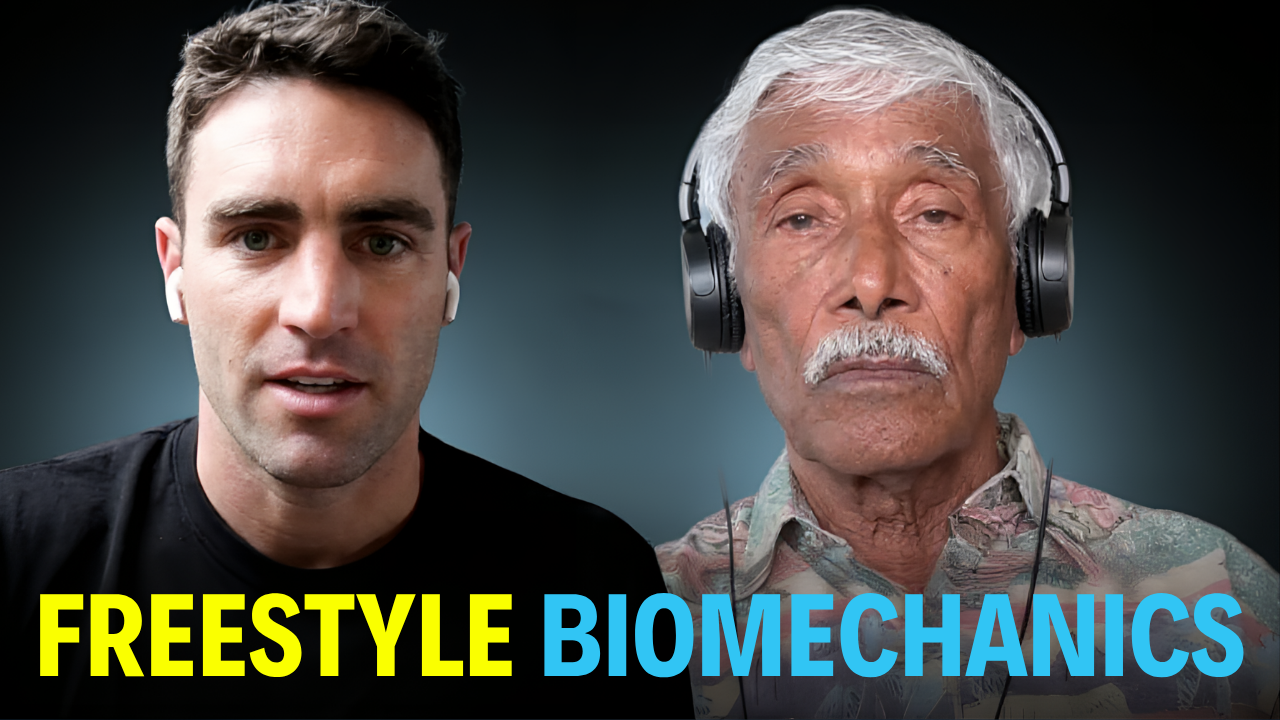








Jason Key is an age group triathlete based out of Texas. Jason joined our membership last year and has since gone from 1:50/100m pace in his triathlon swims to an incredible 1:30/100m pace.
Click here to join the video membership
00:56 How Jason started with Effortless Swimming.
02:01 Jason’s focus as an athlete.
04:54 Time Trial Average pace.
05:58 Flexibility.
10:21 Next Stage of Improvement.
11:55 2 Beat. 4-Beat or 6-Beat Kick.
14:25 Training Frequency.
16:24 From 1:50 to 1:30.
Click here to join the video membership
Transcript
Read the full transcript
The first couple of times I swam, I went to the gym and I was like, Hey, listen, I’m swimming. You don’t have to come rescue me. I’m really just trying to swim. Welcome to the Effortless Swimming podcast to show that help swimmers and triathletes love the water, become a better swimmer and live a better life. Here’s your host, Brenton Ford.
Welcome to the Effortless Swimming podcast. On today’s episode, I have Jason Key, who is a age group triathlete based out of Texas. And over the last four years, Jason’s gone from being a 150 swimmer per hundred down to a 130 swimmer per hundred. And on today’s episode, you’re going to learn some of the feelings and frustrations that you can expect to go through as you are working on your technique. You’re going to find out some of the technical changes that Jason’s made over the last couple of years to help him bring his hundred pace down by 20 seconds and what Jason is working on now to get down to a 125 pace per hundred. So let’s listen in. This is Jason talking about when he first got started with us. Yeah, well, I I started Effortless Swimming. I was looking back at my records and it was like 2015. So and that was after about six months of trying to swim and really trying to make a difference in them.
And I’ll tell you what, the first couple of times I swam, I went to the gym and I was like, hey, listen, I’m swimming. You don’t have to come rescue me. I’m really just trying to swim.
And it was a struggle. I mean, for the first year, so in 2015, I mean, I was like it 151, 145 per hundred meters. And I was working really, really hard. And that’s what kind of pushed me towards Effortless Swimming. I mean, I was looking at your your clips that you had and the different things. And it’s just everything just kind of made sense. And it really helps me a lot. And over the last couple of years, what what were those things that you’ve that you were focusing on? So, you know, what were some of those aspects of the stroke that that you were looking to to improve? And and what was it that sort of made made everything click for you? It really helped a lot was your swim analysis,
you know, kind of looking at different parts of my stroke. I don’t think before before I had your swim analysis, like, you know, just like everybody else, I felt like I was just swimming perfect.
I know I didn’t look perfect. And, you know, I’m, you know, being an age group or it was limited time and working hard and the family and stuff. I mean, I would work really, really hard. And I’m not opposed to hard work and I was really struggling. And so then I came to effortless effortless swimming and then I got your your your video analysis. And then what really helped was the way that you’re able to, like, break down my stroke and not only just like pointed out, but really kind of help me appreciate, understand what I should do. Because, you know, in between the times that I’m not sending about video analysis, like, I’ll have a daughter or another swimmer, like record me. And so I can kind of use those tools that you’ve kind of taught me to, you know, help me with my arm placement
and really kind of work on those aspects. I feel like I’m doing that I that I know I’m not doing, but I feel like it. And so I can kind of take those things and really kind of perfect those a little bit more. And that helps that helps a lot. I think that’s one of the biggest things that I see with the swimmers like yourself, who take that next step and they get to that next level of improvement or speed. And it’s it’s really when you can start to
you can combine the perception of what you’re doing with what you’re actually doing. And often it takes just some recording, some video of yourself to be able to to do that, because it doesn’t matter how experienced you are in in the water. What you what you perceive that you’re doing is often very, very different, especially the first time. And then I think the more that you the more analysis that you do or the more video and you do, you start to get a much better sense of of where you actually are. And, you know, and so you’re sending videos sort of every maybe two to three months, I think in the beginning. And then it sort of every maybe six months, five to six months. So sort of spread out. But I know and that’s off. That’s what we often see is because, you know, you can just take that quick video and you can see for yourself, whether you’re doing the things that you’re trying to to do or not. And you can make the changes based on on that.
And I think you said you did a time trial not long ago, a thirty two hundred meter time trial. What was your average pace there for that? Yeah, I got down to a minute thirty one per hundred. And that was a time trial I did about three or four weeks ago. And I’m still making improvements. I mean, I swam today and I started dropping down into a minute twenty eight a minute twenty seven and and so I mean, I’m seeing improvements. I mean, it’s phenomenal. But I mean, it’s been incrementally like since two thousand fifteen. It has not been all at once by any means. I mean, I was kind of looking back in in two thousand sixteen. I was like around I was in the minute forty range two thousand seventeen. I was like the high minute thirties two thousand eighteen. I was like the mid one thirty range one thirty four one thirty five. And now I’m getting down to one thirty one. And it’s and it’s just it’s been real helpful.
Oh, one other thing that’s real helpful too. And I got this from your video is and this taught me a lot. And I see it in other people is my flexibility I’ve been working on quite a bit because one thing I’ve noticed that like when I first started swimming, like I really couldn’t get into the right position to kind of like to get the right catch because my arms weren’t moving right or they weren’t, you know, they weren’t straightening out. And by just working on flexibility, you know, I’m forty seven and working on flexibility to get in the right position to be able to catch it and pull. That has made a huge in different, you know, a huge change in my swim because when I first started, I didn’t realize it, but I couldn’t even get into the right position. It was almost impossible for me to get the right stroke if I can’t even get to the right position. Yeah, that’s that’s interesting. What what have you been doing to improve your flexibility?
Well, one of the things, well, I noticed from your video by by Fatale, you know, he would, you know, he’d lay on his stomach and he’d put his arms up and he’d show like what angle he could get his arms up. And so where I noticed it is on the front top of my shoulders on each one. That’s that’s my tight spot. And so one of the things I’ll do is like I’ll lay on a roller, a roller, a tube, I’ll lay on at my spine and I’ll lay my back. And then I kind of put my arms out to the side and put them up over my head and kind of rotate them and try to hit that position. And I’ll even have my daughter hold my arms a little bit. And I don’t do it every day, but maybe like, you know, two or three times a week for about 10 minutes, just to, especially after a hard swim that day or the night before. And that really helps. That helps loosen me up and it helps when I get into to water quite a bit. So now I can work on my pole.
Yeah, that’s that’s excellent. It makes such a difference, even, as you said, three times a week of 10 minutes. Same thing with strength training. Like I’ve been taking these these younger kids sort of twice a week here just locally. And I’ve been doing a little bit of strength work with them about it’s only about a 25, 30 minute workout. But it just gives them this this base level of strength. And it’s the same thing with with flexibility is you just want this sort of base level that makes a huge difference if you’re not doing any at the moment. So you don’t need to do three times an hour a week. It’s just that little bit can really change things, especially if you’re on the bike in T.T. position, even running, the shoulders get so tight. And I experienced that when I was doing triathlon a couple of years ago that it just really changes the way that you feel. So you just want to make sure that you’re keeping on top of that mobility,
which, yeah, which is makes a big, big difference. And, you know, sometimes when I’m running clinics will do like one of the first drills we do is just this really simple front kick drill with the arms out in front. And one of the first things we work on is that train tracks position with the hands directly in line with the shoulders. And with about, you know, sort of one in 10, two out of 10 people, they can’t actually get their arms straight because they’re so tight through their through their upper traps. And so tight through the shoulders. And that’s really limiting from a drag perspective, but it’s also going to be limiting from a catch and pull perspective. So I’d be curious as to is to see what how much of an impact that actually has. And I mean, I’ve seen it have a big, big impact with a lot of swimmers. But yeah, it’d be interesting to see what what percentage of improvement comes from just the mobility alone and then the the technical side of things, too.
So that’s, yeah, that’s really good to good to hear. And it’s not, you know, it’s not this big, big overnight change that you’re going to have with your with your swimming. It’s just this incremental improvement. And to see that continual improvement, I think is it’s even sort of more exciting because if you were to go from 150 down to 130 in the space of two weeks, it’s, you know, it’s just not it’s just not how it works. Even though it would be nice. But it’s just that continual improvement. And what do you what do you see the next stage of improvement? What do you see that coming from to get down towards that 125 mark?
When I got to the 130s, what really I started really focusing on quite a bit was kind of like the connectivity. I mean, you you you’ve you’ve called me out on in the past of, you know, being too mechanical, you know, in my swim. And I’ve noticed it. And one thing I noticed that when I hit my 130s, my I was a lot more fluid in my swim. And that helped a lot when I was I had the flexibility. I could get my arm in the right position. My kick on slower, you know, easy sets of 50 or easy set of 50 or easy set of 100. I mean, I do like a two beat kick. But it would be it’d be easy. And then when I’d go a little bit faster, I’d go up to a four beat kick. And then that four beat kick is what helped me kind of with my timing. That’s what pulled everything together. If I noticed if I go to a six beat kick, I’m just I’m just kicking. I’m not even nothing’s tied together. My legs are just going crazy. But the four beat kick, it really helped me in in that continuity
in in terms of all my timing and being less mechanical and more fluid. And that helped my time immensely. Yeah, that’s that’s a really big one. And I’ve started, I think you were probably one of the first sort of guys in the membership who went from that two beat to four beat kick. And I’ve started to sort of test it out or have other swimmers try it out and see how they go with it. Because especially when you want to pick up the pace, a two beat kick can be quite challenging to be able to pick up the pace. But with a four beat kick, it’s often just as easy in terms of effort and heart rate. But it gives you this much better fluency and rhythm in the stroke and that overall connection. And I think it’s really it’s a really good one to to try out. And if anyone who’s sort of listening, I did a video on YouTube, which which explains it, it’s called, I think, two beat, four beat or six beat kick. And yeah, that four beat kick is is easy to do.
Helps sitting, sit the body a little bit higher as well. And and that connection that you mentioned. And I really like how you were able to get to that point of of swimming with with rhythm. So it happens a lot when you’re concentrating on these technical changes, it can be hard to kind of let things go and be loose and and fluid in the water. But as soon as soon as you get those technical changes, like like you have, and you’ve locked them in, then it’s about just kind of trusting yourself and trusting the the muscle memory to do what it’s been trained to do and to then just think about pace and rhythm when you’re going at that faster, faster race pace. And it was a similar thing. I did a sort of second analysis for Taryn Giselle, who’s the triathlon Taryn on YouTube. And it’s the same thing. It was just looking a little bit overly controlled and mechanical. And so the sort of next thing that I said to him was, all right,
now it’s time to to let things go and and to trust yourself a bit. And I think that’s where where you can really see a big change in in speed. So that’s that’s exciting. And for you, you’ve got a couple of races coming up where you’ll get to sort of test all this out and see where you’re at in terms of racing. So what what have you got coming up that, yeah, that is on the race calendar?
Well, the beginning of April, I’ve got Oceanside 70.3 coming up. I’m really excited about that one. And then in the fall, I think it’s October. I’m doing Waco 70.3 in Texas. So those will both be some really nice races. Yeah, fantastic. And and in terms of sort of training, how often do you get in the pool every week and how far is each swim on average? Which I’m about three times a week. There are some weeks when I’m really focusing on my swim. I’ll do four times sometimes not very often. I’ll do only two times when I’m like having a hard like a hard run week and I’m really turning up the dial on the run or the bike. But it’s mostly between three to four. And that getting in that extra swim has really helped a lot. And how that’s helped a lot was and you’ve emphasized it before, you know.
Well, an example is is my daughter swims. Chris, she’s in high school. She’s 15. And I’ve noticed, I mean, they swim like a minute, nine, a minute, 10 per 100 meters. But when they swim, they do it like with very little effort. And and I just picture myself huffing and puffing and racing, trying to get to a minute 30. And I know I’m doing something wrong. I just know it because they do. I mean, they’re tired, but they just do it so effortlessly. And so that’s really what caused me to, you know, really ask you a lot of questions in terms of form, trying to get my body placement, because I’ve come to realize that I work. I don’t work near as hard at racing at a minute 30 than when I did it a minute 50, I worked way harder than and I was going way less. And I was just out of breath. Now I just have to swim further to get the same workout because it really is it’s still hard, but it’s not as difficult, especially using,
you know, soft hands and trying to not expel any miscellaneous energy and just trying to use just the right amount of energy and trying to be relaxed is really helped like immensely made a huge impact. Do you feel that when you’re around 150, did it seem like 130 was would be a bit farfetched because of the effort that you had to put in to get to 150? Did it feel like, you know, I can’t possibly go any harder. How is 130 achievable?
Well, that that’s that’s been my problem. I mean, since the last four years, I think what’s changed has been. I mean, it has been my fitness that’s improved a little bit
and my flexibility. But I think the biggest change has been like the mindset of, you know,
how much form is really that much of an impact and how much, you know, like you’ve said before, you know, you only have propulsion and you only have drag. Those are those are really the two things. And so I’ve been able to kind of like really break those down. And when I’ve been able to kind of streamline them a little bit better, my my resistance is less. And I’ve been able to work on my pole with high elbow a little bit better. And so I’ve been able to utilize that energy a little bit more. And it’s just made it drastically drastically easier. And I’ll have other people say, well, you know, they’ll make a comment, you know, like, how do you, you know, how do you do that? I mean, that’s crazy. You must swim all the time and blah, blah, blah. And I was like, I mean, I wish I could explain to them. The process, because it’s all been a mindset of what it really takes. I thought when I was at 150, I thought it was it was almost impossible for me
to ever get to 130 because I can’t work any harder. I can’t. I mean, I’m I’m giving all my effort. You know, it’s there. My heart rate was high. I was getting after it, but it wasn’t about the harder work. It was about working smarter. And that’s that’s why I went to you. Yeah, that’s that’s really interesting. Um, and, you know, you think of it in terms of someone who’s who’s swimming at a 110 pace for, say, 400 meters, compared to 150. It’s not, it’s not like that they’re putting in any more effort. They might even be the one tensor might be using a lot less effort. And it is it is just technique and form. And I mean, obviously fitness, fitness is is required. Fitness and strength is required. But yeah, that’s that’s the thing. And I think it’s it appears like the those little wins that you have where you might get a couple seconds faster overall with your pace. It’s like you get these little wins and that builds up and it snowballs.
And then it just sort of turns into this thing where you where you believe you can get to that that next step. Whereas if you look down, if you look down the track to think of 130, you go, no, that’s not that’s not possible. But all it is is you get down to 146, 147 and then and then onwards from there. So it’s it’s really great to see. And I mean, that it all just comes down to the work and the the focus that you’ve that you’ve put in. So well done on on that. It’s it’s really good to see. And it’s what I just love to I love to see that this one is that I I work with. And it’s you know, and you’re not finished yet. There’s still still a lot more to come. So thanks very much for for joining me on the podcast. And is there what would you say to someone out there who might be around, you know, the one fifty two minute plus mark who wants to improve their swimming, what are some of the things that they should expect to go
through, maybe in terms of mentally, what are some of the things that they’ll that they might go through that they need to maybe push through? And what advice can you give them?
Oh, I can tell you they’re going to go through frustration because they’re going to feel like they are like doing everything they can. They’re going to feel like they’re doing the work and it’s not paying off. And, you know, by getting a couple video analysis from you and then
and then like if they’re working on arm entry, hand entry, you know, have a friend record them a little bit more often than they send you a video and and see if they’re really doing it. And then if they’re not doing it, swim a twenty five and then make a tweak and watch it on the other side of the pool. And then if you’re not doing it, make another tweak and watch it on the other side of the pool again after that video and you’ll learn that arm and that entry and or it could be body position or something like that. And then every couple months sends you a video or, you know, whatever the frequency might be because it’s those little tweaks that you think you’re doing, but you’re really not doing. And that’s been my hardest frustration. And now that I’m aware of it, what it takes, I think getting for me, getting to 120 is definitely within reach now because I’ve busted through that frustration and I know it’s not necessarily working harder.
It’s just kind of working smarter and being more efficient. Yeah. Yeah, that’s awesome. Well, guys, thanks so much for being on the podcast. It’s been great to chat to you. And in the next six, 12 months and on from there. I, yeah, can only imagine where you can get to. So we’ll have to do a have to do a comparison video for YouTube from where you started to where you are now and just to show what’s what’s possible. I think it’s I think it’s really, really exciting. So thank you again and good luck for the races.
Thank you, Brandon. I appreciate the time. Thanks for listening to the Effortless Swimming Podcast. If you’d like us to help you become a faster, more efficient swimmer, go to www.effortlesswimming.com.