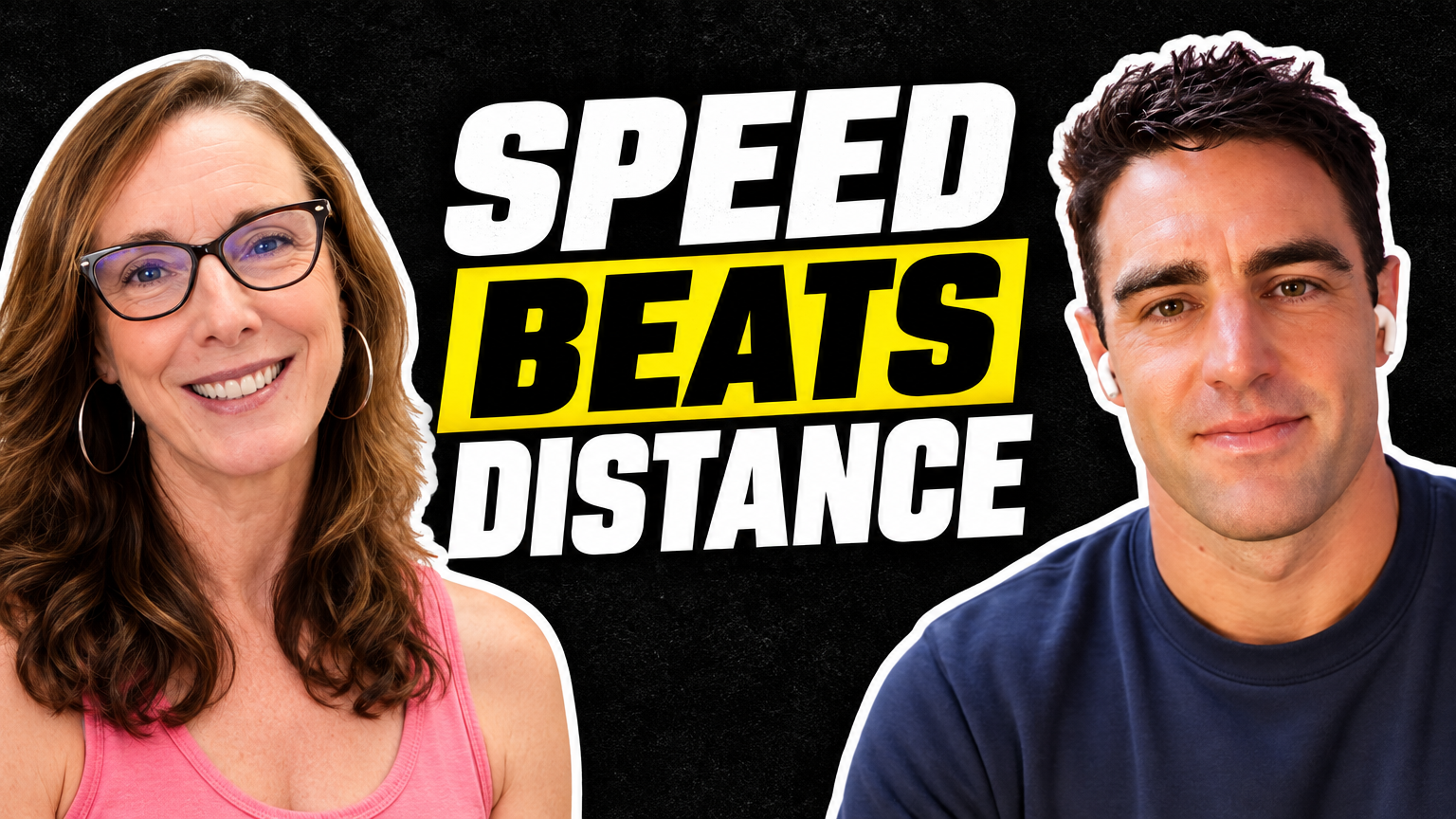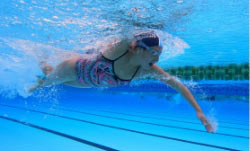








In today’s episode, we have Laura Quilter, a New Zealand swimmer and coach who has previously been the national champion in the 50m, 100m and 200m freestyle. Laura has achieved a lifetime PB at the age of 31, with only a third of the training she was doing in her earlier years. She’s also ventured into the sport of ice swimming (water under 5 degrees celsius) and is coaching through her platform at Aura Move. Tune in now!
02:14 Introduction and Background
04:33 Training Changes and Mindset Shift
06:55 Understanding the Sprint Stroke: Differences and Techniques
10:03 Coaching Middle to Long Distance Swimmers: More Time to Work Through
14:56 Paralysis by Analysis: The Pitfalls of Overthinking in Swimming
16:39 The Importance of Fun and Play in Swimming and Racing
20:42 Shifting Competitive Focus to Skill Execution
23:37 Curiosity as a Key Element in Consistency
29:27 Ice Swimming: Challenges and Experiences
34:24 The Recovery Process: Stripping off wet clothes and getting warm
35:47 Adapting Coaching Techniques for Individual Swimmers
40:22 Get in touch with Laura!
Follow Laura on Instagram
Do you want to work with me personally to improve your technique? Join my swim technique coaching here:
https://effortlessswimming.com/stroke-analysis-membership/?el=blog
View our freestyle clinic schedule around Australia:
https://effortlessswimming.com/freestyle-clinics
Get 15% off our 8-week Faster Freestyle course by using the code 8week15
https://effortlessswimming.com/8-week-faster-freestyle-course/
Try PILLAR today, head to pillarperformance.shop and enter code EFFORTLESS for 15% off, or for any North American listeners, enter the same code at TheFeed.com.
Watch the episode on YouTube:
Transcript
Read the full transcript
I think it was Cameron McAvoy, he talks about the fact that someone’s a cyclical sport. And basically, as long as you get that one cycle correct, all you have to do is replicate that for 20 to 30 seconds. I don’t know what made me start this habit. I do every training session, I do a lap of dolphin dive, and that’s like two parts to remember to just enjoy and, you know, have a bit of fun, and also just relax my breathing. But I definitely think the enjoyment has to be there. Welcome to the Effortless Swimming Podcast, the show that helps swimmers and triathletes love the water, become a better swimmer, and live a better life. Here’s your host, Brenton Ford. Hi, and welcome to today’s podcast episode. How do you get faster as you get older? That’s a question that we ask on today’s episode with our guest Laura Quilter. She is a former New Zealand swimmer, and she is a swim coach. She was on the 2014 Commonwealth Games team.
She has been New Zealand champion in the 50, the 100, and the 200 freestyle at different times of her career, as well as the 50 butterfly. Now recently, Laura set a lifetime PB in the 50 freestyle at 31 years of age, and that has come with about a third of the training that she was doing in her younger years. So I asked Laura about how she’s managed to swim faster than ever before with less training and what she’s done to achieve that, as well as what she’s doing now with some challenging things with ice swimming. So if you’re looking to find some different challenges in the water, if you’re looking to get faster as you get older, and if you’re looking to improve your technique, we have got a lot in store in today’s episode. So let’s get into it with Laura Quilter. My guest today is Laura Quilter from AuraMood in New Zealand. Laura, thanks for jumping on the podcast. I’m keen to talk about quite a few topics today because just saying from your socials
and chatting to you before some of the things you’ve been doing lately, not out of the box, but they’re just really challenging things to do, and pushing yourself mentally and physically. And also seeing you go swim some PBs as you get older is a really incredible thing to see. So I want to dig into some of those things and just get your take on how you’re managing to do it. So firstly, welcome to the podcast. Yeah, it’s awesome to be here. Thanks for having me on. So for those that are listening, what’s a little bit about your background? You’re a very well accomplished swimmer and life saver. For those that are listening, a bit of background on your swimming history. So I’m a I’m a lifetime swimmer. I was chucked in as a as a baby from mum and dad, grew up in quite a small city on the east coast of New Zealand. And then just I was the kid that always loved training. And that did did help me as I grew older in terms of swimming.
I did compete for New Zealand at the Commonwealth Games in 2014. And also that was three world championships for surf lifesaving. And those were some awesome experiences. I did it quite crack the Olympics. I had to go a couple of times, but then now one of my 32 years old, I’ve kind of had this almost second hack at competition again, which I’d never had expected. And that all came out of doing a master’s swimming event in 2023. So it’s been quite the journey. And I feel very lucky that I am one of, you know, a lot of my friends who swim at a high level, they don’t enjoy swimming anymore. And I’m an absolute fanatic, I think. Swimming is one of the coolest activities. And it’s it equips you for so much more than just let some in. So yeah, it’s been awesome. And why do you think you have stuck around or you’ve got this renewed passion for swimming? You said you did the master’s competition. What did that spark inside of you?
It was actually quite a contradictory feeling. So I swam off the back of almost no training in a tri-squad, which was not sprint specific. And I threw down a couple of times that weren’t too far off my best. And so I was like simultaneously quite like amazed and then also frustrated being like, well, is there, you know, another way that I could do this? So the context when I was swimming in my early 20s, I was training about 16 hours a week in the water. And then this year I’ve been training about three to five. And you did a PB in the 50 free, the 50 fly this year at Olympic trials. And you were only 0.6 of a second off qualifying to the 50 free, which is a huge achievement. Talk a bit about what you’ve changed in your training from now to back then and maybe what you wish in you back then compared to what you know now.
I think it’s a few things. I’m a lot more fascinated in what swimming is all about. And that’s both physically and mentally. So I picked apart the stroke and I’ve done a lot more research and looking at elite athletes and how different people swim. And I didn’t even know, you know, the stroke changes so much for the 50 freestyle versus the longer distance events. And then really manipulating my stroke to kind of reflect that sprint styles. You know, a surprising one for me is more flexion at the knee for the kick. And that’s for extra propulsion, whereas in your longer distance things, you know, swims, you’re not kind of bending as much. So it was this obsession with technique on the one side. Another side is I’m just so much more relaxed. Like I’ve got I’m working full time nursing at the moment, got, you know, a relationship. So I was actually told, I remember by one of my first the high performance coach in Auckland, he said, I live and die by my training
sets, which just basically meant if I had a good set, I was, you know, on top of the world, I was really positive, laughing. And if I had a bad training day, I was down in the dump. So I felt like I was, you know, I was one of those summers that tied my identity to swimming. So I was going, well, I was happy if it wasn’t going well, I wasn’t. And having that time away, I’m a lot more. I enjoy the whole process, even if it’s a really shocking training day. It doesn’t affect me globally in my life anymore. So the obsession with the technique, I think, been a lot more chill and then getting way stronger. So my I really enjoy the gym and my partners are physiotherapists. So I’ve been very lucky in throwing myself into understanding how the body works, especially around different training modalities and methodologies and being very lucky in this position, being a bit older to actually put the brains of different coaches
around New Zealand. And that was something that, you know, when you’re a bit younger, you’re you’re with that one coach. And there are some amazing coaches, but I was in a very fortunate position that I could chat to a few different ones. So that’s probably the three key differences. And what about the sprint strike? So you said you started to understand some of those differences. How would you describe, say, a 50 sprint technique to someone? One of those things that you’re stealing for or trying to achieve when you are sprinting? It’s like calculated chaos in a weird way. So you need to be performing with the most amount of aggression and power that you can. But it has to be funneled through an effective mechanics. And I quite like I think it was Cameron McEvoy. He talks about the fact that someone’s a cyclical sport. And basically, as long as you get that one cycle correct, all you have to do is replicate that for 20 to 30 seconds.
So when I started to change my stroke, primarily, it was focused on my hips, staying a little bit more level in the water and a lot more rotation through the upper body and the shoulders. I did notice that in the early stages, I’ve got quite limited thoracic mobility and that kind of felt like I was jammed up a bit. So I did have to spend a bit of time on mobility as well to actually even swim like that. And with the sprint style, pulling a lot straighter under the water was a new concept to me. And that came that comes with a whole lot of other challenges. I wouldn’t go tell most people to swim a 50 style because it does put so much more pressure on the shoulder, which really emphasised the need to get a lot stronger in the gym. So the three key aspects I did start to train with, I was using resistance training a lot more than I had formally. So that was, you know, your parachutes, fins and socks, which I’d never use.
I really like drag socks, actually. More than the parachute, I actually really detest the parachute. So a lot more resistance training, a lot more work on the dive mechanics and then just that, you know, still hits with a big kick and the power coming through the shoulders. And with the socks, so the drag socks for people listening, it’s not just normal socks. These are special sort of swimming socks. D-R-A-G-S-O-X. Is that trying to think of that’s the brand? But like, they’re things that kind of drop around you just while you’re calves, right? Yeah, so you can actually, if you’re more beginner, you can do them up just below the knee or you can have them around the ankle. And the reason I really like the drag socks is I feel that my stroke is affected. So like my body position is still the same with the parachute. I do feel like it drags me a little bit lower in the water. So my mechanics are slightly altered versus, say, a bungee,
which I didn’t use because I didn’t have training partners in that very often. But the bungee, because of where it’s anchored, or same with the power stacks, you know, it’s anchored above you versus dragging down. So there were all these kind of minute changes that I don’t think I would have even noticed when I was younger. But I feel that one of the reasons I love swimming is it’s just such a mindful activity that I could start to actually just really feel what one body was doing and how it was changing depending on the training set or even the different tools I was using. And one thing I found coaching is that the sprint stroke is it’s the techniques. I wouldn’t necessarily say harder to coach, but it’s all happening so quickly that it’s very much like, yes, you need the power. You need the strength, but it’s like it’s you just got less time to sort of think about it, having to to tune into that feel
throughout that calculated chaos, as you mentioned. So I’ve found that like a challenging thing to sort of coach for sprinting. I find like I really enjoy coaching more, you know, middle to long distance swimming as the triathletes, because there’s just a bit more time to to work through that stuff. So what have you found there? Because you like you do a lot of coaching, you provide a lot of advice and tips for people. And like, what have you found in terms of coaching those sort of different styles and getting that message across and getting people to take it on board? Yeah, that the speed is definitely one of the more challenging aspects. And also just I think the biggest thing with coaching is the frustration that it feels like you’re going backwards initially. Any change to your mechanics, whether that’s how you walk, run or particularly when you swim, often that change will make you feel worse. And I think psychologically, one of the key parts of the coaching
is actually just setting realistic expectations that you’re probably going to feel pretty awful, but just give it a bit of time to actually see whether it’s going to make a change. So that was probably the key aspect. In terms of that, you know, changing the stroke at speed and technique, one of my favorite tools was kind of this mindful approach to technique. And so I would focus on or get my athletes to focus on one limb at a time. So the first thing would be working from kind of the center out to be all about the core. So that’s not just, you know, your ads. It’s trying to think about like how you lengthen. I mean, when you breathe, so say that the athlete is breathing once or twice in the 15, making sure that even though it’s fast, it’s coming deep and the diaphragm still being used. So you’d say, for an example, for the central approach, you do 825s. The first lap of sprint, you consider what is my trunk doing?
Like is my core engaged? The second lap, you’d think about the shoulders. How much are they rotating? The third lap, you wouldn’t think about anything. You’re just sprint. Fourth lap, going down to the hips. Fifth lap, thinking about the left hand. Sixth lap, thinking about nothing and so on and so forth. You basically only think about one aspect of the body at a time. Going through this really intense focus period, really understanding how the water pressure feels. I think understanding how you can generate pressure is one of the key aspects. But then also allowing the mind to relax and just enjoy the swimming because ultimately you need to combine this, you know, thoughtful process with just being in the moment and swimming with the water. So that was kind of this flow between heavy thinking and just swimming. I think that’s such a great point that you make there. I often talk about you’ve got the thinking brain and the feeling brain
and we just need to go between the two of them. And when we ski too far one way or another, that’s when we tend to not see improvements because an adult really tender, especially who I think listen to, say the podcast or maybe watch, you know, watch a lot of content. They can tend to ski too far inside the thinking side of things and just not enjoy being in the water and not just feel for those things. But swimming is so much about that feel and that pressure and being aware of it. And I think as lifelong swimmers, if we started young, we are very good at that feeling aspect of it because that’s really, I think talking for myself here, but I’d be curious to get your perspective on this. But like drying up, yeah, I thought about my stroke, but it was very much about feel. You’re doing that much volume, that much training and you just become very attuned to how you’re moving through the water. And that’s how you tend to improve.
And then as we get older, we look for other ways to get better and we start to think about things a lot more. So I think a balance between the two is really key. What are your thoughts on that in terms of as a youngster? Yeah, was it all about sort of feel for you or were you thinking about your technique as at a young age?
Yeah, on that, I think one of my favorite podcasts from you, actually, because I am also an avid listener. You talk about the paralysis by analysis and as a coach. And I think you would have experienced that too. You can see it happen in live time. The whole body, it’s like so tense. When I talk about swimming, it’s kind of like you’re engaged, but it’s fluid, right? So if you’re sat on the couch watching TV, you’ve got zero engagement in your muscles. Ten, you’re about to do your max deadlift. The whole body is engaged. You want to be sitting around that seven, where, yes, you’re using your muscles, but you’re able to kind of move with the water. And in terms of how much I thought about my stroke growing up, on reflection, I actually do think that I was considering technique the whole way through. I used to have my stroke used to be too long. I used to flick my bum because the stroke would kind of come out
so far that the hand would flick and then come over. But I do actually remember quite interestingly when I did go up one level in squad swimming, my stroke fell apart because suddenly I went from leading the group to coming last. And it got really scrappy and short. And I had this amazing coach called Pat and Gizbin, and she did a couple of one-to-ones with me, just focusing on maintaining that length, not so far that I was pushing that far back. And I think that was actually really helpful. And I was often the last person in the drill set because I didn’t care about how fast I was doing 25s. I was actually thinking about when I’m sculling, what I can feel and what happens if I move my wrist in a certain way or, you know, whether I’m rotating through the whole body and whatnot. So I did consider swimming my whole life. But as you see, I think as a kid, you also have lots of fun. And some of my favorite sessions, we pretended to be animals, right?
Like dolphin dives for two hours. So yeah, I think you’ve got an asset growing up as a swimmer because you’ve got so much more time to embed as long as it’s done well, embed those good technical aspects. One thing you touched on there was the fun aspect of it. And I think it’s easy to take things too seriously as an as an adult and having that element of play and fun, even in your swimming and even in your racing, that makes such a big difference. Because I think not the less you care, the better you can do. But I think it’s like you talked about now, you not putting so much pressure on yourself to perform in training or in the races and being able to enjoy things and just not have that unnecessary stress. Then I think you can we can really just do a lot better. And I find that now I’m just not as competitive as I used to be. I don’t care as much as I used to in terms of the places that I get and things like that.
But it doesn’t mean that I don’t train hard or I don’t do do well. It’s just that I’ve got other priorities. But I think that can help you in a lot of ways that you can just be really enjoy just the racing and the training. And now I use it more as like a physical outlet. It’s more of a challenge just to see how well I can contest myself. But if they were bad session, have a bad race, it’s like, well, all right, let’s move on to the next one. But as a kid, it’s probably a bigger part of your your life. And as adults, we’ve got other things dying on. And we see what the real what’s really important there. So yeah, I think that’s a really important part of it. This episode is brought to you by Pillar Performance. Our new sponsors Pillar are a sports micronutrition company. And the easiest way to describe it is that while hydration and carbohydrates, products will take you through to touch the wall as fast as possible.
Pillar’s mission is to get consumers to the starting blocks in the best condition over and over again. I recently started taking Pillar triple magnesium after a friend had recommended it. And it’s been a game changer for my sleep and recovery. I take one scoop 30 minutes before bed each night in the same way that you might start your day with a coffee. I finish it up with a magnesium and recover better for tomorrow’s session in the pool. Pillar performance is used by some of the biggest names in swimming and triathlon, including Zack Stubble to cook, Jan Frodeno, Ben Canute, Ash Gentle, Taylor Nib amongst the host of other well-known swimmers and triathletes. Where Pillar differs from other micronutrition you may have taken before is both the quality of the types of magnesium and the tangible results that I see on my garment each morning. If you’d like to try Pillar today, head to pillarperformance.shop
and enter code effortless for 15 percent off. That’s effortless for 15 percent off all first time purchases or for anyone in North America. Enter the same code at thefeed.com.
Yeah, there are two things I really liked about what you just said. The first about having fun, I feel like we almost get this fear that if you’re joking around, you’re not being serious. But I actually don’t know what made me start this habit. I do every training session, I do a lap of dolphin dive. And that’s like two parts to remember to just enjoy and, you know, have a bit of fun and also just relax my breathing. But I definitely think the enjoyment has to be there. And then the second part you said about not being as competitive. It’s interesting. My competitive drive is now so isolated on an obsession with the execution of skills. So even at trials this year, I had my own goals. But instead of being, you know, outwardly focused, how I used to look at my other competitors and probably think too much out of what was outside of my control and trying to beat other people. I was absolutely obsessed with, you know,
getting a quick reaction time of getting my six kicks underwater and that first breakout about really getting the arm free and seeing that last little T on the bottom to be like, OK. That’s where we lift the stroke rate a little bit. And it was quite funny. I didn’t really think about that until we just brought it up that my competitive focus is now shifted quite significantly onto the execution of skills and those things that are inside of my own control. Yeah, that’s that’s so interesting. I what I find when I’m racing is and especially being a coach, I want other people to do well, especially if I may have coached the people I’m racing or I know them like, I really want them to do well. So to be like, I’m going to I’m going to really beat this person. Or that’s not fair. But yeah, you’re right. It’s the pressure you put on yourself to to want to perform to to what you know is possible. And yeah, not not worrying about the the others.
That’s yeah, it’s interesting. Yeah, I think I think what helped with motivation as well because a lot of people are like, oh, how do you stay motivated? Or, you know, and I think discipline is definitely a key aspect. But I think curiosity was one of the key elements about consistency for me. So if I was having, you know, a day where I was like, so tired, I think the curiosity about what my body could do on a set day or during a specific training set, that was actually quite fun because I felt like I approached this whole return to something as an experiment. And I think having that curiosity in the gym and also in the pool was quite a cool, I suppose, reframing of how to approach training. Yeah, I like that. And a couple of things there. So the first one is, with longer you can go without expecting to see a return on it, I think you can set yourself up really well to have have great success. So whether that’s with your technique or your strength training,
it’s like I’m not trying to get results within two months. Like I’m just going to use this as an experiment and just practice it and just see what happens. So just being willing to delay the payoffs, I think is a big part of it. And then just back to the sort of fun and play aspect. One thing I’ve started to do with the squad that I train with and I set the programs for, especially on a Wednesday, which is our sprint morning, we like we do a couple of things like yesterday we did some partner toes. So we do like 50 meters where you grab onto someone’s foot for 25 meters. They’re tying you along and then they’ll tow for 25 and then they’ll sprint for 15 and go easy to the end. And you’ll just alternate doing that. So you’ll swap that around. Then we do some, you know, a couple of fifties or go 15 front scale, 15 bucket scale, just on your back, feet forwards, scone, feet forwards. And then swim into the end, some dolphin dives.
We sometimes do just partner up and race. But that you can make sessions challenging and fun and you still get the benefit from it. And it’s often a lot more enjoyable. But I remember coming out of yesterday’s session where we were doing that stuff like that was I’m really glad. I’m really glad I went and did that because I kind of felt I’d been a kid again and we still got just as much benefit from it. And it was just it was it was a lot of fun. So I think if you can work that into your sessions, then you’re going to have a much longer career in the sport and you’re not going to be dreading going to the pool much at all if you’re doing those sorts of things. Yeah, couldn’t agree more. Now, you’ve you’ve recently returned from the ice swimming championships and New Zealand ice swimming championships. For those that don’t know what that is, could you explain what ice swimming is for them? And then what spurred you on to to enter these events
because you don’t get the full context just watching videos until you’ve experienced actually how cold sub five degrees is. So yeah, what is ice swimming for those of the listening? Yeah, if you had told me even a month ago that I was going to be doing ice swimming, I would have told you you’re absolutely insane. I’ve never enjoyed the cold, which was part of the motivation to get into it. So essentially, ice swimming is like a sport that started in 2009 and it involves people competing in water that’s less than five degrees Celsius and just a standard swim costume and silicon cap. So all the people out there are thinking they’re going to wrap up in a wetsuit or a wetsuit cap or even rub yourself in fat. All of those aren’t allowed. There are events ranging from 50 metres all the way up to the most coveted event, which is the ice mile. So that’s 1.6 kilometres in sub five. And I’ve only just realised there’s also something called an extreme ice mile.
So that’s 1.6 kilometres under two degrees, which is pretty wild. But yeah, I’ve also had an interesting challenge because I live in Auckland, which is not known for its freezing cold temperatures. So I basically went in with some mindset of as frequent exposure to cold water as I could, realistically. And some of the other unique sorry, aspects about ice swimming, there’s no dives and there’s also no tumble terms and that’s just for safety. And you also race in a belt. So if you pass out, the safety team can pull you out.
There’s a lot of people will probably think this sport like absolutely nuts, but there is a lot that goes on into the background to keep athletes safe. And I found it really interesting talking to the medical team because they have got a whole bunch of things they’re looking at as swimmers are competing. And one of the more interesting ones is the mouth. So when you get really cold, well, sorry, normal swimmers will roll to breathe and they will open the mouth to breathe. When you get really cold, you can get a jaw retraction and the carotids get really cold. So often the summer will roll and the mouth will be fixed open. If the medical team noticed that, they’ll just tap you on the head, ask a couple of questions, check your cognition. And if they deem you safe, you can continue swimming. And if you’re not, you know, they’ll drag you out. So yeah, it’s a pretty, pretty wild sport. And it was such a cool experience.
Did you experience any of that? Could you feel your jaw starting to be sort of fixed or you didn’t get to that point? When I first started training, I had a good friend’s ice bath that I was doing most of my sessions in. When I started with the face in, I it was it was quite pronounced for me. Like I did notice that and I found it challenging to speak because almost not what my throat was closing, but all that muscle, all the muscles were going quite tense for me. The because I only originally was going to do the hundred meters thinking, you know, this is a good challenge, but it’s not too out of the box. And then, you know, with a bit of encouragement from a friend, I decided to put my head in and I did do the 500 and then been a little bit competitive at the actual event. I went all the way up to the thousand meters and it was 2.1 degrees at the nationals. So, you know, 15 minutes of that kind of temperature was wild.
And when you say about, did I experience that there’s flip cards like you would have in the 1500 meter race at 10 laps to go? I did take a moment because I felt like that was getting quite uncomfortable. And in my head, I thought, you know, if this gets any worse over the next two laps, I’ll pull pin and it didn’t get any worse. I still felt my breathing and my mental status felt 100 percent. So I was like, you know, I got this in the bag at that point. But in terms of the actual statistics, that was pretty wild. So my fastest 50 was 34 seconds and my slowest was 51.
And my stroke count went from something like, I think it was 14 or 15 up to 19 strokes, which for me is if you told me to go do that in a pool today, I’d struggle to swim that slow with that many strokes.
And was that was the first like the fastest one? And then progressively started to slow up as you got colder? Yeah. So we were given a bit of advice before we jumped in about how to approach that because I was, you know, that is probably the most nervous I’ve ever been for an event. And the person that it was giving us a bit of education said to approach it like a negative split. She said, physically, you’re unlikely to negative split, but psychologically, you should start comfortable, not actually super slow, because then it’s difficult to raise the pace. So that was kind of how I went in. 34 is actually still relatively fast for how relaxed I felt. But the only kind of like scary part is in the last 100 ish meters when I was rolling to breathe, I could see rain. But logically, I knew that it was definitely not raining. So I did have a couple of like somewhat mild hallucinations, and that kind of did carry on after the event.
I got myself out of the pool, but I couldn’t I couldn’t stand upright. So I kind of had two people under my armpits taking me into the medical. And do you know what? Like the recovery was actually so much harder than the actual event, which, you know, I didn’t really expect. I thought I was going to bite through my tongue with a shivering, but it was such a such a wild ride. Like, yeah, talking about the recovery. So are you talking about the post two hours or post 24 hours? And what did you do to warm up after that? So the focus is mainly you just strip all the wet stuff off and then you want to get warm centrally. So I had to be assisted to kind of get changed. I had my eyes closed the whole time because I was really nauseous. So they, you know, walls the first layer because that wicks away moisture, but it also heats you at the same time. So I think I had three layers of wool, a synthetic layer, a big jacket.
I had polyprop on the legs, ski jacket. And then I was laid on a bed with like four or five blankets. And then they just pack hot water bottles around you. So like had one on top of my head, which in one of the videos you can see like shaking. And I think the reason I I enjoyed was probably a weird word, but I enjoyed the experience is you just have no control. You just have to sit with this just absolutely intense reaction. So they and I mean, they do talk to about an after drop, which is where the body continues to cool even after you’ve exited the water. And that can be quite a dangerous thing if you’re not prepared for it. And that’s something to do with like the the cold water that’s kind of the more sorry, the cold blood in your extremities recirculating centrally. So what happened for me is I kind of I was shaking a little bit and then it got really violent and then you get loaded to this false sense
security because you’d stop shaking, you could talk, you’d feel OK. And then you just plunge back in and have this uncontrollable shaking. So that process was probably 40 minutes of that kind of wild shaking and recovery. And then I was completely warm, happy as two hours later. But then what I didn’t expect, you know, I’m about a week on or just under a week on from the event, I didn’t train for like two days. Like it was the most intense full body fatigue I’ve had. And I do wonder whether the physiological after that event was a lot more than I had anticipated to the next day. I did like a light gym session, but that Monday and Tuesday, I got home and I slept for three hours after my nursing shift. I was so tired. Well, that’s so interesting. It makes sense, right? Like it’s just what you put your body through to be that cold all the way through to then have to reheat. And yeah, that’s that’s really, really interesting.
And I’m kind of similar to you. I’ve started to do a little bit more cold water stuff this winter for the reason of I wasn’t good in the cold. And I just wanted to prove to myself that I could actually train myself to get get better in it. So we I mean, it’s about 13 degrees, maybe 14 degrees here. So I’ve been going for a couple of swims just out to the boy and back. So not far, but it’s just I like that physical challenge of your standing on the edge. It’s cold. You got to strip down and then get in. And I say to myself, I’ll stay in until I get to that point where I go from being like, this is uncomfortable. Man, I can’t breathe to when I then relax because you only get to that point where it’s like, this is actually quite nice. So I just always say to myself, stick around until you get to that point. And then you kind of want to stay in anyway. And by the time the swims over, actually, that was I wouldn’t mind to keep keep going for a bit,
depending on how long you’ve been in for, obviously. But yeah, it’s it’s actually been quite enjoyable. And I can see the appeal. I can see why people get addicted to that kind of feeling because it that endorphin release and the way that you feel afterwards is a is a really, yeah, really nice thing. And I feel if I don’t do it for a few days, I kind of need my fix again to go out into that cold water. Yeah, I had no idea why people would do this before before I got into it. Like, as I said, I’ve just got zero interest in the cold before I decided to try. And just like you, I feel like I’ve jumped on the bandwagon and that whole like cold water exhilaration is an actual true experience. So when somebody asked me about, like, did I have any health benefits from that thousand? I don’t think so. I think that was just a hard graft. But I tell you what, the 50s and the 100s, they were so fun because you get out and you’re like cold,
but you just absolutely buzz in. So the 50s and the 100s, gosh, they were so fun. But the the 500 and the K for me, that’s probably close to my limit. But you know, what’s interesting is it was actually there was a competitor from Australia and when I saw her after the thousand, honestly, she could have just done that in a regular pool. She wasn’t shaking at all. She was so relaxed. She got herself changed and I was standing there be like, Oh, oh, that’s amazing. Like, you know, people are just so different. And I think one of the the best things about this whole experience has been that true reflection of how much the mental game matters, because when I was just doing the ice bath theme and I was gradually building up the duration and the submersion times, if I wasn’t prepared mentally, my tolerance for that cold was so diminished. Like I couldn’t tolerate, you know, half of what I normally could. And that was quite I enjoyed that challenge of being like,
I feel tired. I’ve just finished a busy shift. You know, I’ve got to do all this stuff at home. But being like, no, we’re here right now. Get it done. Couldn’t always do that. But I quite like the fact that the exposure was so reliant on the mental state. It’s such a huge part of it. One thing that I’ve noticed with that is I so the grip that I strummed with, we did a like a winter mock race down here where I knew where I live. It’s about 1.2 Ks and we start from the pier and we swim into the into the beach. And everyone else wore wetsuits this year and I went without. And I think just that, like, you sort of convince yourself, like, no, it’s fine. And you and I sort of see myself as like, now I’ll be like, I don’t I don’t need a wetsuit. You kind of train yourself to be a bit tougher and to like the way the way you sort of want to see yourself or the way that you sort of mentally see the cold can make a huge, huge difference.
So now I see it as like, it’s actually not that bad. Whereas had I done this last year, I’d be like, there’s no way I’m getting in the water without a wetsuit on. So such a big part of it is part of it mentally. Now, you’ve you’ve been doing quite a bit of coaching over the last last couple of years and doing a lot of content and things like that. What what would you say some of the things that you’ve learned over the last few years that maybe five years ago, 10 years ago, you either didn’t know or like any perspectives that have changed since you’ve been doing a lot more coaching and putting out content and studying the stroke and things like that. Yeah, I feel like I’m such a different coach from five years ago. I was very binary in my thinking. A few years ago, you know, like everyone had to some like even thought they had to be long, they had to be a perfect high elbow. And I think one reason I really enjoy working with adults
is understanding them in the context of their own capacity. So, you know, are they carrying injury? What’s their history with swimming and particularly what are their goals? So five years ago, I would have wanted everyone swimming 50 meters with under 30 strokes, having a nice solid kick. But, you know, that suits a competitive swimmer doing, you know, two 400 meter. I think my perspective now has been really focused on getting the most out of the person in front of me. So having the patience to and the creativity to, I suppose, help them develop a stroke that’s the most effective for them if they say can’t get a high elbow. And I’m sure my partner won’t mind me saying, you know, he’s a kaiakon, he’s really strong anteriorly, but it also means he’s got really reduced range of motion through the shoulders. So he can’t effectively get a high elbow catch when he swims. So to offset that, because when I first saw him swimming,
you know, I thought in my head, I was like, I’m stumped. Like, I don’t know what I would do. So this was, you know, six, seven years ago. And now it’s like, well, the first point of call would be to try and improve that mobility. But the second immediate one is, well, you’re strong. So we’re just going to have to offset that high elbow by increasing the stroke rate and getting as effective kick as we can. And, you know, just developing the fitness with the style that he can manage. And so I think that’s probably been the biggest growth point is knowing what excellent technique looks like, but not being afraid to adapt that based on the capacities of the person with me. I’m also, you know, quite like, in terms of that wanting to see change straight away, I’ve had to be a lot more patient with how quickly people progress. I think swimming isn’t, you know, an overnight fix. And I did have to, you know, take my level of understanding
in my own, you know, understanding of how it feels to swim down to what people can understand. And particularly that was kind of highlighted when teaching people to tumble turn. You know, I’ve done this, I’ve done this skill since I was probably 10, if not younger, and to actually break it down and understand the pain points and what people struggle with was really fun. So, you know, I’m probably telling a wordy person and having to get a lot more concise with my education and developing ways of coaching either through description. So, you know, some people work off metaphors, other people want to blend off mechanics, understand exactly how the body works. So that’s probably been also another challenge is learning different ways to educate but in a simple, concise way. Yeah, I see a lot of parallels with my journey as a coach as well. And yeah, especially when you start working with adults who don’t have this great range of motion a lot of the time,
you just can’t get into some of those positions. So you just got to work with what people have got. And it doesn’t mean they’re not going to swim fast either. Like I’ve done a lot of filming with a lot of very good triathletes who either front pack or second pack and like some of them, like the stroke doesn’t look that good, but they’re really quick. So to me, that’s been, it’s like, all right, well, how are they actually this quick when their stroke doesn’t look that nice? So what actually matters here? And that’s something I’ve really had to learn as well. So Laura, thanks so much for being on the podcast. I really enjoyed chatting about these types of things and even just watching you compete over the last sort of six to 12 months and seeing you hit PBs in your early 30s. And I’m looking forward to seeing where it, where you can go with that to see if you can continue to get faster. And I’ve got no doubt that the commitment’s there
and the thought about how to do it is there. So I’m really looking forward to seeing what that brings. So thank you so much for being on the podcast. And for those that are listening, go and follow Laura on Instagram, we’ll include the links in the show notes here. So it’s at or remove NZ, is it on Instagram? Yeah, it will include those links there. Anything you want to finish with Laura? Stay persistent, stay consistent and enjoy the process. I love it. Well, I’ll be sure to get you back on and yes, it’s been great having you on. Thanks Laura. Thank you. Thanks for listening to the Effortless Swimming podcast. If you’d like us to help you become a faster, more efficient swimmer, go to www.effortlesswimming.com.