








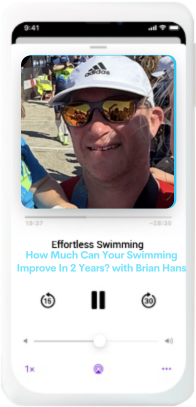
Two years ago, Brian Hans was swimming 2:00 per 100 yards—struggling to find rhythm and wondering if he’d ever feel smooth in the water. Fast forward to now, he’s cruising under 1:30s and just placed 9th out of 171 in his Half Ironman swim. How did he make that kind of jump? What changes in his stroke made the biggest difference? And what nearly stopped him along the way? In this episode, Brian shares the breakthroughs, setbacks, and lessons from his two-year transformation—proving what’s possible when you combine patience, feedback, and the right focus in training.
In this episode
- 01:43 — Introduction to Brian Hans and His Background
- 04:36 — The Journey from Recreational to Competitive Swimming
- 07:06 — The Importance of Technique and Video Analysis
- 10:06 — Experiencing Breakthroughs in Swimming Performance
- 13:01 — Navigating Open Water Challenges
- 15:57 — Training Consistency and Session Structure
- 18:29 — The Role of Flip Turns in Swimming Efficiency
- 21:39 — Current Focus and Future Goals in Swimming
- 24:11 — Patience and Long-Term Progress in Swimming
Links from this episode
- Get your NanoClear swimming goggles here and get 15% off your first purchase with code PODCAST15. https://shop.effortlessswimming.com/
- Grab the freestyle checklist here
- Work with us (stroke analysis coaching)
- Join a camp
Transcript
Read the full transcript
Thanks to you and your really helpful video analysis, I started to kind of go from 210 to two down to 150, this is per hundred yards, down to 145. And I think when I was right around that pace, you said the next kind of breakthrough for you is gonna be connection, right? So you gotta hit, you gotta kick while you're catching on the same side and you gotta feel that connection and feel like, have the water help you move. Don't move against the water, like use it to your advantage to just kind of glide. And you gave me that skating analogy. You know, like one catch side, one catch kick, just skate to the other side. I think that was another one of those sort of moments where once I practiced that and got it down, that was another sort of like five, six second jump. Welcome to the Effortless Swimming Podcast, the show that helps swimmers and triathletes love the water, become a better swimmer and live a better life. Here's your host, Brenton Ford. Two years ago, Brian Harns was swimming two minutes per hundred yards, struggling to find rhythm and wondering if he'd ever feel smooth in the water. Fast forward to now, he's cruising under 130s and just placed ninth out of 171 in his recent half Ironman swim. How did he make that kind of jump? What changes in his stroke made the biggest difference?
And what nearly stopped him along the way? In this episode, Brian shares the breakthroughs, setbacks and lessons from his two-year transformation, proving what's possible when you combine patience, feedback and the right focus in training. Welcome to the podcast. Just for those that are listening, if you can give it like a quick background on yourself and your swimming and your triathlon background as well. Yeah, sure. Thanks for having me, Brenton, great. Great to be here. I'm a regular listener to the podcast, so it's an honor to be on. I think you guys are doing amazing things at Effortless Swimming. It's an incredible platform that you've built and you guys are incredible at helping adult swimmers get comfortable and kind of distilling things down into digestible terms. So it's really, really great to be here. Yeah, so just a little bit of background. I swam just kind of recreationally growing up. Like I wasn't a competitive swimmer, just a little bit. I played a lot of sports and then wound up, when I was in high school, middle school and high school just kind of started to focus more on wrestling and that was my thing in high school. So I did that mostly, but I also ran and I played baseball. So definitely played a lot of sports and like I said, just kind of swam recreationally, but wasn't a competitive swimmer. And then after college and went to law school, I was kind of looking for something to keep that competitive atmosphere going and I picked up running. So I did a lot of half marathons and marathons and that was fun. I was like for someone who had a demanding job and I was like a decent runner for half marathon.
Like I could keep like a 715 pace for a half marathon. So it was pretty good. And then my older brother got into triathlon and he was like, hey, you should get a bike and try this, this is amazing.
So I did, I started biking a little bit and I started hitting the pool a little bit. I did a sprint race and that was it. I was just like totally hooked. I was a fairly decent cyclist and pretty good runner like having a kind of running background, but the pool and the swim, I was like so uncomfortable. Like everything, the race atmosphere and the open water and just being able to sustain because I had never really swam competitively, but I was okay. I could kind of just put together a decent enough swim to get myself in a position to be in the mix somewhat on the bike and the run, but it just became a focus where I wanted to get, I just wanted to feel more comfortable, basically swimming. So like around that time, I was probably, like a 210 per a hundred yard pace, like somewhere around that, but not particularly relaxed, like feeling that was like working when it shouldn't have been, because I was pretty good running shape. So I just started to kind of watch some YouTube videos and about technique. And I realized it wasn't about, there's a kind of thing like you talk about where, more effort doesn't equal more results. Like I was starting to go to the pool a little more and it just wasn't translating into better results. So I started to watch a few YouTube videos and pick up a little technique. And I was there one day and I remember,
I forget exactly what it was, but it was either something about like head position or body position. I was trying it for a while. And then one day, like it just clicked, the actual like technique and I felt it. And then that was it. I've just been completely obsessed with swimming since that moment. And it's not like at that moment, I just all of a sudden was, as good a swimmer as I've become over the years, but it was just enough to bring me back. And then I just completely fell in love with,
how highly technical it is swimming and that like tension between, needing to put in the time and how fit you can get swimming. But at the same time, just the mental side where you have to be putting in like smart work, not just more work. And yeah, so ever since then, I've just been just going at it as much as I can. Because when I speak to people, it's like they love the run, they love the ride. Their swim is often the thing that they want to avoid because it's not fun and it's not enjoyable. So that moment there, is that the one that kind of converted you to enjoying the swim more than the other legs? Yeah, yeah, for sure. Yeah, once I feel like I hear people talk about golf a lot like this, like they hit one shot that just like takes them, just like makes them fall in love with it and brings them back. And like that, yeah, that was it for me. Just feeling that moment where that technique just like clicked into place and then just like seeing the difference in pace and feeling how you're supposed to be moving through the water. Yeah, then I just started kind of prioritizing swimming over biking and running. And it just became by far my favorite of the three, for sure. And then take me back to about two years ago, I think when you sent your first video in for analysis, what made you decide, all right, I think I need a little bit of help here. Yeah, I just kind of realized that I wasn't gonna figure it out myself. You know what I mean? And I was talking, there was a guy at the pool
who I kind of watched. We were equal and we were pretty friendly, like really nice guy. He did tries, like a local try guy. And we would talk at the pool and I started seeing him, we were pretty equal. And then I started seeing him all of a sudden and I was like, man, I can't keep up with this guy anymore. You know, and then all of a sudden he's like hitting flip turns and like dolphin kicking underneath the water and just like, I mean, literally just lapping me. So I asked him like, what's going on? And he said, oh yeah, he said, I started doing online tutorial. Like I started watching videos and I sent in to do a video analysis and just like completely changed my stroke. Like I never realized everything I was doing wrong. So I was like, oh, you know, let me give it a shot. So that was what prompted me to send you that first video. And can you remember back to that first one, what were the main couple of things that you got out of that first analysis? Yeah, I mean, yeah, I think you were pretty kind to me. I think you went pretty easy on me because there was a lot, but it was just the basics. It was just head position, body position. I think I was over rotating, which was causing my legs to kind of splay out. But it was mostly just like the fundamentals because I never, you know, even though I love it, I didn't like grow up as a swimmer. So I just didn't have a good sort of like base foundation. So like I said, I think you talked to me about like head position, not over rotating, like lighter kick and just kind of like feeling the water, you know, kind of like skating through the water,
not muscling your way through the water. So I think those were the sort of first kind of cues that you gave me that were super helpful. And then we've obviously done more videos over the last two years. Was there any particular piece of advice or a moment where you were swimming one day and you made a change and you noticed like, oh, okay, this feels just as good as that first kind of breakthrough you had when you changed that initial part of your technique a couple of years back?
Yeah, I think it was, so I started to, you know, thanks to you and your really helpful video analysis, I started to kind of, you know, go from 210 to two down to 150, this is, you know, per hundred yards, down to 145. And I think when I was right around that pace, you said, you know, the next kind of breakthrough for you is gonna be connection, right? So you gotta hit, you gotta kick while you're catching on the same side. And you gotta feel that connection and feel like, have the water help you move, don't move against the water, like use it to your advantage to just kind of glide. And you gave me that skating analogy, you know, like one catch side, one catch kick, just skate to the other side. I think that was another one of those sort of moments where once I practiced that and got it down, that was another sort of like five, six second jump. And then I think the biggest one, you know, more recently was, was breathing. So, you know, just sort of breathing position, breathing technique. I think I was coming up out of the water a lot, which I just, at the pool, I kind of see and kind of notice a lot of people doing that now, ever since you pointed out to me. So you gave me that cue, that like, like goggles split, you know, like where the water should be sort of one, you know, one goggle underneath, one goggle over. So the top of your head is kind of pressing into the water. And that was total game changer,
because that took so much of that, so much of the effort out of the wrong part of the stroke and put it into the right part of the stroke. Like there was no more, like there's no more effort to breathe. Now it's just like waiting for the, you know, catch hand to be at the right spot to like put the pressure on. So that was, that was another just kind of cue. That was a total game changer. And what I really like about seeing your progression over the last two years as well is the, you haven't been in a rush to like, all right, I need to be 20 seconds quicker by the next month. It's like, you know, two years, it's a long time, but it's also a short amount of time. And typically it's people who are willing to just focus on one or two things for several months, make those changes, like your head and body positions and really basic stuff, but a lot of people just don't have that in place. And that's why I went easy on you, so to speak. It's like, well, there's no point trying to like give you everything. Let's just keep it super simple and get that right. And then we can reassess and go from there. And now, so your most recent triathlon, most recent race that you did, it was a 32.50 for your half Ironman swim, where you got ninth out of 171 in your age group for the swim. One of the things you mentioned in your email a few weeks back was you allowed yourself to get a little bit scrappy in that race. Can you talk a little bit about what that means for you? Yeah, and, you know, first of all, I think like, you know, testament to you and everything you guys are doing there.
Two years ago, when I, you know, really was enjoying swimming and thinking like, I'll just try to get better and just see what happens. Like I enjoy that sort of technical challenge. If you told me I would have like a top 10, division swim at an Ironman branded event, I would have told you you're completely out of your mind. So that was, you know, that was pretty cool. And I think, you know, as I mentioned to you in the email too, you know, I think I didn't really seed myself appropriately. I should have probably put myself up a little further because I was kind of climbing over people for most of the swim. So I'm gonna take that with me. And like you always talk about, you know, you can't be a victim out there in the open water. And I think I had a little bit of that syndrome in the seeding. Like I sort of just seeded more appropriately. So I'm gonna remember that for next time. But yeah, so in terms of like the scrappiness, I guess like what I met was, there was a really like a pretty good chop in the water. But it was kind of like, it was a wind driven chop, right? So right underneath the surface was just like nice clean water. So I couldn't, you couldn't do your normal, like easy kind of feeling fluid split goggle, like breathing like you can in the pool. So I had to kind of just figure out like how am I gonna keep my catch, you know, the way that I want it to be, like it is in the pool because I got this nice clean water. But every time I went up for a breath the first couple strokes, I was just like eating water. So I just had to kind of like figure out with elbows in my face and kind of heels, like almost, you know, hitting me in the goggles, just kind of, I skipped the breath about, you know, a couple of times,
just was whatever, hopefully I could get some air on the next one, you know, and then just would breathe like a little bit behind, a little bit in front, like coming up a little bit more maybe than you would if you were trying to execute really good technique in the pool. So basically just trying to like make sure that the basic mechanics were down that I know work, but just figuring out like how to get the breath and just how to get around people. And one other thing that was really helpful was I think I did like a pretty good job of, and I heard you talk about this in one of your podcasts, I forget who was on, but talking about trying to get like a feel of what's around you when you're in the open water, somebody's on my left. And as we're kind of stroking together, I'm trying to get a sense, is that a heel? Is that their catch? Like, is that their arm? And then as soon as I figure it out, I can figure out kind of without breaking my stroke, figure out how to navigate it around, right? There was one guy we were together for like a bunch of it. And then I realized I was gonna like just turn it up a little. And I realized that it was his, it was his catch that I was feeling, right? So I figured after I feel the elbow like kind of slide through, I'm just gonna slide like right over that shoulder and just like get in front of them. So, you know, things like that, just kind of figure it out on the fly. Hmm, so that the awareness in the open waters is such a big one. And we had our Maldives camp last week, two weeks ago. And so we had Sharon Van Rivendel there who was the Olympic 10K champ. And it was really good hearing her talk about the awareness in open water is one of the first things.
And we did a lot of exercises with the group where we'd be drafting, I might be in front and then we'd have three, three, three, and we'd all have to work together in this group. And then we'd kind of do it as like, all right, let's all try and swim at the same pace. And, you know, if you find yourself dropping off or you've got to make sure that you're not out by yourself because you're gonna be having to break all of that water in front of you. So you've got to make sure that you have that awareness, right, where's the group or is there someone nearby that I can slip in behind or get on their hip and just get back up with the group. And especially in an Ironman race where you're going to have hundreds of people spread out. Well, you've got lots of opportunities to slip in behind and then slip past them and kind of use that to your advantage. And then in terms of the scrappiness with the stroke, you wanna be in flow with the ocean. You wanna adapt your stroke to the conditions that you've got. And quite often the surface of the water is not pretty. And so your stroke's probably not going to look that pretty as well. And you have to be willing to get a little bit, yeah, a bit scrappy with it. And often that sort of one-two timing, like one stroke's longer than the other, often that works pretty well in those choppy conditions, especially if you normally breathe to the one side. So just allowing yourself to get scrappy. I'm glad it worked well because I find people usually start off by trying to be too perfect in the open water, especially when they're working so hard on swimming well in the pool, but then they just don't adapt for the open water. So is that something that you feel like you've developed over time or you were generally pretty good at it when you started?
No, I think it's not, yeah, I think it's something you just develop by just doing more races, just doing more open water swimming. So I think this was my, this was my seventh, seventh 70.3. And then I've done one full Ironman and like a bunch of sprints in the Olympics. And I think just the experience, you know, like going out there and knowing like at first, and then this is something that I think actually is, you could work on the pool that I worked on is, you have to be able to really like put a burst on and like feel pretty uncomfortable for 50 meters and then be able to settle back down, right? And just like calm back down, get into your normal stroke or like one race, I swam like right into the buoy. Just, you know, that'll, that'll kind of throw you out like for a loop, you know, you're like, I'm like right under it. And then, so you need to, you know, you get kind of disoriented, you got to, you know, get your stuff together mentally again. But yeah, I think, I think it kind of just comes with experience. Yeah. And it's, yeah, you, I mean, you've progressed a lot in those, in those two years being around two minutes plus to, just under 130 per hundred yards in a lot of your training sessions. And a good question to ask is, how much swimming are you actually doing? Because I know with us, we focus a lot on the technical side of things, but you've got to marry that up with training consistently and putting in the, in the case still. So what's your standard week look like in terms of how many sessions and how many kilometers or miles are you doing? Yeah. So, so yeah, as we've talked about, I have a young family and I work a lot. So if I could, I'd be at the pool,
you know, five days a week, every week, but that's not, that's not realistic. So usually, usually I hit the pool three days a week and I do a 4K session. So, you know, usually around 12. And then if it's a good week, I'll do a fourth. And then over the winter, I like to kind of throw in some longer sessions just if I can on the weekend, like I'll go do like a five or 6K swim in the pool if I can, if I have time, just to try to, you know, ramp it up a little bit. But that's usually, that's like pretty, pretty typical. Three, three or four swims a week and kind of minimum 4K per session. And what's a typical session look like in terms of structure and then like, what are some types of, say, main sets that you've found to be really beneficial, especially for your racing? Yeah. So I like to, I like to switch it up. Sometimes I'll do, you know, just open with like a straight 1K, just straight. And then, you know, the next K, do sort of hundreds on, you know, 150 or two minutes
and just mix in some, mix in some drills. So I'll do, so I'll do like a warmup and sometimes I'll mix in drills to the main set as well. So I'll do like 50 drill or a hundred drill. And then after that, like with no rest. So like take, you know, fins come off, snorkel comes off and then you're right in and do like either two or 300. So I'll do that, you know, for six or seven reps as like a main set. So I usually, I usually keep it pretty varied. And, you know, the hardest set, one that I don't like, but I think is really beneficial. And I think translates really well into the open water is doing sets where within each, you know, within each hundred or 200 or whatever that particular rep is, like you'd go out really hard and then have to settle in. So I'll do like, you know, 50 at pace plus, plus, plus. And then like, you have to settle in cause you're doing like 300 for that particular rep. So you don't know, you can't stop. You have to like, and you can't take it easy on the 50 either. You got to really like let it rip. So I like those, but they're really, I mean, those are, those are super painful. I think one of the ones I got from you, which was torture. I think I was like cursing you while I was doing it was doing 30, 31 hundreds on like 150, something like that. So, I mean, I like stuff like that where you just mentally, it's like physical and mental. So you have to keep it together mentally cause you know you've got a long way to go. And it doesn't sound like it doesn't sound that hard
but you're only going, you're only going 100 yards, right? But when you're at like 15, 16, 17 and there's not a lot of rest there, that's like to me when you get that combination of the mental and physical challenge where you really got to like focus. Yeah, I mean, both of those kinds of sets are great. I mean, at the World Champs recently, an Aussie guy, Matt Houser won that race and his initial 100 meters in the swim, he went out like an absolute rocket. He was like, he got a body length on the field pretty quickly. He went out so hard and so fast. And I mean, most triathletes not gonna have to do that especially in an Ironman race but perhaps as a pro you'd have to but the change of pace stuff where you have to go hard and then you've got to settle, bring the heart rate back down, it is great to practice. And I've told this story a little bit on the podcast probably a year ago but a friend of mine is a pro triathlete and he was training with one of the best Ironman swimmers about a year ago. And he said that he was actually about the same pace in training but the thing that he wasn't very good at personally was that he wasn't very good at going out strong, kept being with the group and then sticking with them. So he had to work on that front end speed. And when he ended up training with this top triathlete he was doing a lot of sets which was like 150 hard and then five seconds rest into 250 moderate or like a seven, seven and a half out of 10. And then they do a hundred hard
and then like a 200 moderate. I mean, they do that sort of thing repeatedly. And so it's great for that front end speed if you want to kind of make a break for it. And then those like sustained efforts with short rest. Yeah, it really simulates that race. Like if you're doing a, well, what is it? 1.8K, 1.9K swim for a half Ironman. Well, if you can do 3,100s with five, 10 seconds rest, quick turnaround time. First eight, nine are fine but then you really start to feel it halfway through. And we did a set like that this morning which was just five seconds rest after each hundred. And yeah, the feedback I got was that set sucked but it was really good as well. It's just hard, it's painful but great for practicing what it's gonna be like in a race. Yeah. The other is really helpful. Yeah, yeah, for sure. The other thing that is hard for kind of a pedestrian swimmer like me who's gotten better but didn't grow up swimming is I try to do the other strokes too because it's so uncomfortable. Like to do butterfly or backstroke is so hard, it's so uncomfortable but I have started to feel how it kind of balances you out. Like I don't breathe to my non-comfortable side particularly well, but I started doing backstroke more and just kind of doing the drills where you swim like half the length and then kind of flip over and swim the rest backstroke. So doing things like that where it takes you out of your comfort zone.
Well, again, for someone like me who didn't grow up as a swimmer, I found those really beneficial. The other thing that really worked really well for me which was so hard to get used to was again so I didn't grow up with a swimming background so I wasn't doing flip turns at the pool, right? And someone said, just try doing a flip turn. You're gonna be a lot more comfortable if you could just keep the momentum going. So I started doing flip turns two years, maybe two years ago or so and it was so painful. I thought my lungs were gonna burst every time I pushed off the wall because I wasn't getting that quick breath. But I think it translates. Now it feels much more natural. I think it looks like a reasonable flip turn and it translates really well to the open water, right? Because you don't know, like I said before, you might go up for a breath and get like a foot in the face and not get like a clean breath or just get like a chop in the face and to be able to kind of know you could still stay settled down and you'll catch the next one. Like doing the flip turns and pushing off the wall and just kind of being patient in that extended position has been a game changer for sure. How did you get more comfortable doing flip turns? Just practice. Just keep doing it. I think I sent you, I sent you some videos. I was like, look at this horrendous flip turn. Can you help me please? And you sent me back some really helpful pointers and then I stuck a video camera on the bottom of the pool and would just watch my flip turn and just kind of compare it to some real flip turns
and over time it has actually progressed into like a halfway decent one. I can't like fully dolphin kick yet and get like a quarter down the length, but it looks halfway decent and yeah, it was just a matter of practice.
That's good.
Yeah, it's one of those initial hurdles for people where it's like, I might actually be going slower initially, I'm more tired, I'm more fatigued and so they don't wanna go through that two or three month period where they're having to adjust to it, but I think long-term, it's just, it's so much more enjoyable if you can get your flip turns and your speed will be better. And as you mentioned, it can correlate to being more comfortable in open water because you may not get every breath easily. Yeah, it's worthwhile putting the work in and from memory, I think, I think you might've been sort of like going in like hands in front maybe and trying to get around initially and then worked on getting the hands to the hips, flipping over and then straighten the streamline because I find when people were coming into the wall, like hands in front and then doing this big pull through with both arms, it's hard work. It's like, yeah, you're doing twice as much effort rather than just finishing both hands at the hip, tucking up nice and tight and then flipping over on your back. So there's some common mistakes there that do make the flip turns a hell of a lot harder. And one thing that people do too, which I don't think you were doing, but quite often they know that a good thing to do is some dolphin kicks under water and try and break out past the flags. But for most adults who haven't had that swim background, trying to do like four or five dolphin kicks under water, you're spending way too long under there. So I'd suggest for most people who are learning them, just push off, do a few freestyle kicks and break out and then you'll get your next breath fairly quickly. Don't try and replicate a Caleb Dressel
off the turns when we're baby steps. You know, we wanna start small. Yeah, yeah. No, yeah, no, it's definitely been a progression. And that was another one of those moments where once that just kind of made me become even more hopelessly addicted to swimming was, like once you can hit that, like I could do a turn off the wall and then just like keep the momentum and the rhythm going where you don't feel like you, if you do an open turn, like you're stopping, you're starting, you feel like you got to start all over again, that's tiring. But being able to hit the wall and just like bounce off, that was another one of those moments where I was like, and I just, you know, I just love that. Like, you know, you pick something, you pick like some technical issue that you're having, you work to resolve it. It's painful and hard. And sometimes you wanna just like take your swim stuff and throw them in the dumpster and just like light them on fire. But you know, if you keep going, like it's gonna get better. And with the flip turn, it was definitely one of that. So that like feeling of being able to just like spring off and just keep the momentum and the rhythm going was another one of those like light bulb moments for sure. And what about now? What are you focused on now with your stroke and with your swimming? Yeah, so a lot more to come offline with you on this one. But I can't, right now, I am just leaving so much on the table because my left catch, I can't get my head back in the water fast enough to really be in proper position to get like the full catch and really get in a good position. So my left arm is dropping because I'm just kind of like spending too much time getting the breath.
So I'm just trying to get my face back. So I'm basically like, if you look at it, I'm swimming with just like basically, you know, like one effective catch and the other one is like serviceable. But I'm just trying to get, work on getting my head back in the water faster so that I could be like head straight ahead to like set up that left catch. So that's been, it's, I haven't been working on it that long, but I think you, you know, you helped me identify that one. And that's so far that's, it's been a, I've had to, I've had to think back to, hearing you say on many podcasts, like don't chase speed, right? And it's okay if you make a change and initially you're slower. Those are two pretty counterintuitive things. So that's hard, but yeah. So that's where I'm at right now. Yeah, fantastic. Well, it's, yeah, it's a long journey and the patience that you've got with working on these things and not trying to do it all at once, I think is why you've had such, partly why you've had such great success over the last couple of years. And I'm looking forward to seeing where it takes you in the next 12 to 24 months. And to see someone who initially is maybe a stronger rider, a stronger runner and a weaker swimmer, but then change and turn into loving swimming, that to me, I really love to see it. I'm being obviously a swimmer and a coach. And when someone finds that passion for swimming and especially the passion for the nuance of the stroke and finding these small areas that they can improve, that's really like to see it.
So I appreciate you jumping on the podcast and sharing that with everyone, because I think there's so many people who are in your shoes, especially that sort of two minute, two minute 10 pace. It's where a lot of people end up starting or getting to after 12 months. But then they feel like that next hurdle might be trying to get under that two minutes or down to 145. And then to get to that under 130 is a big hurdle for people. So I'm sure there's a lot of lessons in that. Is there anything that any say words of wisdom or anything you'd leave people with if they're wanting to do the same thing that we haven't covered yet? Yeah, no, I think like we talked about, it's just that patience. I think like you talk about, you have to just sort of take a long-term view of things and just know if you stay the course, like you're gonna make a change and things you're gonna get faster. It's just sometimes it's not linear. You know what I mean? Like if your approach is, I'm gonna go to the pool and try to make this change and in a few sessions, I'm gonna be like blazing around the pool, like you're just gonna be mad and frustrated. That's like the most helpful thing that I took away from what you always talk about. It's just like take, if you really love it, which I really, like I said, I really fell in love with swimming, like just take that long-term view and over time there's gonna be ups and downs, but it should trend in the right direction. Absolutely. Yeah, you might get like two or three strokes of like, oh, that felt nice, but you might not get it for a pool session for a while. So yeah, fantastic. Well, Brian, appreciate that a lot
and looking forward to seeing what you do over the next year or two and continuing to work together. So thank you for jumping on the podcast. Yeah, thanks for having me. Pleasure to be here. If you can relate to what Brian was talking about in today's podcast, check out our Effortless Swimming Coaching membership. This is where we'll give you feedback every single month on what to focus on to take that next step with your swimming and how you can make those changes with certain drills and how you can make those changes permanent over three to six months. So if you'd like to improve your own swimming, check out our coaching membership at effortlessswimming.com and we'll be back with another episode next week.