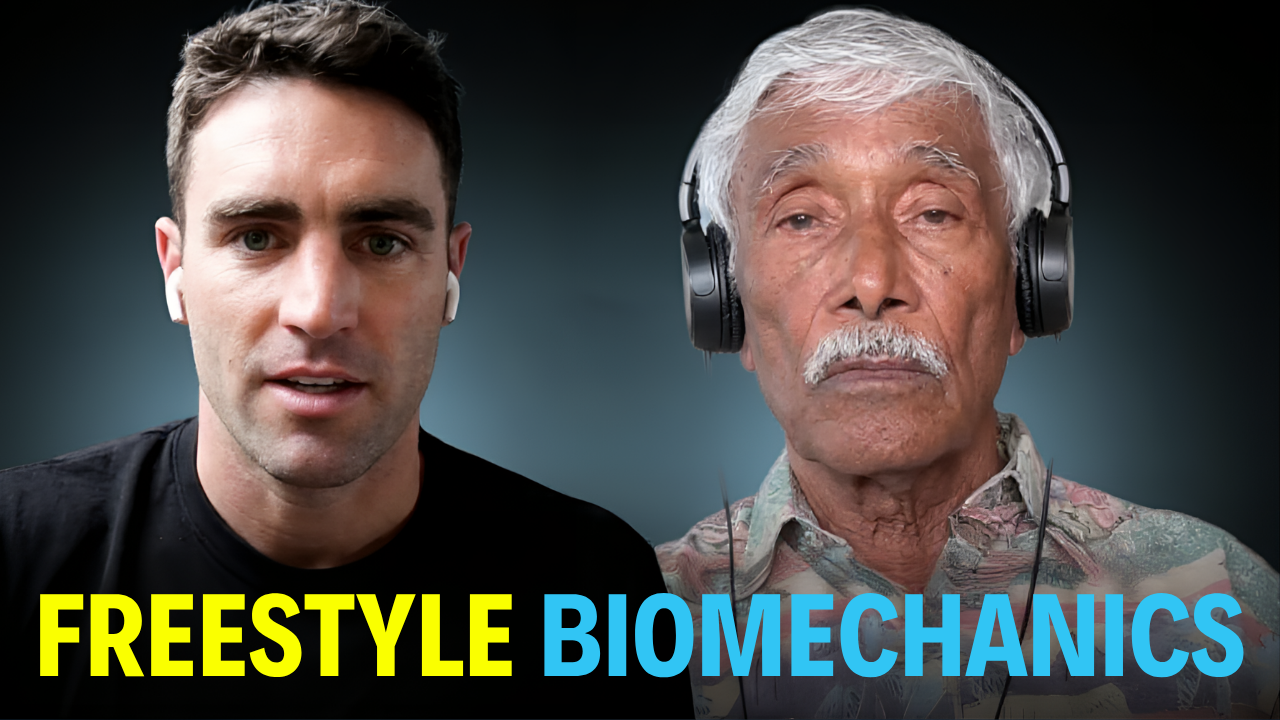








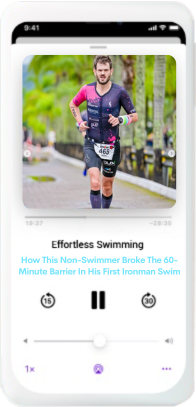
Felipe Telles broke the magical 60-minute barrier in his first ever Ironman swim, coming in at 56 minutes with an average of 1:28/100m. When he first started swimming a few years ago, Felipe struggled to go faster than 2:00/100m. So how did he manage to increase his speed by that much? Find out in today’s podcast episode.
00:56 Swimming Background
03:34 The Impact of Learning the Right Technique
07:09 How Relaxation Transforms Your Swim
09:50 The Benefits of Incorporating Drills in Swim Workouts
13:18 Structured Sessions: Warm-ups, Technique, and Intense Training
16:46 Finding the Balance: Consistency vs. Pushing Too Hard in Training
20:35 How to Get the Most Out of Your Swim Training
24:23 How Observing Others Can Improve Your Technique
31:20 Catch and Pull: Finding the Right Amount of Power
37:23 Swimming Tips for Triathletes: Small Changes, Big Results
41:24 Follow Felipe on Instagram for Inspiring Content
Follow Felipe on Instagram
Change your technique and swim a smoother, easier freestyle with the Effortless Swimming membership:
https://effortlessswimming.com/training-and-membership-plans/?el=blog
Do you want to work with me personally to improve your technique? Join my swim technique coaching here:
https://effortlessswimming.com/stroke-analysis-membership/?el=blog
Get 20% off wetsuits at Great Ocean Wetsuits with code ‘EFFORTLESS20’:
https://greatoceanwetsuits.com/
5 Day Catch Challenge:
https://effortlessswimming.com/5-day-catch-challenge/
Get 15% off our 8-week Faster Freestyle course by using the code 8week15
https://effortlessswimming.com/8-week-faster-freestyle-course/
Related Content:
[Case Study] 2:05 to 1:40/100m in 4 months with Felipe Telles
Watch the episode on YouTube:
Transcript
Read the full transcript
I don’t like to do many drills, I hate them, but I know that it’s just learning how to write. It doesn’t feel natural at first, it doesn’t feel okay sometimes, but once you get the steps, the little steps, it’s much easier. And once you understand the importance of it, it’s much better to to progress. So this helps a lot because these little details in the end of the day, they make a big difference. Swimming is about technique and power. Welcome to the Effortless Swimming Podcast to show that help swimmers and triathletes love the water, become a better swimmer and live a better life. Here’s your host, Brenton Ford.
A goal for many seasoned Ironman athletes is to swim under the 60-minute mark for their Ironman swim. On today’s episode, we have a guest who managed to swim 56 minutes in his first ever attempt at a full-distance Ironman. And this person wasn’t a swimmer as a youngster, didn’t have a swimming background. When he first started training for triathlons only a couple of years ago, he was around the two-minute mark per hundred. Now in his Ironman event, he averaged less than one minute 30 per hundred. So on today’s episode, I wanted to dig into what he did to improve his fitness to get to that point. But more importantly, how did he manage to improve his technique and his comfort in the water to be able to swim at that speed for that long? Let’s get into the episode with Philip Tellers. My guest today is an athlete who did his first Ironman swim in the time of 56 minutes, which is just under one minute 30 pace per hundred, which is a huge achievement for
not only your first Ironman swim, but for someone who really only started a couple of years ago. And we exchanged messages for quite a while. We’ve gotten to know each other, we’ve worked together a bit. And I remember three years ago, you started off at two minute pace per hundred and you’re now obviously down to under one 30. So I wanted to get you on the podcast to talk about how you did that, because I think there’s going to be a lot of lessons there for anyone who finds themselves in a similar situation. So Philip, welcome to the podcast. Dave Redman, thank you for having me. And it’s been an awesome journey to get to this point. And of course, you’re a great part of it. I’m very happy to be here talking to you about. Tell me a little bit about where you started with your swimming and your triathlon. What was your background in in swimming, if you had any at all? So when I was a kid, I had a little background in swimming. My parents used to take me to the
pool and have some classes, but nothing crazy or serious, maybe like three months at a time, like four or five times during my childhood and teenage years, just to get a feel for the water and not to drown myself. I always go to the beach. So it’s important to to learn how to swim. But other than that, I never been a good swimmer or practice for a long time. And I got into triathlons before because I wanted to lose weight. I was in a journey to lose weight and three years ago I said, okay, in three years I’ve been doing an Ironman. And so the journey had to start somewhere. And I didn’t know how to swim with the proper technique or fast or anything. I was over a week and I was living in a city that we didn’t have a coach or a teacher to get alongside with us in the water. So I had to teach myself how to swim. And then from there, I picked up their videos or classes, I was swimming analysis and everything got better from from there on. I did like five 70.3 Ironman distances with great
results, always improving my swimming. And almost a month ago, I did my first Ironman, and I wasn’t expecting it at all. I was doing about one hour of swimming. I just got there and it’s been like I used to do every every week. And I was very happy to get out of the water 56 minutes. What was that feeling like when you looked at your watch after you came out of the swim? So in Ironman Brazil, the one I did, the twin is divided into two parts. The first part you go out into the ocean and you come back and you go again in the sand. And then you go back to the ocean and go back and then you go to the tradition area. So the first 2000 meters, I look at my watch when I arrived at the sand and I looked it was like 30, 30 something minutes. And I was very happy. I knew I could swim an hour. It was something I planned. So but I know that the current in the second leg of the swim, the second part was in favor of our destination.
So I thought myself, okay, I can swim faster because now the current will help me. And then I could stay on the feet of some people that were a little bit faster than me. I could visualize the buoys very well. So I knew that I was swimming very well and it wasn’t make a lot of effort to do it. And so when I arrived at the beach, just passing the marker, and I looked at my watch, I was really, really happy. I knew it was going to be a good day. And take me back to when you first started swimming and training for triathlon, what were you experiencing when you were swimming? What were some of the maybe the frustrations that you had? How did your stroke feel back when you first started those first couple of months? Yeah, so it felt like something that’s not natural. I always tried to push myself. I’m a very dedicated person. So I always got into the water and looking at my times, I felt very frustrated because I know I knew some other people, of course, they were much more
experienced, but they were swimming much faster than me. And I knew I wasn’t making progress. So I knew that just making an effort without technique wouldn’t be enough. So I’m a person that likes to learn about things. I’m always looking at forums, at videos, at what people are doing, new techniques. So I found some videos on YouTube on our channel teaching how to swim properly. Just very basic technique, like, okay, how to breathe, write, how to kick your legs, how to position your body on the water. So these techniques, I started to put my to put them into my swim and I could see that I was improving little by little because it’s really frustrating when you go to swim and you cannot swim like 50 meters without guessing out or having to get out of the water because you’re not feeling well or not having making any progress. So when I started to learn these things, I knew that my effort was was less and I was swimming faster. So I tried to
reach for more knowledge and I knew that it was possible if I learned the right technique to be better and to reach my goals. So I always try to improve, but not only improve, but learn how to do it right. It’s the most important thing is swimming, not just making the effort, but how to make the effort. And were there any key parts of your technique that you had to focus on over the last couple of years that you felt made the biggest difference for you? Yes. One thing that when I started to swim was that when I was breathing, I was moving my body to the side like this. So I was breaking every time my body, my head went out of the water. So I knew that this was something that I must stop. You know, of course, it’s not easy. You have to control your muscles. You have to position yourself from the water. You have to be comfortable in the water for do that. So it took me a lot of time, but after learning that everything is connected like
that. How your hands goes into water, how you push the water and how you kick, everything comes in a chain and you start to get straight. You know, you don’t have to push yourself. You don’t have to push your body too much to a dream right. You don’t have to make an effort, a big effort to stay without turning yourself. So everything was much better when I started to understand this. And the most important thing I think it was how to get my hands in the water and start to pushing like that. And I could feel that I was going faster. I was making an effort. And if I focus on that and how to be stronger with that, I know that my swing could be better. One thing you brought up there was you said you don’t have to do as much. And that’s something that I see a lot of is that whenever I’m analyzing people, they’re usually doing too much of something. They’re kicking too much. They’re rotating too much. They’re lifting their head too
much to breathe. So often the change that people have to make is to do less and to relax and hold the body right. And often it’s going to be a lot easier that way. So it’s not about adding more things. Usually it’s just about taking them away or reducing the amount of something that you’re doing. And that for a lot of people, I think can be a moment of realization that if they just allow themselves to relax and think about being long and smooth, then it’s not only a lot easier, but it’s just so much faster as well. But I mean, a part of that too is if you knew, then you don’t have that balance and stability in the water and it takes a little while to develop that and that level of comfort. But once you get past that point, then you can really make some big inroads to faster times and to a better stroke by just learning what are the key fundamental things that will help you be smoother in the water.
Did you do any drills when you were training or was it more just about just practicing those things when you were swimming? Yes, I don’t like to do many drills. I hate them. But I know that it’s just learning how to write. It doesn’t feel natural at first. It doesn’t feel okay sometimes. But once you get the steps, the little steps, it’s much easier. And once you understand the importance of it, it’s much, much, much better to progress. Because just like your channel says, effortless, if you’re trying too hard, if you’re swimming like, okay, I must do this, but I have to try really hard to put the hand. I have must try really hard to put the body in the water, then it doesn’t become natural. You suffer a lot. And imagine doing this in an RMM or 70.3 distance that you’re at least half an hour more than that in the water, you’re going to feel really tired after that. So doing the drills, you learn how to be natural.
It will start to feel natural for you. And the drills also, especially in the five day catch challenge, I think it really helped because one of the most important things that I felt doing during this course that I always recommend to people, I have over 50,000 people follow me on Instagram, and I always recommend that people always come to me and say, okay, really help. Because the drills makes you realize what you have to do right, and especially what you’re doing wrong. Because if you’re like pushing on the other way or your elbow is not working right, you’re going to start to feel it during your stroke. So drills are very important because of that. They not only teach you how to do it right, but they will show you what you’re doing wrong, and you’re going to fix it much faster.
That’s so many people that I come across don’t enjoy doing drills because they feel like they’re wasting their time. They want to get a good session in. They want to feel like they’re working hard. But sometimes it’s a necessary thing to do to develop those skills. Like you said about writing. My kids are young and they’re learning to write and read, and we’ve got to do these exercises in order for them to have that base level of understanding. I don’t think you need to do a whole lot of drills, but if you do just a handful of them correctly, then you can really make some big improvements from there. So I’d like to get it. Some people that swim with me and what I realized after some times that they don’t have as much as progress as I did. Not because of many things, but some people they just want to go there in the class and suffer a lot and do all the training. But sometimes you feel dedicate like 5-10 minutes each session to go in the water and do the right thing, position your body,
like pay your toll. You know, learn how to do things right. You improve like the same as you would in six months during just during the strengthening exercise or doing the pull exercises. Yeah, I totally agree. And tell me about the type of training that you’re doing leading into the Iron Man. How often were you swimming? What was the distance of those sessions and was there a certain type of session structure that you’d have each week? Just tell me a little bit about that. Okay, so my first year and a half swimming, I used to swim by myself and my wife, we used to go to the pool together. It was a really small town, we didn’t have a coach. So I’m gonna say it was really hard. I hated swimming because it was cold and we didn’t have anybody to put ourselves to push and to talk and to play sometimes, you know, to raise them. So it’s really hard. I really congratulated people that can’t swim by themselves. Not that common
here in Brazil. We have lots of spring clubs. So during the first year and a half, many things I used to swim like three times a week. And after my first 70.3, I wanted to swim sub 30. So I was talking to a friend of mine and he said, okay, if you want to swim above 30 minutes, maybe you should start swimming more. So I tried to swim more four or five times a week.
It was hard. I didn’t swim much. Maybe like 80% of the weeks I could do that. But then I moved to a bigger studio and here we had a swimming club that was the same as my triathlon court. He was doing classes. So I started swimming with the people. We have a very big class. Sometimes we have like 20 people in the pool with us. So it’s really nice to swim with them. And things got much easier. After that, I start to swim four times a week, every week from a year and a half now. And our sessions are usually like 20 minutes warm-up. Then we do freestyle, whatever we want. Usually I try to swim a thousand meters, but sometimes a little less than 15 minutes with technique and breathing. And after that, a lot of pushing and racing and various fast sessions, depending on the schedule, of course. And after that, usually the class, we go for an hour and a half. The last 20-30 minutes is just swimming around and opening your volume. Yeah, yeah, nice. And did you start to notice the
benefits, the fitness benefits to doing that? Did you start to feel like you could hold your pace longer, like you were stronger? Did it take long for that to kick in or to feel that? No, actually, I don’t consider myself like a swimmer. In the pool, I have many, maybe it’s an ego problem. I swim faster than me and try to catch up with them. But there’s people that swim like, for their professionals, triathletes, swimming with me. So it’s not a fair comparison. But I tried to swim five, six times before a week. But when I started to do that, I felt really tired and I felt that the sessions were really good quality. So I started to swim less. And now it’s swimming four times a week. I know that I have to control myself not to push so hard in the warm-up or after the sessions, because I know that the next day, my session is not going to be a very good quality. So you have to be smart, not to push yourself all the times. You have to control. It’s really important for endurance
sports, you know, how to maintain your endurance zone all the time, not to push yourself so hard. So it took a while for me to get in a pace that I felt relaxed, maybe six months of swimming with everybody in this swimming club. But I’m always having to control myself and try not to push so hard because I know that I will suffer in the next session. Yeah, that’s something that’s taken me a long time to understand and realize as well. It’s about winning the war, not the battle. And those battles are the sessions. And you want to train your best, but you also don’t want to push every session to the point where you’re just are going to either get sick or get injured or that you just have one or two sessions that are total rubbish because you’ve pushed so hard the session before. And there is a time and a place for those harder, harder sessions, but especially for endurance sports, whenever I’ve listened to some of the best pro triathletes, often that realization that they have later
on in their career is that it’s about just being steady and consistent, not having these big spikes up and up and down. It’s about that consistency. And then you are much better prepared for your racing and you’ve got better fitness as well because you haven’t got weeks away from training because you’ve pushed too hard. Yeah, especially when you think about Ironman, you’re going to swim almost four kilometers. It’s going to be at least an hour and five minutes. You’re not going to push yourself, you’re not going to be cast out. You have to swim in a comfort of pace and to swim in a comfort pace, in fast in a comfort pace, you have to really be in the space. A lot of time doing your training because you have to train your body to adapt to it.
And if you’re swimming three to four times a week and you’re training for an Ironman,
you really want to be doing some good volume within those sessions. And you’re doing probably three and a half to four kilometers in those hour and a half sessions, maybe a little bit more at times. And that I think can make a big difference because if you’re stopping your sessions at two kilometers rather than four, well, you know, those four sessions you might be getting a total of eight Ks done instead of 16 kilometers. So that’s a big difference over many months. You have to know that especially when you’re first Ironman or even if you’re a really experienced athlete, Ironman training is not easy. You’re going to bike, you’re going to run a lot. So you’re going to go into pool and start to feel tired. You’re not being 100% of the time. So you have to push yourself sometimes to swim 4K, three and a half. You have to, I’m always one of the first in the water and sometimes most of the time one of the last to get out. And I know that it pays off because I’m swimming
much faster than some people that been swimming for more time than me. But it’s really a discipline consistent strategy, you know, of course you don’t have to be every day inside the pool or sacrifice everything. But sometimes those 10, 15 minutes that you put yourself a little, they’re push yourself a little bit, they make a big time in the end, you know. Yeah, it can really add up, especially if you are busy and look, you’re going four times a week. Well, if you can squeeze in that extra 10 minutes, that’s, you know, it adds up a lot. And one of the things you mentioned was just your session structure. So you said you would normally do like 1000 meters, maybe a little bit less of just easy swimming and warm up, then you do another 10 minutes or so with some drills and skills work. And then you have your main set. That’s very similar to what we do in our squad. It’s often just 600 meters with fins on,
just choice. And then we go into some, some drills, some kicking, maybe some breath control. And then the end of the warm up will do some either building efforts, just to get the heart rate up something like 3 100s, build one to three, or 450s, build one to four, just to get the heart rate up. And then we’ll go into our main set, which might be anywhere exactly. And it might be 2k to 3.5k for the main set, depending on what we’re doing. But that, like to me, that’s like, that’s a very simple structure that can work for 90% of people. And there’s no, you know, I think it is important how you structure your workouts. But if you are doing in the, if you’re in the pool for an hour and 15 an hour and a half, and you’re doing something a bit like that, I think that’s going to get most people a long way to those goals that they want to achieve. Yes. And I mean, okay, people may be maybe listening to this and think, okay, it’s too much
one 15, one 30 minutes. But once you realize how much time it takes for you to get in the pool and change and take a shower, sometimes you can be a little fast. And these things, you know, and squeeze a little time in the pool, but and also people care too much sometimes with the bike and with the run, but some they forget about the swimming. Very commonly in Brazil, and maybe some other parts of the world as well, they say, okay, why, why would you care so much about swimming? It’s the, the, the smallest part in the triathlon, you’re going to be one hour, one hour and 20 minutes into a big Ironman in like 10 hours, 11 hours, even more than that. But what most people don’t realize is that this first hour, it really sets the pace for everything. If you get out of the water, really tired, if it’s really a big effort for you to swim the far, for almost park kilometers in the Ironman swim, you want to be in a rough spot going to the bike and also just going to translate that into
around. And I mean, it’s sometimes these little details add up and you’re having, you’re going to have a bad day in the end, you know, people said to me, why you waste so much time swimming? And I said, I feel much better in the water. I don’t feel panic. And I like to be in the water. I know that the people that are in my age group, they are suffering much more than I am, because I know that I’m putting more work than that than them. And also going to the bike and they run after that’s much easier. You want to get a very fast group. You want to keep up with them. It’s very, very easy mentally to keep up with them. And you’re going to have a very, very much more easy racer. You know, of course, it’s not that simple, but it helps a lot. Yeah, yeah, absolutely. And you also get like in the pool, it’s not hard on the body. It’s, it can be good recovery. You get great aerobic training as well with it too. So it’s not like
the swimming is only improving your swimming. I think it can help your cardiovascular system a lot as well. And it’s just, it doesn’t have that. Yeah, it’s just a lot easier on, on your muscles being in the, in the water as well. So it’s, it’s got benefits outside of that too, I think. And for you, with your catch, you said that was a big aspect of your stroke that you had improved and you felt like it made a big difference. What were some of the things that you changed to be able to improve your catch?
This podcast has brought you by great ocean wetsuits and up and coming Australian performance wetsuit brand for triathletes and open water swimmers. The wetsuits are designed and tested in Melbourne, Australia for fast, easy and enjoyable swimming for athletes of all levels. They’re worn in and raced by Olympians triathletes and open water swimmers from all over the world. And I personally use great ocean wetsuits even before they became a sponsor of the podcast. I’ve personally found that the buoyancy, the freedom through the shoulders and the fit are the best that I’ve ever had in a wetsuit. So I highly recommend them. And you can currently get 20% off either the gold or silver wetsuit models using our own code effortless20 at checkout. So enter the code effortless20 at checkout at greatoceanwetsuits.com. And no matter where you are in the world, if you’re in Australia, the US, Europe, there’s free shipping worldwide. So get yourself a great ocean wetsuit.
I personally use the gold model of the wetsuit. It just depends on what your goals are. So greatoceanwetsuits.com effortless20 at checkout. I know you’ll like them. It’s really doing the drills that help you understand what you should do and what you shouldn’t do in the beginning. So you start to understand, you start to feel your muscles, you start to feel your back, start to feel your shoulders, how they should feel. Once you get used to it, it’s much easier to try to feel the water and how can you swim faster? Like, okay, I’m going to do a really 50 meter really fast. So I know how hard I can push, I know how my frequency of the strokes must be. And also you start to change a little bit from time to time to get a little faster. So one thing that I’m always looking for, sometimes there’s this guy that’s swimming next to me, I know that he’s faster than me. So I know that I relax with my catch or I relax with my stroke. He will pass me. So he’s a good test for me to know
if I’m doing good at my technique, or if I’m lazy and my catch is not really that good. Sometimes just changing a little bit or just like pushing a little harder or put my arms a little to the side. I know that we’re observing him that these things make a difference because sometimes you’re swimming by yourself, you cannot see your watcher, you don’t have that feedback. But if you have someone that is next to your side and it’s faster and you know that you have to put everything to pass this person or at least to keep up, it’s much easier to understand how these little things can help a lot. And if you do it right, you’re going to feel in the end of this session, your muscles going to be sore, but you really feel that you made some improvements regarding your technique. It’s a great way to know whether or not you’re catching, pulling correctly is what muscles do you feel towards the end of a session. And
if you are pulling quite well, you’ll likely feel it in your in your lats and a little bit around the back of the shoulders as well. And usually when people make a significant change to their catch, rather than pushing down on the water, they roll over a ball and they get their fingers down and they’ve got a good catch. Usually they really notice that and they notice for my lats are starting to feel this a bit more. Okay, great. Keep working at that because that is where you should be starting to really feel it. So if you feel it through the front of your shoulders in a painful way, well, you’re probably not moving correctly. Or if you are feeling it in your upper traps as well, that’s that’s probably not great either. So yeah, there’s and there’s ways that you can correct it. And usually and probably what you know, you may have been doing at the start as well is often people are they drop their elbow,
their fingers point forwards when they’re moving their hand through the first part of the stroke, rather than going over that ball. And when you have your arm and it’s very small and narrow position, you’re just you’re not opening up through your underarms and your lats. So if you think about being very open through your underarms, that can help a lot as well because then you’ve got a much bigger paddle to to work with. And it sounds like you and you know, thinking back to your videos as well, like you’ve made a big change to what you were doing there. Yeah, it’s not hard. I mean, it’s not natural in the beginning, but once you get two or three sessions doing that, it’s gonna be gonna feel natural. And you’re gonna miss it when you are not doing it too right, because you’re gonna be so much slower. But after you get it, it’s game changing. You’re gonna do it all the time and you’re gonna be faster.
And when I think back to like when I’m working with people who are around that two minute mark, usually they’re like their body position, head position and alignment’s not great. And their catch and pull isn’t very good either. So if they do improve their their body position, usually by fixing their head position and breathing, then they will often be swinging a bit faster. But if they’re still stuck around that like 150 to two minute mark, it’s likely that their catch and pull is not very effective. So if you know, if that’s if that’s you, then you might want to look at the catch and pull after that. But we always want to get the head and body position right first like you talked about, and the alignment, and then we can start to work on the catch and pull after that. But if I was to think of what’s like that, what’s the bottleneck for people at these different paces? It’s usually head and body position around the two minute mark 150, it’s probably catch and pull if you’ve corrected
those other things. Does that’s how does that with where you were with your with your pace? Well, exactly. You were describing me. And I see with with other people as well, people that have trouble that their legs are too deep in the water or they have trouble getting their butts up. And it’s I mean, it doesn’t you imagine it’s very hard once if you’re not doing it. But once you start to realize that your head position changes a lot, and you start to put your leg a little bit just by changing your body position. Of course, being in the pool with swimming, we also strength your muscles. So your core is going to help these things improve. So it’s a little bit of everything. And that’s exactly what I felt. Once I start to improve my body position. And after that, the catch, my paces are worth more getting faster. Now, talk to me a little bit about the power aspect of the catch and pull, because one thing,
like with it with the catch challenge, we work a lot on their position and getting a good catch and our power diamond and exit getting all these positions right. But if someone goes slower after improving that, I find that the thing that they’re usually lacking is power. And maybe their stroke rate has gone down too much. Their cadence has dropped too much. So I think a really important aspect after getting the catch and pull right is is figuring out how much power you can apply and how to speed up the stroke. So can you tell me a little bit about the power aspect of it? Where do you feel like you put in power and it works well? And when you end up swimming at the same speed as that swimmer next to you? Yeah. So it’s hard to describe, but unless you get into the water and you’re just going like, this is the water and this is your hand, you start to feel like that. It’s hard to describe, but I think paddles and help they help a lot realizing what you should do with your arms and
how much power you use, you know, it’s really, it’s really important to understand how much power you should put in where to put it. Otherwise, you’re going to waste a lot of energy doing the wrong stuff. So it comes down to be the water and really try to feel how your energy is using the right way. Because sometimes if you pull just like, oh, when your arms are almost in the end of the stroke, of course it helps, but not so much as in the beginning. So these little things, these details, of course, just like you said, they made a lot of difference for me. And sometimes you have to be in the water, be conscious about it like, okay, this time I’m going to go to the water, go to the viewpoint, the first 15 minutes, I’m going to change a little bit how my force has been applied to, okay, I’m going to try this, I’m going to try that and see how I feel. And of course, one thing that helped me a lot was watching the videos just before going into the pool or
sometimes even inside the pool, because we had the pools for ourselves. And so you used to watch the videos in the pool. So this helps a lot because these little details in the end of the day, they make a big difference. 20 minutes about technique and power. And it’s much easier to get this technique right when you’re watching someone explaining to you right, right before you do it, then just imagining how you’re going to feel, you know. A lot of swimmers that I’ve spoken to will do that. I’ll watch a video or listen to a video on the way to the pool as they’re driving or they might just watch it before they get in. I like to watch a video of a top level swimmer and just visualize what that would feel like, how it would look if I was to be swimming like that. And to me, that has a huge positive impact on my swimming. And then with the power aspect of it, I heard a coach mention this last week and I don’t know how
true exactly it is, but it makes a lot of sense. You said you’ve only got about, you max out at about five kilos of force in the water with your catch or pool. So if you go any harder than that, you’re going to be flipping and it’s wasted effort, but if you go less than that, well, you’re not maximizing it. So I’d like to think as your hands are passing from just in front of your shoulders to just past your shoulders, that middle section of your, of your catch and pull, that is where you want to have four to five kilos of force. Now that’s very hard to judge, right? We’re not going to be measuring it, but, but you know, if you’re putting too much into it.
Yeah, exactly. You know, we’re going for just one kilo, which is very, very light, and we’re not going for 10 kilos where we’re just really trying to muscle our way through it, but there’s that sweet spot where you feel like you’re not slipping. You’re just, you’ve got your hand in the water and you’re moving your body past it because you’ve got the right amount of force. You’ve got a strong position with your arm and you, the more you can repeat that kind of stroke there, the better off you’ll be. So I think it’s worth experimenting a bit with the power aspect of it, like, like you did. And one drill that I’ve started to get people to do now is it’s like, it’s called power pulls. So if you’re kicking face down, you’ve got both hands in front and when you’re ready, you pull through with both arms towards the hip, just like if you’re doing a butterfly stroke under the water. And your aim is to get as far as you can with each of these pulls. So pull through,
see how far you can travel with your body once your hands are at your hip. And what you start to figure out is where you need to apply the power. Because if you try and go too hard at the start, you like, you don’t get a good catch and you slip. But if you gradually build it up and you get your fingers pointing down, like you’re getting over over a ball or a barrel, and then you really put most of the force in under the shoulders and you accelerate through the back. That’s when you notice that you travel the furthest. So I think that can be a really good drill to do to kind of figure that out as well, which we’ve started to do. Yes. And one way to get faster is to stop doing the things that make you lower. So
once you apply pressure to the right spot, it’s much easier. You don’t have to make power. You don’t have to make an effort all the way. You don’t have to kick all the way. You don’t have to breathe hard. I mean, you have to take it easy. Swimming should be, surely it should feel easy, natural, effortless, just like I said a certain time I said, but it’s true. Once you’re in the water and once you’re doing the laps, it’s going to be feeling natural after sometimes if you’re doing it right. If it’s a big effort, maybe you have to change something.
And is there anything that we haven’t talked about on this podcast that you think could be helpful for other triathletes who are out there around that two minute mark who wanted to try and get quicker with their swimming? Yes. Just like I said in the video, watch the courses, make the video analysis. This every time I did the analysis, I draw two to three seconds. It really helps a lot. It’s very, very small things that you do that help you go faster. Just like I said, sometimes it takes three months training to go down two seconds, but sometimes a small technique change will help a lot. Also, strength training for me helped a lot. I don’t know if in the beginning it’s much necessary, but after sometimes I felt that my game changed a little after I started to hit the weights, especially for running and biking also. They helped get out of the injuries, but triathletes don’t have to be afraid of the water and don’t have to
be scared of going to the pool more than two or three times a week. It makes our life so much easier during the races. I think triathlon, it’s going to take a lot of our time. It’s a long day racing, so it should be enjoyable and going to the water feeling that you’re going to have a good time and enjoying it. It’s much easier. Swimming is a really nice sport. It’s a really fun sport once you know how to do it. If you’re going to the water panicking or don’t know how to do it, it’s not so pleasant. Take some time. You don’t have to spend hours in the pool. Sometimes a little bit of technique change, a little tip that you get helps a lot. It happened to me in one month using the five-day catch challenge. My swimming drops, my swimming time is dropped after the video analysis also. If you want, you can watch my other podcast, you see what I’m talking about. That’s what I have to say. Work or swimming,
you’re really going to appreciate it in the end. I appreciate that. It sounds like I set you up to promote the catch challenge. You converted me because me and my wife, we got so much better and it was so much easier. Just like I said, I used to go to the pool without a coach, without a teacher. In the middle of nowhere, I imagined myself that I had no background or really how to swim fast or really how to do things. Just watching videos on the internet, getting faster. One of the things that I love to do is teach people how to enjoy the sport. I got into this part to lose weight, to have a better life and many people are following that.
If I can make better lives easier, and one step that I know that helps and surely helped me was your courses. Of course, you didn’t say anything, people, the Brenton didn’t say anything in the beginning of the video. He never mentioned, okay, talk about core courses like that. The video now is what I’m doing because I’m really grateful for what he has taught me in his videos and everything. I mean, what, $10, the five-day couch challenge?
Yes, like going to take a coffee after you go swimming. It’s really worth it. Well, Felipe, thank you so much for sharing all of this on the podcast. For those that are listening, and a lot of I’ve seen that before and after video, I think, of you maybe running when you first started to where you are now, just look like a different person. I’m sure you probably feel like that as well. Day to day, you probably just feel like you’ve got so much more energy and you’ve just transformed yourself in a couple of years. Where can people follow you on Instagram? They might need to use the translation tool on some of your posts, as I’ve had to do, but where can they go and follow you on Instagram? Yeah, my name is Felipe Mendoza. It’s Felipe, F-E-L-I-P-E, and Mendoza, it’s N-E-N-D-O-N-C-A. I’m trying to make some content in English, but if you’re listening to this and you don’t speak Portuguese, you can dare me in English. I’m glad we will answer to you.
I love to talk to people, love to help people and I’m really grateful for speaking to my experience. This is a very happy day for me. I couldn’t imagine myself three years ago being here talking about this. Yeah, well, you were on our podcast two years ago, it was April 2022 that you’re on to the first episode. So I will also link to that in the show notes if anyone wants to go back to that. There we got really into the technique that you’ve changed and improved. And I love saying two years later that you’re able to go under 60 minutes for an Iron Man swim, which is a big goal for a lot of people. And it’s no small feat to be able to have done that. So that time I wanted to swim 140, I remember that, you know, half hour or so while 30 in a full, it’s a big improvement. Absolutely. Well, I know you’ve got New Zealand, the Iron Man World Champs, half Iron Man World Champs in New Zealand in December. So good luck for that. And yeah, everyone listening,
go give Felipe a follow and follow his journey. Thanks again. Thanks for listening to the Effortless Swimming podcast. If you’d like us to help you become a faster, more efficient swimmer, go to www.effortlesswimming.com.